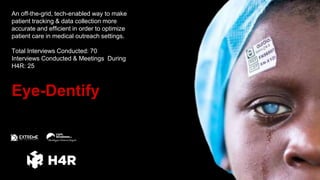
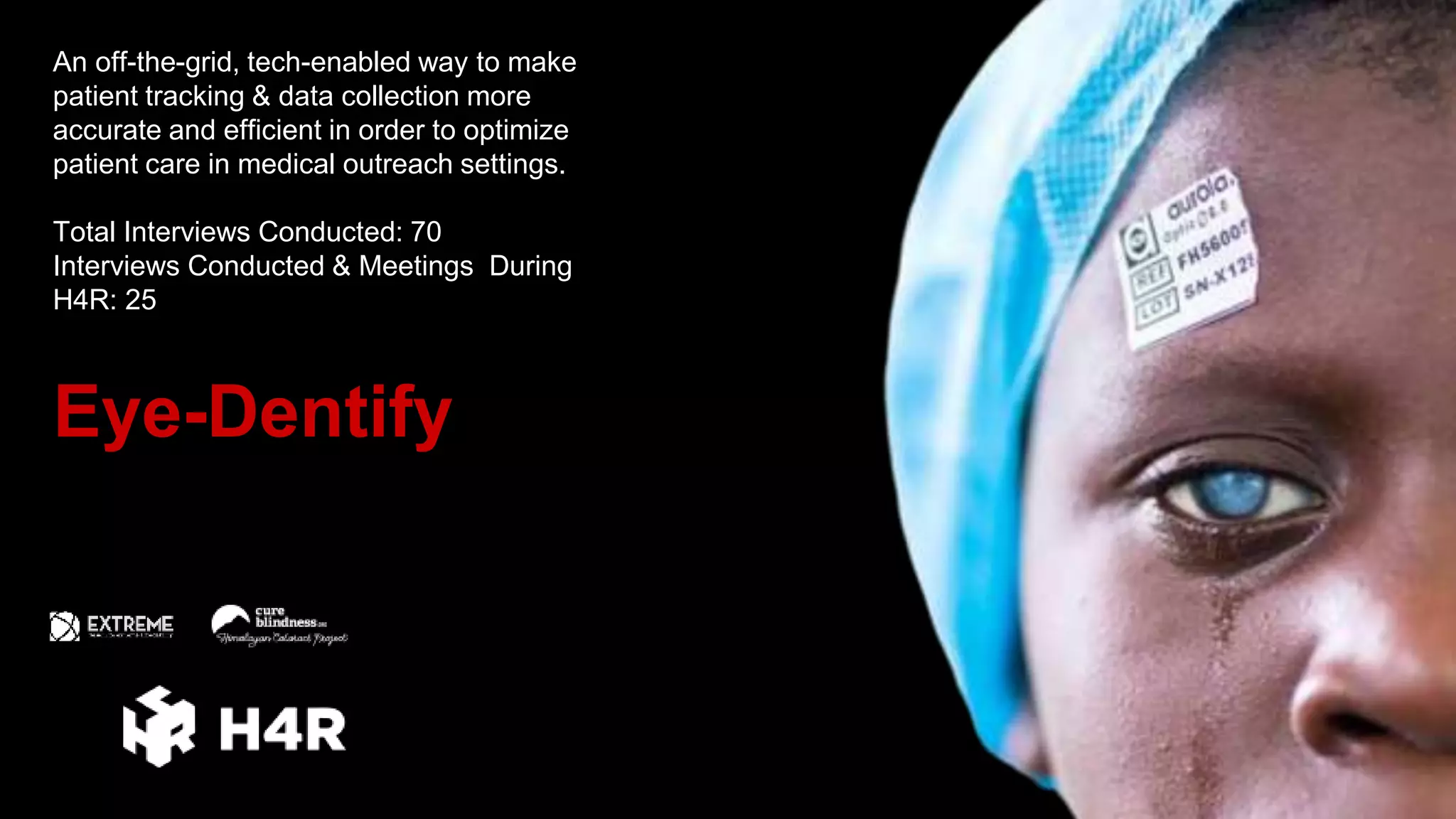
An off-the-grid, tech-enabled way to make
patient tracking & data collection more
accurate and efficient in order to optimize
patient care in medical outreach settings.
Total Interviews Conducted: 70
Interviews Conducted & Meetings During
H4R: 25
Eye-Dentify
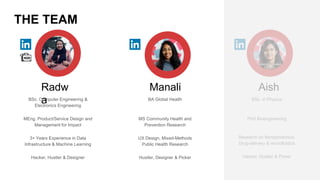
THE TEAM
Radw
aBSc. Computer Engineering &
Electronics Engineering
MEng. Product/Service Design and
Management for Impact
3+ Years Experience in Data
Infrastructure & Machine Learning
Hacker, Hustler & Designer
Aish
BSc. in Physics
PhD Bioengineering
Research on Nanophotonics,
Drug-delivery & microfluidics
Hacker, Hustler & Picker
Manali
BA Global Health
MS Community Health and
Prevention Research
UX Design, Mixed-Methods
Public Health Research
Hustler, Designer & Picker
Problem
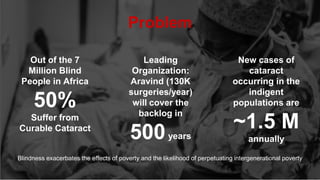
Blindness exacerbates the effects of poverty and the likelihood of perpetuating intergenerational poverty
Out of the 7
Million Blind
People in Africa
50%
Suffer from
Curable Cataract
Leading
Organization:
Aravind (130K
surgeries/year)
will cover the
backlog in
500years
New cases of
cataract
occurring in the
indigent
populations are
~1.5 M
annually
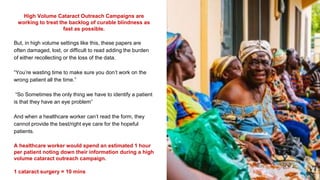
High Volume Cataract Outreach Campaigns are
working to treat the backlog of curable blindness as
fast as possible.
But, in high volume settings like this, these papers are
often damaged, lost, or difficult to read adding the burden
of either recollecting or the loss of the data.
“You’re wasting time to make sure you don’t work on the
wrong patient all the time.”
“So Sometimes the only thing we have to identify a patient
is that they have an eye problem”
And when a healthcare worker can’t read the form, they
cannot provide the best/right eye care for the hopeful
patients.
A healthcare worker would spend an estimated 1 hour
per patient noting down their information during a high
volume cataract outreach campaign.
1 cataract surgery = 10 mins
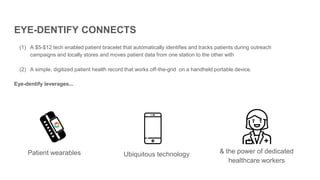
EYE-DENTIFY CONNECTS
(1) A $5-$12 tech enabled patient bracelet that automatically identifies and tracks patients during outreach
campaigns and locally stores and moves patient data from one station to the other with
(2) A simple, digitized patient health record that works off-the-grid on a handheld portable device.
Eye-dentify leverages...
Ubiquitous technologyPatient wearables & the power of dedicated
healthcare workers
Revenue Streams
B2B/B2G
Hardware sales and set-up [Hardware Leasing Fees -
Service Setup Fee - Data Storage Subscription]
Healthcare outcomes data
Key Partners
Hospitals
EMR companies
Healthcare NGOS
Universities & researchers
Key Activities
Key Resources
Engineers, product
designers, community
health specialists, medical
specialists, business
experts
Financial Resources:
Grants and stipend
Value Proposition
Enabling more efficient
nursing via:
- Digitizing global eyecare
patient identification &
tracking in rural areas to
-Seamlessness &
Automation of healthcare
data aggregation
-More streamlined patient
flow
Access to more
complete and accurate
data to enable improved
patient outcomes and
improved quality of care,
leading to improved
livelihood of patients via
cured blindness.
Customer Relationship
Healthcare Workers
(direct users)
International Healthcare
Organizations
(Customer)[User
access/Promotional
services/ Provide training/
mutually owned service.]
Patients (indirect
users/wearers)
Fixed Costs [Software Design - Hardware Design]
Variable Costs [Wearable Unit Purchase - Wearable
Unit Customization - Scanning Devices / Data Insertion
Devices - Intranet Hardware devices - Software Scaling
and Cloud Data Storage - Salaries & Stipend - User
Training Cost - Shipping & Distribution]
Cost Reduction Strategies [Recycling wearable
hardware / outreach - Purchasing from local vendors &
manufacturers - Establishing a local Training of Trainers
System ]
Customer Segments
End users: Health care
workers & Patients at
crowded medical camps.
Decision Makers and
Economic Buyer: health-
care outreach organizers like
Unite for Sight, HCP, Swiss
Red Cross administrators
(program managers/
directors) & in-country High
volume campaign
coordinators (members of
Ministry of Health eg: Ghana),
Organizations involved in
vaccination camps,
healthcare in refugee camps,
eye-care outreach like
Aravind eye care, HCP
Awareness: International
healthcare NGOS like Red
Cross, Doctors without
Borders that organize
outreach camps
Evaluation: feedback from
healthcare workers, patients,
biostatisticians
Lifetime support: measure
device success alongside
camp progress/success
metrics, get feedback from
healthcare workers and
patients and biostatisticians
Networking: Establishing
partner relation,
connection with med-tech
companies and eye-care
organization
Solution testing: High-
fidelity and low-fidelity
prototyping, concept
testing on ground
Delivery: Training,
marketing, website/app
communication
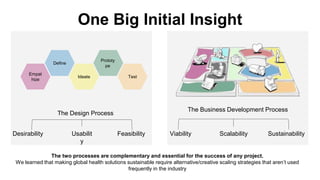
One Big Initial Insight
Empat
hize
Define
Ideate
Prototy
pe
Test
The Design Process
The Business Development Process
Desirability Usabilit
y
Viability SustainabilityFeasibility
The two processes are complementary and essential for the success of any project.
We learned that making global health solutions sustainable require alternative/creative scaling strategies that aren’t used
frequently in the industry
Scalability
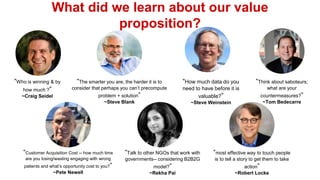
What did we learn about our value
proposition?
“Who is winning & by
how much ?”
~Craig Seidel
“The smarter you are, the harder it is to
consider that perhaps you can’t precompute
problem + solution”
~Steve Blank
“Talk to other NGOs that work with
governments-- considering B2B2G
model?”
~Rekha Pai
“Think about saboteurs;
what are your
countermeasures?”
~Tom Bedecarre
“most effective way to touch people
is to tell a story to get them to take
action”
~Robert Locke
“Customer Acquisition Cost -- how much time
are you losing/wasting engaging with wrong
patients and what’s opportunity cost to you?”
~Pete Newell
“How much data do you
need to have before it is
valuable?”
~Steve Weinstein
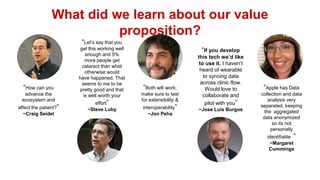
What did we learn about our value
proposition?
“How can you
advance the
ecosystem and
affect the patient?”
~Craig Seidel
“Let’s say that you
get this working well
enough and 5%
more people get
cataract than what
otherwise would
have happened. That
seems to me to be
pretty good and that
is well worth your
effort”
~Steve Luby
“Both will work;
make sure to test
for extensibility &
interoperability”
~Jon Peha
“Apple has Data
collection and data
analysis very
separated, keeping
the aggregated
data anonymized
so its not
personally
identifiable ”
~Margaret
Cummings
“If you develop
this tech we’d like
to use it. I haven’t
heard of wearable
to syncing data
across clinic flow.
Would love to
collaborate and
pilot with you”
~Jose Luis Burgos
What did we learn about our
Customer Segments/Revenue
Model?
Considering different
revenue models
beyond direct sales
of product [ex: 2-
sided business]
B2B2G Model rather
than direct B2G --
partner with NGOs
who work with gov
health systems
Perception matters
when seeking
funding in global
health/international
development
Customer Segments
Revenue Streams
Key Partners & Suppliers Key Activities
Key Resources
Buy-in Support
Cost Structure
Beneficiaries
Value Proposition
Value Proposition
CS 1&2 - Increased number
of patients treated during
outreach campaign
[increased cost
effectiveness]
CS 1&2 - Better-informed
program budget and
operation decisions for
future healthcare service
delivery
CS 3 - Access to large
aggregate population eye
health datasets
CS 2 - Decision
Makers/Economic
Buyer: Philanthropic
Foundations who fund
global health NGOs
Pilot testing in COVID-
adapted outreach settings
Implementers: Health
Ministries / Governing
Bodies
Suppliers: Product
manufacturing/
supplier
Implementers/Users:
Local Hospitals &
Healthcare staff Software Dev.→ MVP
Electronic devices/
hardware
Supply chain management
and distribution
Training resources for
implementation
Customized EMR
software
Get - CS 1&2: email
marketing, articles, webinars //
guest articles, research
conferences & publications
CS 3 - Economic
Buyer: Health
research groups
[IHME, WHO]
Fixed costs: Software &
Hardware Design
Cost Reduction
Strategies:
* Recycling hardware
* Establishing training of
trainer program
* Local vendor
purchasing
Variable costs:
* unit purchase /
customization
* software customization
* training resources
B2B2G Models Hardware sales and set-up
[Hardware Leasing Fees -
Service Setup Fee - Data
Storage Subscription]
Healthcare outcomes dataSelling aggregated
outcomes data to research
institutions
Channels
CS 1 - 2-step distribution
Training Healthcare
Workers
Get - CS 3: email marketing,
SEM // research conferences
& publications
CS 3 - Dedicated E-
commerce or Aggregator
CS 1- Decision
Makers/Economic
Buyer: Global Health
NGOs who fund and
operate outreach
health services [via
universities, non-
profits, etc.]
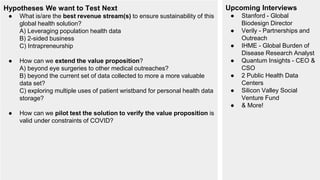
Hypotheses We want to Test Next
● What is/are the best revenue stream(s) to ensure sustainability of this
global health solution?
A) Leveraging population health data
B) 2-sided business
C) Intrapreneurship
● How can we extend the value proposition?
A) beyond eye surgeries to other medical outreaches?
B) beyond the current set of data collected to more a more valuable
data set?
C) exploring multiple uses of patient wristband for personal health data
storage?
● How can we pilot test the solution to verify the value proposition is
valid under constraints of COVID?
Upcoming Interviews
● Stanford - Global
Biodesign Director
● Verily - Partnerships and
Outreach
● IHME - Global Burden of
Disease Research Analyst
● Quantum Insights - CEO &
CSO
● 2 Public Health Data
Centers
● Silicon Valley Social
Venture Fund
● & More!
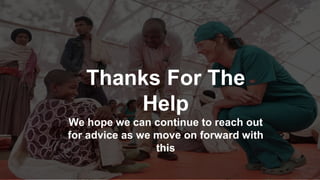
Thanks For The
Help
We hope we can continue to reach out
for advice as we move on forward with
this

Eye-Dentify H4R Stanford 2020

  • 1.
    An off-the-grid, tech-enabledway to make patient tracking & data collection more accurate and efficient in order to optimize patient care in medical outreach settings. Total Interviews Conducted: 70 Interviews Conducted & Meetings During H4R: 25 Eye-Dentify
  • 2.
    THE TEAM Radw aBSc. ComputerEngineering & Electronics Engineering MEng. Product/Service Design and Management for Impact 3+ Years Experience in Data Infrastructure & Machine Learning Hacker, Hustler & Designer Aish BSc. in Physics PhD Bioengineering Research on Nanophotonics, Drug-delivery & microfluidics Hacker, Hustler & Picker Manali BA Global Health MS Community Health and Prevention Research UX Design, Mixed-Methods Public Health Research Hustler, Designer & Picker
  • 3.
    Problem Blindness exacerbates theeffects of poverty and the likelihood of perpetuating intergenerational poverty Out of the 7 Million Blind People in Africa 50% Suffer from Curable Cataract Leading Organization: Aravind (130K surgeries/year) will cover the backlog in 500years New cases of cataract occurring in the indigent populations are ~1.5 M annually
  • 4.
    High Volume CataractOutreach Campaigns are working to treat the backlog of curable blindness as fast as possible. But, in high volume settings like this, these papers are often damaged, lost, or difficult to read adding the burden of either recollecting or the loss of the data. “You’re wasting time to make sure you don’t work on the wrong patient all the time.” “So Sometimes the only thing we have to identify a patient is that they have an eye problem” And when a healthcare worker can’t read the form, they cannot provide the best/right eye care for the hopeful patients. A healthcare worker would spend an estimated 1 hour per patient noting down their information during a high volume cataract outreach campaign. 1 cataract surgery = 10 mins
  • 5.
    EYE-DENTIFY CONNECTS (1) A$5-$12 tech enabled patient bracelet that automatically identifies and tracks patients during outreach campaigns and locally stores and moves patient data from one station to the other with (2) A simple, digitized patient health record that works off-the-grid on a handheld portable device. Eye-dentify leverages... Ubiquitous technologyPatient wearables & the power of dedicated healthcare workers
  • 6.
    Revenue Streams B2B/B2G Hardware salesand set-up [Hardware Leasing Fees - Service Setup Fee - Data Storage Subscription] Healthcare outcomes data Key Partners Hospitals EMR companies Healthcare NGOS Universities & researchers Key Activities Key Resources Engineers, product designers, community health specialists, medical specialists, business experts Financial Resources: Grants and stipend Value Proposition Enabling more efficient nursing via: - Digitizing global eyecare patient identification & tracking in rural areas to -Seamlessness & Automation of healthcare data aggregation -More streamlined patient flow Access to more complete and accurate data to enable improved patient outcomes and improved quality of care, leading to improved livelihood of patients via cured blindness. Customer Relationship Healthcare Workers (direct users) International Healthcare Organizations (Customer)[User access/Promotional services/ Provide training/ mutually owned service.] Patients (indirect users/wearers) Fixed Costs [Software Design - Hardware Design] Variable Costs [Wearable Unit Purchase - Wearable Unit Customization - Scanning Devices / Data Insertion Devices - Intranet Hardware devices - Software Scaling and Cloud Data Storage - Salaries & Stipend - User Training Cost - Shipping & Distribution] Cost Reduction Strategies [Recycling wearable hardware / outreach - Purchasing from local vendors & manufacturers - Establishing a local Training of Trainers System ] Customer Segments End users: Health care workers & Patients at crowded medical camps. Decision Makers and Economic Buyer: health- care outreach organizers like Unite for Sight, HCP, Swiss Red Cross administrators (program managers/ directors) & in-country High volume campaign coordinators (members of Ministry of Health eg: Ghana), Organizations involved in vaccination camps, healthcare in refugee camps, eye-care outreach like Aravind eye care, HCP Awareness: International healthcare NGOS like Red Cross, Doctors without Borders that organize outreach camps Evaluation: feedback from healthcare workers, patients, biostatisticians Lifetime support: measure device success alongside camp progress/success metrics, get feedback from healthcare workers and patients and biostatisticians Networking: Establishing partner relation, connection with med-tech companies and eye-care organization Solution testing: High- fidelity and low-fidelity prototyping, concept testing on ground Delivery: Training, marketing, website/app communication
  • 7.
    One Big InitialInsight Empat hize Define Ideate Prototy pe Test The Design Process The Business Development Process Desirability Usabilit y Viability SustainabilityFeasibility The two processes are complementary and essential for the success of any project. We learned that making global health solutions sustainable require alternative/creative scaling strategies that aren’t used frequently in the industry Scalability
  • 8.
    What did welearn about our value proposition? “Who is winning & by how much ?” ~Craig Seidel “The smarter you are, the harder it is to consider that perhaps you can’t precompute problem + solution” ~Steve Blank “Talk to other NGOs that work with governments-- considering B2B2G model?” ~Rekha Pai “Think about saboteurs; what are your countermeasures?” ~Tom Bedecarre “most effective way to touch people is to tell a story to get them to take action” ~Robert Locke “Customer Acquisition Cost -- how much time are you losing/wasting engaging with wrong patients and what’s opportunity cost to you?” ~Pete Newell “How much data do you need to have before it is valuable?” ~Steve Weinstein
  • 9.
    What did welearn about our value proposition? “How can you advance the ecosystem and affect the patient?” ~Craig Seidel “Let’s say that you get this working well enough and 5% more people get cataract than what otherwise would have happened. That seems to me to be pretty good and that is well worth your effort” ~Steve Luby “Both will work; make sure to test for extensibility & interoperability” ~Jon Peha “Apple has Data collection and data analysis very separated, keeping the aggregated data anonymized so its not personally identifiable ” ~Margaret Cummings “If you develop this tech we’d like to use it. I haven’t heard of wearable to syncing data across clinic flow. Would love to collaborate and pilot with you” ~Jose Luis Burgos
  • 10.
    What did welearn about our Customer Segments/Revenue Model? Considering different revenue models beyond direct sales of product [ex: 2- sided business] B2B2G Model rather than direct B2G -- partner with NGOs who work with gov health systems Perception matters when seeking funding in global health/international development
  • 11.
    Customer Segments Revenue Streams KeyPartners & Suppliers Key Activities Key Resources Buy-in Support Cost Structure Beneficiaries Value Proposition Value Proposition CS 1&2 - Increased number of patients treated during outreach campaign [increased cost effectiveness] CS 1&2 - Better-informed program budget and operation decisions for future healthcare service delivery CS 3 - Access to large aggregate population eye health datasets CS 2 - Decision Makers/Economic Buyer: Philanthropic Foundations who fund global health NGOs Pilot testing in COVID- adapted outreach settings Implementers: Health Ministries / Governing Bodies Suppliers: Product manufacturing/ supplier Implementers/Users: Local Hospitals & Healthcare staff Software Dev.→ MVP Electronic devices/ hardware Supply chain management and distribution Training resources for implementation Customized EMR software Get - CS 1&2: email marketing, articles, webinars // guest articles, research conferences & publications CS 3 - Economic Buyer: Health research groups [IHME, WHO] Fixed costs: Software & Hardware Design Cost Reduction Strategies: * Recycling hardware * Establishing training of trainer program * Local vendor purchasing Variable costs: * unit purchase / customization * software customization * training resources B2B2G Models Hardware sales and set-up [Hardware Leasing Fees - Service Setup Fee - Data Storage Subscription] Healthcare outcomes dataSelling aggregated outcomes data to research institutions Channels CS 1 - 2-step distribution Training Healthcare Workers Get - CS 3: email marketing, SEM // research conferences & publications CS 3 - Dedicated E- commerce or Aggregator CS 1- Decision Makers/Economic Buyer: Global Health NGOs who fund and operate outreach health services [via universities, non- profits, etc.]
  • 12.
    Hypotheses We wantto Test Next ● What is/are the best revenue stream(s) to ensure sustainability of this global health solution? A) Leveraging population health data B) 2-sided business C) Intrapreneurship ● How can we extend the value proposition? A) beyond eye surgeries to other medical outreaches? B) beyond the current set of data collected to more a more valuable data set? C) exploring multiple uses of patient wristband for personal health data storage? ● How can we pilot test the solution to verify the value proposition is valid under constraints of COVID? Upcoming Interviews ● Stanford - Global Biodesign Director ● Verily - Partnerships and Outreach ● IHME - Global Burden of Disease Research Analyst ● Quantum Insights - CEO & CSO ● 2 Public Health Data Centers ● Silicon Valley Social Venture Fund ● & More!
  • 13.
    Thanks For The Help Wehope we can continue to reach out for advice as we move on forward with this

Editor's Notes

  • #4 Himalayan Cataract Project has treated ~1 Million patients in 20 years.
  • #8 LOW point - Day 1: We came in with perception that we really understood problem - but turns out we didn’t understand it fully. Understood deeply about end user experience whereas didnt have understand of business perspective We learned that making global health solutions solutions require alternative/creative scaling strategies that aren’t used frequently in the industry
  • #9 We used to think that the solution itself was the value we are providing. But we learned that The solution isn’t the value -- it’s the impact or outcome of the solution is the value. We learned to ask, what is the improved outcome we provide to organizations on the ground? This helped us uncover some of these scaling strategies to explore . -- CRAIG, STEVE W., PETE
  • #10 Before this class, we had been getting out of the building a lot! Partnering with HCW in Ghana for several months, we thought that addressing end-user’s needs was good enough validation that our product was valuable. But after this week, we learned that it is important to reach out to the vast array of other stakeholders in the field to assess what exactly is valuable about our product. For ex - Dr Burgos. This week We validated that our solution is both desirable and feasible to OTHER players in the field beyond our initial partnership with HCP, and that we should keep working towards making this solution scalable and sustainable.
  • #11 Working towards sustainability of this global health solution, we interviewed some potential customer segments who were PRETTY hard to get a hold of -- Hyp 1 - sell to NGOs to implement this.NGO prob cant pay us; result: more likely funded from philanthropic org or impact investing Hyp 2- was having govts as customer segments since they are implementers -- realized B2B2G - is more feasible [ex: Salauno govt tenders, HCP] in terms of access to funding, more flexibility in operations, quicker pilot testing, etc. But how to fund b2b? HYP 3 - was selling aggregate data to research institutions. Result of interview Perception -- make sure there is a closed loop of impact if you are selling the data - Luby + RC + IHME. Better to look at institutions directly influencing field of global health rather than disconnected people.