DISTRIBUTION TECHNOLOGY
The First cinemas








Before the introduction of the first cinema in 1896, most films were
shown at public gatherings in small rooms/buildings or at
festivals/carnivals.
Cinemas became the easiest and cheapest way to show film to the
public in masses.
1934 – The first drive-in cinema opened in New Jersey.
Moving images were produced on revolving drums and disks in the
1830s
Camera Obscura – light is inverted through a hole or lens and is
projected onto a surface or screen, using this, it was possible to
project a moving image, but it could not be recorded for later
viewings.
In 1891 W.L.K Dickson created the first Kinetograph, which took a
series of photographs on photographic emulsion coated onto a
celluloid strip. This was then placed in the Kinetoscope, which
allowed a single person at a time to view the motion picture through
a small peephole. This was another development that led onto
projectors.
VTR
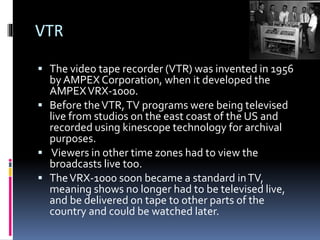
 The video tape recorder (VTR) was invented in 1956

by AMPEX Corporation, when it developed the
AMPEX VRX-1000.
 Before the VTR, TV programs were being televised
live from studios on the east coast of the US and
recorded using kinescope technology for archival
purposes.
 Viewers in other time zones had to view the
broadcasts live too.
 The VRX-1000 soon became a standard in TV,
meaning shows no longer had to be televised live,
and be delivered on tape to other parts of the
country and could be watched later.
VHS
 VHS is a consumer-level analog recording videotape




based cassette standard developed by Victor
Company of Japan (JVC).
In the 1970s, video recording became a major
contributor to the television industry.
several companies made an attempt to produce a
television recording standard. Two of the formats, VHS
and Betamax, received the most media exposure.
VHS eventually became most popular, and therefore
succeed as the dominant home video format.
The subsequent DVD format gained popularity and
replaced VHS as the preferred method of distribution
after 2000.
VCD
 The compact disc project was launched following a






failure with its video disc technology in 1978.
The Video CD was finally created in 1993, another
method to aid film watching at home.
The video disc was one of the first products to use
laser technology that could read information from a
disc without physical contact.
The CD’s were smaller however, their longevity
depended solely on the handling of the Disc. If it got
scratched, it would not work.
The VCD was not particularly successful due to these
problems, and the films to be distributed by this
method were limited to 70 minutes.
DVD
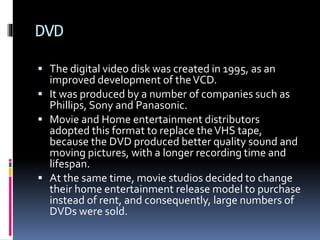
 The digital video disk was created in 1995, as an

improved development of the VCD.
 It was produced by a number of companies such as
Phillips, Sony and Panasonic.
 Movie and Home entertainment distributors
adopted this format to replace the VHS tape,
because the DVD produced better quality sound and
moving pictures, with a longer recording time and
lifespan.
 At the same time, movie studios decided to change
their home entertainment release model to purchase
instead of rent, and consequently, large numbers of
DVDs were sold.
Blu-Ray Discs
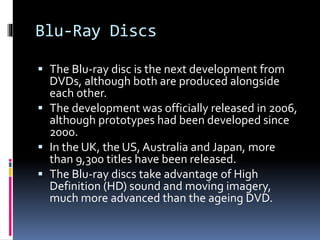
 The Blu-ray disc is the next development from
DVDs, although both are produced alongside

each other.
 The development was officially released in 2006,
although prototypes had been developed since
2000.
 In the UK, the US, Australia and Japan, more
than 9,300 titles have been released.
 The Blu-ray discs take advantage of High
Definition (HD) sound and moving imagery,
much more advanced than the ageing DVD.
The Internet
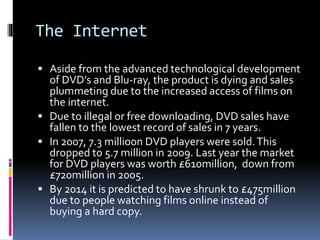
 Aside from the advanced technological development

of DVD’s and Blu-ray, the product is dying and sales
plummeting due to the increased access of films on
the internet.
 Due to illegal or free downloading, DVD sales have
fallen to the lowest record of sales in 7 years.
 In 2007, 7.3 millio0n DVD players were sold. This
dropped to 5.7 million in 2009. Last year the market
for DVD players was worth £610million, down from
£720million in 2005.
 By 2014 it is predicted to have shrunk to £475million
due to people watching films online instead of
buying a hard copy.
NETFLIX, LoveFilm.


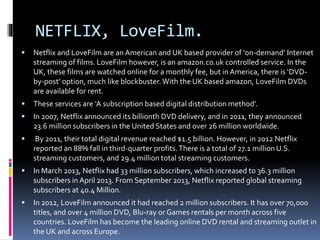
Netflix and LoveFilm are an American and UK based provider of ‘on-demand’ Internet
streaming of films. LoveFilm however, is an amazon.co.uk controlled service. In the
UK, these films are watched online for a monthly fee, but in America, there is ‘DVDby-post’ option, much like blockbuster. With the UK based amazon, LoveFilm DVDs
are available for rent.



These services are ‘A subscription based digital distribution method’.



In 2007, Netflix announced its billionth DVD delivery, and in 2011, they announced
23.6 million subscribers in the United States and over 26 million worldwide.



By 2011, their total digital revenue reached $1.5 billion. However, in 2012 Netflix
reported an 88% fall in third-quarter profits. There is a total of 27.1 million U.S.
streaming customers, and 29.4 million total streaming customers.



In March 2013, Netflix had 33 million subscribers, which increased to 36.3 million
subscribers in April 2013. From September 2013, Netflix reported global streaming
subscribers at 40.4 Million.



In 2012, LoveFilm announced it had reached 2 million subscribers. It has over 70,000
titles, and over 4 million DVD, Blu-ray or Games rentals per month across five
countries. LoveFilm has become the leading online DVD rental and streaming outlet in
the UK and across Europe.

Distribution technology

  • 1.
  • 2.
    The First cinemas       Beforethe introduction of the first cinema in 1896, most films were shown at public gatherings in small rooms/buildings or at festivals/carnivals. Cinemas became the easiest and cheapest way to show film to the public in masses. 1934 – The first drive-in cinema opened in New Jersey. Moving images were produced on revolving drums and disks in the 1830s Camera Obscura – light is inverted through a hole or lens and is projected onto a surface or screen, using this, it was possible to project a moving image, but it could not be recorded for later viewings. In 1891 W.L.K Dickson created the first Kinetograph, which took a series of photographs on photographic emulsion coated onto a celluloid strip. This was then placed in the Kinetoscope, which allowed a single person at a time to view the motion picture through a small peephole. This was another development that led onto projectors.
  • 3.
    VTR  The videotape recorder (VTR) was invented in 1956 by AMPEX Corporation, when it developed the AMPEX VRX-1000.  Before the VTR, TV programs were being televised live from studios on the east coast of the US and recorded using kinescope technology for archival purposes.  Viewers in other time zones had to view the broadcasts live too.  The VRX-1000 soon became a standard in TV, meaning shows no longer had to be televised live, and be delivered on tape to other parts of the country and could be watched later.
  • 4.
    VHS  VHS isa consumer-level analog recording videotape    based cassette standard developed by Victor Company of Japan (JVC). In the 1970s, video recording became a major contributor to the television industry. several companies made an attempt to produce a television recording standard. Two of the formats, VHS and Betamax, received the most media exposure. VHS eventually became most popular, and therefore succeed as the dominant home video format. The subsequent DVD format gained popularity and replaced VHS as the preferred method of distribution after 2000.
  • 5.
    VCD  The compactdisc project was launched following a     failure with its video disc technology in 1978. The Video CD was finally created in 1993, another method to aid film watching at home. The video disc was one of the first products to use laser technology that could read information from a disc without physical contact. The CD’s were smaller however, their longevity depended solely on the handling of the Disc. If it got scratched, it would not work. The VCD was not particularly successful due to these problems, and the films to be distributed by this method were limited to 70 minutes.
  • 6.
    DVD  The digitalvideo disk was created in 1995, as an improved development of the VCD.  It was produced by a number of companies such as Phillips, Sony and Panasonic.  Movie and Home entertainment distributors adopted this format to replace the VHS tape, because the DVD produced better quality sound and moving pictures, with a longer recording time and lifespan.  At the same time, movie studios decided to change their home entertainment release model to purchase instead of rent, and consequently, large numbers of DVDs were sold.
  • 7.
    Blu-Ray Discs  TheBlu-ray disc is the next development from DVDs, although both are produced alongside each other.  The development was officially released in 2006, although prototypes had been developed since 2000.  In the UK, the US, Australia and Japan, more than 9,300 titles have been released.  The Blu-ray discs take advantage of High Definition (HD) sound and moving imagery, much more advanced than the ageing DVD.
  • 8.
    The Internet  Asidefrom the advanced technological development of DVD’s and Blu-ray, the product is dying and sales plummeting due to the increased access of films on the internet.  Due to illegal or free downloading, DVD sales have fallen to the lowest record of sales in 7 years.  In 2007, 7.3 millio0n DVD players were sold. This dropped to 5.7 million in 2009. Last year the market for DVD players was worth £610million, down from £720million in 2005.  By 2014 it is predicted to have shrunk to £475million due to people watching films online instead of buying a hard copy.
  • 9.
    NETFLIX, LoveFilm.  Netflix andLoveFilm are an American and UK based provider of ‘on-demand’ Internet streaming of films. LoveFilm however, is an amazon.co.uk controlled service. In the UK, these films are watched online for a monthly fee, but in America, there is ‘DVDby-post’ option, much like blockbuster. With the UK based amazon, LoveFilm DVDs are available for rent.  These services are ‘A subscription based digital distribution method’.  In 2007, Netflix announced its billionth DVD delivery, and in 2011, they announced 23.6 million subscribers in the United States and over 26 million worldwide.  By 2011, their total digital revenue reached $1.5 billion. However, in 2012 Netflix reported an 88% fall in third-quarter profits. There is a total of 27.1 million U.S. streaming customers, and 29.4 million total streaming customers.  In March 2013, Netflix had 33 million subscribers, which increased to 36.3 million subscribers in April 2013. From September 2013, Netflix reported global streaming subscribers at 40.4 Million.  In 2012, LoveFilm announced it had reached 2 million subscribers. It has over 70,000 titles, and over 4 million DVD, Blu-ray or Games rentals per month across five countries. LoveFilm has become the leading online DVD rental and streaming outlet in the UK and across Europe.