1
Validation of Membrane Filter
Mr. Sagar Kishor Savale
[Department of Pharmaceutics]
avengersagar16@gmail.com
2015-2016
Department of Pharmacy (Pharmaceutics) | Sagar savale
Introduction1
Why Validate?
What needs to be Validate?
Who is responsible for Validation
Elements of validation study
Conclusion
2
Why Validate
 Good Manufacturing Practice
For LVP,SVP, ophthalmic, veterinary
medicine, bulk chemicals & in-vitro
diagnostic
 For Good business Practice
A control process gives reproducibility
& product consistency with in known
limits
Provides license to do business. 3
What Needs to be Validate?
 Before any work is initiated to validate
a filter prerequisite must be satisfied
 The filter itself must be consistent &
reproducible from lot to lot
4
Who is responsible for
Validation2
 Drug Manufacturer is responsible
 Drug Manufacturer should select a
filter manufacturer who Provide
sufficient information and services to
facilitate the Validation
 Q.A. Manager & Q.A. Team
5
Components of Validation
Study3,4,5, l ll
 Destructive testing –
 Non destructive testing –
- Bubble point test –
- Diffusion test -
- Pressure Holding testing –
 Water intrusion test -
6
Continue..
 Filter Inertness –
 Operating Conditions –
 Fibers –
 Endotoxins –
 Toxicity -
7
Destructive Testing 3,5,4
 Select 0.22 µm filter discs
 Solution of culture media
-Brevundimonas diminuta
- Pseudomonas diminuta
 The effluent is then passed through a
second 0.45 µm assay filter disc
 placed on an agar plate and incubated
8
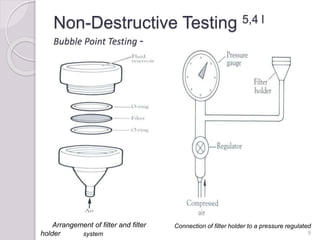
Non-Destructive Testing 5,4 l
Bubble Point Testing -
9
Connection of filter holder to a pressure regulated
system
Arrangement of filter and filter
holder
Continue.
10
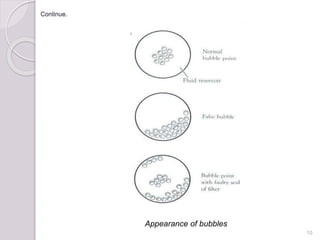
Appearance of bubbles
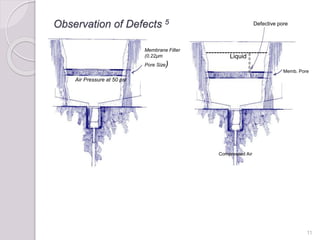
Observation of Defects 5
11
Compressed Air
Defective pore
0
0
0
0
0 Memb. Pore
Liquid
-----------------------
Air Pressure at 50 psi
Membrane Filter
(0.22µm
Pore Size)
In Process bubble point testing 5
12
5
psi
When the applied pressure
reaches
the bubble point pressure of
the
>50 psi
filter, liquid is displaced from
the
(3.5 bar)
filter pores.
>50 psi
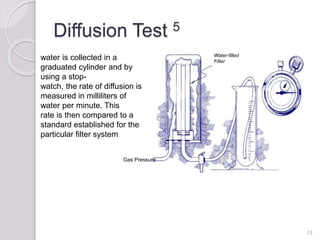
Diffusion Test 5
13
water is collected in a
graduated cylinder and by
using a stop-
watch, the rate of diffusion is
measured in milliliters of
water per minute. This
rate is then compared to a
standard established for the
particular filter system
Gas Pressure
Water-filled
Filter
.
 Pressure Holding testing5
 Water intrusion test ll
also name as Water Flow Integrity test
 Filter Inertness 6,l
 Operating Conditions 4
-Temperature
-Time
-Pressure
14
Fibers lll
 Any filter which after any appropriate
pretreatment such as washing or
flushing will not release fiber into the
component of drug product
 Fiber exceeding 2.5 µm must be
eliminated
15
Endotoxins 6,7
 Filter does not add Endotoxin to a
drug product
 Endotoxin content of new filter will
depend on quality control process of
filter manufacturing, filter manufacturer
and the water used in filter
manufacturing
16
Toxicity 6
 filter does not cause any toxicological
effect.
 All filter material of construction should
be addressed
 It is then responsibility of drug
manufacturer to ensure that contract
of the filter and drug product does not
result in any toxic by product
17
Conclusion
 Filter validation performed by Q.A.
Team & drug manufacturer is not just
a regulatory requirement it also makes
good business.
 It start with a filter requirements
specification
 From this specification it is simply a
matter of choosing the method that
allow verification of the requirements
18
References
1. Potdar AM. Pharmaceutical Quality
Assurance,1st ed. Published by Nirali
Prakashan; 2006.P. 8.13
2. Syed Imtiaz Haider. Pharmaceutical Master
Validation Plan , The Ultimate Guide to
FDA,GMP and GLP Compliance, informa
healthcare;2010. P. 329-331
3.VALIDATION OF BACTERIAL RETENTION BY
MEMBRANE FILTRATION: A PROPOSED
APPROACH FOR DETERMINING STERILITY
ASSURANCE (January 1, 1983)
19
continue
4. Reinhard Baumfalk, systems development of
the Biotechnology Division, Sartorius AG,
Weender Landstrasse, D-37075 Göttingen,
Germany, 94-108
5. Millipore ,Manual of filter integrity test
methods, India pvt Ltd Bangalore ,Page 99-
121
6. American Society for Testing and Materials.
"Standard test method for determining
bacterial retention of membrane filters utilized
for liquid filtration."Philadelphia, PA 1993,
20
continue
7. Jornitz MW ,Advances in Biochemical
Engineering/Biotechnology. Sterile
Filtration. Vol. 98, Chap. 6. Springer Verlag.
Berlin. 2006.
21
Web References -
1.www.bioprocessresources.com/servicelist/i
nformation/filterintegritytesting
ll. www.springerlink.com
lll. www.gmp.compliance.org
22
THANKYOU…
23

Validation of membrane filter

  • 1.
    1 Validation of MembraneFilter Mr. Sagar Kishor Savale [Department of Pharmaceutics] avengersagar16@gmail.com 2015-2016 Department of Pharmacy (Pharmaceutics) | Sagar savale
  • 2.
    Introduction1 Why Validate? What needsto be Validate? Who is responsible for Validation Elements of validation study Conclusion 2
  • 3.
    Why Validate  GoodManufacturing Practice For LVP,SVP, ophthalmic, veterinary medicine, bulk chemicals & in-vitro diagnostic  For Good business Practice A control process gives reproducibility & product consistency with in known limits Provides license to do business. 3
  • 4.
    What Needs tobe Validate?  Before any work is initiated to validate a filter prerequisite must be satisfied  The filter itself must be consistent & reproducible from lot to lot 4
  • 5.
    Who is responsiblefor Validation2  Drug Manufacturer is responsible  Drug Manufacturer should select a filter manufacturer who Provide sufficient information and services to facilitate the Validation  Q.A. Manager & Q.A. Team 5
  • 6.
    Components of Validation Study3,4,5,l ll  Destructive testing –  Non destructive testing – - Bubble point test – - Diffusion test - - Pressure Holding testing –  Water intrusion test - 6
  • 7.
    Continue..  Filter Inertness–  Operating Conditions –  Fibers –  Endotoxins –  Toxicity - 7
  • 8.
    Destructive Testing 3,5,4 Select 0.22 µm filter discs  Solution of culture media -Brevundimonas diminuta - Pseudomonas diminuta  The effluent is then passed through a second 0.45 µm assay filter disc  placed on an agar plate and incubated 8
  • 9.
    Non-Destructive Testing 5,4l Bubble Point Testing - 9 Connection of filter holder to a pressure regulated system Arrangement of filter and filter holder
  • 10.
  • 11.
    Observation of Defects5 11 Compressed Air Defective pore 0 0 0 0 0 Memb. Pore Liquid ----------------------- Air Pressure at 50 psi Membrane Filter (0.22µm Pore Size)
  • 12.
    In Process bubblepoint testing 5 12 5 psi When the applied pressure reaches the bubble point pressure of the >50 psi filter, liquid is displaced from the (3.5 bar) filter pores. >50 psi
  • 13.
    Diffusion Test 5 13 wateris collected in a graduated cylinder and by using a stop- watch, the rate of diffusion is measured in milliliters of water per minute. This rate is then compared to a standard established for the particular filter system Gas Pressure Water-filled Filter
  • 14.
    .  Pressure Holdingtesting5  Water intrusion test ll also name as Water Flow Integrity test  Filter Inertness 6,l  Operating Conditions 4 -Temperature -Time -Pressure 14
  • 15.
    Fibers lll  Anyfilter which after any appropriate pretreatment such as washing or flushing will not release fiber into the component of drug product  Fiber exceeding 2.5 µm must be eliminated 15
  • 16.
    Endotoxins 6,7  Filterdoes not add Endotoxin to a drug product  Endotoxin content of new filter will depend on quality control process of filter manufacturing, filter manufacturer and the water used in filter manufacturing 16
  • 17.
    Toxicity 6  filterdoes not cause any toxicological effect.  All filter material of construction should be addressed  It is then responsibility of drug manufacturer to ensure that contract of the filter and drug product does not result in any toxic by product 17
  • 18.
    Conclusion  Filter validationperformed by Q.A. Team & drug manufacturer is not just a regulatory requirement it also makes good business.  It start with a filter requirements specification  From this specification it is simply a matter of choosing the method that allow verification of the requirements 18
  • 19.
    References 1. Potdar AM.Pharmaceutical Quality Assurance,1st ed. Published by Nirali Prakashan; 2006.P. 8.13 2. Syed Imtiaz Haider. Pharmaceutical Master Validation Plan , The Ultimate Guide to FDA,GMP and GLP Compliance, informa healthcare;2010. P. 329-331 3.VALIDATION OF BACTERIAL RETENTION BY MEMBRANE FILTRATION: A PROPOSED APPROACH FOR DETERMINING STERILITY ASSURANCE (January 1, 1983) 19
  • 20.
    continue 4. Reinhard Baumfalk,systems development of the Biotechnology Division, Sartorius AG, Weender Landstrasse, D-37075 Göttingen, Germany, 94-108 5. Millipore ,Manual of filter integrity test methods, India pvt Ltd Bangalore ,Page 99- 121 6. American Society for Testing and Materials. "Standard test method for determining bacterial retention of membrane filters utilized for liquid filtration."Philadelphia, PA 1993, 20
  • 21.
    continue 7. Jornitz MW,Advances in Biochemical Engineering/Biotechnology. Sterile Filtration. Vol. 98, Chap. 6. Springer Verlag. Berlin. 2006. 21
  • 22.
  • 23.