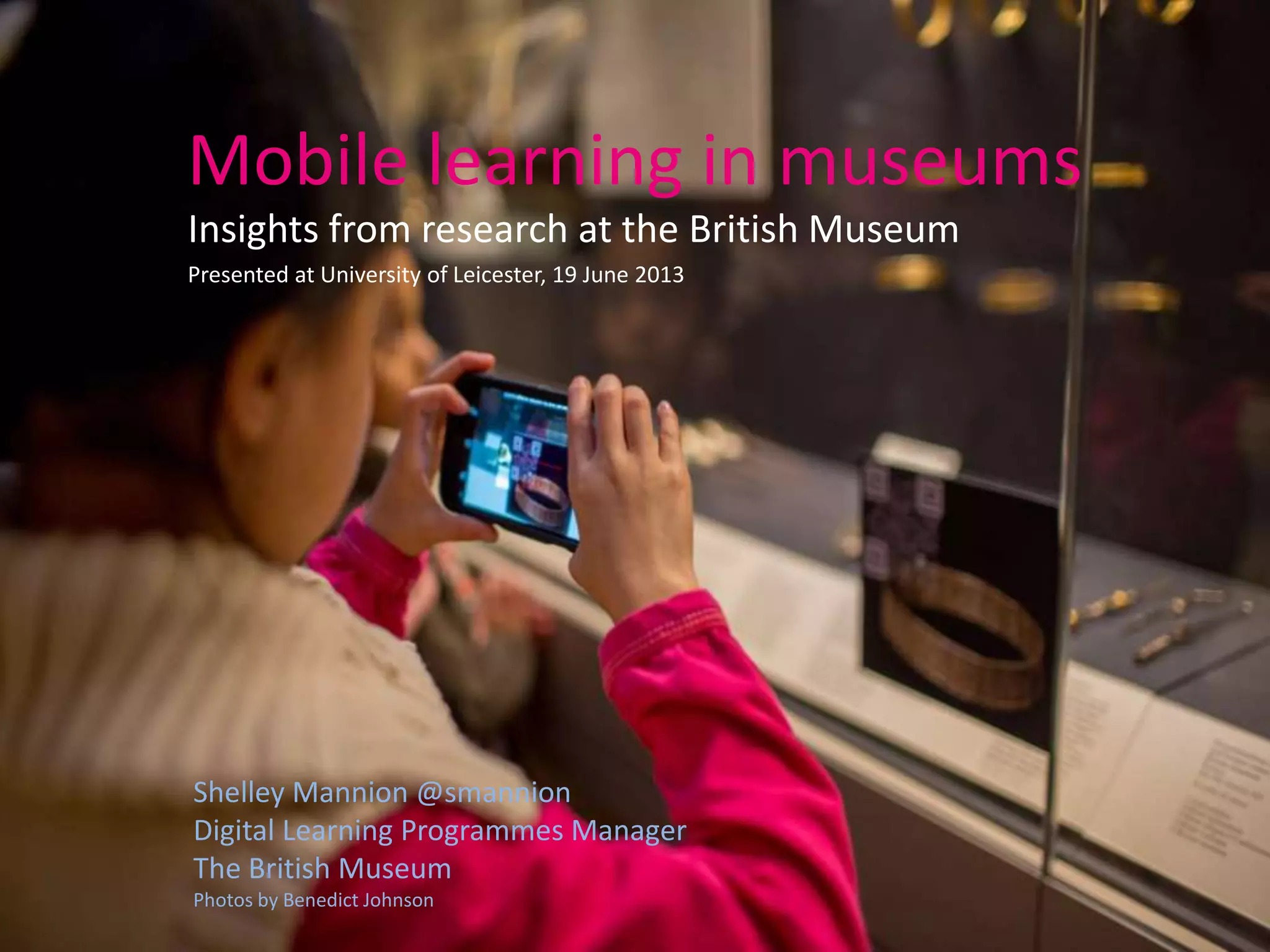
Mobile learning in museums
Insights from research at the British Museum
Presented at University of Leicester, 19 June 2013
Shelley Mannion @smannion
Digital Learning Programmes Manager
The British Museum
Photos by Benedict Johnson
Virtual versus real.
Really?
Stedelijk Museum,
Amsterdam, 1952
Photo by LoicT on Flickr
Integrated interpretation
From Peter Samis, MW2007, Gaining Traction in Vaseline
Mobile is simply an
addition to our existing
arsenal of interpretive
tools.
Big Draw, 2010: Even old devices are cool.
Mobile learning at the British Museum
Passport to the Afterlife Augmented Reality trail
QR code trails with iBeaken in permanent galleries
Photography trails for schools, families. Cameras are mobile devices too.
Tablet-based activity trails plus cameras in Multimedia Magic.
Mobile worksheets with WildForm for fact gathering offline.
Get away from
stop-based treasure hunts
Active and participatory
Experiential
Collaborative
Accommodate different
learning styles
Our goals
Our audience
Our content
Novelty effect
Motivating
• Can be superficial. Too excited.
Distractions
Distractions
Distractions
Distractions
Collaboration
4-5 per device too
many
Large screens - bah.
Can blend with
analogue (sometimes)
Friendship groups
versus ability groups
Younger children, 2
per device, but
prompt them to
share
Teens (11 and up),
own device doesn’t
discourage social
interaction
Activity design
Photography trumps all
Drawing.
Drawing.
Very creative and you can
remember it more if you do
something yourself. 65
Augmented Reality.
Provides direct visual dialogue
between camera view and
objects in cases.
Natural feature tracking
and reconstruction.
Challenges spatial
hegemony in galleries.
Promotes kinaesthetic learning.
Narrative / theme versus
object-based activities.
1 2 3
Paper prototypes
Model for mobile learning
Frohberg, et al 2009
Adapted by Doll 2012: 31
Only 11 of 102
mobile learning
apps used this
approach
Voice recording,
drawing
Platforms
Research models
Educators as
pioneers

Mobile Learning in Museums: Insights from recent research

Editor's Notes

  • #4 http://www.geschiedenis24.nl/speler.program.7072658.html