

Emotions and Agents 
in Games 
Rui 
Prada
Who am I? 
Professor 
at 
Ins0tuto 
Superior 
Técnico 
Dep. 
Computer 
Science 
and 
Engineering 
Applica0on 
Area 
on 
Games 
h5p://ajist.tecnico.ulisboa.pt/ 
7 
years, 
2 
courses 
>200 
students, 
> 
50 
game 
prototypes
Who am I? 
Senior 
Researcher 
at 
INESC-­‐ID 
Intelligent 
Agents 
and 
Synthe0c 
Characters 
Group 
h5p://gaips.inesc-­‐id.pt/
Who am I? 
Sociedade 
Portuguesa 
de 
Ciências 
dos 
Videojogos 
(Est. 
2009) 
Co-­‐Founder 
and 
Current 
President 
Promo0ng 
Knowledge 
and 
understanding 
CollaboraHon 
of 
peers 
Teaching 
and 
research 
www.spcvideojogos.org
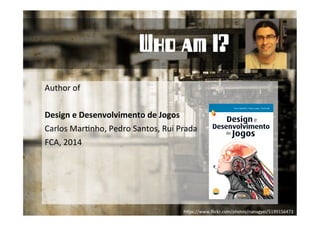
Author 
of 
Who am I? 
Design 
e 
Desenvolvimento 
de 
Jogos 
Carlos 
MarHnho, 
Pedro 
Santos, 
Rui 
Prada 
FCA, 
2014 
h5ps://www.flickr.com/photos/nanagyei/5199156473
Who am I? 
Avid 
Player 
Game 
Collector 
h5ps://www.flickr.com/photos/merydith/5875929614
Player Experience 
h5ps://www.flickr.com/photos/jamesHmbrell/8314586801/
Experience? Why? 
Gameplay 
Experience 
Games 
are 
means 
to 
live 
experiences 
Voluntary 
Subjec0ve 
Game 
Designer 
Player
Experience? Why? 
Experience 
Design 
for 
the 
Gameplay 
experience 
A 
good 
game 
is 
one 
that 
promotes 
a 
good 
experience 
Player 
Game 
Designer
Experience? What? 
1. 
Doing/Performing 
2. 
Feeling/Assessing 
3. 
Remembering/Learning
Fulfill 
a 
dream 
Do 
something 
that 
cannot 
be 
done 
Feel 
special 
Live 
and 
acquire 
something 
unique 
Player Experience
Crafting the Experience 
Doing/Performing 
Create 
moHvaHon, 
opportuniHes, 
incenHves 
for 
acHon 
Feeling/Assessing 
Promote 
interesHng 
choices 
Define 
consequences 
of 
choices 
Remembering/Learning 
Promote 
re-­‐use 
and 
combinaHon
Pleasure 
h5p://pixabay.com/p-­‐110303
A Good Experience 
A 
good 
experience 
elicits 
pleasure 
Brain 
rewards 
“desirable” 
situaHons 
and 
behaviours
Pleasure: Satisfaction of Needs 
Achievement. 
Achieve 
milestones, 
finish 
tasks. 
Power. 
Have 
an 
impact 
on 
the 
world, 
improve 
skill. 
Affilia0on. 
Maintain 
posiHve 
interacHons 
with 
others. 
Avoidance. 
Self-­‐preservaHon, 
seeking 
certainty. 
Balance 
Novelty 
and 
Control
Pleasure: Emotions 
Internal 
sensa0ons 
linked 
to 
assessment 
of 
situaHons 
People 
have 
needs 
of 
emo0onal 
regula0on 
(to 
relax 
or 
get 
excited) 
Regulate 
engagement 
(a5enHon 
and 
moHvaHon)
Emotions and Engagement 
If 
something 
has 
emo0onal 
impact 
it 
is 
relevant!
Primary Emotions 
Anger 
Fear 
Disgust 
a. b. c. 
Surprise 
Happiness 
Sadness 
d. e. f.
Eliciting Emotions 
Achieve 
a 
desirable 
situaHon 
Complete 
a 
level 
Give 
the 
players 
what 
they 
desire 
Nice 
rewards 
(e.g. 
rare 
items) 
Achieve 
an 
undesirable 
situaHon 
Lose 
something 
important 
Lose 
an 
opportunity 
Stronger 
if 
the 
situaHon 
is 
irreversible
Eliciting Emotions 
Obstruct/deny 
players’ 
goals 
Hurt/damage 
what 
they 
like 
The 
blame 
is 
not 
a5ributed 
enHrely 
to 
the 
self 
Belief 
that 
the 
situaHon 
is 
recoverable 
Promote 
anHcipaHon 
of 
an 
undesirable 
situaHon 
Threaten 
what 
is 
important 
for 
the 
player 
Creates 
tension 
PotenHates 
other 
emoHons 
(e.g. 
Happiness)
Eliciting Emotions 
Create 
unexpected 
situaHons 
Framed 
in 
the 
expectaHons 
of 
players 
and 
uncertainty 
PosiHve 
or 
negaHve 
surprises 
Create 
uncomfortable 
situaHons 
Not 
clearly 
undesirable, 
but 
to 
avoid 
Social 
disgust: 
related 
to 
social 
values
Which Emotions? 
All 
emoHons 
ma5er 
Go 
beyond 
primary 
emoHons 
Social 
emo0ons 
(Guilt, 
shame, 
pride, 
love…)
Pleasure: Learning 
Playing 
is 
a 
learning 
ac0vity 
(players 
learn 
controls, 
mechanics, 
strategies, 
story…)
Learning 
Support 
learning 
in 
your 
game 
Balance 
guidance 
and 
self-­‐explora0on
Learning 
The 
experience 
is 
ruined 
if 
There 
is 
nothing 
to 
learn 
It 
is 
impossible 
to 
learn 
(noise, 
sensory 
overload) 
There 
is 
no 
interest 
in 
the 
things 
learnt 
(are 
not 
applied 
in 
the 
game)
Types of Pleasure 
Visceral: 
moHon, 
heat, 
relaxaHon 
Cogni0ve: 
problem 
solving, 
memory 
challenges 
Social: 
social 
status, 
sense 
of 
belonging, 
interacHng 
with 
others 
Moral: 
follow 
ideals, 
moral 
code
Types of Pleasure 
Mechanics, 
Dynamics 
and 
AestheHcs
MDA: Sensation 
h5p://www.hyperplus.pl/gra-­‐limbo_1958
MDA: Fantasy 
h5p://upload.wikimedia.org/wikipedia/commons/3/34/Guitar_Hero_World_Tour-­‐players.jpg
MDA: Narrative 
h5ps://c1.staHcflickr.com/9/8157/7339666002_12643d98b5.jpg
MDA: Challenge 
h5p://www.destructoid.com/ul/238434-­‐/77222_NSMBWiiU_Boss-­‐05-­‐620x.jpg
MDA: Fellowship 
h5ps://www.flickr.com/photos/brendan-­‐c/4136435012
MDA: Discovery 
h5ps://www.flickr.com/photos/terr/2071342211/
MDA: Expression 
h5p://tjseabury.deviantart.com/art/Minecrak-­‐Manor-­‐280667402
MDA: Submission 
h5ps://www.flickr.com/photos/ilamont/4329344542
Progression 
h5ps://www.flickr.com/photos/usafe/14050607788/
Progression 
The 
experience 
changes 
with 
Hme
Managing the Progression 
Challenge 
and 
Novelty 
(keep 
the 
learning)
The Flow 
Flow 
Channel 
Skill Level 
Experience 
Degree of 
Challenge 
Skill Level 
Anxiety 
Boredom 
Experience
Agents in Games 
h5p://irisaurus.deviantart.com/art/Vocaloid-­‐The-­‐sims-­‐2-­‐336146712
Agents 
Autonomous 
enHHes 
ProacHve 
ReacHve 
DeliberaHve
Interactive Agents 
Interact 
with 
people 
Become 
characters
Characters 
Social 
Roles 
Purpose 
IdenHty 
EmoHons 
Personality
Characters 
Promote 
Social 
Experience
Believability 
Coherent 
behaviour 
Fit 
the 
context 
Meet 
the 
expecta0ons 
(The 
Media 
EquaHon)
Believability 
Suspension 
of 
disbelief 
“Illusion 
of 
Life”
Believability: Visual
Believability: Behavioural
Models For Believable AI 
h5p://agsandrew.deviantart.com/art/Emergence-­‐of-­‐ArHficial-­‐Intelligence-­‐0007-­‐382222119
SGD Model 
Group 
dynamics 
Personality: 
OCEAN 
PosiHon 
in 
the 
group 
InteracHon 
dynamics: 
IPA
SGD Model 
Social 
RelaHons 
Influence 
and 
A5racHon 
Balance
Perfect Circle
Social Power 
PotenHal 
force 
towards 
change: 
beliefs, 
behaviour 
Influence 
= 
Power 
-­‐ 
Resistance
Social Power 
Reward 
Coercion 
LegiHmate 
Referent 
Expert
Social Theater
DIMA Model 
IdenHty 
Layered: 
personal, 
social 
(group 
memberships) 
salience 
= 
accessibility 
x 
fit
DIMA Model 
Intergroup 
relaHonships 
EmoHonal 
appraisal 
In-­‐group 
bias
Volcano Island
SID Model 
Social 
Importance 
InteracHon 
Dynamics 
Claim 
and 
Confer
SI Model: Culture 
Individualism/collecHvism 
Power 
distance 
Uncertainty 
avoidance 
Long 
term/short 
term 
orientaHon 
Masculinity/femininity 
Indulgence/restraint
Traveller
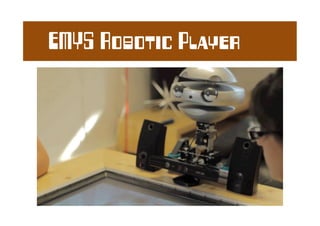
EMYS Robotic Player 
Physical 
embodiment 
Face 
to 
face 
interacHon 
Verbal 
and 
non-­‐verbal 
behaviour: 
gaze, 
a5enHon
EMYS Robotic Player 
EmoHonal 
appraisal: 
luck, 
social 
relaHons, 
state 
of 
the 
game 
Social 
memory: 
players 
and 
past 
experiences 
Social 
roles: 
helper, 
dominator
EMYS Robotic Player
Conclusions 
h5p://pixabay.com/en/message-­‐in-­‐a-­‐bo5le-­‐post-­‐bo5le-­‐413680/
Games 
are 
means 
for 
experience 
Emo0ons 
and 
learning 
have 
a 
crucial 
role 
Believable 
agents 
may 
improve 
the 
social 
experience 
of 
games 
Concluding
Concluding 
People 
have 
social 
expecta0ons 
of 
agents 
To 
achieve 
believability: 
idenHty 
personality, 
emoHons, 
social 
awareness, 
social 
skills, 
social 
needs, 
balanced 
behaviour
Contacts 
rui.prada@tecnico.ulisboa.pt 
h5p://gaips.inesc-­‐id.pt/rprada 
h5p://spcvideojogos.org 
h5p://ajist.tecnico.ulisboa.pt/

Emotions and Agents in Games