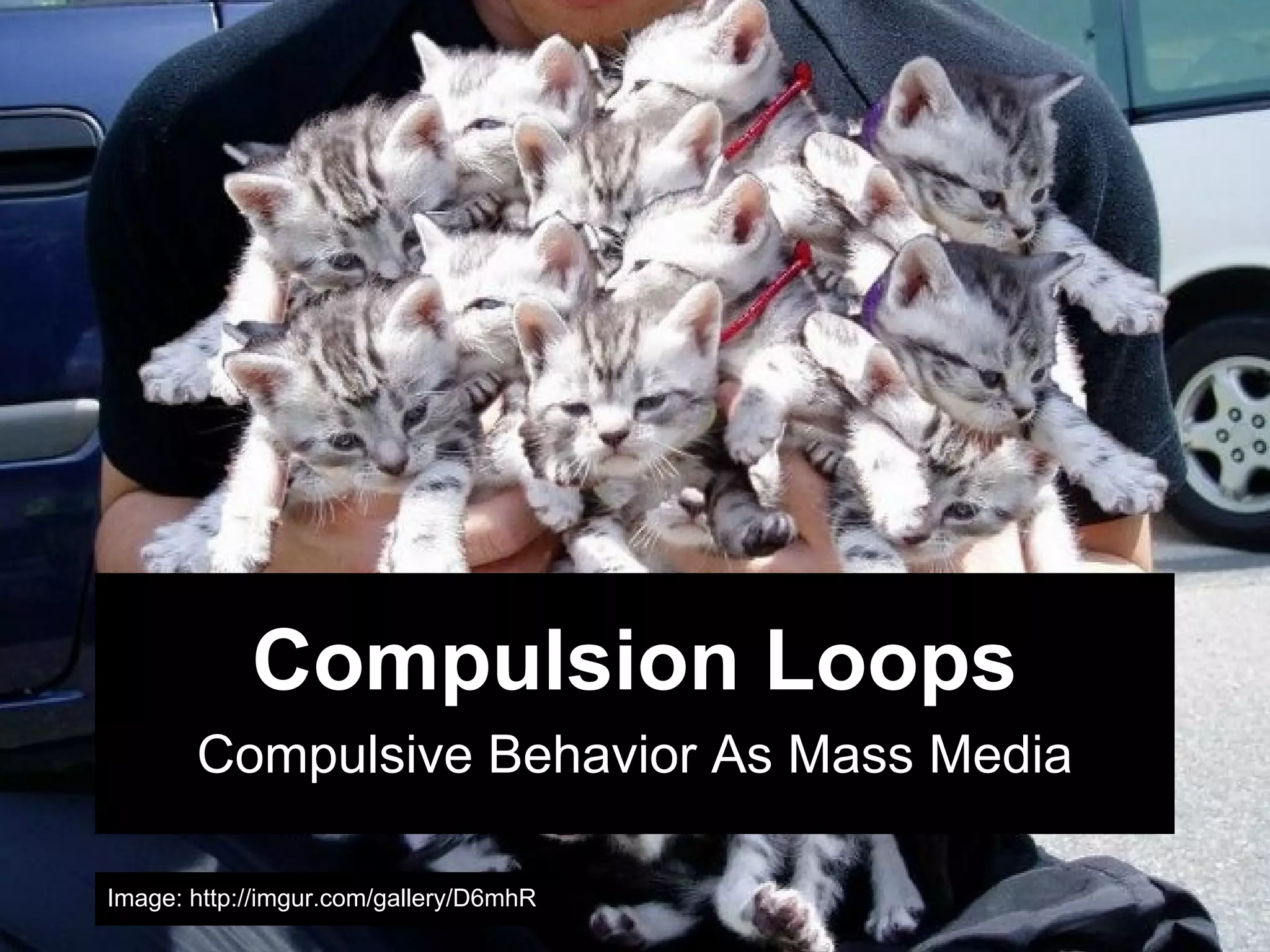


Compulsion Loops
       Compulsive Behavior As Mass Media

Image: http://imgur.com/gallery/D6mhR
A presentation to students attending the
Michigan State University: Study Abroad
2012: Mass Media in the UK programme.
Who are you guys?
Richard Buchanan @replayzero
— Creative Strategist (Ideas)
Adam Crowe @adamcrowe
— Engagement Strategist (Interactions)

We look for behavioral patterns shaped by
new technologies and use those patterns
to create clever ideas and engaging
interactions to connect people to brands.
1. The Evolution of Media
2. Compulsion Loops
3. Why is this happening?
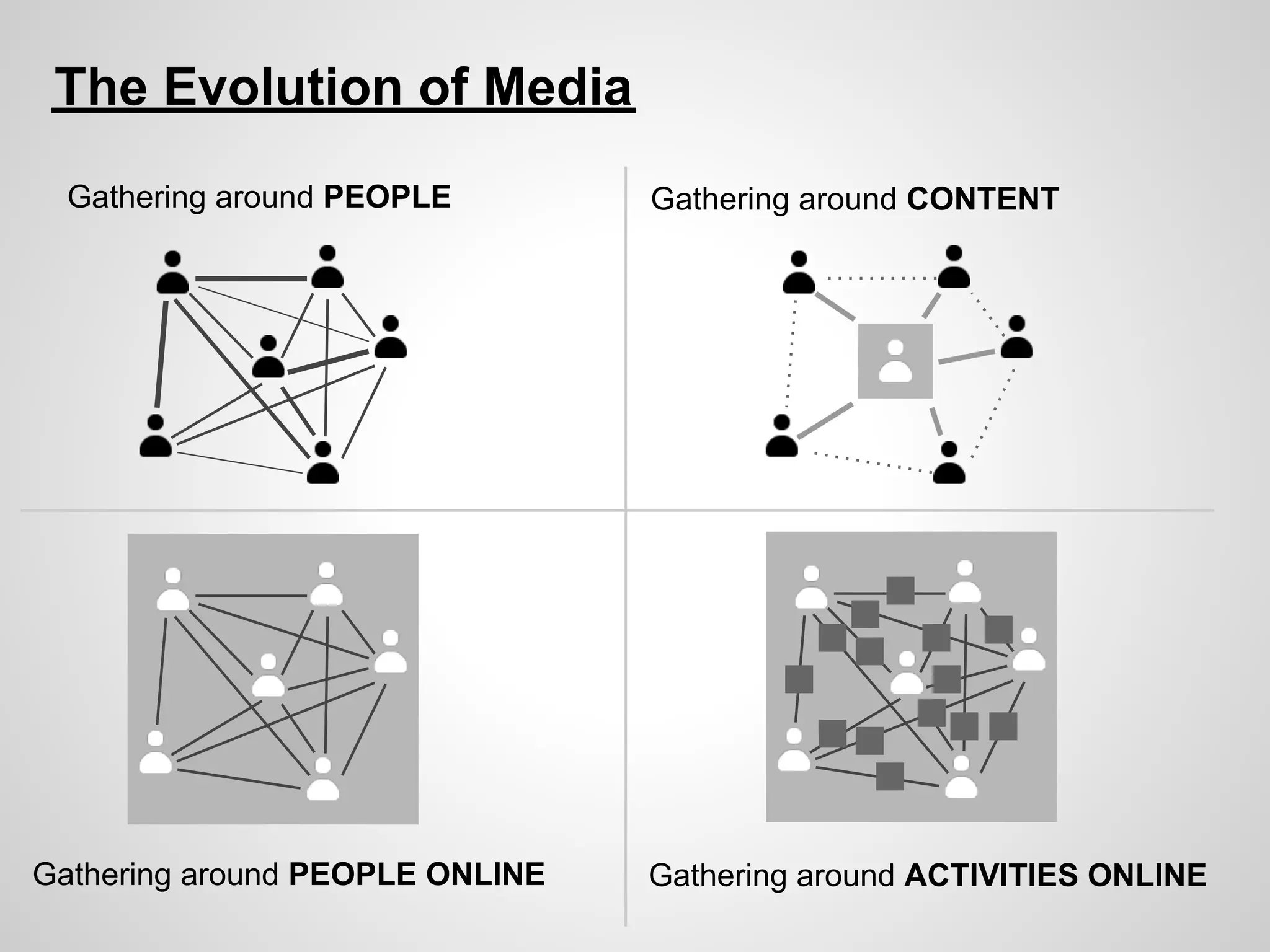
The Evolution of Media
  Gathering around PEOPLE        Gathering around CONTENT


Gathering around PEOPLE ONLINE   Gathering around ACTIVITIES ONLINE
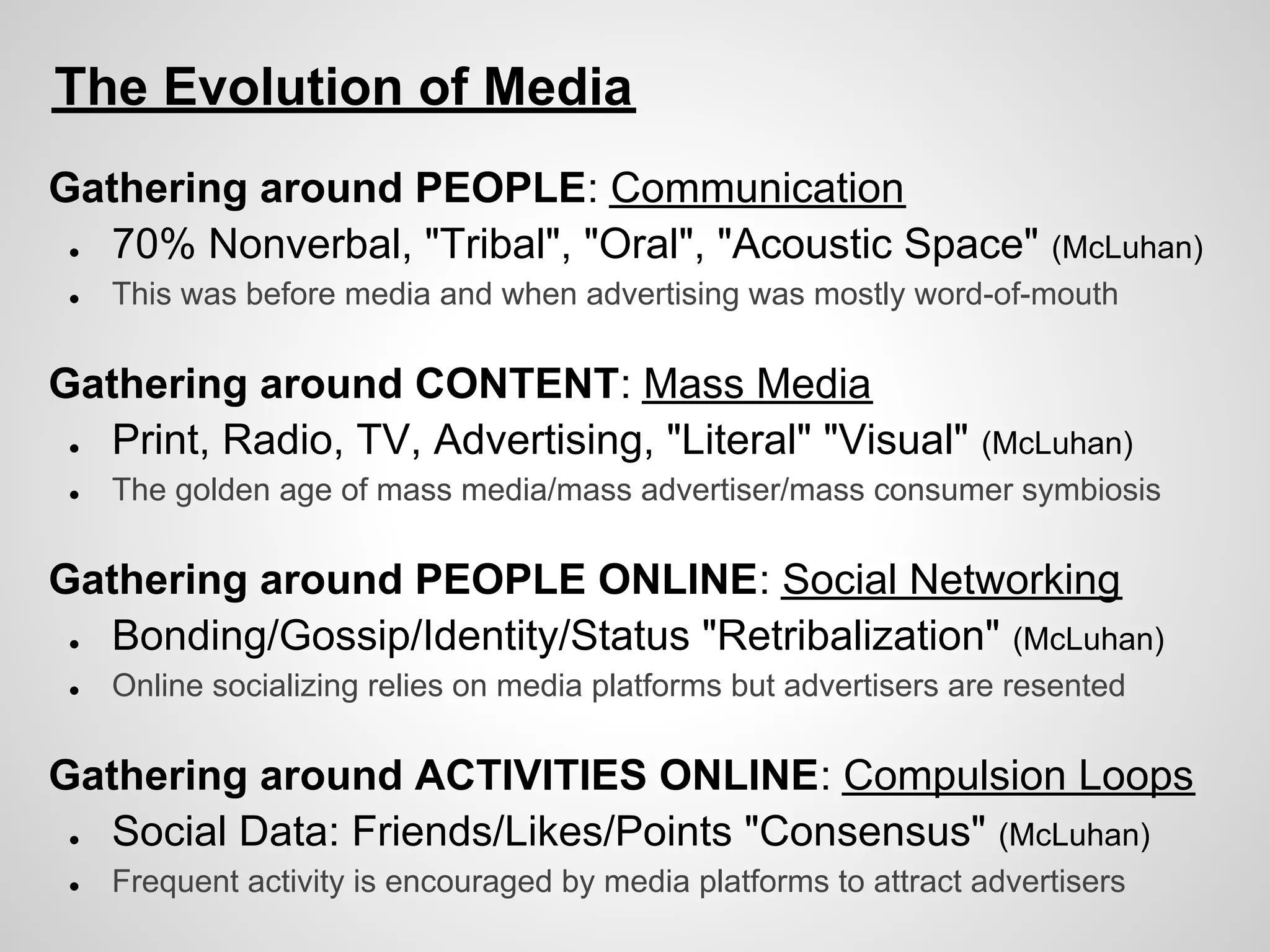
The Evolution of Media
Gathering around PEOPLE: Communication
 ● 70% Nonverbal, "Tribal", "Oral", "Acoustic Space" (McLuhan)
 ●   This was before media and when advertising was mostly word-of-mouth

Gathering around CONTENT: Mass Media
 ● Print, Radio, TV, Advertising, "Literal" "Visual"         (McLuhan)
 ●   The golden age of mass media/mass advertiser/mass consumer symbiosis

Gathering around PEOPLE ONLINE: Social Networking
 ● Bonding/Gossip/Identity/Status "Retribalization" (McLuhan)
 ●   Online socializing relies on media platforms but advertisers are resented

Gathering around ACTIVITIES ONLINE: Compulsion Loops
 ● Social Data: Friends/Likes/Points "Consensus" (McLuhan)
 ●   Frequent activity is encouraged by media platforms to attract advertisers
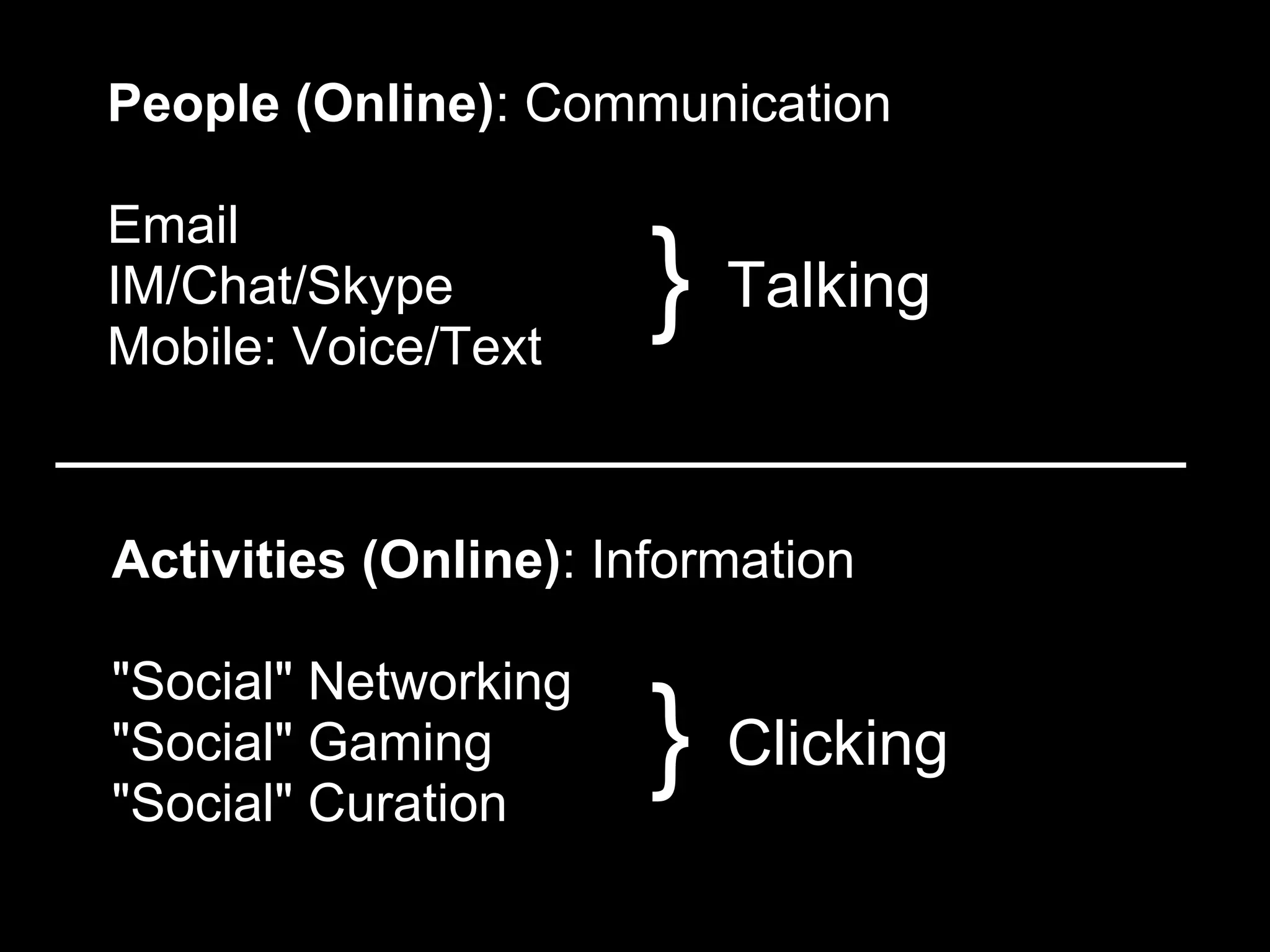
People (Online): Communication

Email
IM/Chat/Skype
Mobile: Voice/Text
                       } Talking

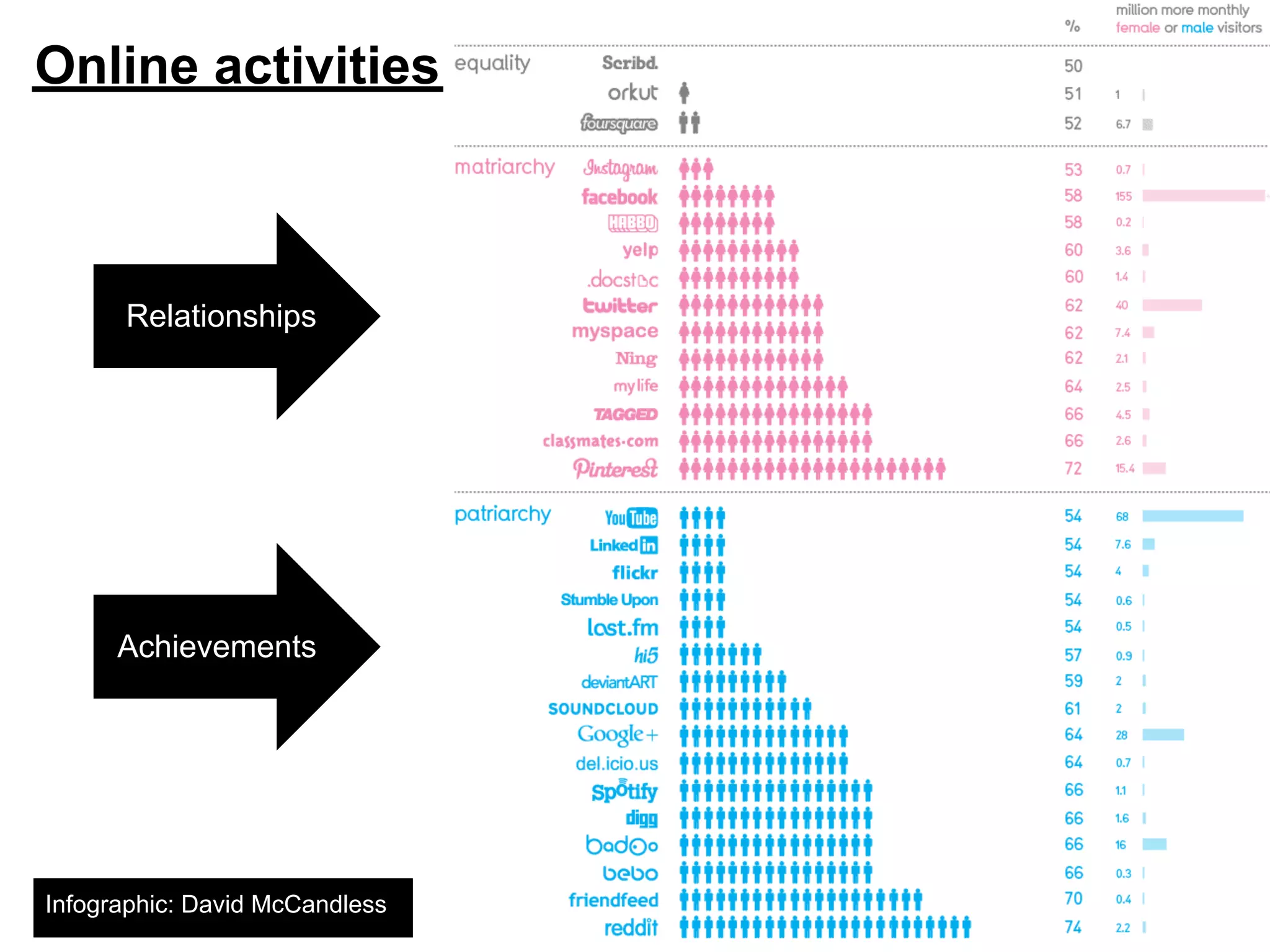
Activities (Online): Information

"Social" Networking
"Social" Gaming
"Social" Curation
                       } Clicking
Online activities


      Relationships


      Achievements


Infographic: David McCandless
Compulsion Loops?
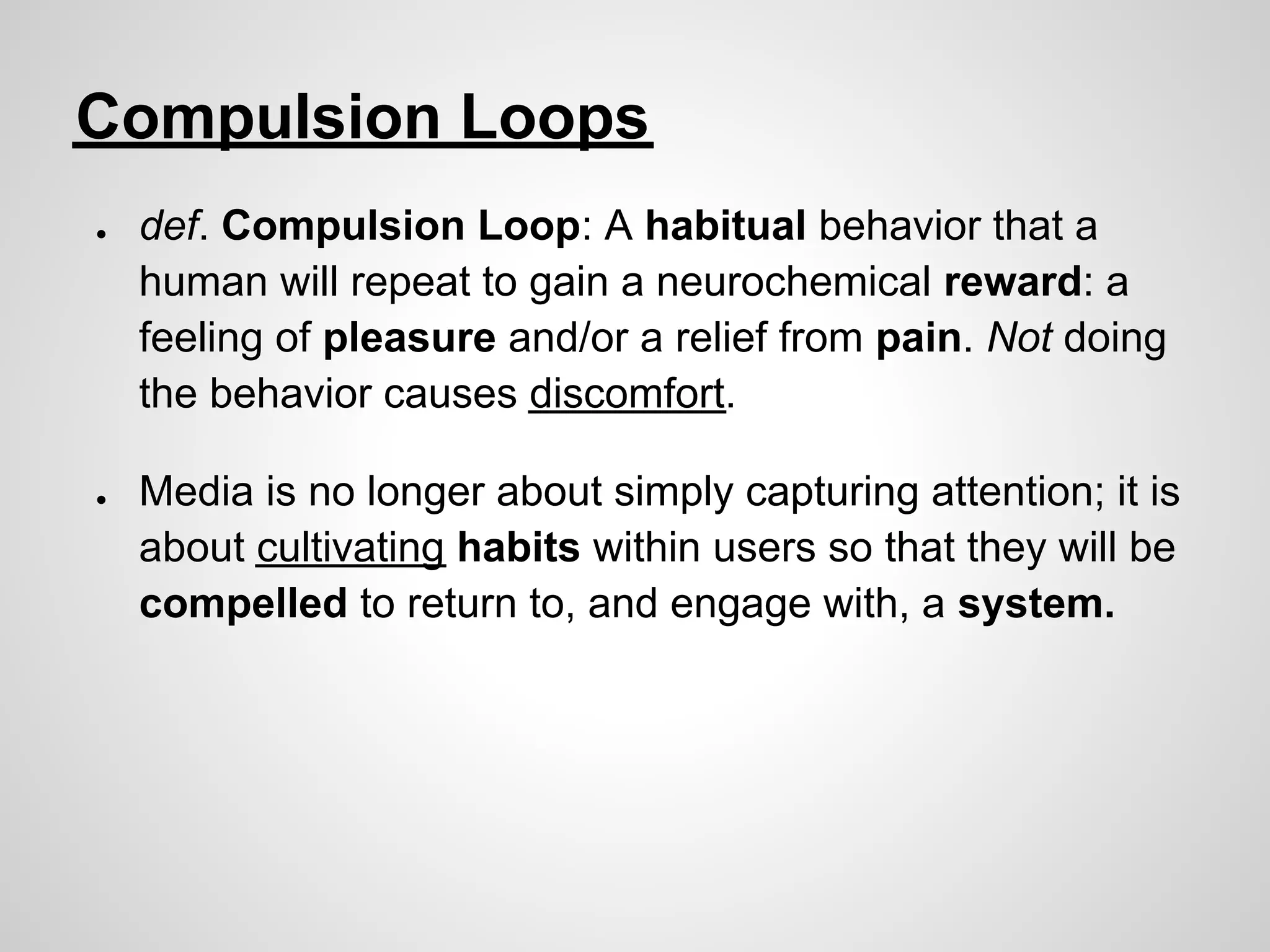
Compulsion Loops
●   def. Compulsion Loop: A habitual behavior that a
    human will repeat to gain a neurochemical reward: a
    feeling of pleasure and/or a relief from pain. Not doing
    the behavior causes discomfort.

●   Media is no longer about simply capturing attention; it is
    about cultivating habits within users so that they will be
    compelled to return to, and engage with, a system.
We are talking about
the psychobiology and
    neurochemistry
      of media
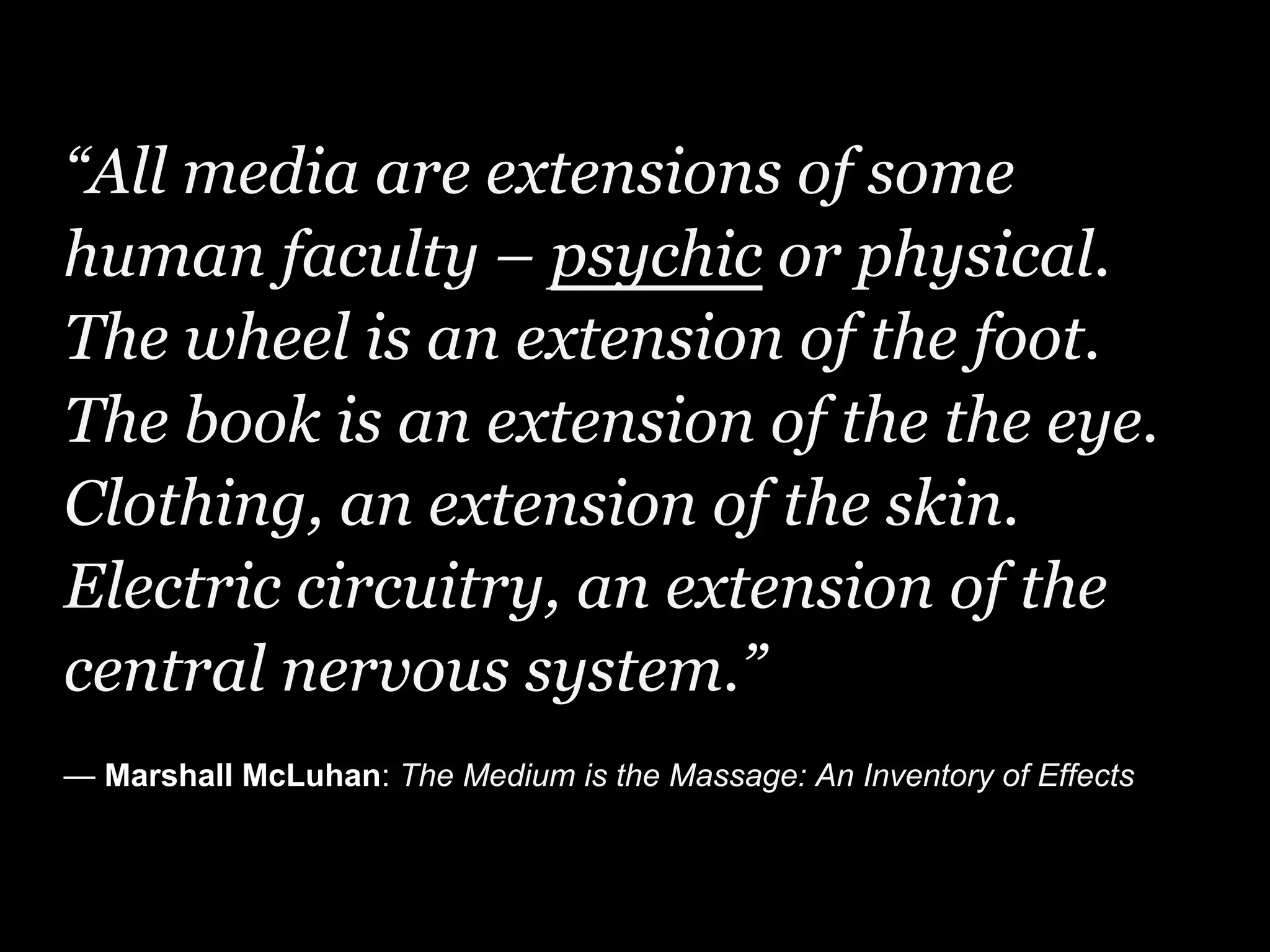
“All media are extensions of some
human faculty – psychic or physical.
The wheel is an extension of the foot.
The book is an extension of the the eye.
Clothing, an extension of the skin.
Electric circuitry, an extension of the
central nervous system.”
— Marshall McLuhan: The Medium is the Massage: An Inventory of Effects
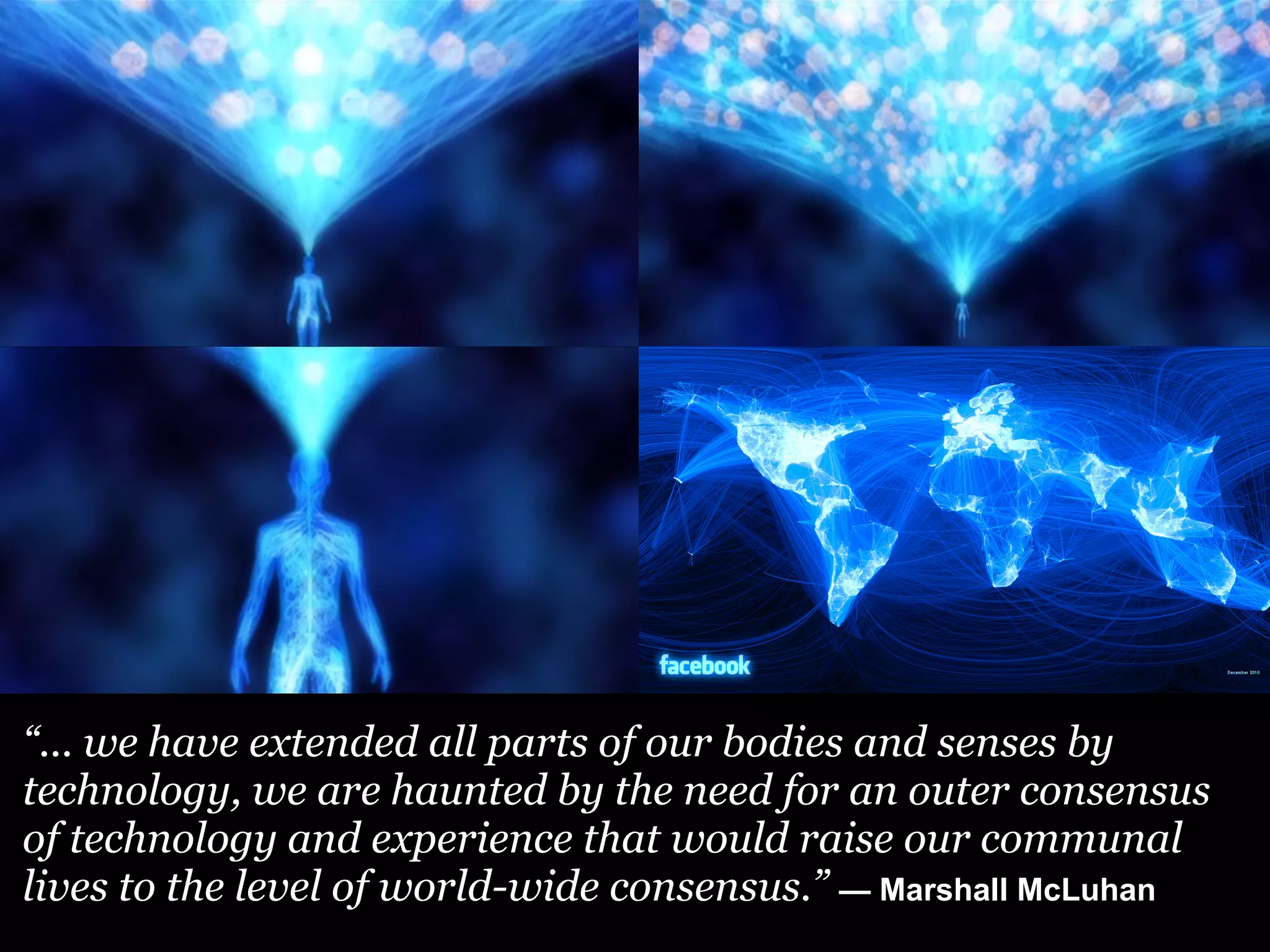
“... we have extended all parts of our bodies and senses by
technology, we are haunted by the need for an outer consensus
of technology and experience that would raise our communal
lives to the level of world-wide consensus.” — Marshall McLuhan
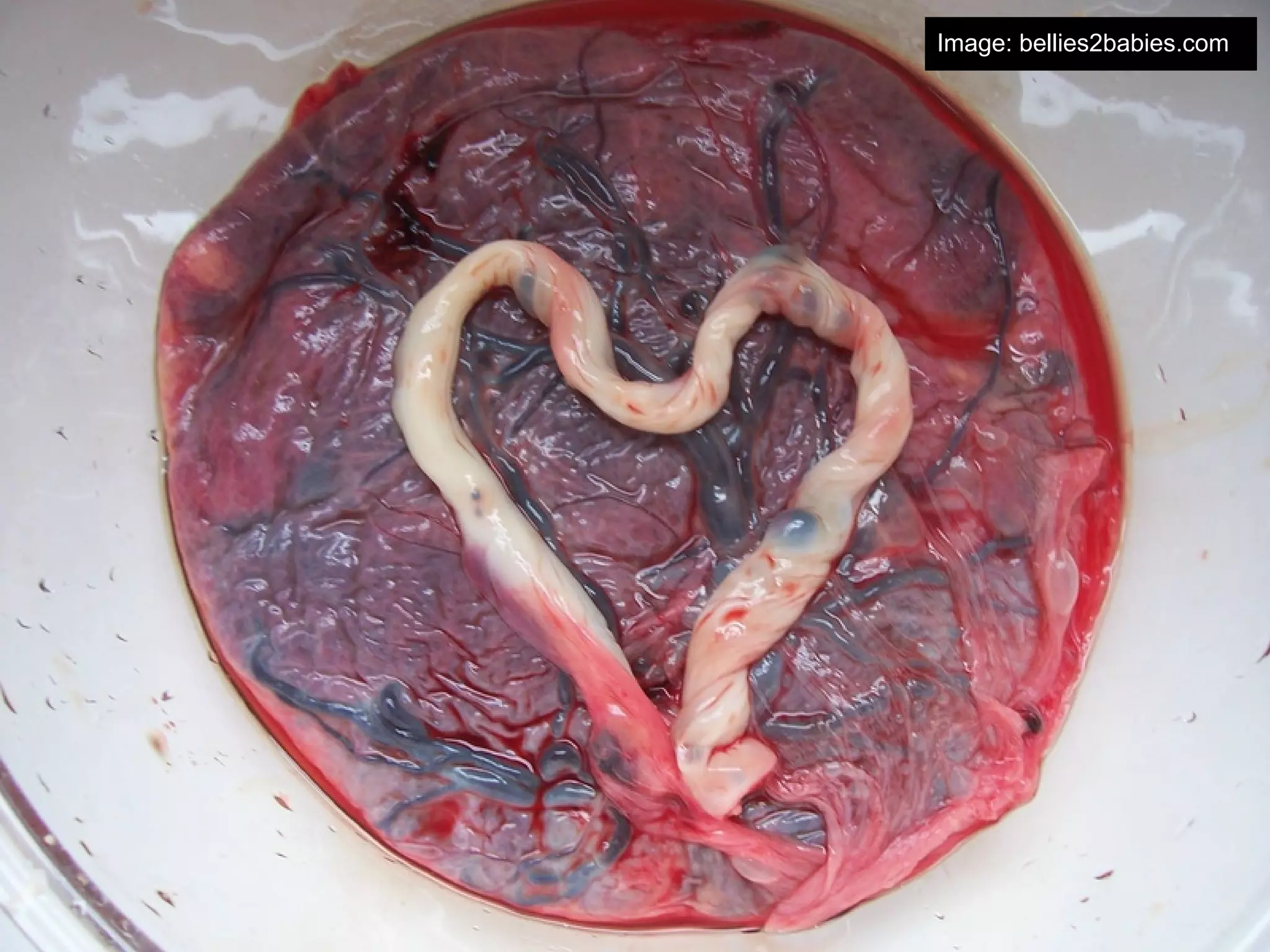
This is a placenta
Image: bellies2babies.com
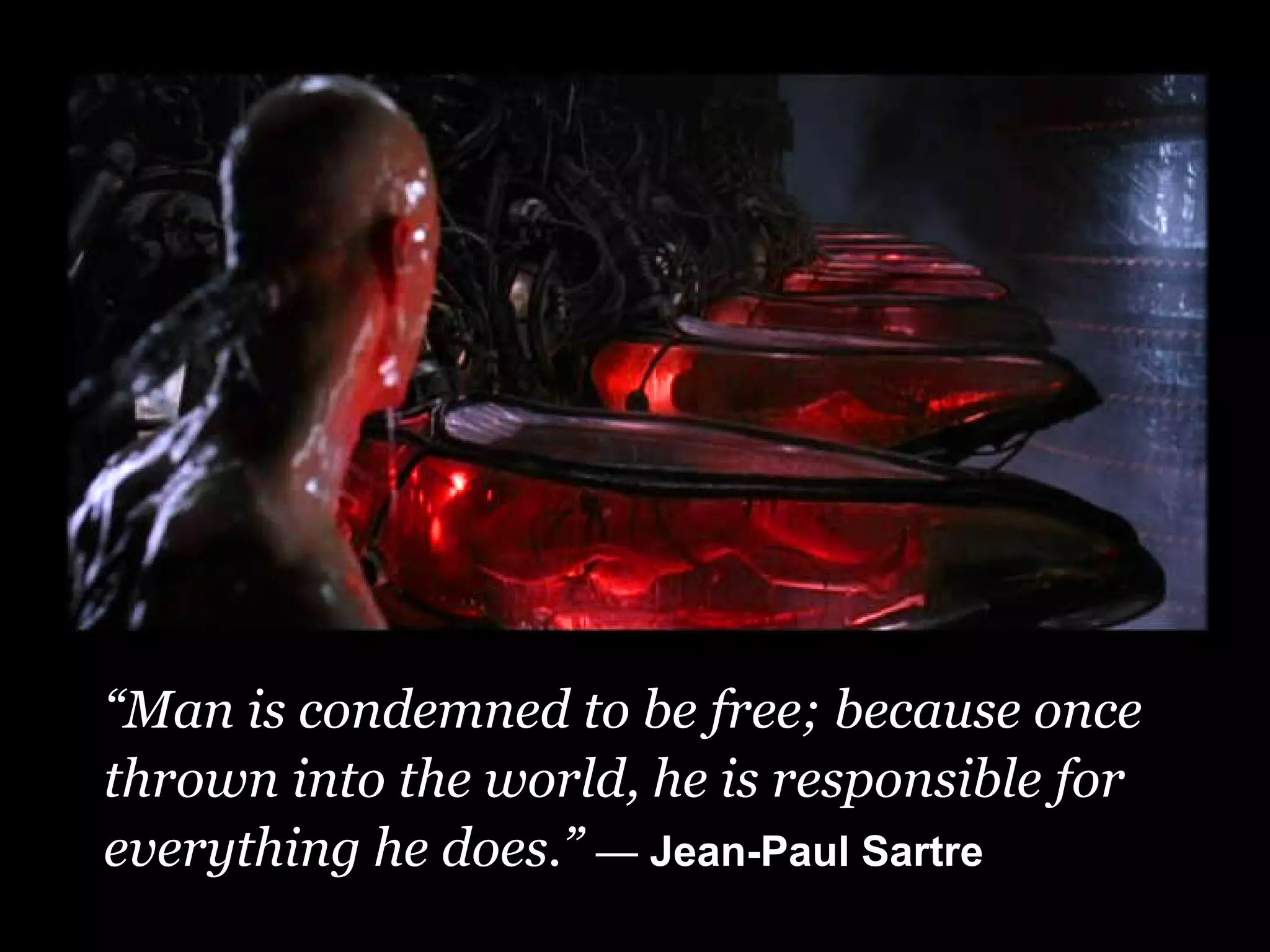
“Man is condemned to be free; because once
thrown into the world, he is responsible for
everything he does.” — Jean-Paul Sartre
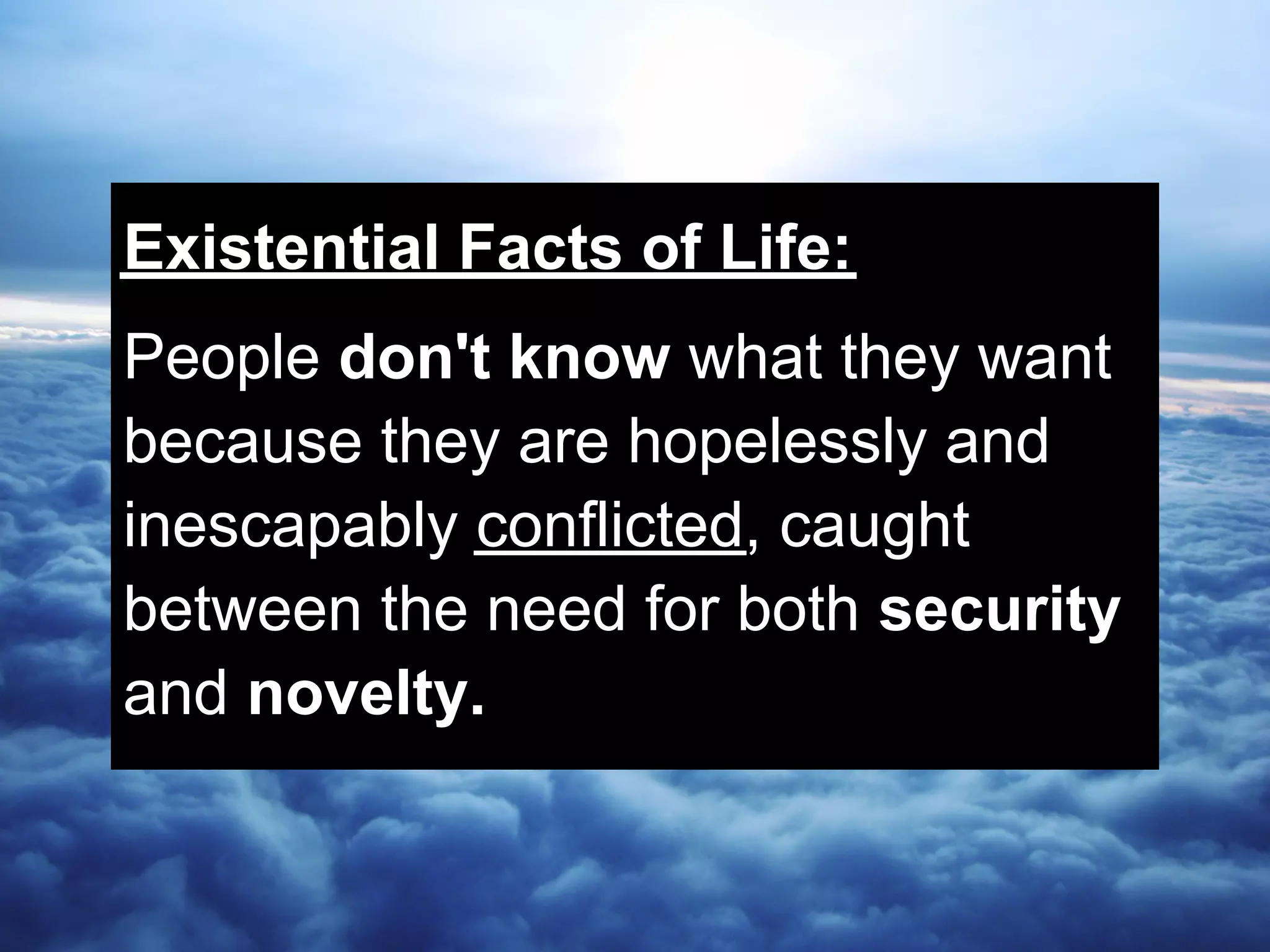
Existential Facts of Life:
People don't know what they want
because they are hopelessly and
inescapably conflicted, caught
between the need for both security
and novelty.
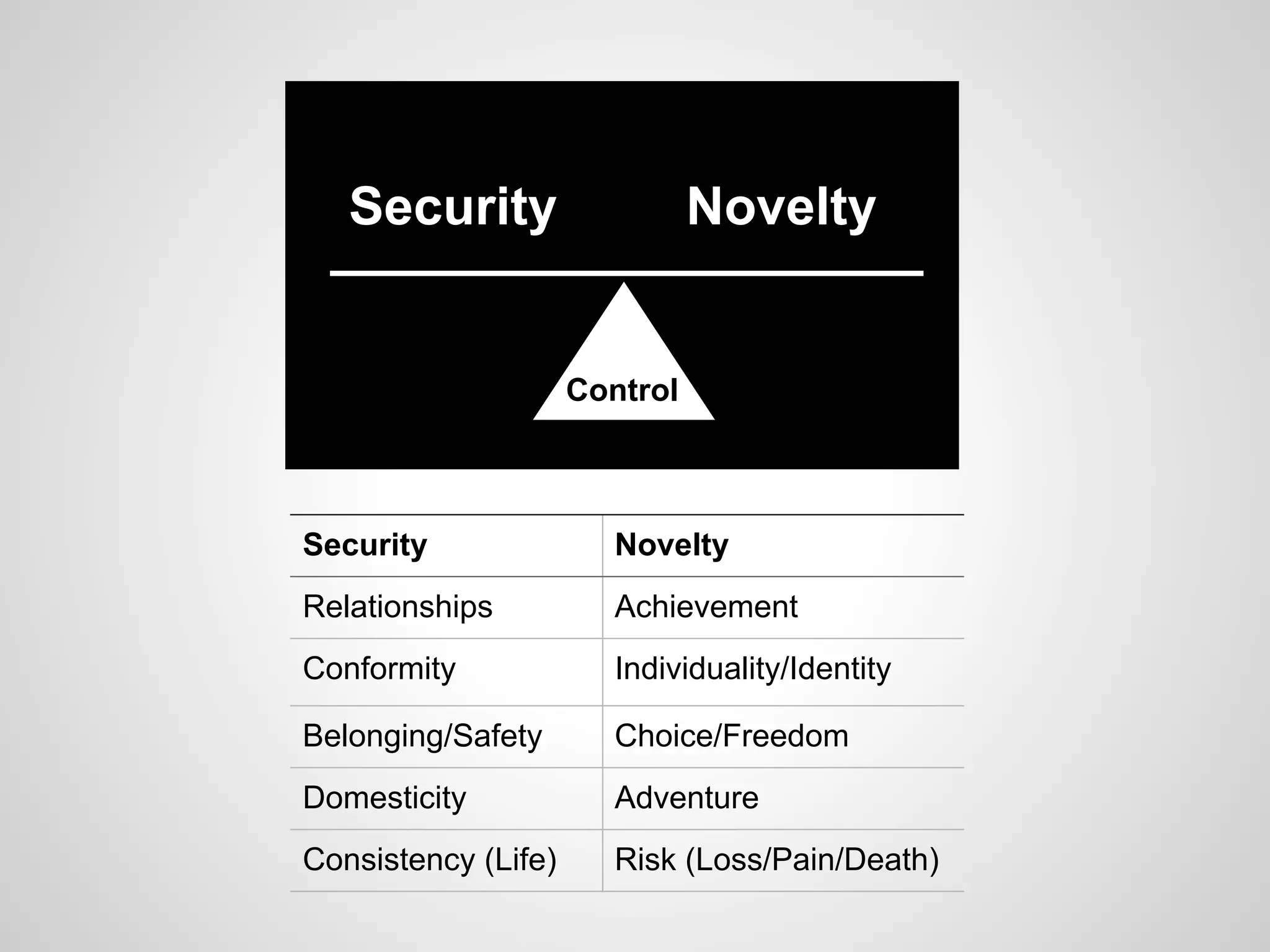
Security                    Novelty


                     Control


Security                Novelty
Relationships           Achievement
Conformity              Individuality/Identity

Belonging/Safety        Choice/Freedom
Domesticity             Adventure
Consistency (Life)      Risk (Loss/Pain/Death)
Thus:
Modern marketing wants to help
people manage this overwhelming
sense of choice in order to achieve
a sense of belonging.
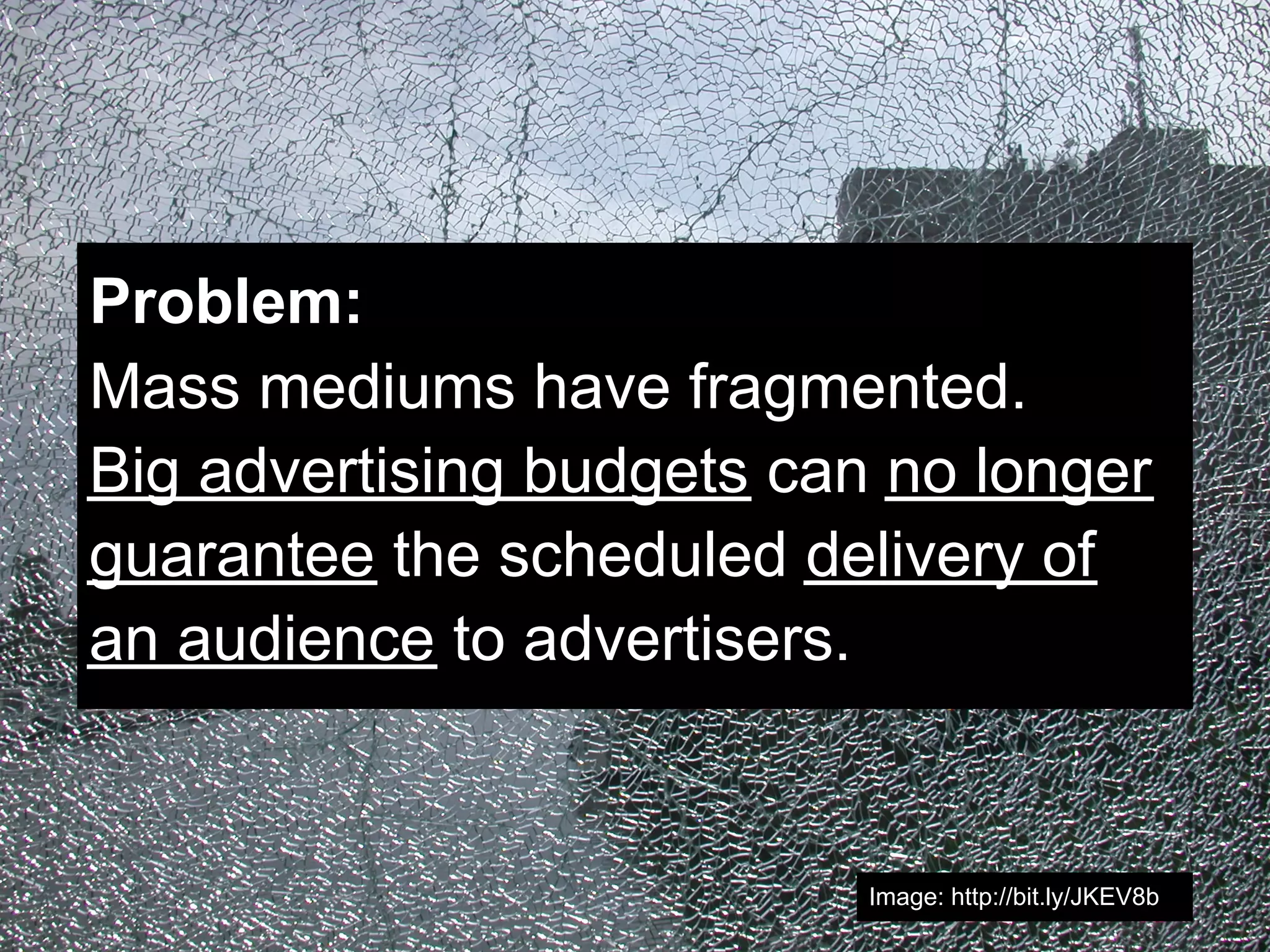
Problem:
Mass mediums have fragmented.
Big advertising budgets can no longer
guarantee the scheduled delivery of
an audience to advertisers.


                           Image: http://bit.ly/JKEV8b
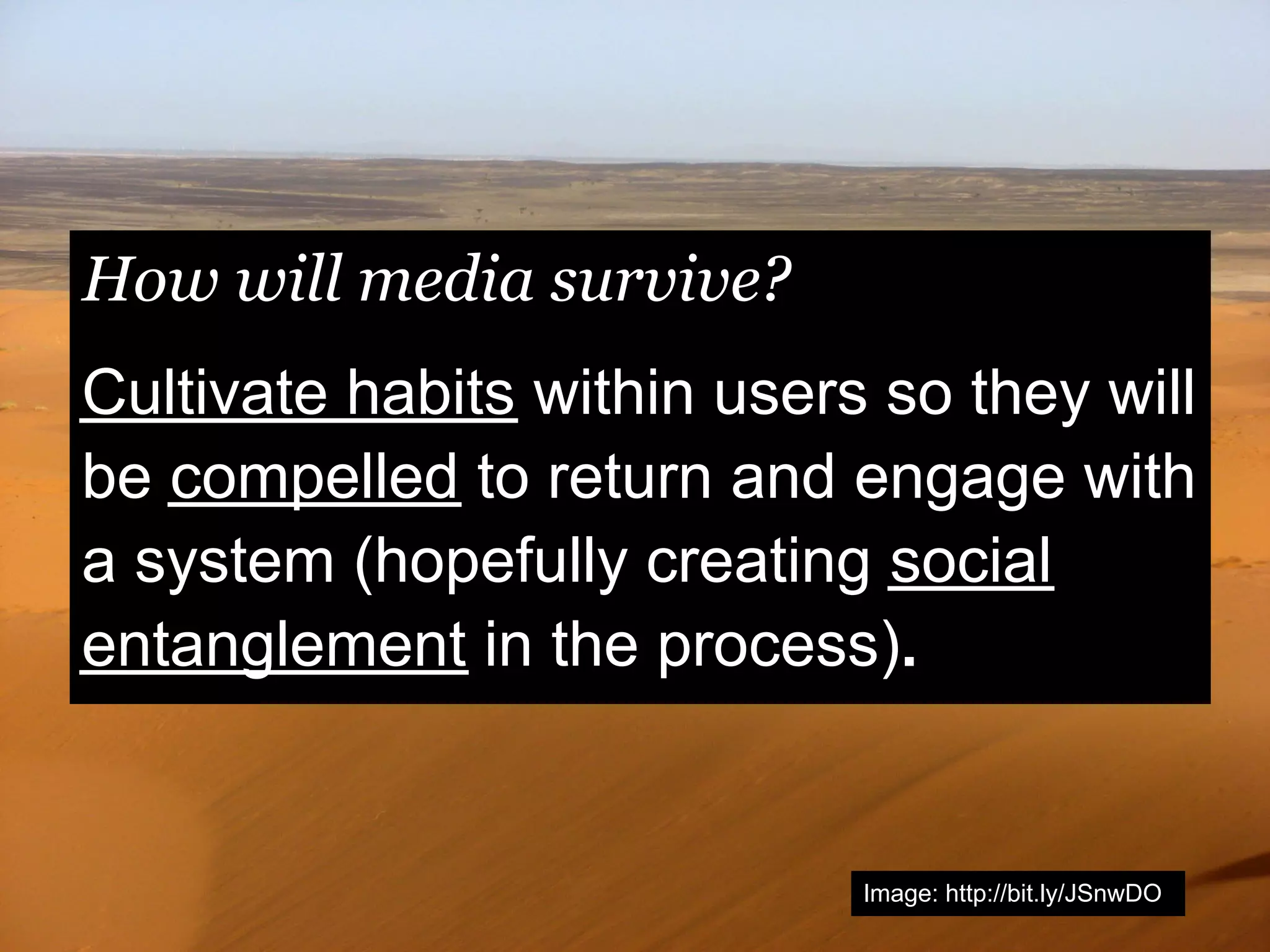
How will media survive?
Cultivate habits within users so they will
be compelled to return and engage with
a system (hopefully creating social
entanglement in the process).


                             Image: http://bit.ly/JSnwDO
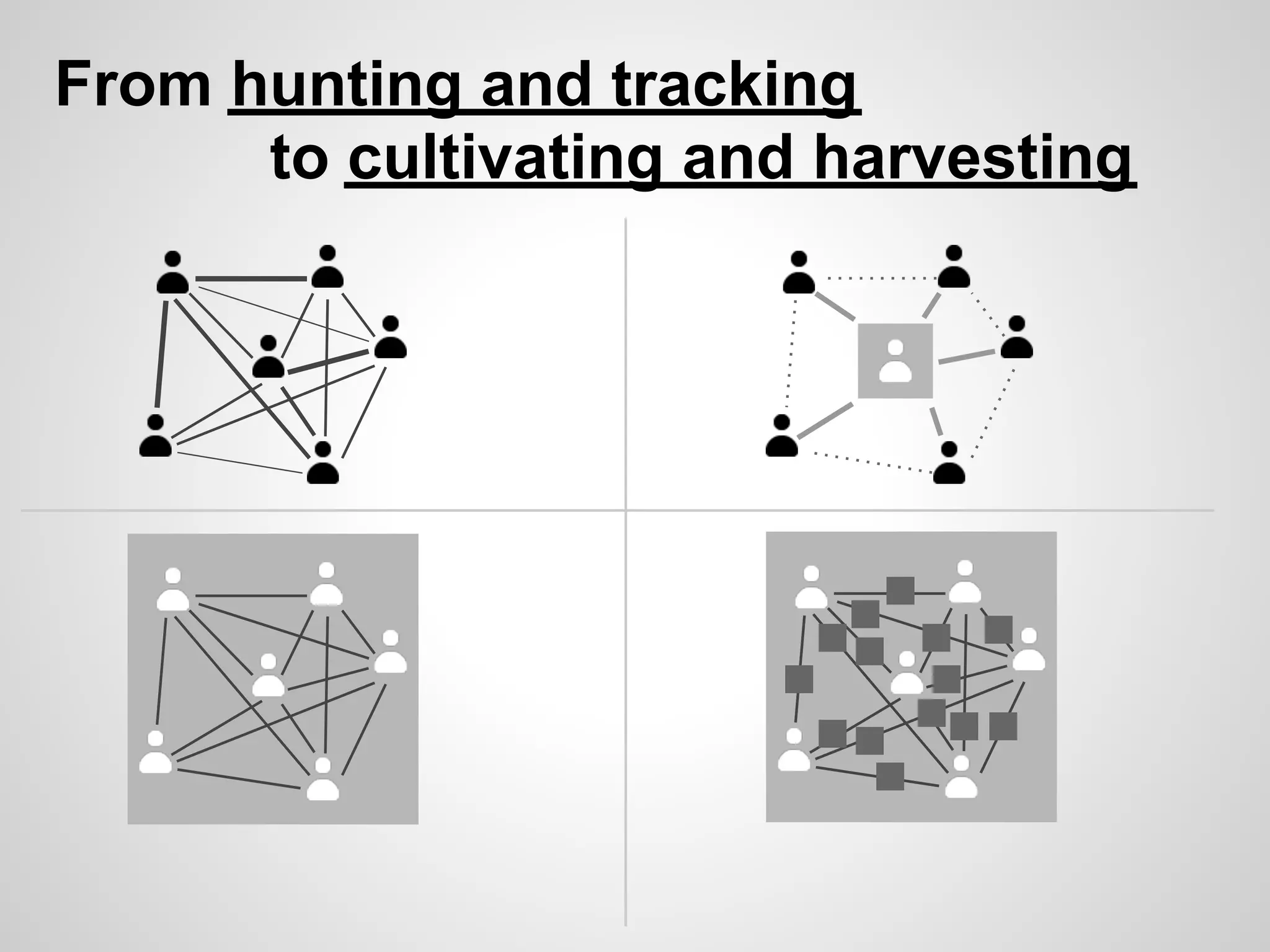
From hunting and tracking
      to cultivating and harvesting
Why are we telling you this?
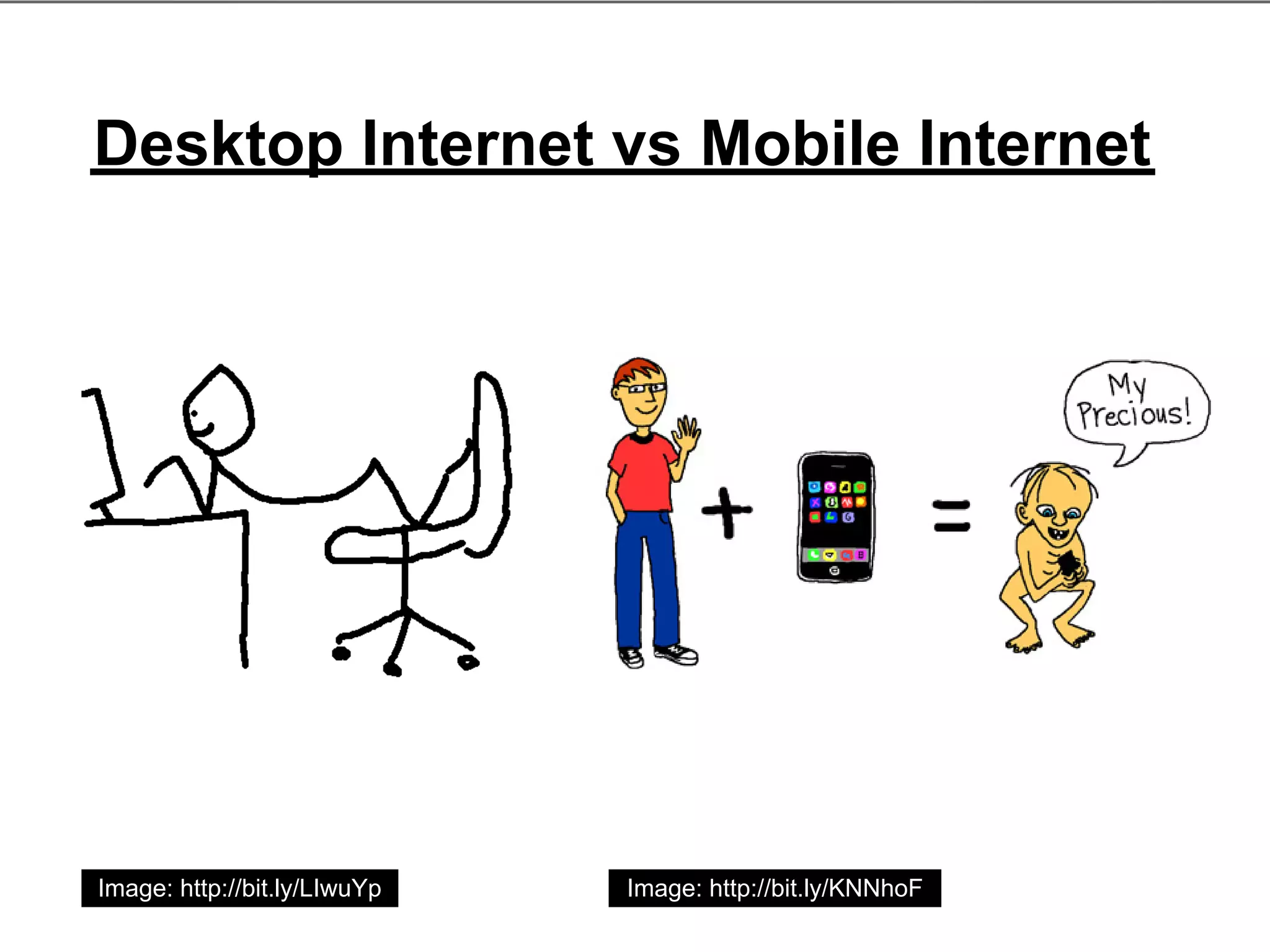
Desktop Internet vs Mobile Internet


Image: http://bit.ly/LIwuYp   Image: http://bit.ly/KNNhoF
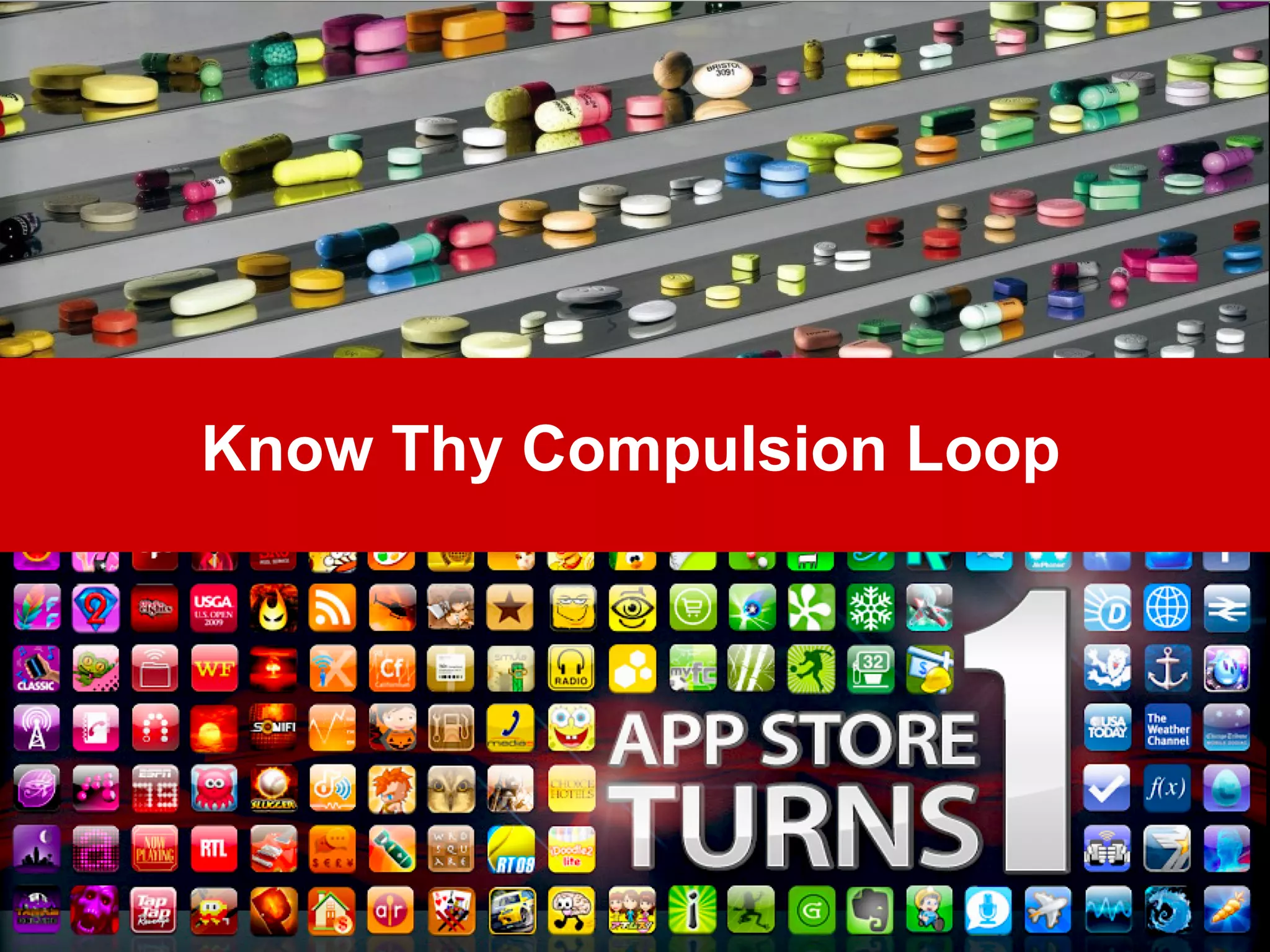
Know Thy Compulsion Loop
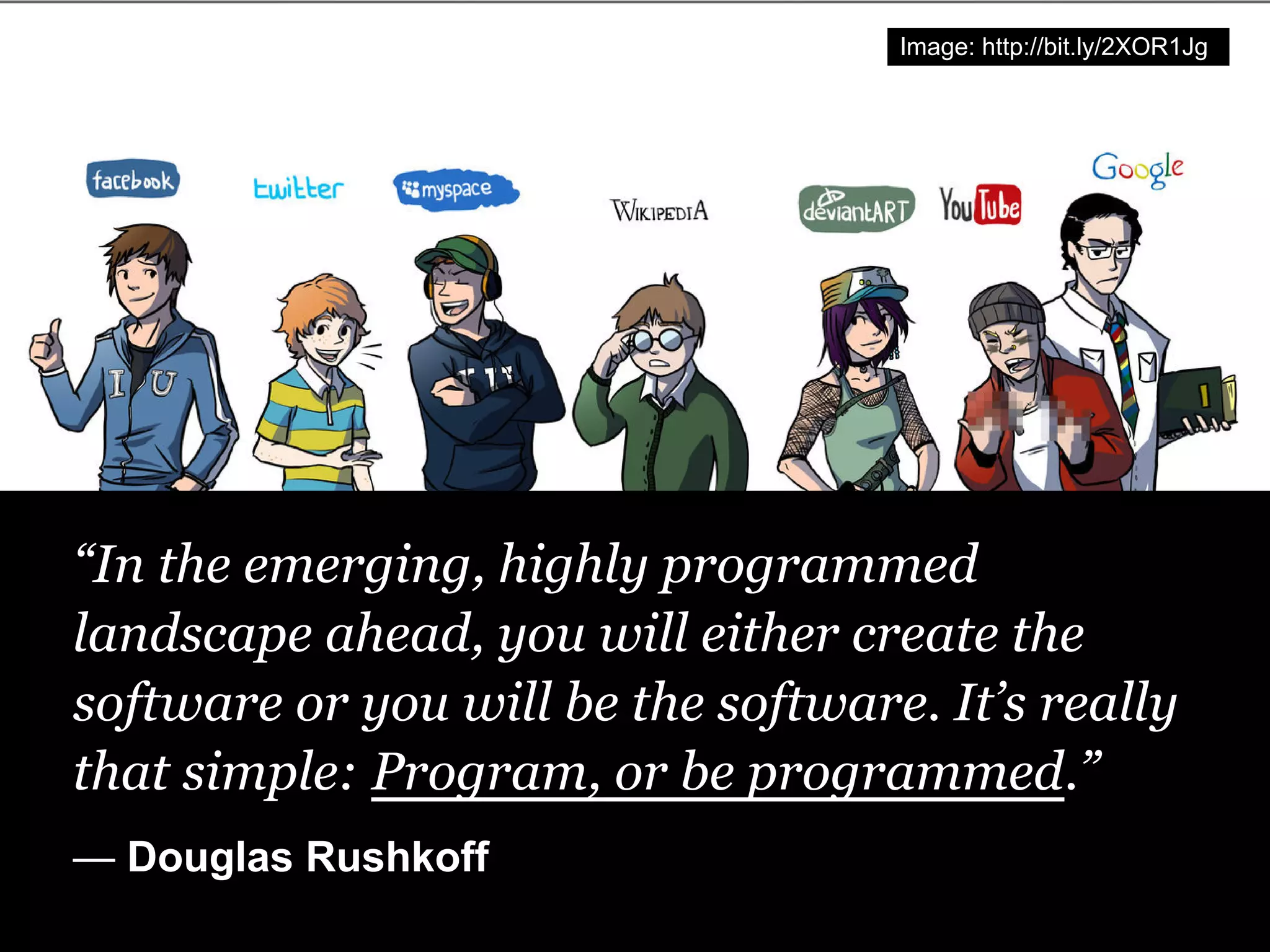
Image: http://bit.ly/2XOR1Jg


“In the emerging, highly programmed
landscape ahead, you will either create the
software or you will be the software. It’s really
that simple: Program, or be programmed.”
— Douglas Rushkoff
Prediction:
Successful future media platforms
will be those that cultivate and
then service their users' emotional
dependencies.
Compulsion Loops
Compulsion Loops
●   def. Compulsion Loop: A habitual behavior that a
    human will repeat to gain a neurochemical reward: a
    feeling of pleasure and/or a relief from pain. Not doing
    the behavior causes discomfort.

●   Dopamine motivates novelty-seeking behavior. Both
    novelty-seeking (achievement) and relationship-seeking
    (security) behaviors are rewarded with Endorphins
    (pleasure and/or pain relief).
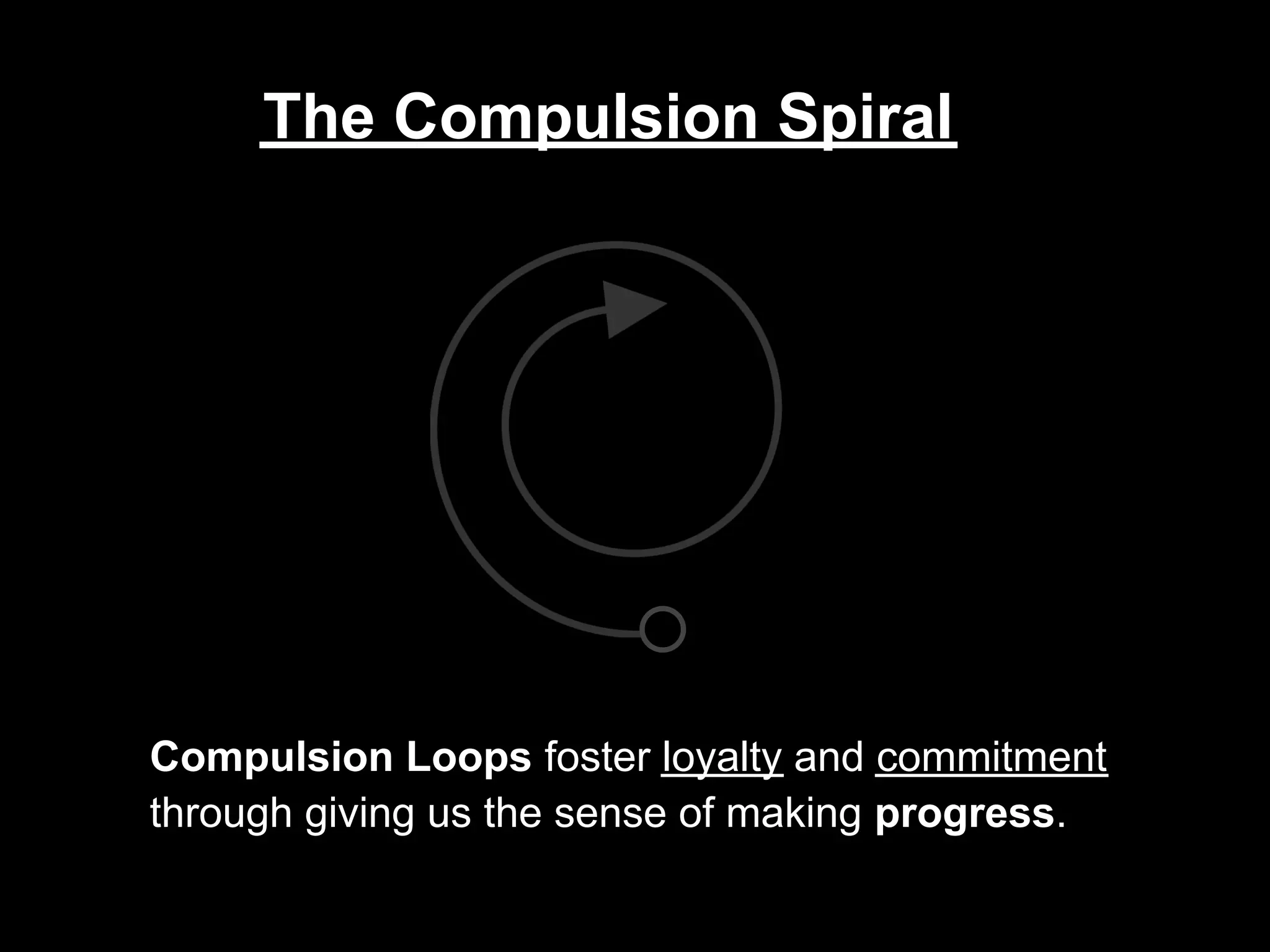
The Compulsion Spiral


Compulsion Loops foster loyalty and commitment
through giving us the sense of making progress.
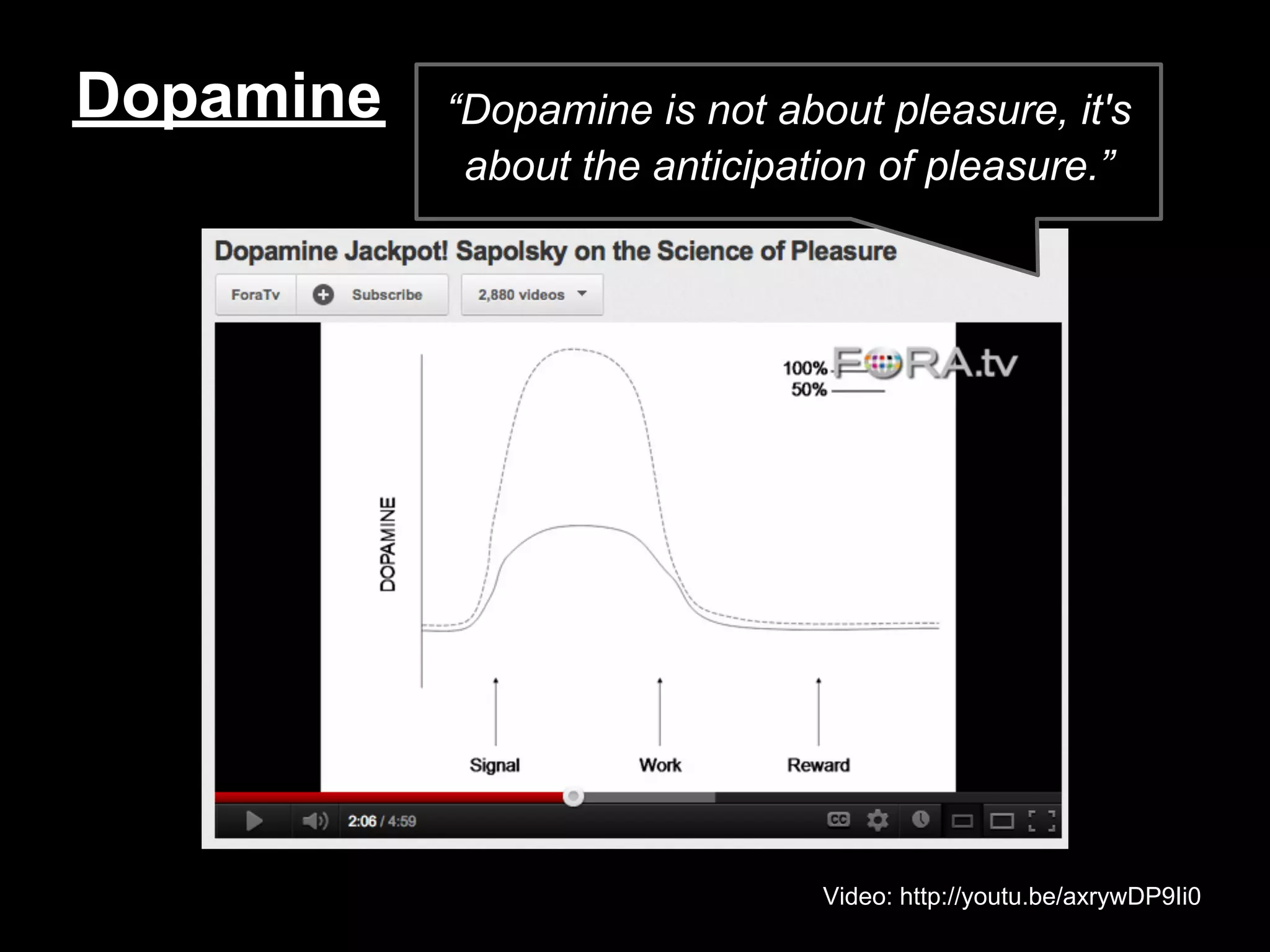
Dopamine
Dopamine   “Dopamine is not about pleasure, it's
            about the anticipation of pleasure.”


                               Video: http://youtu.be/axrywDP9Ii0
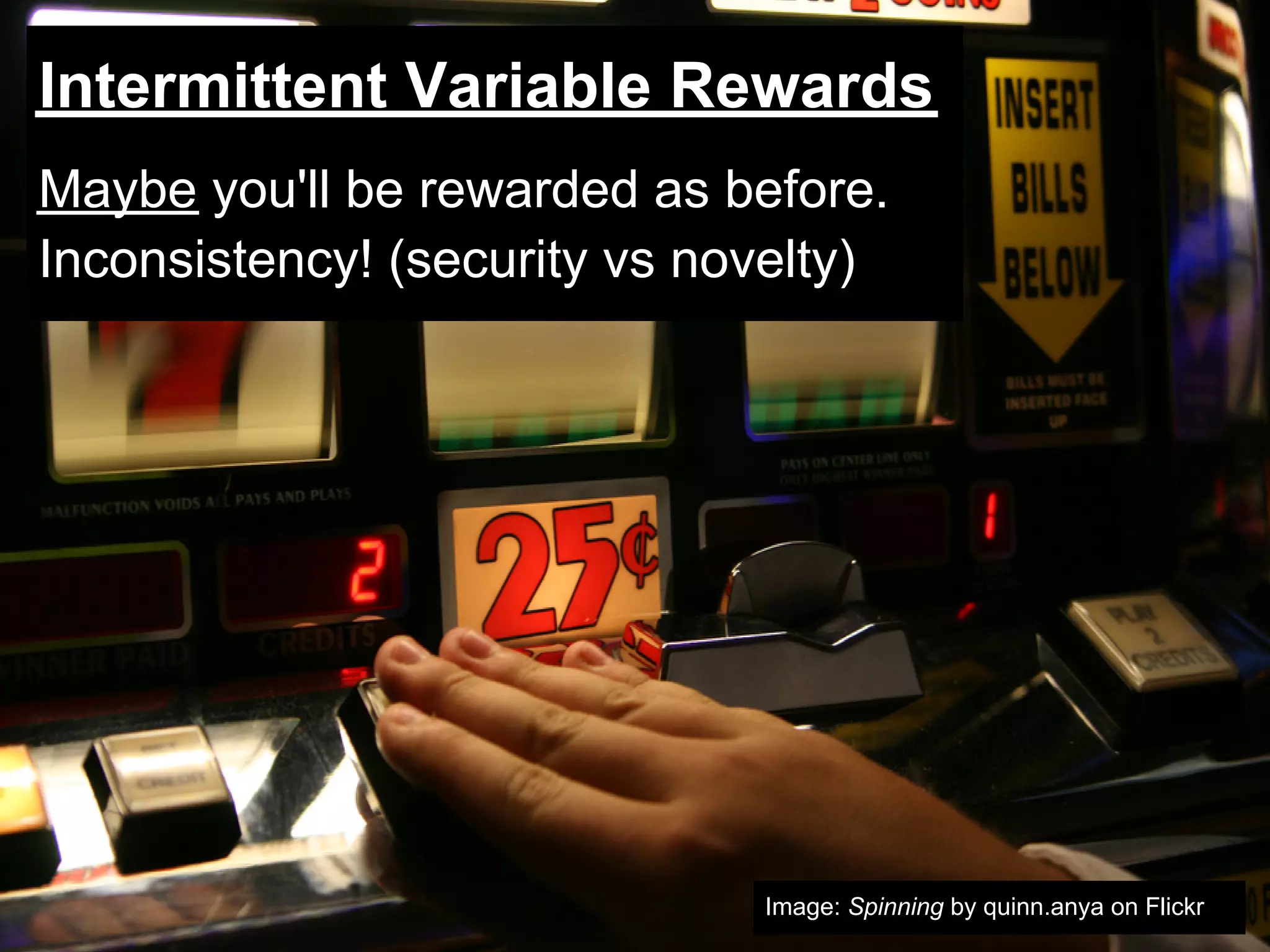
Intermittent Variable Rewards
Maybe you'll be rewarded as before.
Inconsistency! (security vs novelty)


                              Image: Spinning by quinn.anya on Flickr
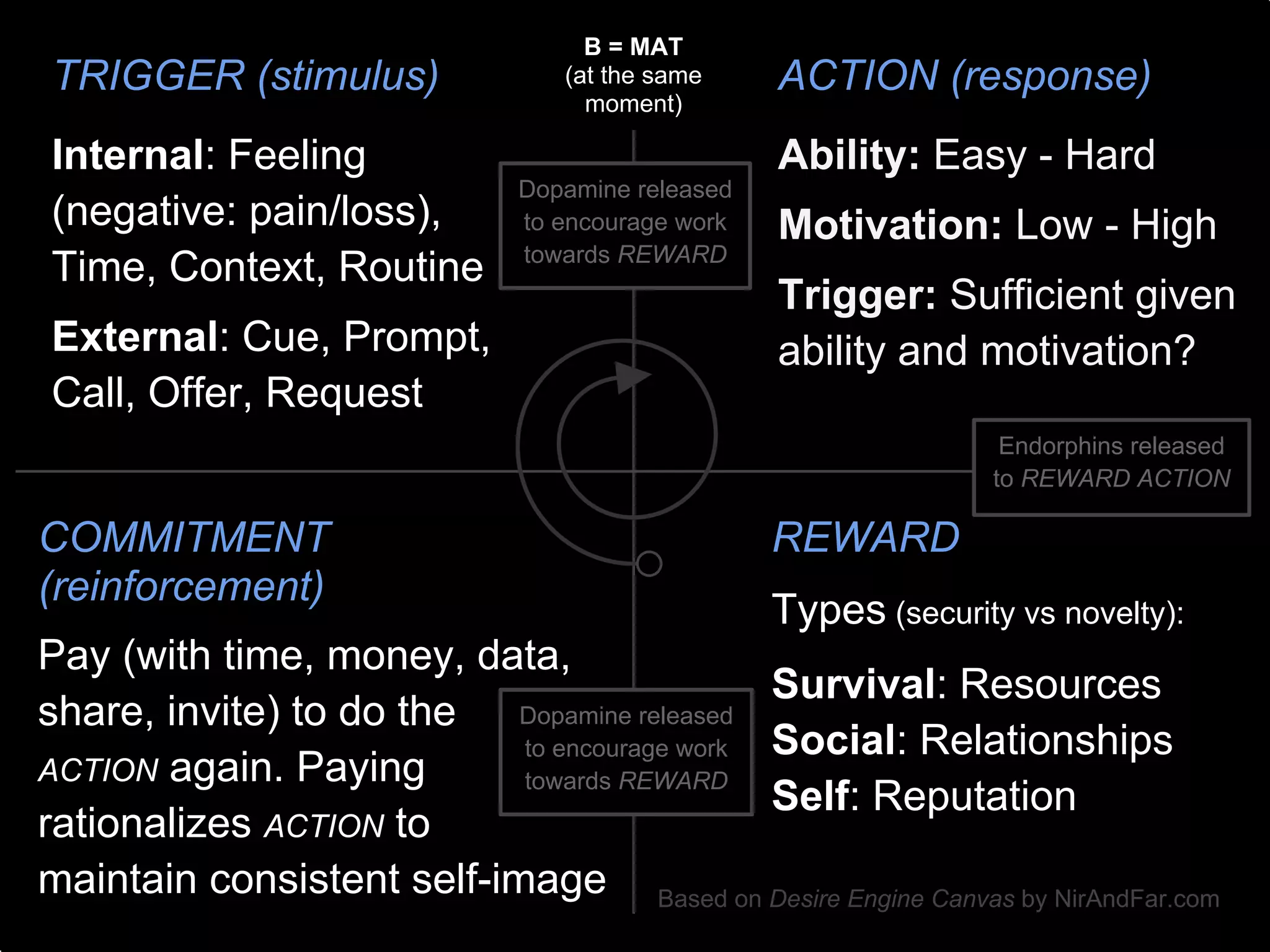
B = MAT
TRIGGER (stimulus)                (at the same     ACTION (response)
                                    moment)

Internal: Feeling                                  Ability: Easy - Hard
                               Dopamine released
(negative: pain/loss),         to encourage work   Motivation: Low - High
                               towards REWARD
Time, Context, Routine
                                                   Trigger: Sufficient given
External: Cue, Prompt,                             ability and motivation?
Call, Offer, Request
                                                                   Endorphins released
                                                                  to REWARD ACTION

COMMITMENT                                         REWARD
(reinforcement)
                                                   Types (security vs novelty):
Pay (with time, money, data,
                                             Survival: Resources
share, invite) to do the Dopamine released
                           to encourage work Social: Relationships
ACTION again. Paying       towards REWARD
                                             Self: Reputation
rationalizes ACTION to
maintain consistent self-image Based on Desire Engine Canvas by NirAndFar.com
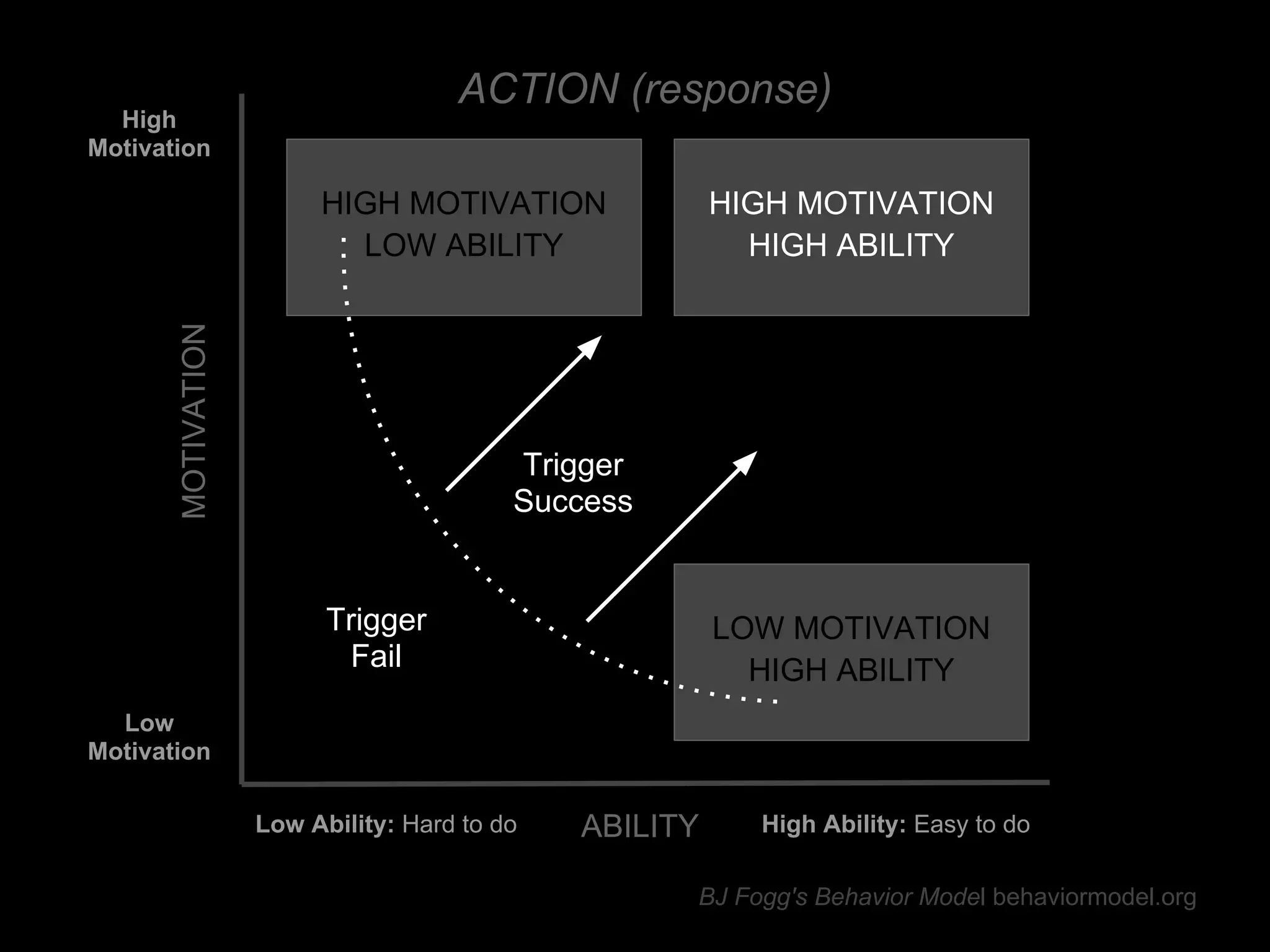
ACTION (response)
  High
Motivation

                         HIGH MOTIVATION                HIGH MOTIVATION
                           LOW ABILITY                    HIGH ABILITY
       MOTIVATION


                                          Trigger
                                          Success


                          Trigger                       LOW MOTIVATION
                            Fail                          HIGH ABILITY
  Low
Motivation

                    Low Ability: Hard to do   ABILITY     High Ability: Easy to do

                                                    BJ Fogg's Behavior Model behaviormodel.org
Triggers   “More and more of those [hot] triggers are
                coming through our peers ... ”


                                Video: http://youtu.be/5WaToiunuWY
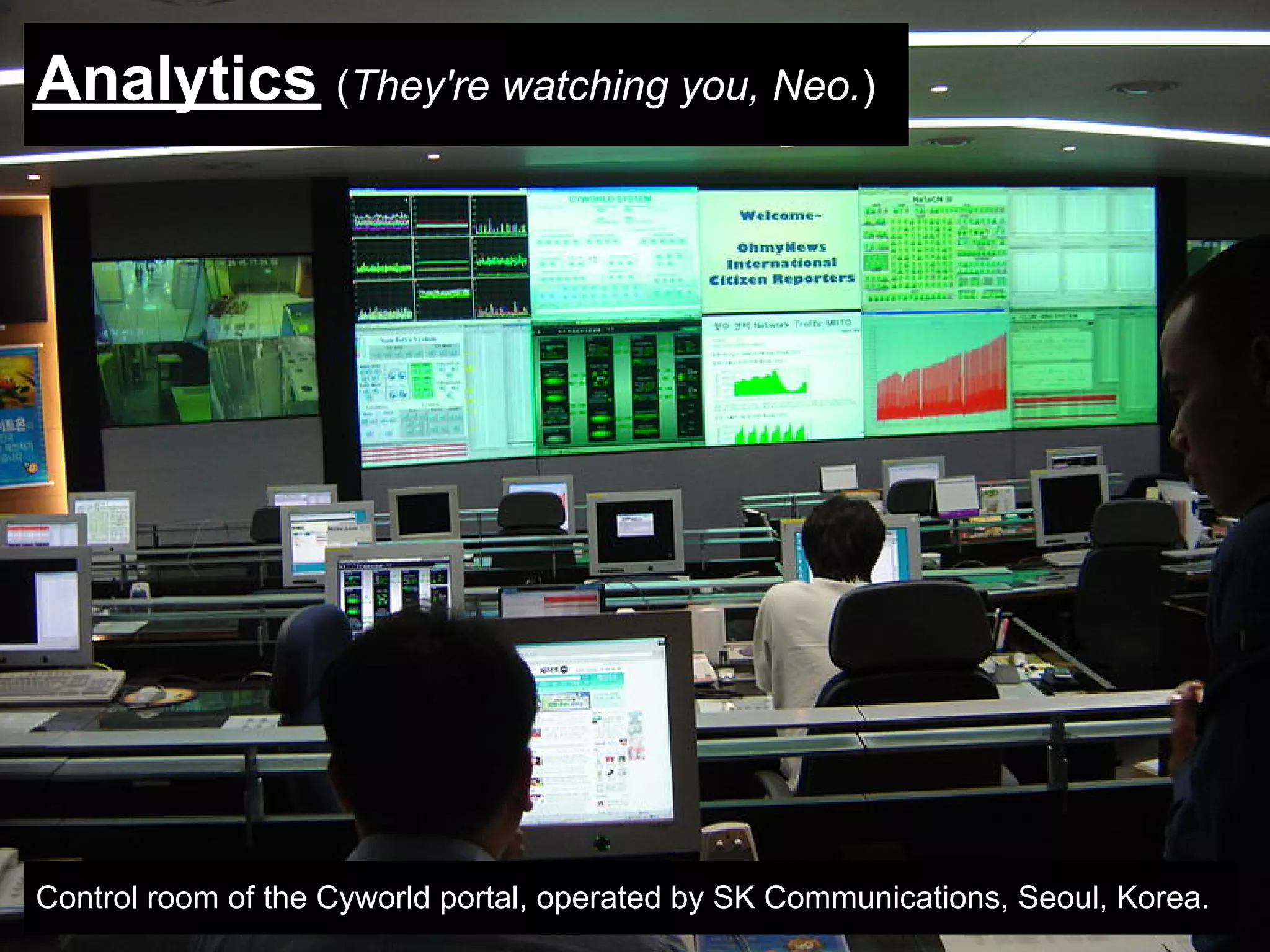
Analytics (They're watching you, Neo.)


Control room of the Cyworld portal, operated by SK Communications, Seoul, Korea.
“Games can produce enormous volumes of
data because it’s really simple to gather every
little interaction the player has in the game ...
Zynga, for example, uses data to determine
which design choices create greater tendencies
for players to stay engaged longer, involve
more friends, or pay to enhance the game
experience…”
— John Ferrara in: A Gaming Revolution, Minus the Hype
“[T]he data trail we create
online can hem us in and trap
us.... [O]ur past history
becomes inescapable, shaping
the contours of the online
experience we can have, which
more and more shapes the
kind of life experience we can
have generally, limiting what
we know about, what we do
and how we are seen and what
we accomplish.”
— Rob Horning: "Engagement Ads" on
Facebook
Examples...
Image: http://bit.ly/yILgOq
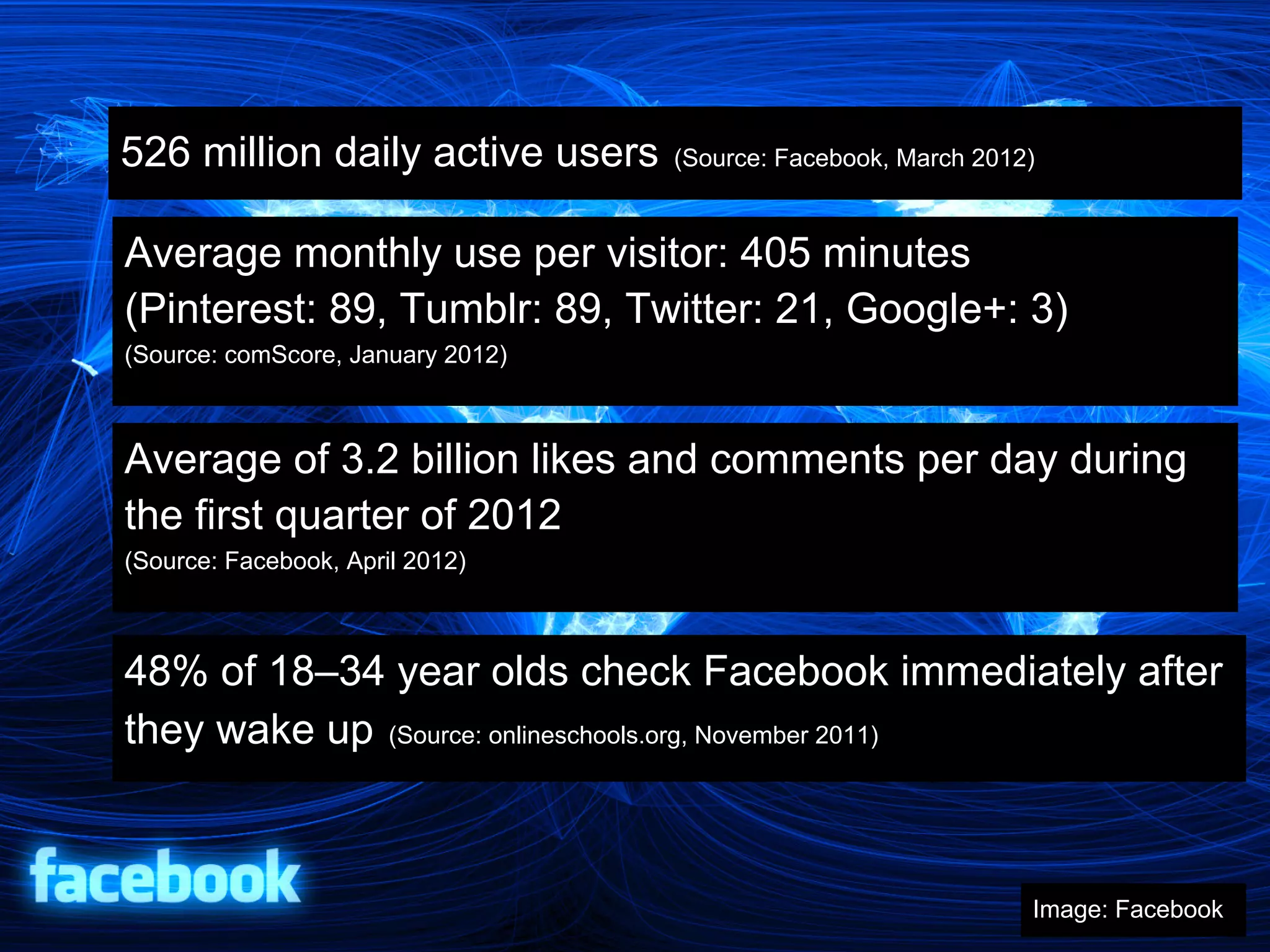
526 million daily active users     (Source: Facebook, March 2012)


Average monthly use per visitor: 405 minutes
(Pinterest: 89, Tumblr: 89, Twitter: 21, Google+: 3)
(Source: comScore, January 2012)


Average of 3.2 billion likes and comments per day during
the first quarter of 2012
(Source: Facebook, April 2012)


48% of 18–34 year olds check Facebook immediately after
they wake up (Source: onlineschools.org, November 2011)


                                                                Image: Facebook
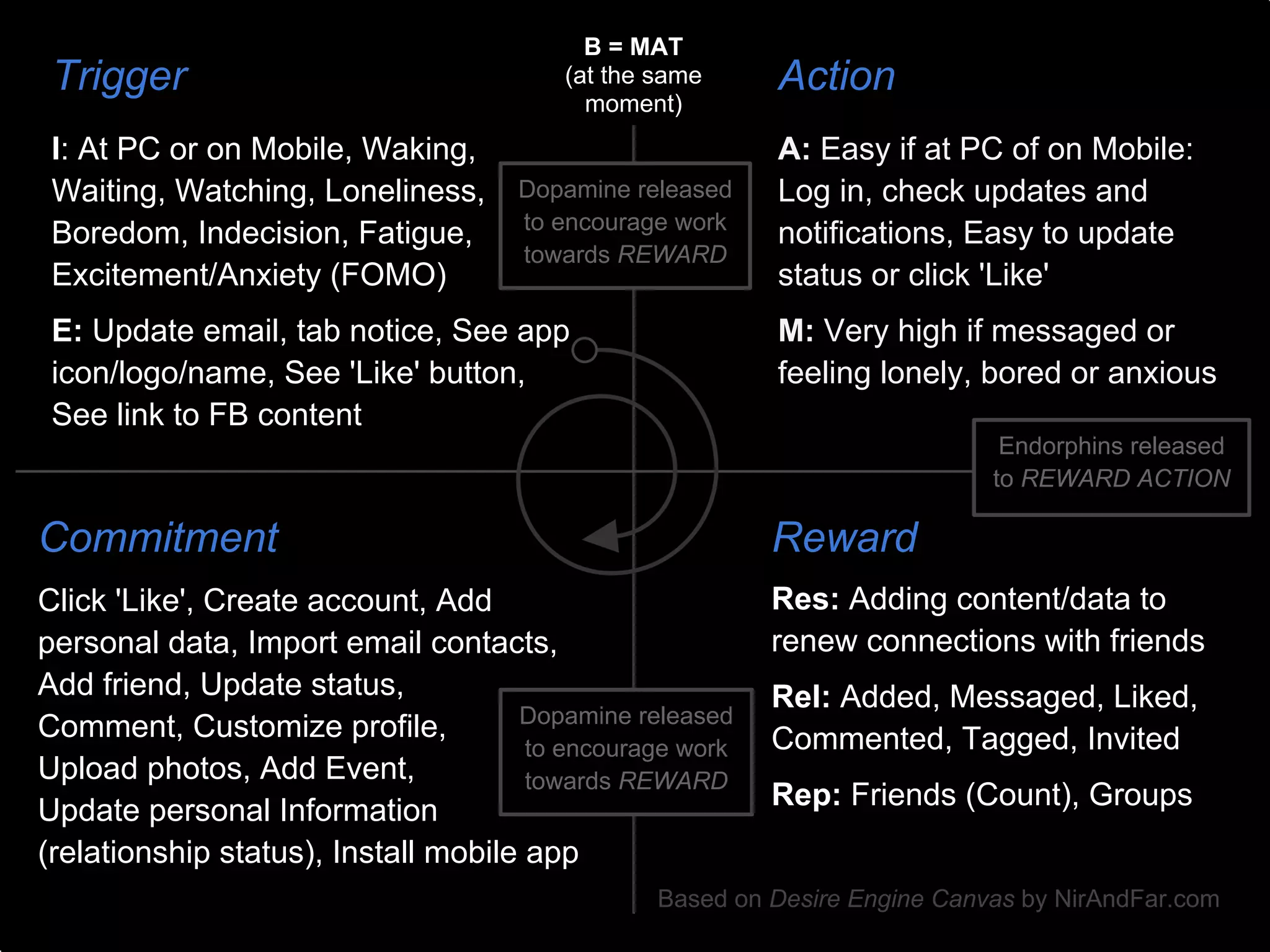
B = MAT
 Trigger                                 (at the same     Action
                                           moment)
 I: At PC or on Mobile, Waking,                           A: Easy if at PC of on Mobile:
 Waiting, Watching, Loneliness,      Dopamine released    Log in, check updates and
                                     to encourage work
 Boredom, Indecision, Fatigue,                            notifications, Easy to update
                                     towards REWARD
 Excitement/Anxiety (FOMO)                                status or click 'Like'
 E: Update email, tab notice, See app                     M: Very high if messaged or
 icon/logo/name, See 'Like' button,                       feeling lonely, bored or anxious
 See link to FB content
                                                                             Endorphins released
                                                                            to REWARD ACTION

Commitment                                                Reward
Click 'Like', Create account, Add                         Res: Adding content/data to
personal data, Import email contacts,                     renew connections with friends
Add friend, Update status,                                Rel: Added, Messaged, Liked,
                                     Dopamine released
Comment, Customize profile,                               Commented, Tagged, Invited
                                      to encourage work
Upload photos, Add Event,             towards REWARD
Update personal Information                               Rep: Friends (Count), Groups
(relationship status), Install mobile app
                                                 Based on Desire Engine Canvas by NirAndFar.com
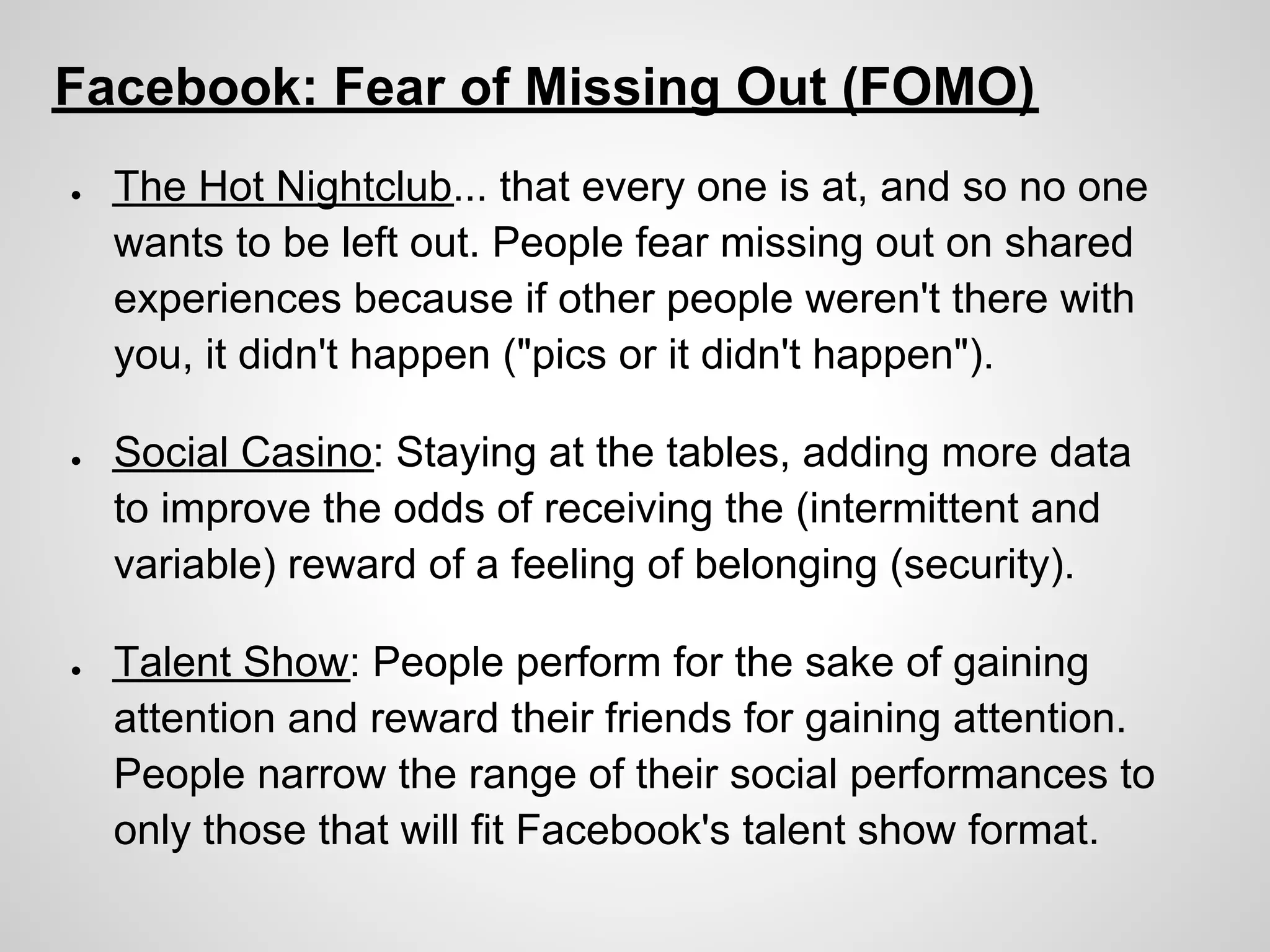
Facebook: Fear of Missing Out (FOMO)
●   The Hot Nightclub... that every one is at, and so no one
    wants to be left out. People fear missing out on shared
    experiences because if other people weren't there with
    you, it didn't happen ("pics or it didn't happen").

●   Social Casino: Staying at the tables, adding more data
    to improve the odds of receiving the (intermittent and
    variable) reward of a feeling of belonging (security).

●   Talent Show: People perform for the sake of gaining
    attention and reward their friends for gaining attention.
    People narrow the range of their social performances to
    only those that will fit Facebook's talent show format.
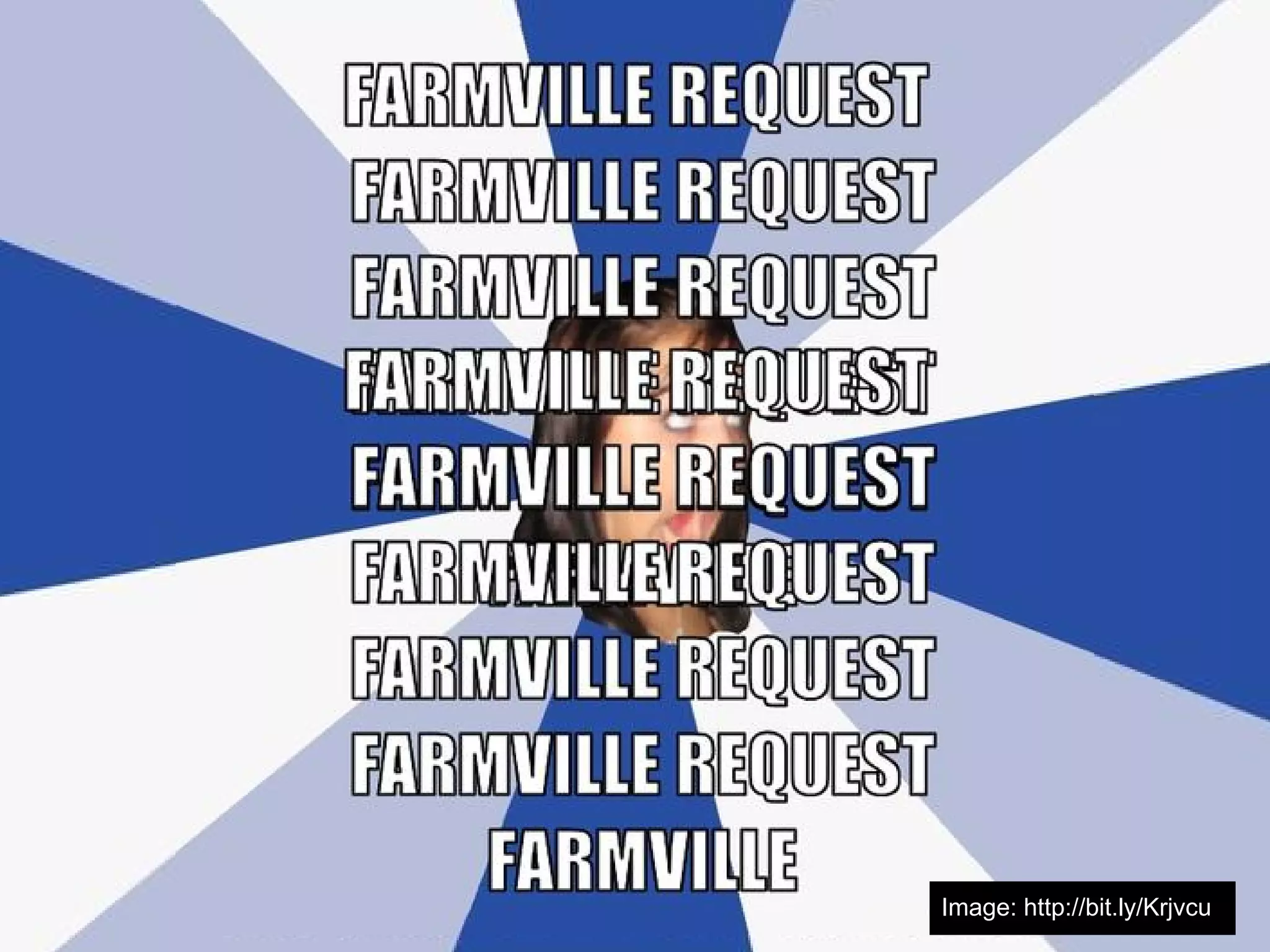
Image: http://bit.ly/Krjvcu
ZYNGA
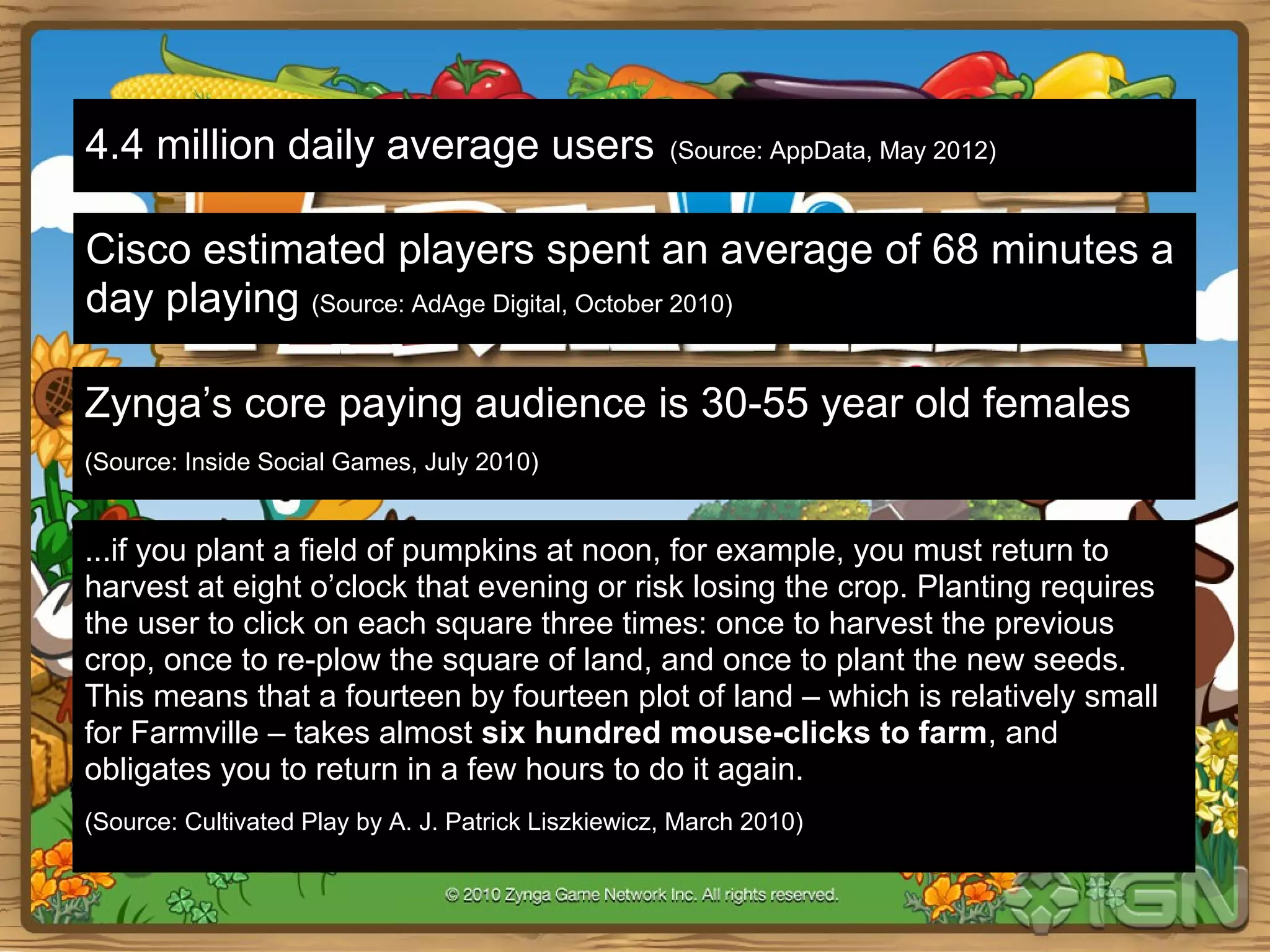
4.4 million daily average users                      (Source: AppData, May 2012)


Cisco estimated players spent an average of 68 minutes a
day playing (Source: AdAge Digital, October 2010)

Zynga’s core paying audience is 30-55 year old females

                                     ZYNGA
(Source: Inside Social Games, July 2010)


...if you plant a field of pumpkins at noon, for example, you must return to
harvest at eight o’clock that evening or risk losing the crop. Planting requires
the user to click on each square three times: once to harvest the previous
crop, once to re-plow the square of land, and once to plant the new seeds.
This means that a fourteen by fourteen plot of land – which is relatively small
for Farmville – takes almost six hundred mouse-clicks to farm, and
obligates you to return in a few hours to do it again.
(Source: Cultivated Play by A. J. Patrick Liszkiewicz, March 2010)
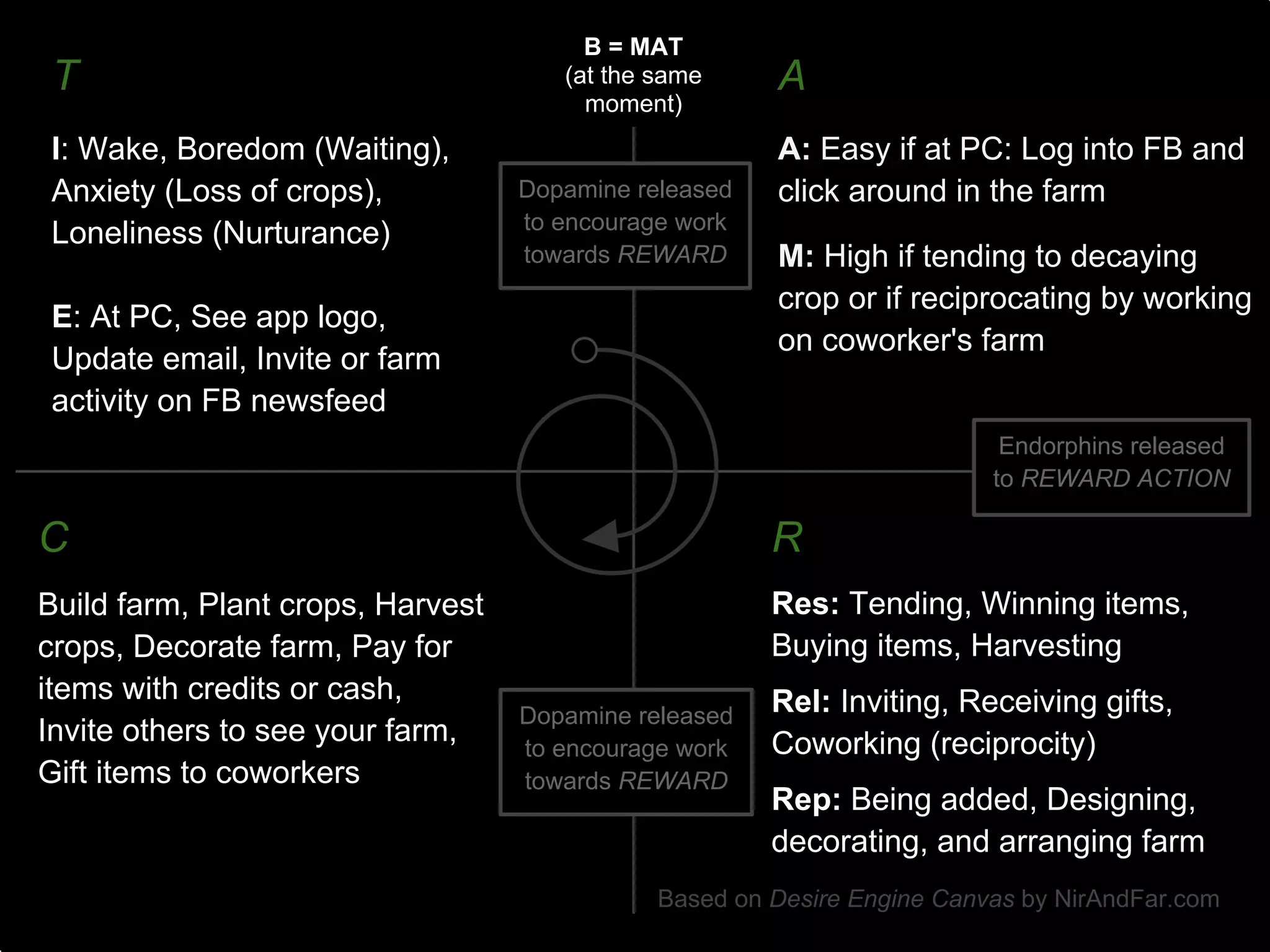
B = MAT
T                                     (at the same     A
                                        moment)
l: Wake, Boredom (Waiting),                            A: Easy if at PC: Log into FB and
Anxiety (Loss of crops),           Dopamine released   click around in the farm
                                   to encourage work
Loneliness (Nurturance)
                                   towards REWARD      M: High if tending to decaying
                                                       crop or if reciprocating by working
E: At PC, See app logo,
                                                       on coworker's farm
Update email, Invite or farm
activity on FB newsfeed
                                                                          Endorphins released
                                                                         to REWARD ACTION

C                                                      R
Build farm, Plant crops, Harvest                       Res: Tending, Winning items,
crops, Decorate farm, Pay for                          Buying items, Harvesting
items with credits or cash,                            Rel: Inviting, Receiving gifts,
                                   Dopamine released
Invite others to see your farm,    to encourage work   Coworking (reciprocity)
Gift items to coworkers            towards REWARD
                                                       Rep: Being added, Designing,
                                                       decorating, and arranging farm
                                              Based on Desire Engine Canvas by NirAndFar.com
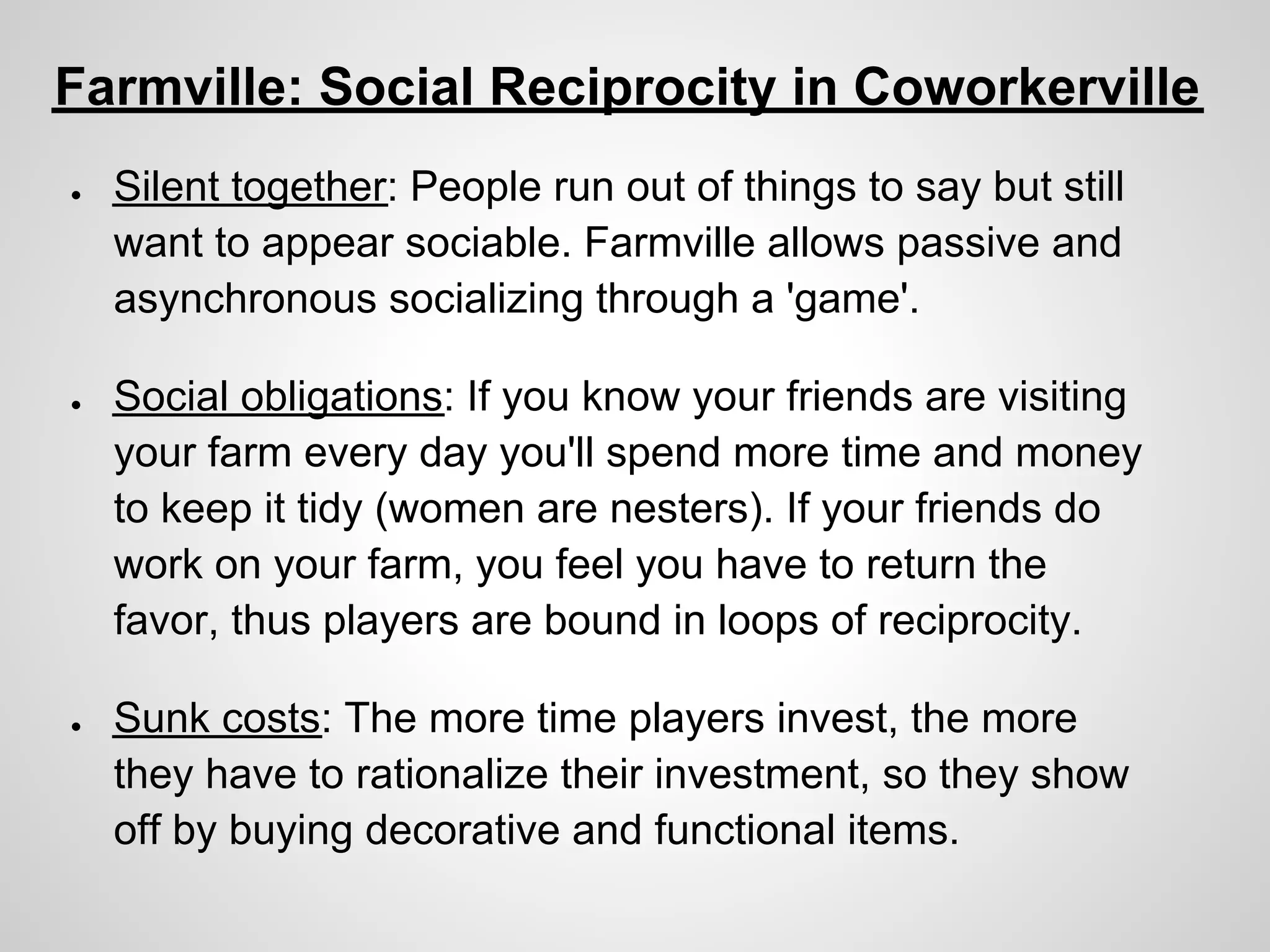
Farmville: Social Reciprocity in Coworkerville
●   Silent together: People run out of things to say but still
    want to appear sociable. Farmville allows passive and
    asynchronous socializing through a 'game'.

●   Social obligations: If you know your friends are visiting
    your farm every day you'll spend more time and money
    to keep it tidy (women are nesters). If your friends do
    work on your farm, you feel you have to return the
    favor, thus players are bound in loops of reciprocity.

●   Sunk costs: The more time players invest, the more
    they have to rationalize their investment, so they show
    off by buying decorative and functional items.
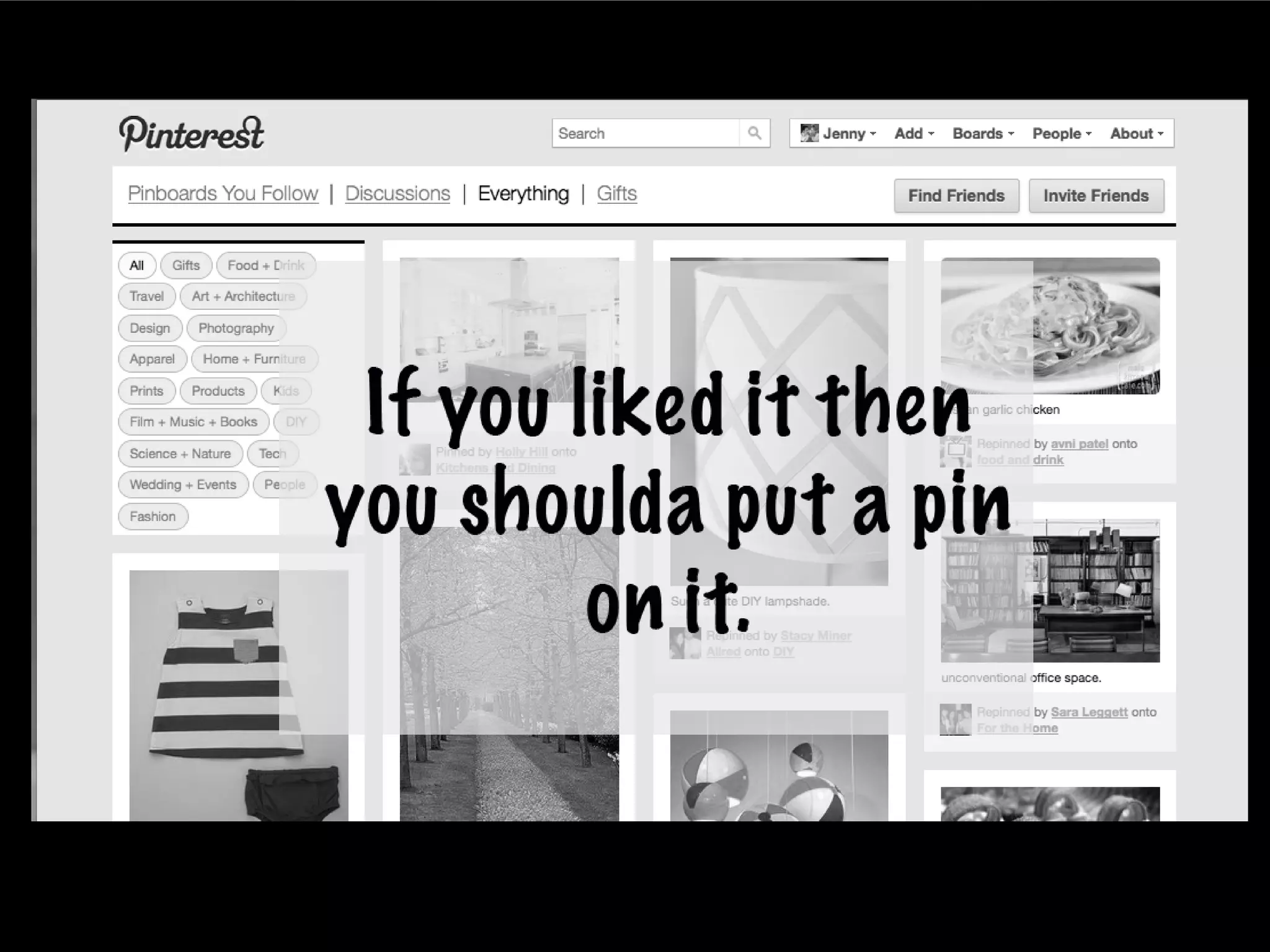
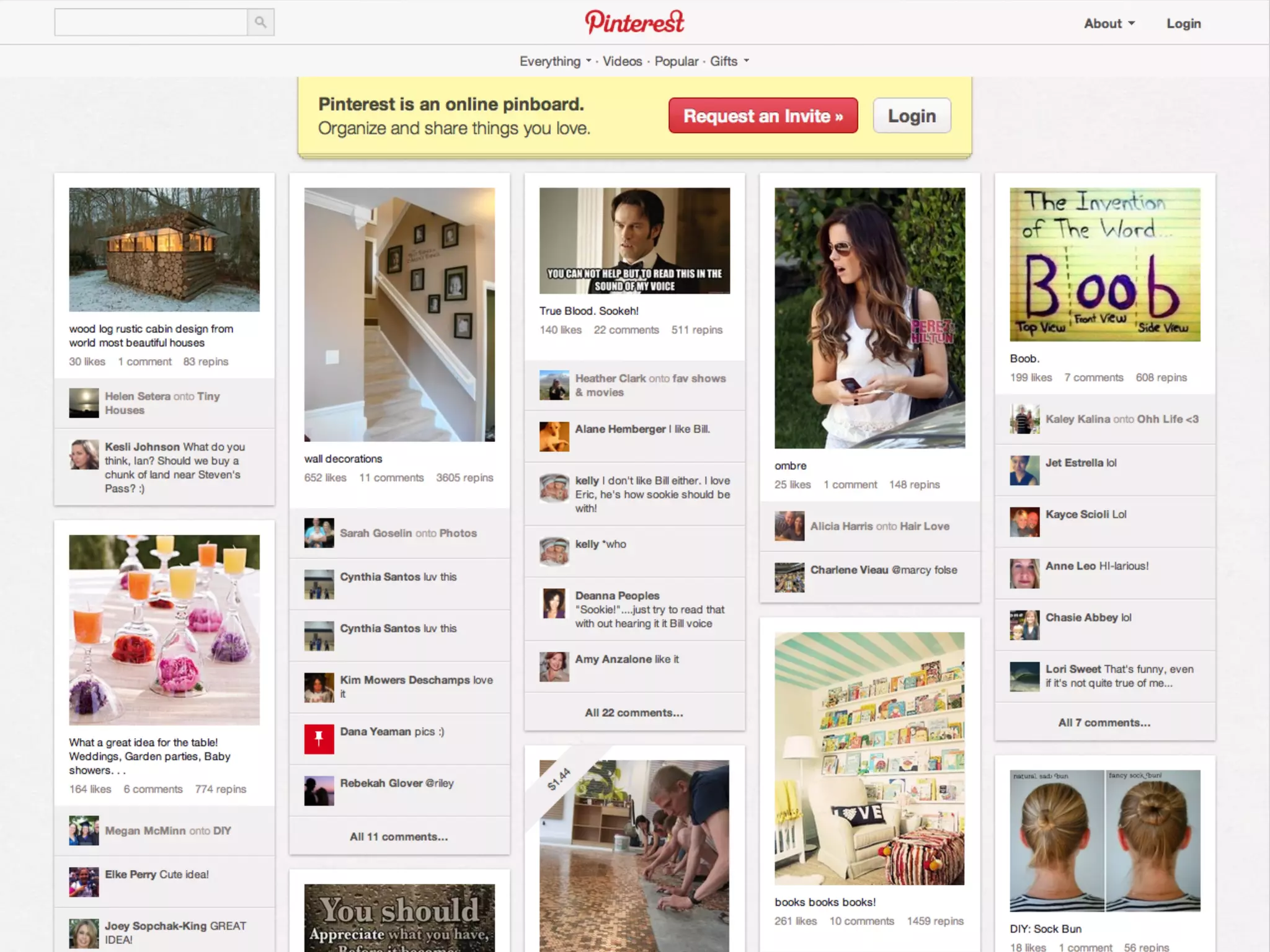
PINTEREST
PINTEREST
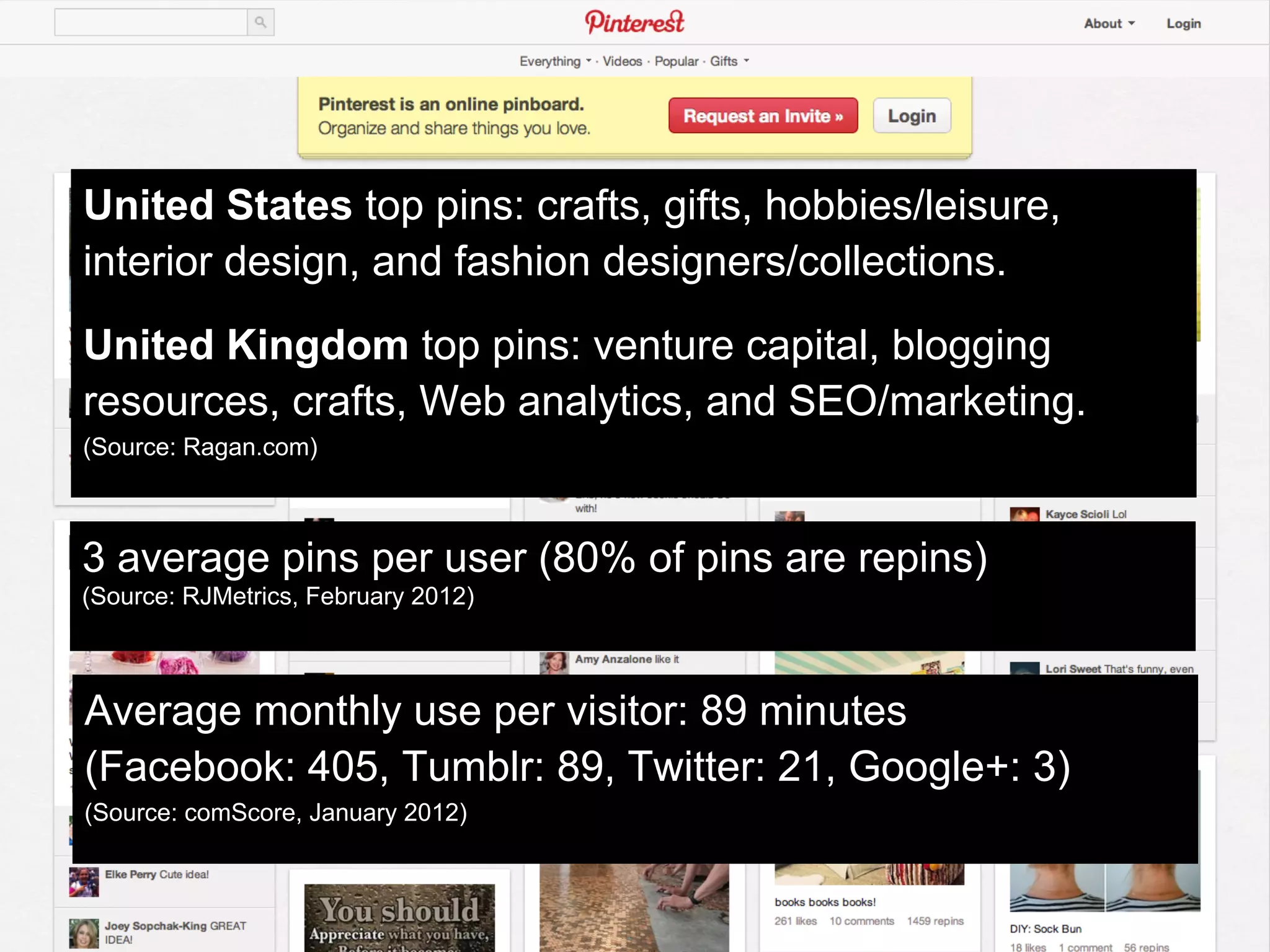
United States top pins: crafts, gifts, hobbies/leisure,
interior design, and fashion designers/collections.
United Kingdom top pins: venture capital, blogging
resources, crafts, Web analytics, and SEO/marketing.
(Source: Ragan.com)

                           PINTEREST
3 average pins per user (80% of pins are repins)
(Source: RJMetrics, February 2012)


Average monthly use per visitor: 89 minutes
(Facebook: 405, Tumblr: 89, Twitter: 21, Google+: 3)
(Source: comScore, January 2012)
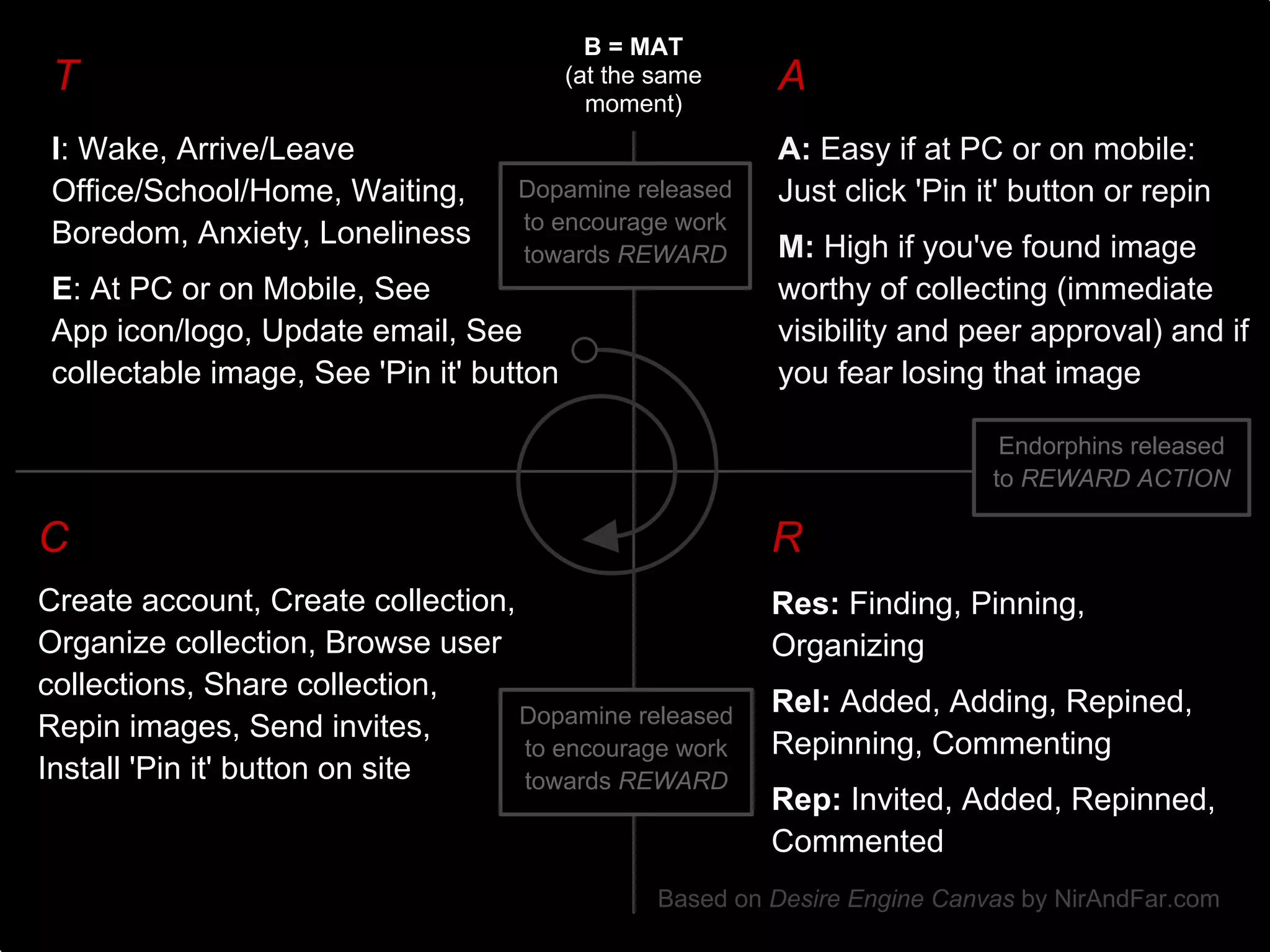
B = MAT
 T                                        (at the same     A
                                            moment)
 I: Wake, Arrive/Leave                                     A: Easy if at PC or on mobile:
 Office/School/Home, Waiting,      Dopamine released       Just click 'Pin it' button or repin
                                   to encourage work
 Boredom, Anxiety, Loneliness                              M: High if you've found image
                                   towards REWARD
 E: At PC or on Mobile, See                                worthy of collecting (immediate
 App icon/logo, Update email, See                          visibility and peer approval) and if
 collectable image, See 'Pin it' button                    you fear losing that image

                                                                              Endorphins released
                                                                             to REWARD ACTION

C                                                          R
Create account, Create collection,                         Res: Finding, Pinning,
Organize collection, Browse user                           Organizing
collections, Share collection,
                                   Dopamine released       Rel: Added, Adding, Repined,
Repin images, Send invites,
                                   to encourage work       Repinning, Commenting
Install 'Pin it' button on site    towards REWARD
                                                           Rep: Invited, Added, Repinned,
                                                           Commented
                                                  Based on Desire Engine Canvas by NirAndFar.com
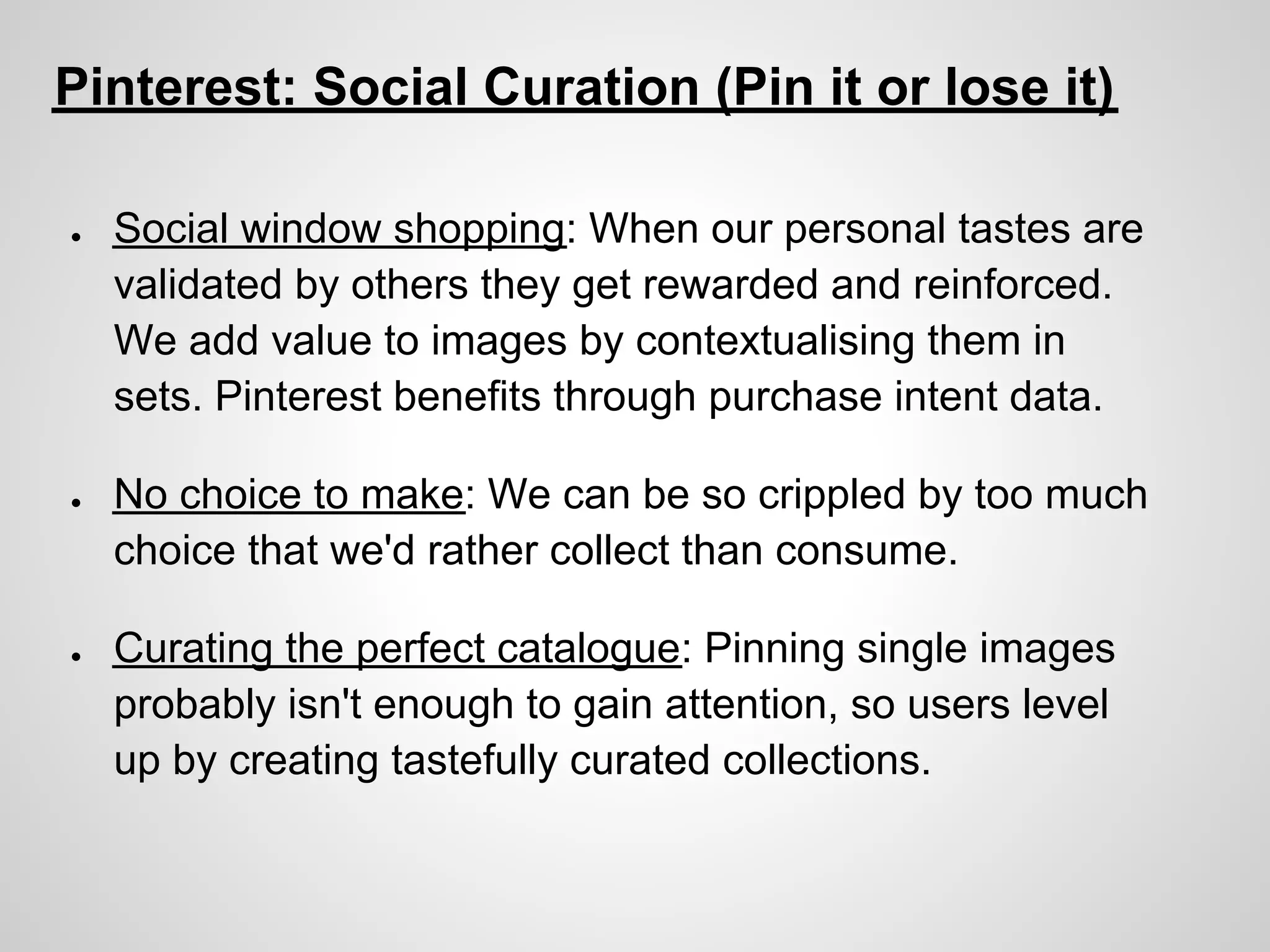
Pinterest: Social Curation (Pin it or lose it)

●   Social window shopping: When our personal tastes are
    validated by others they get rewarded and reinforced.
    We add value to images by contextualising them in
    sets. Pinterest benefits through purchase intent data.

●   No choice to make: We can be so crippled by too much
    choice that we'd rather collect than consume.

●   Curating the perfect catalogue: Pinning single images
    probably isn't enough to gain attention, so users level
    up by creating tastefully curated collections.
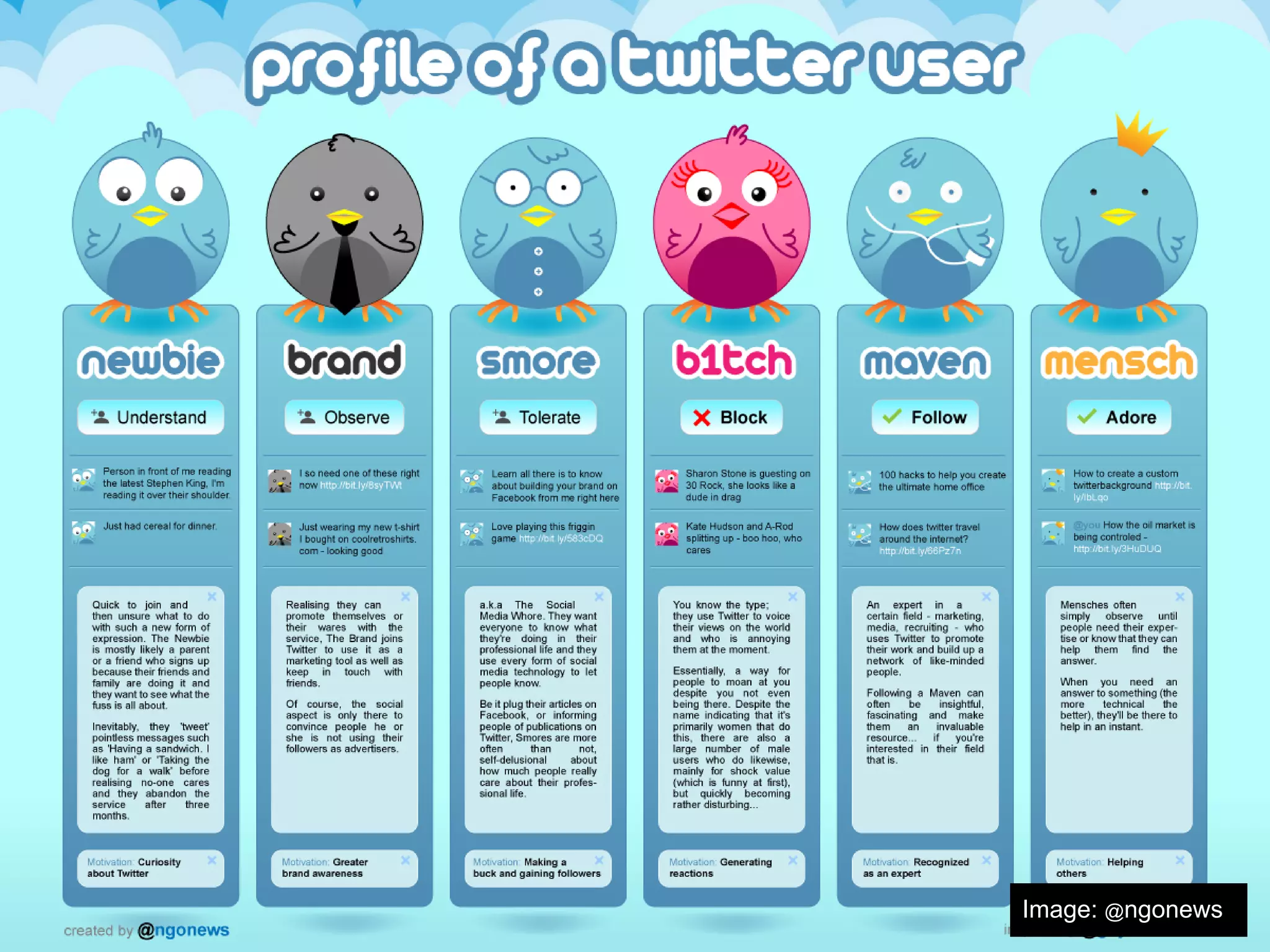
TWITTER


          Image: @ngonews
TWITTER
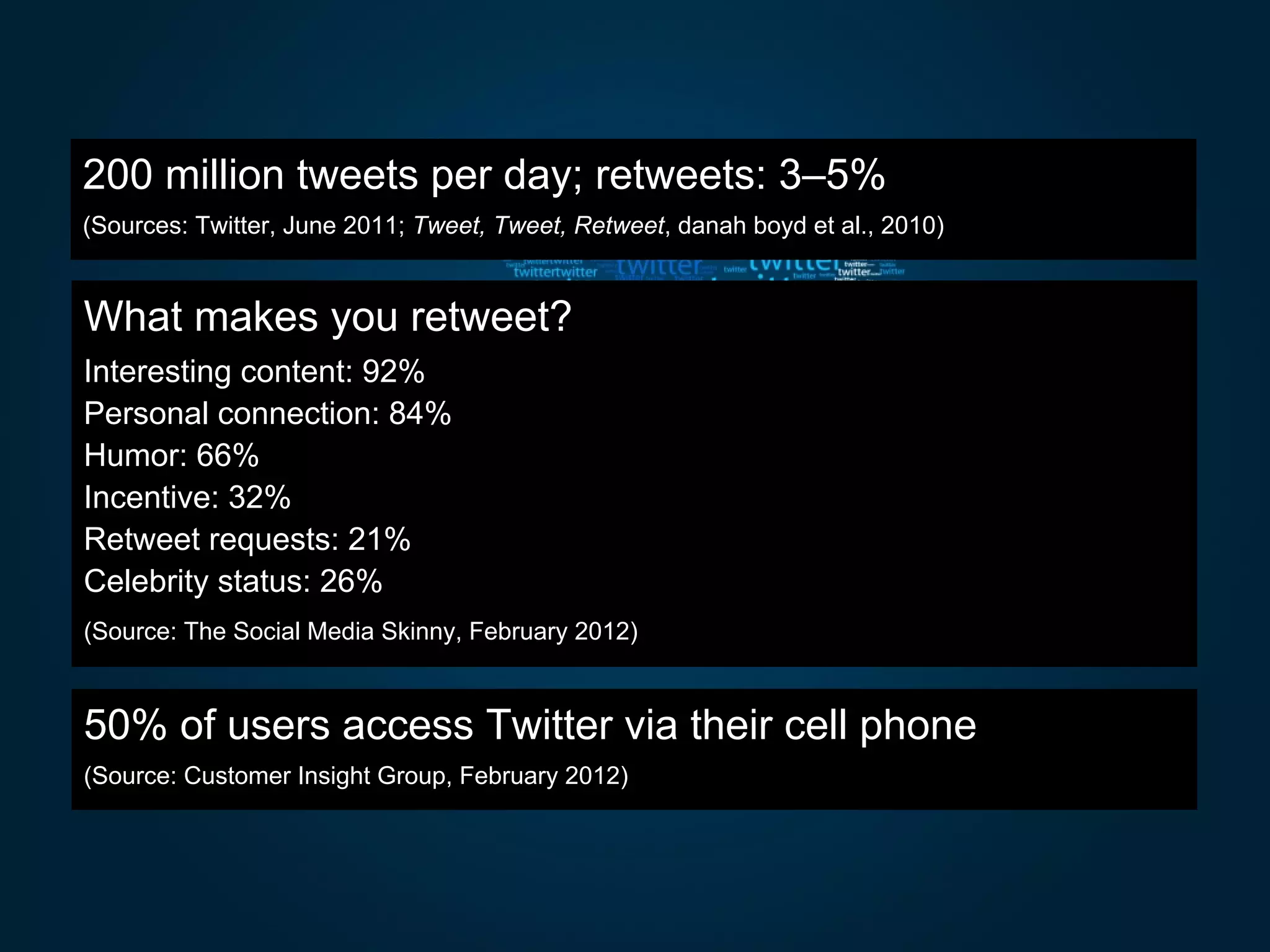
200 million tweets per day; retweets: 3–5%
(Sources: Twitter, June 2011; Tweet, Tweet, Retweet, danah boyd et al., 2010)


What makes you retweet?
Interesting content: 92%
Personal connection: 84%
Humor: 66%
Incentive: 32%
Retweet requests: 21%
                                TWITTER
Celebrity status: 26%
(Source: The Social Media Skinny, February 2012)


50% of users access Twitter via their cell phone
(Source: Customer Insight Group, February 2012)
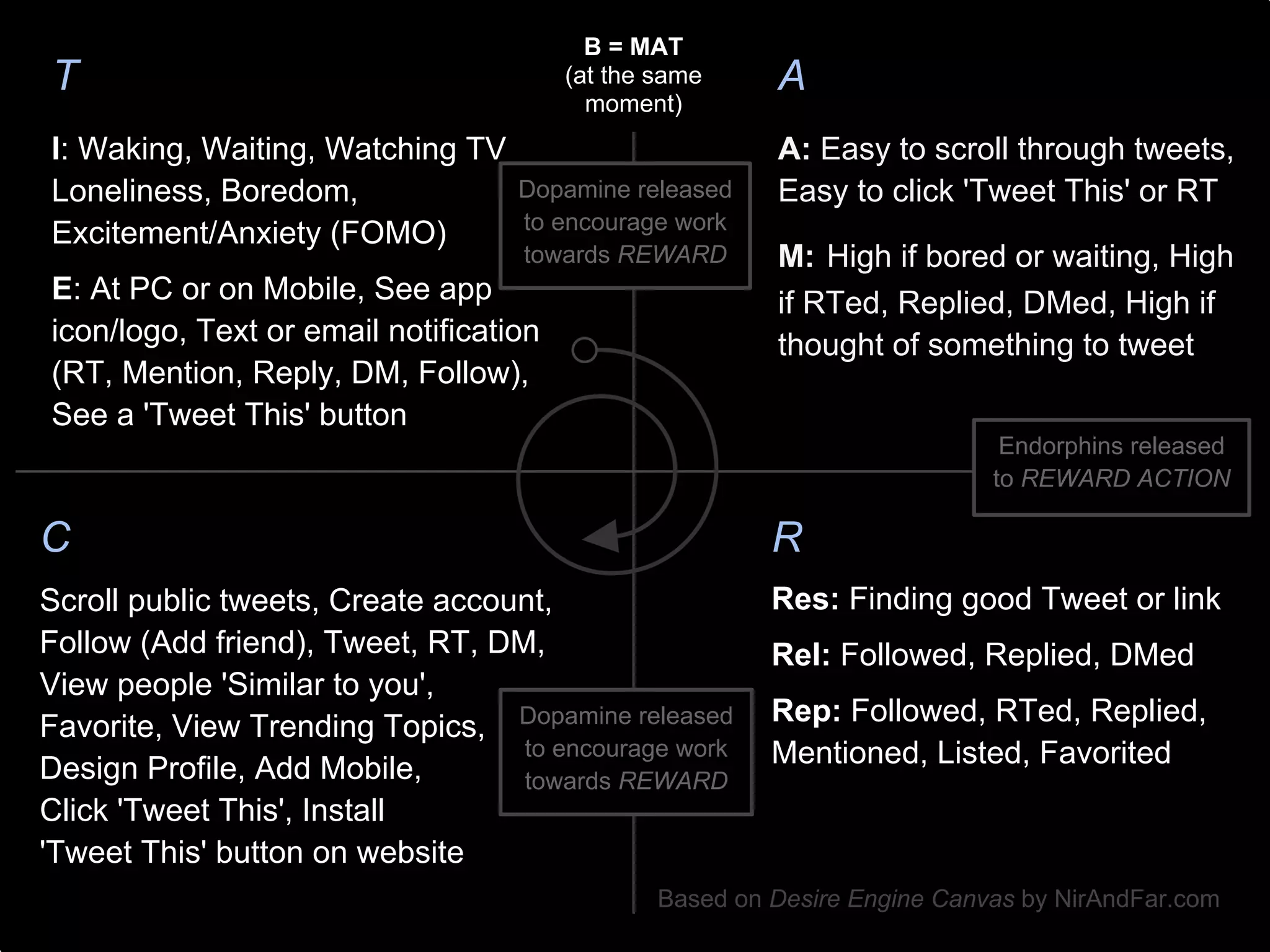
B = MAT
T                                       (at the same     A
                                          moment)
I: Waking, Waiting, Watching TV                          A: Easy to scroll through tweets,
Loneliness, Boredom,               Dopamine released     Easy to click 'Tweet This' or RT
                                   to encourage work
Excitement/Anxiety (FOMO)
                                   towards REWARD        M: High if bored or waiting, High
E: At PC or on Mobile, See app                           if RTed, Replied, DMed, High if
icon/logo, Text or email notification                    thought of something to tweet
(RT, Mention, Reply, DM, Follow),
See a 'Tweet This' button
                                                                            Endorphins released
                                                                           to REWARD ACTION

C                                                        R
Scroll public tweets, Create account,                    Res: Finding good Tweet or link
Follow (Add friend), Tweet, RT, DM,                      Rel: Followed, Replied, DMed
View people 'Similar to you',
Favorite, View Trending Topics, Dopamine released        Rep: Followed, RTed, Replied,
                                  to encourage work      Mentioned, Listed, Favorited
Design Profile, Add Mobile,       towards REWARD
Click 'Tweet This', Install
'Tweet This' button on website
                                                Based on Desire Engine Canvas by NirAndFar.com
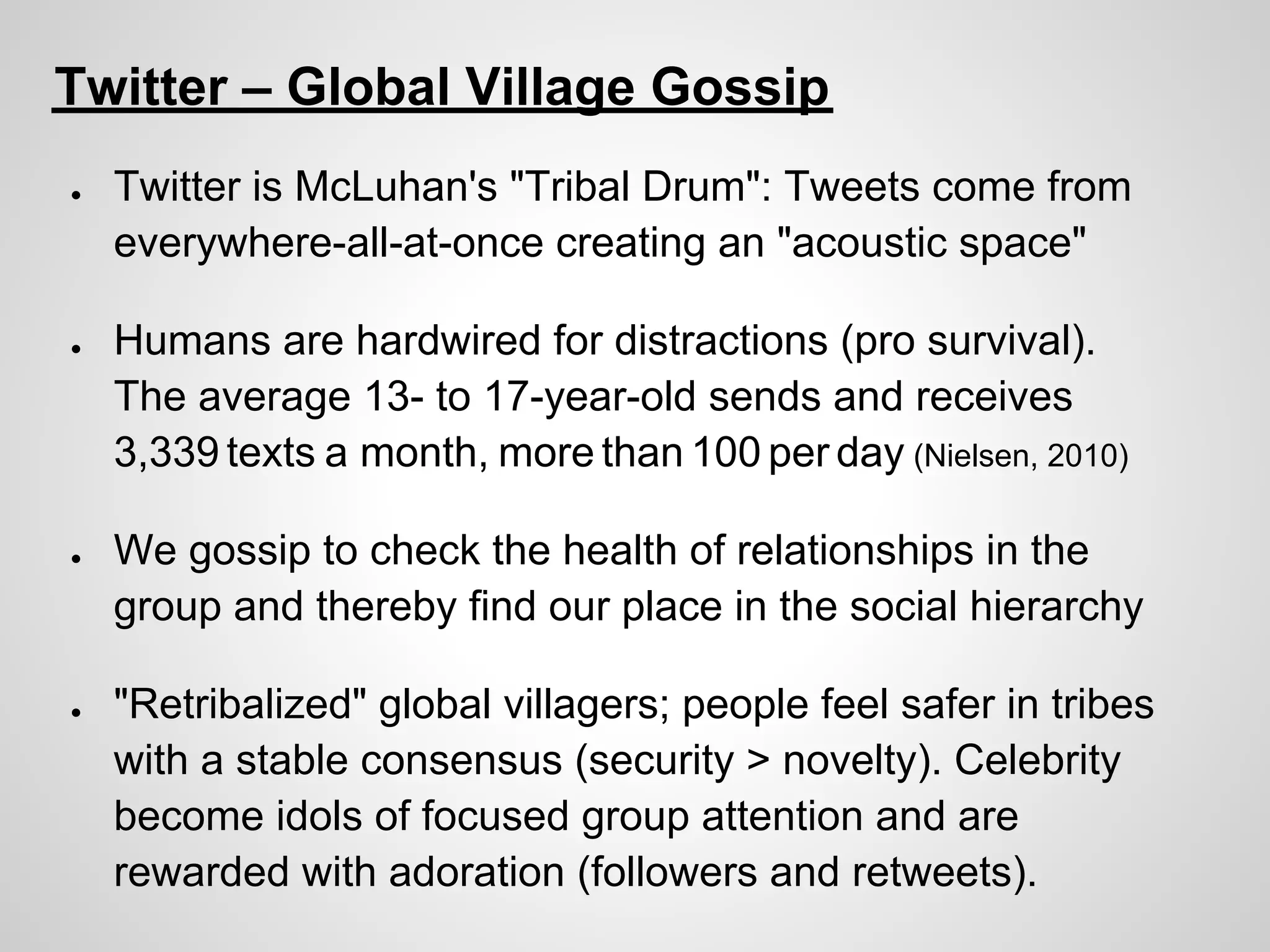
Twitter – Global Village Gossip
●   Twitter is McLuhan's "Tribal Drum": Tweets come from
    everywhere-all-at-once creating an "acoustic space"

●   Humans are hardwired for distractions (pro survival).
    The average 13- to 17-year-old sends and receives
    3,339 texts a month, more than 100 per day (Nielsen, 2010)

●   We gossip to check the health of relationships in the
    group and thereby find our place in the social hierarchy

●   "Retribalized" global villagers; people feel safer in tribes
    with a stable consensus (security > novelty). Celebrity
    become idols of focused group attention and are
    rewarded with adoration (followers and retweets).
Why is this happening?
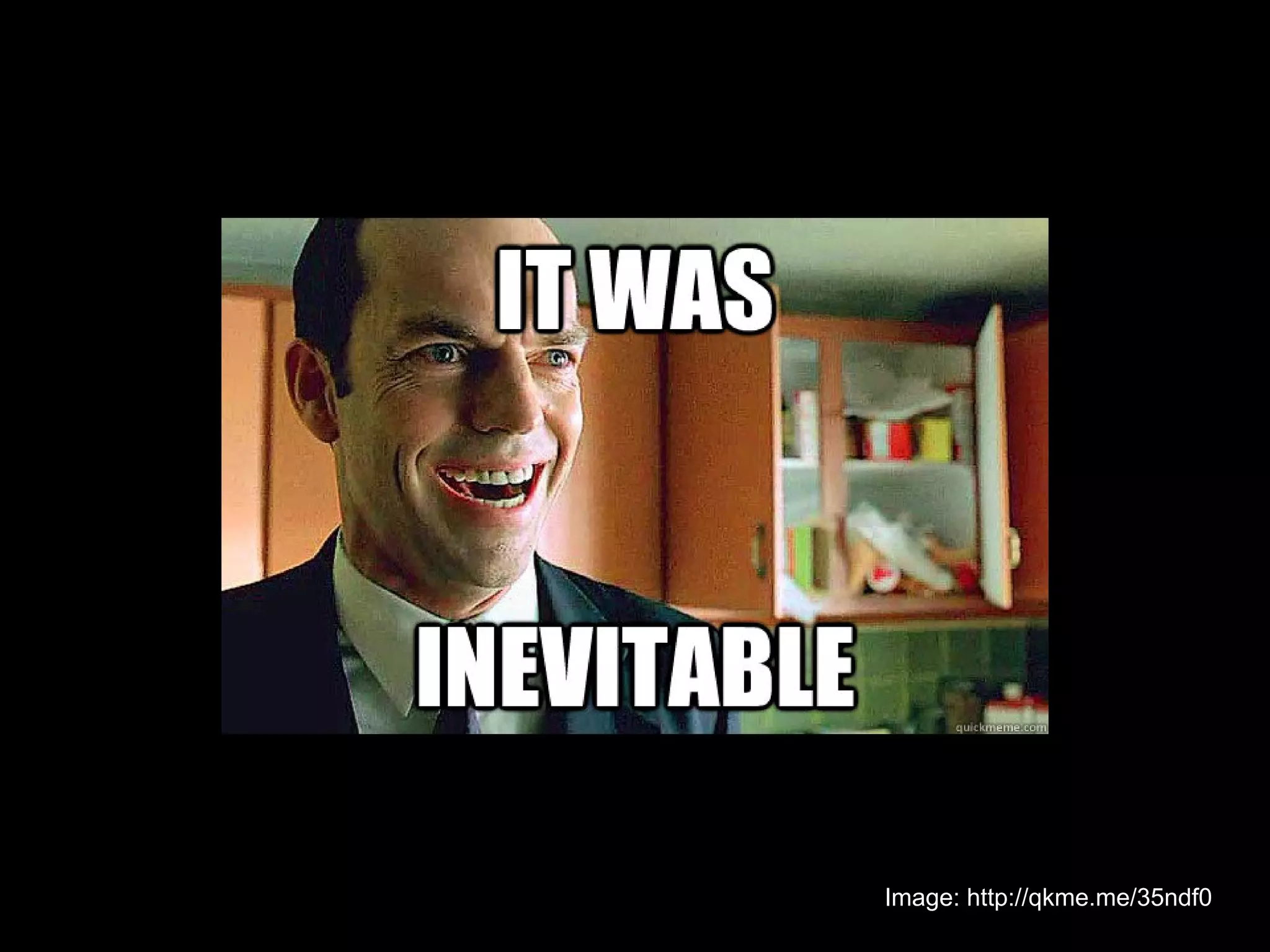
Image: http://qkme.me/35ndf0
People Crave Feedback
●   Compulsion Loops offer both users and the media
    platform immediate feedback on their activities and this
    feedback is available on any internet-connected device.
    So long as this feedback is flowing, everyone is happy.

●   Compulsion Loops resolve our conflicting needs for
    both security and novelty by rewarding us for achieving
    a sense of control over our environment by giving us
    new things to control within that same environment

●   Compulsion Loops foster loyalty and commitment
    because they give us a sense of making progress.
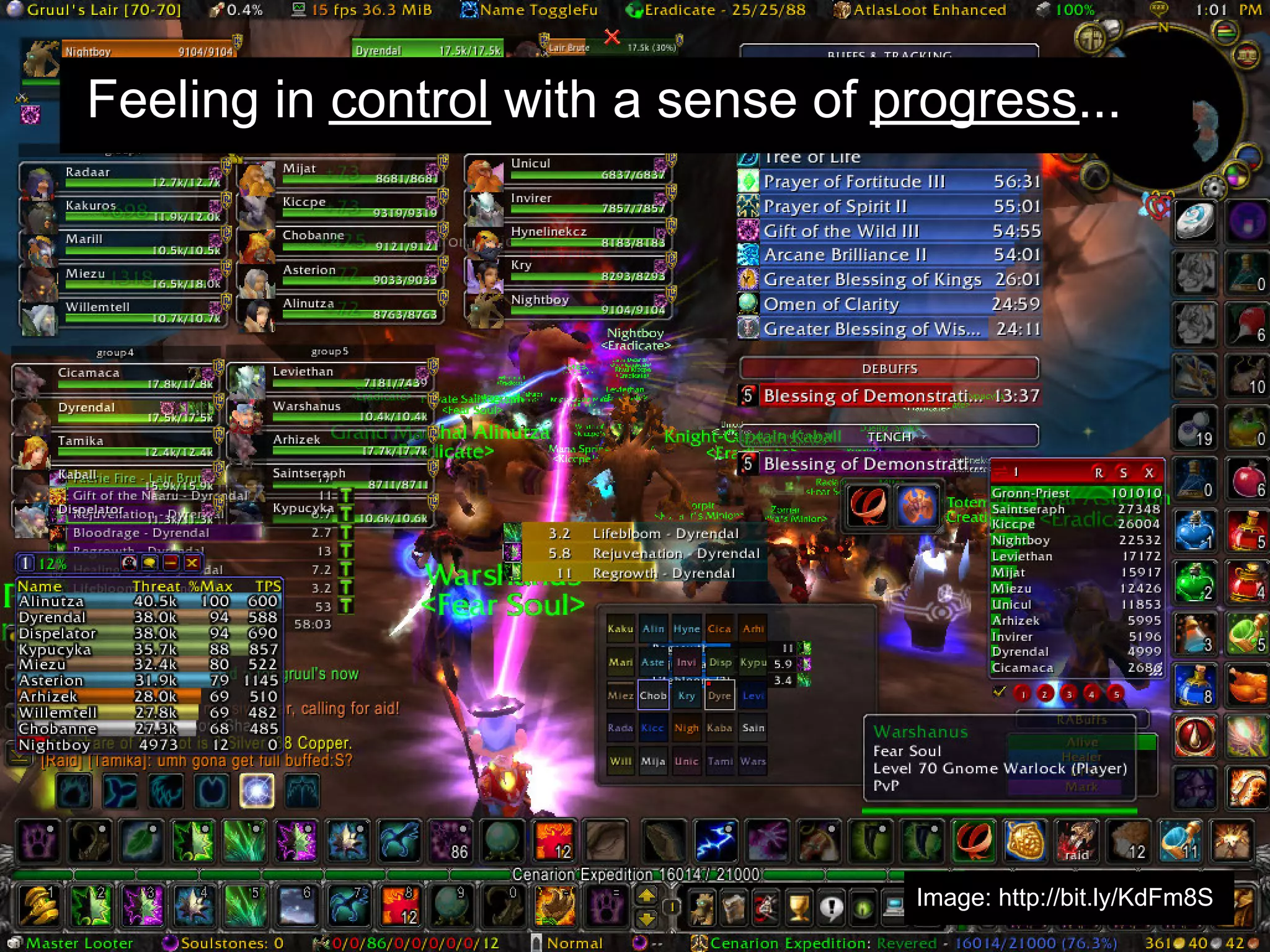
Feeling in control with a sense of progress...


                                    Image: http://bit.ly/KdFm8S
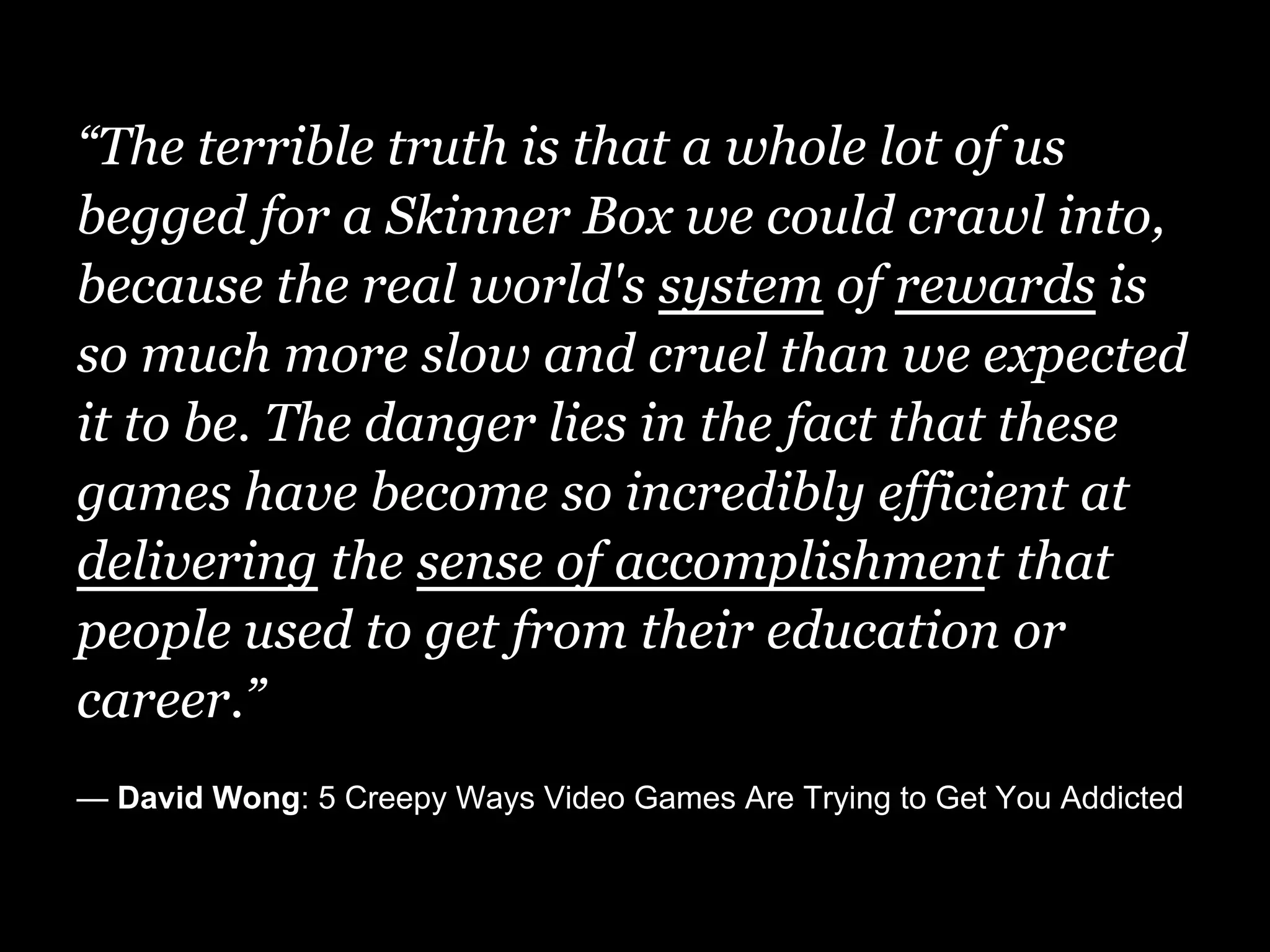
“The terrible truth is that a whole lot of us
begged for a Skinner Box we could crawl into,
because the real world's system of rewards is
so much more slow and cruel than we expected
it to be. The danger lies in the fact that these
games have become so incredibly efficient at
delivering the sense of accomplishment that
people used to get from their education or
career.”
— David Wong: 5 Creepy Ways Video Games Are Trying to Get You Addicted
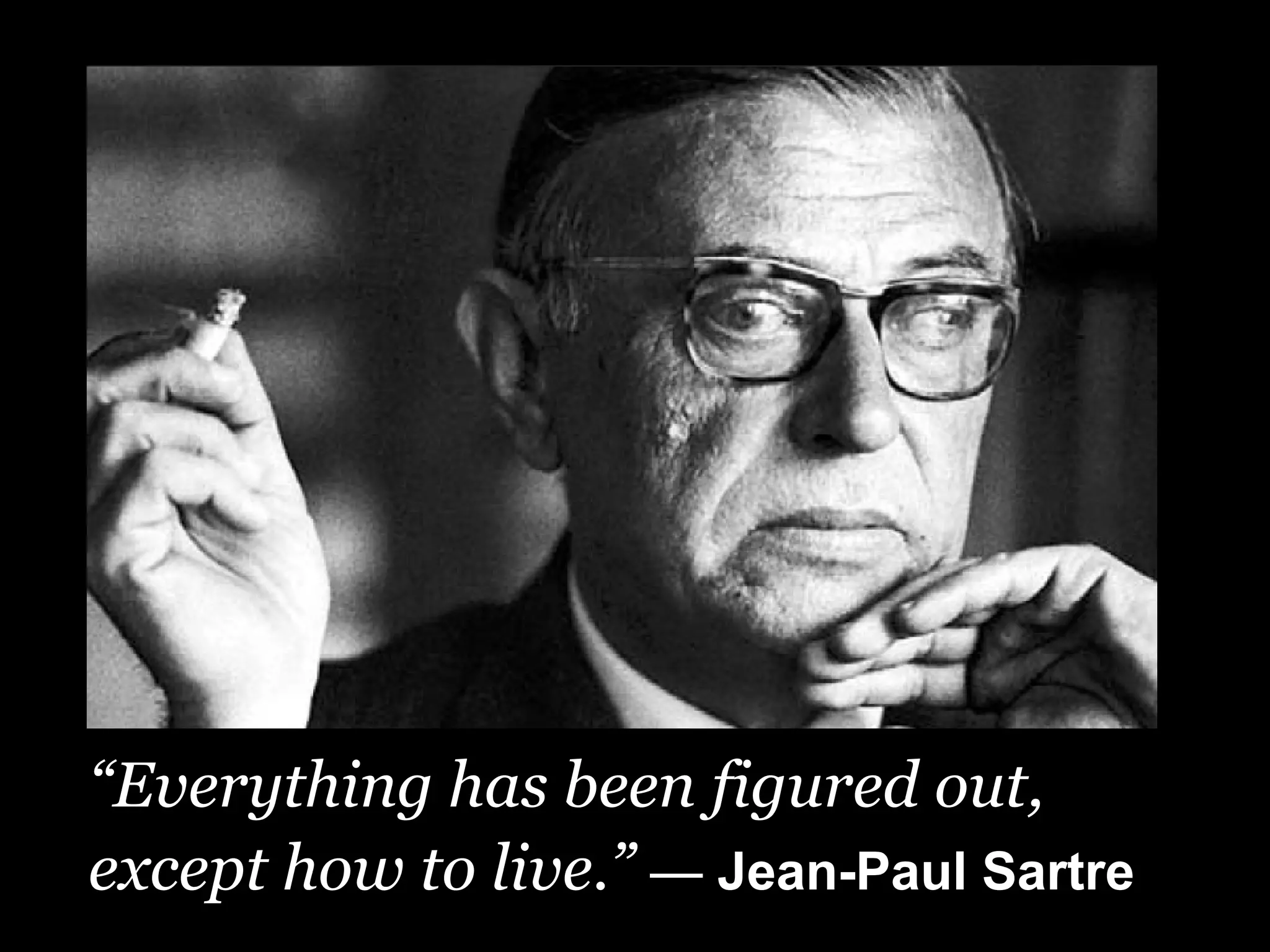
“Everything has been figured out,
except how to live.” — Jean-Paul Sartre
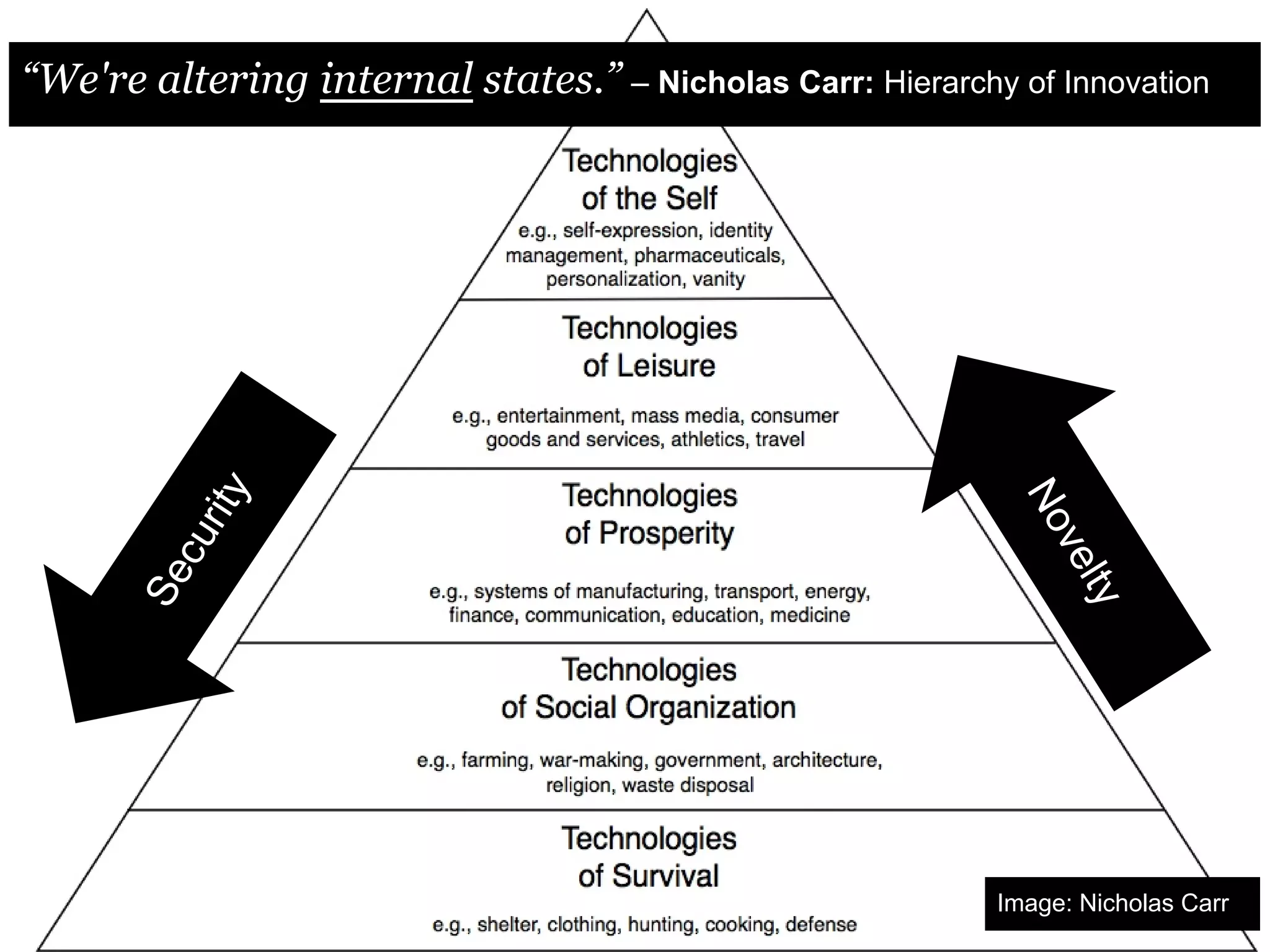
“We're altering internal states.” – Nicholas Carr: Hierarchy of Innovation


           ty


                                                              No
         uri


                                                                ve
          c
       Se


                                                                  lty
                                                            Image: Nicholas Carr
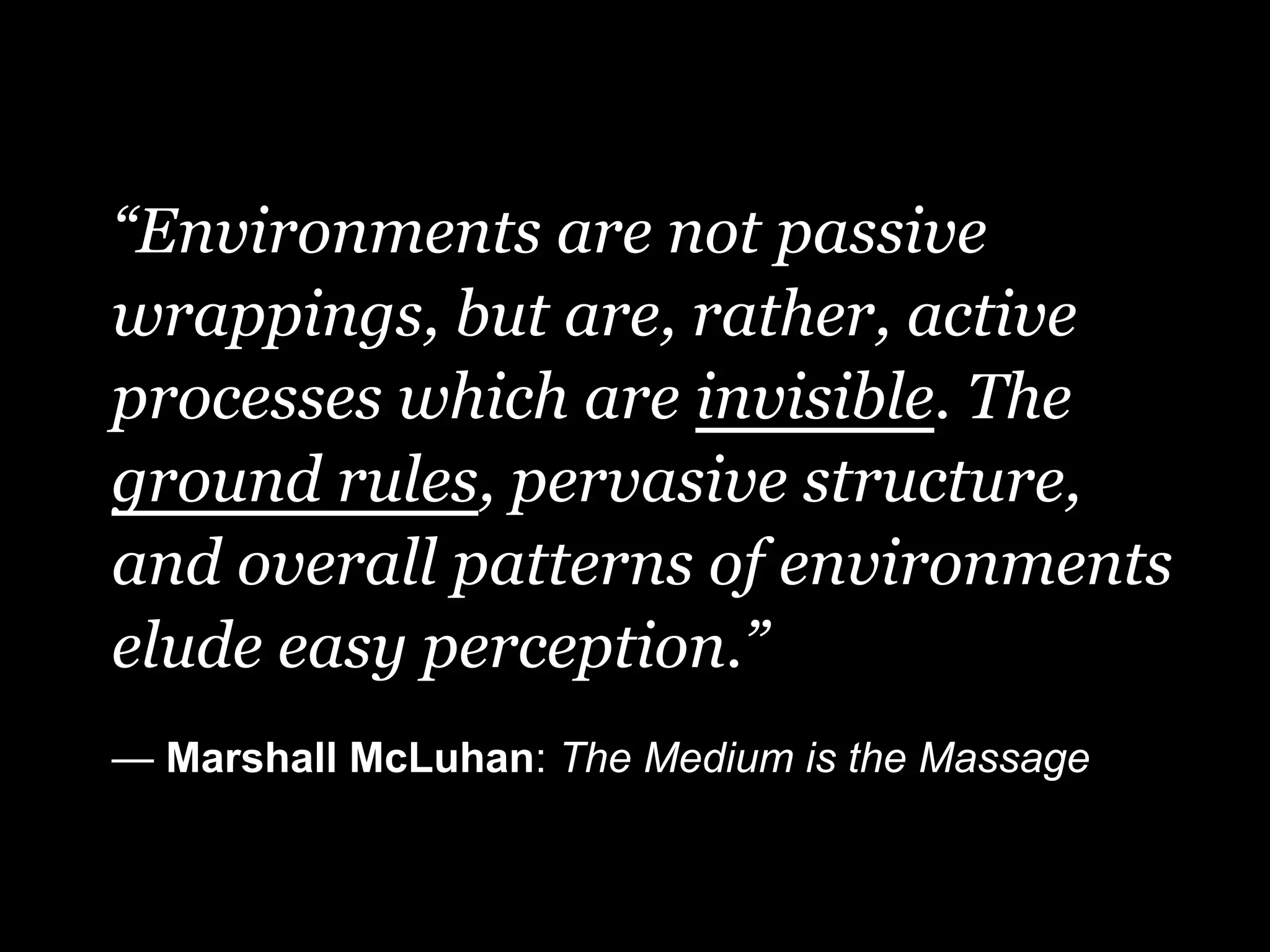
“Environments are not passive
wrappings, but are, rather, active
processes which are invisible. The
ground rules, pervasive structure,
and overall patterns of environments
elude easy perception.”
— Marshall McLuhan: The Medium is the Massage
“Everything is number.”
— Pythagoras, Philosopher, ~570–495 BC
“People’s lives are being
run by stupid algorithms
more and more.”
— Jaron Lanier (Technologist and author of You Are
Not a Gadget)
“When we see ourselves
ranked, we're trained to
want to grow that score.”
— Joe Fernandez (Creator and founder of social
media analytics service Klout)
“... in a world of overwhelming
information and choice, people will
turn to their friends to help them decide
... that is what we have learned to do
through thousands of years of
evolution.”
— Paul  Adams: The future of advertising: Many, lightweight
interactions over time
“People start asking
simpler questions so they
can get immediate
answers.”
— Sherry Turkle: Expecting More from Technology
and Less from Each Other
“Things have moved from:
‘I have a feeling, I want to make a
call to ‘I want to have a feeling,
I need to send a text.’”
— Sherry Turkle, Psychologist and author of Alone
Together
“Our culture, obsessed with numbers, has given
us the idea that what we can measure is more
important that what we can't measure. It
means that we make quantity more important
than quality. If quantity forms the goals of our
feedback loops, if quantity is the center of our
attention and language and institutions, if we
motivate ourselves, rate ourselves, and reward
ourselves on our ability to produce quantity,
then quantity will be the result.
— Donella H. Meadows: Thinking in Systems
Why are we telling you this?

         Questions?
References
Slide 01: Karma whoring
http://en.wikipedia.org/wiki/Karma_whoring

Slide 09: InformationIsBeautiful - Chicks Rule?
http://bit.ly/L0OeKC

Slide 13: Marshall McLuhan: The Medium is the Massage: An Inventory of Effects
http://en.wikipedia.org/wiki/The_Medium_is_the_Massage

Slide 14: Facebook - Visualizing Friendships by Paul Butler
https://www.facebook.com/notes/facebook-engineering/visualizing-friendships/469716398919

Slide 14: Understanding Media: The Extensions of Man
http://en.wikipedia.org/wiki/Understanding_Media

Slide 17: Jean-Paul Sartre
http://en.wikipedia.org/wiki/Sartre
References
Slide 26: Lullaby Spring by Damien Hirst
http://en.wikipedia.org/wiki/Damien_Hirst

Slide 32: Dopamine Jackpot! Sapolsky on the Science of Pleasure
https://www.youtube.com/watch?v=axrywDP9Ii0

Slide 33: Schedules of reinforcement
http://en.wikipedia.org/wiki/Reinforcement#Schedules_of_reinforcement

Slide 34: How to Manufacture Desire: An Intro to the Desire Engine by Nir Eyal
http://www.nirandfar.com/2012/03/how-to-manufacture-desire.html

Slide 35: BJ Fogg's Behavior Model
http://behaviormodel.org/

Slide 36: Changing Behavior and Changing Policies: BJ Fogg
http://youtu.be/5WaToiunuWY
References
Slide 37: Cyworld
http://en.wikipedia.org/wiki/Cyworld

Slide 38: O'Reilly Radar - A gaming revolution, minus the hype
http://radar.oreilly.com/2012/05/playful-design-gaming-revolution-john-ferrara.html

Slide 39: Filter bubble
http://en.wikipedia.org/wiki/Filter_bubble

Slide 39: Marginal Utility - "Engagement Ads" on Facebook
http://www.popmatters.com/pm/post/131542-/

Slide 61: Agent Smith
http://en.wikipedia.org/wiki/Agent_smith

Slide 65: Jean-Paul Sartre
http://en.wikipedia.org/wiki/Sartre
References
Slide 66: Rough Type: Nicholas Carr's Blog - The hierarchy of innovation
http://www.roughtype.com/archives/2012/05/the_hierarchy_o.php

Slide 67: Marshall McLuhan: The Medium is the Massage: An Inventory of Effects
http://en.wikipedia.org/wiki/The_Medium_is_the_Massage

Slide 68: Pythagoras
http://en.wikipedia.org/wiki/Pythagoras

Slide 69: Wired - What Your Klout Score Really Means by Seth Stevenson
http://www.wired.com/epicenter/2012/04/ff_klout/

Slide 70: Wired - What Your Klout Score Really Means by Seth Stevenson
http://www.wired.com/epicenter/2012/04/ff_klout/

Slide 71: THINK OUTSIDE IN - The future of advertising: Many, lightweight interactions over time
http://www.thinkoutsidein.com/blog/2012/03/many-lightweight-interactions-over-time/
References
Slide 72: Harvard Book Store Channel - Sherry Turkle (Video)
http://www.harvard.com/events/hbs_channel/sherry_turkle/

Slide 73: Confessions of an Aca/Fan - "Does This Technology Serve Human Purposes?": A
"Necessary Conversation" with Sherry Turkle (Part Three)
http://henryjenkins.org/2011/08/does_this_technology_serve_hum_1.html

Slide 74: Donella Meadows
http://en.wikipedia.org/wiki/Donella_Meadows

Compulsion Loops

  • 1.
    Compulsion Loops Compulsive Behavior As Mass Media Image: http://imgur.com/gallery/D6mhR
  • 2.
    A presentation tostudents attending the Michigan State University: Study Abroad 2012: Mass Media in the UK programme.
  • 3.
  • 4.
    Richard Buchanan @replayzero —Creative Strategist (Ideas) Adam Crowe @adamcrowe — Engagement Strategist (Interactions) We look for behavioral patterns shaped by new technologies and use those patterns to create clever ideas and engaging interactions to connect people to brands.
  • 5.
    1. The Evolutionof Media 2. Compulsion Loops 3. Why is this happening?
  • 6.
  • 7.
    The Evolution ofMedia Gathering around PEOPLE Gathering around CONTENT Gathering around PEOPLE ONLINE Gathering around ACTIVITIES ONLINE
  • 8.
    The Evolution ofMedia Gathering around PEOPLE: Communication ● 70% Nonverbal, "Tribal", "Oral", "Acoustic Space" (McLuhan) ● This was before media and when advertising was mostly word-of-mouth Gathering around CONTENT: Mass Media ● Print, Radio, TV, Advertising, "Literal" "Visual" (McLuhan) ● The golden age of mass media/mass advertiser/mass consumer symbiosis Gathering around PEOPLE ONLINE: Social Networking ● Bonding/Gossip/Identity/Status "Retribalization" (McLuhan) ● Online socializing relies on media platforms but advertisers are resented Gathering around ACTIVITIES ONLINE: Compulsion Loops ● Social Data: Friends/Likes/Points "Consensus" (McLuhan) ● Frequent activity is encouraged by media platforms to attract advertisers
  • 9.
    People (Online): Communication Email IM/Chat/Skype Mobile:Voice/Text } Talking Activities (Online): Information "Social" Networking "Social" Gaming "Social" Curation } Clicking
  • 10.
    Online activities Relationships Achievements Infographic: David McCandless
  • 11.
  • 12.
    Compulsion Loops ● def. Compulsion Loop: A habitual behavior that a human will repeat to gain a neurochemical reward: a feeling of pleasure and/or a relief from pain. Not doing the behavior causes discomfort. ● Media is no longer about simply capturing attention; it is about cultivating habits within users so that they will be compelled to return to, and engage with, a system.
  • 13.
    We are talkingabout the psychobiology and neurochemistry of media
  • 14.
    “All media areextensions of some human faculty – psychic or physical. The wheel is an extension of the foot. The book is an extension of the the eye. Clothing, an extension of the skin. Electric circuitry, an extension of the central nervous system.” — Marshall McLuhan: The Medium is the Massage: An Inventory of Effects
  • 15.
    “... we haveextended all parts of our bodies and senses by technology, we are haunted by the need for an outer consensus of technology and experience that would raise our communal lives to the level of world-wide consensus.” — Marshall McLuhan
  • 16.
    This is aplacenta
  • 17.
  • 18.
    “Man is condemnedto be free; because once thrown into the world, he is responsible for everything he does.” — Jean-Paul Sartre
  • 19.
    Existential Facts ofLife: People don't know what they want because they are hopelessly and inescapably conflicted, caught between the need for both security and novelty.
  • 20.
    Security Novelty Control Security Novelty Relationships Achievement Conformity Individuality/Identity Belonging/Safety Choice/Freedom Domesticity Adventure Consistency (Life) Risk (Loss/Pain/Death)
  • 21.
    Thus: Modern marketing wantsto help people manage this overwhelming sense of choice in order to achieve a sense of belonging.
  • 22.
    Problem: Mass mediums havefragmented. Big advertising budgets can no longer guarantee the scheduled delivery of an audience to advertisers. Image: http://bit.ly/JKEV8b
  • 23.
    How will mediasurvive? Cultivate habits within users so they will be compelled to return and engage with a system (hopefully creating social entanglement in the process). Image: http://bit.ly/JSnwDO
  • 24.
    From hunting andtracking to cultivating and harvesting
  • 25.
    Why are wetelling you this?
  • 26.
    Desktop Internet vsMobile Internet Image: http://bit.ly/LIwuYp Image: http://bit.ly/KNNhoF
  • 27.
  • 28.
    Image: http://bit.ly/2XOR1Jg “In theemerging, highly programmed landscape ahead, you will either create the software or you will be the software. It’s really that simple: Program, or be programmed.” — Douglas Rushkoff
  • 29.
    Prediction: Successful future mediaplatforms will be those that cultivate and then service their users' emotional dependencies.
  • 30.
  • 31.
    Compulsion Loops ● def. Compulsion Loop: A habitual behavior that a human will repeat to gain a neurochemical reward: a feeling of pleasure and/or a relief from pain. Not doing the behavior causes discomfort. ● Dopamine motivates novelty-seeking behavior. Both novelty-seeking (achievement) and relationship-seeking (security) behaviors are rewarded with Endorphins (pleasure and/or pain relief).
  • 32.
    The Compulsion Spiral CompulsionLoops foster loyalty and commitment through giving us the sense of making progress.
  • 33.
    Dopamine Dopamine “Dopamine is not about pleasure, it's about the anticipation of pleasure.” Video: http://youtu.be/axrywDP9Ii0
  • 34.
    Intermittent Variable Rewards Maybeyou'll be rewarded as before. Inconsistency! (security vs novelty) Image: Spinning by quinn.anya on Flickr
  • 35.
    B = MAT TRIGGER(stimulus) (at the same ACTION (response) moment) Internal: Feeling Ability: Easy - Hard Dopamine released (negative: pain/loss), to encourage work Motivation: Low - High towards REWARD Time, Context, Routine Trigger: Sufficient given External: Cue, Prompt, ability and motivation? Call, Offer, Request Endorphins released to REWARD ACTION COMMITMENT REWARD (reinforcement) Types (security vs novelty): Pay (with time, money, data, Survival: Resources share, invite) to do the Dopamine released to encourage work Social: Relationships ACTION again. Paying towards REWARD Self: Reputation rationalizes ACTION to maintain consistent self-image Based on Desire Engine Canvas by NirAndFar.com
  • 36.
    ACTION (response) High Motivation HIGH MOTIVATION HIGH MOTIVATION LOW ABILITY HIGH ABILITY MOTIVATION Trigger Success Trigger LOW MOTIVATION Fail HIGH ABILITY Low Motivation Low Ability: Hard to do ABILITY High Ability: Easy to do BJ Fogg's Behavior Model behaviormodel.org
  • 37.
    Triggers “More and more of those [hot] triggers are coming through our peers ... ” Video: http://youtu.be/5WaToiunuWY
  • 38.
    Analytics (They're watchingyou, Neo.) Control room of the Cyworld portal, operated by SK Communications, Seoul, Korea.
  • 39.
    “Games can produceenormous volumes of data because it’s really simple to gather every little interaction the player has in the game ... Zynga, for example, uses data to determine which design choices create greater tendencies for players to stay engaged longer, involve more friends, or pay to enhance the game experience…” — John Ferrara in: A Gaming Revolution, Minus the Hype
  • 40.
    “[T]he data trailwe create online can hem us in and trap us.... [O]ur past history becomes inescapable, shaping the contours of the online experience we can have, which more and more shapes the kind of life experience we can have generally, limiting what we know about, what we do and how we are seen and what we accomplish.” — Rob Horning: "Engagement Ads" on Facebook
  • 41.
  • 42.
  • 43.
    526 million dailyactive users (Source: Facebook, March 2012) Average monthly use per visitor: 405 minutes (Pinterest: 89, Tumblr: 89, Twitter: 21, Google+: 3) (Source: comScore, January 2012) Average of 3.2 billion likes and comments per day during the first quarter of 2012 (Source: Facebook, April 2012) 48% of 18–34 year olds check Facebook immediately after they wake up (Source: onlineschools.org, November 2011) Image: Facebook
  • 44.
    B = MAT Trigger (at the same Action moment) I: At PC or on Mobile, Waking, A: Easy if at PC of on Mobile: Waiting, Watching, Loneliness, Dopamine released Log in, check updates and to encourage work Boredom, Indecision, Fatigue, notifications, Easy to update towards REWARD Excitement/Anxiety (FOMO) status or click 'Like' E: Update email, tab notice, See app M: Very high if messaged or icon/logo/name, See 'Like' button, feeling lonely, bored or anxious See link to FB content Endorphins released to REWARD ACTION Commitment Reward Click 'Like', Create account, Add Res: Adding content/data to personal data, Import email contacts, renew connections with friends Add friend, Update status, Rel: Added, Messaged, Liked, Dopamine released Comment, Customize profile, Commented, Tagged, Invited to encourage work Upload photos, Add Event, towards REWARD Update personal Information Rep: Friends (Count), Groups (relationship status), Install mobile app Based on Desire Engine Canvas by NirAndFar.com
  • 45.
    Facebook: Fear ofMissing Out (FOMO) ● The Hot Nightclub... that every one is at, and so no one wants to be left out. People fear missing out on shared experiences because if other people weren't there with you, it didn't happen ("pics or it didn't happen"). ● Social Casino: Staying at the tables, adding more data to improve the odds of receiving the (intermittent and variable) reward of a feeling of belonging (security). ● Talent Show: People perform for the sake of gaining attention and reward their friends for gaining attention. People narrow the range of their social performances to only those that will fit Facebook's talent show format.
  • 46.
  • 47.
  • 48.
    4.4 million dailyaverage users (Source: AppData, May 2012) Cisco estimated players spent an average of 68 minutes a day playing (Source: AdAge Digital, October 2010) Zynga’s core paying audience is 30-55 year old females ZYNGA (Source: Inside Social Games, July 2010) ...if you plant a field of pumpkins at noon, for example, you must return to harvest at eight o’clock that evening or risk losing the crop. Planting requires the user to click on each square three times: once to harvest the previous crop, once to re-plow the square of land, and once to plant the new seeds. This means that a fourteen by fourteen plot of land – which is relatively small for Farmville – takes almost six hundred mouse-clicks to farm, and obligates you to return in a few hours to do it again. (Source: Cultivated Play by A. J. Patrick Liszkiewicz, March 2010)
  • 49.
    B = MAT T (at the same A moment) l: Wake, Boredom (Waiting), A: Easy if at PC: Log into FB and Anxiety (Loss of crops), Dopamine released click around in the farm to encourage work Loneliness (Nurturance) towards REWARD M: High if tending to decaying crop or if reciprocating by working E: At PC, See app logo, on coworker's farm Update email, Invite or farm activity on FB newsfeed Endorphins released to REWARD ACTION C R Build farm, Plant crops, Harvest Res: Tending, Winning items, crops, Decorate farm, Pay for Buying items, Harvesting items with credits or cash, Rel: Inviting, Receiving gifts, Dopamine released Invite others to see your farm, to encourage work Coworking (reciprocity) Gift items to coworkers towards REWARD Rep: Being added, Designing, decorating, and arranging farm Based on Desire Engine Canvas by NirAndFar.com
  • 50.
    Farmville: Social Reciprocityin Coworkerville ● Silent together: People run out of things to say but still want to appear sociable. Farmville allows passive and asynchronous socializing through a 'game'. ● Social obligations: If you know your friends are visiting your farm every day you'll spend more time and money to keep it tidy (women are nesters). If your friends do work on your farm, you feel you have to return the favor, thus players are bound in loops of reciprocity. ● Sunk costs: The more time players invest, the more they have to rationalize their investment, so they show off by buying decorative and functional items.
  • 51.
  • 52.
  • 53.
    United States toppins: crafts, gifts, hobbies/leisure, interior design, and fashion designers/collections. United Kingdom top pins: venture capital, blogging resources, crafts, Web analytics, and SEO/marketing. (Source: Ragan.com) PINTEREST 3 average pins per user (80% of pins are repins) (Source: RJMetrics, February 2012) Average monthly use per visitor: 89 minutes (Facebook: 405, Tumblr: 89, Twitter: 21, Google+: 3) (Source: comScore, January 2012)
  • 54.
    B = MAT T (at the same A moment) I: Wake, Arrive/Leave A: Easy if at PC or on mobile: Office/School/Home, Waiting, Dopamine released Just click 'Pin it' button or repin to encourage work Boredom, Anxiety, Loneliness M: High if you've found image towards REWARD E: At PC or on Mobile, See worthy of collecting (immediate App icon/logo, Update email, See visibility and peer approval) and if collectable image, See 'Pin it' button you fear losing that image Endorphins released to REWARD ACTION C R Create account, Create collection, Res: Finding, Pinning, Organize collection, Browse user Organizing collections, Share collection, Dopamine released Rel: Added, Adding, Repined, Repin images, Send invites, to encourage work Repinning, Commenting Install 'Pin it' button on site towards REWARD Rep: Invited, Added, Repinned, Commented Based on Desire Engine Canvas by NirAndFar.com
  • 55.
    Pinterest: Social Curation(Pin it or lose it) ● Social window shopping: When our personal tastes are validated by others they get rewarded and reinforced. We add value to images by contextualising them in sets. Pinterest benefits through purchase intent data. ● No choice to make: We can be so crippled by too much choice that we'd rather collect than consume. ● Curating the perfect catalogue: Pinning single images probably isn't enough to gain attention, so users level up by creating tastefully curated collections.
  • 56.
    TWITTER Image: @ngonews
  • 57.
  • 58.
    200 million tweetsper day; retweets: 3–5% (Sources: Twitter, June 2011; Tweet, Tweet, Retweet, danah boyd et al., 2010) What makes you retweet? Interesting content: 92% Personal connection: 84% Humor: 66% Incentive: 32% Retweet requests: 21% TWITTER Celebrity status: 26% (Source: The Social Media Skinny, February 2012) 50% of users access Twitter via their cell phone (Source: Customer Insight Group, February 2012)
  • 59.
    B = MAT T (at the same A moment) I: Waking, Waiting, Watching TV A: Easy to scroll through tweets, Loneliness, Boredom, Dopamine released Easy to click 'Tweet This' or RT to encourage work Excitement/Anxiety (FOMO) towards REWARD M: High if bored or waiting, High E: At PC or on Mobile, See app if RTed, Replied, DMed, High if icon/logo, Text or email notification thought of something to tweet (RT, Mention, Reply, DM, Follow), See a 'Tweet This' button Endorphins released to REWARD ACTION C R Scroll public tweets, Create account, Res: Finding good Tweet or link Follow (Add friend), Tweet, RT, DM, Rel: Followed, Replied, DMed View people 'Similar to you', Favorite, View Trending Topics, Dopamine released Rep: Followed, RTed, Replied, to encourage work Mentioned, Listed, Favorited Design Profile, Add Mobile, towards REWARD Click 'Tweet This', Install 'Tweet This' button on website Based on Desire Engine Canvas by NirAndFar.com
  • 60.
    Twitter – GlobalVillage Gossip ● Twitter is McLuhan's "Tribal Drum": Tweets come from everywhere-all-at-once creating an "acoustic space" ● Humans are hardwired for distractions (pro survival). The average 13- to 17-year-old sends and receives 3,339 texts a month, more than 100 per day (Nielsen, 2010) ● We gossip to check the health of relationships in the group and thereby find our place in the social hierarchy ● "Retribalized" global villagers; people feel safer in tribes with a stable consensus (security > novelty). Celebrity become idols of focused group attention and are rewarded with adoration (followers and retweets).
  • 61.
    Why is thishappening?
  • 62.
  • 63.
    People Crave Feedback ● Compulsion Loops offer both users and the media platform immediate feedback on their activities and this feedback is available on any internet-connected device. So long as this feedback is flowing, everyone is happy. ● Compulsion Loops resolve our conflicting needs for both security and novelty by rewarding us for achieving a sense of control over our environment by giving us new things to control within that same environment ● Compulsion Loops foster loyalty and commitment because they give us a sense of making progress.
  • 64.
    Feeling in controlwith a sense of progress... Image: http://bit.ly/KdFm8S
  • 65.
    “The terrible truthis that a whole lot of us begged for a Skinner Box we could crawl into, because the real world's system of rewards is so much more slow and cruel than we expected it to be. The danger lies in the fact that these games have become so incredibly efficient at delivering the sense of accomplishment that people used to get from their education or career.” — David Wong: 5 Creepy Ways Video Games Are Trying to Get You Addicted
  • 66.
    “Everything has beenfigured out, except how to live.” — Jean-Paul Sartre
  • 67.
    “We're altering internalstates.” – Nicholas Carr: Hierarchy of Innovation ty No uri ve c Se lty Image: Nicholas Carr
  • 68.
    “Environments are notpassive wrappings, but are, rather, active processes which are invisible. The ground rules, pervasive structure, and overall patterns of environments elude easy perception.” — Marshall McLuhan: The Medium is the Massage
  • 69.
    “Everything is number.” —Pythagoras, Philosopher, ~570–495 BC
  • 70.
    “People’s lives arebeing run by stupid algorithms more and more.” — Jaron Lanier (Technologist and author of You Are Not a Gadget)
  • 71.
    “When we seeourselves ranked, we're trained to want to grow that score.” — Joe Fernandez (Creator and founder of social media analytics service Klout)
  • 72.
    “... in aworld of overwhelming information and choice, people will turn to their friends to help them decide ... that is what we have learned to do through thousands of years of evolution.” — Paul Adams: The future of advertising: Many, lightweight interactions over time
  • 73.
    “People start asking simplerquestions so they can get immediate answers.” — Sherry Turkle: Expecting More from Technology and Less from Each Other
  • 74.
    “Things have movedfrom: ‘I have a feeling, I want to make a call to ‘I want to have a feeling, I need to send a text.’” — Sherry Turkle, Psychologist and author of Alone Together
  • 75.
    “Our culture, obsessedwith numbers, has given us the idea that what we can measure is more important that what we can't measure. It means that we make quantity more important than quality. If quantity forms the goals of our feedback loops, if quantity is the center of our attention and language and institutions, if we motivate ourselves, rate ourselves, and reward ourselves on our ability to produce quantity, then quantity will be the result. — Donella H. Meadows: Thinking in Systems
  • 76.
    Why are wetelling you this? Questions?
  • 77.
    References Slide 01: Karmawhoring http://en.wikipedia.org/wiki/Karma_whoring Slide 09: InformationIsBeautiful - Chicks Rule? http://bit.ly/L0OeKC Slide 13: Marshall McLuhan: The Medium is the Massage: An Inventory of Effects http://en.wikipedia.org/wiki/The_Medium_is_the_Massage Slide 14: Facebook - Visualizing Friendships by Paul Butler https://www.facebook.com/notes/facebook-engineering/visualizing-friendships/469716398919 Slide 14: Understanding Media: The Extensions of Man http://en.wikipedia.org/wiki/Understanding_Media Slide 17: Jean-Paul Sartre http://en.wikipedia.org/wiki/Sartre
  • 78.
    References Slide 26: LullabySpring by Damien Hirst http://en.wikipedia.org/wiki/Damien_Hirst Slide 32: Dopamine Jackpot! Sapolsky on the Science of Pleasure https://www.youtube.com/watch?v=axrywDP9Ii0 Slide 33: Schedules of reinforcement http://en.wikipedia.org/wiki/Reinforcement#Schedules_of_reinforcement Slide 34: How to Manufacture Desire: An Intro to the Desire Engine by Nir Eyal http://www.nirandfar.com/2012/03/how-to-manufacture-desire.html Slide 35: BJ Fogg's Behavior Model http://behaviormodel.org/ Slide 36: Changing Behavior and Changing Policies: BJ Fogg http://youtu.be/5WaToiunuWY
  • 79.
    References Slide 37: Cyworld http://en.wikipedia.org/wiki/Cyworld Slide38: O'Reilly Radar - A gaming revolution, minus the hype http://radar.oreilly.com/2012/05/playful-design-gaming-revolution-john-ferrara.html Slide 39: Filter bubble http://en.wikipedia.org/wiki/Filter_bubble Slide 39: Marginal Utility - "Engagement Ads" on Facebook http://www.popmatters.com/pm/post/131542-/ Slide 61: Agent Smith http://en.wikipedia.org/wiki/Agent_smith Slide 65: Jean-Paul Sartre http://en.wikipedia.org/wiki/Sartre
  • 80.
    References Slide 66: RoughType: Nicholas Carr's Blog - The hierarchy of innovation http://www.roughtype.com/archives/2012/05/the_hierarchy_o.php Slide 67: Marshall McLuhan: The Medium is the Massage: An Inventory of Effects http://en.wikipedia.org/wiki/The_Medium_is_the_Massage Slide 68: Pythagoras http://en.wikipedia.org/wiki/Pythagoras Slide 69: Wired - What Your Klout Score Really Means by Seth Stevenson http://www.wired.com/epicenter/2012/04/ff_klout/ Slide 70: Wired - What Your Klout Score Really Means by Seth Stevenson http://www.wired.com/epicenter/2012/04/ff_klout/ Slide 71: THINK OUTSIDE IN - The future of advertising: Many, lightweight interactions over time http://www.thinkoutsidein.com/blog/2012/03/many-lightweight-interactions-over-time/
  • 81.
    References Slide 72: HarvardBook Store Channel - Sherry Turkle (Video) http://www.harvard.com/events/hbs_channel/sherry_turkle/ Slide 73: Confessions of an Aca/Fan - "Does This Technology Serve Human Purposes?": A "Necessary Conversation" with Sherry Turkle (Part Three) http://henryjenkins.org/2011/08/does_this_technology_serve_hum_1.html Slide 74: Donella Meadows http://en.wikipedia.org/wiki/Donella_Meadows