The Middle Ages
Unit 1
2º ESO
The Middle Ages
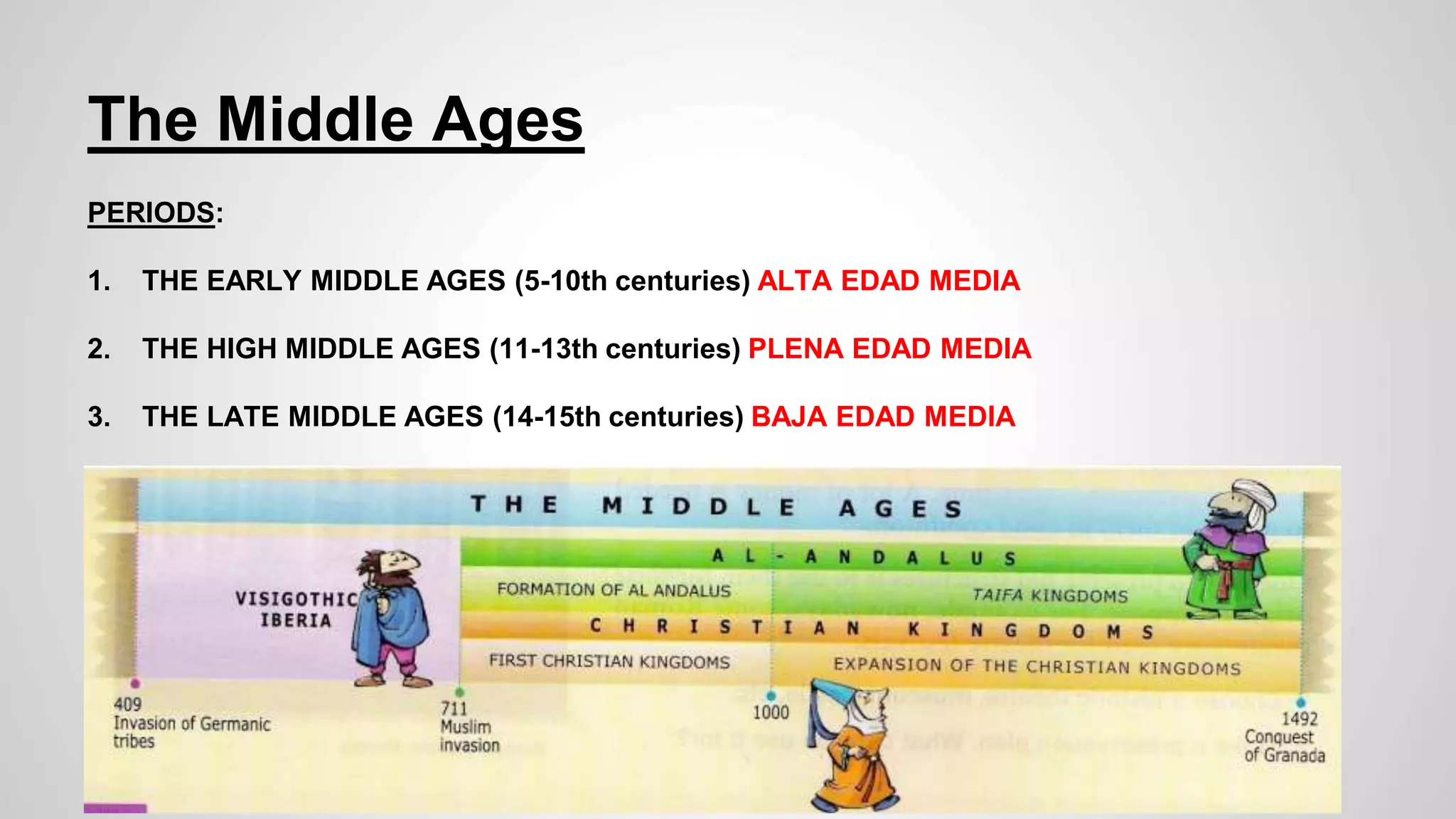
PERIODS:
1. THE EARLY MIDDLE AGES (5-10th centuries) ALTA EDAD MEDIA
2. THE HIGH MIDDLE AGES (11-13th centuries) PLENA EDAD MEDIA
3. THE LATE MIDDLE AGES (14-15th centuries) BAJA EDAD MEDIA
The division of the Roman Empire, 395
BYZANTIUM: THE EASTERN ROMAN EMPIRE
The splendor of Byzantium: Justinian
Emperor Justinian ruled between 527-
565. He was the most powerful
basileus in the Byzantine Empire.
He tried to reconquer the former
territories of the Roman Empire.
After Justinian the Byzantine Empire started its
slow decline...
They changed their traditions, language and
customs into the greek ones.
Byzantine culture
-LAW: They had a compilation of laws, the
Code of Justinian, for every part of the
Empire.
-ART: they created famous mosaics and
greek-cross plan churches mainly, with
domes. The best example is Hagia Sophia
in Constantinople.
-LANGUAGE: After Justinian they changed
into greek customs, including greek
language.
Hagia Sophia
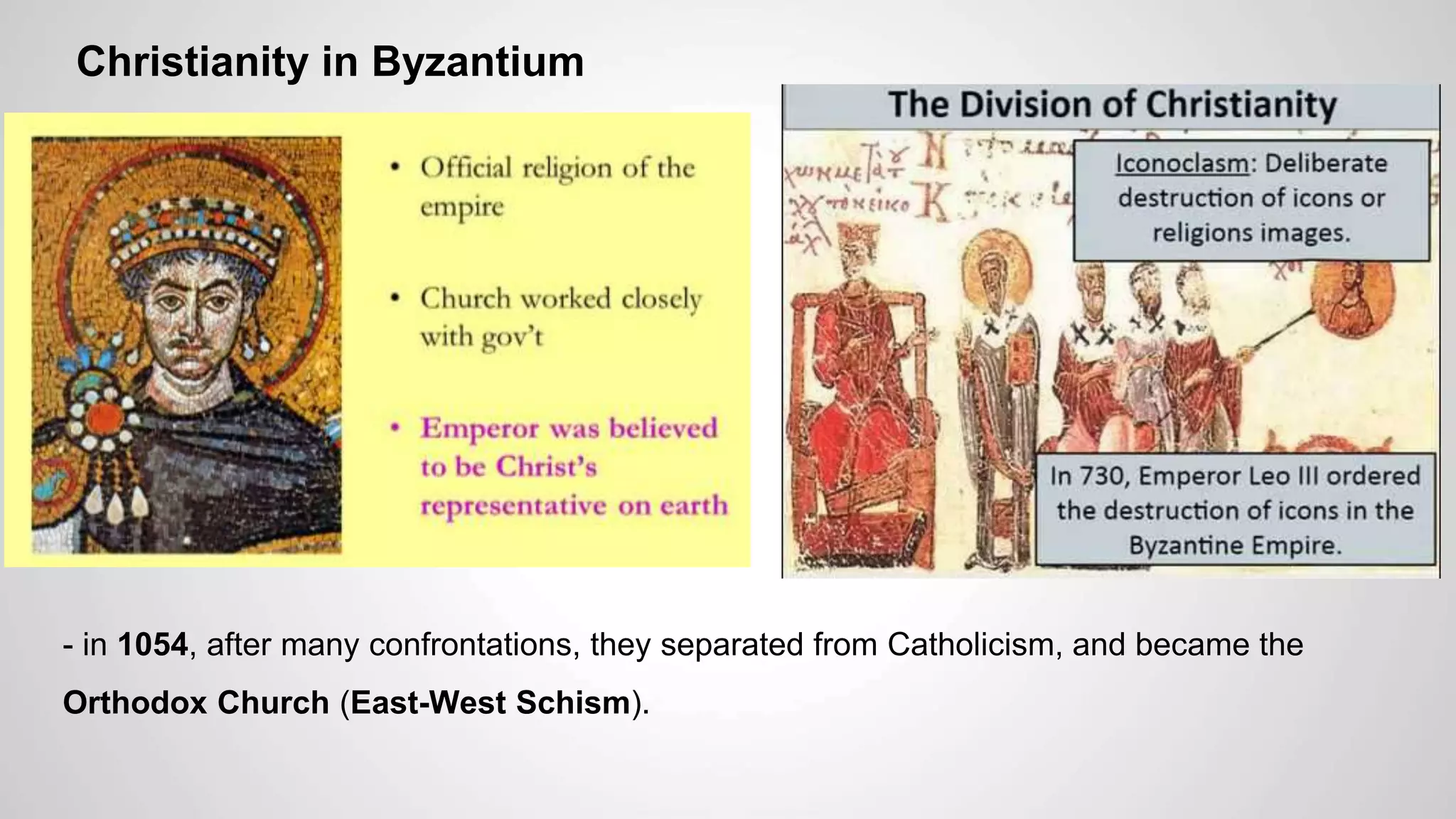
Christianity in Byzantium
- in 1054, after many confrontations, they separated from Catholicism, and became the
Orthodox Church (East-West Schism).
Islam: origins and doctrine
MUHAMMAD
He was the founder of Islam.
He was a merchant who learnt about the monotheistic religions in
his trade travels.
He heard the call of God and founded a new religion.
Before him, Arabia was polytheistic.
In 622 he fled from Mecca to Medina, what it is called
the Hegira, and it is considered the beginning of the
muslim calendar.
Muhammad started spreading Islam through Arabia.
Islamic doctrine
They have five main precepts
in their religion:
1- Declaration of faith: Allah is
the only god, and Muhammad
his prophet.
2- Obligatory prayer: Pray 5
times a facing Mecca.
3- Compulsory charity: Give
alms to the poor.
4- Ramadan fasting.
5- Pilgrimage to Mecca.
THE QURAN
Their sacred book is The Quran.
It contains the teachings of
Muhammad, only the literal
unchanged words of Allah that were
revealed to the prophet in Arabic.
SHARIA LAW
THE ISLAMIC EMPIRE
The expansion of the caliphate
Phases of the Islamic conquest
The decline of the empire
By the 10th century it began to decline
because it was very difficult to control such a
vast empire... so the Islamic Empire
weakened.
There were internal conflicts and also
foreign attacks.
The Islamic Empire was no longer expanding,
but its religion went on spreading into other
regions.
The Islamic Empire: ECONOMY AND SOCIETY
MUSLIM CITIES
ISLAMIC ART
Muslims adopted artistic elements from different cultures during the expansion period.
Islam temple: Mosque Quibla wall
Haram
Sahn
Kaaba, the most sacred temple
TOMBS
CIVIC AND MILITARY BUILDINGS
Madrasas
Fortresses
What were the
Germanic migrations?
-They were different tribes from
the North of Europe.
-They invaded the Western
Roman Empire from the 3rd to
the 5th Century.
-The Western Roman Empire
ended in 476 A.D. due to these
invasions.
The Germanic Kingdoms
Who were the visigoths?
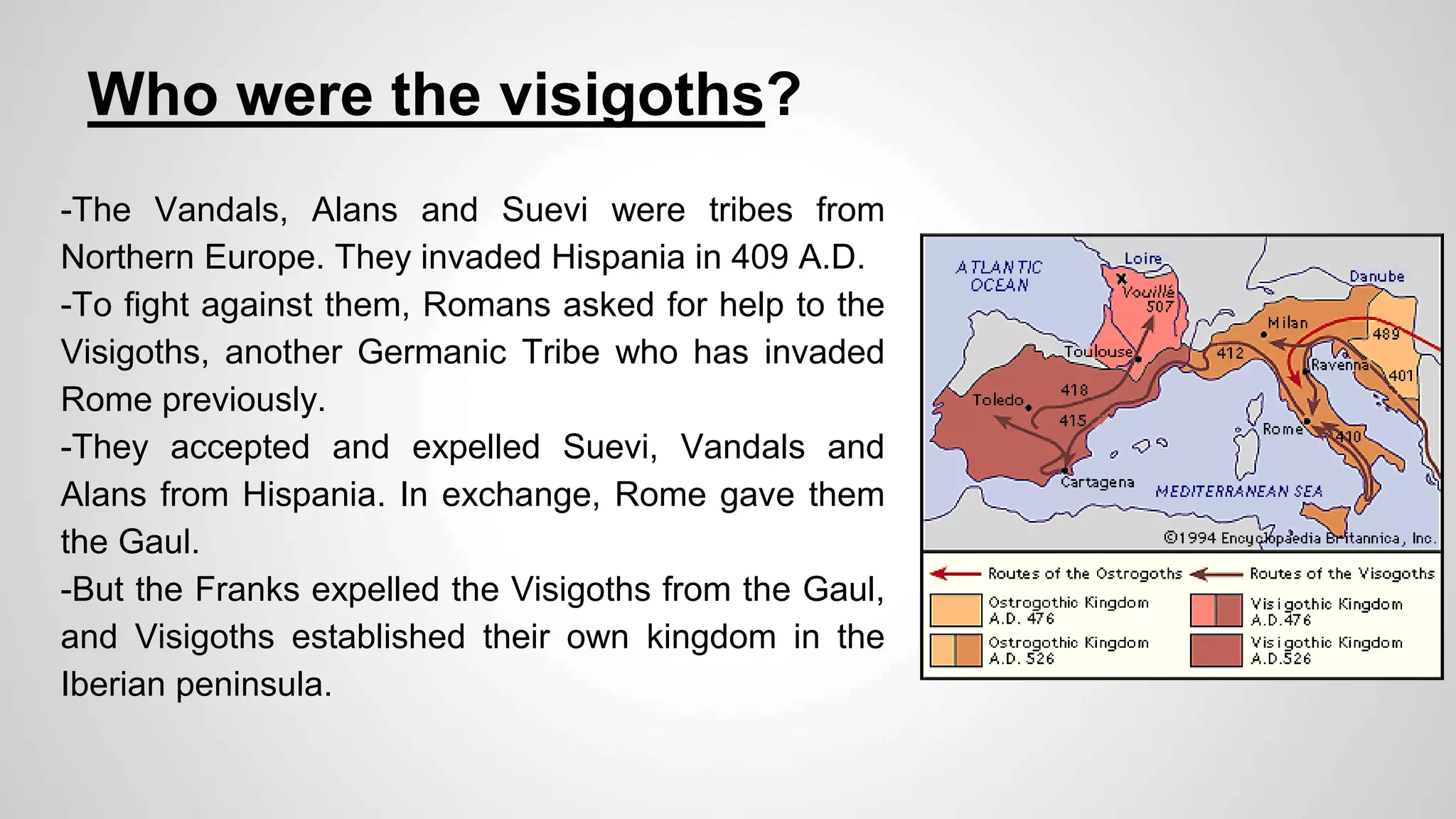
-The Vandals, Alans and Suevi were tribes from
Northern Europe. They invaded Hispania in 409 A.D.
-To fight against them, Romans asked for help to the
Visigoths, another Germanic Tribe who has invaded
Rome previously.
-They accepted and expelled Suevi, Vandals and
Alans from Hispania. In exchange, Rome gave them
the Gaul.
-But the Franks expelled the Visigoths from the Gaul,
and Visigoths established their own kingdom in the
Iberian peninsula.
Visigothic Kingdom
-The Visigothic Kingdom was ruled by a
King.
-They made Toledo their capital.
-The main kings were Leovigild and his
son Reccared.
-They unified their new kingdom by
changing their own language (to Latin),
religion (from arrianism to Christianism)
and laws (based their laws on Roman
laws).
Examples
● Church of San Juan Bautista in Baños de Cerrato (province of Palencia)
● Church of San Pedro de la Nave in San Pedro de la Nave-Almendra (province of
Zamora)
San Juan de Baños
Interior of San Juan de Baños
San Pedro de la Nave
How to interpret a work of art:
1- What is it? It is a sculpture, it’s a capital from a column inside a church. It belongs to
San Pedro de la Nave, Zamora.
2- Who did it? or Which civilization? It is from the visigothic style in the Iberian
Peninsula.
3- Which is its approximate date? It was made about the end of the 7th century.
4- How is it? (form, material, decoration, theme...) It is made from stone, it is part of a
column, and the sculpture is on relief, adapted to the architectural element. This is a
scene from the Bible, a religious theme, depicting the sacrifice of Isaac. It is very clear,
designed for the people, who were illiterate in those days, to easily understand it.
5- What information from the past does it give us? (facts, government,
population...) In the Visigothic kingdom, in the medieval era of history, churches were
small, and used the decoration in order to teach people about christianity.
6- What was it used for? (function) Churches were a place to pray, and capitals were
an element of the architecture, part of the column and therefore a support element. The
real function of the decoration in this capitals was to show people the scenes of the Bible
in a simple form.
Charlemagne and the Carolingian Empire
-Frankish kingdom (Germanic tribe).
-Power in the Mayors of the Palace.
-Charles Martel, the most important mayor of the
palace, he was famous for defeating the muslims in
732 in Poitiers.
Carolingian Empire
Pepin the Short started the Carolingian dynasty after being crowned king by the pope.
His son CharleMagne (Charles I) succeeded him and tried to restore the Western
Roman Empire. In year 800 he was crowned by the Pope as Holy Roman Emperor.
Palace of Aachen
CharleMagne made Aachen its capital,
and built a Palace there.
Carolingian Empire
CharleMagne divided his Empire into counties and marches to better control the territory.
Louis the Pious succeeded his father in 814, and when he died (840), his three sons
inherited the Empire, so it had to be divided into three after a civil war (that ended with
the Treaty of Verdun, 843).
Unit 1 The Early Middle Ages

Unit 1 The Early Middle Ages

  • 1.
  • 2.
    The Middle Ages PERIODS: 1.THE EARLY MIDDLE AGES (5-10th centuries) ALTA EDAD MEDIA 2. THE HIGH MIDDLE AGES (11-13th centuries) PLENA EDAD MEDIA 3. THE LATE MIDDLE AGES (14-15th centuries) BAJA EDAD MEDIA
  • 3.
    The division ofthe Roman Empire, 395
  • 4.
  • 6.
    The splendor ofByzantium: Justinian Emperor Justinian ruled between 527- 565. He was the most powerful basileus in the Byzantine Empire. He tried to reconquer the former territories of the Roman Empire. After Justinian the Byzantine Empire started its slow decline... They changed their traditions, language and customs into the greek ones.
  • 7.
    Byzantine culture -LAW: Theyhad a compilation of laws, the Code of Justinian, for every part of the Empire. -ART: they created famous mosaics and greek-cross plan churches mainly, with domes. The best example is Hagia Sophia in Constantinople. -LANGUAGE: After Justinian they changed into greek customs, including greek language.
  • 8.
  • 9.
    Christianity in Byzantium -in 1054, after many confrontations, they separated from Catholicism, and became the Orthodox Church (East-West Schism).
  • 13.
    Islam: origins anddoctrine MUHAMMAD He was the founder of Islam. He was a merchant who learnt about the monotheistic religions in his trade travels. He heard the call of God and founded a new religion. Before him, Arabia was polytheistic. In 622 he fled from Mecca to Medina, what it is called the Hegira, and it is considered the beginning of the muslim calendar. Muhammad started spreading Islam through Arabia.
  • 14.
    Islamic doctrine They havefive main precepts in their religion: 1- Declaration of faith: Allah is the only god, and Muhammad his prophet. 2- Obligatory prayer: Pray 5 times a facing Mecca. 3- Compulsory charity: Give alms to the poor. 4- Ramadan fasting. 5- Pilgrimage to Mecca.
  • 16.
    THE QURAN Their sacredbook is The Quran. It contains the teachings of Muhammad, only the literal unchanged words of Allah that were revealed to the prophet in Arabic.
  • 17.
  • 21.
  • 24.
    The expansion ofthe caliphate
  • 25.
    Phases of theIslamic conquest
  • 26.
    The decline ofthe empire By the 10th century it began to decline because it was very difficult to control such a vast empire... so the Islamic Empire weakened. There were internal conflicts and also foreign attacks. The Islamic Empire was no longer expanding, but its religion went on spreading into other regions.
  • 28.
    The Islamic Empire:ECONOMY AND SOCIETY
  • 32.
  • 33.
    ISLAMIC ART Muslims adoptedartistic elements from different cultures during the expansion period.
  • 35.
    Islam temple: MosqueQuibla wall Haram Sahn
  • 38.
    Kaaba, the mostsacred temple
  • 39.
  • 40.
  • 41.
  • 42.
  • 44.
    What were the Germanicmigrations? -They were different tribes from the North of Europe. -They invaded the Western Roman Empire from the 3rd to the 5th Century. -The Western Roman Empire ended in 476 A.D. due to these invasions.
  • 46.
  • 47.
    Who were thevisigoths? -The Vandals, Alans and Suevi were tribes from Northern Europe. They invaded Hispania in 409 A.D. -To fight against them, Romans asked for help to the Visigoths, another Germanic Tribe who has invaded Rome previously. -They accepted and expelled Suevi, Vandals and Alans from Hispania. In exchange, Rome gave them the Gaul. -But the Franks expelled the Visigoths from the Gaul, and Visigoths established their own kingdom in the Iberian peninsula.
  • 49.
    Visigothic Kingdom -The VisigothicKingdom was ruled by a King. -They made Toledo their capital. -The main kings were Leovigild and his son Reccared. -They unified their new kingdom by changing their own language (to Latin), religion (from arrianism to Christianism) and laws (based their laws on Roman laws).
  • 52.
    Examples ● Church ofSan Juan Bautista in Baños de Cerrato (province of Palencia) ● Church of San Pedro de la Nave in San Pedro de la Nave-Almendra (province of Zamora) San Juan de Baños Interior of San Juan de Baños
  • 53.
    San Pedro dela Nave
  • 54.
    San Pedro dela Nave
  • 55.
    How to interpreta work of art: 1- What is it? It is a sculpture, it’s a capital from a column inside a church. It belongs to San Pedro de la Nave, Zamora. 2- Who did it? or Which civilization? It is from the visigothic style in the Iberian Peninsula. 3- Which is its approximate date? It was made about the end of the 7th century. 4- How is it? (form, material, decoration, theme...) It is made from stone, it is part of a column, and the sculpture is on relief, adapted to the architectural element. This is a scene from the Bible, a religious theme, depicting the sacrifice of Isaac. It is very clear, designed for the people, who were illiterate in those days, to easily understand it. 5- What information from the past does it give us? (facts, government, population...) In the Visigothic kingdom, in the medieval era of history, churches were small, and used the decoration in order to teach people about christianity. 6- What was it used for? (function) Churches were a place to pray, and capitals were an element of the architecture, part of the column and therefore a support element. The real function of the decoration in this capitals was to show people the scenes of the Bible in a simple form.
  • 56.
    Charlemagne and theCarolingian Empire -Frankish kingdom (Germanic tribe). -Power in the Mayors of the Palace. -Charles Martel, the most important mayor of the palace, he was famous for defeating the muslims in 732 in Poitiers.
  • 57.
    Carolingian Empire Pepin theShort started the Carolingian dynasty after being crowned king by the pope. His son CharleMagne (Charles I) succeeded him and tried to restore the Western Roman Empire. In year 800 he was crowned by the Pope as Holy Roman Emperor.
  • 58.
    Palace of Aachen CharleMagnemade Aachen its capital, and built a Palace there.
  • 59.
    Carolingian Empire CharleMagne dividedhis Empire into counties and marches to better control the territory. Louis the Pious succeeded his father in 814, and when he died (840), his three sons inherited the Empire, so it had to be divided into three after a civil war (that ended with the Treaty of Verdun, 843).