Motivate,
Decide,
Activate!
Motivational and Decision
Making Theories that affect
the school leaders
Motivational Hygiene Theory
       FrederickHerzberg
       Born in MA, attended City College of NY,
        then Army, then graduated from CCNY
       Taught at U of Pitt and Case Western

Motivator Factors            Hygiene Factors
•Achievement
                             •Pay and Benefits
•Recognition
                             •Company Policy and
•Work Itself
                             Administration
•Responsibility
                             •Relationships with co-workers
•Promotion
                             •Supervision
•Growth
Motivational Hygiene Theory
 Two  Factor Theory
 Hygiene needs are cyclical in nature and
  come back to a starting point. This leads
  to the "What have you done for me
  lately?" syndrome.
 Hygiene needs have an escalating zero
  point and no final answer
Theory X and Theory Y
 Douglas   McGregor
 PhD in psychology from Harvard
 In the book The Human Side of Enterprise,
  identified an approach of creating an
  environment within which employees are
  motivated via authoritative, direction and
  control or integration and self-control,
  which he called theory X and theory Y
Theory X and Theory Y
   Theory X:
   In this theory, which has been proven counter effective in
    most modern practice, management assumes employees
    are inherently lazy and will avoid work if they can and that
    they inherently dislike work. Requires a strong hierarchical
    structure with several checkpoints.
   Theory Y:
   In this theory, management assumes employees may be
    ambitious and self-motivated and exercise self-control. It is
    believed that employees enjoy their mental and physical
    work duties. According to them work is as natural as play.
    They can creatively problem solve on their own. Requires a
    manager willing to let others succeed on their own.
Administrative Model
   Herbert Simon, well respected in several areas
    of study; organization sociology, psychology,
    decision making theory, economist, political
    science and computer science
   Professor at Carnegie Melon University
   Administrative Behavior, 1947, based on his
    doctoral dissertation
   The centerpiece of this book is the behavioral
    and cognitive processes of making rational
    human choices, that is, decisions.
Administrative Model
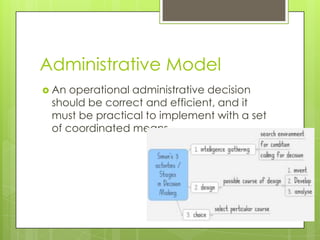
 An operational administrative decision
 should be correct and efficient, and it
 must be practical to implement with a set
 of coordinated means.
Descriptive Theory
   Theory of choice
   Describes how the decision is made and what
    people will actually do in the decision-making
    process
   Similification of the choices is done to be as
    rational as possible
   Three models of this are common:
       Garbage can model
       Political model
       Incremental model
Garbage Can Model
   Michael D Cohen, Michigan
   James March, Stanford
   Johan P. Olsen, U. of Bergden
   Together they published the paper; A Garbage
    Can Model of Organizational Choice.
   The paper, frequently cited, describes a model
    which disconnects problems, solutions and
    decision makers from each other.
   novel approach compared to traditional decision
    theory
   Model separates the problem, the players and the
    solution
Incremental Model
 Wayne  K Hoy, The Ohio State U
 John Tarter, University of Alabama
 Theory allows the leader to make
  decisions as small increments in order to
  avoid negative consequences
 “baby steps”
Mixed Scanning Model
 Amitai   Etzioni, The George Washington
  Univ.
 Often called the “third” model
 Combines flexibility of incremental model
  to the rationality of satisficing model
 Forces leaders to continue to question
  how their decisions will continue to move
  the organization (schoolhouse) towards
  and not away from the mission
Normative Theory: Vroom-
Yetton Model
 Victor  Vroom, Yale
 Phillip Yetton
 Model distinguishes between individual
  decision making and group decision
  making
 Model suggests when to involve others in
  the decision making process
 5 decision making procedures
5 decision making procedures
   1. Totally autocratic
       Leaders make their own decisions
   2. Autocratic with Assistance
       Leaders receive information from the followers
   3. Consultative with individual(s)
       Leaders interact with followers and share some information,
        solicits ideas and listens to opinions of the followers
   4. Consultative with Group
       Leaders interact with the followers as a group, shares some
        information, solicits ideas and listens to the opinions
   5. Group Decision
       Leader interacts with the followers as a group, shares some
        information about the problem, solicits ideas, and listens to the
        opinions, and then seeks to reach a consensus on the decision.
Normative Theory: Vroom-
Jago Model
    Redesigned with Arthur Jago
    Model is basically the same but adds two critical
     factors in the decision making process:
1.     If a decision needs to be made quickly, then
       selecting a particpation style may be
       counterproductive
2.     If followers have the skills and attributes
       necessary for participating in the decision
       making process, then, under certain conditions,
       they should be invited, particularly if an
       immediate decision is not necessary. The
       followers’ participation could enhance decision
       quality and acceptance.
Political Theory
 Decision  making tool when organizational
  goals are replaced by personal influence
  and power is the overriding force
 The power and influence of individuals
  and/or groups become the overriding
  goals and not those of the organization.
 Conflict, bargaining and game-playing
  are often seen in this environment

Presentation theory

  • 2.
    Motivate, Decide, Activate! Motivational and Decision MakingTheories that affect the school leaders
  • 3.
    Motivational Hygiene Theory  FrederickHerzberg  Born in MA, attended City College of NY, then Army, then graduated from CCNY  Taught at U of Pitt and Case Western Motivator Factors Hygiene Factors •Achievement •Pay and Benefits •Recognition •Company Policy and •Work Itself Administration •Responsibility •Relationships with co-workers •Promotion •Supervision •Growth
  • 4.
    Motivational Hygiene Theory Two Factor Theory  Hygiene needs are cyclical in nature and come back to a starting point. This leads to the "What have you done for me lately?" syndrome.  Hygiene needs have an escalating zero point and no final answer
  • 5.
    Theory X andTheory Y  Douglas McGregor  PhD in psychology from Harvard  In the book The Human Side of Enterprise, identified an approach of creating an environment within which employees are motivated via authoritative, direction and control or integration and self-control, which he called theory X and theory Y
  • 6.
    Theory X andTheory Y  Theory X:  In this theory, which has been proven counter effective in most modern practice, management assumes employees are inherently lazy and will avoid work if they can and that they inherently dislike work. Requires a strong hierarchical structure with several checkpoints.  Theory Y:  In this theory, management assumes employees may be ambitious and self-motivated and exercise self-control. It is believed that employees enjoy their mental and physical work duties. According to them work is as natural as play. They can creatively problem solve on their own. Requires a manager willing to let others succeed on their own.
  • 7.
    Administrative Model  Herbert Simon, well respected in several areas of study; organization sociology, psychology, decision making theory, economist, political science and computer science  Professor at Carnegie Melon University  Administrative Behavior, 1947, based on his doctoral dissertation  The centerpiece of this book is the behavioral and cognitive processes of making rational human choices, that is, decisions.
  • 8.
    Administrative Model  Anoperational administrative decision should be correct and efficient, and it must be practical to implement with a set of coordinated means.
  • 9.
    Descriptive Theory  Theory of choice  Describes how the decision is made and what people will actually do in the decision-making process  Similification of the choices is done to be as rational as possible  Three models of this are common:  Garbage can model  Political model  Incremental model
  • 10.
    Garbage Can Model  Michael D Cohen, Michigan  James March, Stanford  Johan P. Olsen, U. of Bergden  Together they published the paper; A Garbage Can Model of Organizational Choice.  The paper, frequently cited, describes a model which disconnects problems, solutions and decision makers from each other.  novel approach compared to traditional decision theory  Model separates the problem, the players and the solution
  • 11.
    Incremental Model  Wayne K Hoy, The Ohio State U  John Tarter, University of Alabama  Theory allows the leader to make decisions as small increments in order to avoid negative consequences  “baby steps”
  • 12.
    Mixed Scanning Model Amitai Etzioni, The George Washington Univ.  Often called the “third” model  Combines flexibility of incremental model to the rationality of satisficing model  Forces leaders to continue to question how their decisions will continue to move the organization (schoolhouse) towards and not away from the mission
  • 13.
    Normative Theory: Vroom- YettonModel  Victor Vroom, Yale  Phillip Yetton  Model distinguishes between individual decision making and group decision making  Model suggests when to involve others in the decision making process  5 decision making procedures
  • 14.
    5 decision makingprocedures  1. Totally autocratic  Leaders make their own decisions  2. Autocratic with Assistance  Leaders receive information from the followers  3. Consultative with individual(s)  Leaders interact with followers and share some information, solicits ideas and listens to opinions of the followers  4. Consultative with Group  Leaders interact with the followers as a group, shares some information, solicits ideas and listens to the opinions  5. Group Decision  Leader interacts with the followers as a group, shares some information about the problem, solicits ideas, and listens to the opinions, and then seeks to reach a consensus on the decision.
  • 15.
    Normative Theory: Vroom- JagoModel  Redesigned with Arthur Jago  Model is basically the same but adds two critical factors in the decision making process: 1. If a decision needs to be made quickly, then selecting a particpation style may be counterproductive 2. If followers have the skills and attributes necessary for participating in the decision making process, then, under certain conditions, they should be invited, particularly if an immediate decision is not necessary. The followers’ participation could enhance decision quality and acceptance.
  • 16.
    Political Theory  Decision making tool when organizational goals are replaced by personal influence and power is the overriding force  The power and influence of individuals and/or groups become the overriding goals and not those of the organization.  Conflict, bargaining and game-playing are often seen in this environment