CHAPTER 3
RESEARCH
METHOD AND
PROCEDURES
Learning
Objectives
At the end of the lesson, the
students should be able to:
1. Identify the different parts of
chapter 3,
2. Determine the importance
of each part in crafting a
research paper, and
3. Evaluate what
methodology is applicable
in their paper.
RESEARCH METHODOLOGY
Parts of
chapter 3
1.Research Design
2.Locale of the Study
3.Population and
Sampling Technique
4.Data Gathering
Procedure
5.Research Instrument
6.Statistical Treatment
of Data
03/15/2021 RESEARCH METHODOLOGY 3
Research Design
Research Design
03/15/2021 RESEARCH METHODOLOGY 5
•It refers to a scheme or plan of action for
meeting the objectives
•A blueprint for conducting a study that
maximize control over factors that could
interfere with the validity of the findings.
Types of Basic Research Design
03/15/2021 RESEARCH METHODOLOGY 6
1.Descriptive Design
2.Experimental Design
3.Qualitative Method
1. Descriptive Design
03/15/2021 RESEARCH METHODOLOGY 7
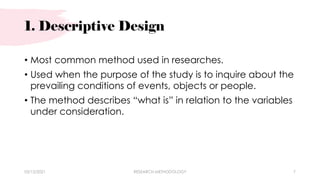
• Most common method used in researches.
• Used when the purpose of the study is to inquire about the
prevailing conditions of events, objects or people.
• The method describes “what is” in relation to the variables
under consideration.
Characteristics of Descriptive Research
03/15/2021 RESEARCH METHODOLOGY 8
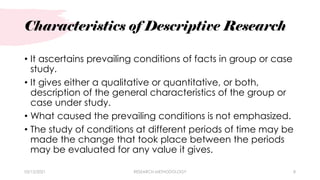
• It ascertains prevailing conditions of facts in group or case
study.
• It gives either a qualitative or quantitative, or both,
description of the general characteristics of the group or
case under study.
• What caused the prevailing conditions is not emphasized.
• The study of conditions at different periods of time may be
made the change that took place between the periods
may be evaluated for any value it gives.
Characteristics of Descriptive Research
03/15/2021 RESEARCH METHODOLOGY 9
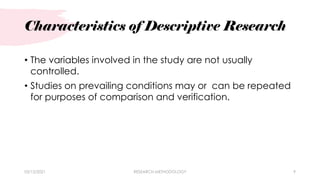
• The variables involved in the study are not usually
controlled.
• Studies on prevailing conditions may or can be repeated
for purposes of comparison and verification.
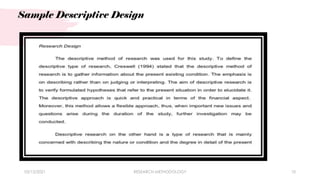
Sample Descriptive Design
03/15/2021 RESEARCH METHODOLOGY 10
2. Experimental Design
03/15/2021 RESEARCH METHODOLOGY 11
• 1 central characteristics:
- manipulating the independent variable and
measuring the effect on the dependent variable
• the classical experimental designs consist of h the
experimental group and the controlled group.
Experimental Group
03/15/2021 RESEARCH METHODOLOGY 12
- Independent variable that can be manipulated
- While in the control group, the dependent variable is
measured when no alteration has been made on the
dependent variable.
Control group
03/15/2021 RESEARCH METHODOLOGY 13
• The dependent variable is measures in the experimental
group the same way, and at the same time, as in the
control group.
03/15/2021 RESEARCH METHODOLOGY 14
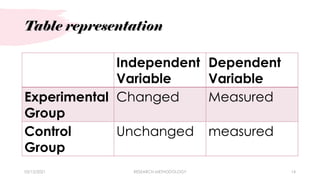
Independent
Variable
Dependent
Variable
Experimental
Group
Changed Measured
Control
Group
Unchanged measured
Table representation
3. Qualitative Method
03/15/2021 RESEARCH METHODOLOGY 15
1. Historical Method
2. Ethnographic Method
3. Phenomenological Method
03/15/2021 RESEARCH METHODOLOGY 16
1. Historical Method – the objective is to
interpret events in the light of the present
situation
2. Ethnographic Method – defined as the
environment or setting where the behavior
occurs.
3. Phenomenological Method – described as an
approach in sociology that is based on
human character as the subject matter of the
discipline.
Locale of the study
Locale of the Study
03/15/2021 RESEARCH METHODOLOGY 18
•The setting of the study.
Research Locale example
03/15/2021 RESEARCH METHODOLOGY 19
• The study will be conducted in the Philippines. The
respondents will be interviewed in their houses or any
comfortable place that the respondent will choose to. The
researchers also gathered respondents residing in USA.
These respondents will be interviewed via video chat. The
researchers chose the place of implementation because it
will give the researchers the needed information for people
with spina bifida. The study will be conducted in the first
semester of the academic year 2016-2017.
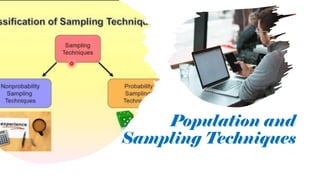
Population and
Sampling Techniques
Population/Universe:
03/15/2021 RESEARCH METHODOLOGY 21
- in statistics denotes the aggregate from
which sample (items) is to be taken.
- A population can be defined as including all
people or items with the characteristic one
wishes to understand.
03/15/2021 RESEARCH METHODOLOGY 22
-Sampling frame is the list from which
the potential respondents are drawn .
-A sample is “a smaller (but hopefully
representative) collection of units from
a population used to determine truths
about that population” (Field, 2005)
Sampling
03/15/2021 RESEARCH METHODOLOGY 23
- Sampling: the process of learning about population on
the basis of sample drawn from it.
Three elements in process of sampling:
- Selecting the sample
- Collecting the information
- Making inference about population
24
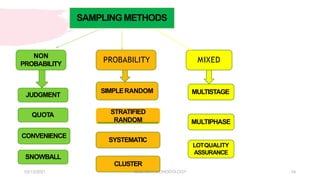
SAMPLINGMETHODS
NON
PROBABILITY
PROBABILITY MIXED
JUDGMENT
QUOTA
CONVENIENCE
SNOWBALL
SIMPLERANDOM
STRATIFIED
RANDOM
SYSTEMATIC
CLUSTER
MULTISTAGE
MULTIPHASE
LOTQUALITY
ASSURANCE
03/15/2021 RESEARCH METHODOLOGY
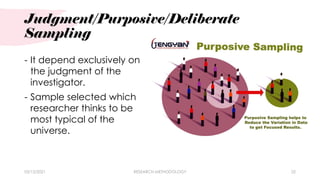
Judgment/Purposive/Deliberate
Sampling
03/15/2021 RESEARCH METHODOLOGY 25
- It depend exclusively on
the judgment of the
investigator.
- Sample selected which
researcher thinks to be
most typical of the
universe.
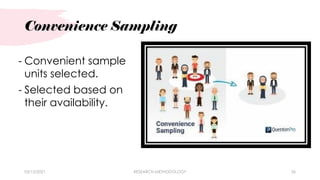
Convenience Sampling
03/15/2021 RESEARCH METHODOLOGY 26
- Convenient sample
units selected.
- Selected based on
their availability.
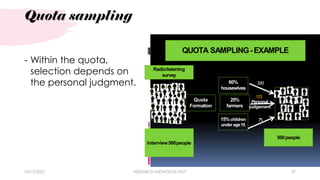
Quota sampling
03/15/2021 RESEARCH METHODOLOGY 27
- Within the quota,
selection depends on
the personal judgment.
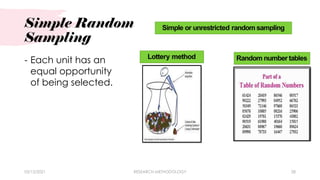
Simple Random
Sampling
03/15/2021 RESEARCH METHODOLOGY 28
- Each unit has an
equal opportunity
of being selected.
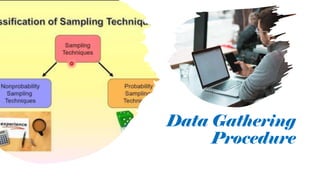
Data Gathering
Procedure
Data Gathering Procedure
03/15/2021 RESEARCH METHODOLOGY 30
- Data collection is defined as the procedure of collecting,
measuring and analyzing accurate insights for research
using standard validated techniques.. In most cases, data
collection is the primary and most important step for
research, irrespective of the field of research. The
approach of data collection is different for different fields
of study, depending on the required information.
Research Instrument
Research Instrument
03/15/2021 RESEARCH METHODOLOGY 32
- A research instrument is a tool used to
obtain, measure, and analyze data from
subjects around the research topic. You
need to decide the instrument to use based
on the type of study you are conducting:
quantitative, qualitative, or mixed-method.
It can be Questionnaire, interview,
observation, or checklist.
Questionnaire
03/15/2021 RESEARCH METHODOLOGY 33
- The most common instrument or tool of research for
obtaining the data.
1. Closed form – it has fixed number of questions and a
limited choice of answer. The respondents should
choose one or more suitable answers.
2. Open form – it consist a number of questions. The
answers are in the form of essay and the content may
vary depending on the respondents.
Interview
03/15/2021 RESEARCH METHODOLOGY 34
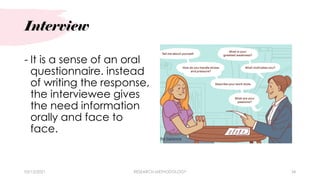
- It is a sense of an oral
questionnaire. instead
of writing the response,
the interviewee gives
the need information
orally and face to
face.
Checklist
03/15/2021 RESEARCH METHODOLOGY 35
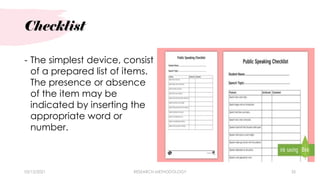
- The simplest device, consist
of a prepared list of items.
The presence or absence
of the item may be
indicated by inserting the
appropriate word or
number.
Observation
03/15/2021 RESEARCH METHODOLOGY 36
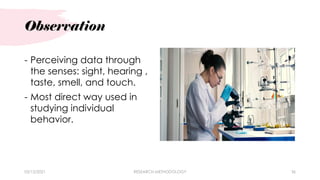
- Perceiving data through
the senses: sight, hearing ,
taste, smell, and touch.
- Most direct way used in
studying individual
behavior.
Statistical treatment
03/15/2021 RESEARCH METHODOLOGY 38
- Is a way of removing researcher bias by interpreting the
data statistically rather than subjectively.
- Statistical treatment of data is essential in order to make
use of the data in the right form. Raw data collection is
only one aspect of any experiment; the organization of
data is equally important so that appropriate conclusions
can be drawn. This is what statistical treatment of data is
all about.
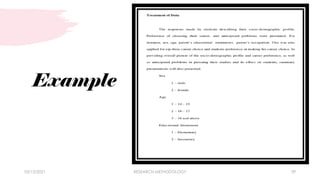
Example
03/15/2021 RESEARCH METHODOLOGY 39
The way to get started
is to quit talking and
begin doing.
Walt Disney
03/15/2021 RESEARCH METHODOLOGY 40

Chapter 3 g10 Research Method and Procedure

  • 1.
  • 2.
    Learning Objectives At the endof the lesson, the students should be able to: 1. Identify the different parts of chapter 3, 2. Determine the importance of each part in crafting a research paper, and 3. Evaluate what methodology is applicable in their paper. RESEARCH METHODOLOGY
  • 3.
    Parts of chapter 3 1.ResearchDesign 2.Locale of the Study 3.Population and Sampling Technique 4.Data Gathering Procedure 5.Research Instrument 6.Statistical Treatment of Data 03/15/2021 RESEARCH METHODOLOGY 3
  • 4.
  • 5.
    Research Design 03/15/2021 RESEARCHMETHODOLOGY 5 •It refers to a scheme or plan of action for meeting the objectives •A blueprint for conducting a study that maximize control over factors that could interfere with the validity of the findings.
  • 6.
    Types of BasicResearch Design 03/15/2021 RESEARCH METHODOLOGY 6 1.Descriptive Design 2.Experimental Design 3.Qualitative Method
  • 7.
    1. Descriptive Design 03/15/2021RESEARCH METHODOLOGY 7 • Most common method used in researches. • Used when the purpose of the study is to inquire about the prevailing conditions of events, objects or people. • The method describes “what is” in relation to the variables under consideration.
  • 8.
    Characteristics of DescriptiveResearch 03/15/2021 RESEARCH METHODOLOGY 8 • It ascertains prevailing conditions of facts in group or case study. • It gives either a qualitative or quantitative, or both, description of the general characteristics of the group or case under study. • What caused the prevailing conditions is not emphasized. • The study of conditions at different periods of time may be made the change that took place between the periods may be evaluated for any value it gives.
  • 9.
    Characteristics of DescriptiveResearch 03/15/2021 RESEARCH METHODOLOGY 9 • The variables involved in the study are not usually controlled. • Studies on prevailing conditions may or can be repeated for purposes of comparison and verification.
  • 10.
    Sample Descriptive Design 03/15/2021RESEARCH METHODOLOGY 10
  • 11.
    2. Experimental Design 03/15/2021RESEARCH METHODOLOGY 11 • 1 central characteristics: - manipulating the independent variable and measuring the effect on the dependent variable • the classical experimental designs consist of h the experimental group and the controlled group.
  • 12.
    Experimental Group 03/15/2021 RESEARCHMETHODOLOGY 12 - Independent variable that can be manipulated - While in the control group, the dependent variable is measured when no alteration has been made on the dependent variable.
  • 13.
    Control group 03/15/2021 RESEARCHMETHODOLOGY 13 • The dependent variable is measures in the experimental group the same way, and at the same time, as in the control group.
  • 14.
    03/15/2021 RESEARCH METHODOLOGY14 Independent Variable Dependent Variable Experimental Group Changed Measured Control Group Unchanged measured Table representation
  • 15.
    3. Qualitative Method 03/15/2021RESEARCH METHODOLOGY 15 1. Historical Method 2. Ethnographic Method 3. Phenomenological Method
  • 16.
    03/15/2021 RESEARCH METHODOLOGY16 1. Historical Method – the objective is to interpret events in the light of the present situation 2. Ethnographic Method – defined as the environment or setting where the behavior occurs. 3. Phenomenological Method – described as an approach in sociology that is based on human character as the subject matter of the discipline.
  • 17.
  • 18.
    Locale of theStudy 03/15/2021 RESEARCH METHODOLOGY 18 •The setting of the study.
  • 19.
    Research Locale example 03/15/2021RESEARCH METHODOLOGY 19 • The study will be conducted in the Philippines. The respondents will be interviewed in their houses or any comfortable place that the respondent will choose to. The researchers also gathered respondents residing in USA. These respondents will be interviewed via video chat. The researchers chose the place of implementation because it will give the researchers the needed information for people with spina bifida. The study will be conducted in the first semester of the academic year 2016-2017.
  • 20.
  • 21.
    Population/Universe: 03/15/2021 RESEARCH METHODOLOGY21 - in statistics denotes the aggregate from which sample (items) is to be taken. - A population can be defined as including all people or items with the characteristic one wishes to understand.
  • 22.
    03/15/2021 RESEARCH METHODOLOGY22 -Sampling frame is the list from which the potential respondents are drawn . -A sample is “a smaller (but hopefully representative) collection of units from a population used to determine truths about that population” (Field, 2005)
  • 23.
    Sampling 03/15/2021 RESEARCH METHODOLOGY23 - Sampling: the process of learning about population on the basis of sample drawn from it. Three elements in process of sampling: - Selecting the sample - Collecting the information - Making inference about population
  • 24.
  • 25.
    Judgment/Purposive/Deliberate Sampling 03/15/2021 RESEARCH METHODOLOGY25 - It depend exclusively on the judgment of the investigator. - Sample selected which researcher thinks to be most typical of the universe.
  • 26.
    Convenience Sampling 03/15/2021 RESEARCHMETHODOLOGY 26 - Convenient sample units selected. - Selected based on their availability.
  • 27.
    Quota sampling 03/15/2021 RESEARCHMETHODOLOGY 27 - Within the quota, selection depends on the personal judgment.
  • 28.
    Simple Random Sampling 03/15/2021 RESEARCHMETHODOLOGY 28 - Each unit has an equal opportunity of being selected.
  • 29.
  • 30.
    Data Gathering Procedure 03/15/2021RESEARCH METHODOLOGY 30 - Data collection is defined as the procedure of collecting, measuring and analyzing accurate insights for research using standard validated techniques.. In most cases, data collection is the primary and most important step for research, irrespective of the field of research. The approach of data collection is different for different fields of study, depending on the required information.
  • 31.
  • 32.
    Research Instrument 03/15/2021 RESEARCHMETHODOLOGY 32 - A research instrument is a tool used to obtain, measure, and analyze data from subjects around the research topic. You need to decide the instrument to use based on the type of study you are conducting: quantitative, qualitative, or mixed-method. It can be Questionnaire, interview, observation, or checklist.
  • 33.
    Questionnaire 03/15/2021 RESEARCH METHODOLOGY33 - The most common instrument or tool of research for obtaining the data. 1. Closed form – it has fixed number of questions and a limited choice of answer. The respondents should choose one or more suitable answers. 2. Open form – it consist a number of questions. The answers are in the form of essay and the content may vary depending on the respondents.
  • 34.
    Interview 03/15/2021 RESEARCH METHODOLOGY34 - It is a sense of an oral questionnaire. instead of writing the response, the interviewee gives the need information orally and face to face.
  • 35.
    Checklist 03/15/2021 RESEARCH METHODOLOGY35 - The simplest device, consist of a prepared list of items. The presence or absence of the item may be indicated by inserting the appropriate word or number.
  • 36.
    Observation 03/15/2021 RESEARCH METHODOLOGY36 - Perceiving data through the senses: sight, hearing , taste, smell, and touch. - Most direct way used in studying individual behavior.
  • 37.
  • 38.
    Statistical treatment 03/15/2021 RESEARCHMETHODOLOGY 38 - Is a way of removing researcher bias by interpreting the data statistically rather than subjectively. - Statistical treatment of data is essential in order to make use of the data in the right form. Raw data collection is only one aspect of any experiment; the organization of data is equally important so that appropriate conclusions can be drawn. This is what statistical treatment of data is all about.
  • 39.
  • 40.
    The way toget started is to quit talking and begin doing. Walt Disney 03/15/2021 RESEARCH METHODOLOGY 40