Tranquility Over Turbulence
Rob Keefer
@rbkeefer
@rbkeefer
Developer

User Advocate

Data Scientist
Craft Solid Software

Make People Awesome

Follow a Process
@rbkeefer
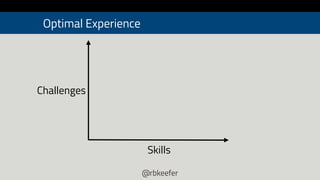
Optimal Experience
@rbkeefer
Optimal Experience
Challenges
Skills
@rbkeefer
Optimal Experience
Challenges
Skills
Anxiety
Boredom
Worry
Apathy
@rbkeefer
Optimal Experience
Challenges
Skills
FLOW
Anxiety
Boredom
Worry
Apathy
@rbkeefer
Optimal Experience
“Assembly of Japanese bicycle require great peace of mind.”
~ Robert Pirsig, Zen and the Art of Motorcycle Maintenance
@rbkeefer
Three Perspectives
User
TeamClient
@rbkeefer
Seven Principles for Peace of Mind
Things should Work as Expected
Always Know How Things Are Going
Quality is Baked In
Always Know How the Parts Relate to the Whole
Interaction should be Distraction Free
Things Go Better when Done with Others
Embrace Your Complexity and No One Else’s
@rbkeefer
Things Should Work
as Expected
@rbkeefer
Things Should Work as Expected
@rbkeefer
Expectations are premeditated disappointments.
Things Should Work as Expected
@rbkeefer
User Expectations of System Performance:
• Respond within one second to avoid interrupting a user’s flow of
thought
• Distraction and performance of other tasks if an application’s
response time exceeds ten seconds
• Complete sub-tasks in less than a minute
• Complete an entire task in less than ten minutes.
Things Should Work as Expected
Nielsen, J. (2009) Powers of 10: Time Scales in User Experience.
@rbkeefer
Manage Expectations:
•Align expectations with use
•Perception is reality
Things Should Work as Expected
Turner, S. (2008). Selling the Sizzle: The Importance of Managing Expectations. User Experience
Magazine, 7(2).
@rbkeefer
Unknown expectations will go unmet.
Things Should Work as Expected
@rbkeefer
Seven Principles for Peace of Mind
Things should Work as Expected
@rbkeefer
Always Know How Things
Are Going
@rbkeefer
Always Know How Things are Going
Tactical
Pivotal Strategic
@rbkeefer
Tactical: Daily standup meetings;
Quality measures
Pivotal: Relative progress toward cycle goals
Strategic: Frequency of production releases;
Backlog growth
Always Know How Things are Going
Applied to Agile Teams:
@rbkeefer
Tactical: Daily homework;
Test / quiz scores
Pivotal: Periodic grade cards
Strategic: Grade level completion;
Graduation
Applied to Children’s Grades:
Always Know How Things are Going
@rbkeefer
Seven Principles for Peace of Mind
Things should Work as Expected
Always Know How Things Are Going
@rbkeefer
Quality is Baked In
@rbkeefer
Quality is Baked In
@rbkeefer
Engineering Quality Measures:
• Correctness
• Reliability
• Robustness
• Integrity
• Efficiency
• Testability
• Maintainability
• Flexibility
• Resilience
• Portability
• Interoperability
• Generality
• Functionality
• Validity
• Etc.
Quality is Baked In
@rbkeefer
Users Measure Quality (SUS):
No Trust
Some Trust
Begrudging Use
Cynical Satisfaction
Basic Promises
Fulfilled
Fits
Environment
No Negative
Consequences Delights
Quality is Baked In
Bangor, A., et al. (2009) Determining what Individual SUS Scores Mean: Adding an Adjective
Rating Scale. Journal of Usability Studies, 4(3). pp. 114 - 123.
@rbkeefer
Quality is Baked In
Net Promoter Score:
Loyal
Enthusiasts
Satisfied /
Unenthusiastic
Unhappy Customers
@rbkeefer
Seven Principles for Peace of Mind
Things should Work as Expected
Always Know How Things Are Going
Quality is Baked In
@rbkeefer
Always Know How the
Parts Relate to the Whole
@rbkeefer
Always Know How the Parts Relate to the Whole
@rbkeefer
Always Know How the Parts Relate to the Whole
@rbkeefer
Organizations which design systems … are constrained
to produce designs which are copies of the
communication structures of these organizations.
~ Melvin Conway, 1967
Software Architecture
Always Know How the Parts Relate to the Whole
@rbkeefer
Always Know How the Parts Relate to the Whole
Information Architecture
Keefer, R. (2015) Creating a DoGo Map: A Step-by-Step Guide. User Experience Magazine.
February. Vol. 15(1). http://bit.ly/1zPyfZu
Keefer, R. (2015) Adapting Information Architecture for Lean and Agile Environments with
DoGo Mapping. UX Magazine. January. No. 1371. http://bit.ly/1DUV6Hh
@rbkeefer
Investors
Development
Team
Costs
Business Value Architecture
Always Know How the Parts Relate to the Whole
Users
Customers
Benefits
Keefer, R. (2018) Evidence-Based Story Mapping. User Experience Magazine, 18(2).
@rbkeefer
Seven Principles for Peace of Mind
Things should Work as Expected
Always Know How Things Are Going
Quality is Baked In
Always Know How the Parts Relate to the Whole
@rbkeefer
Interaction Should be
Distraction Free
@rbkeefer
Interaction Should be Distraction Free
@rbkeefer
Interaction Should be Distraction Free
Interruption of a task that required moderate to high
cognitive load had a significant impact on:
• the time required to complete the task
• levels of annoyance and anxiety
Bailey, B., et al. (2001) The Effects of Interruptions on Task Performance,Annoyance, and Anxiety in
the User Interface. Interact .Vol. 1.
Mark, G., et al. (2008) The Cost of Interrupted Work: More Speed and Stress. CHI 2008
Proceedings.
@rbkeefer
Interaction Should be Distraction Free
“I have sort of come to rely on interrupts. If I’m
not being interrupted, I don’t know what to do. I
have to generate an internal interrupt of some
sort to get me going.”
~ Manager
Hudson, J., et al. (2002) “I’d Be Overwhelmed, But It’s Just One More Thing to Do.:” Availability and
Interruption in Research Management. CHI 2002 Proceedings, 4(1).
@rbkeefer
Interaction Should be Distraction Free
“I used to be really good at keeping a list of things
to do, but once I became a manger, the list slowly
disappeared, and now I focus on whatever is in
front of me in the moment.”
~ Interview Participant
@rbkeefer
Interaction Should be Distraction Free
$300 Million Button
Spool, J. (2009) The $300 Million Button. https://articles.uie.com/three_hund_million_button/
@rbkeefer
Interaction Should be Distraction Free
$300 Million Button
Spool, J. (2009) The $300 Million Button. https://articles.uie.com/three_hund_million_button/
Skip
@rbkeefer
Seven Principles for Peace of Mind
Things should Work as Expected
Always Know How Things Are Going
Quality is Baked In
Always Know How the Parts Relate to the Whole
Interaction should be Distraction Free
@rbkeefer
Things Go Better When
Done with Others
@rbkeefer
Things Go Better when Done with Others
@rbkeefer
Start with ‘we’
Things Go Better when Done with Others
@rbkeefer
‘Make’ people get together
Start with ‘we’
Things Go Better when Done with Others
@rbkeefer
Begin with your next new hire
‘Make’ people get together
Start with ‘we’
Things Go Better when Done with Others
@rbkeefer
Seven Principles for Peace of Mind
Things should Work as Expected
Always Know How Things Are Going
Quality is Baked In
Always Know How the Parts Relate to the Whole
Interaction should be Distraction Free
Things Go Better when Done with Others
@rbkeefer
Embrace Your Complexity
and
No One Else’s
@rbkeefer
Embrace Your Complexity and No One Else’s
@rbkeefer
Admit that complexity exists
Embrace Your Complexity and No One Else’s
@rbkeefer
Determine who owns the complexity
Admit that complexity exists
Embrace Your Complexity and No One Else’s
@rbkeefer
If it’s your complexity - embrace it
Determine who owns the complexity
Admit that complexity exists
Embrace Your Complexity and No One Else’s
@rbkeefer
If it’s your complexity - embrace it
Determine who owns the complexity
Admit that complexity exists
Else - push back
Embrace Your Complexity and No One Else’s
@rbkeefer
Seven Principles for Peace of Mind
Things should Work as Expected
Always Know How Things Are Going
Quality is Baked In
Always Know How the Parts Relate to the Whole
Interaction should be Distraction Free
Things Go Better when Done with Others
Embrace Your Complexity and No One Else’s
@rbkeefer
Three Perspectives
User
TeamClient
@rbkeefer
Things should Work as Expected
User
TeamClient
Simple
Cohesive
Feedback
Tools
Tests
Environment
Integrity
Engaged
Quality
@rbkeefer
Always Know how Things are Going
User
TeamClient
Breadcrumbs
Clear Labels
Appropriate Navigation
Transparency
Clarity
Certainty
Test Results
Team Capacity
Build/Deploy Status
@rbkeefer
Quality is Baked In
User
TeamClient
“Just Works”
Assurance
Clear communication
Verify information architecture
Clarify taxonomy
Test interaction design
Code coverage (60% min)
Continuous integration/testing/deployment
Short concise methods
@rbkeefer
Always Know how the Parts are Related to the Whole
User
TeamClient
Impact of risks
Relate demo to release plan
Understand domain
Interactions affect domain
Understand architectures
Understand effect of change
@rbkeefer
Interaction should be Distraction Free
User
TeamClient
Low cost of failure
Limit use of pop-ups
Focus
Limit external distractions
Planned feedback
Published agenda
Finish early
Focused communication
@rbkeefer
Things Go Better when Done with Others
User
TeamClient
Identify all stakeholders
Invite stakeholders into
process
Identify primary interactions
Provide open communication
Open team communication
Direct contact with PO
Timely answers to questions
@rbkeefer
Embrace Your Complexity and No One Else’s
User
TeamClient
Embrace domain decisions
Shun technical complexity
Embrace domain complexity
Shun technical complexity
Embrace technical complexity
Shun domain decisions
@rbkeefer
Seven Principles for Peace of Mind
Things should Work as Expected
Always Know How Things Are Going
Quality is Baked In
Always Know How the Parts Relate to the Whole
Interaction should be Distraction Free
Things Go Better when Done with Others
Embrace Your Complexity and No One Else’s
@rbkeefer
References
• Bailey, B., et al. (2001) The Effects of Interruptions on Task Performance, Annoyance, and Anxiety in the User Interface. Interact . Vol. 1.
• Bangor, A., et al. (2009) Determining what Individual SUS Scores Mean: Adding an Adjective Rating Scale. Journal of Usability Studies,
4(3). pp. 114 - 123.
• Csikszentmihalyi, M. (1990). Flow: The psychology of optimal experience. New York: Harper & Row.
• Hudson, J., et al. (2002) “I’d Be Overwhelmed, But It’s Just One More Thing to Do.:” Availability and Interruption in Research
Management. CHI 2002 Proceedings, 4(1).
• Keefer, R. (2018) Evidence-Based Story Mapping. User Experience Magazine, 18(2). https://bit.ly/2PXESZv
• Keefer, R. (2015) Creating a DoGo Map: A Step-by-Step Guide. User Experience Magazine. February. Vol. 15(1). http://bit.ly/1zPyfZu
• Keefer, R. (2015) Adapting Information Architecture for Lean and Agile Environments with DoGo Mapping. UX Magazine. January. No.
1371. http://bit.ly/1DUV6Hh
• Keefer, R. (2014) Designing for Peace of Mind: Almost Getting to Flow. User Experience Magazine. Vol. 14(2). pp. 24-26. http://bit.ly/
1B6ZCTZ
• Mark, G., et al. (2008) The Cost of Interrupted Work: More Speed and Stress. CHI 2008 Proceedings.
• Matsudaira, K. (2018) Bad Software Architecture is a People Problem. Communications of the ACM, 59(9).
• Nielsen, J. (2009) Powers of 10: Time Scales in User Experience. https://www.nngroup.com/articles/powers-of-10-time-scales-in-ux/
• Spool, J. (2009) The $300 Million Button. https://articles.uie.com/three_hund_million_button/
• Turner, S. (2008). Selling the Sizzle: The Importance of Managing Expectations. User Experience Magazine, 7(2).
@rbkeefer
Rob Keefer, PhD
rob.keefer@ilwllc.com
Continue the Conversation

Tranquilty Over Tubulence

  • 1.
  • 2.
    @rbkeefer Developer User Advocate Data Scientist CraftSolid Software Make People Awesome Follow a Process
  • 3.
  • 4.
  • 5.
  • 6.
  • 7.
    @rbkeefer Optimal Experience “Assembly ofJapanese bicycle require great peace of mind.” ~ Robert Pirsig, Zen and the Art of Motorcycle Maintenance
  • 8.
  • 9.
    @rbkeefer Seven Principles forPeace of Mind Things should Work as Expected Always Know How Things Are Going Quality is Baked In Always Know How the Parts Relate to the Whole Interaction should be Distraction Free Things Go Better when Done with Others Embrace Your Complexity and No One Else’s
  • 10.
  • 11.
  • 12.
    @rbkeefer Expectations are premeditateddisappointments. Things Should Work as Expected
  • 13.
    @rbkeefer User Expectations ofSystem Performance: • Respond within one second to avoid interrupting a user’s flow of thought • Distraction and performance of other tasks if an application’s response time exceeds ten seconds • Complete sub-tasks in less than a minute • Complete an entire task in less than ten minutes. Things Should Work as Expected Nielsen, J. (2009) Powers of 10: Time Scales in User Experience.
  • 14.
    @rbkeefer Manage Expectations: •Align expectationswith use •Perception is reality Things Should Work as Expected Turner, S. (2008). Selling the Sizzle: The Importance of Managing Expectations. User Experience Magazine, 7(2).
  • 15.
    @rbkeefer Unknown expectations willgo unmet. Things Should Work as Expected
  • 16.
    @rbkeefer Seven Principles forPeace of Mind Things should Work as Expected
  • 17.
    @rbkeefer Always Know HowThings Are Going
  • 18.
    @rbkeefer Always Know HowThings are Going Tactical Pivotal Strategic
  • 19.
    @rbkeefer Tactical: Daily standupmeetings; Quality measures Pivotal: Relative progress toward cycle goals Strategic: Frequency of production releases; Backlog growth Always Know How Things are Going Applied to Agile Teams:
  • 20.
    @rbkeefer Tactical: Daily homework; Test/ quiz scores Pivotal: Periodic grade cards Strategic: Grade level completion; Graduation Applied to Children’s Grades: Always Know How Things are Going
  • 21.
    @rbkeefer Seven Principles forPeace of Mind Things should Work as Expected Always Know How Things Are Going
  • 22.
  • 23.
  • 24.
    @rbkeefer Engineering Quality Measures: •Correctness • Reliability • Robustness • Integrity • Efficiency • Testability • Maintainability • Flexibility • Resilience • Portability • Interoperability • Generality • Functionality • Validity • Etc. Quality is Baked In
  • 25.
    @rbkeefer Users Measure Quality(SUS): No Trust Some Trust Begrudging Use Cynical Satisfaction Basic Promises Fulfilled Fits Environment No Negative Consequences Delights Quality is Baked In Bangor, A., et al. (2009) Determining what Individual SUS Scores Mean: Adding an Adjective Rating Scale. Journal of Usability Studies, 4(3). pp. 114 - 123.
  • 26.
    @rbkeefer Quality is BakedIn Net Promoter Score: Loyal Enthusiasts Satisfied / Unenthusiastic Unhappy Customers
  • 27.
    @rbkeefer Seven Principles forPeace of Mind Things should Work as Expected Always Know How Things Are Going Quality is Baked In
  • 28.
    @rbkeefer Always Know Howthe Parts Relate to the Whole
  • 29.
    @rbkeefer Always Know Howthe Parts Relate to the Whole
  • 30.
    @rbkeefer Always Know Howthe Parts Relate to the Whole
  • 31.
    @rbkeefer Organizations which designsystems … are constrained to produce designs which are copies of the communication structures of these organizations. ~ Melvin Conway, 1967 Software Architecture Always Know How the Parts Relate to the Whole
  • 32.
    @rbkeefer Always Know Howthe Parts Relate to the Whole Information Architecture Keefer, R. (2015) Creating a DoGo Map: A Step-by-Step Guide. User Experience Magazine. February. Vol. 15(1). http://bit.ly/1zPyfZu Keefer, R. (2015) Adapting Information Architecture for Lean and Agile Environments with DoGo Mapping. UX Magazine. January. No. 1371. http://bit.ly/1DUV6Hh
  • 33.
    @rbkeefer Investors Development Team Costs Business Value Architecture AlwaysKnow How the Parts Relate to the Whole Users Customers Benefits Keefer, R. (2018) Evidence-Based Story Mapping. User Experience Magazine, 18(2).
  • 34.
    @rbkeefer Seven Principles forPeace of Mind Things should Work as Expected Always Know How Things Are Going Quality is Baked In Always Know How the Parts Relate to the Whole
  • 35.
  • 36.
  • 37.
    @rbkeefer Interaction Should beDistraction Free Interruption of a task that required moderate to high cognitive load had a significant impact on: • the time required to complete the task • levels of annoyance and anxiety Bailey, B., et al. (2001) The Effects of Interruptions on Task Performance,Annoyance, and Anxiety in the User Interface. Interact .Vol. 1. Mark, G., et al. (2008) The Cost of Interrupted Work: More Speed and Stress. CHI 2008 Proceedings.
  • 38.
    @rbkeefer Interaction Should beDistraction Free “I have sort of come to rely on interrupts. If I’m not being interrupted, I don’t know what to do. I have to generate an internal interrupt of some sort to get me going.” ~ Manager Hudson, J., et al. (2002) “I’d Be Overwhelmed, But It’s Just One More Thing to Do.:” Availability and Interruption in Research Management. CHI 2002 Proceedings, 4(1).
  • 39.
    @rbkeefer Interaction Should beDistraction Free “I used to be really good at keeping a list of things to do, but once I became a manger, the list slowly disappeared, and now I focus on whatever is in front of me in the moment.” ~ Interview Participant
  • 40.
    @rbkeefer Interaction Should beDistraction Free $300 Million Button Spool, J. (2009) The $300 Million Button. https://articles.uie.com/three_hund_million_button/
  • 41.
    @rbkeefer Interaction Should beDistraction Free $300 Million Button Spool, J. (2009) The $300 Million Button. https://articles.uie.com/three_hund_million_button/ Skip
  • 42.
    @rbkeefer Seven Principles forPeace of Mind Things should Work as Expected Always Know How Things Are Going Quality is Baked In Always Know How the Parts Relate to the Whole Interaction should be Distraction Free
  • 43.
    @rbkeefer Things Go BetterWhen Done with Others
  • 44.
    @rbkeefer Things Go Betterwhen Done with Others
  • 45.
    @rbkeefer Start with ‘we’ ThingsGo Better when Done with Others
  • 46.
    @rbkeefer ‘Make’ people gettogether Start with ‘we’ Things Go Better when Done with Others
  • 47.
    @rbkeefer Begin with yournext new hire ‘Make’ people get together Start with ‘we’ Things Go Better when Done with Others
  • 48.
    @rbkeefer Seven Principles forPeace of Mind Things should Work as Expected Always Know How Things Are Going Quality is Baked In Always Know How the Parts Relate to the Whole Interaction should be Distraction Free Things Go Better when Done with Others
  • 49.
  • 50.
  • 51.
    @rbkeefer Admit that complexityexists Embrace Your Complexity and No One Else’s
  • 52.
    @rbkeefer Determine who ownsthe complexity Admit that complexity exists Embrace Your Complexity and No One Else’s
  • 53.
    @rbkeefer If it’s yourcomplexity - embrace it Determine who owns the complexity Admit that complexity exists Embrace Your Complexity and No One Else’s
  • 54.
    @rbkeefer If it’s yourcomplexity - embrace it Determine who owns the complexity Admit that complexity exists Else - push back Embrace Your Complexity and No One Else’s
  • 55.
    @rbkeefer Seven Principles forPeace of Mind Things should Work as Expected Always Know How Things Are Going Quality is Baked In Always Know How the Parts Relate to the Whole Interaction should be Distraction Free Things Go Better when Done with Others Embrace Your Complexity and No One Else’s
  • 56.
  • 57.
    @rbkeefer Things should Workas Expected User TeamClient Simple Cohesive Feedback Tools Tests Environment Integrity Engaged Quality
  • 58.
    @rbkeefer Always Know howThings are Going User TeamClient Breadcrumbs Clear Labels Appropriate Navigation Transparency Clarity Certainty Test Results Team Capacity Build/Deploy Status
  • 59.
    @rbkeefer Quality is BakedIn User TeamClient “Just Works” Assurance Clear communication Verify information architecture Clarify taxonomy Test interaction design Code coverage (60% min) Continuous integration/testing/deployment Short concise methods
  • 60.
    @rbkeefer Always Know howthe Parts are Related to the Whole User TeamClient Impact of risks Relate demo to release plan Understand domain Interactions affect domain Understand architectures Understand effect of change
  • 61.
    @rbkeefer Interaction should beDistraction Free User TeamClient Low cost of failure Limit use of pop-ups Focus Limit external distractions Planned feedback Published agenda Finish early Focused communication
  • 62.
    @rbkeefer Things Go Betterwhen Done with Others User TeamClient Identify all stakeholders Invite stakeholders into process Identify primary interactions Provide open communication Open team communication Direct contact with PO Timely answers to questions
  • 63.
    @rbkeefer Embrace Your Complexityand No One Else’s User TeamClient Embrace domain decisions Shun technical complexity Embrace domain complexity Shun technical complexity Embrace technical complexity Shun domain decisions
  • 64.
    @rbkeefer Seven Principles forPeace of Mind Things should Work as Expected Always Know How Things Are Going Quality is Baked In Always Know How the Parts Relate to the Whole Interaction should be Distraction Free Things Go Better when Done with Others Embrace Your Complexity and No One Else’s
  • 65.
    @rbkeefer References • Bailey, B.,et al. (2001) The Effects of Interruptions on Task Performance, Annoyance, and Anxiety in the User Interface. Interact . Vol. 1. • Bangor, A., et al. (2009) Determining what Individual SUS Scores Mean: Adding an Adjective Rating Scale. Journal of Usability Studies, 4(3). pp. 114 - 123. • Csikszentmihalyi, M. (1990). Flow: The psychology of optimal experience. New York: Harper & Row. • Hudson, J., et al. (2002) “I’d Be Overwhelmed, But It’s Just One More Thing to Do.:” Availability and Interruption in Research Management. CHI 2002 Proceedings, 4(1). • Keefer, R. (2018) Evidence-Based Story Mapping. User Experience Magazine, 18(2). https://bit.ly/2PXESZv • Keefer, R. (2015) Creating a DoGo Map: A Step-by-Step Guide. User Experience Magazine. February. Vol. 15(1). http://bit.ly/1zPyfZu • Keefer, R. (2015) Adapting Information Architecture for Lean and Agile Environments with DoGo Mapping. UX Magazine. January. No. 1371. http://bit.ly/1DUV6Hh • Keefer, R. (2014) Designing for Peace of Mind: Almost Getting to Flow. User Experience Magazine. Vol. 14(2). pp. 24-26. http://bit.ly/ 1B6ZCTZ • Mark, G., et al. (2008) The Cost of Interrupted Work: More Speed and Stress. CHI 2008 Proceedings. • Matsudaira, K. (2018) Bad Software Architecture is a People Problem. Communications of the ACM, 59(9). • Nielsen, J. (2009) Powers of 10: Time Scales in User Experience. https://www.nngroup.com/articles/powers-of-10-time-scales-in-ux/ • Spool, J. (2009) The $300 Million Button. https://articles.uie.com/three_hund_million_button/ • Turner, S. (2008). Selling the Sizzle: The Importance of Managing Expectations. User Experience Magazine, 7(2).
  • 66.