Bulut Nesim
DoIT Application Development & Integration
Project Management Office
Needs driven solution design
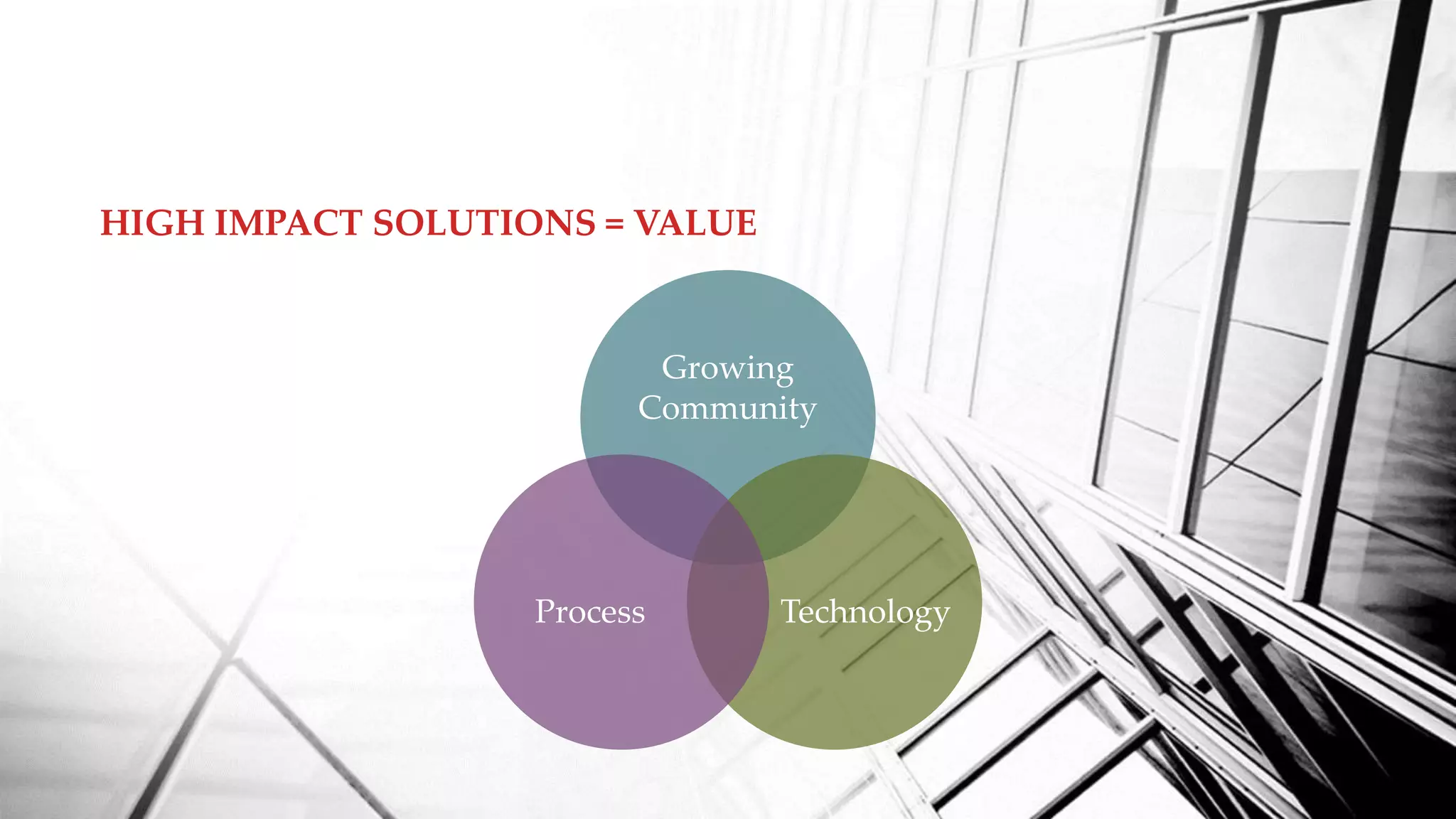
HIGH IMPACT SOLUTIONS = VALUE
Growing
Community
TechnologyProcess
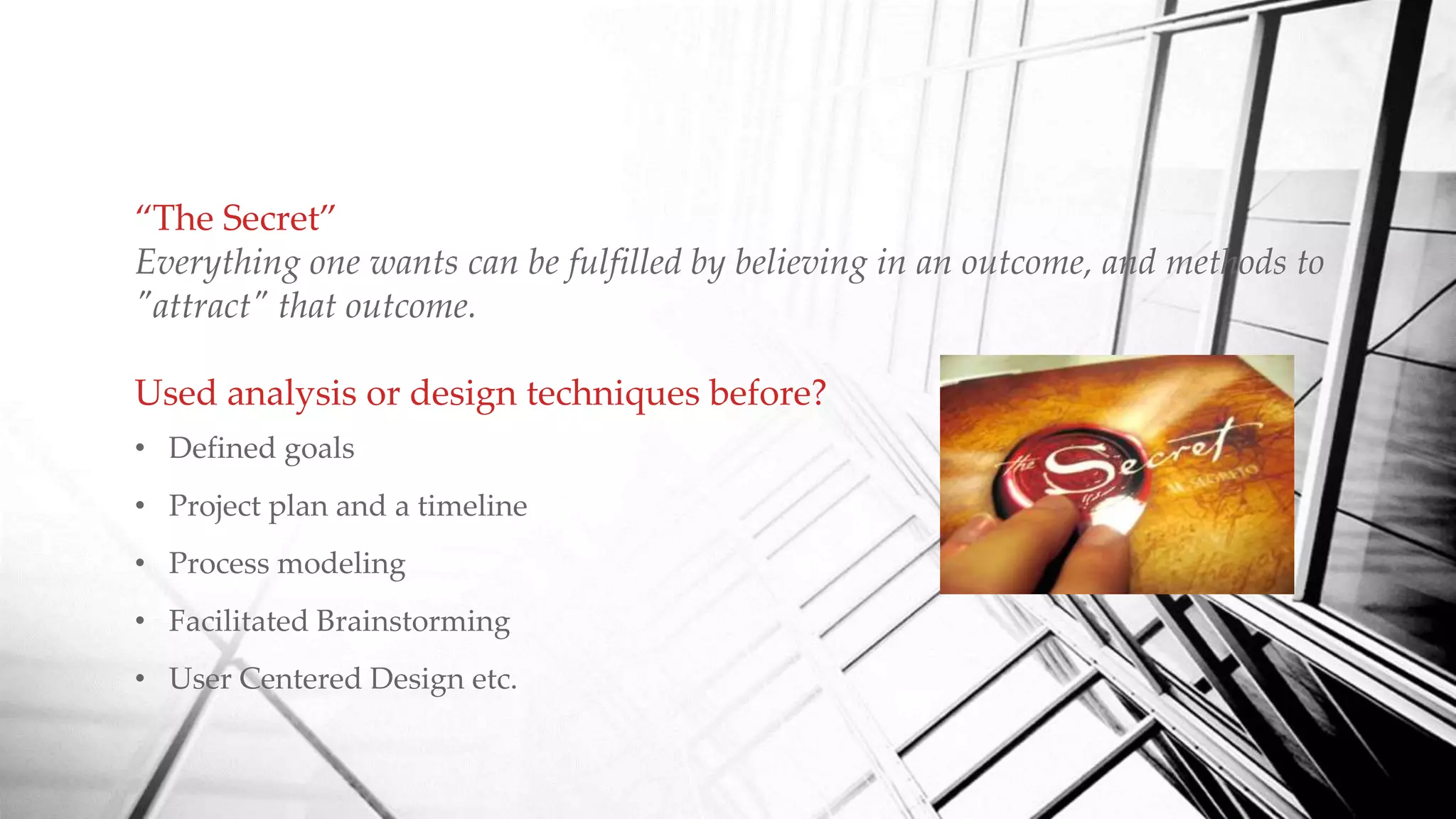
“The Secret”
Everything one wants can be fulfilled by believing in an outcome, and methods to
"attract" that outcome.
Used analysis or design techniques before?
• Defined goals
• Project plan and a timeline
• Process modeling
• Facilitated Brainstorming
• User Centered Design etc.
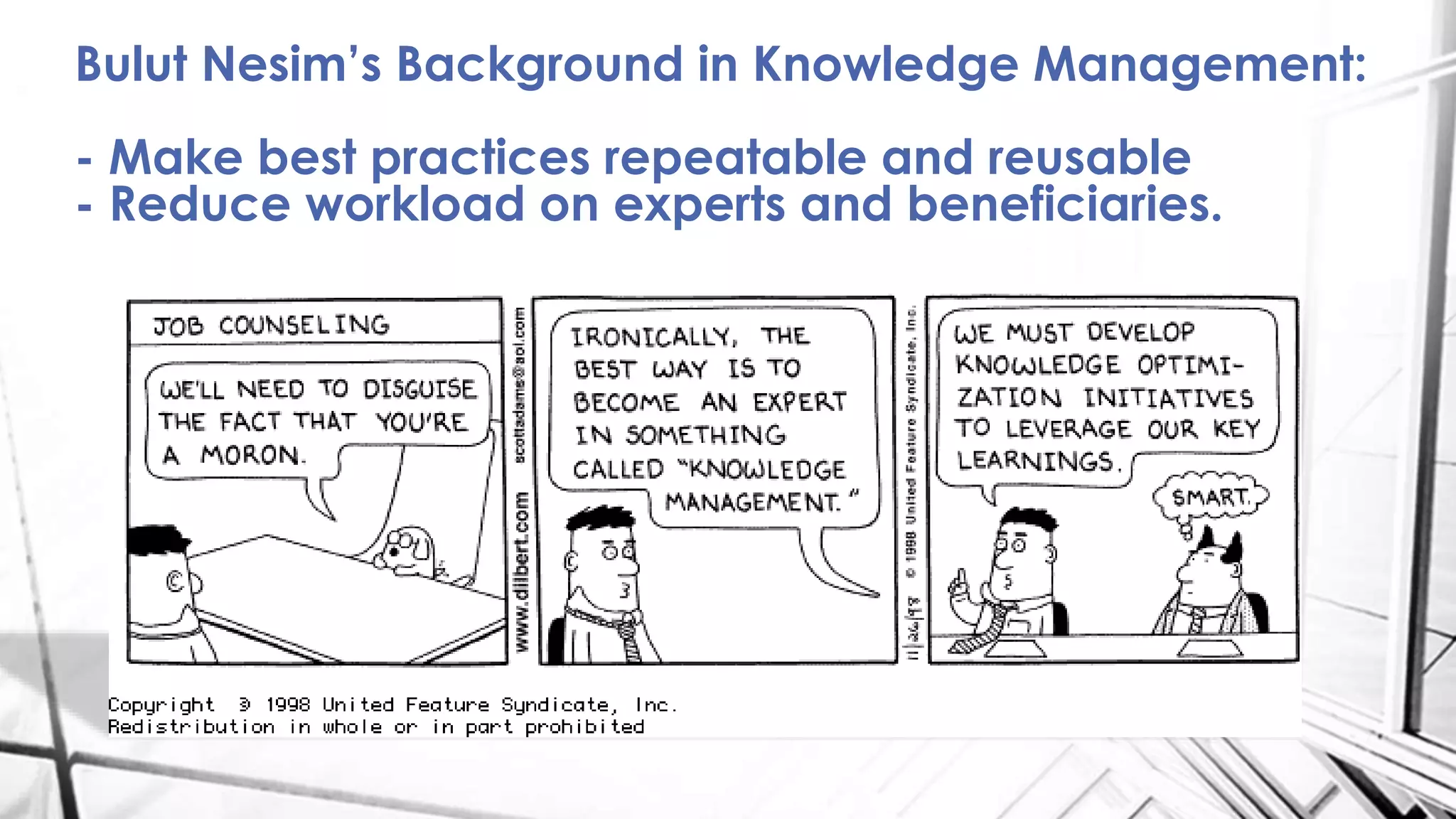
Bulut Nesim’s Background in Knowledge Management:
- Make best practices repeatable and reusable
- Reduce workload on experts and beneficiaries.
• Experience includes intellectual capital management, CRM, portals, web
analytics, e-commerce, security, data warehousing, software product management
• 8 years as software engineer
• 8 years as a project/program manager
• 5 years as a business analyst
• Very excited to be at DoIT
• Delivered many solutions in 18 industries which align well with various UW organizations.
• Strengths and Passions
• Focus on “long term strategy and the big picture” while delivering “near term increments”.
• Motivated to solve the world’s problems through social business solutions
• i.e. bring people closer through networking, collaboration, knowledge sharing, and learning.
• Creative software, tools, world music, photography, videography, cooking, outdoors.
Bulut Nesim’s Background
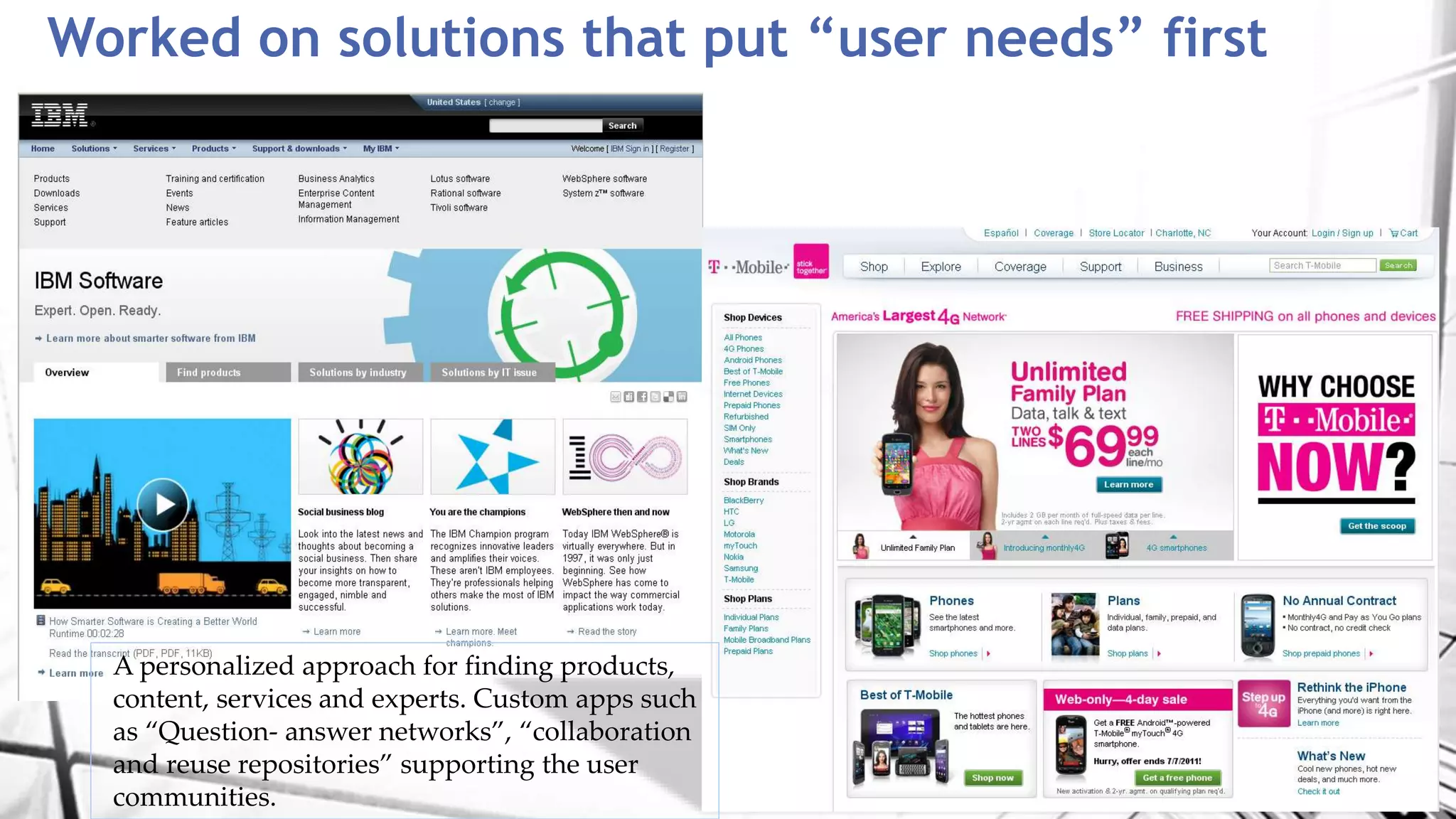
Worked on solutions that put “user needs” first
A personalized approach for finding products,
content, services and experts. Custom apps such
as “Question- answer networks”, “collaboration
and reuse repositories” supporting the user
communities.
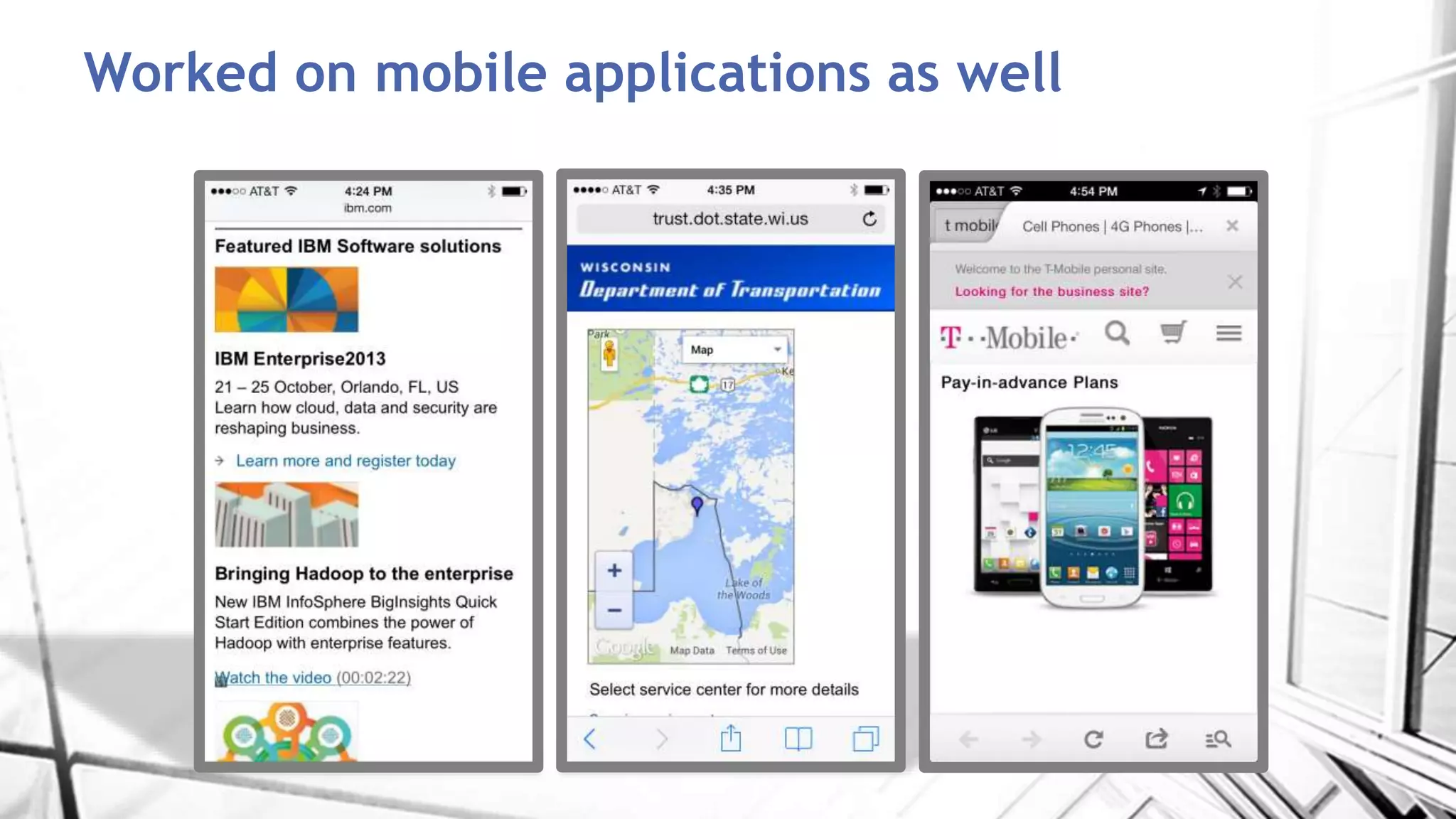
Worked on mobile applications as well
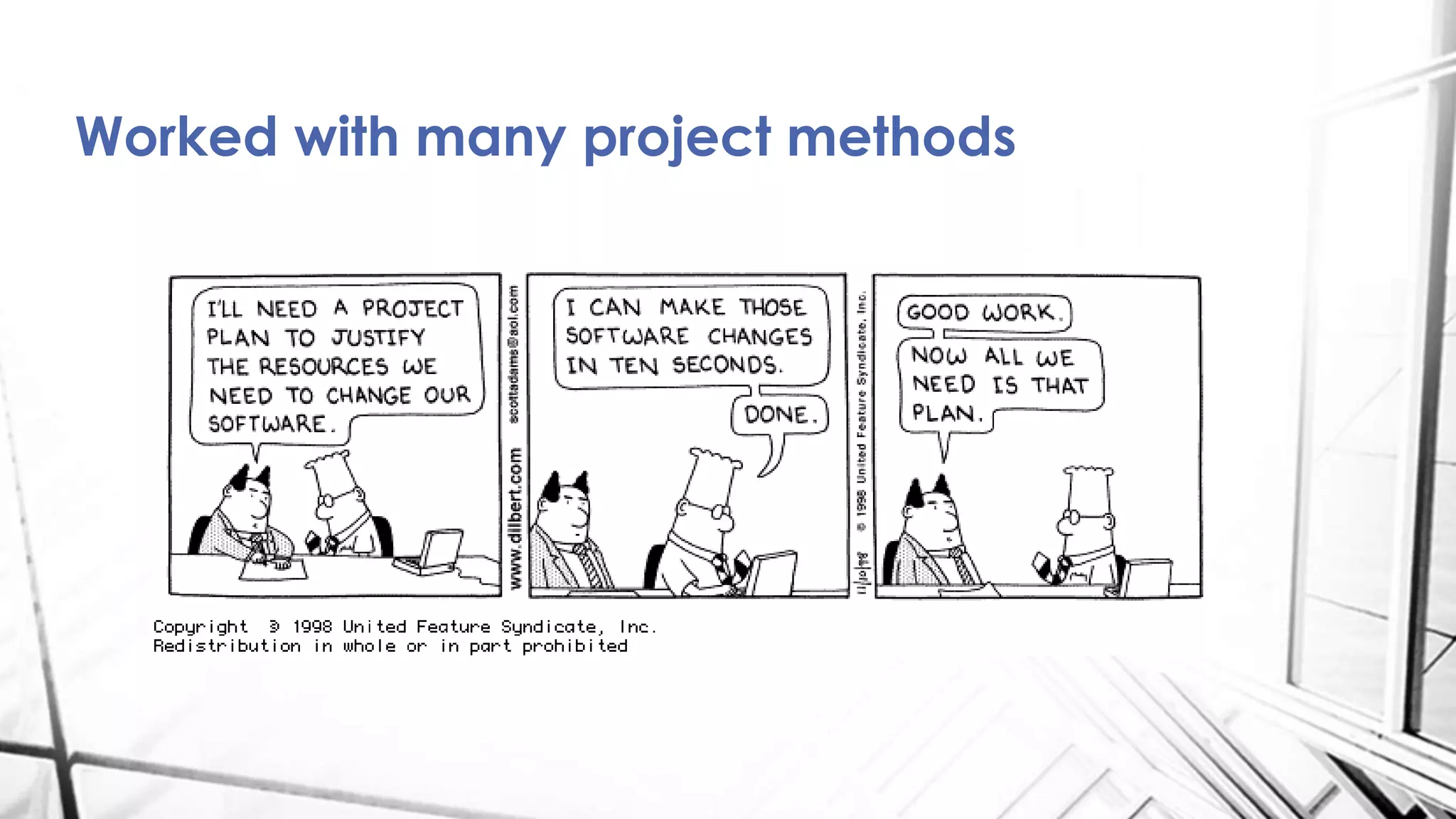
Worked with many project methods
"Common sense is not so common."
Voltaire, Dictionnaire Philosophique (1764)
- Need to work with people to reach a conclusion
most people can accept
A guiding principle
“While we are working through a
problem, the brain's tendency to stick
with familiar ideas can literally blind us
to superior solutions.”
By Merim Bilalić and Peter McLeod
Scientific American – March 2014
- In my experience, initial ideas might be
OK but they can be limiting
A guiding principle
One more guiding principle
“We are never going to be more ignorant
about this project than we are today. We’re
constantly learning.
And it’s not just about needs. It’s about
everything—team, technology, cost, value.”
Robert Merrill, DoIT ADI PMO
- We often need to answer tough questions
upfront such as scope, cost and timeline 
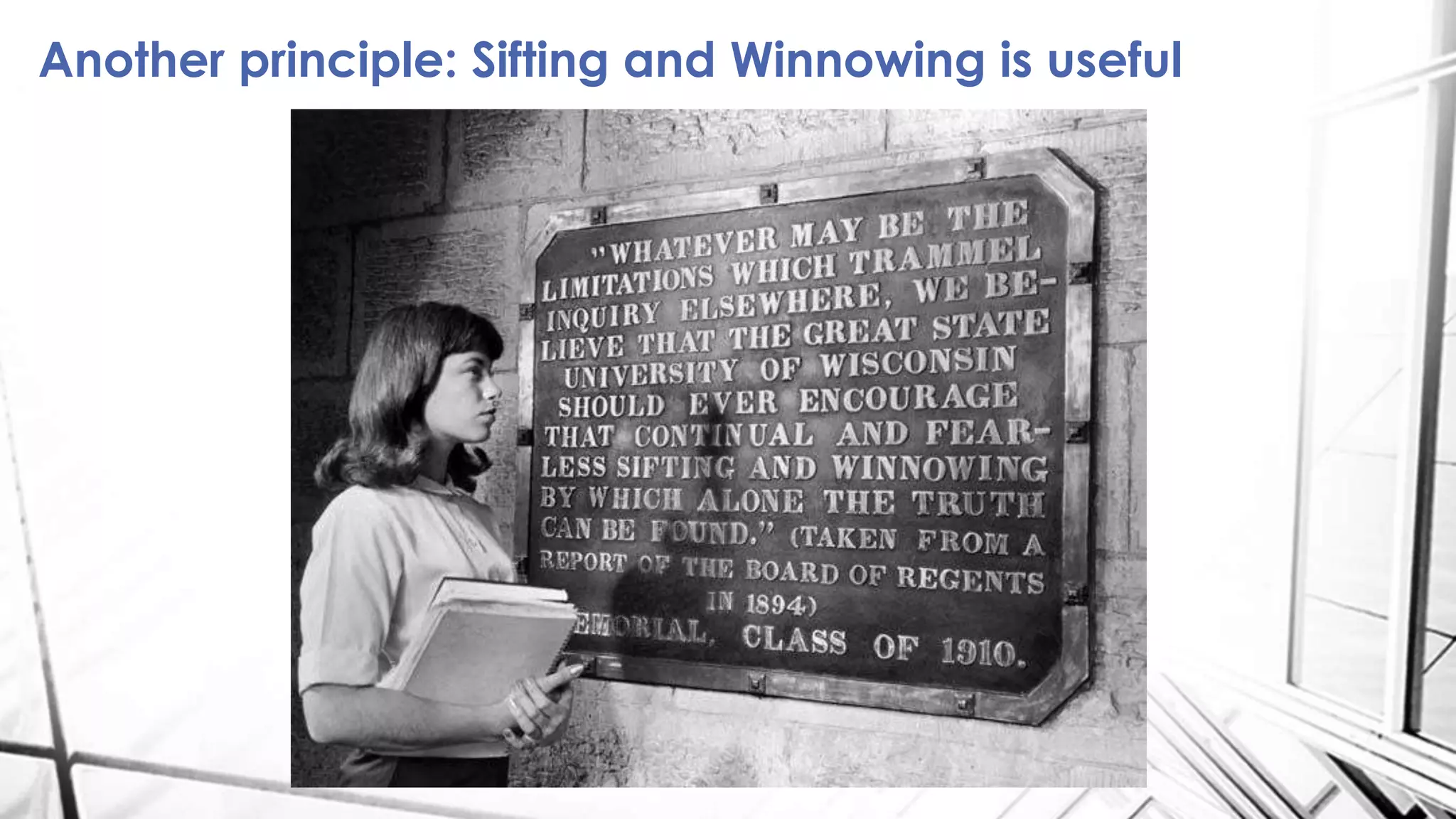
Another principle: Sifting and Winnowing is useful
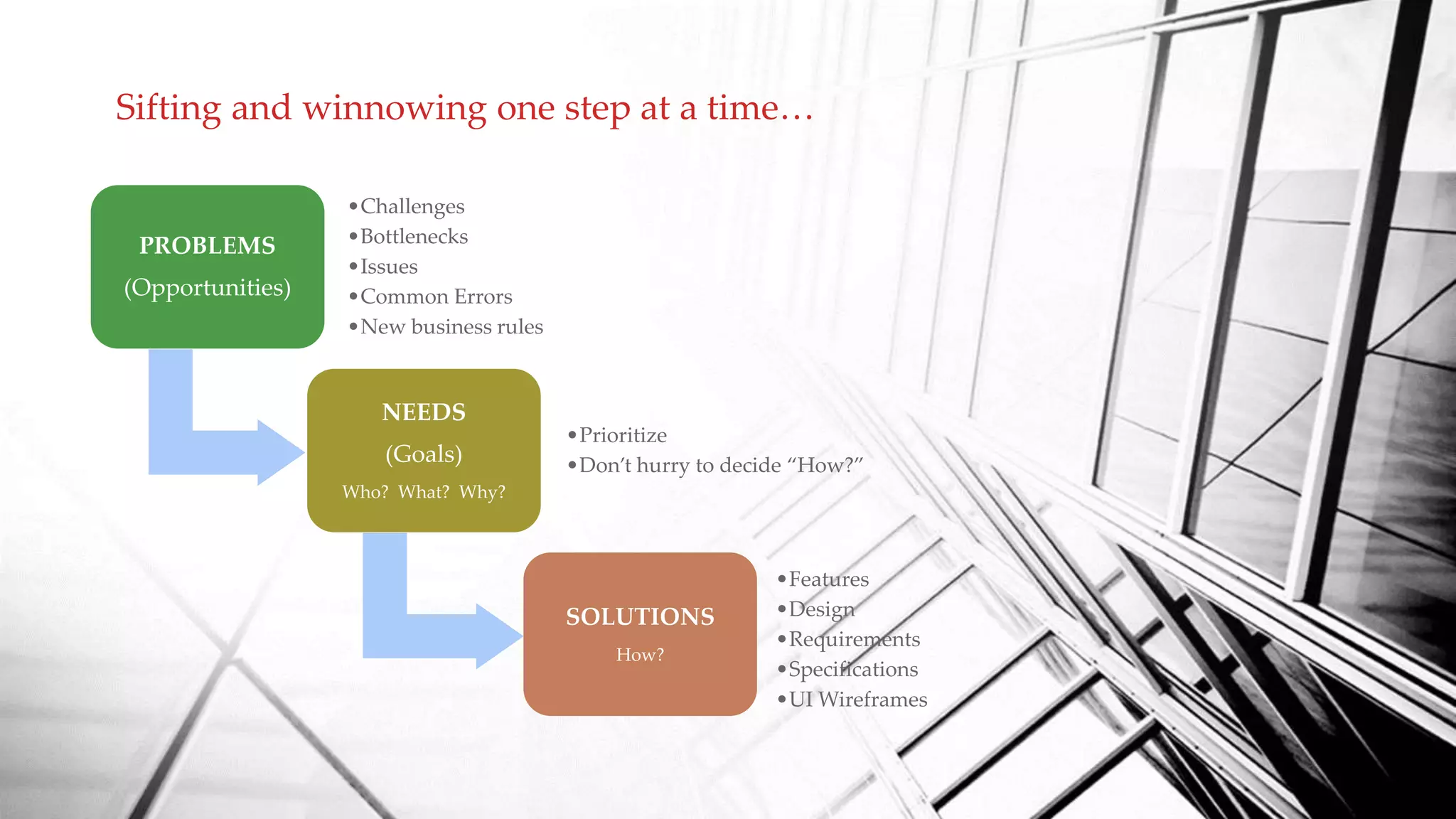
Sifting and winnowing one step at a time…
PROBLEMS
(Opportunities)
•Challenges
•Bottlenecks
•Issues
•Common Errors
•New business rules
NEEDS
(Goals)
Who? What? Why?
•Prioritize
•Don’t hurry to decide “How?”
SOLUTIONS
How?
•Features
•Design
•Requirements
•Specifications
•UI Wireframes
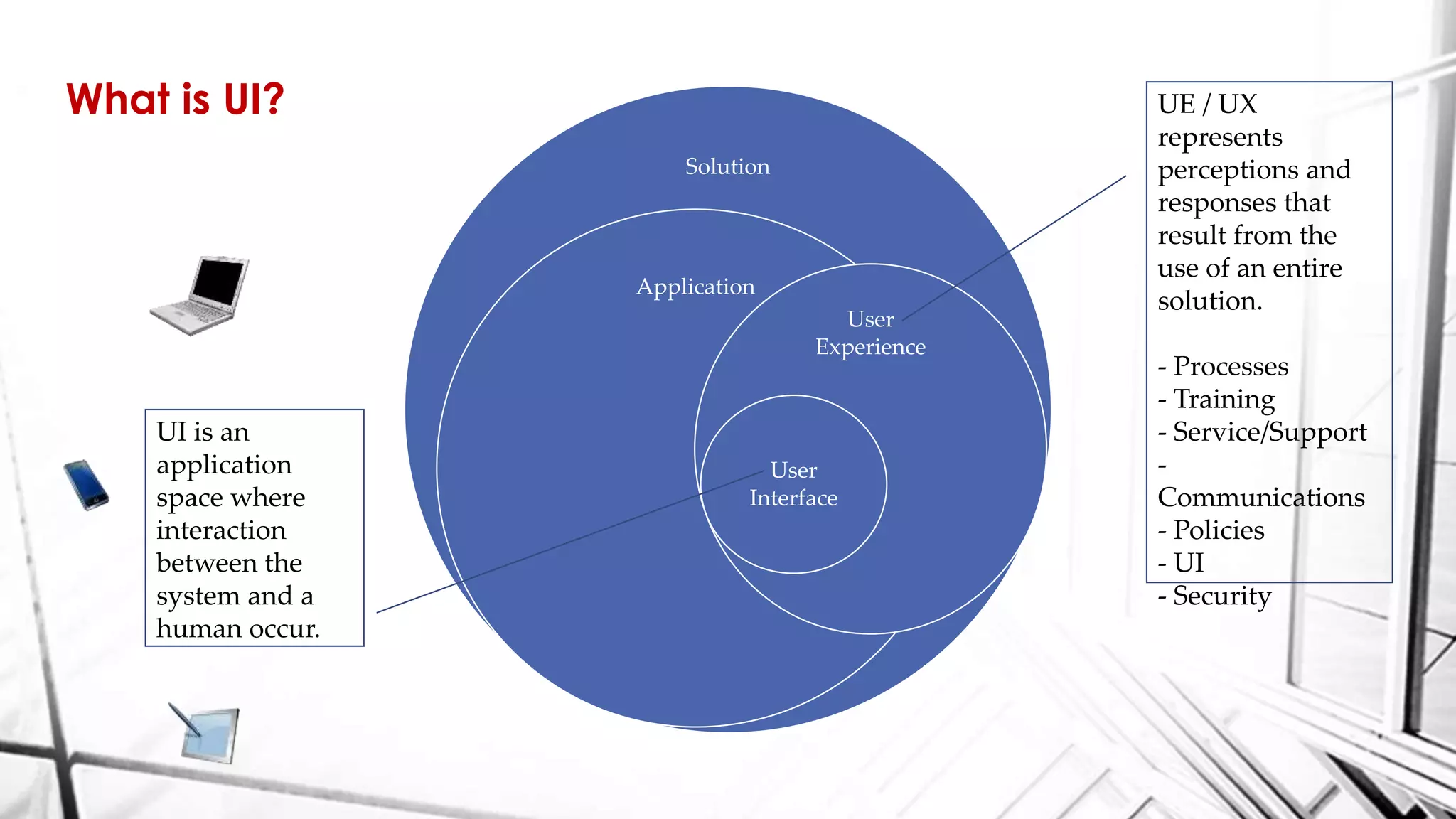
What is UI?
Solution
Application
User
Experience
User
Interface
UE / UX
represents
perceptions and
responses that
result from the
use of an entire
solution.
- Processes
- Training
- Service/Support
-
Communications
- Policies
- UI
- Security
UI is an
application
space where
interaction
between the
system and a
human occur.
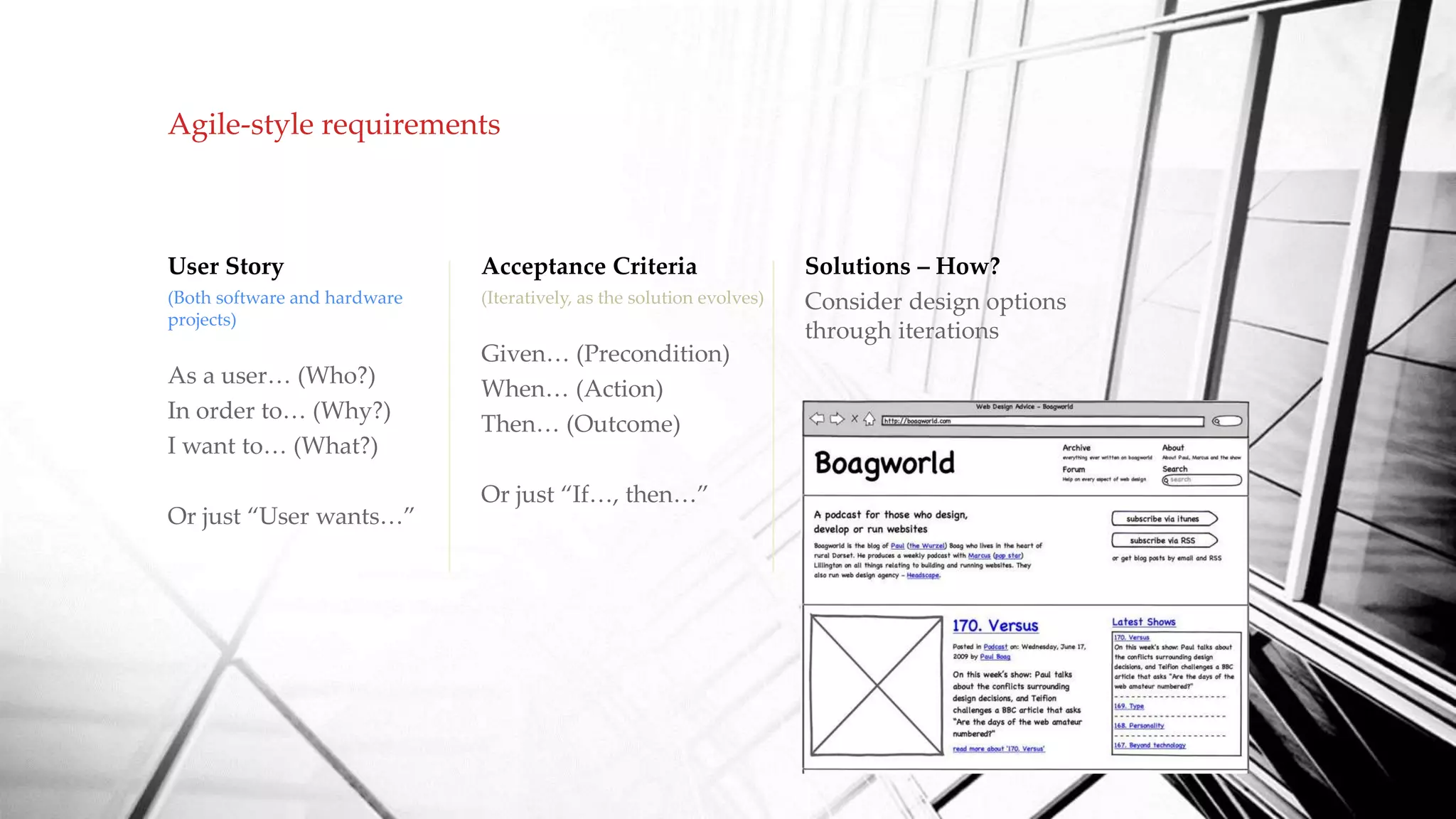
Agile-style requirements
User Story
(Both software and hardware
projects)
As a user… (Who?)
In order to… (Why?)
I want to… (What?)
Or just “User wants…”
Acceptance Criteria
(Iteratively, as the solution evolves)
Given… (Precondition)
When… (Action)
Then… (Outcome)
Or just “If…, then…”
Solutions – How?
Consider design options
through iterations
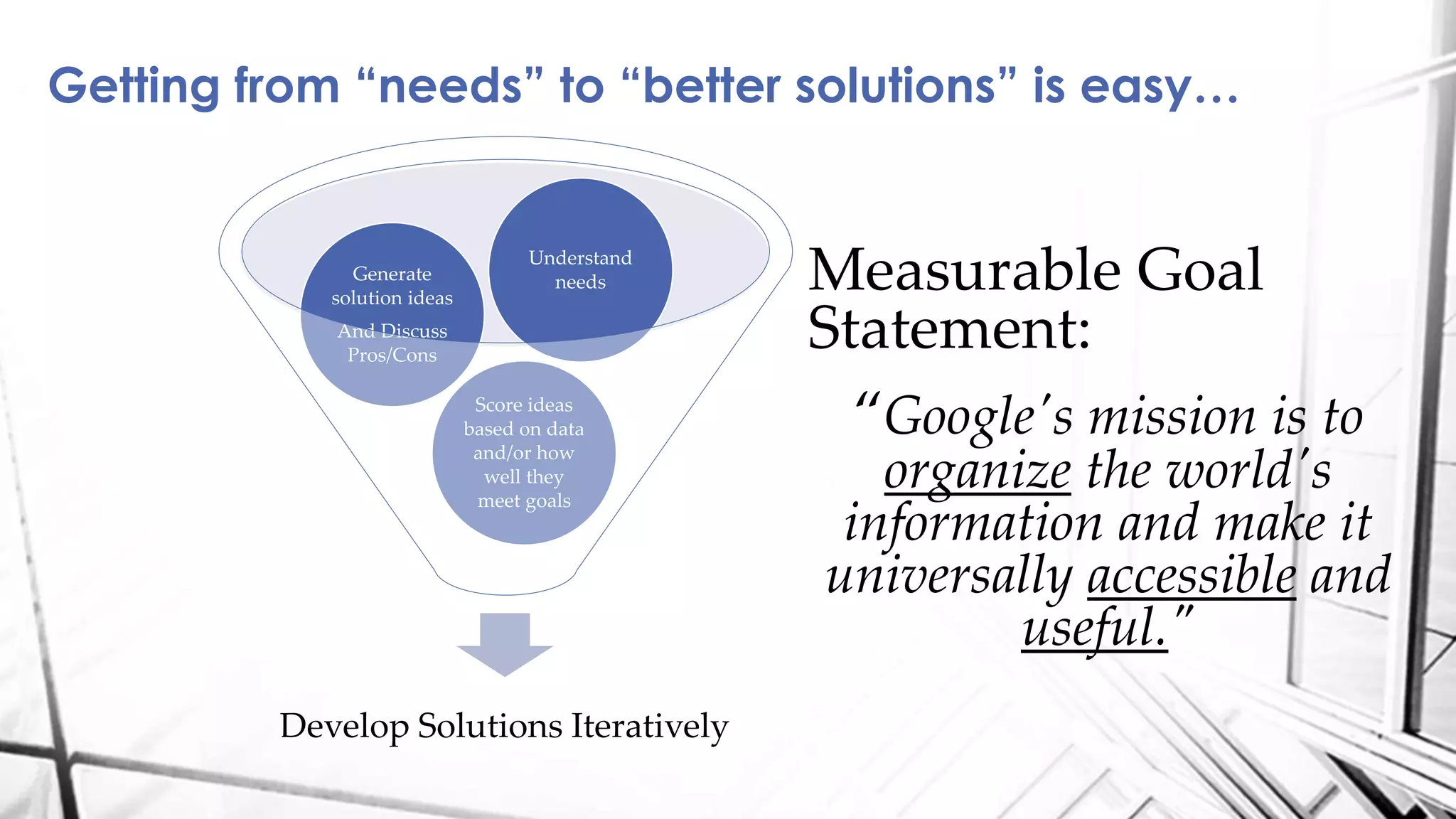
Develop Solutions Iteratively
Score ideas
based on data
and/or how
well they
meet goals
Generate
solution ideas
And Discuss
Pros/Cons
Understand
needs
Getting from “needs” to “better solutions” is easy…
Measurable Goal
Statement:
“Google's mission is to
organize the world's
information and make it
universally accessible and
useful."
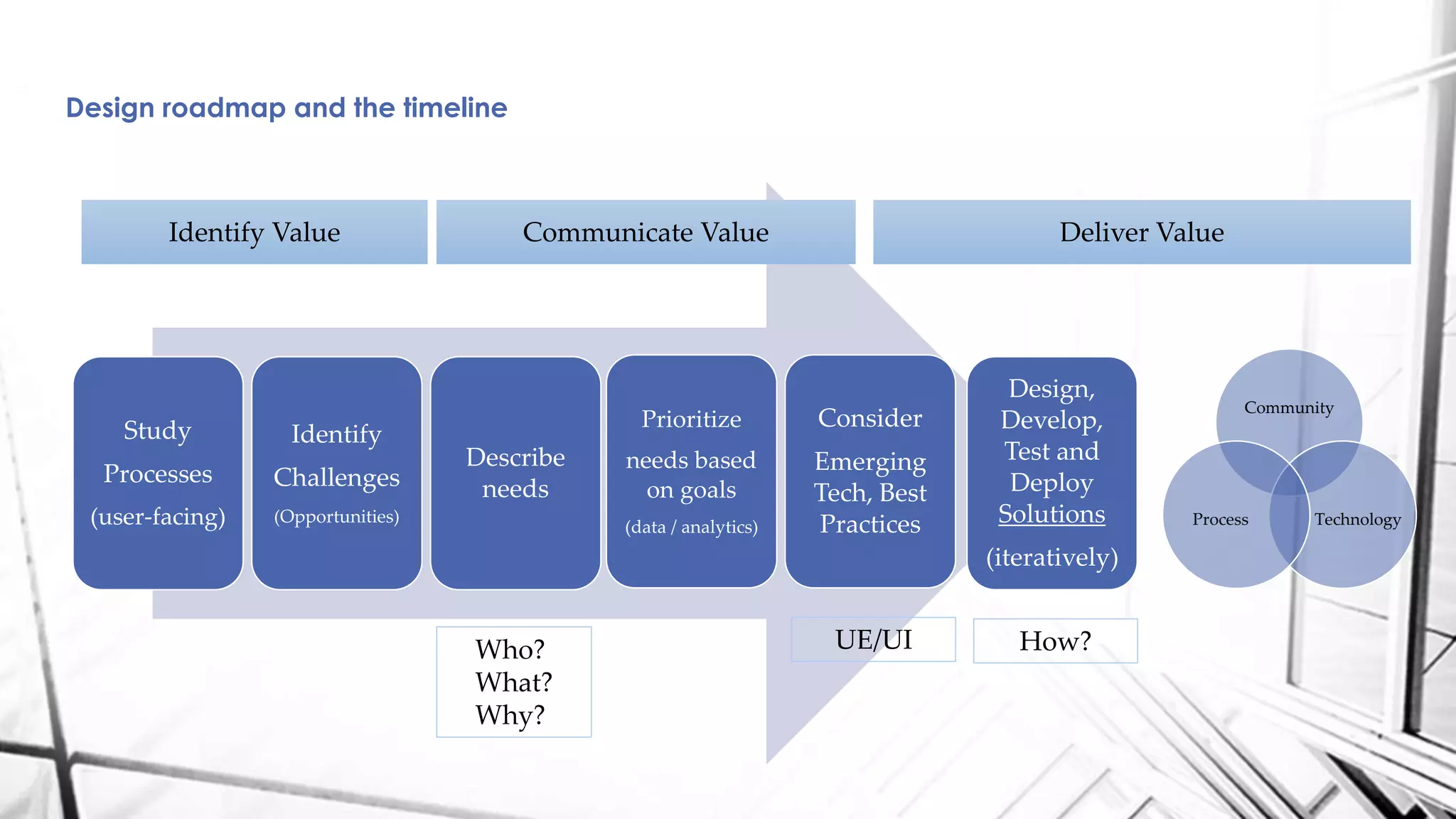
Study
Processes
(user-facing)
Identify
Challenges
(Opportunities)
Describe
needs
Prioritize
needs based
on goals
(data / analytics)
Consider
Emerging
Tech, Best
Practices
Design,
Develop,
Test and
Deploy
Solutions
(iteratively)
Design roadmap and the timeline
Community
TechnologyProcess
Identify Value Deliver ValueCommunicate Value
Who?
What?
Why?
How?UE/UI
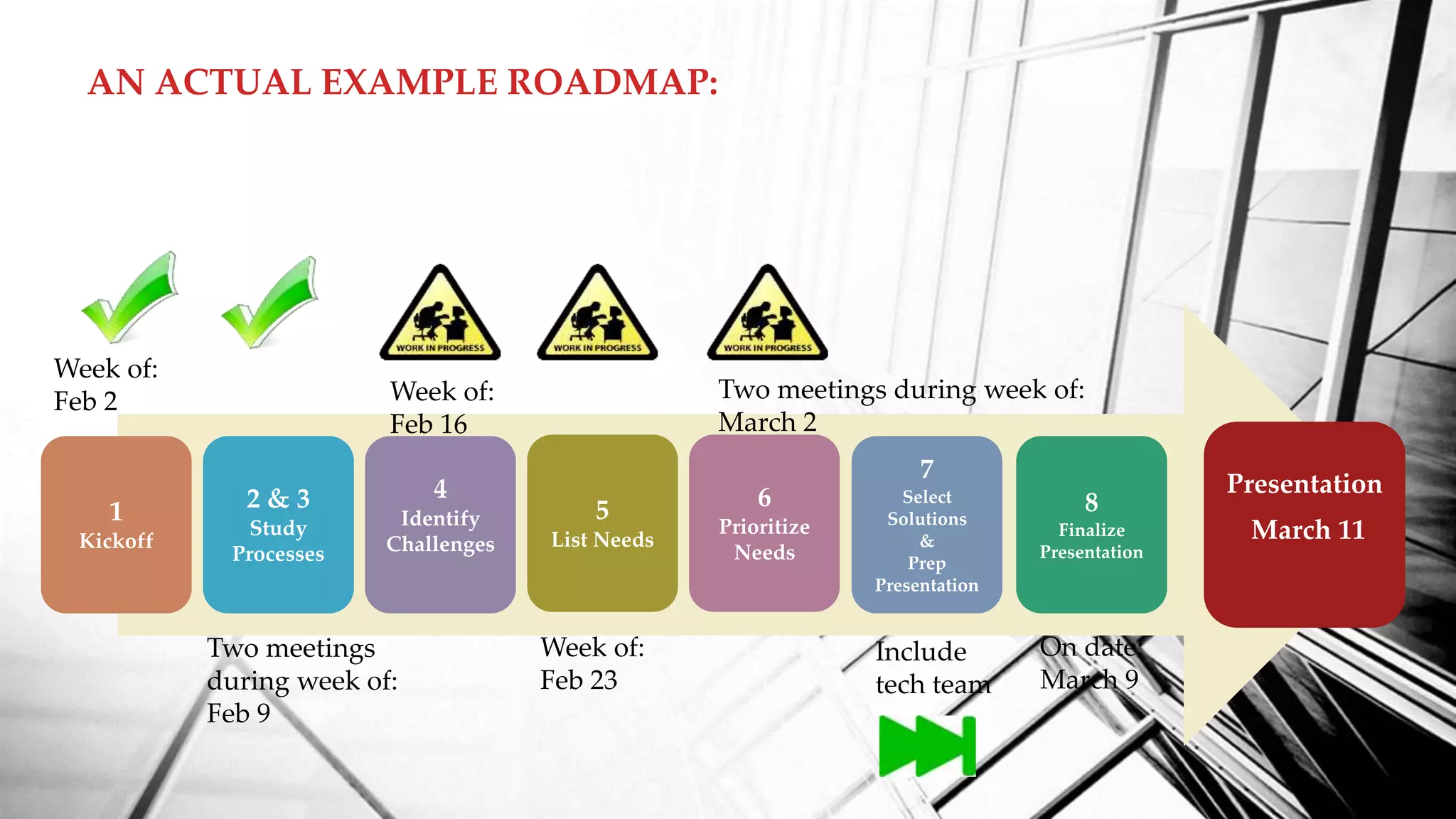
1
Kickoff
2 & 3
Study
Processes
4
Identify
Challenges
5
List Needs
6
Prioritize
Needs
7
Select
Solutions
&
Prep
Presentation
8
Finalize
Presentation
Presentation
March 11
AN ACTUAL EXAMPLE ROADMAP:
Week of:
Feb 2 Week of:
Feb 16
Week of:
Feb 23
Two meetings during week of:
March 2
On date:
March 9
Two meetings
during week of:
Feb 9
Include
tech team
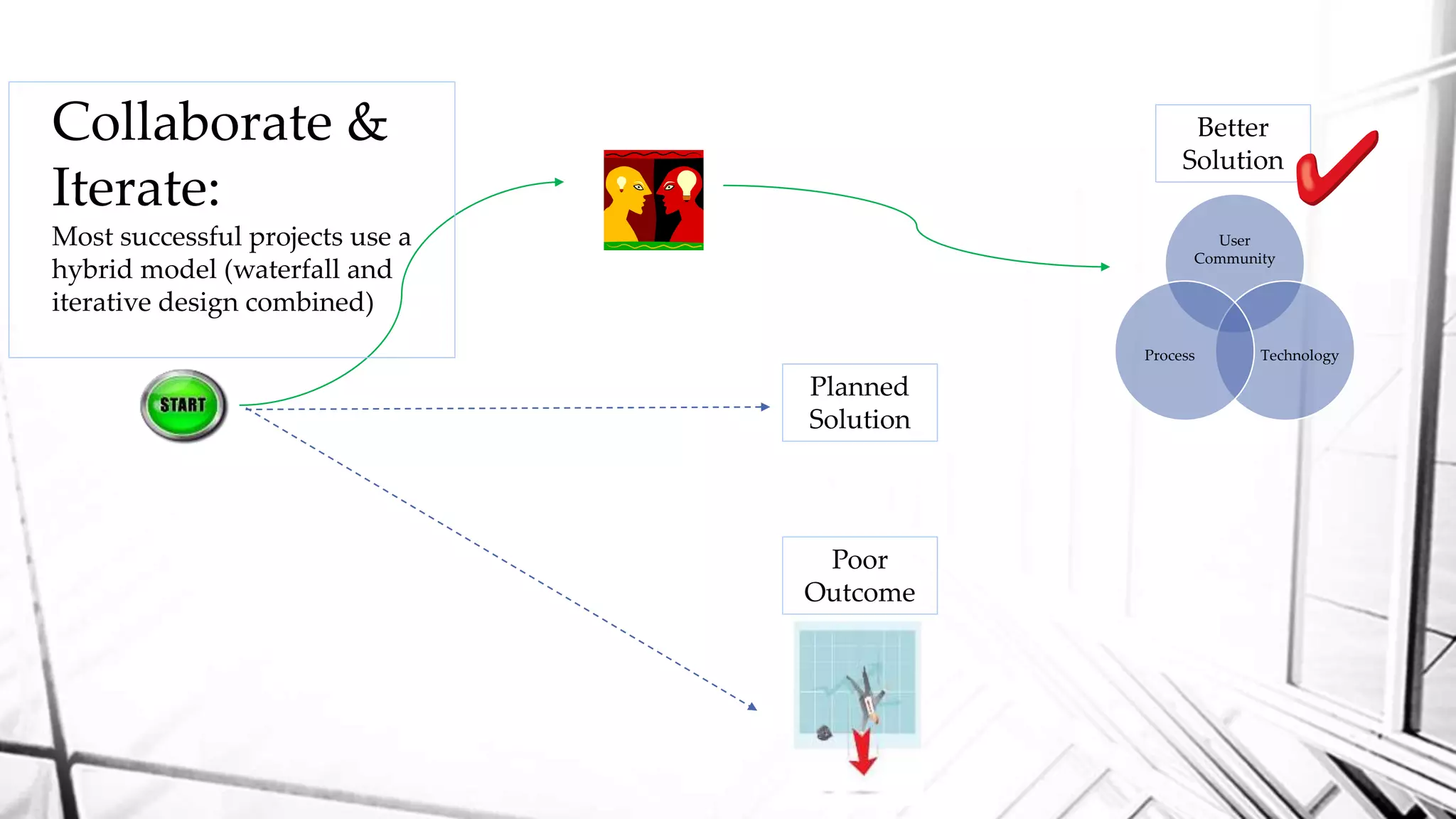
Collaborate &
Iterate:
Most successful projects use a
hybrid model (waterfall and
iterative design combined)
User
Community
TechnologyProcess
Better
Solution
Planned
Solution
Poor
Outcome
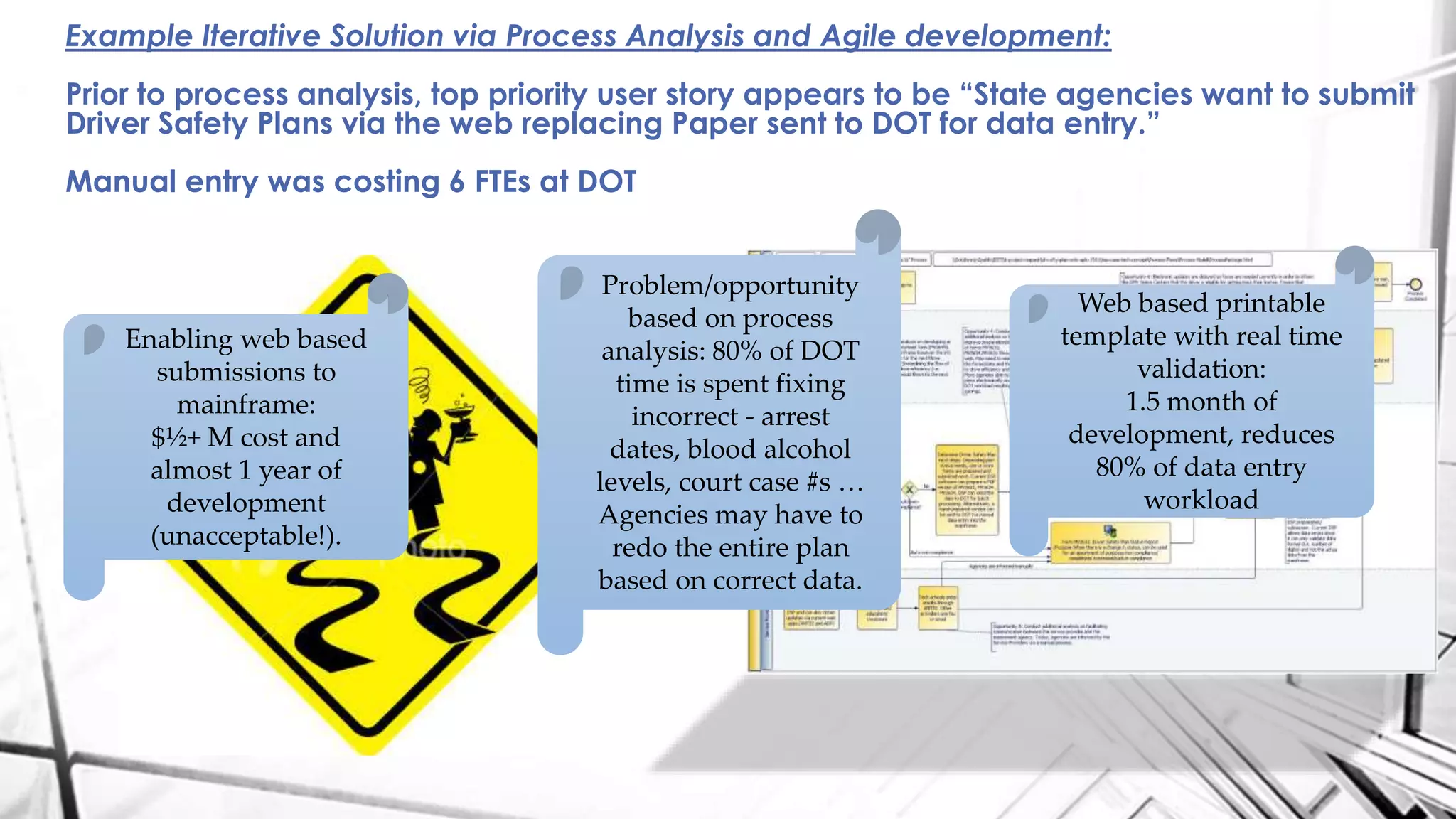
Example Iterative Solution via Process Analysis and Agile development:
Prior to process analysis, top priority user story appears to be “State agencies want to submit
Driver Safety Plans via the web replacing Paper sent to DOT for data entry.”
Manual entry was costing 6 FTEs at DOT
Enabling web based
submissions to
mainframe:
$½+ M cost and
almost 1 year of
development
(unacceptable!).
Web based printable
template with real time
validation:
1.5 month of
development, reduces
80% of data entry
workload
Problem/opportunity
based on process
analysis: 80% of DOT
time is spent fixing
incorrect - arrest
dates, blood alcohol
levels, court case #s …
Agencies may have to
redo the entire plan
based on correct data.
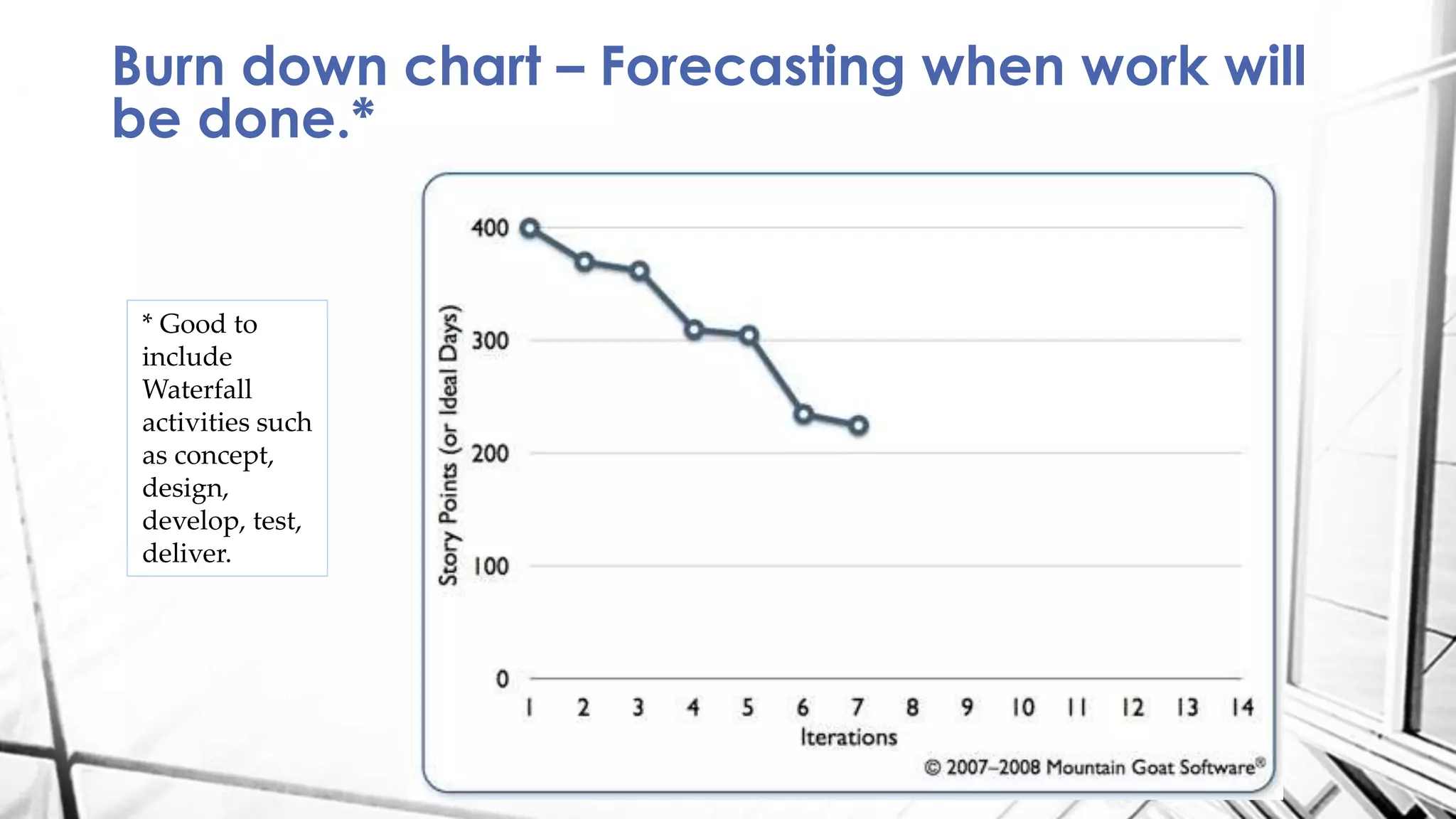
Burn down chart – Forecasting when work will
be done.*
* Good to
include
Waterfall
activities such
as concept,
design,
develop, test,
deliver.
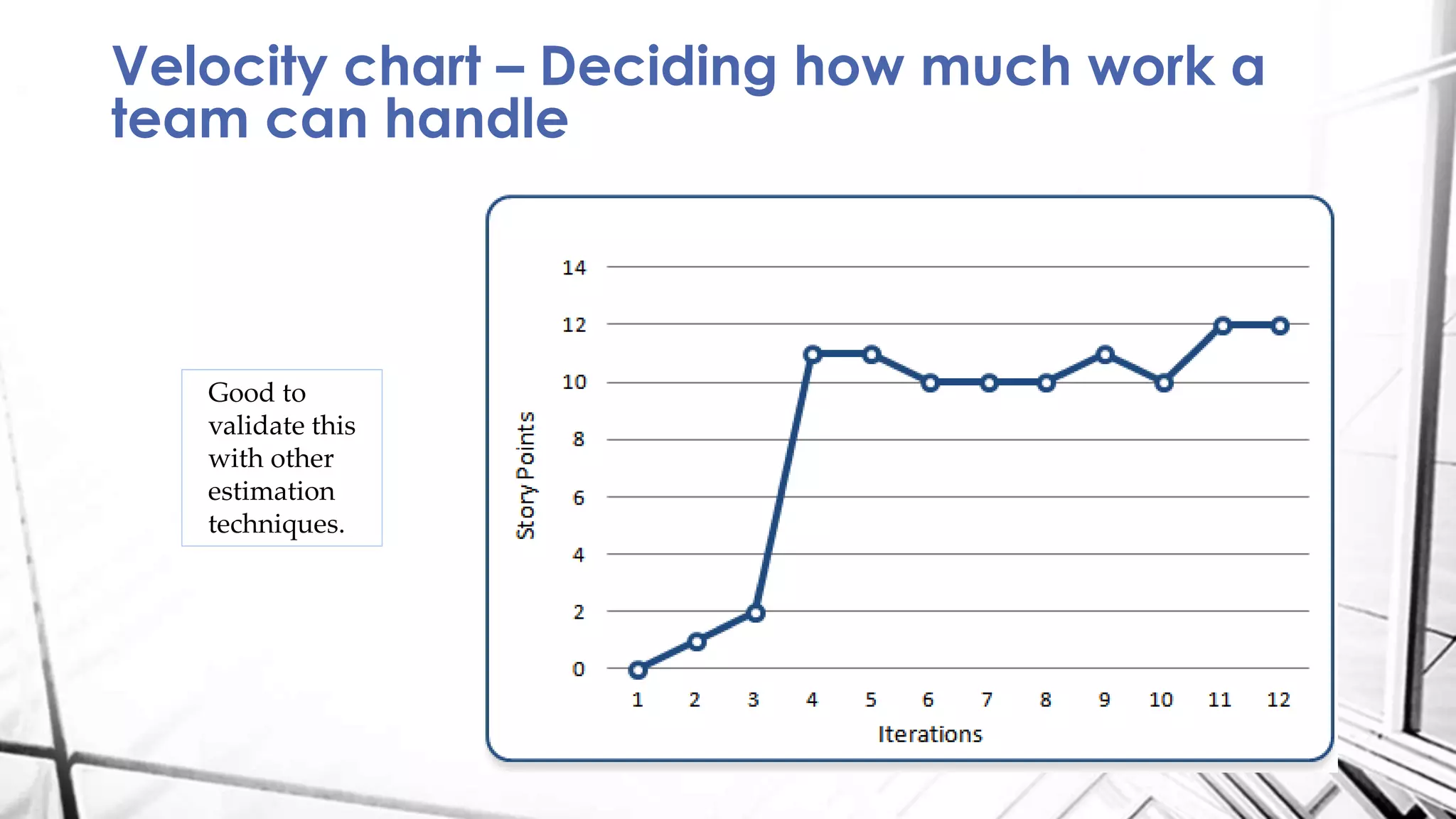
Velocity chart – Deciding how much work a
team can handle
Good to
validate this
with other
estimation
techniques.
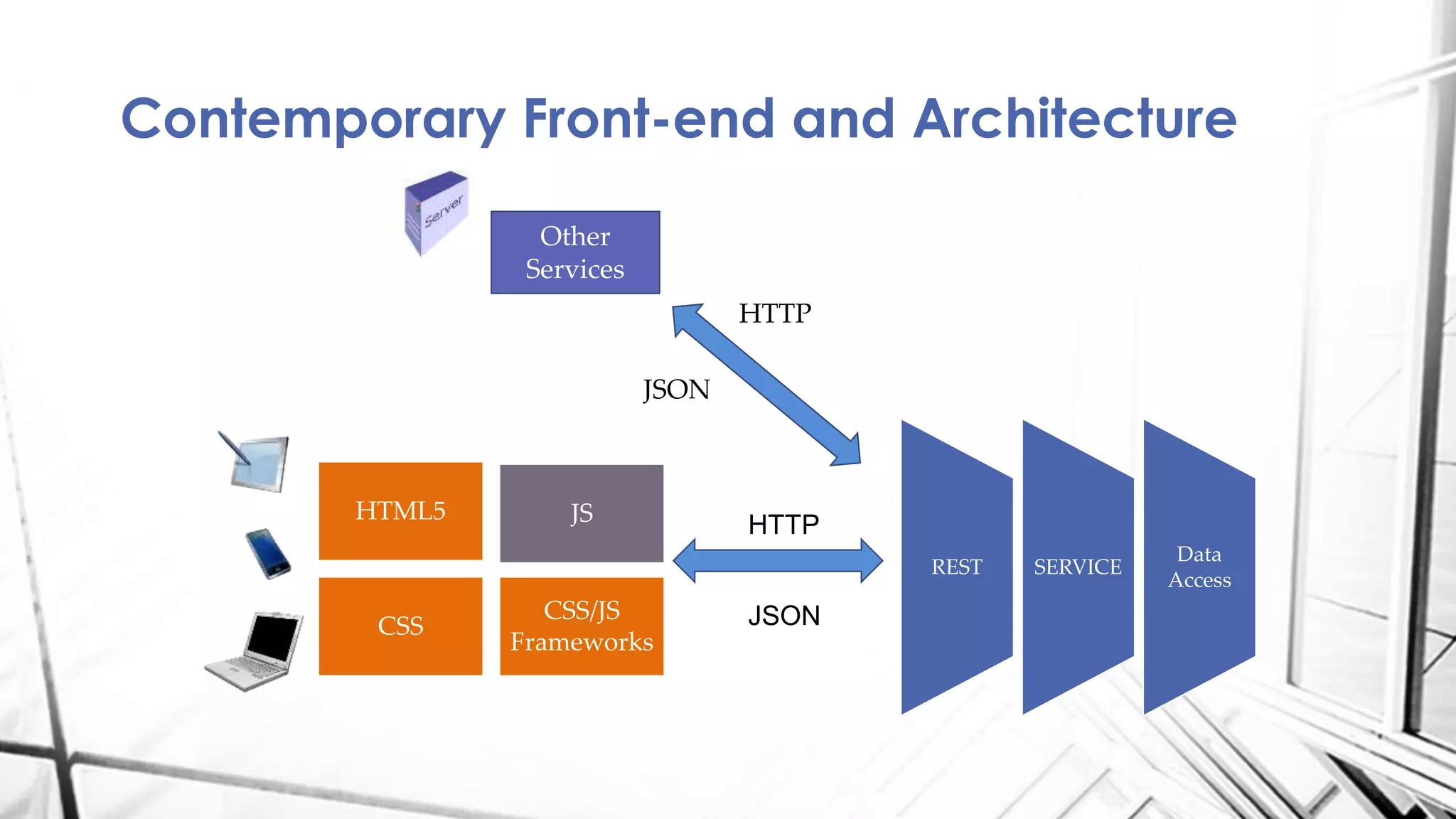
Contemporary Front-end and Architecture
HTML5 JS
CSS
CSS/JS
Frameworks
REST SERVICE
Data
Access
HTTP
JSON
Other
Services
HTTP
JSON
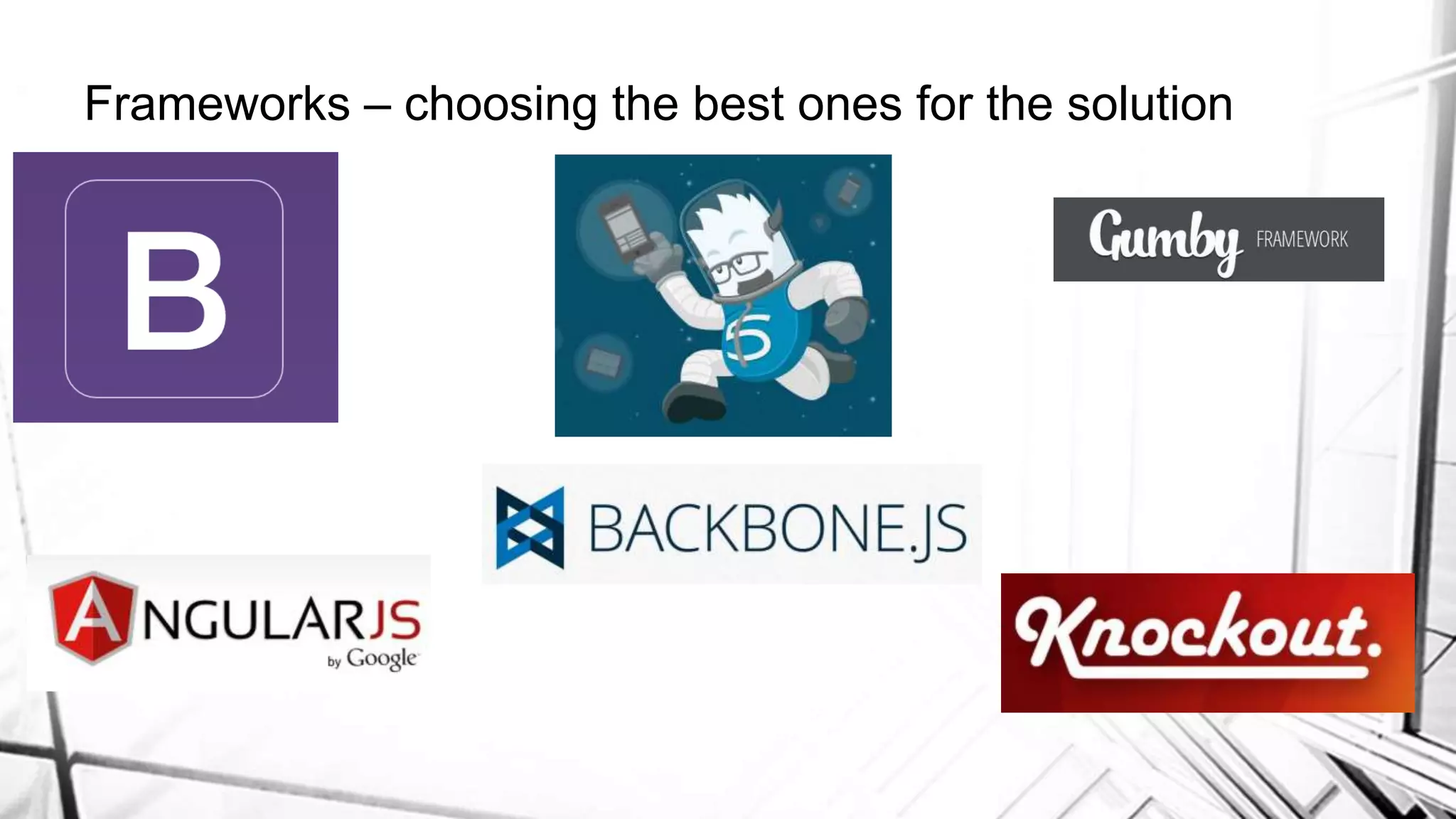
Frameworks – choosing the best ones for the solution
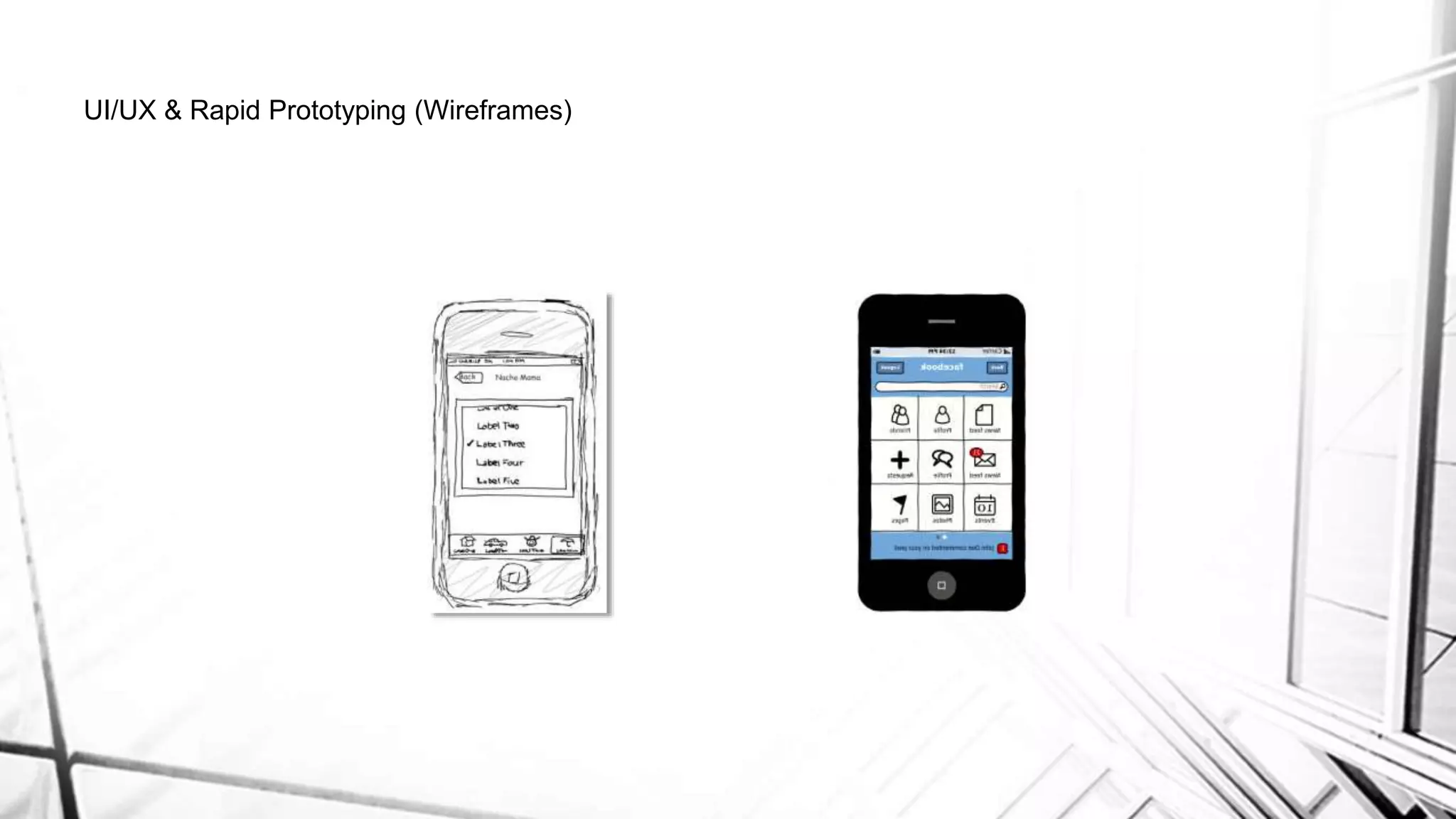
UI/UX & Rapid Prototyping (Wireframes)
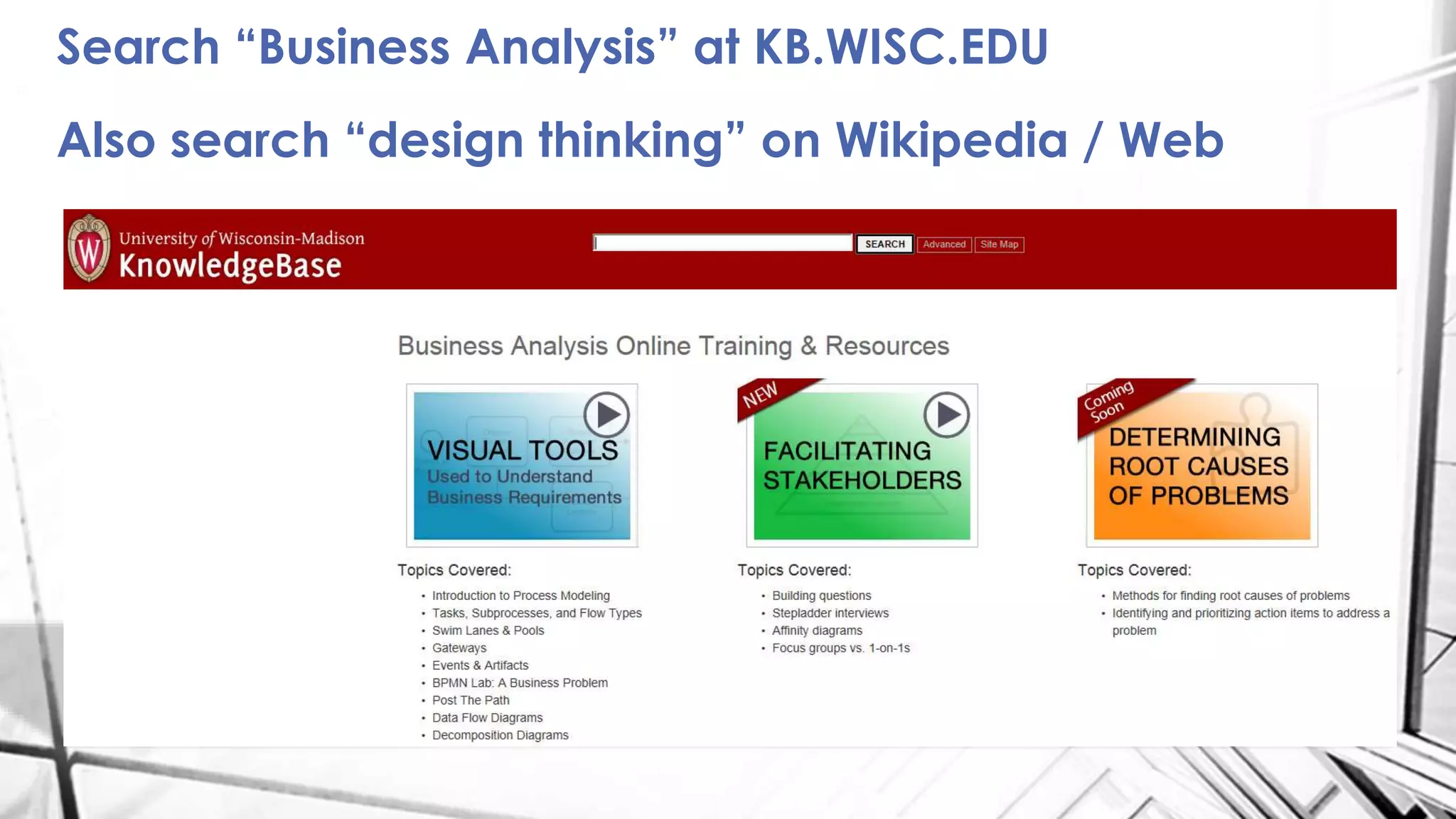
Search “Business Analysis” at KB.WISC.EDU
Also search “design thinking” on Wikipedia / Web
Q&A

Need-driven-design-Bulut V2

  • 1.
    Bulut Nesim DoIT ApplicationDevelopment & Integration Project Management Office Needs driven solution design
  • 2.
    HIGH IMPACT SOLUTIONS= VALUE Growing Community TechnologyProcess
  • 3.
    “The Secret” Everything onewants can be fulfilled by believing in an outcome, and methods to "attract" that outcome. Used analysis or design techniques before? • Defined goals • Project plan and a timeline • Process modeling • Facilitated Brainstorming • User Centered Design etc.
  • 4.
    Bulut Nesim’s Backgroundin Knowledge Management: - Make best practices repeatable and reusable - Reduce workload on experts and beneficiaries.
  • 5.
    • Experience includesintellectual capital management, CRM, portals, web analytics, e-commerce, security, data warehousing, software product management • 8 years as software engineer • 8 years as a project/program manager • 5 years as a business analyst • Very excited to be at DoIT • Delivered many solutions in 18 industries which align well with various UW organizations. • Strengths and Passions • Focus on “long term strategy and the big picture” while delivering “near term increments”. • Motivated to solve the world’s problems through social business solutions • i.e. bring people closer through networking, collaboration, knowledge sharing, and learning. • Creative software, tools, world music, photography, videography, cooking, outdoors. Bulut Nesim’s Background
  • 6.
    Worked on solutionsthat put “user needs” first A personalized approach for finding products, content, services and experts. Custom apps such as “Question- answer networks”, “collaboration and reuse repositories” supporting the user communities.
  • 7.
    Worked on mobileapplications as well
  • 8.
    Worked with manyproject methods
  • 9.
    "Common sense isnot so common." Voltaire, Dictionnaire Philosophique (1764) - Need to work with people to reach a conclusion most people can accept A guiding principle
  • 10.
    “While we areworking through a problem, the brain's tendency to stick with familiar ideas can literally blind us to superior solutions.” By Merim Bilalić and Peter McLeod Scientific American – March 2014 - In my experience, initial ideas might be OK but they can be limiting A guiding principle
  • 11.
    One more guidingprinciple “We are never going to be more ignorant about this project than we are today. We’re constantly learning. And it’s not just about needs. It’s about everything—team, technology, cost, value.” Robert Merrill, DoIT ADI PMO - We often need to answer tough questions upfront such as scope, cost and timeline 
  • 12.
    Another principle: Siftingand Winnowing is useful
  • 13.
    Sifting and winnowingone step at a time… PROBLEMS (Opportunities) •Challenges •Bottlenecks •Issues •Common Errors •New business rules NEEDS (Goals) Who? What? Why? •Prioritize •Don’t hurry to decide “How?” SOLUTIONS How? •Features •Design •Requirements •Specifications •UI Wireframes
  • 14.
    What is UI? Solution Application User Experience User Interface UE/ UX represents perceptions and responses that result from the use of an entire solution. - Processes - Training - Service/Support - Communications - Policies - UI - Security UI is an application space where interaction between the system and a human occur.
  • 15.
    Agile-style requirements User Story (Bothsoftware and hardware projects) As a user… (Who?) In order to… (Why?) I want to… (What?) Or just “User wants…” Acceptance Criteria (Iteratively, as the solution evolves) Given… (Precondition) When… (Action) Then… (Outcome) Or just “If…, then…” Solutions – How? Consider design options through iterations
  • 16.
    Develop Solutions Iteratively Scoreideas based on data and/or how well they meet goals Generate solution ideas And Discuss Pros/Cons Understand needs Getting from “needs” to “better solutions” is easy… Measurable Goal Statement: “Google's mission is to organize the world's information and make it universally accessible and useful."
  • 17.
    Study Processes (user-facing) Identify Challenges (Opportunities) Describe needs Prioritize needs based on goals (data/ analytics) Consider Emerging Tech, Best Practices Design, Develop, Test and Deploy Solutions (iteratively) Design roadmap and the timeline Community TechnologyProcess Identify Value Deliver ValueCommunicate Value Who? What? Why? How?UE/UI
  • 18.
    1 Kickoff 2 & 3 Study Processes 4 Identify Challenges 5 ListNeeds 6 Prioritize Needs 7 Select Solutions & Prep Presentation 8 Finalize Presentation Presentation March 11 AN ACTUAL EXAMPLE ROADMAP: Week of: Feb 2 Week of: Feb 16 Week of: Feb 23 Two meetings during week of: March 2 On date: March 9 Two meetings during week of: Feb 9 Include tech team
  • 19.
    Collaborate & Iterate: Most successfulprojects use a hybrid model (waterfall and iterative design combined) User Community TechnologyProcess Better Solution Planned Solution Poor Outcome
  • 20.
    Example Iterative Solutionvia Process Analysis and Agile development: Prior to process analysis, top priority user story appears to be “State agencies want to submit Driver Safety Plans via the web replacing Paper sent to DOT for data entry.” Manual entry was costing 6 FTEs at DOT Enabling web based submissions to mainframe: $½+ M cost and almost 1 year of development (unacceptable!). Web based printable template with real time validation: 1.5 month of development, reduces 80% of data entry workload Problem/opportunity based on process analysis: 80% of DOT time is spent fixing incorrect - arrest dates, blood alcohol levels, court case #s … Agencies may have to redo the entire plan based on correct data.
  • 21.
    Burn down chart– Forecasting when work will be done.* * Good to include Waterfall activities such as concept, design, develop, test, deliver.
  • 22.
    Velocity chart –Deciding how much work a team can handle Good to validate this with other estimation techniques.
  • 23.
    Contemporary Front-end andArchitecture HTML5 JS CSS CSS/JS Frameworks REST SERVICE Data Access HTTP JSON Other Services HTTP JSON
  • 24.
    Frameworks – choosingthe best ones for the solution
  • 25.
    UI/UX & RapidPrototyping (Wireframes)
  • 26.
    Search “Business Analysis”at KB.WISC.EDU Also search “design thinking” on Wikipedia / Web
  • 27.

Editor's Notes