Introduction to Natural
Language Processing

Pranav Gupta
Rajat Khanduja
What is NLP ?

”Natural language processing (NLP) is a field of computer science,
 artificial intelligence (also called machine learning), and linguistics
 concerned with the interactions between computers and human
 (natural) languages. Specifically, the process of a computer
 extracting meaningful information from natural language input
 and/or producing natural language output ”

 - Wikipedia
Scope of discussion
• Language of focus :- English

• Domain of Natural Language Processing to be discussed.
   Text linguistics


• Focus on statistical methods.
Why NLP ?
Answering Questions


    ”What time is the next bus from the city after the 5:00 pm bus ?”


    ”I am a 3rd year CSE student, which classes do I have today ?”


    ”Which gene is associated with Diabetes ?”


    ”Who is Donald Knuth ?”
Information extraction
•
    Extraction of meaning from email :-

    We have decided to meet tomorrow at 10:00am in the lab.
Information extraction
•
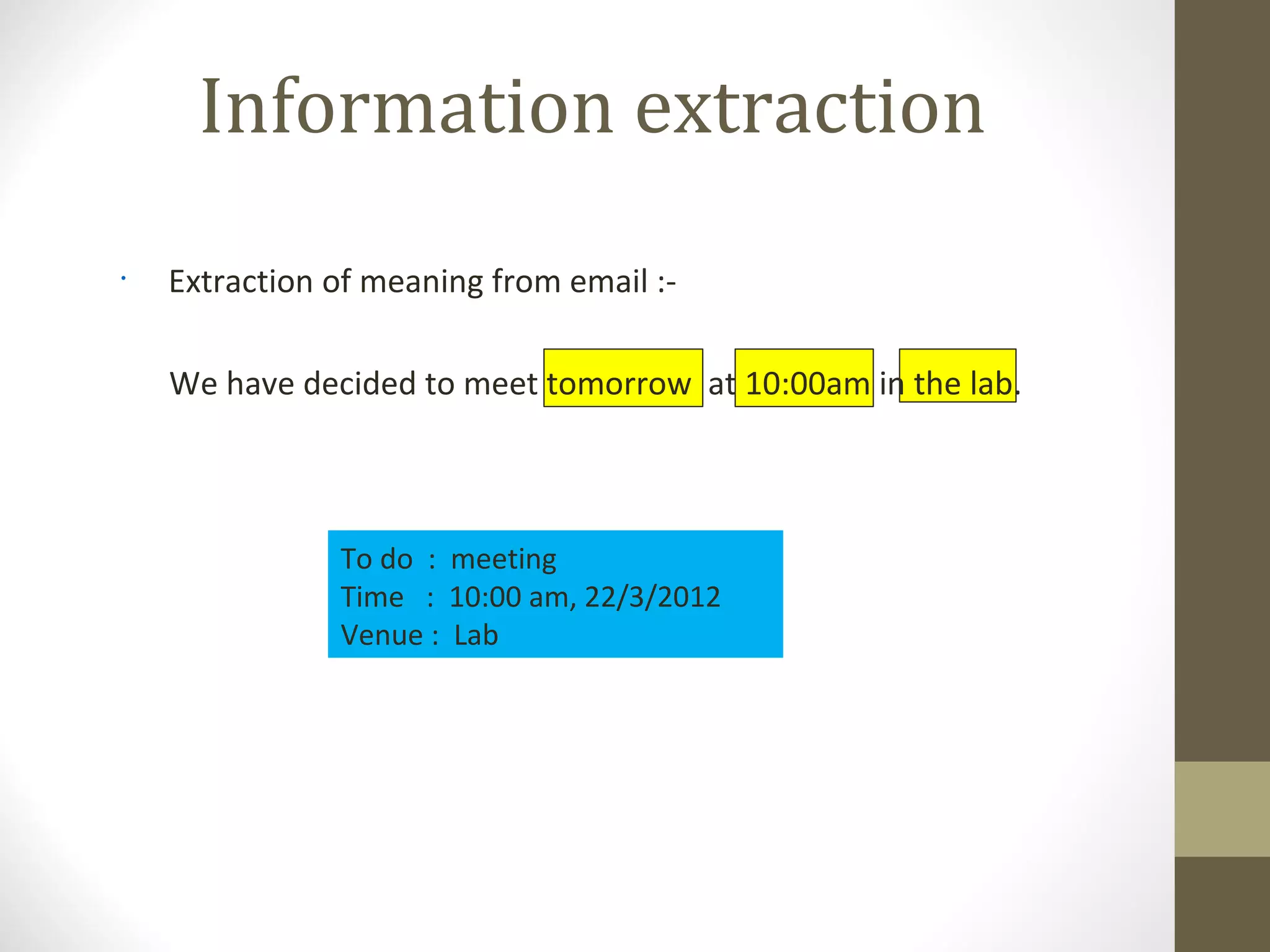
    Extraction of meaning from email :-

    We have decided to meet tomorrow at 10:00am in the lab.


               To do : meeting
               Time : 10:00 am, 22/3/2012
               Venue : Lab
Machine Translation

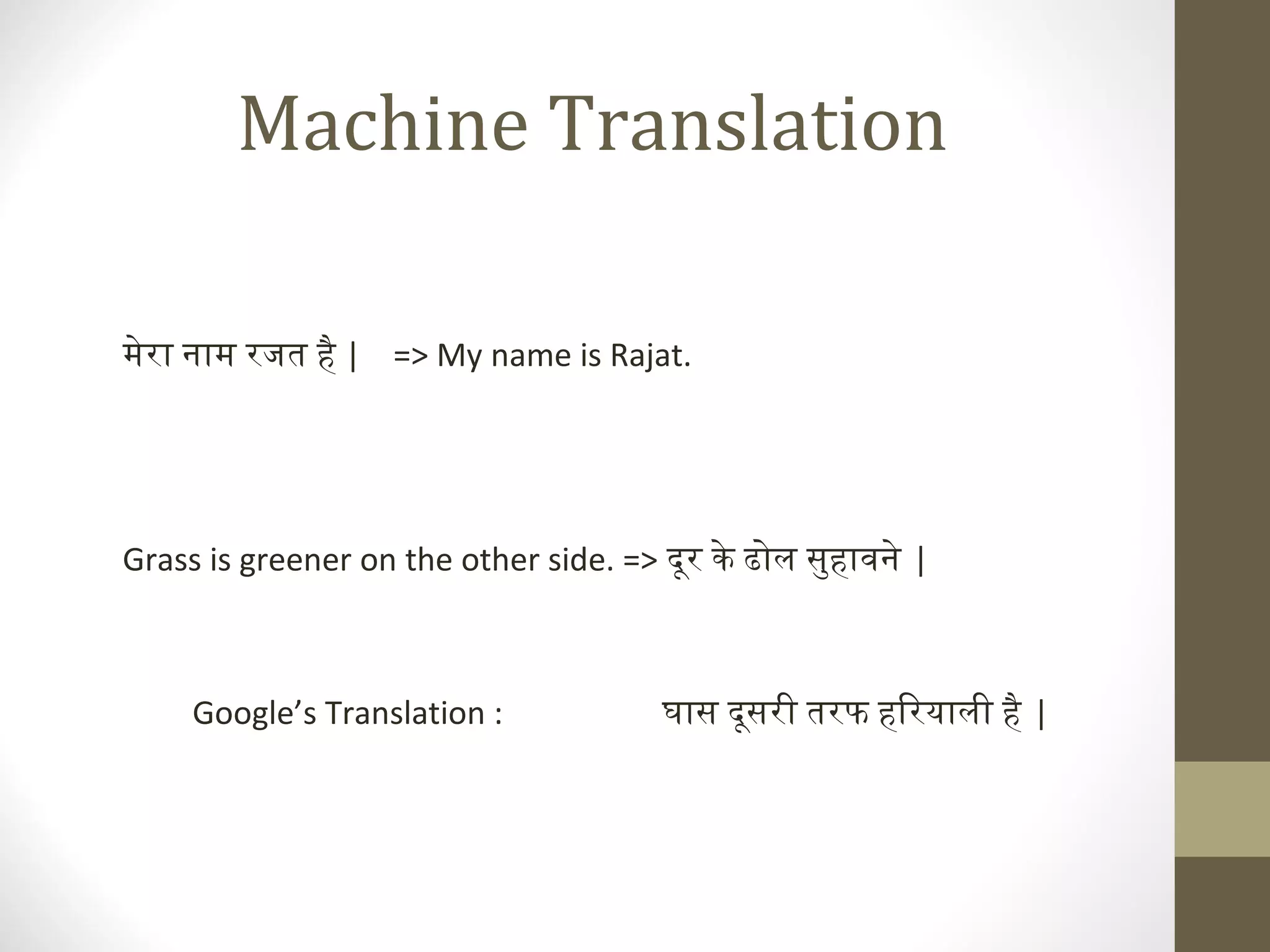
मेरा नाम रजत है | => My name is Rajat.
Machine Translation

मेरा नाम रजत है | => My name is Rajat.


Grass is greener on the other side.
Machine Translation

मेरा नाम रजत है | => My name is Rajat.


Grass is greener on the other side. => दूर के ढोल सुहावने |


     Google’s Translation :            घास दूसरी तरफ हिरयाली है |
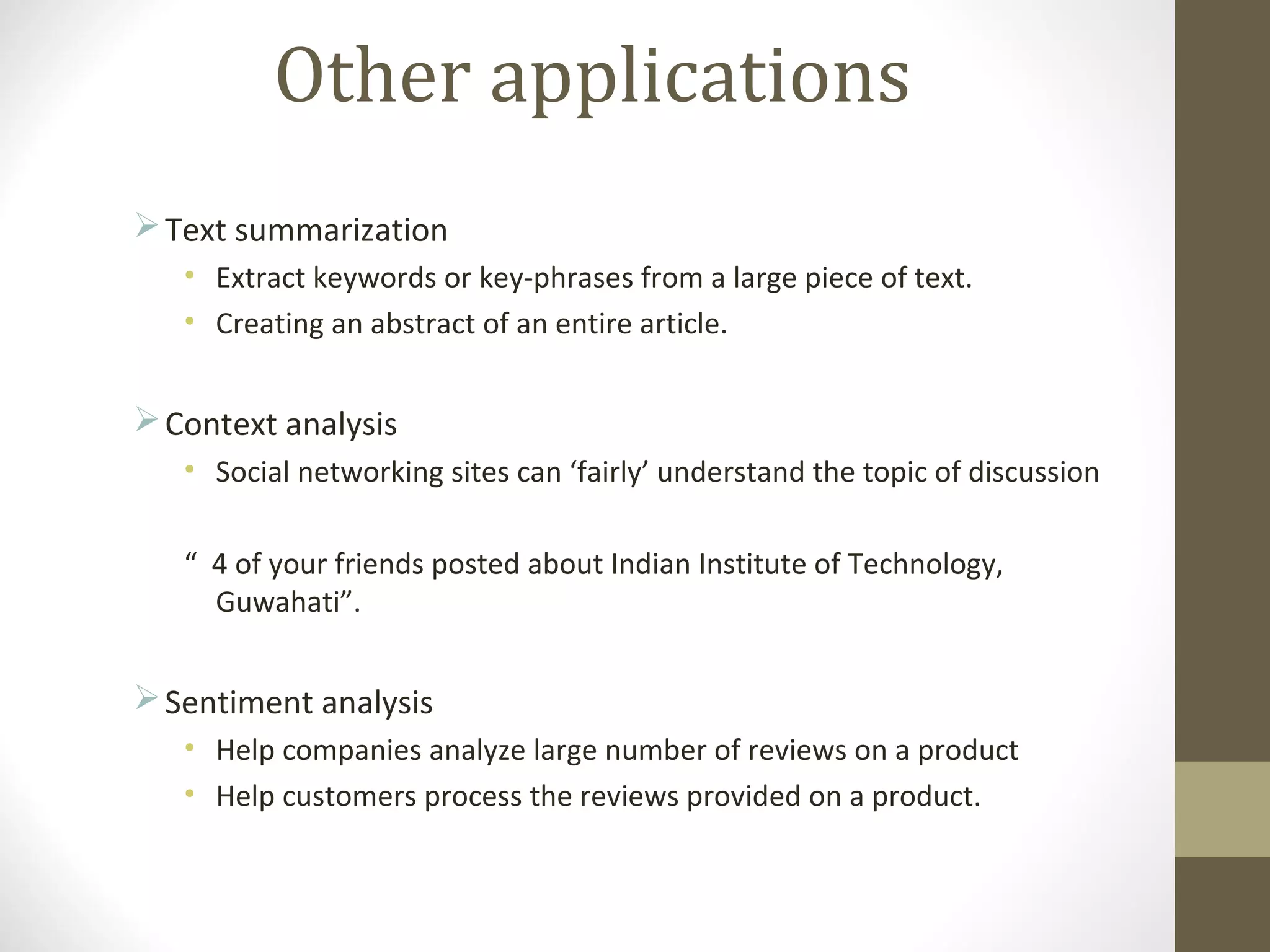
Other applications
 Text summarization
   • Extract keywords or key-phrases from a large piece of text.
   • Creating an abstract of an entire article.


 Context analysis
   • Social networking sites can ‘fairly’ understand the topic of discussion

   “ 4 of your friends posted about Indian Institute of Technology,
     Guwahati”.


 Sentiment analysis
   • Help companies analyze large number of reviews on a product
   • Help customers process the reviews provided on a product.
Tasks in NLP
• Tokenization / Segmentation

• Disambiguation

• Stemming

• Part of Speech (POS) tagging

• Contextual Analysis

• Sentiment Analysis
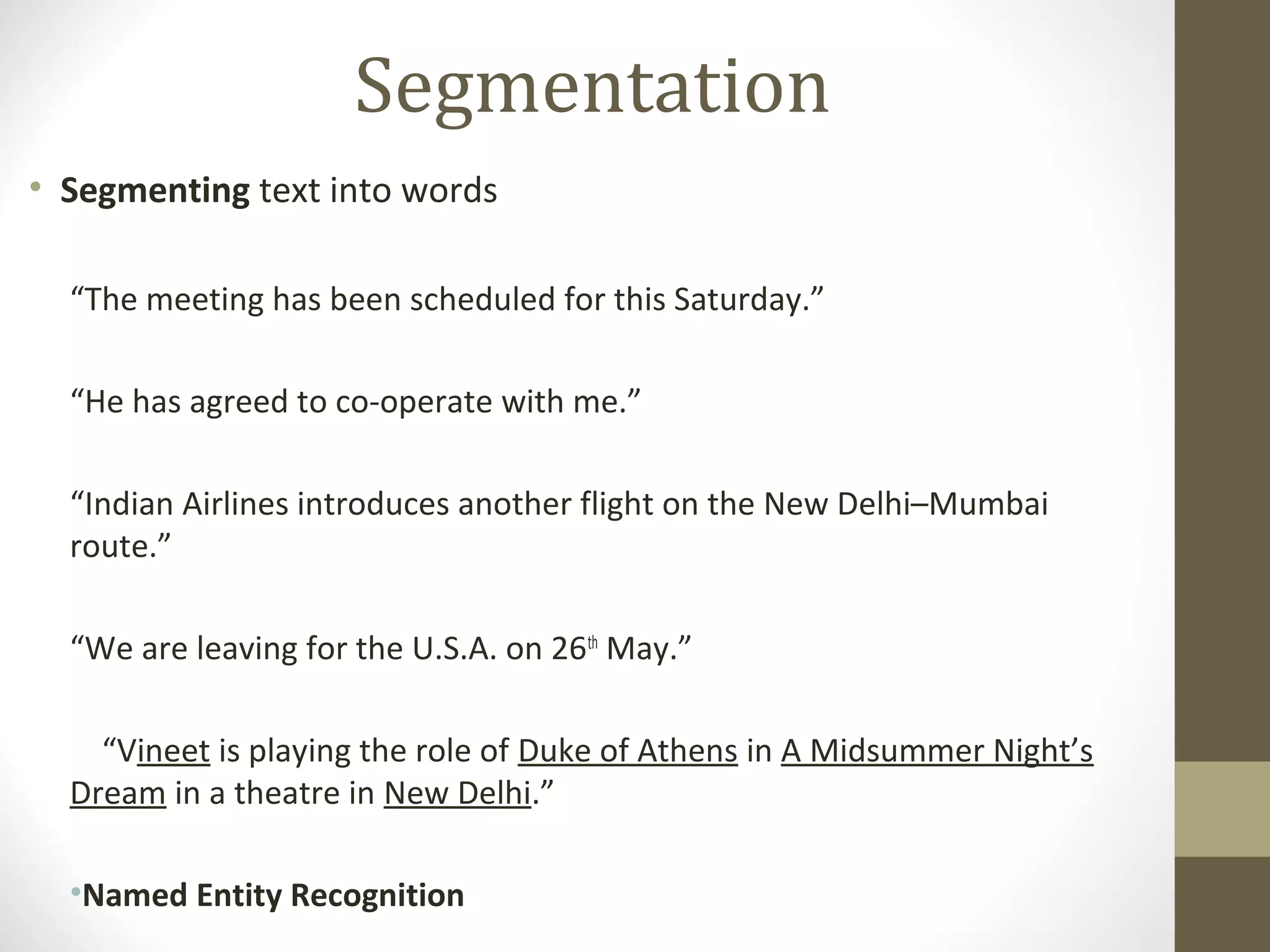
Segmentation
• Segmenting text into words

  “The meeting has been scheduled for this Saturday.”

  “He has agreed to co-operate with me.”

  “Indian Airlines introduces another flight on the New Delhi–Mumbai
  route.”

  “We are leaving for the U.S.A. on 26th May.”

    “Vineet is playing the role of Duke of Athens in A Midsummer Night’s
  Dream in a theatre in New Delhi.”

  •Named Entity Recognition
Stemming
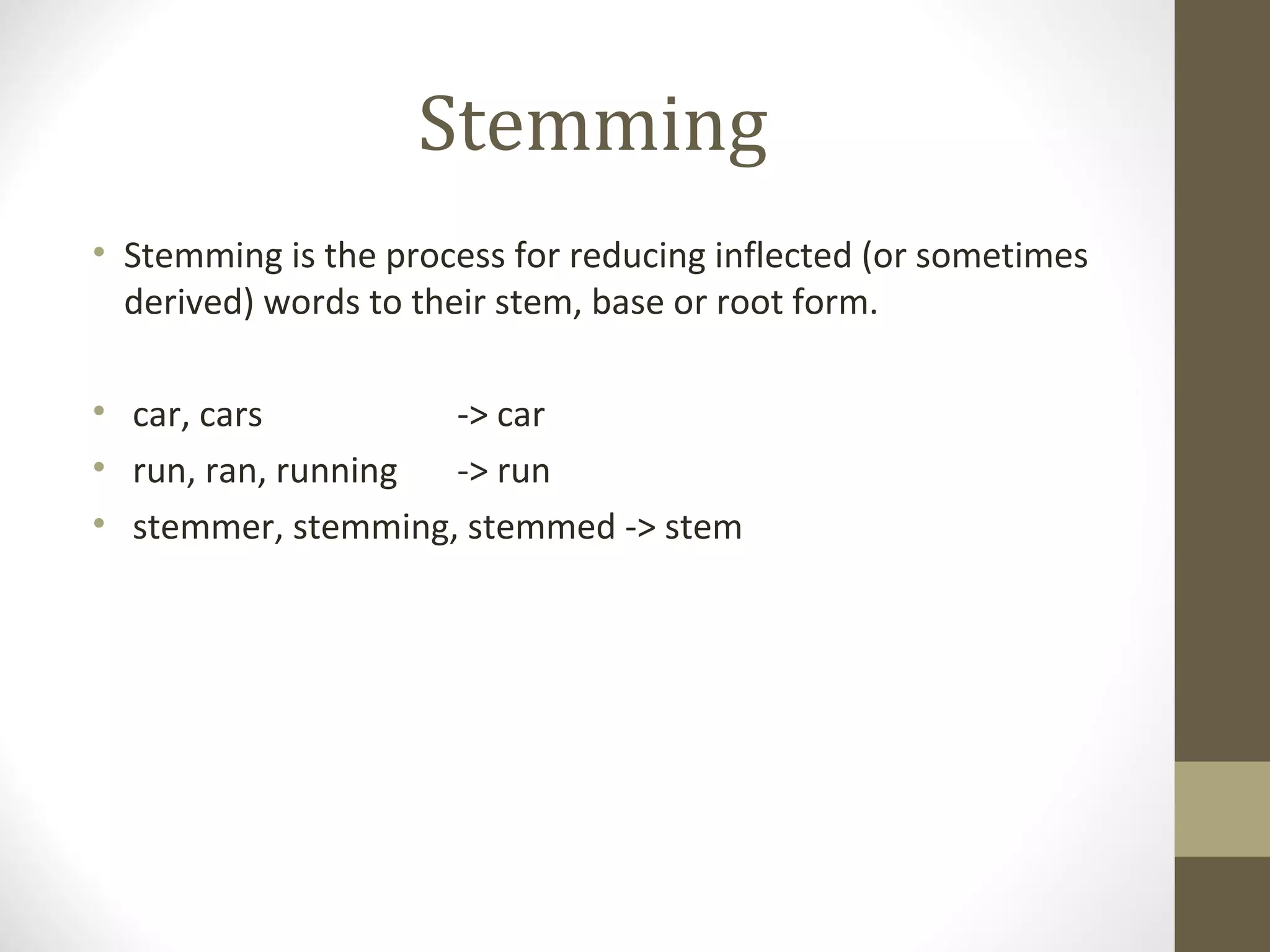
• Stemming is the process for reducing inflected (or sometimes
  derived) words to their stem, base or root form.

• car, cars         -> car
• run, ran, running -> run
• stemmer, stemming, stemmed -> stem
POS tagging
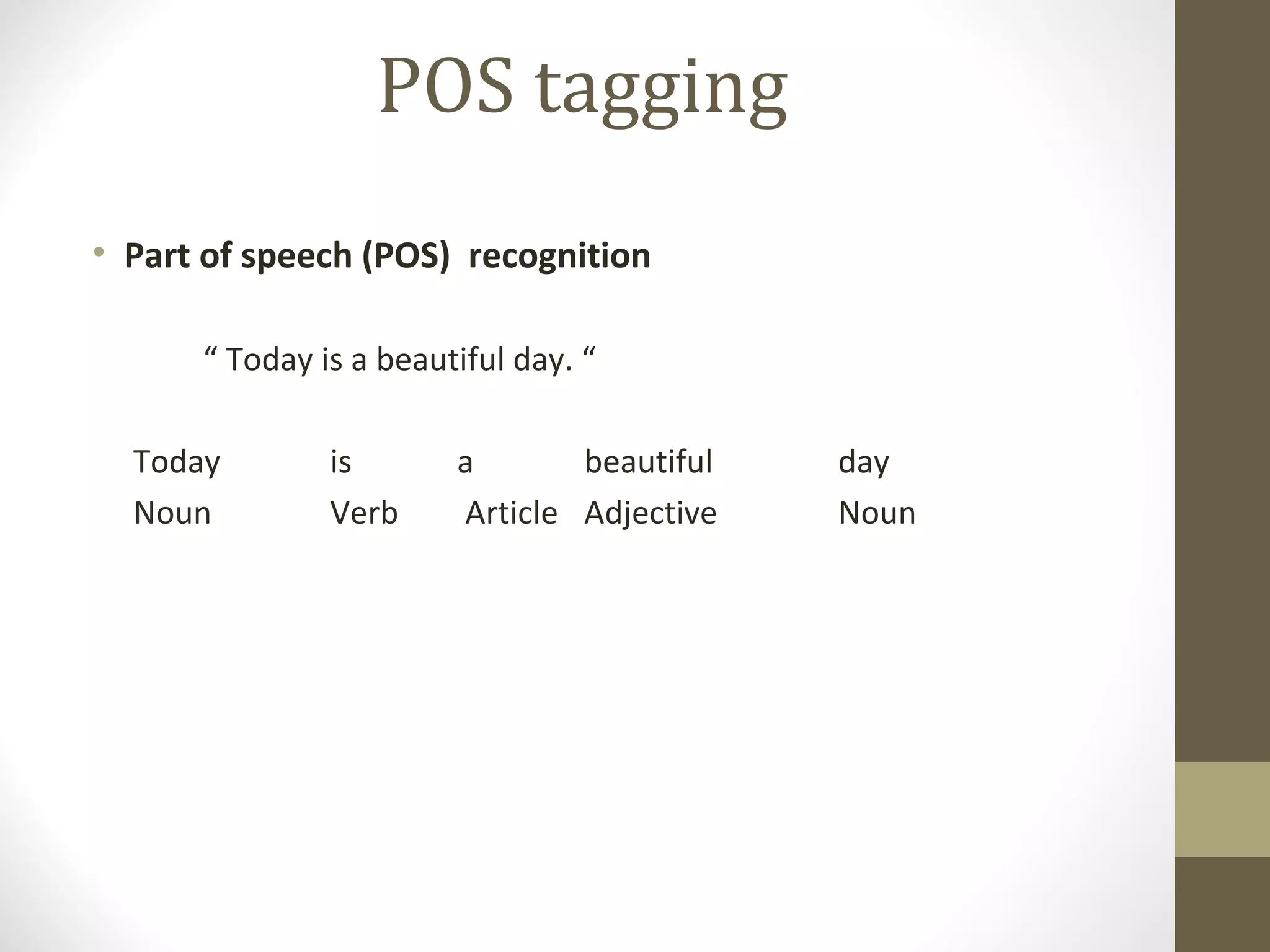
• Part of speech (POS) recognition

      “ Today is a beautiful day. “

  Today        is       a       beautiful   day
  Noun         Verb     Article Adjective   Noun
POS tagging
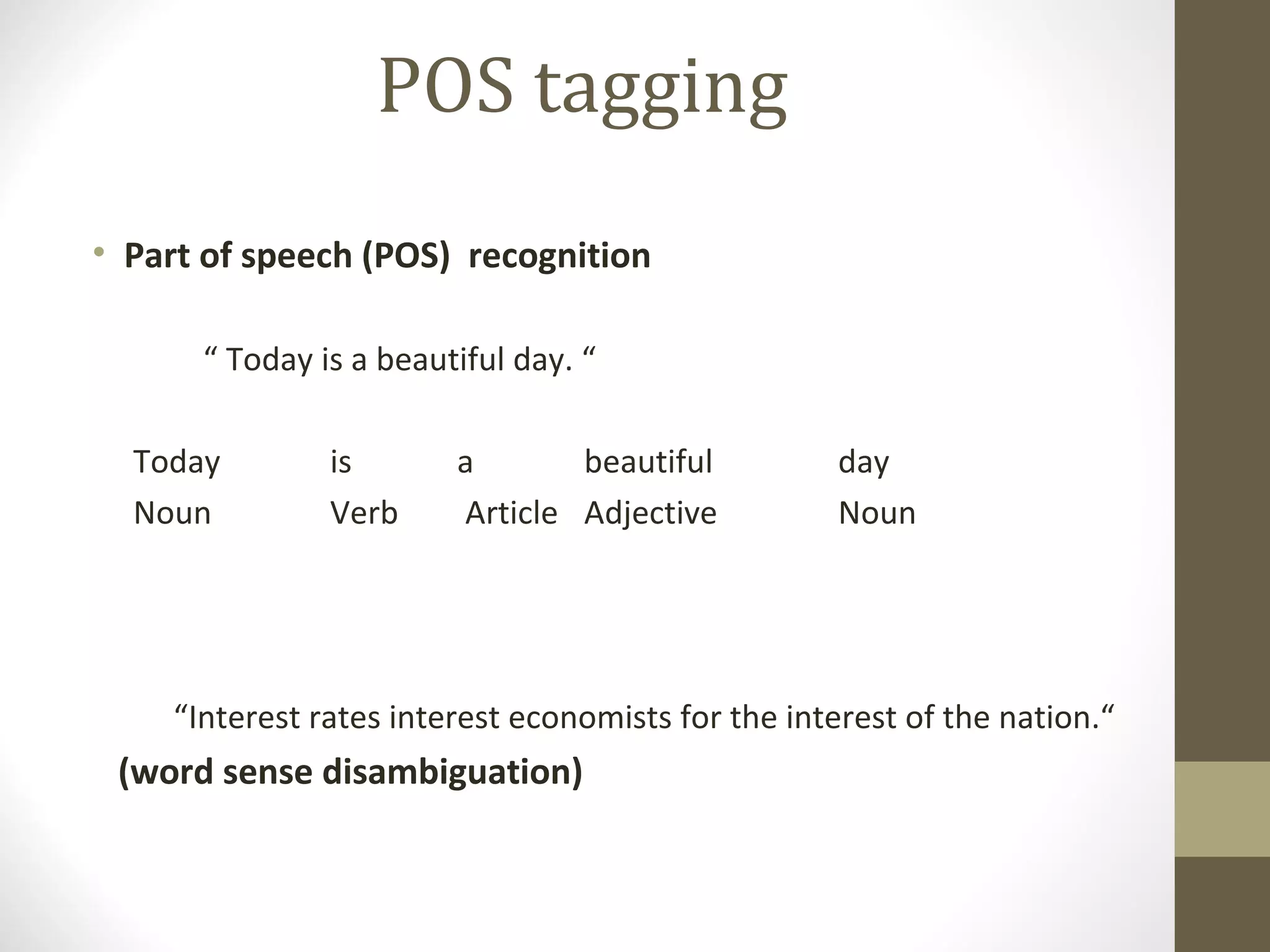
• Part of speech (POS) recognition

      “ Today is a beautiful day. “

  Today        is       a       beautiful           day
  Noun         Verb     Article Adjective           Noun


    “Interest rates interest economists for the interest of the nation.“
 (word sense disambiguation)
Word Sense Disambiguation

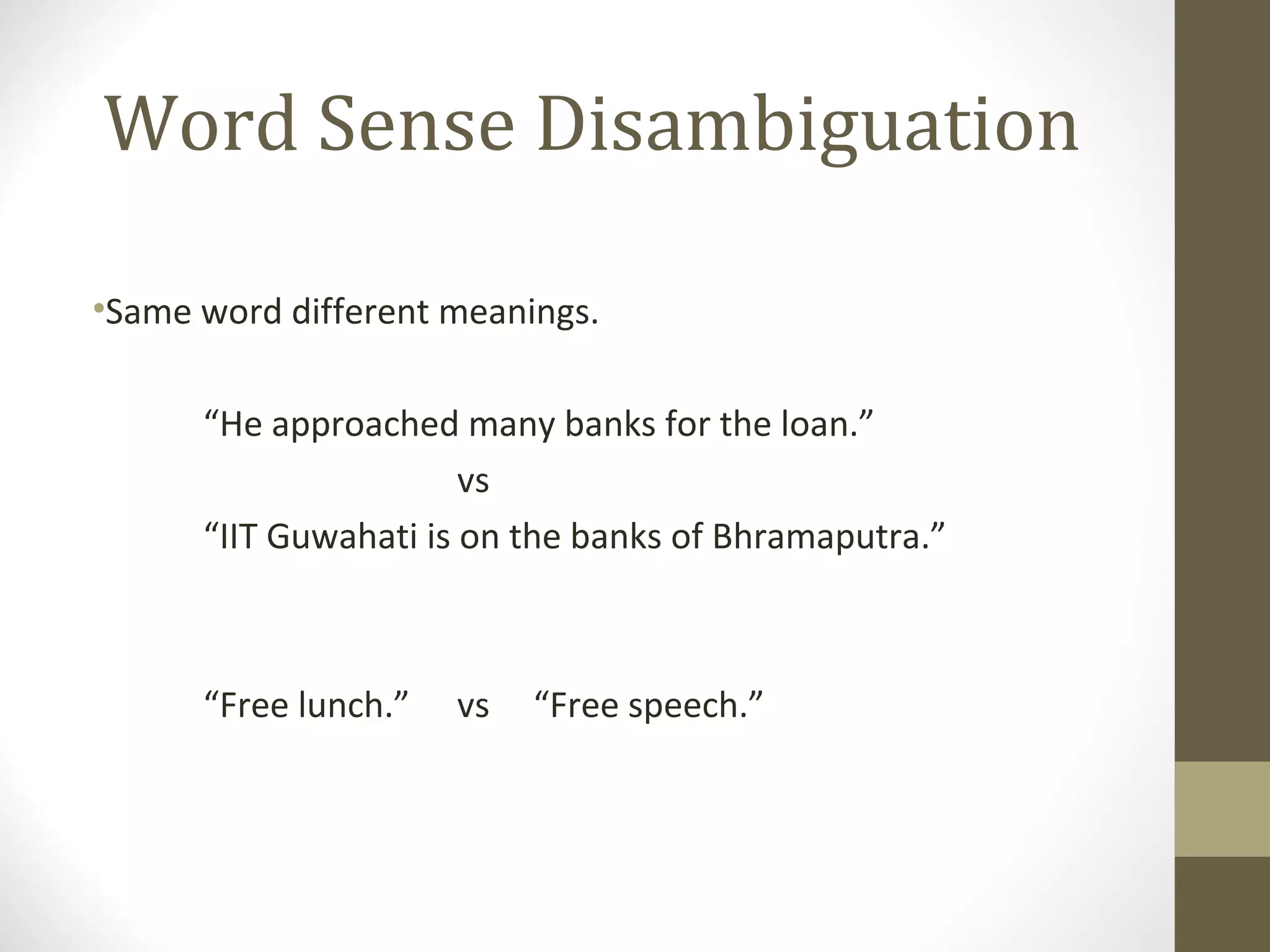
•Same word different meanings.

      “He approached many banks for the loan.”
                       vs
      “IIT Guwahati is on the banks of Bhramaputra.”


      “Free lunch.”   vs   “Free speech.”
Contextual Analysis

• “The teacher pointed out that ‘Mark is the smartest person on
  Earth’ has two proper nouns.”

• “Violinist linked with JAL Crash Blossoms.”
Sentiment Analysis
• Reviews about a restaurant :-

  “Best roast chicken in New Delhi.”

  “Service was very disappointing.”
Sentiment Analysis
• Reviews about a restaurant :-

  “Best roast chicken in New Delhi.”

  “Service was very disappointing.”


• Another set of reviews

     “iPhone 4S is over-hyped.”
Sentiment Analysis
• Reviews about a restaurant :-

  “Best roast chicken in New Delhi.”

  “Service was very disappointing.”


• Another set of reviews

     “iPhone 4S is over-hyped.”

  “The hype about iPhone 4S is justified.”
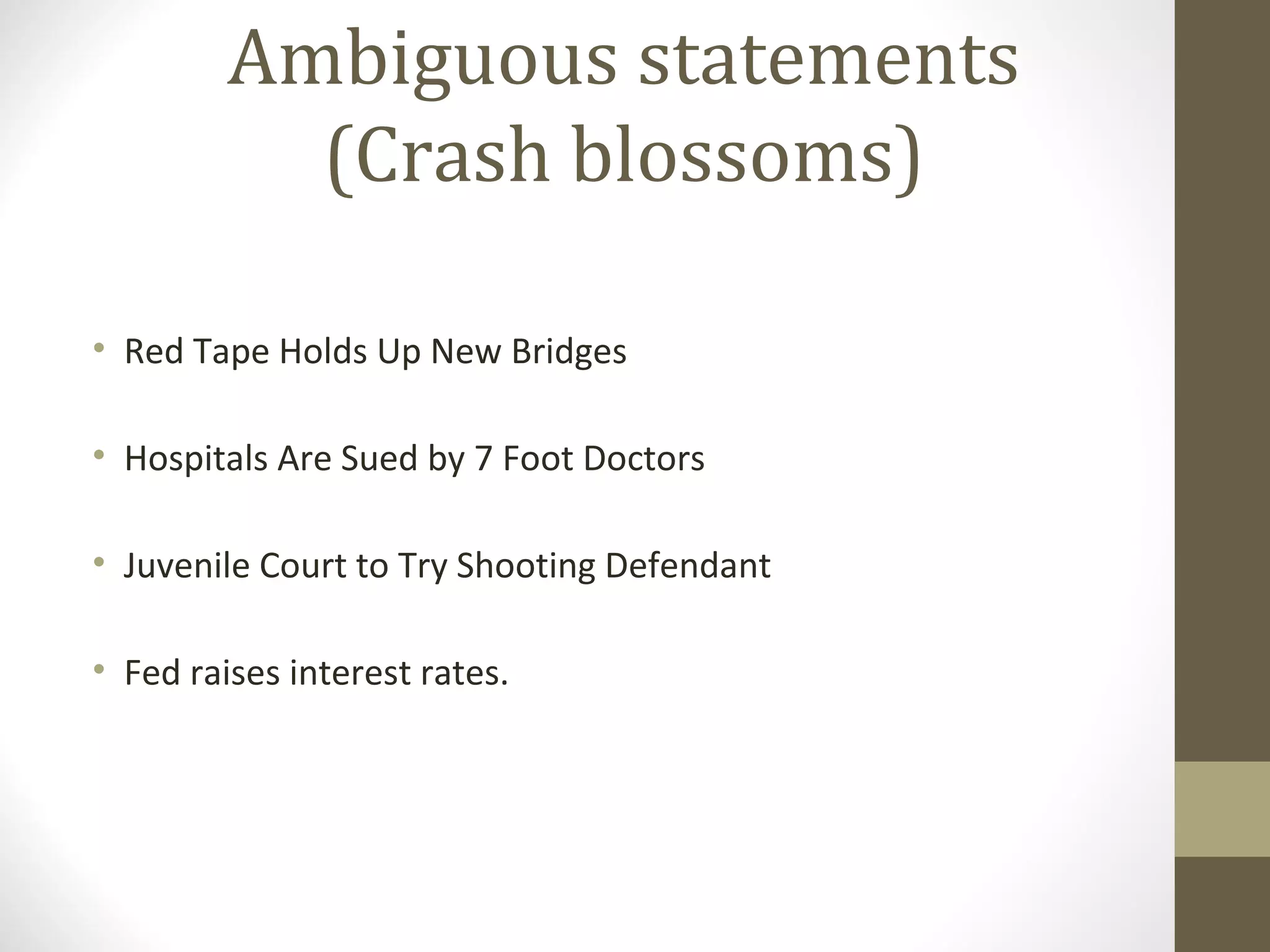
Ambiguous statements
           (Crash blossoms)

• Red Tape Holds Up New Bridges

• Hospitals Are Sued by 7 Foot Doctors

• Juvenile Court to Try Shooting Defendant

• Fed raises interest rates.
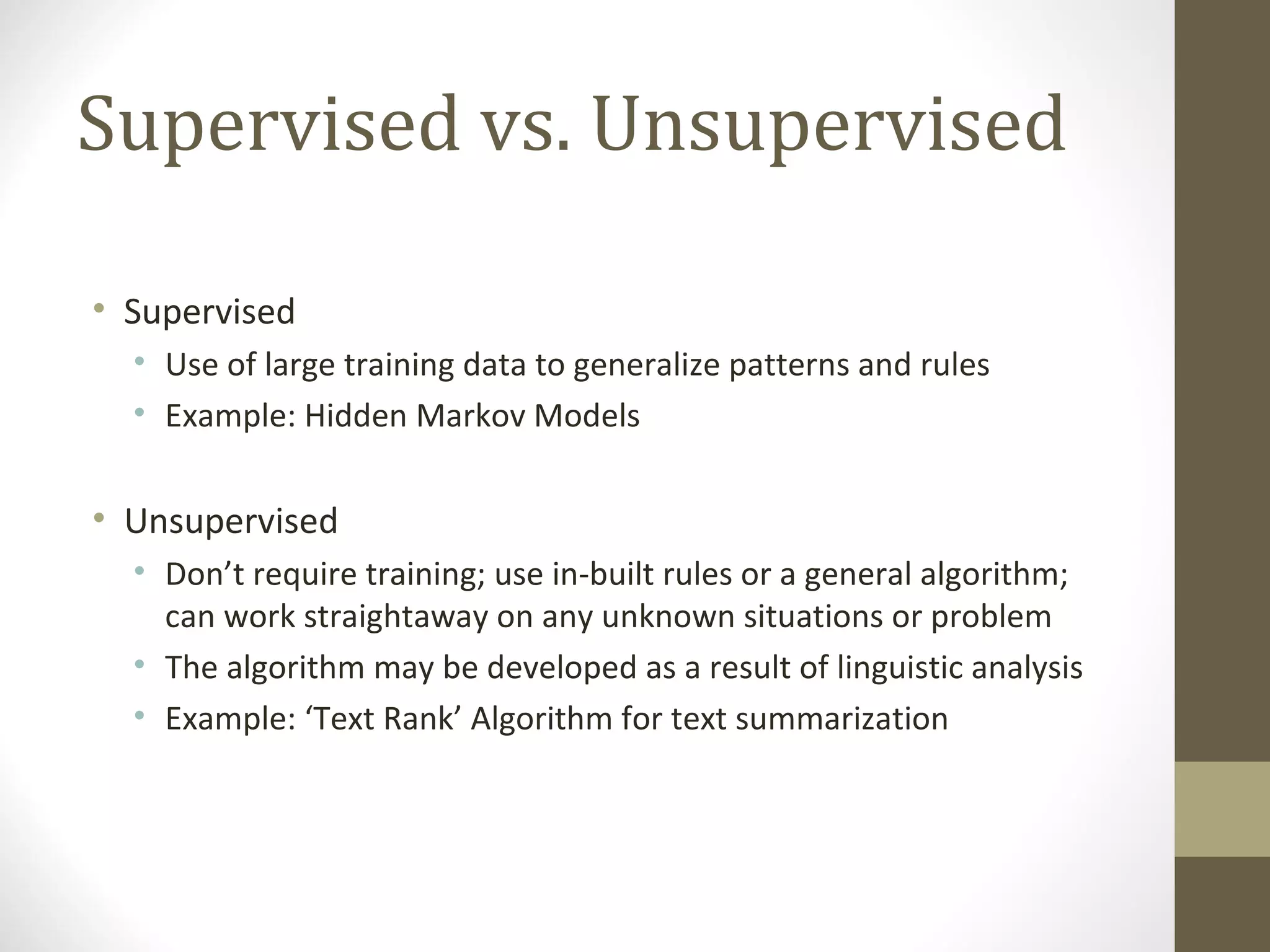
Supervised vs. Unsupervised

• Supervised
  • Use of large training data to generalize patterns and rules
  • Example: Hidden Markov Models


• Unsupervised
  • Don’t require training; use in-built rules or a general algorithm;
    can work straightaway on any unknown situations or problem
  • The algorithm may be developed as a result of linguistic analysis
  • Example: ‘Text Rank’ Algorithm for text summarization
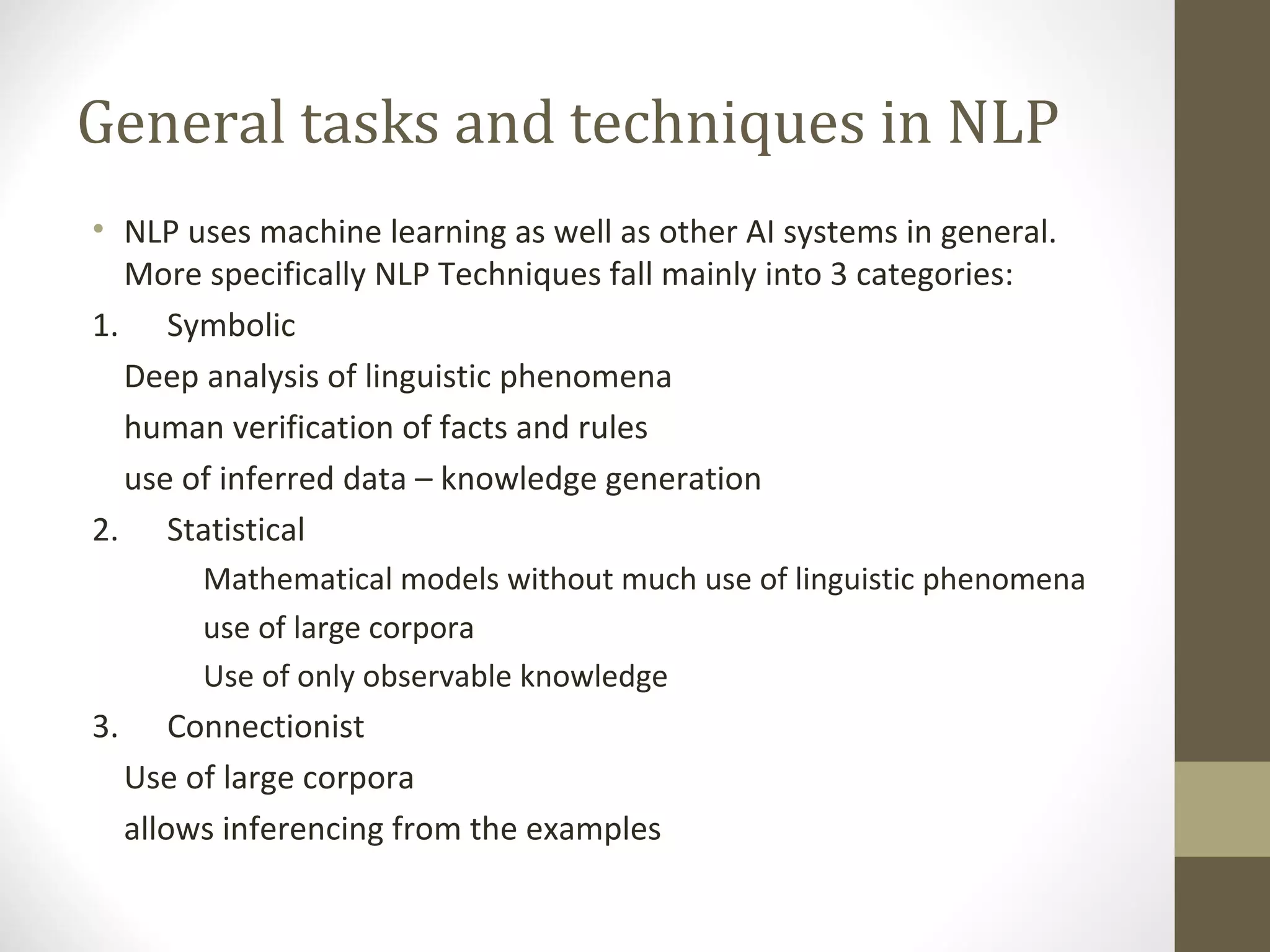
General tasks and techniques in NLP
• NLP uses machine learning as well as other AI systems in general.
  More specifically NLP Techniques fall mainly into 3 categories:
1. Symbolic
  Deep analysis of linguistic phenomena
  human verification of facts and rules
  use of inferred data – knowledge generation
2. Statistical
       Mathematical models without much use of linguistic phenomena
       use of large corpora
       Use of only observable knowledge
3. Connectionist
  Use of large corpora
  allows inferencing from the examples
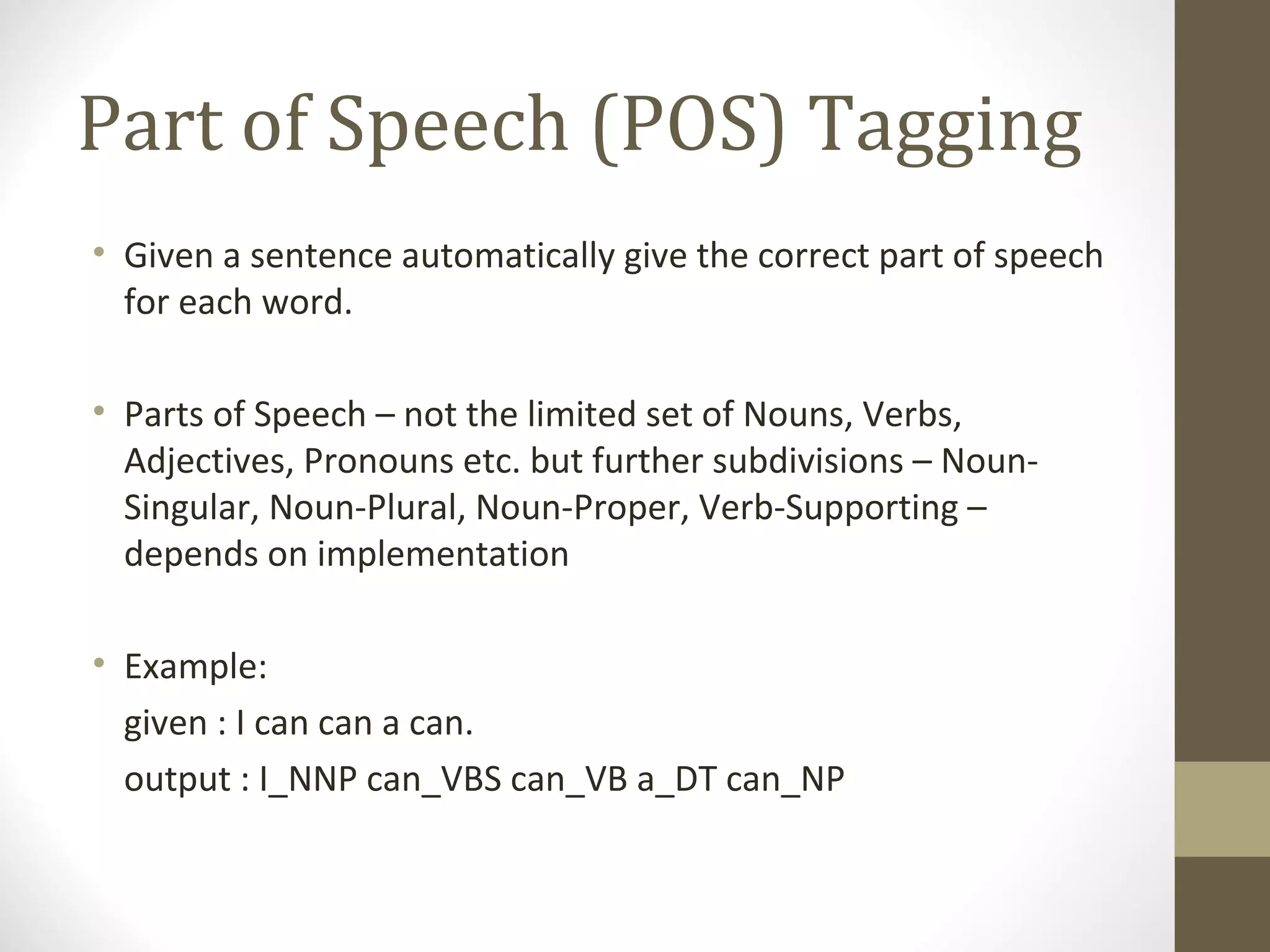
Part of Speech (POS) Tagging
• Given a sentence automatically give the correct part of speech
  for each word.

• Parts of Speech – not the limited set of Nouns, Verbs,
  Adjectives, Pronouns etc. but further subdivisions – Noun-
  Singular, Noun-Plural, Noun-Proper, Verb-Supporting –
  depends on implementation

• Example:
  given : I can can a can.
  output : I_NNP can_VBS can_VB a_DT can_NP
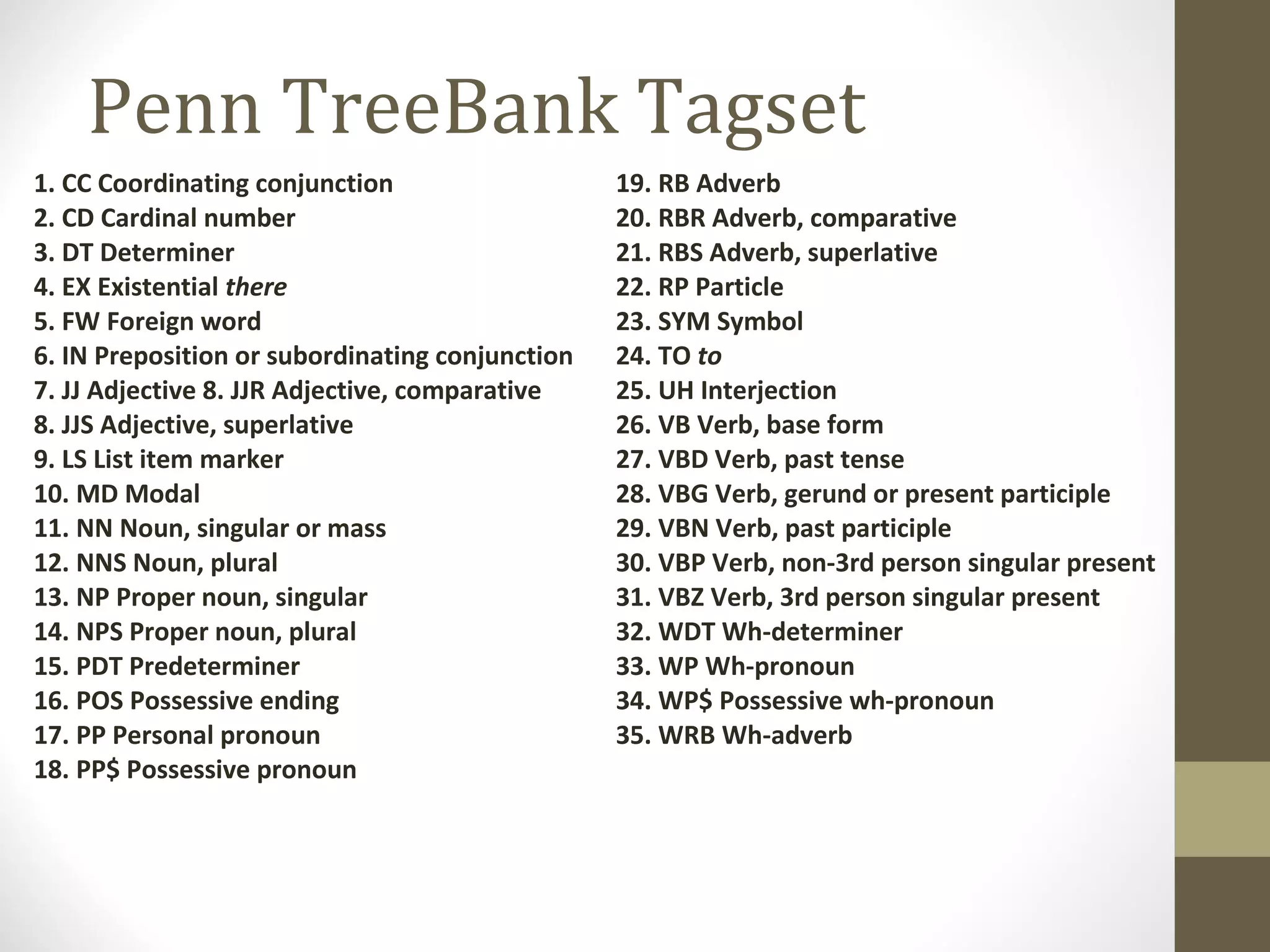
Penn TreeBank Tagset
1. CC Coordinating conjunction                   19. RB Adverb
2. CD Cardinal number                            20. RBR Adverb, comparative
3. DT Determiner                                 21. RBS Adverb, superlative
4. EX Existential there                          22. RP Particle
5. FW Foreign word                               23. SYM Symbol
6. IN Preposition or subordinating conjunction   24. TO to
7. JJ Adjective 8. JJR Adjective, comparative    25. UH Interjection
8. JJS Adjective, superlative                    26. VB Verb, base form
9. LS List item marker                           27. VBD Verb, past tense
10. MD Modal                                     28. VBG Verb, gerund or present participle
11. NN Noun, singular or mass                    29. VBN Verb, past participle
12. NNS Noun, plural                             30. VBP Verb, non-3rd person singular present
13. NP Proper noun, singular                     31. VBZ Verb, 3rd person singular present
14. NPS Proper noun, plural                      32. WDT Wh-determiner
15. PDT Predeterminer                            33. WP Wh-pronoun
16. POS Possessive ending                        34. WP$ Possessive wh-pronoun
17. PP Personal pronoun                          35. WRB Wh-adverb
18. PP$ Possessive pronoun
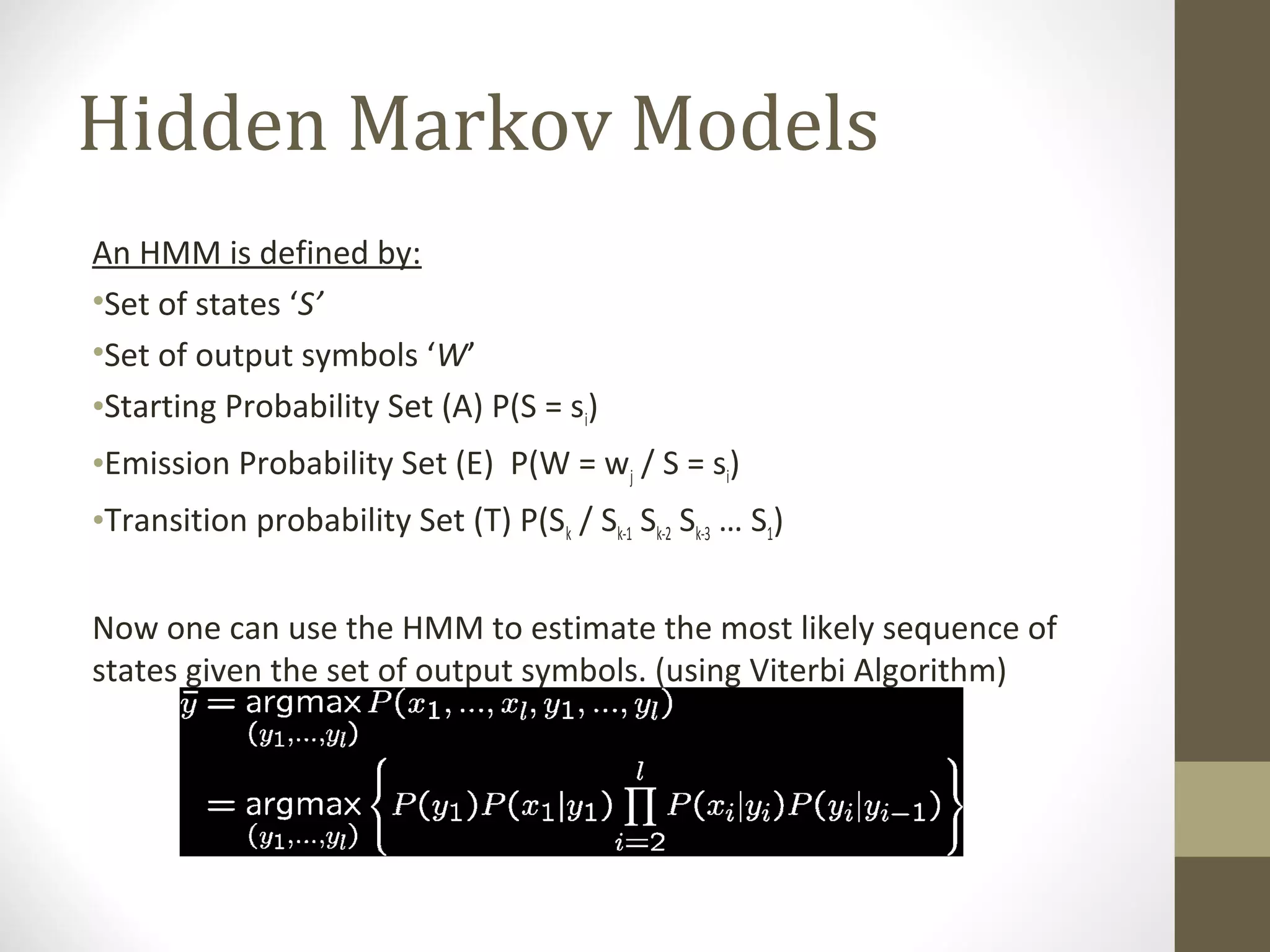
Hidden Markov Models
An HMM is defined by:
•Set of states ‘S’
•Set of output symbols ‘W’
•Starting Probability Set (A) P(S = si)
•Emission Probability Set (E) P(W = wj / S = si)
•Transition probability Set (T) P(Sk / Sk-1 Sk-2 Sk-3 … S1)


Now one can use the HMM to estimate the most likely sequence of
states given the set of output symbols. (using Viterbi Algorithm)
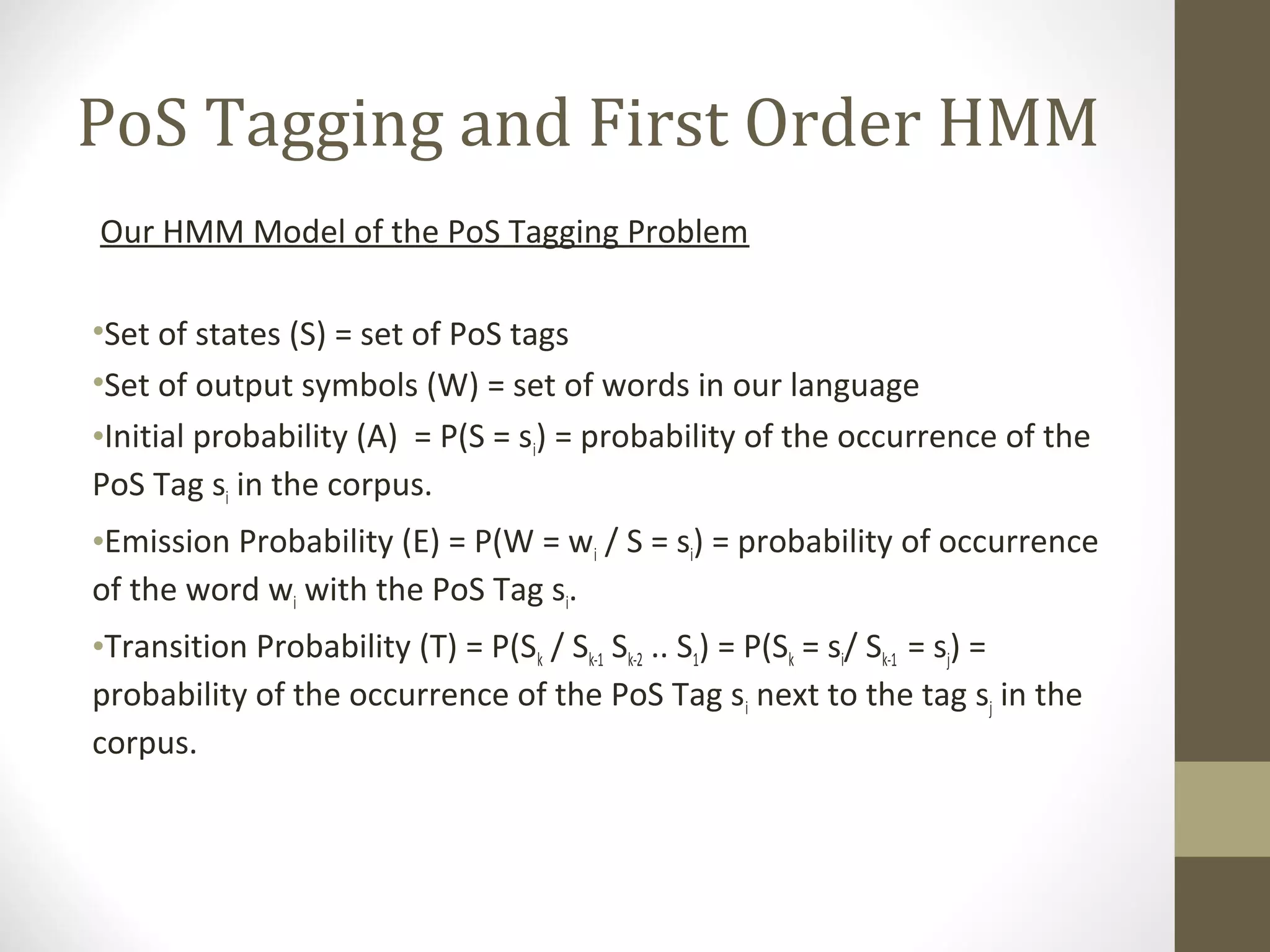
PoS Tagging and First Order HMM
Our HMM Model of the PoS Tagging Problem

•Set of states (S) = set of PoS tags
•Set of output symbols (W) = set of words in our language
•Initial probability (A) = P(S = si) = probability of the occurrence of the
PoS Tag si in the corpus.
•Emission Probability (E) = P(W = wi / S = si) = probability of occurrence
of the word wi with the PoS Tag si.
•Transition Probability (T) = P(Sk / Sk-1 Sk-2 .. S1) = P(Sk = si/ Sk-1 = sj) =
probability of the occurrence of the PoS Tag si next to the tag sj in the
corpus.
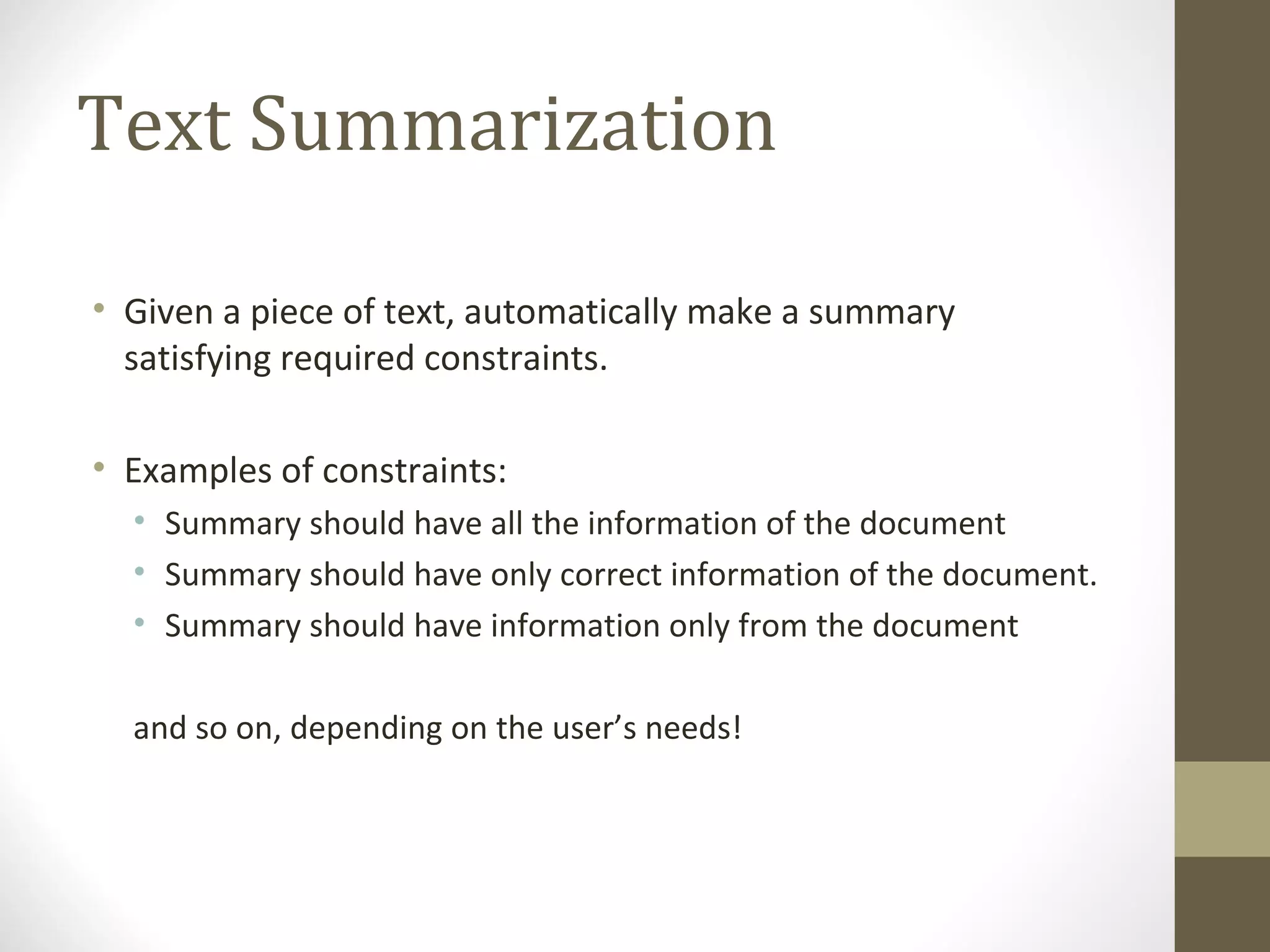
Text Summarization

• Given a piece of text, automatically make a summary
  satisfying required constraints.

• Examples of constraints:
  • Summary should have all the information of the document
  • Summary should have only correct information of the document.
  • Summary should have information only from the document

  and so on, depending on the user’s needs!
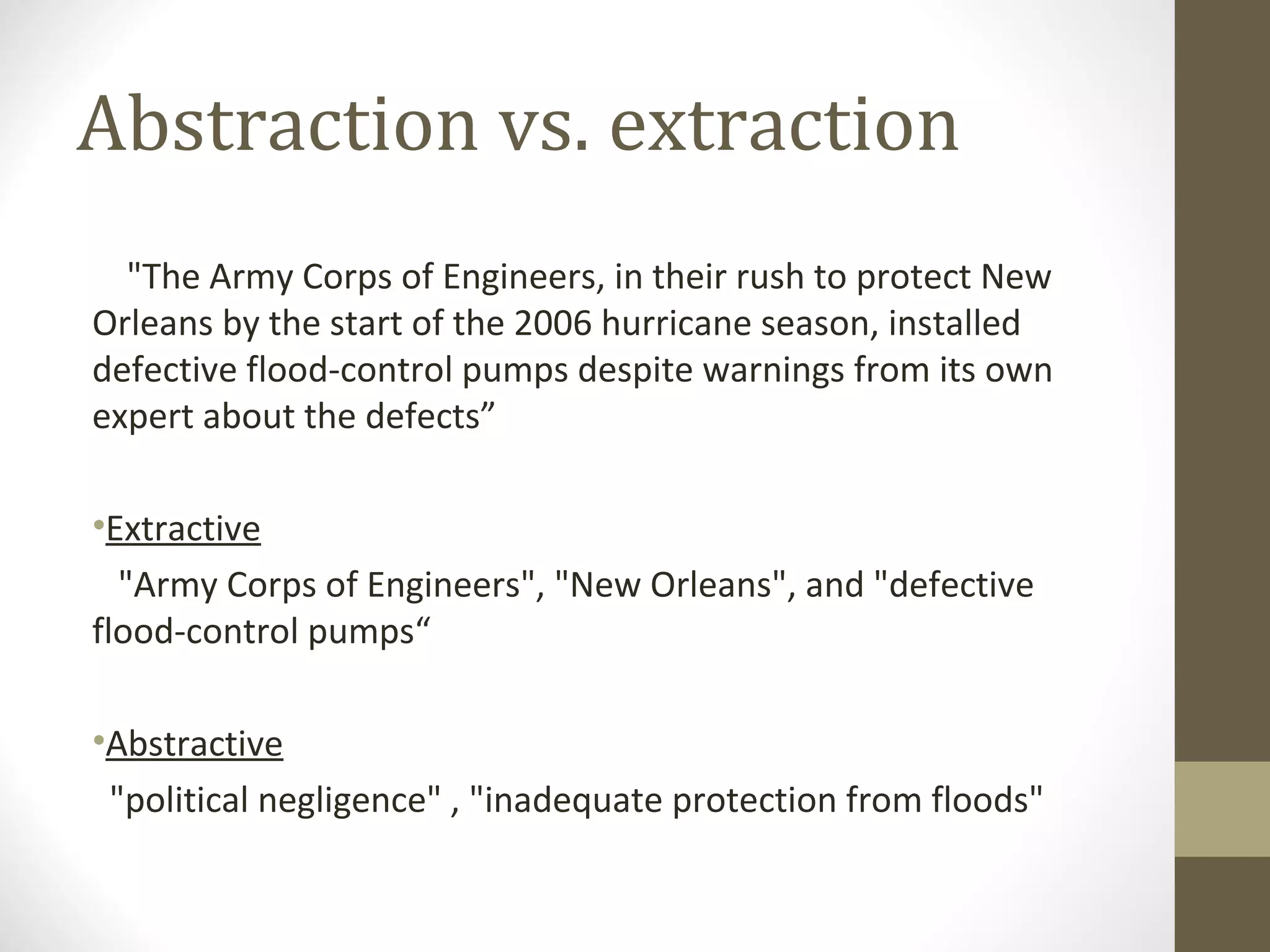
Abstraction vs. extraction
  "The Army Corps of Engineers, in their rush to protect New
Orleans by the start of the 2006 hurricane season, installed
defective flood-control pumps despite warnings from its own
expert about the defects”

•Extractive
  "Army Corps of Engineers", "New Orleans", and "defective
flood-control pumps“

•Abstractive
 "political negligence" , "inadequate protection from floods"
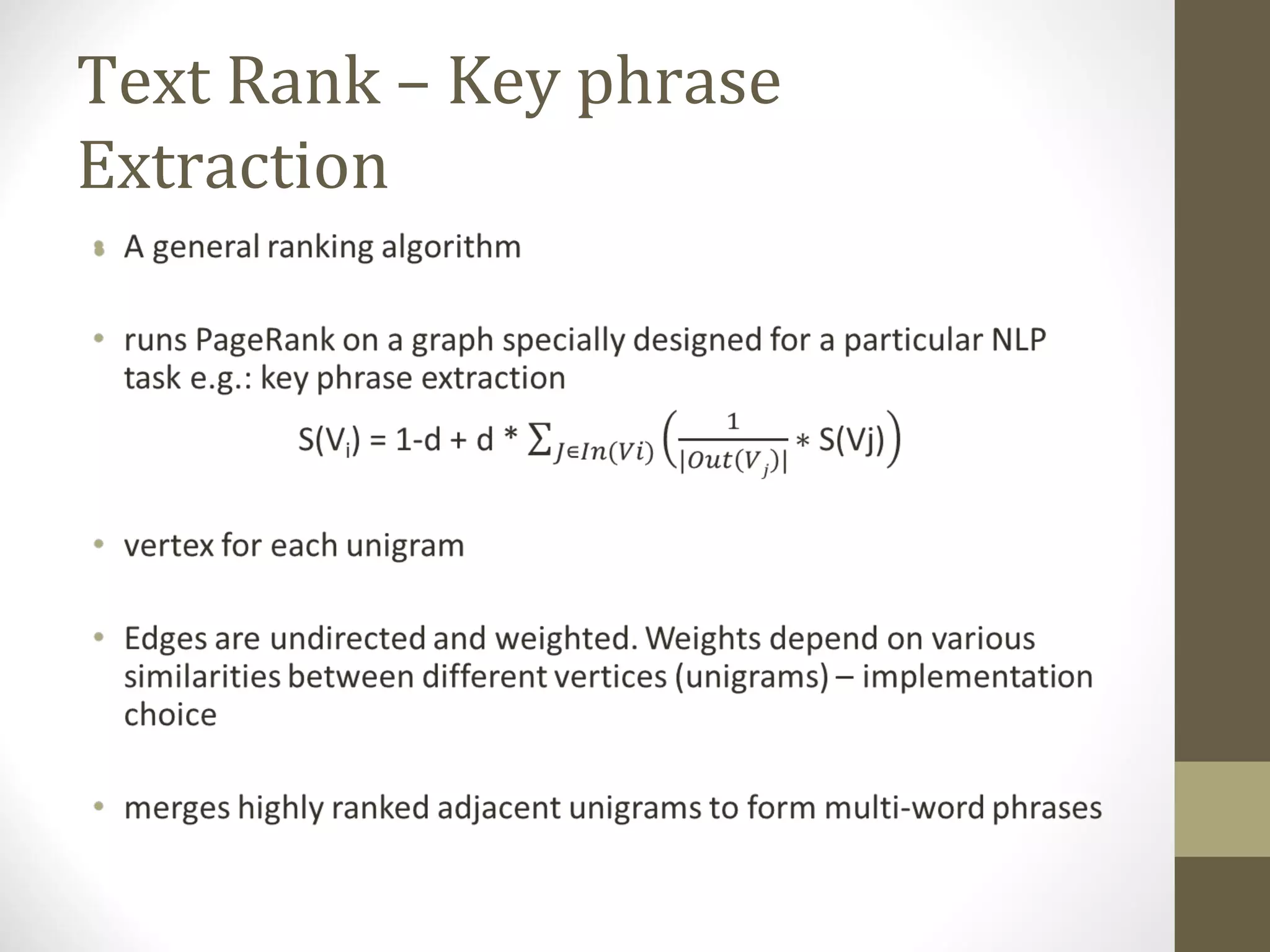
Text Rank – Key phrase
Extraction
Questions
Thank You!
Resources
Links
•acl.ldc.upenn.edu/acl2004/emnlp/pdf/Mihalcea.pdf
•ilpubs.stanford.edu:8090/422/1/1999-66.pdf
•en.wikipedia.org/wiki/Automatic_summarization
•en.wikipedia.org/wiki/Viterbi_algorithm
•http://
ieeexplore.ieee.org/stamp/stamp.jsp?arnumber=01450960
•http://nlp-class.org

Books:
•Artificial Intelligence and Intelligence Systems, N.P. Padhy

Introduction to Natural Language Processing

  • 1.
    Introduction to Natural LanguageProcessing Pranav Gupta Rajat Khanduja
  • 2.
    What is NLP? ”Natural language processing (NLP) is a field of computer science, artificial intelligence (also called machine learning), and linguistics concerned with the interactions between computers and human (natural) languages. Specifically, the process of a computer extracting meaningful information from natural language input and/or producing natural language output ” - Wikipedia
  • 3.
    Scope of discussion •Language of focus :- English • Domain of Natural Language Processing to be discussed. Text linguistics • Focus on statistical methods.
  • 4.
  • 5.
    Answering Questions  ”What time is the next bus from the city after the 5:00 pm bus ?”  ”I am a 3rd year CSE student, which classes do I have today ?”  ”Which gene is associated with Diabetes ?”  ”Who is Donald Knuth ?”
  • 6.
    Information extraction • Extraction of meaning from email :- We have decided to meet tomorrow at 10:00am in the lab.
  • 7.
    Information extraction • Extraction of meaning from email :- We have decided to meet tomorrow at 10:00am in the lab. To do : meeting Time : 10:00 am, 22/3/2012 Venue : Lab
  • 8.
    Machine Translation मेरा नामरजत है | => My name is Rajat.
  • 9.
    Machine Translation मेरा नामरजत है | => My name is Rajat. Grass is greener on the other side.
  • 10.
    Machine Translation मेरा नामरजत है | => My name is Rajat. Grass is greener on the other side. => दूर के ढोल सुहावने | Google’s Translation : घास दूसरी तरफ हिरयाली है |
  • 11.
    Other applications  Textsummarization • Extract keywords or key-phrases from a large piece of text. • Creating an abstract of an entire article.  Context analysis • Social networking sites can ‘fairly’ understand the topic of discussion “ 4 of your friends posted about Indian Institute of Technology, Guwahati”.  Sentiment analysis • Help companies analyze large number of reviews on a product • Help customers process the reviews provided on a product.
  • 12.
    Tasks in NLP •Tokenization / Segmentation • Disambiguation • Stemming • Part of Speech (POS) tagging • Contextual Analysis • Sentiment Analysis
  • 13.
    Segmentation • Segmenting textinto words “The meeting has been scheduled for this Saturday.” “He has agreed to co-operate with me.” “Indian Airlines introduces another flight on the New Delhi–Mumbai route.” “We are leaving for the U.S.A. on 26th May.” “Vineet is playing the role of Duke of Athens in A Midsummer Night’s Dream in a theatre in New Delhi.” •Named Entity Recognition
  • 14.
    Stemming • Stemming isthe process for reducing inflected (or sometimes derived) words to their stem, base or root form. • car, cars -> car • run, ran, running -> run • stemmer, stemming, stemmed -> stem
  • 15.
    POS tagging • Partof speech (POS) recognition “ Today is a beautiful day. “ Today is a beautiful day Noun Verb Article Adjective Noun
  • 16.
    POS tagging • Partof speech (POS) recognition “ Today is a beautiful day. “ Today is a beautiful day Noun Verb Article Adjective Noun “Interest rates interest economists for the interest of the nation.“ (word sense disambiguation)
  • 17.
    Word Sense Disambiguation •Sameword different meanings. “He approached many banks for the loan.” vs “IIT Guwahati is on the banks of Bhramaputra.” “Free lunch.” vs “Free speech.”
  • 18.
    Contextual Analysis • “Theteacher pointed out that ‘Mark is the smartest person on Earth’ has two proper nouns.” • “Violinist linked with JAL Crash Blossoms.”
  • 19.
    Sentiment Analysis • Reviewsabout a restaurant :- “Best roast chicken in New Delhi.” “Service was very disappointing.”
  • 20.
    Sentiment Analysis • Reviewsabout a restaurant :- “Best roast chicken in New Delhi.” “Service was very disappointing.” • Another set of reviews “iPhone 4S is over-hyped.”
  • 21.
    Sentiment Analysis • Reviewsabout a restaurant :- “Best roast chicken in New Delhi.” “Service was very disappointing.” • Another set of reviews “iPhone 4S is over-hyped.” “The hype about iPhone 4S is justified.”
  • 22.
    Ambiguous statements (Crash blossoms) • Red Tape Holds Up New Bridges • Hospitals Are Sued by 7 Foot Doctors • Juvenile Court to Try Shooting Defendant • Fed raises interest rates.
  • 23.
    Supervised vs. Unsupervised •Supervised • Use of large training data to generalize patterns and rules • Example: Hidden Markov Models • Unsupervised • Don’t require training; use in-built rules or a general algorithm; can work straightaway on any unknown situations or problem • The algorithm may be developed as a result of linguistic analysis • Example: ‘Text Rank’ Algorithm for text summarization
  • 24.
    General tasks andtechniques in NLP • NLP uses machine learning as well as other AI systems in general. More specifically NLP Techniques fall mainly into 3 categories: 1. Symbolic Deep analysis of linguistic phenomena human verification of facts and rules use of inferred data – knowledge generation 2. Statistical Mathematical models without much use of linguistic phenomena use of large corpora Use of only observable knowledge 3. Connectionist Use of large corpora allows inferencing from the examples
  • 25.
    Part of Speech(POS) Tagging • Given a sentence automatically give the correct part of speech for each word. • Parts of Speech – not the limited set of Nouns, Verbs, Adjectives, Pronouns etc. but further subdivisions – Noun- Singular, Noun-Plural, Noun-Proper, Verb-Supporting – depends on implementation • Example: given : I can can a can. output : I_NNP can_VBS can_VB a_DT can_NP
  • 26.
    Penn TreeBank Tagset 1.CC Coordinating conjunction 19. RB Adverb 2. CD Cardinal number 20. RBR Adverb, comparative 3. DT Determiner 21. RBS Adverb, superlative 4. EX Existential there 22. RP Particle 5. FW Foreign word 23. SYM Symbol 6. IN Preposition or subordinating conjunction 24. TO to 7. JJ Adjective 8. JJR Adjective, comparative 25. UH Interjection 8. JJS Adjective, superlative 26. VB Verb, base form 9. LS List item marker 27. VBD Verb, past tense 10. MD Modal 28. VBG Verb, gerund or present participle 11. NN Noun, singular or mass 29. VBN Verb, past participle 12. NNS Noun, plural 30. VBP Verb, non-3rd person singular present 13. NP Proper noun, singular 31. VBZ Verb, 3rd person singular present 14. NPS Proper noun, plural 32. WDT Wh-determiner 15. PDT Predeterminer 33. WP Wh-pronoun 16. POS Possessive ending 34. WP$ Possessive wh-pronoun 17. PP Personal pronoun 35. WRB Wh-adverb 18. PP$ Possessive pronoun
  • 27.
    Hidden Markov Models AnHMM is defined by: •Set of states ‘S’ •Set of output symbols ‘W’ •Starting Probability Set (A) P(S = si) •Emission Probability Set (E) P(W = wj / S = si) •Transition probability Set (T) P(Sk / Sk-1 Sk-2 Sk-3 … S1) Now one can use the HMM to estimate the most likely sequence of states given the set of output symbols. (using Viterbi Algorithm)
  • 28.
    PoS Tagging andFirst Order HMM Our HMM Model of the PoS Tagging Problem •Set of states (S) = set of PoS tags •Set of output symbols (W) = set of words in our language •Initial probability (A) = P(S = si) = probability of the occurrence of the PoS Tag si in the corpus. •Emission Probability (E) = P(W = wi / S = si) = probability of occurrence of the word wi with the PoS Tag si. •Transition Probability (T) = P(Sk / Sk-1 Sk-2 .. S1) = P(Sk = si/ Sk-1 = sj) = probability of the occurrence of the PoS Tag si next to the tag sj in the corpus.
  • 29.
    Text Summarization • Givena piece of text, automatically make a summary satisfying required constraints. • Examples of constraints: • Summary should have all the information of the document • Summary should have only correct information of the document. • Summary should have information only from the document and so on, depending on the user’s needs!
  • 30.
    Abstraction vs. extraction "The Army Corps of Engineers, in their rush to protect New Orleans by the start of the 2006 hurricane season, installed defective flood-control pumps despite warnings from its own expert about the defects” •Extractive "Army Corps of Engineers", "New Orleans", and "defective flood-control pumps“ •Abstractive "political negligence" , "inadequate protection from floods"
  • 31.
    Text Rank –Key phrase Extraction
  • 32.
  • 33.
  • 34.