The Pop Music Tree
Family Tree of Music
Today we will begin to create our “Musical
Family Tree”. Use the blank tree outline to
fill in the various evolutions of Pop Music
as it developed throughout the 20th century
and into today. Keep key, important notes
on the side of the trunk by each style of
music and on a separate piece keep more
detailed notes. We will listen to examples
of each and see specifically how they’ve
influenced modern music
JAZZ
Growing a Pop Music Tree…
We are going to use the diagram of a tree to illustrate how
music grew into the many genres we now have choices of:
• On your tree diagram, write each
of the 6 founding styles of Jazz
along the 6 corresponding roots
History/Beginning of Jazz
Timeline of Jazz:
o1890’s – 1910’s Jazz is born; Ragtime
o1910’s – 1920’s Blues
o1920’s – 1930’s Dixieland
o1930’s – 1940’s Swing/Big Band
o1940’s Bebop
o1960’s Free Jazz
At the base of the trunk on your music
tree, write Jazz in the first section
ROOTS of TREE
Ragtime Blues Dixieland Swing Bebop Free Jazz
JAZZ
191OS
Although Jazz rhythms have
roots in African rhythms
blended by slaves, the music
originated in African
American Communities in
New Orleans from the
tradition of marching,
funeral, & Street bands
Jazz makes heavy use of
IMPROVISATION,
POLYRHYTHMS,
SYNCOPATION and SWING.
In other words: It has
unrhythmical sounds that
become a regular pattern.
Jazz was the first music
regarded as “pop music”,
from the fact its rise was
due to its popularity,
rather than classical
roots. It is mainly
instrumental, but there
are famous jazz singers
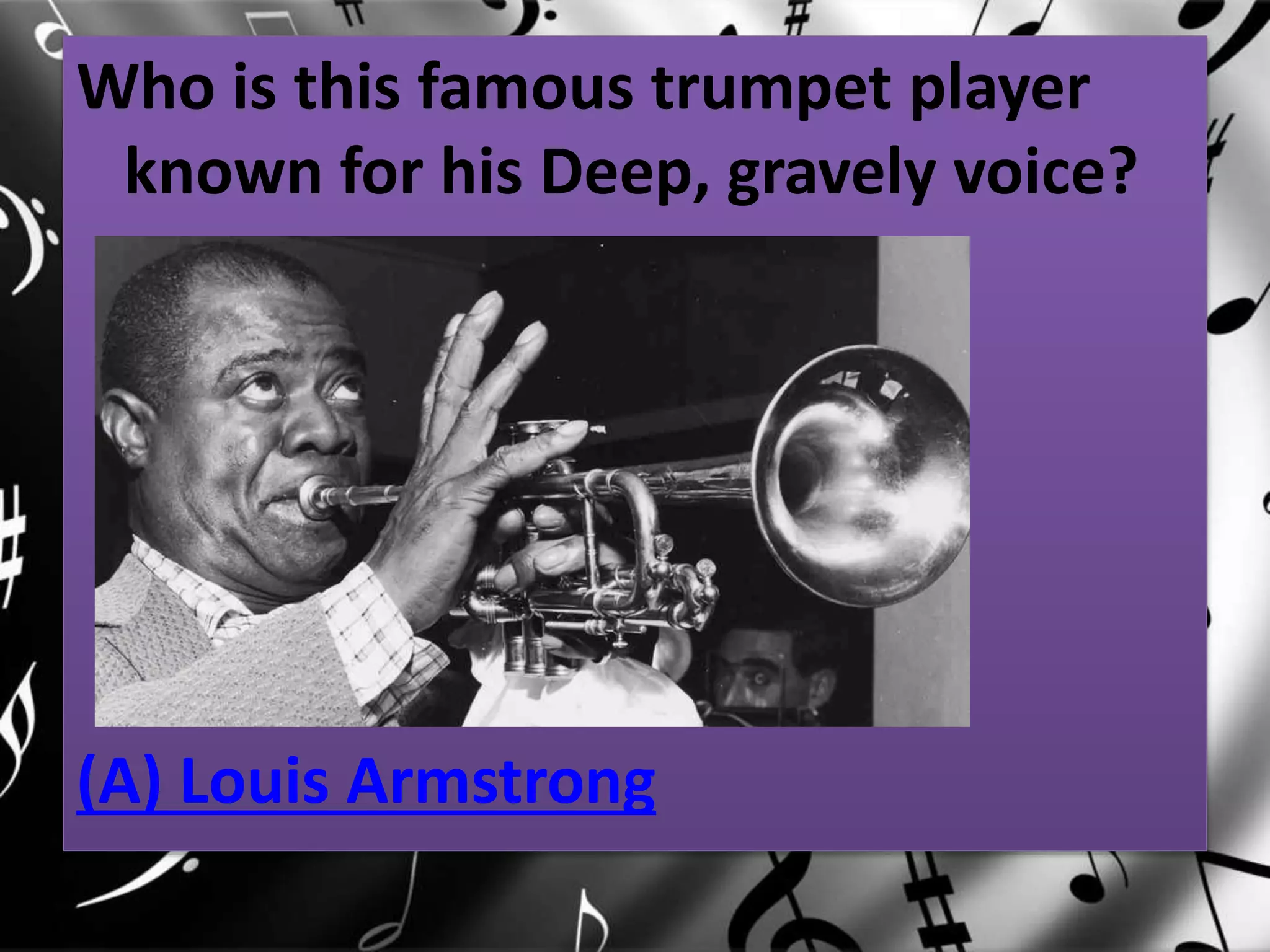
Who is this famous trumpet player
known for his Deep, gravely voice?
(A) Louis Armstrong
BLUES
At the base of the trunk on your music
tree, write Blues in the second section
ROOTS of TREE
Ragtime - Blues - Dixieland - Swing - Bebop - Free Jazz
JAZZ
1910s
BLUES
1920s
Write characteristics of
the genre on the side
of the trunk, and the
time it gained
popularity in the trunk!!
The name “BLUES”
reflects the musical mood of
melancholy and sadness, the
regular use of “Blue Notes”, or
minor chords, and subject
matter that focuses on the
difficulties in real life (love
lost or found, pain, sadness)
BLUES originated in African-American
communities in the “Deep South” of
the USA near end of the 19th century
and rose to popularity in the 1920s &
EARLY 30s after Ragtime introduced
many Jazz rhythms .
RHYTHM AND
BLUES
Moving up the trunk on your music tree,
write R & B in the next section
ROOTS of TREE
Ragtime - Blues - Dixieland - Swing - Bebop - Free Jazz
JAZZ
BLUES
R & B
1940s
Write characteristics of
the genre on the side of
the trunk, and the time
it gained popularity in
the trunk!!
It originated in the 1940s from urban
African Americans.
It encapsulates the African-American
experience of pain and the quest for
freedom and happiness.
The bands consisted of piano, one or
two guitars, bass, drums, saxophone
and sometimes background
vocalists.
The Supremes – baby love (R&B)
The Supremes
Contemporary R&B: R Kelly – I believe I can fly
R KELLY
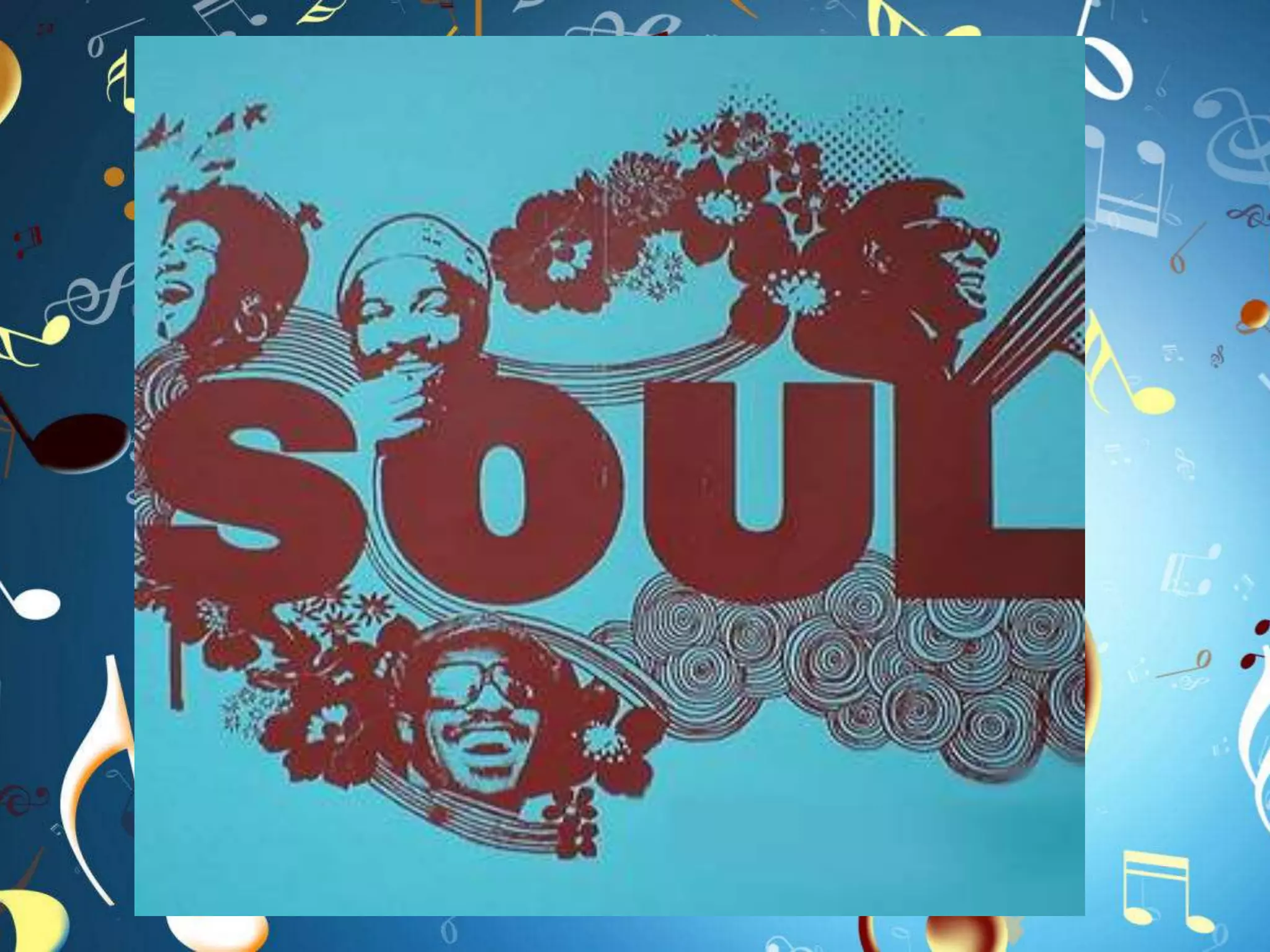
Soul
SOUL
1950s
ROOTS of TREE
Ragtime - Blues - Dixieland - Swing - Bebop - Free Jazz
JAZZ
BLUES
R & B
1940s
Write characteristics
of the genre on the
side of the trunk,
and the time it
gained popularity in
the trunk!!
Soul originated in the US
in the 1950s.
It combines elements of
African-American
gospel music, rhythm
and blues and jazz.
Soul arose out of the black
experience in America:
Catchy rhythms, stressed by
handclaps, and improvised
body moves, are an important
characteristic of soul music
Contemporary Soul:
Jammie Collum What A Difference A Day Made
Jamie Collum
FUNK
Funk is a genre that originated
in the 1960s.
African American musicians
created a rhythmic, danceable
new form of music through a
mixture of Soul, Jazz, Rock &
Roll, and R&B.
NEXT WEEK!!
Next Evolution Into…
Hip Hop
After that Reggae
grows outta
Ska & Rock Steady
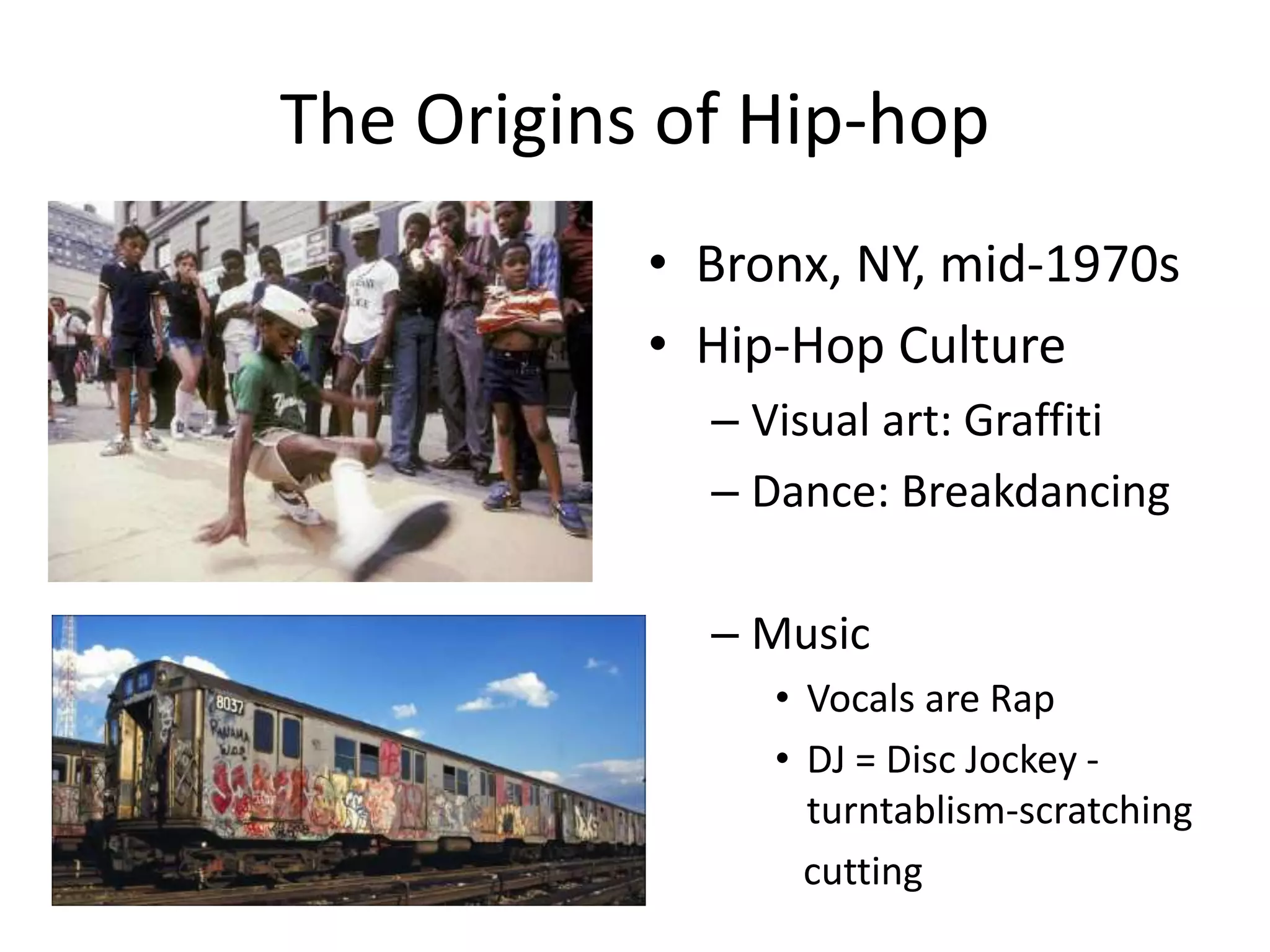
The Origins of Hip-hop
• Bronx, NY, mid-1970s
• Hip-Hop Culture
– Visual art: Graffiti
– Dance: Breakdancing
– Music
• Vocals are Rap
• DJ = Disc Jockey -
turntablism-scratching
cutting
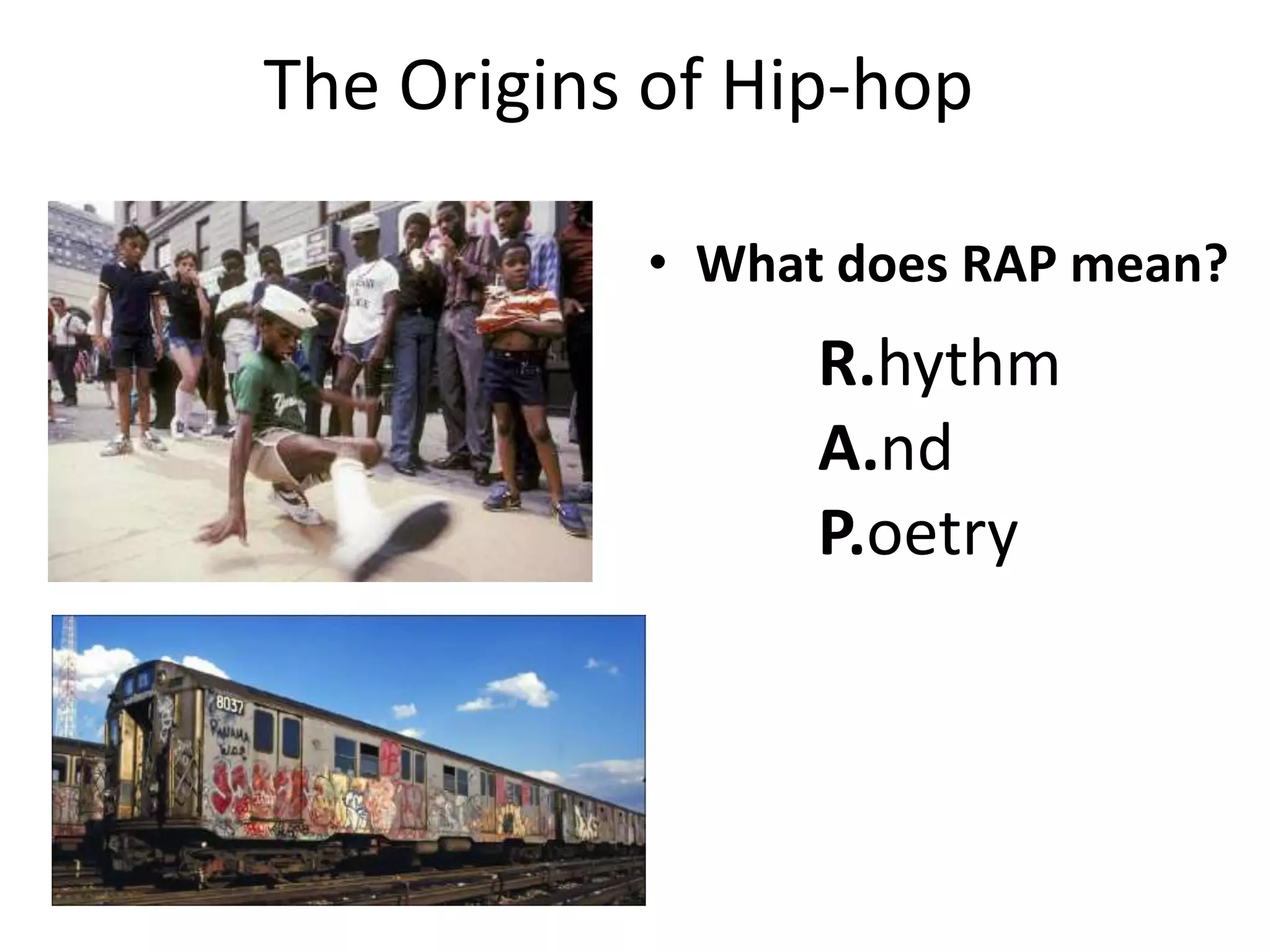
The Origins of Hip-hop
• What does RAP mean?
R.hythm
A.nd
P.oetry
The end

Pop Music Tree

  • 1.
  • 2.
    Family Tree ofMusic Today we will begin to create our “Musical Family Tree”. Use the blank tree outline to fill in the various evolutions of Pop Music as it developed throughout the 20th century and into today. Keep key, important notes on the side of the trunk by each style of music and on a separate piece keep more detailed notes. We will listen to examples of each and see specifically how they’ve influenced modern music
  • 4.
  • 6.
    Growing a PopMusic Tree… We are going to use the diagram of a tree to illustrate how music grew into the many genres we now have choices of: • On your tree diagram, write each of the 6 founding styles of Jazz along the 6 corresponding roots
  • 7.
    History/Beginning of Jazz Timelineof Jazz: o1890’s – 1910’s Jazz is born; Ragtime o1910’s – 1920’s Blues o1920’s – 1930’s Dixieland o1930’s – 1940’s Swing/Big Band o1940’s Bebop o1960’s Free Jazz
  • 8.
    At the baseof the trunk on your music tree, write Jazz in the first section ROOTS of TREE Ragtime Blues Dixieland Swing Bebop Free Jazz JAZZ 191OS
  • 9.
    Although Jazz rhythmshave roots in African rhythms blended by slaves, the music originated in African American Communities in New Orleans from the tradition of marching, funeral, & Street bands
  • 11.
    Jazz makes heavyuse of IMPROVISATION, POLYRHYTHMS, SYNCOPATION and SWING. In other words: It has unrhythmical sounds that become a regular pattern.
  • 12.
    Jazz was thefirst music regarded as “pop music”, from the fact its rise was due to its popularity, rather than classical roots. It is mainly instrumental, but there are famous jazz singers
  • 13.
    Who is thisfamous trumpet player known for his Deep, gravely voice? (A) Louis Armstrong
  • 14.
  • 15.
    At the baseof the trunk on your music tree, write Blues in the second section ROOTS of TREE Ragtime - Blues - Dixieland - Swing - Bebop - Free Jazz JAZZ 1910s BLUES 1920s Write characteristics of the genre on the side of the trunk, and the time it gained popularity in the trunk!!
  • 17.
    The name “BLUES” reflectsthe musical mood of melancholy and sadness, the regular use of “Blue Notes”, or minor chords, and subject matter that focuses on the difficulties in real life (love lost or found, pain, sadness)
  • 18.
    BLUES originated inAfrican-American communities in the “Deep South” of the USA near end of the 19th century and rose to popularity in the 1920s & EARLY 30s after Ragtime introduced many Jazz rhythms .
  • 19.
  • 20.
    Moving up thetrunk on your music tree, write R & B in the next section ROOTS of TREE Ragtime - Blues - Dixieland - Swing - Bebop - Free Jazz JAZZ BLUES R & B 1940s Write characteristics of the genre on the side of the trunk, and the time it gained popularity in the trunk!!
  • 23.
    It originated inthe 1940s from urban African Americans. It encapsulates the African-American experience of pain and the quest for freedom and happiness. The bands consisted of piano, one or two guitars, bass, drums, saxophone and sometimes background vocalists.
  • 24.
    The Supremes –baby love (R&B) The Supremes
  • 25.
    Contemporary R&B: RKelly – I believe I can fly R KELLY
  • 26.
  • 27.
    SOUL 1950s ROOTS of TREE Ragtime- Blues - Dixieland - Swing - Bebop - Free Jazz JAZZ BLUES R & B 1940s Write characteristics of the genre on the side of the trunk, and the time it gained popularity in the trunk!!
  • 29.
    Soul originated inthe US in the 1950s. It combines elements of African-American gospel music, rhythm and blues and jazz.
  • 30.
    Soul arose outof the black experience in America: Catchy rhythms, stressed by handclaps, and improvised body moves, are an important characteristic of soul music
  • 31.
    Contemporary Soul: Jammie CollumWhat A Difference A Day Made Jamie Collum
  • 32.
  • 34.
    Funk is agenre that originated in the 1960s. African American musicians created a rhythmic, danceable new form of music through a mixture of Soul, Jazz, Rock & Roll, and R&B.
  • 36.
    NEXT WEEK!! Next EvolutionInto… Hip Hop After that Reggae grows outta Ska & Rock Steady
  • 37.
    The Origins ofHip-hop • Bronx, NY, mid-1970s • Hip-Hop Culture – Visual art: Graffiti – Dance: Breakdancing – Music • Vocals are Rap • DJ = Disc Jockey - turntablism-scratching cutting
  • 38.
    The Origins ofHip-hop • What does RAP mean? R.hythm A.nd P.oetry
  • 39.