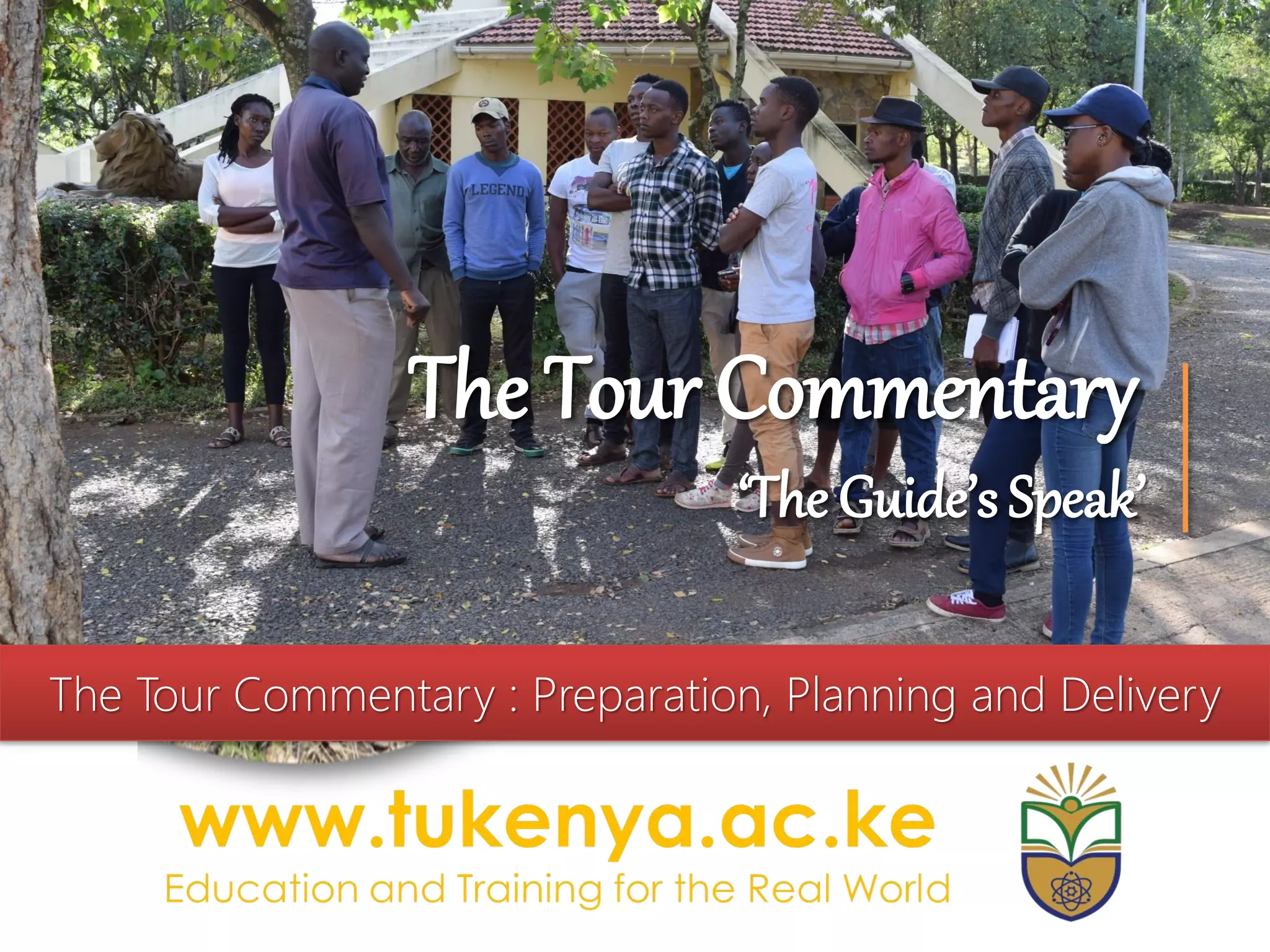
The Tour Commentary
‘The Guide’s Speak’
The Tour Commentary : Preparation, Planning and Delivery
The Tour Commentary
• Preparation & Planning
• Delivery of Commentaries
• Attention, Participation & Enthusiasm
• Responding to Special Needs Visitors
• Keeping the Commentary updated
What is a Tour Commentary?
The Tour Commentary
A tour commentary is a narrative used by a tour guide to
describe a site and provide information about various
aspects of a country to tourists while on a tour. They are
generally referred to as the “guide’s speak” and include
general information and local stories about attractions or
sites, events and personalities in a country.
What are the contents of a Tour Commentary?
Parts if a Tour Commentary
• The Introduction
• The Briefing
• The Presentation
• The Closing
A tour guide should prepare the tour commentary before
beginning a tour and it is composed of the four main parts:
How does a tour guide prepare a tour commentary?
• Establish the needs and interests of the group.
• Confirm the itinerary.
• Access sources of information about sites to be
visited.
• Research on the facts about the attractions to
be visited.
• Prepare the text of the tour commentary based
on the established facts.
Preparing a Tour Commentary
The procedure for preparing a commentary is as follows:
The following guideline should be ensured :
• Distractions or interruptions including questions
from the audience will leave you floundering.
• Learn the concepts and meanings exhaustively
and deliver them with an inflection that reflects
both enthusiasm and authority.
• This helps you answer any questions and segue
back into your spiel.
Planning the delivery of a Commentary
Know the contents of your tour commentary backwards
and forward but do not memorize in verbatim
Project the right Body Language
• They way you deliver the commentary can be
just as important as what you say, take your
time to work on it.
• Stand straight to convey confidence in your
product as you pitch your tour commentary.
• Maintain confidence, yet an easy going body
language so you appear approachable but not
aggressive.
• Take your cues from the tourists to see if your
body language is mirrored or if you need to
tone it down.
Planning the delivery of a Commentary
• Whether a single person or a group, pay
attention to their reactions, especially their facial
expressions and body language as you delivery
the commentary.
• Watch for signs of boredom or discomfort to
adjust your commentary accordingly e.g.
yawning, fidgeting and checking the time.
• Recapture attention by interrupting the spiel to
relate to a short personal experience or by
moving about to focus their attention to you.
Build natural rapport with your audience
Planning the delivery of a Commentary
• If you are extremely confident and talking to
one person, you can grasp his arm or shoulder
while making an important point as if to take
him into your confidence.
• Confirm the interests and expectations of the
visitors at the outset of the tour.
• Introduce yourself by clearly state: your name,
designation, purpose of the tour, distance to be
travelled, locations, events, expectations and
activities.
• Present the spiel in a conversational rather than
noted or memorized way.
• Make the commentary interesting, relevant,
simple and deliver it in logical sequence.
• Be sensitive to the group’s interests and tailor the
commentary to the group.
Delivery of Commentaries On-Transit
• Seek feedback throughout the tour to foster the
visitors’ attention.
• Respond to enquiries accurately and positively,
when an answer is not available, refer to the field
guides and other information sources.
• If an answer is still not available for a query,
apologize and refer the enquiry to an alternative
source of information.
• Focus on what you know, be specific and
express the information in terms of what the
visitors can see.
Delivery of Commentaries On-Transit
• Be accommodating and flexible towards visitors
allowing for different points of view and ways of
doing things.
• Allow enough time at each stop for visitors to
fully enjoy and gain information with private
time at the stop.
Delivery of Commentaries On-Transit
• Start with greetings and introductions.
• Deliver the spiel in ways that makes visitors
interested.
• Use good sense of humor to deliver the spiel.
• Remember that spiels help people appreciate and
understand what they see.
• Face the entire group, not a few, speak slowly and
clearly with an audible voice.
• Always maintain eye contact with the visitors.
• Prepare yourself for questions that may be asked.
• Take control of your breathing and emphasize on
important words.
Delivery of Commentaries On-Site
• Use synonyms and examples when making
explanations.
• When mentioning a local name, repeat or spell it.
• Maintain silence if the need arises.
• Listen carefully to questions and other concerns.
• Never argue or debate with the visitors.
• Always end the tour by thanking the visitors and
wishing them a good day, evening or night.
• Issue the visitor questionnaire to obtain their
views, feedback, opinions and recommendations
of the day’s tour.
Delivery of Commentaries On-Site
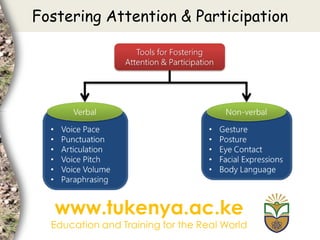
Fostering Attention & Participation
Change your voice Speed
• A consistent pace of voice can make the
commentary delivery ineffective.
• Vary the speed of your voice depending on the
tourists and purpose of the communication.
• To gain attention and excite the visitors, speak
quickly and enthusiastically.
• Speak slowly to enable visitors to pay attention
to your words.
Fostering Attention & Participation
Punctuate with Pauses
• It is important to break the flow of information
during commentary delivery so that visitors
can understand what they just heard.
• A pause is taken when the guide has conveyed
an important point or wants the visitors to
anticipate.
Fostering Attention & Participation
Articulate Clearly
• It is important that your spiel is clear to the
audience.
• Avoid technical terms unless explained and
often use the simplest word.
• Learn basic foreign terms and phrases even if
you are not a linguist.
• Have expertise in pronunciation and articulate
each word clearly when you speak to gain
more confidence and clarity.
Fostering Attention & Participation
Posture
Shift the Pitch of your Voice
• Frequency of speech is called voice pitch.
• Depending on the aim of the speech, you can
use high and low pitches at times.
• Using extremes can tarnish the success of your
commentary delivery.
Fostering Attention & Participation
• A guide has to cultivate and maintain elegance
in way of standing and walking as it conveys
messages about personality.
Control your Voice Volume
• Volume of voice create a direct impact on the
audience.
• An average volume should be used in general.
• It can be loud or soft depending on the aim of
the commentary.
• When a mix of loudness and softness is used, it
adds special effects to the commentary.
Fostering Attention & Participation
• A gesture can communicate all that the guide
feels, consciously or unconsciously.
• Shaking of hands, head, holding, embracing or
patting on the back all convey varied messages.
Use of Gestures
• Facial expressions are most natural and
unconscious.
• They continually change during interactions and
are observed constantly by the audience.
• Smiling is considered to be pleasant and helpful.
Facial Expressions
Fostering Attention & Participation
Paraphrasing
• Paraphrasing is simply explaining statements or
remarks in shortened or renowned versions of
facts so as to clarify the meaning visitors need.
Fostering Attention & Participation
A group of visitors on a scenic tour intend to visit
the Ndere Island National Park. On-route, the bus passes
through Port Victoria on the west of the Island in
Kisumu near the site of the British landing in 1945. The
tour guide had previously read the following extract and
wishes to paraphrase the facts to the group.
Paraphrase Case Study:
• People seek enjoyment in travel, so present the
facts in a witty and humorous fashion.
• However, do not be a stand-up comedian,
always modulate your voice for variation and
emphasis.
Keep the Commentary Light
Keeping Visitors Enthusiastic
The tour duration affects the amount of energy the
guide needs to use with the idea being having visitors
happy and enthused throughout the tour. To keep
the visitors enthusiastic, the guide needs to:
• Each country or county has its problems, do not
dwell on them, constantly highlight
improvements and progress being made.
Keep the Narrations Positive
• Tailor the information to each particular group.
• If the group is composed of farmers or
accountants, point out sites they might find
most interesting.
• Schedule and allow many photo opportunities.
Know and Involve your Audience
Keeping Visitors Enthusiastic
Be Accurate and Specific
Personalize the Information
Keeping Visitors Enthusiastic
• Present the information in a scholarly way that
is accurate and specific.
• Quiz the visitors on the spiel to add some
entertainment and interest.
• Groups are curious about the guide’s personal
and professional life.
• Turn their curiosity to an advantage and weave
some personal information into the commentary.
• Be aware that your life does not become the tour.
• Have a mastery of the subject, visitors will
respect a guide who knows his subject well.
• Adopt a friendly attitude and take responsibility
for creating and maintaining harmony.
• Let visitors know that their enjoyment is your
primary concern.
• Respect others and be a careful and concerned
listener.
• Establish and environment where visitors feel
free to contribute, is more interesting and
advantageous to all, in this way visitors are
more likely to approach a guide with minor
issues before they become major problems.
Developing Rapport, Cohesiveness & Order
“we’ll be leaving in about ten minutes” guarantees a late
departure. A clearer approach is to say “we’ll be departing
at eleven sharp, according to my watch it is ten forty.”
Developing Rapport, Cohesiveness & Order
• Give clear instructions, a guide who says:
• Follow through on promises, it is best to be
conservative with promises and do not mention
places and events visitors may not see.
• Avoid playing favorites and treat everyone the
same.
Developing Rapport, Cohesiveness & Order
• Do not give ultimatums that cannot be
enforced, e.g.
Telling visitors that if they are late,
they will be left behind, will they?
• Although leaving behind a perennially late
person may be extremely popular with other
tour members, it should never be done without
considerable warning and care.
Keeping the Commentary Updated
Keeping the spiel updated is fundamental to
enjoying the tour guiding job and ensuring the
spiel remains top-notch for repeat visitors. A spiel
can be kept lively using the following ways:
• Current issues can be of a subject matter or at a
site.
• Keeping updated on current issues gives some
measure of energy to the tour guide and
subsequently to the narration.
Keeping updated on current issues
Keeping the Commentary Updated
Striving for continuous Improvement
• Review the daily performance.
• Take an informal poll of the visitors and make
amendments with each tour.
Look at the attraction through the visitor’s eyes
• Remember most visitors may be seeing the
attraction or site for the first time.
• Imagine what can be improved, what may be of
interest and anticipate questions so that the
answers may be ready.
Keeping the Commentary Updated
As a performer, draw on the group’s energy
• The guide may feel renewed during the many
hours of the tour by looking at visitor’s reaction,
feelings their enthusiasm, asking open questions
to ensure active participation and eliminate
boredom.
The Tour Commentary
Take Home Assignment
Upon learning on the planning and delivery of the
tour commentary, you are required to develop
a commentary on the following sites:
Brian Mumo Saiwa Swamp National Park
James Mutevu Kakamega National Reserve
Guiding Visitors with Special Needs
• Growth of Disabled Travelers
• Visitors with Special Needs
• Guidelines for working with Disabled
• Types & Responding to Disabled Visitors
• Do’s and Don’ts in handling the Disabled
Thank you for being meticulously responsible
Thematic Areas
• Tour Guiding and Interpretation
• Tourism and Travel Law
• Travel and Tour Operations
• Wildlife Tourism
• Sustainable Tourism
• Marketing for Travel and Tourism
• Social Media Marketing
Victory
Loves
Preparation
paulolola@hotmail.com
Victory
Loves
Preparation

The Tour Commentary

  • 1.
    The Tour Commentary ‘TheGuide’s Speak’ The Tour Commentary : Preparation, Planning and Delivery
  • 2.
    The Tour Commentary •Preparation & Planning • Delivery of Commentaries • Attention, Participation & Enthusiasm • Responding to Special Needs Visitors • Keeping the Commentary updated
  • 3.
    What is aTour Commentary? The Tour Commentary A tour commentary is a narrative used by a tour guide to describe a site and provide information about various aspects of a country to tourists while on a tour. They are generally referred to as the “guide’s speak” and include general information and local stories about attractions or sites, events and personalities in a country.
  • 4.
    What are thecontents of a Tour Commentary? Parts if a Tour Commentary • The Introduction • The Briefing • The Presentation • The Closing A tour guide should prepare the tour commentary before beginning a tour and it is composed of the four main parts:
  • 5.
    How does atour guide prepare a tour commentary? • Establish the needs and interests of the group. • Confirm the itinerary. • Access sources of information about sites to be visited. • Research on the facts about the attractions to be visited. • Prepare the text of the tour commentary based on the established facts. Preparing a Tour Commentary The procedure for preparing a commentary is as follows:
  • 6.
    The following guidelineshould be ensured : • Distractions or interruptions including questions from the audience will leave you floundering. • Learn the concepts and meanings exhaustively and deliver them with an inflection that reflects both enthusiasm and authority. • This helps you answer any questions and segue back into your spiel. Planning the delivery of a Commentary Know the contents of your tour commentary backwards and forward but do not memorize in verbatim
  • 7.
    Project the rightBody Language • They way you deliver the commentary can be just as important as what you say, take your time to work on it. • Stand straight to convey confidence in your product as you pitch your tour commentary. • Maintain confidence, yet an easy going body language so you appear approachable but not aggressive. • Take your cues from the tourists to see if your body language is mirrored or if you need to tone it down. Planning the delivery of a Commentary
  • 8.
    • Whether asingle person or a group, pay attention to their reactions, especially their facial expressions and body language as you delivery the commentary. • Watch for signs of boredom or discomfort to adjust your commentary accordingly e.g. yawning, fidgeting and checking the time. • Recapture attention by interrupting the spiel to relate to a short personal experience or by moving about to focus their attention to you. Build natural rapport with your audience Planning the delivery of a Commentary
  • 9.
    Planning the deliveryof a Commentary • If you are extremely confident and talking to one person, you can grasp his arm or shoulder while making an important point as if to take him into your confidence.
  • 10.
    • Confirm theinterests and expectations of the visitors at the outset of the tour. • Introduce yourself by clearly state: your name, designation, purpose of the tour, distance to be travelled, locations, events, expectations and activities. • Present the spiel in a conversational rather than noted or memorized way. • Make the commentary interesting, relevant, simple and deliver it in logical sequence. • Be sensitive to the group’s interests and tailor the commentary to the group. Delivery of Commentaries On-Transit
  • 11.
    • Seek feedbackthroughout the tour to foster the visitors’ attention. • Respond to enquiries accurately and positively, when an answer is not available, refer to the field guides and other information sources. • If an answer is still not available for a query, apologize and refer the enquiry to an alternative source of information. • Focus on what you know, be specific and express the information in terms of what the visitors can see. Delivery of Commentaries On-Transit
  • 12.
    • Be accommodatingand flexible towards visitors allowing for different points of view and ways of doing things. • Allow enough time at each stop for visitors to fully enjoy and gain information with private time at the stop. Delivery of Commentaries On-Transit
  • 13.
    • Start withgreetings and introductions. • Deliver the spiel in ways that makes visitors interested. • Use good sense of humor to deliver the spiel. • Remember that spiels help people appreciate and understand what they see. • Face the entire group, not a few, speak slowly and clearly with an audible voice. • Always maintain eye contact with the visitors. • Prepare yourself for questions that may be asked. • Take control of your breathing and emphasize on important words. Delivery of Commentaries On-Site
  • 14.
    • Use synonymsand examples when making explanations. • When mentioning a local name, repeat or spell it. • Maintain silence if the need arises. • Listen carefully to questions and other concerns. • Never argue or debate with the visitors. • Always end the tour by thanking the visitors and wishing them a good day, evening or night. • Issue the visitor questionnaire to obtain their views, feedback, opinions and recommendations of the day’s tour. Delivery of Commentaries On-Site
  • 15.
    Fostering Attention &Participation
  • 16.
    Change your voiceSpeed • A consistent pace of voice can make the commentary delivery ineffective. • Vary the speed of your voice depending on the tourists and purpose of the communication. • To gain attention and excite the visitors, speak quickly and enthusiastically. • Speak slowly to enable visitors to pay attention to your words. Fostering Attention & Participation
  • 17.
    Punctuate with Pauses •It is important to break the flow of information during commentary delivery so that visitors can understand what they just heard. • A pause is taken when the guide has conveyed an important point or wants the visitors to anticipate. Fostering Attention & Participation
  • 18.
    Articulate Clearly • Itis important that your spiel is clear to the audience. • Avoid technical terms unless explained and often use the simplest word. • Learn basic foreign terms and phrases even if you are not a linguist. • Have expertise in pronunciation and articulate each word clearly when you speak to gain more confidence and clarity. Fostering Attention & Participation
  • 19.
    Posture Shift the Pitchof your Voice • Frequency of speech is called voice pitch. • Depending on the aim of the speech, you can use high and low pitches at times. • Using extremes can tarnish the success of your commentary delivery. Fostering Attention & Participation • A guide has to cultivate and maintain elegance in way of standing and walking as it conveys messages about personality.
  • 20.
    Control your VoiceVolume • Volume of voice create a direct impact on the audience. • An average volume should be used in general. • It can be loud or soft depending on the aim of the commentary. • When a mix of loudness and softness is used, it adds special effects to the commentary. Fostering Attention & Participation
  • 21.
    • A gesturecan communicate all that the guide feels, consciously or unconsciously. • Shaking of hands, head, holding, embracing or patting on the back all convey varied messages. Use of Gestures • Facial expressions are most natural and unconscious. • They continually change during interactions and are observed constantly by the audience. • Smiling is considered to be pleasant and helpful. Facial Expressions Fostering Attention & Participation
  • 22.
    Paraphrasing • Paraphrasing issimply explaining statements or remarks in shortened or renowned versions of facts so as to clarify the meaning visitors need. Fostering Attention & Participation A group of visitors on a scenic tour intend to visit the Ndere Island National Park. On-route, the bus passes through Port Victoria on the west of the Island in Kisumu near the site of the British landing in 1945. The tour guide had previously read the following extract and wishes to paraphrase the facts to the group. Paraphrase Case Study:
  • 23.
    • People seekenjoyment in travel, so present the facts in a witty and humorous fashion. • However, do not be a stand-up comedian, always modulate your voice for variation and emphasis. Keep the Commentary Light Keeping Visitors Enthusiastic The tour duration affects the amount of energy the guide needs to use with the idea being having visitors happy and enthused throughout the tour. To keep the visitors enthusiastic, the guide needs to:
  • 24.
    • Each countryor county has its problems, do not dwell on them, constantly highlight improvements and progress being made. Keep the Narrations Positive • Tailor the information to each particular group. • If the group is composed of farmers or accountants, point out sites they might find most interesting. • Schedule and allow many photo opportunities. Know and Involve your Audience Keeping Visitors Enthusiastic
  • 25.
    Be Accurate andSpecific Personalize the Information Keeping Visitors Enthusiastic • Present the information in a scholarly way that is accurate and specific. • Quiz the visitors on the spiel to add some entertainment and interest. • Groups are curious about the guide’s personal and professional life. • Turn their curiosity to an advantage and weave some personal information into the commentary. • Be aware that your life does not become the tour.
  • 26.
    • Have amastery of the subject, visitors will respect a guide who knows his subject well. • Adopt a friendly attitude and take responsibility for creating and maintaining harmony. • Let visitors know that their enjoyment is your primary concern. • Respect others and be a careful and concerned listener. • Establish and environment where visitors feel free to contribute, is more interesting and advantageous to all, in this way visitors are more likely to approach a guide with minor issues before they become major problems. Developing Rapport, Cohesiveness & Order
  • 27.
    “we’ll be leavingin about ten minutes” guarantees a late departure. A clearer approach is to say “we’ll be departing at eleven sharp, according to my watch it is ten forty.” Developing Rapport, Cohesiveness & Order • Give clear instructions, a guide who says: • Follow through on promises, it is best to be conservative with promises and do not mention places and events visitors may not see. • Avoid playing favorites and treat everyone the same.
  • 28.
    Developing Rapport, Cohesiveness& Order • Do not give ultimatums that cannot be enforced, e.g. Telling visitors that if they are late, they will be left behind, will they? • Although leaving behind a perennially late person may be extremely popular with other tour members, it should never be done without considerable warning and care.
  • 29.
    Keeping the CommentaryUpdated Keeping the spiel updated is fundamental to enjoying the tour guiding job and ensuring the spiel remains top-notch for repeat visitors. A spiel can be kept lively using the following ways: • Current issues can be of a subject matter or at a site. • Keeping updated on current issues gives some measure of energy to the tour guide and subsequently to the narration. Keeping updated on current issues
  • 30.
    Keeping the CommentaryUpdated Striving for continuous Improvement • Review the daily performance. • Take an informal poll of the visitors and make amendments with each tour. Look at the attraction through the visitor’s eyes • Remember most visitors may be seeing the attraction or site for the first time. • Imagine what can be improved, what may be of interest and anticipate questions so that the answers may be ready.
  • 31.
    Keeping the CommentaryUpdated As a performer, draw on the group’s energy • The guide may feel renewed during the many hours of the tour by looking at visitor’s reaction, feelings their enthusiasm, asking open questions to ensure active participation and eliminate boredom.
  • 32.
    The Tour Commentary TakeHome Assignment Upon learning on the planning and delivery of the tour commentary, you are required to develop a commentary on the following sites: Brian Mumo Saiwa Swamp National Park James Mutevu Kakamega National Reserve
  • 33.
    Guiding Visitors withSpecial Needs • Growth of Disabled Travelers • Visitors with Special Needs • Guidelines for working with Disabled • Types & Responding to Disabled Visitors • Do’s and Don’ts in handling the Disabled
  • 34.
    Thank you forbeing meticulously responsible Thematic Areas • Tour Guiding and Interpretation • Tourism and Travel Law • Travel and Tour Operations • Wildlife Tourism • Sustainable Tourism • Marketing for Travel and Tourism • Social Media Marketing Victory Loves Preparation paulolola@hotmail.com Victory Loves Preparation