Communication Skills
Communicatio
n Process
The process of
communication
involves a source that
uses a channel to
deliver a message to
the receiver, and this
message produces an
effect and feedback.
Element
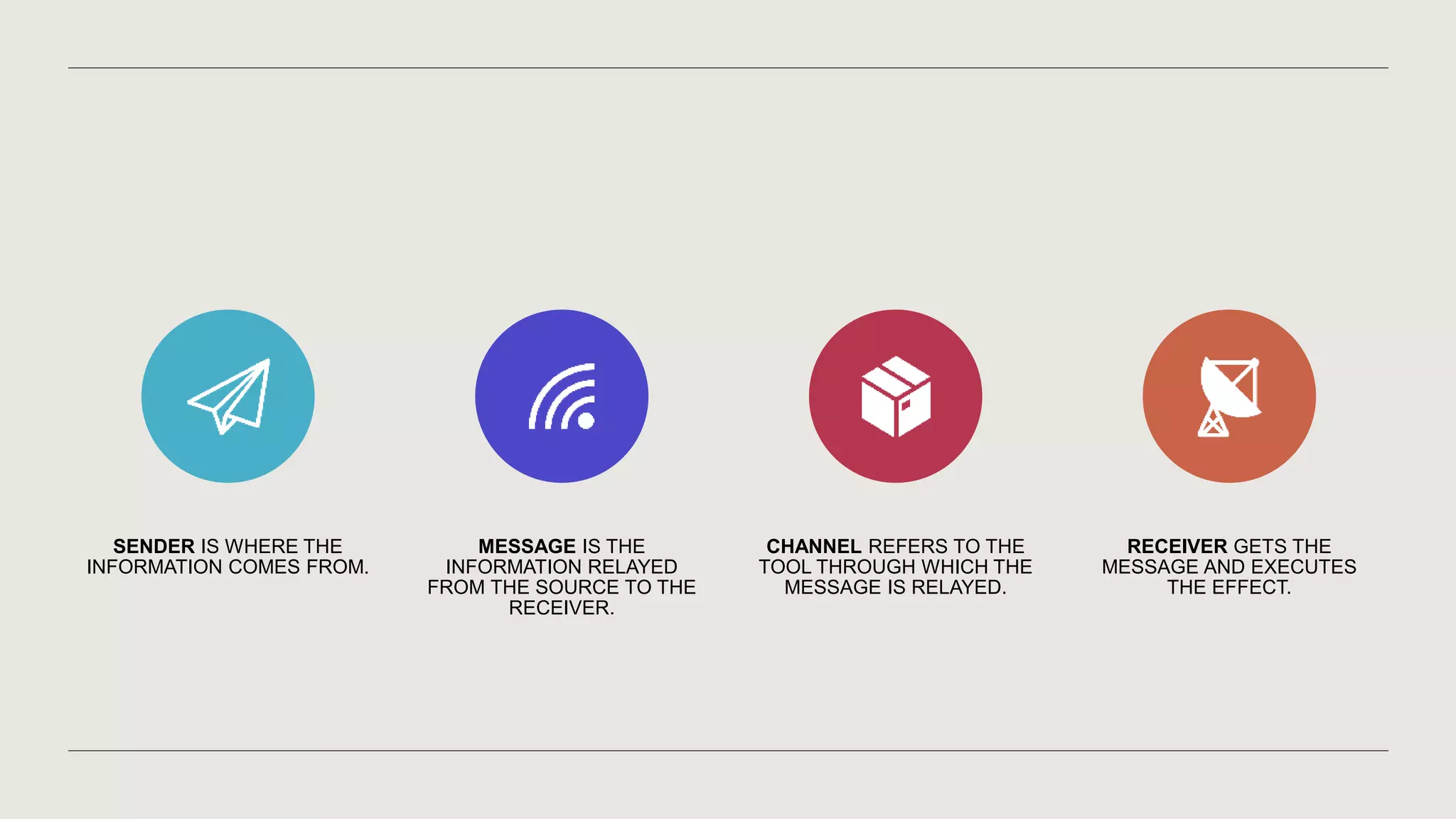
SENDER IS WHERE THE
INFORMATION COMES FROM.
MESSAGE IS THE
INFORMATION RELAYED
FROM THE SOURCE TO THE
RECEIVER.
CHANNEL REFERS TO THE
TOOL THROUGH WHICH THE
MESSAGE IS RELAYED.
RECEIVER GETS THE
MESSAGE AND EXECUTES
THE EFFECT.
Sender is the
tour guide.
Message is the
commentary.
Channel can
be a
microphone.
Receiver is the
tourist.
Effect is the
tourist’s
reaction and
appreciation.
Feedback is also
relayed by the tourist to
the tour guide in the
form of formal
evaluation of the tour
guide’s performance
through feedback
forms, suggestions on
how to improve the tour
guide’s performance,
tips of gratuities, and
repeat visits.
Communication Barriers
1. Physical barriers
Examples
Channels
• Microphones
• Telephones
• Radios
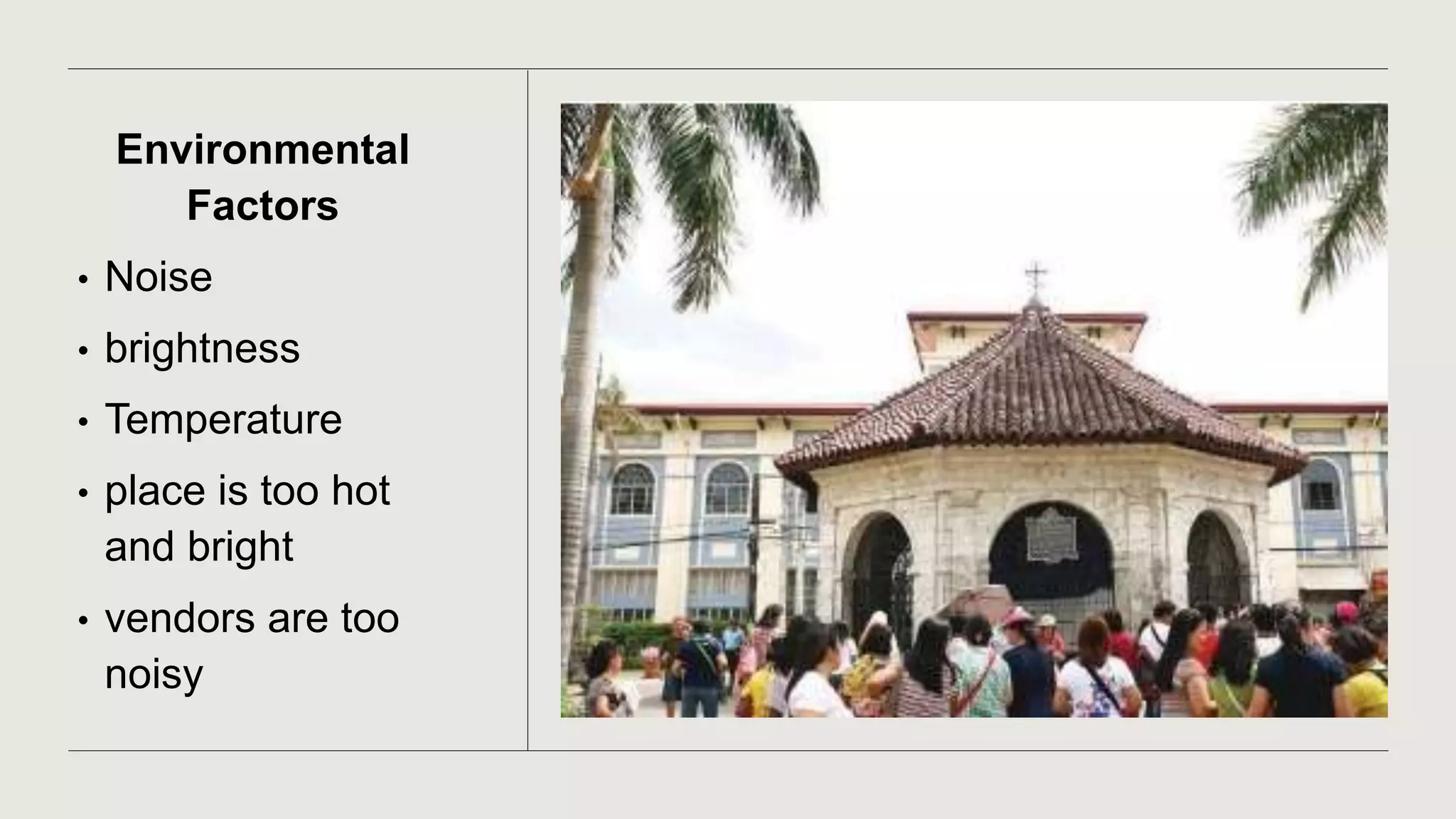
Environmental
Factors
• Noise
• brightness
• Temperature
• place is too hot
and bright
• vendors are too
noisy
2. Socio-psychological barriers
• difference in
pronunciation
Purposesof Communication inTour
Guiding
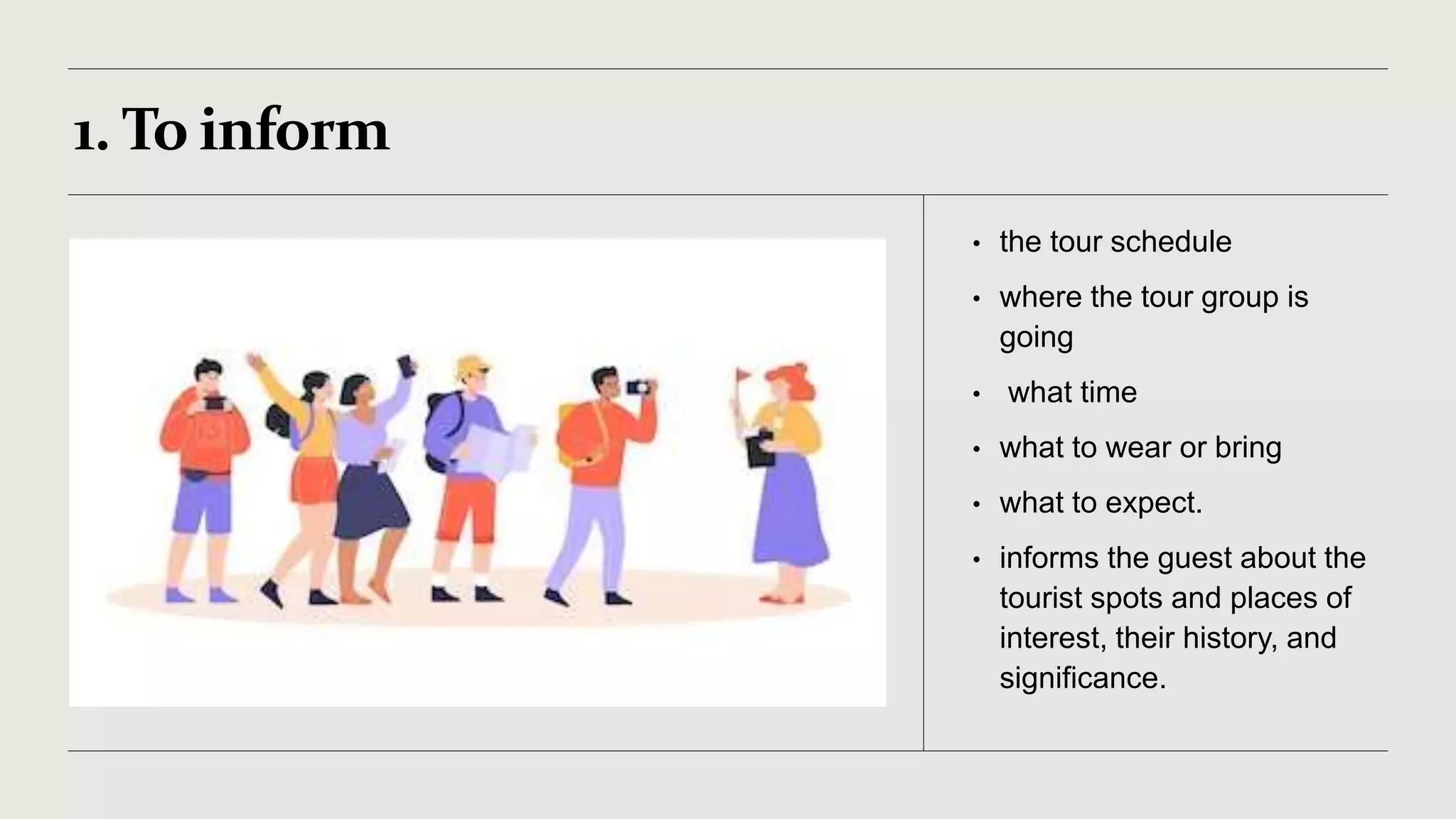
1. To inform
• the tour schedule
• where the tour group is
going
• what time
• what to wear or bring
• what to expect.
• informs the guest about the
tourist spots and places of
interest, their history, and
significance.
2. Toclarify
• Tourists come from different cultural
backgrounds, and as such,
meanings, symbols, and
pronunciations may differ and affect
communication. As a tour guide,
part of his/her role is to break those
barriers and promote
understanding through clarification.
Paraphrasing and repetition are
some of the means to ensure that
the message is understood. A
bridge remark can also be used to
encourage response.
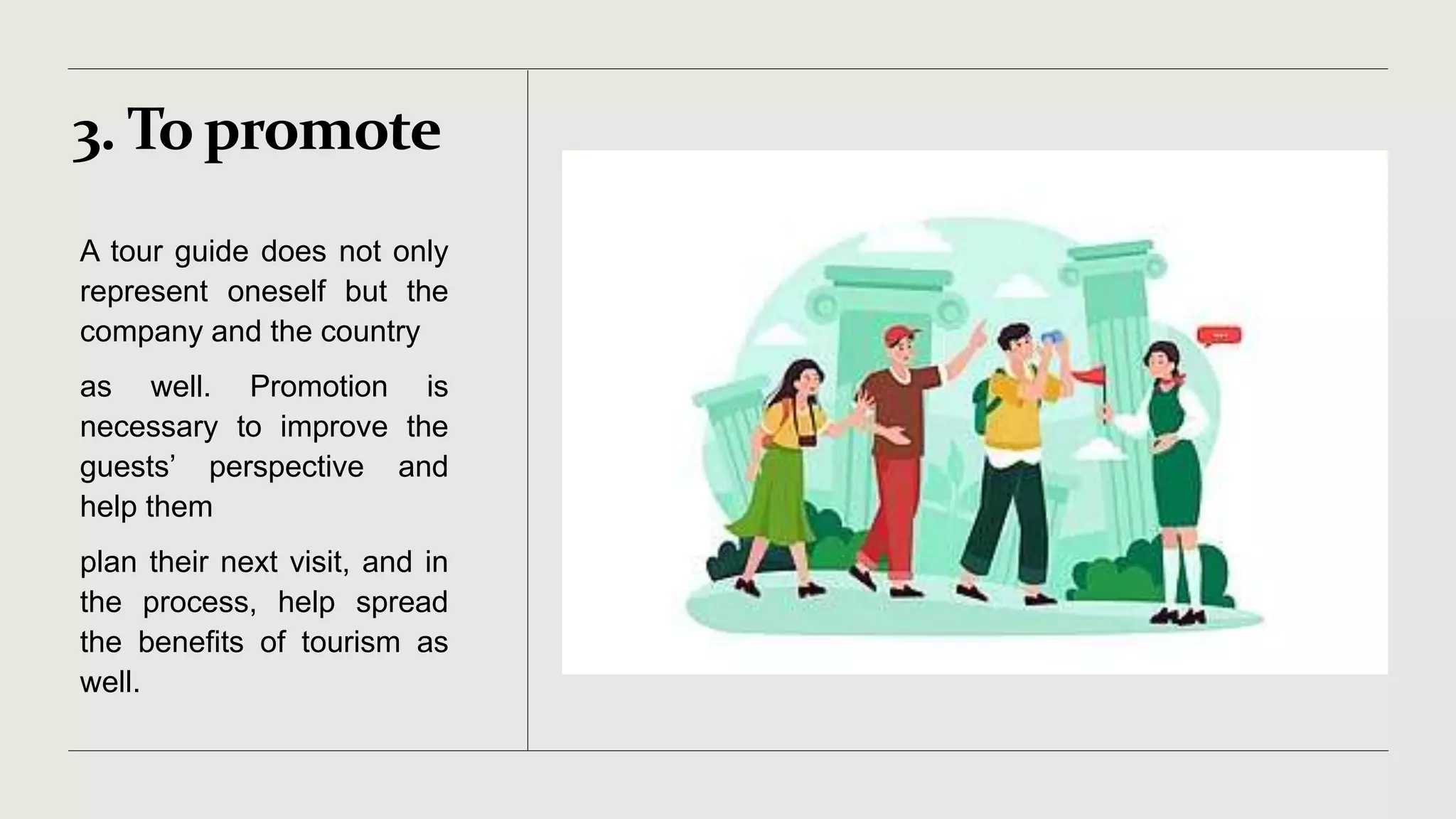
3. To promote
A tour guide does not only
represent oneself but the
company and the country
as well. Promotion is
necessary to improve the
guests’ perspective and
help them
plan their next visit, and in
the process, help spread
the benefits of tourism as
well.
4. To build relationships
As a tour guide, you will not only
interact with your guests. It is also
your duty to liaise with tourism
suppliers, including your
colleagues in the travel trade.
Effective communication helps
build lasting interpersonal
relationships with customers,
colleagues, and suppliers; this is
important to sustain tourism
activities.
5. Toevaluatetheservice
Collecting feedback from
guests is important because
this will serve as basis for
improving services. There are
several ways to get feedback.
Aside from filling outa
feedback form, responses
may also be gathered simply
by asking questions about the
guests’ interests and whether
their expectations are met
during and after the tour.
The
Importanceof
Communicatio
n in Tour
Guiding
Knowing the definition of communication is “not as important as knowing how
communication takes place”. The essential part of communication is how well
the message is understood and creates the intended effect. In tourism, the
ultimate intended effect is customer satisfaction. Without communicating
properly to tourists, tour guides will not be able to deliver the service well. Tour
guides need good communication skills to describe tourist attractions, remind
tourists of the tour schedule, coordinate with suppliers, and perform other duties.
Thus, it is important for tour guides to sharpen their communication skills.
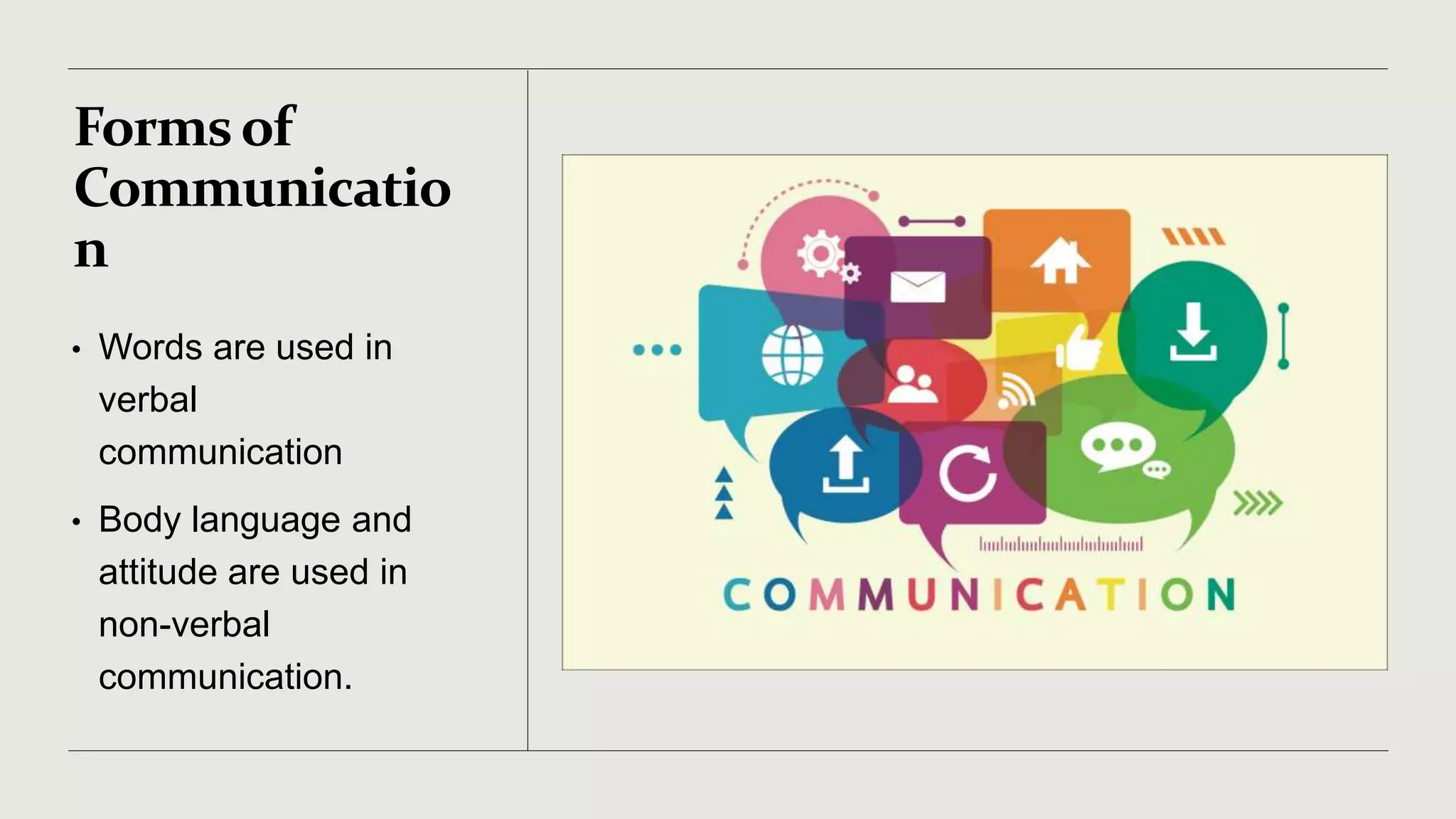
Formsof
Communicatio
n
• Words are used in
verbal
communication
• Body language and
attitude are used in
non-verbal
communication.
Elementsof
theVoice
1. Volume- loudness or
softness of the sound
2. Speed- pace or
tempo of delivery
3. Articulation- accent or
pronunciation
4. Tone- quality of voice
Other Formsof
Non-Verbal
Communication
• Smile
• Facial expressions that
show a person’s mood like
surprise, puzzlement, or
impatience
• Hand gestures to show
direction
Strategiesfor
Effective
Communicatio
n
1. Listen
Listening is different from hearing.
Hearing refers to how your brain
receives the sounds that your ear
catches, while listening is the
deliberate interpretation of these
sounds into meanings.
• When your guests are talking to you give
them your full attention and stop doing other
things. Face them and maintain eye-to-eye
contact.
• Review mentally what you already know
about what the guests are talking about and
organize your thoughts accordingly so that
you can respond appropriately. Set aside
prejudices and keep an open mind to learn
from the guests.
• Nod to show that you are listening and
verbally confirm what you haveheard.
2. Clarify
If you could not
understand what the
guest said, clarify by
paraphrasing what the
guest said and confirm
if your understanding
was correct.
3. Beclear
Use correct language
structures, simple
sentences, and words that
are not confusing. Work on
your pronunciation and voice
projection. Ensure that your
commentaries follow a
logical sequence.
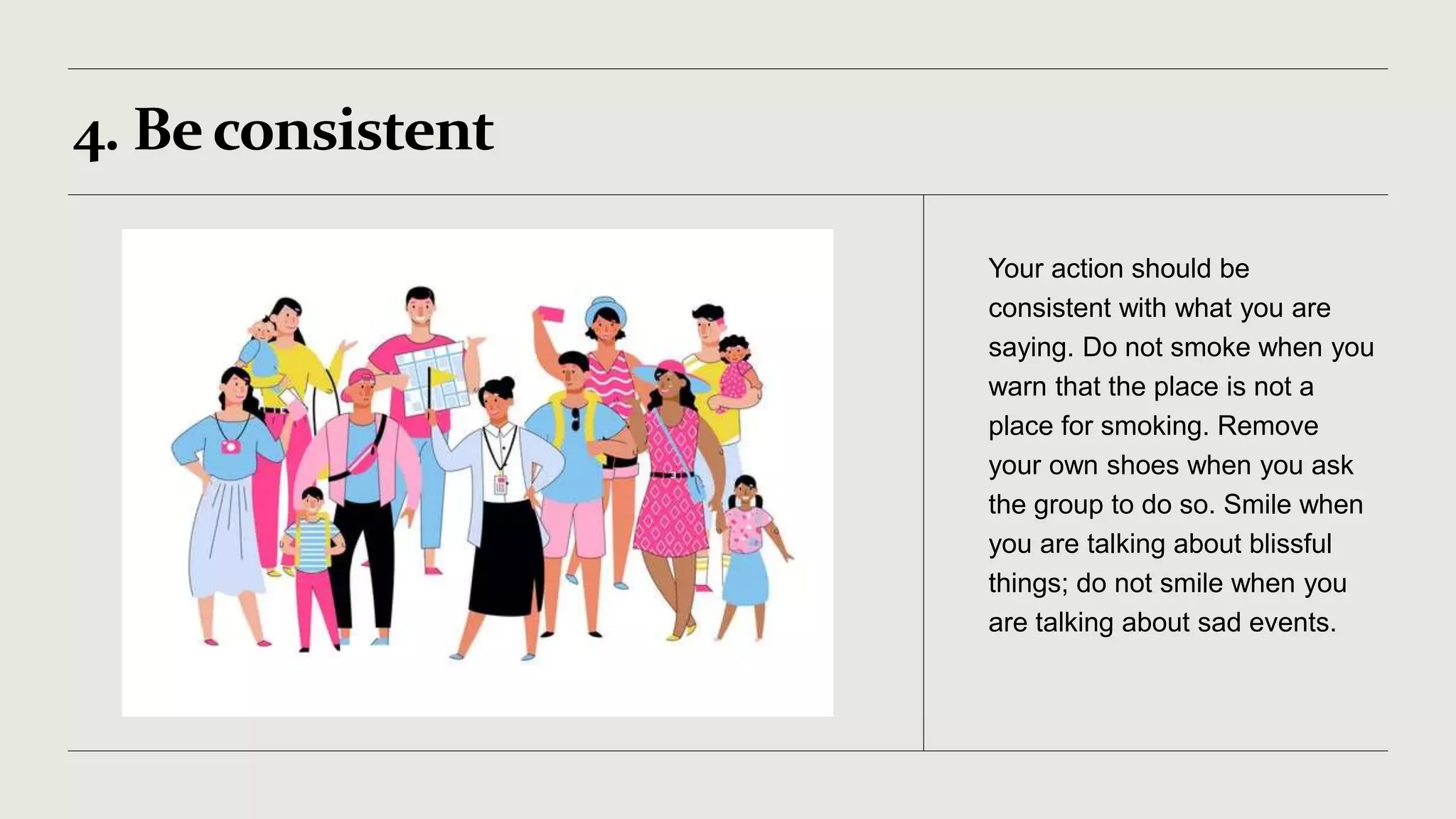
4. Beconsistent
Your action should be
consistent with what you are
saying. Do not smoke when you
warn that the place is not a
place for smoking. Remove
your own shoes when you ask
the group to do so. Smile when
you are talking about blissful
things; do not smile when you
are talking about sad events.
5. Be
confident
Know your tourism product by
heart and ensure the accuracy
of your commentaries. Do
your research properly prior to
the arrival of the group, and
gather information from
reliable sources. Be proud of
your own city and country, but
do not be arrogant. Do not
hesitate to apologize, but
learn from your mistakes and
shortcomings.
6. Payattention
Some guests may be too
polite to say honestly what
they feel. So pay attention
to their body language and
facial expressions to
understand them better.
7. Be
appropriate
Wear appropriate clothes
and apply appropriate
language and manners.
Learn about the places that
you are going to visit as
well as the cultural
background of your guests
before their arrival.
8. Beopen
One of the benefits of
being a tour guide is
meeting people from
different cultural
backgrounds. Keep an
open mind and learn
them as well.
9. Attend to
complaints
with care
As a tour guide, you will
also receive a number of
complaints. Here are some
tips to handle them: (1)
acknowledge what you
heard and the guests’ right
to feel and think as they
do; (2) confirm the incident;
and (3) provide feedback
on action taken.
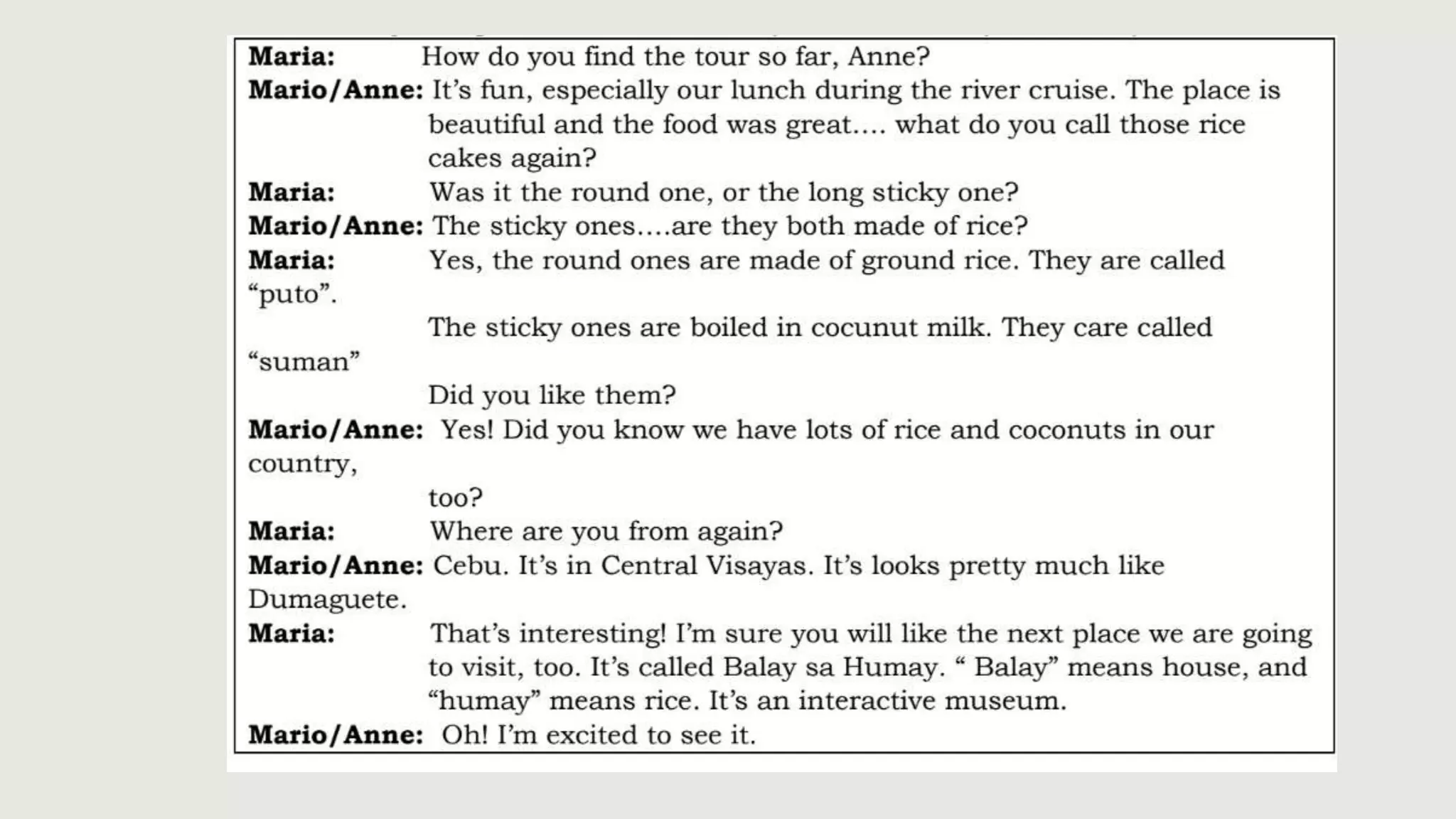
PerformanceTask 2
Directions: Role-playing activity. Chose your partner. One
will play the part of Maria, the tour guide, and the other
Mario/Anne, the tourist. The volunteers will use the following
dialog.
Communication Skills.pptx

Communication Skills.pptx

  • 1.
  • 2.
    Communicatio n Process The processof communication involves a source that uses a channel to deliver a message to the receiver, and this message produces an effect and feedback. Element
  • 3.
    SENDER IS WHERETHE INFORMATION COMES FROM. MESSAGE IS THE INFORMATION RELAYED FROM THE SOURCE TO THE RECEIVER. CHANNEL REFERS TO THE TOOL THROUGH WHICH THE MESSAGE IS RELAYED. RECEIVER GETS THE MESSAGE AND EXECUTES THE EFFECT.
  • 4.
    Sender is the tourguide. Message is the commentary. Channel can be a microphone. Receiver is the tourist. Effect is the tourist’s reaction and appreciation.
  • 5.
    Feedback is also relayedby the tourist to the tour guide in the form of formal evaluation of the tour guide’s performance through feedback forms, suggestions on how to improve the tour guide’s performance, tips of gratuities, and repeat visits.
  • 6.
  • 7.
    1. Physical barriers Examples Channels •Microphones • Telephones • Radios
  • 8.
    Environmental Factors • Noise • brightness •Temperature • place is too hot and bright • vendors are too noisy
  • 9.
    2. Socio-psychological barriers •difference in pronunciation
  • 10.
  • 11.
    1. To inform •the tour schedule • where the tour group is going • what time • what to wear or bring • what to expect. • informs the guest about the tourist spots and places of interest, their history, and significance.
  • 12.
    2. Toclarify • Touristscome from different cultural backgrounds, and as such, meanings, symbols, and pronunciations may differ and affect communication. As a tour guide, part of his/her role is to break those barriers and promote understanding through clarification. Paraphrasing and repetition are some of the means to ensure that the message is understood. A bridge remark can also be used to encourage response.
  • 13.
    3. To promote Atour guide does not only represent oneself but the company and the country as well. Promotion is necessary to improve the guests’ perspective and help them plan their next visit, and in the process, help spread the benefits of tourism as well.
  • 14.
    4. To buildrelationships As a tour guide, you will not only interact with your guests. It is also your duty to liaise with tourism suppliers, including your colleagues in the travel trade. Effective communication helps build lasting interpersonal relationships with customers, colleagues, and suppliers; this is important to sustain tourism activities.
  • 15.
    5. Toevaluatetheservice Collecting feedbackfrom guests is important because this will serve as basis for improving services. There are several ways to get feedback. Aside from filling outa feedback form, responses may also be gathered simply by asking questions about the guests’ interests and whether their expectations are met during and after the tour.
  • 16.
  • 17.
    Knowing the definitionof communication is “not as important as knowing how communication takes place”. The essential part of communication is how well the message is understood and creates the intended effect. In tourism, the ultimate intended effect is customer satisfaction. Without communicating properly to tourists, tour guides will not be able to deliver the service well. Tour guides need good communication skills to describe tourist attractions, remind tourists of the tour schedule, coordinate with suppliers, and perform other duties. Thus, it is important for tour guides to sharpen their communication skills.
  • 18.
    Formsof Communicatio n • Words areused in verbal communication • Body language and attitude are used in non-verbal communication.
  • 19.
    Elementsof theVoice 1. Volume- loudnessor softness of the sound 2. Speed- pace or tempo of delivery 3. Articulation- accent or pronunciation 4. Tone- quality of voice
  • 20.
    Other Formsof Non-Verbal Communication • Smile •Facial expressions that show a person’s mood like surprise, puzzlement, or impatience • Hand gestures to show direction
  • 21.
  • 22.
    1. Listen Listening isdifferent from hearing. Hearing refers to how your brain receives the sounds that your ear catches, while listening is the deliberate interpretation of these sounds into meanings. • When your guests are talking to you give them your full attention and stop doing other things. Face them and maintain eye-to-eye contact. • Review mentally what you already know about what the guests are talking about and organize your thoughts accordingly so that you can respond appropriately. Set aside prejudices and keep an open mind to learn from the guests. • Nod to show that you are listening and verbally confirm what you haveheard.
  • 23.
    2. Clarify If youcould not understand what the guest said, clarify by paraphrasing what the guest said and confirm if your understanding was correct.
  • 24.
    3. Beclear Use correctlanguage structures, simple sentences, and words that are not confusing. Work on your pronunciation and voice projection. Ensure that your commentaries follow a logical sequence.
  • 25.
    4. Beconsistent Your actionshould be consistent with what you are saying. Do not smoke when you warn that the place is not a place for smoking. Remove your own shoes when you ask the group to do so. Smile when you are talking about blissful things; do not smile when you are talking about sad events.
  • 26.
    5. Be confident Know yourtourism product by heart and ensure the accuracy of your commentaries. Do your research properly prior to the arrival of the group, and gather information from reliable sources. Be proud of your own city and country, but do not be arrogant. Do not hesitate to apologize, but learn from your mistakes and shortcomings.
  • 27.
    6. Payattention Some guestsmay be too polite to say honestly what they feel. So pay attention to their body language and facial expressions to understand them better.
  • 28.
    7. Be appropriate Wear appropriateclothes and apply appropriate language and manners. Learn about the places that you are going to visit as well as the cultural background of your guests before their arrival.
  • 29.
    8. Beopen One ofthe benefits of being a tour guide is meeting people from different cultural backgrounds. Keep an open mind and learn them as well.
  • 30.
    9. Attend to complaints withcare As a tour guide, you will also receive a number of complaints. Here are some tips to handle them: (1) acknowledge what you heard and the guests’ right to feel and think as they do; (2) confirm the incident; and (3) provide feedback on action taken.
  • 31.
    PerformanceTask 2 Directions: Role-playingactivity. Chose your partner. One will play the part of Maria, the tour guide, and the other Mario/Anne, the tourist. The volunteers will use the following dialog.

Editor's Notes

  • #2 Tour guides spend much of their time interacting with guests. Communication skills will thus be your main tool if you want to become a tour guide and successfully relate to your guests. What is communication? Explain the purpose of communication in tour guiding? What is the importance of communication in tour guiding?
  • #5 So therefore in the typical scenario.
  • #9 potential disruptions around the source and receiver such tourists may not be able to understand the tour guide well
  • #10 meanings, emotional blocks like stress, and “communicators” role and stature within a group. Tour guides should not perceive communication barriers as problem, but as “challenges” that can be surmounted. In facing these challenges, tour guides will learn about other cultures and improve their service in the process.
  • #11 Tour guides relate with the people around them to inform, to clarify, to promote, to build relationships, and to evaluate the service they provide.
  • #12 It is the tour guide’s duty to inform the guests of
  • #21 When tour guides speak, they apply these two forms of communication. They use voice to provide information and convey meanings through spoken words. They use their appearance and attitude to lead the group, serve as model, and exude appropriateness.