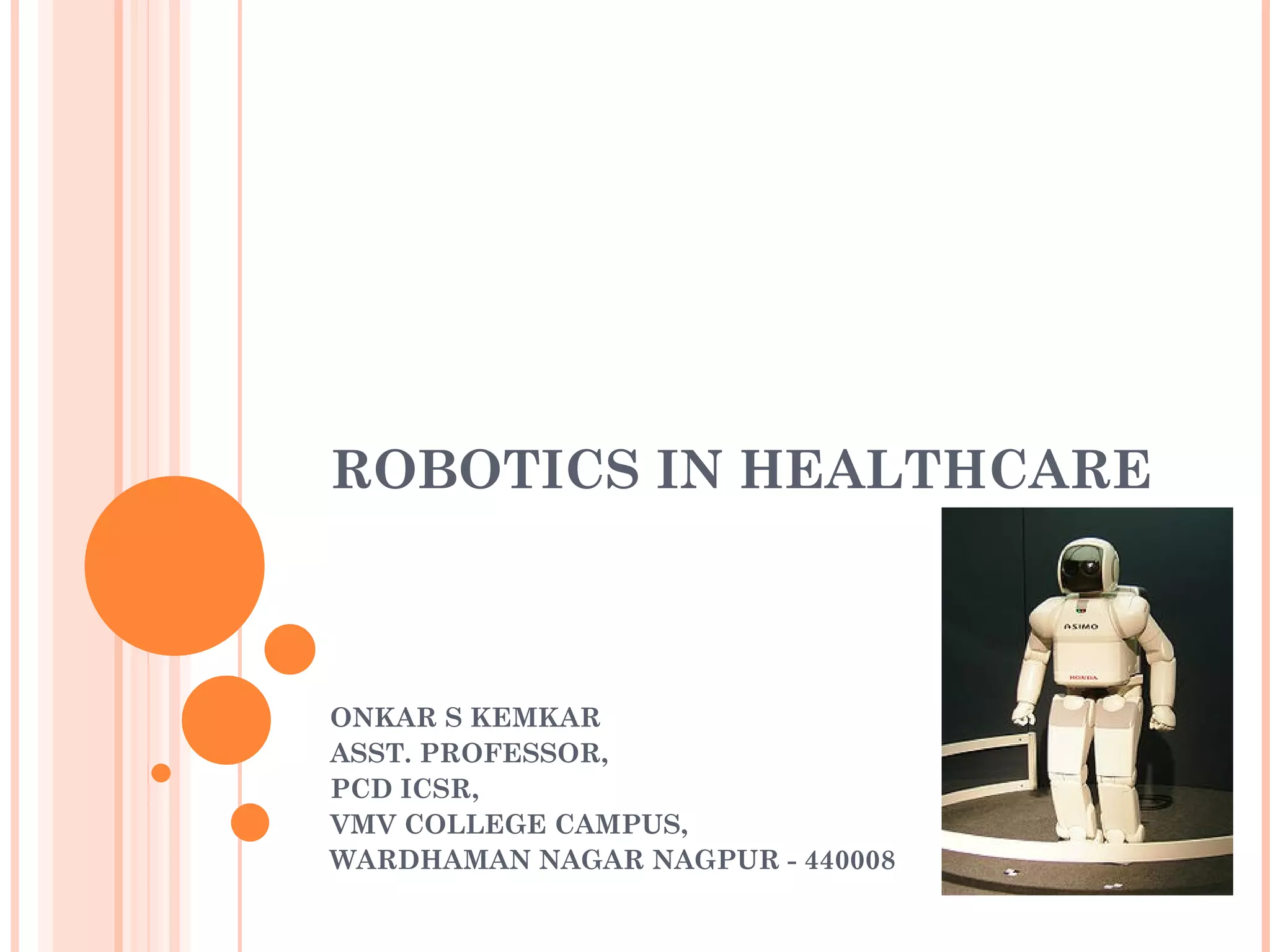



ROBOTICS IN HEALTHCARE ONKAR S KEMKAR ASST. PROFESSOR, PCD ICSR, VMV COLLEGE CAMPUS, WARDHAMAN NAGAR NAGPUR - 440008
AGENDA What is a Robot? Why Robotics? Healthcare & Robotics Use of Robotics in healthcare Significance Conclusion
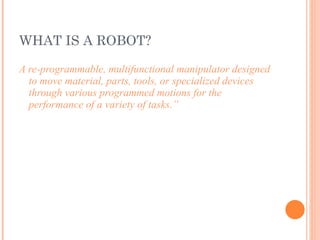
WHAT IS A ROBOT? A re-programmable, multifunctional manipulator designed to move material, parts, tools, or specialized devices through various programmed motions for the performance of a variety of tasks.”
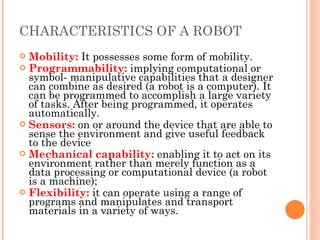
CHARACTERISTICS OF A ROBOT Mobility:   It possesses some form of mobility. Programmability:   implying computational or symbol- manipulative capabilities that a designer can combine as desired (a robot is a computer). It can be programmed to accomplish a large variety of tasks. After being programmed, it operates automatically. Sensors:   on or around the device that are able to sense the environment and give useful feedback to the device Mechanical capability:   enabling it to act on its environment rather than merely function as a data processing or computational device (a robot is a machine);  Flexibility:  it can operate using a range of programs and manipulates and transport materials in a variety of ways.
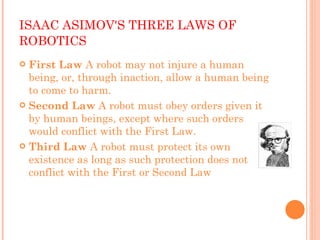
ISAAC ASIMOV'S THREE LAWS OF ROBOTICS   First Law  A robot may not injure a human being, or, through inaction, allow a human being to come to harm. Second Law  A robot must obey orders given it by human beings, except where such orders would conflict with the First Law. Third Law  A robot must protect its own existence as long as such protection does not conflict with the First or Second Law
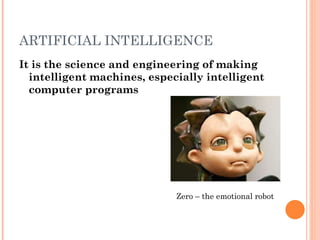
ARTIFICIAL INTELLIGENCE It is the science and engineering of making intelligent machines, especially intelligent computer programs Zero – the emotional robot
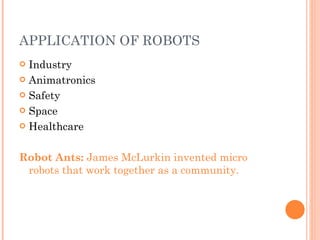
APPLICATION OF ROBOTS Industry Animatronics Safety Space Healthcare Robot Ants:  James McLurkin invented micro robots that work together as a community.
PREDICTION Prediction is difficult . . .. . .    especially about the Future”…. Yogi Berra
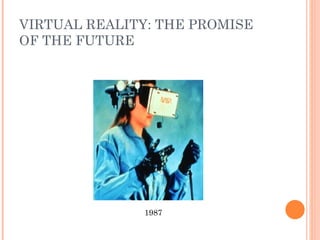
VIRTUAL REALITY: THE PROMISE OF THE FUTURE 1987
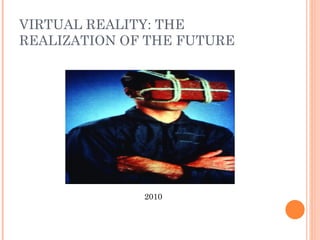
VIRTUAL REALITY: THE REALIZATION OF THE FUTURE 2010
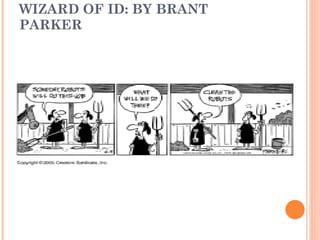
WIZARD OF ID: BY BRANT PARKER
CURRENT VISION The future …………………………… ……… .. Is here………..
ROBOTICS Robotics  is the engineering science and technology of robots, and their design, manufacture, application, and structural disposition.  Robotics is related to  electronics ,  mechanics , and  software . The term "robotics" was coined by  Isaac Asimov  in his 1941 science fiction short-story " Liar! "
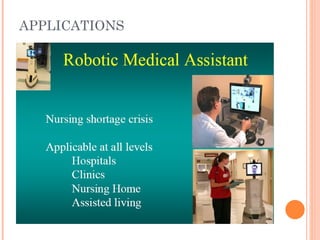
ROBOTICS IN HEALTHCARE By 2050 one in four people in the WORLD will be over the age of 65. The NHS will be unable to cope with the likely increase in chronic illness. To meet this challenge, health and local authority services must reconfigure, placing greater emphasis on community care and the effective use of technology. One promising technology is  robotics .
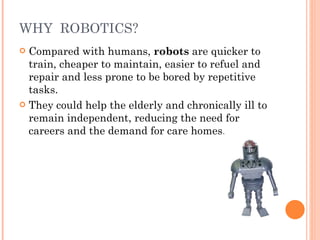
WHY  ROBOTICS? Compared with humans,  robots  are quicker to train, cheaper to maintain, easier to refuel and repair and less prone to be bored by repetitive tasks.  They could help the elderly and chronically ill to remain independent, reducing the need for careers and the demand for care homes.
ADVANTAGES Robots could help in the care of the elderly and chronically ill in four main ways: Addressing cognitive decline; for example, reminding patients to drink, take medicine or of an appointment.  Enabling patients and caregivers to interact, thereby reducing the frequency of personal visits.  Collecting data and monitoring patients, emergencies, such as heart failure and high blood sugar levels, could be avoided.  Assisting people with domestic tasks—many give up independent living because of arthritis.
WHY HEALTHCARE ROBOTICS Medical Robotics is an emerging sub-discipline of robotics in which humans are the focal point of its creation.  Humans interact with medical robotics either as health providers such as physicians or as the healthcare recipients - the patients.  Introducing a medical robot at the interface between a physician and a patient is based on an understanding of the medical treatment itself and its related biology, physiology and anatomy. Inherent to the field of medical robotics is a unique synergy between medicine, life and health sciences, and many sub-disciplines of engineering.
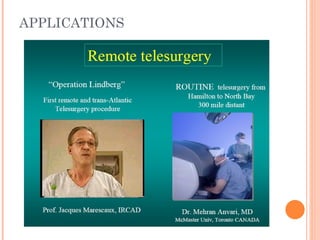
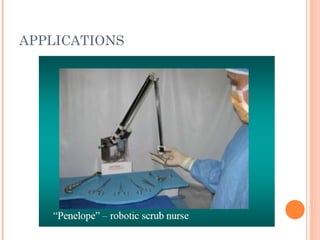
ROBOTICS: TODAY’S SCENARIO The use of Robotics in Healthcare has been tried from more than two decades, but has still not been used to its maximum potential.  Currently in healthcare, robots are mainly used for surgical purposes. Various surgical procedures like hip replacement are being implemented using these robots.  Robots could be used to perform minimal invasive surgery, remote surgery, and unmanned surgery.
USE OF ROBOTICS IN HEALTHCARE SURGERY PROCEDURES TREATMENT (PRE & POST) PLANNING SIMULATION GUIDING
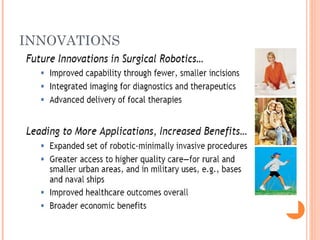
ADVANTAGES Accuracy - Robots once instructed can perform a task without fatigue and with accuracy, even after long hours of operation. A robot would also eliminate hand-tremors of the surgeon, due to fatigue or other reasons and increase accuracy of the operation.  Smaller Scars - Robots perform surgery by making smaller cuts to the patient' s body, thus leaving smaller scars to the patients.  Less Blood Loss - Smaller incisions lead to lesser amount of blood loss for the patients.  Less Pain - Patients suffer lesser pain due to the smaller cuts made by the robots.  Faster Recovery - Smaller external cuts, eventually leads to faster healing, decreased possibility of infections, and therefore a faster recovery for the patients.  Shorter Hospital Stay - Speedier healing and recovery leads to a shorter stay in the hospital thus saving costs.
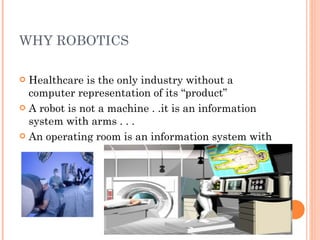
WHY ROBOTICS Healthcare is the only industry without a computer representation of its “product” A robot is not a machine . .it is an information system with arms . . . An operating room is an information system with
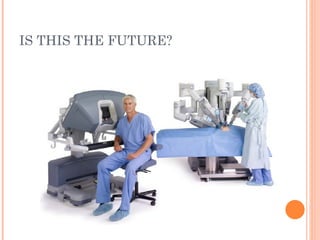
POTENTIAL OF ROBOTICS The value of robotics for healthcare could be huge in terms of health, societal and economic benefits. Robotics offer the promise of sustainable and affordable health provision without compromising quality of care. Some products are already available, like the surgical robot Da Vinci, but this is just the beginning. Clear roadmaps are required for the scale of research and development still needed to transform the challenges that exist – technological, financial, ethical into practical and beneficial solutions.
RESEARCH ROADMAPS FOR ROBOTICS The basic idea of roadmapping is to look for the best way to arrive at a destination.  In healthcare,this means dealing with the societal issues,diseases and other medical conditions, which healthcare systems need to cure, care for or prevent, both now and in the future.  In relation torobotics, this concerns questions such as which robotic applications will be valued additions to healthcare, which products can meet market needs and which technologies are needed to accomplish them.  Some technologies are available, while others need a lot of research and development before they can be applied to the production of a robotic system.
BEST WAYS TO A ROADMAP Smart medical capsules Robotised surgery Intelligent prosthetics Robotised motor coordination analysis and therapy Robot-assisted mental, cognitive and social therapy Robotised patient monitoring systems;
SMART MEDICAL CAPSULES A means of ‘journeying’ through the body in a way that causes less discomfort than traditional endoscopy where invasive probes are used. The smart capsule endoscope is a ‘pill’ that is swallowed and then makes pictures of internal systems such as the intestines, while travelling through the body.  Robotising the capsules boosts greatly their diagnostic and therapeutic effectiveness and signifies a radical change in medicine.  A minirobot (and in the future perhaps a “nanobot”) will be able to move itself, or be externally steered, to have a closer look at internal tissues, take samples or even destroy unwanted tissue.
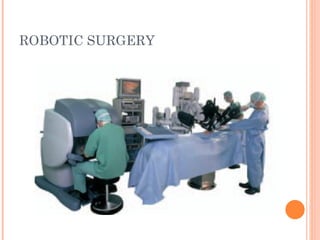
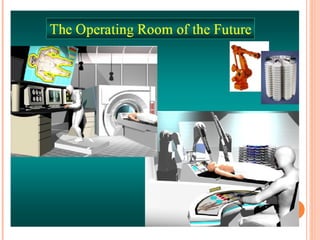
ROBOTISED SURGERY Robotised surgery will facilitate new types of  intervention, e.g., in areas of the human body that are difficult to access.  Precision, durability and repeatability enable automation of surgical tasks and facilitate minimally invasive surgery, remote tele-surgery, preoperative planning, surgical training, intra-operative navigation (image-guided surgery) and surgical simulation all from one place.  The future: the integration of different robotic systems in broader platforms to assist surgeons
ROBOTIC SURGERY
ROBOTICS Robotics for Medicine and Healthcare is the application of technology whereby systems are able to perform coordinated mechatronic actions (force or movement) on the basis of processing information acquired through sensor technology. These systems cooperate safely with humans and support the functioning of impaired individuals, medical interventions, care and rehabilitation of patients as well as participation of individuals in prevention
ADVANTAGES Robotics hold the promise of addressing some major healthcare issues. The field of robotics in healthcare is in its infancy – industry, government and research can still exert influence. There is a need to bridge the difficult ransitions from laboratories to trials and from trials to regular healthcare practice. Systematic support to research is needed for progress to be made. Addressing ethical and legal problems should be an integral part of any research programme in this field. Awareness must be raised through a flanking communication programme.
IS THIS THE FUTURE?
INNOVATIONS
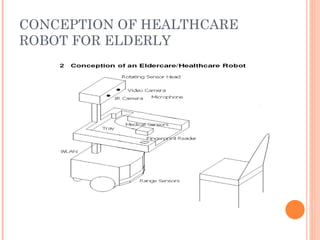
CONCEPTION OF HEALTHCARE ROBOT FOR ELDERLY
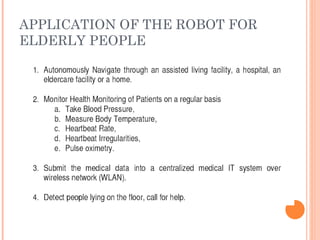
APPLICATION OF THE ROBOT FOR ELDERLY PEOPLE
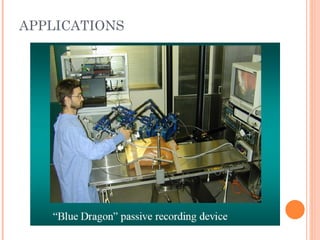
APPLICATIONS
APPLICATIONS
APPLICATIONS
APPLICATIONS
APPLICATIONS
 
ROBOTIC NURSE
 

Robotics in healthcare

  • 1.
    ROBOTICS IN HEALTHCAREONKAR S KEMKAR ASST. PROFESSOR, PCD ICSR, VMV COLLEGE CAMPUS, WARDHAMAN NAGAR NAGPUR - 440008
  • 2.
    AGENDA What isa Robot? Why Robotics? Healthcare & Robotics Use of Robotics in healthcare Significance Conclusion
  • 3.
    WHAT IS AROBOT? A re-programmable, multifunctional manipulator designed to move material, parts, tools, or specialized devices through various programmed motions for the performance of a variety of tasks.”
  • 4.
    CHARACTERISTICS OF AROBOT Mobility: It possesses some form of mobility. Programmability: implying computational or symbol- manipulative capabilities that a designer can combine as desired (a robot is a computer). It can be programmed to accomplish a large variety of tasks. After being programmed, it operates automatically. Sensors: on or around the device that are able to sense the environment and give useful feedback to the device Mechanical capability: enabling it to act on its environment rather than merely function as a data processing or computational device (a robot is a machine); Flexibility: it can operate using a range of programs and manipulates and transport materials in a variety of ways.
  • 5.
    ISAAC ASIMOV'S THREELAWS OF ROBOTICS First Law A robot may not injure a human being, or, through inaction, allow a human being to come to harm. Second Law A robot must obey orders given it by human beings, except where such orders would conflict with the First Law. Third Law A robot must protect its own existence as long as such protection does not conflict with the First or Second Law
  • 6.
    ARTIFICIAL INTELLIGENCE Itis the science and engineering of making intelligent machines, especially intelligent computer programs Zero – the emotional robot
  • 7.
    APPLICATION OF ROBOTSIndustry Animatronics Safety Space Healthcare Robot Ants: James McLurkin invented micro robots that work together as a community.
  • 8.
    PREDICTION Prediction isdifficult . . .. . . especially about the Future”…. Yogi Berra
  • 9.
    VIRTUAL REALITY: THEPROMISE OF THE FUTURE 1987
  • 10.
    VIRTUAL REALITY: THEREALIZATION OF THE FUTURE 2010
  • 11.
    WIZARD OF ID:BY BRANT PARKER
  • 12.
    CURRENT VISION Thefuture …………………………… ……… .. Is here………..
  • 13.
    ROBOTICS Robotics is the engineering science and technology of robots, and their design, manufacture, application, and structural disposition. Robotics is related to electronics , mechanics , and software . The term "robotics" was coined by Isaac Asimov in his 1941 science fiction short-story " Liar! "
  • 14.
    ROBOTICS IN HEALTHCAREBy 2050 one in four people in the WORLD will be over the age of 65. The NHS will be unable to cope with the likely increase in chronic illness. To meet this challenge, health and local authority services must reconfigure, placing greater emphasis on community care and the effective use of technology. One promising technology is robotics .
  • 15.
    WHY ROBOTICS?Compared with humans, robots are quicker to train, cheaper to maintain, easier to refuel and repair and less prone to be bored by repetitive tasks. They could help the elderly and chronically ill to remain independent, reducing the need for careers and the demand for care homes.
  • 16.
    ADVANTAGES Robots couldhelp in the care of the elderly and chronically ill in four main ways: Addressing cognitive decline; for example, reminding patients to drink, take medicine or of an appointment. Enabling patients and caregivers to interact, thereby reducing the frequency of personal visits. Collecting data and monitoring patients, emergencies, such as heart failure and high blood sugar levels, could be avoided. Assisting people with domestic tasks—many give up independent living because of arthritis.
  • 17.
    WHY HEALTHCARE ROBOTICSMedical Robotics is an emerging sub-discipline of robotics in which humans are the focal point of its creation. Humans interact with medical robotics either as health providers such as physicians or as the healthcare recipients - the patients. Introducing a medical robot at the interface between a physician and a patient is based on an understanding of the medical treatment itself and its related biology, physiology and anatomy. Inherent to the field of medical robotics is a unique synergy between medicine, life and health sciences, and many sub-disciplines of engineering.
  • 18.
    ROBOTICS: TODAY’S SCENARIOThe use of Robotics in Healthcare has been tried from more than two decades, but has still not been used to its maximum potential. Currently in healthcare, robots are mainly used for surgical purposes. Various surgical procedures like hip replacement are being implemented using these robots. Robots could be used to perform minimal invasive surgery, remote surgery, and unmanned surgery.
  • 19.
    USE OF ROBOTICSIN HEALTHCARE SURGERY PROCEDURES TREATMENT (PRE & POST) PLANNING SIMULATION GUIDING
  • 20.
    ADVANTAGES Accuracy -Robots once instructed can perform a task without fatigue and with accuracy, even after long hours of operation. A robot would also eliminate hand-tremors of the surgeon, due to fatigue or other reasons and increase accuracy of the operation. Smaller Scars - Robots perform surgery by making smaller cuts to the patient' s body, thus leaving smaller scars to the patients. Less Blood Loss - Smaller incisions lead to lesser amount of blood loss for the patients. Less Pain - Patients suffer lesser pain due to the smaller cuts made by the robots. Faster Recovery - Smaller external cuts, eventually leads to faster healing, decreased possibility of infections, and therefore a faster recovery for the patients. Shorter Hospital Stay - Speedier healing and recovery leads to a shorter stay in the hospital thus saving costs.
  • 21.
    WHY ROBOTICS Healthcareis the only industry without a computer representation of its “product” A robot is not a machine . .it is an information system with arms . . . An operating room is an information system with
  • 22.
    POTENTIAL OF ROBOTICSThe value of robotics for healthcare could be huge in terms of health, societal and economic benefits. Robotics offer the promise of sustainable and affordable health provision without compromising quality of care. Some products are already available, like the surgical robot Da Vinci, but this is just the beginning. Clear roadmaps are required for the scale of research and development still needed to transform the challenges that exist – technological, financial, ethical into practical and beneficial solutions.
  • 23.
    RESEARCH ROADMAPS FORROBOTICS The basic idea of roadmapping is to look for the best way to arrive at a destination. In healthcare,this means dealing with the societal issues,diseases and other medical conditions, which healthcare systems need to cure, care for or prevent, both now and in the future. In relation torobotics, this concerns questions such as which robotic applications will be valued additions to healthcare, which products can meet market needs and which technologies are needed to accomplish them. Some technologies are available, while others need a lot of research and development before they can be applied to the production of a robotic system.
  • 24.
    BEST WAYS TOA ROADMAP Smart medical capsules Robotised surgery Intelligent prosthetics Robotised motor coordination analysis and therapy Robot-assisted mental, cognitive and social therapy Robotised patient monitoring systems;
  • 25.
    SMART MEDICAL CAPSULESA means of ‘journeying’ through the body in a way that causes less discomfort than traditional endoscopy where invasive probes are used. The smart capsule endoscope is a ‘pill’ that is swallowed and then makes pictures of internal systems such as the intestines, while travelling through the body. Robotising the capsules boosts greatly their diagnostic and therapeutic effectiveness and signifies a radical change in medicine. A minirobot (and in the future perhaps a “nanobot”) will be able to move itself, or be externally steered, to have a closer look at internal tissues, take samples or even destroy unwanted tissue.
  • 26.
    ROBOTISED SURGERY Robotisedsurgery will facilitate new types of intervention, e.g., in areas of the human body that are difficult to access. Precision, durability and repeatability enable automation of surgical tasks and facilitate minimally invasive surgery, remote tele-surgery, preoperative planning, surgical training, intra-operative navigation (image-guided surgery) and surgical simulation all from one place. The future: the integration of different robotic systems in broader platforms to assist surgeons
  • 27.
  • 28.
    ROBOTICS Robotics forMedicine and Healthcare is the application of technology whereby systems are able to perform coordinated mechatronic actions (force or movement) on the basis of processing information acquired through sensor technology. These systems cooperate safely with humans and support the functioning of impaired individuals, medical interventions, care and rehabilitation of patients as well as participation of individuals in prevention
  • 29.
    ADVANTAGES Robotics holdthe promise of addressing some major healthcare issues. The field of robotics in healthcare is in its infancy – industry, government and research can still exert influence. There is a need to bridge the difficult ransitions from laboratories to trials and from trials to regular healthcare practice. Systematic support to research is needed for progress to be made. Addressing ethical and legal problems should be an integral part of any research programme in this field. Awareness must be raised through a flanking communication programme.
  • 30.
    IS THIS THEFUTURE?
  • 31.
  • 32.
    CONCEPTION OF HEALTHCAREROBOT FOR ELDERLY
  • 33.
    APPLICATION OF THEROBOT FOR ELDERLY PEOPLE
  • 34.
  • 35.
  • 36.
  • 37.
  • 38.
  • 39.
  • 40.
  • 41.