Goal Setting
“A goal represents something you want to achieve in life.” (Leonard,
2005, p14). When setting goals for yourself they should be Specific,
Measurable, Agreed, Realistic and Time Phased, Exciting, Recorded or
SMARTER. This allows goals to be accurate, achievable, assessable,
interesting, motivating and target related. SMARTER goals are easier to
identify in certain situations than others, this is usually when goals are
appropriate and quantifiable. (Crisfield, Houlston & Simpkin, 1996).

       “This approach is far more likely to provide guidance in the form of
      clear objectives” (Forsyth, 2009, p15).

Clear objectives mean that the objectives are clarified and aren’t too
vague, making them more specific and measurable. (Forsyth, 2009b).

There are also other types of goals such as Outcome Goals and Process
Goals. Outcome Goals are divided into two categories; Product and
Performance. Product goals such as finishing 1st or being selected for a
team can be useful as long term goals. Product goals are generally
affected by the performer and other outside factors, such as other
competitors to produce the outcome.

Performance goals such as achieving a personal best or a certain time
allow the competitor to gain positive feedback from the race outcome as
they might of achieved the goal set but maybe only finished 3rd in the
race, when aiming for 2nd or 1st. The outcome is directly influenced by
someone’s performance, meaning that it is down to the individual and
their own performance.

Process goals analyse what you have to do to become successful. Process
goals are used for short term goals and improving skills. (Crisfield,
Houlston & Simpkin, 1996b).

      “This is because process goals, unlike some outcome goals, are
      more directly under the performer’s control (ie you can control your
      own performance but not that of the opposition)” (Crisfield,
      Houlston & Simpkin, 1996c, p22).

Goal setting can help you become; More organised, less stressed and
more motivated. (Kulas & Scopes, 2008).

I have used (Leonard,2005b) tips to write my goal using simplistic words,
bullet points, action plans and deadlines to complete each step by.
Personal

    Organisation and Time Management
    Organisation and time management have become very important to me
    as I haven’t always been very organised causing me to waste my time
    and then rush activities as I have left them until the last minute. This
    means that the things that have been left don’t get my full attention and
    engagement, which tends to end in them not being up to the standard
    that I am capable of. This mainly happens to my work, so I want to make
    sure that I am paying full attention and putting everything I am capable
    of into achieving the best grades possible.

    I want to become more organised over the next 3 months, so that it
    enables me to have a more professional style about my person. It will
    also improve my performance in tasks across both career and academic
    paths, such as creating a CV for a job interview or planning for an essay.

    To achieve this goal I aim to do the following things to help me progress
    towards its.

           Firstly I am going to purchase a diary and record all of my
           prioritised events, such as assignment deadlines, University
           timetable and work shifts. Target date: 1st December 2011
           I am going to try to design a personal rota for when I do
           everything, for example
Day           9-11     11-1          1-3   3-5            5-7             7 onwards
Monday        Lie in   Free          Free  Uni            Free Time       Socialising
                       Time          Time  Study
Tuesday   Free         Free          Uni   Uni            Work            Work
          Time         Time          Study Study
Wednesday Free         Sports        Sport Free           Uni Study       Socialising
          Time                       s     Time
Thursday  Free         Uni           Uni   Free           Work            Work
          Time                             Time
Friday    Lie in       Uni           Uni   Free           Free Time       Socialising
                       Study         Study Time
Saturday      Work     Work          Work Work            Work            Socialising
Sunday        Lie in   Uni           Uni   Socialis       Socialising     Socialising
                       Study         Study ing
This will allow me to adapt my current routine and assign certain times of
the week to do certain aspects of my life. I have 14 hours of study
outside of University currently timetabled, which is sufficient. I believe
this plan shows a good balance of work with pleasure and if I feel that I
need to be doing more of either I have plenty of free time slots in which
to do that.

     I am going to clear my desk in my room and set up an area with all
     the equipment I will need, paper, pens, file storage(for notes and to
     split up each module) and a printer, so that it is a positive and easy
     environment to work in. Target Date 1st January 2012

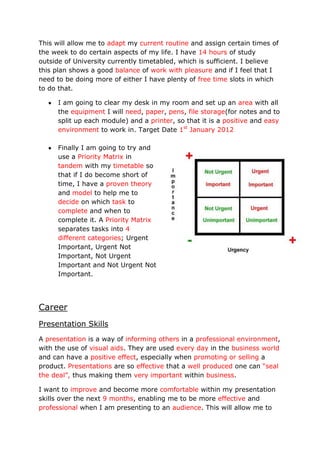
     Finally I am going to try and
     use a Priority Matrix in
     tandem with my timetable so
     that if I do become short of
     time, I have a proven theory
     and model to help me to
     decide on which task to
     complete and when to
     complete it. A Priority Matrix
     separates tasks into 4
     different categories; Urgent
     Important, Urgent Not
     Important, Not Urgent
     Important and Not Urgent Not
     Important.


Career
Presentation Skills
A presentation is a way of informing others in a professional environment,
with the use of visual aids. They are used every day in the business world
and can have a positive effect, especially when promoting or selling a
product. Presentations are so effective that a well produced one can “seal
the deal”, thus making them very important within business.

I want to improve and become more comfortable within my presentation
skills over the next 9 months, enabling me to be more effective and
professional when I am presenting to an audience. This will allow me to
engage and persuade people to believe and be interested in the
information and the views that I am giving them. I know presentation
skills are essential and key within a business as companies normally pitch
or present their product when trying to sell it. I struggle to be strict to a
script as I get my words mixed up when I am trying to remember many
sections.

      Firstly I am going to use simplistic cue cards, to try and narrow
      down the amount of words or key phrases that I have to remember
      and allow myself to elaborate on key points using my prior
      knowledge around the subject.
      Next I am going to run through my presentation multiple times to
      familiarise myself with the content and order of the presentation, to
      hopefully minimise mistakes.
      Lastly I am going to videotape myself to see if my body posture,
      appearance and voice are appropriate and effective. This will also
      show my confidence levels, which in effect will hopefully show my
      comfortability about the situation. (Bradbury, 2010)


Academic
Writing skills are very key to an academic. Being able to write an effective
and inspiring essay is very hard to achieve. According to (Collins, 2004)
many essays and writers contain circumlocution, which is basically using
too many words to explain or describe something. This results in word
wasting and sounding less intellectual as the reader has to prolong their
reading to gain the same information.

Writing Skills
I believe that my writing style and layout needs improving.I say this
through past experiences from GCSE’s through to feedback from my
essays at University. From this feedback I get the feeling that I order my
essays wrong and that I sometimes confuse the reader by not explaining
enough detail. This usually happens when I am talking about a subject
that I am really comfortable and knowledgeable about. I tend to take
some details for granted, I think this is because I believe them to be
simplistic and expect the reader to know them. Obviously this isn’t always
the case, so I believe I need to go into in depth details when explaining
any topic to make sure I give the reader all the information possible.
There are a few steps I want to take to improve this skill. Firstly I
     want to increase my vocabulary. When I am writing an essay I keep
     wanting to use the same words. I am going to use a thesaurus to
     vary the words I use but still keeping the same meaning and effect.
     Secondly to try and improve the layout of my essays I am going to
     make bullet points of all the information that is needed within the
     essay. Once I have successfully done this I am going to analyse the
     bullet points and order them, hopefully allowing the reader to follow
     what I am saying and gain the most amount of information
     possible. (Collins, 2009)
     Lastly I am going to seek advice or methods via my tutors and
     literature. This way I can gain information from experienced and
     proven sources. My tutors will hopefully inform me on what they are
     looking for when they are examining essays, hopefully giving me a
     few ideas and tips to improve my writing style. By reading and
     studying literature I might also come across theories and tips to
     improve, this is a great source as an intellectual has spent many
     hours studying and researching for this information.


Bibliography

     Leonard, E. (2005) Study Skills Simplified, Pearson Education
     Inc, United States.
     Crisfield, P., Houlston, D., Simpkin, A. (1996) Coaching Sessions:
     A guide to planning and goal-setting. Coachwise Ltd, Leeds.
     Stevens, N. (2005) Learn to coach, How To Books Ltd, Oxford.
     Internet source:
     http://www.google.co.uk/url?source=imglanding&ct=img&q=http://
     www.rainmakerlawyer.com/images/uploads/Priority_Matrix_thumb.j
     pg&sa=X&ei=_-_UTuvHGMWWOuO-
     pVY&ved=0CAsQ8wc4IA&usg=AFQjCNERfb5v-mjzv2lZH-
     g5hxGVPbkVMA
     Bradbury, A. (2010) Successful Presentation Skills: 4th Edition.
     Kogan Page, London.
     Collins (2004) Good Writing Skills. Harper Collins Publishers,
     Glasgow.
     Collins (2009) Improve Your Writing Skills. Harper Collins
     Publishers, Glasgow.
     (Kulas & Scopes, 2008). S4L
Forsyth, P. (2009) 100 great time management ideas. Marshall
Cavendish Business, Singapore and London.

Goal setting

  • 1.
    Goal Setting “A goalrepresents something you want to achieve in life.” (Leonard, 2005, p14). When setting goals for yourself they should be Specific, Measurable, Agreed, Realistic and Time Phased, Exciting, Recorded or SMARTER. This allows goals to be accurate, achievable, assessable, interesting, motivating and target related. SMARTER goals are easier to identify in certain situations than others, this is usually when goals are appropriate and quantifiable. (Crisfield, Houlston & Simpkin, 1996). “This approach is far more likely to provide guidance in the form of clear objectives” (Forsyth, 2009, p15). Clear objectives mean that the objectives are clarified and aren’t too vague, making them more specific and measurable. (Forsyth, 2009b). There are also other types of goals such as Outcome Goals and Process Goals. Outcome Goals are divided into two categories; Product and Performance. Product goals such as finishing 1st or being selected for a team can be useful as long term goals. Product goals are generally affected by the performer and other outside factors, such as other competitors to produce the outcome. Performance goals such as achieving a personal best or a certain time allow the competitor to gain positive feedback from the race outcome as they might of achieved the goal set but maybe only finished 3rd in the race, when aiming for 2nd or 1st. The outcome is directly influenced by someone’s performance, meaning that it is down to the individual and their own performance. Process goals analyse what you have to do to become successful. Process goals are used for short term goals and improving skills. (Crisfield, Houlston & Simpkin, 1996b). “This is because process goals, unlike some outcome goals, are more directly under the performer’s control (ie you can control your own performance but not that of the opposition)” (Crisfield, Houlston & Simpkin, 1996c, p22). Goal setting can help you become; More organised, less stressed and more motivated. (Kulas & Scopes, 2008). I have used (Leonard,2005b) tips to write my goal using simplistic words, bullet points, action plans and deadlines to complete each step by.
  • 2.
    Personal Organisation and Time Management Organisation and time management have become very important to me as I haven’t always been very organised causing me to waste my time and then rush activities as I have left them until the last minute. This means that the things that have been left don’t get my full attention and engagement, which tends to end in them not being up to the standard that I am capable of. This mainly happens to my work, so I want to make sure that I am paying full attention and putting everything I am capable of into achieving the best grades possible. I want to become more organised over the next 3 months, so that it enables me to have a more professional style about my person. It will also improve my performance in tasks across both career and academic paths, such as creating a CV for a job interview or planning for an essay. To achieve this goal I aim to do the following things to help me progress towards its. Firstly I am going to purchase a diary and record all of my prioritised events, such as assignment deadlines, University timetable and work shifts. Target date: 1st December 2011 I am going to try to design a personal rota for when I do everything, for example Day 9-11 11-1 1-3 3-5 5-7 7 onwards Monday Lie in Free Free Uni Free Time Socialising Time Time Study Tuesday Free Free Uni Uni Work Work Time Time Study Study Wednesday Free Sports Sport Free Uni Study Socialising Time s Time Thursday Free Uni Uni Free Work Work Time Time Friday Lie in Uni Uni Free Free Time Socialising Study Study Time Saturday Work Work Work Work Work Socialising Sunday Lie in Uni Uni Socialis Socialising Socialising Study Study ing
  • 3.
    This will allowme to adapt my current routine and assign certain times of the week to do certain aspects of my life. I have 14 hours of study outside of University currently timetabled, which is sufficient. I believe this plan shows a good balance of work with pleasure and if I feel that I need to be doing more of either I have plenty of free time slots in which to do that. I am going to clear my desk in my room and set up an area with all the equipment I will need, paper, pens, file storage(for notes and to split up each module) and a printer, so that it is a positive and easy environment to work in. Target Date 1st January 2012 Finally I am going to try and use a Priority Matrix in tandem with my timetable so that if I do become short of time, I have a proven theory and model to help me to decide on which task to complete and when to complete it. A Priority Matrix separates tasks into 4 different categories; Urgent Important, Urgent Not Important, Not Urgent Important and Not Urgent Not Important. Career Presentation Skills A presentation is a way of informing others in a professional environment, with the use of visual aids. They are used every day in the business world and can have a positive effect, especially when promoting or selling a product. Presentations are so effective that a well produced one can “seal the deal”, thus making them very important within business. I want to improve and become more comfortable within my presentation skills over the next 9 months, enabling me to be more effective and professional when I am presenting to an audience. This will allow me to
  • 4.
    engage and persuadepeople to believe and be interested in the information and the views that I am giving them. I know presentation skills are essential and key within a business as companies normally pitch or present their product when trying to sell it. I struggle to be strict to a script as I get my words mixed up when I am trying to remember many sections. Firstly I am going to use simplistic cue cards, to try and narrow down the amount of words or key phrases that I have to remember and allow myself to elaborate on key points using my prior knowledge around the subject. Next I am going to run through my presentation multiple times to familiarise myself with the content and order of the presentation, to hopefully minimise mistakes. Lastly I am going to videotape myself to see if my body posture, appearance and voice are appropriate and effective. This will also show my confidence levels, which in effect will hopefully show my comfortability about the situation. (Bradbury, 2010) Academic Writing skills are very key to an academic. Being able to write an effective and inspiring essay is very hard to achieve. According to (Collins, 2004) many essays and writers contain circumlocution, which is basically using too many words to explain or describe something. This results in word wasting and sounding less intellectual as the reader has to prolong their reading to gain the same information. Writing Skills I believe that my writing style and layout needs improving.I say this through past experiences from GCSE’s through to feedback from my essays at University. From this feedback I get the feeling that I order my essays wrong and that I sometimes confuse the reader by not explaining enough detail. This usually happens when I am talking about a subject that I am really comfortable and knowledgeable about. I tend to take some details for granted, I think this is because I believe them to be simplistic and expect the reader to know them. Obviously this isn’t always the case, so I believe I need to go into in depth details when explaining any topic to make sure I give the reader all the information possible.
  • 5.
    There are afew steps I want to take to improve this skill. Firstly I want to increase my vocabulary. When I am writing an essay I keep wanting to use the same words. I am going to use a thesaurus to vary the words I use but still keeping the same meaning and effect. Secondly to try and improve the layout of my essays I am going to make bullet points of all the information that is needed within the essay. Once I have successfully done this I am going to analyse the bullet points and order them, hopefully allowing the reader to follow what I am saying and gain the most amount of information possible. (Collins, 2009) Lastly I am going to seek advice or methods via my tutors and literature. This way I can gain information from experienced and proven sources. My tutors will hopefully inform me on what they are looking for when they are examining essays, hopefully giving me a few ideas and tips to improve my writing style. By reading and studying literature I might also come across theories and tips to improve, this is a great source as an intellectual has spent many hours studying and researching for this information. Bibliography Leonard, E. (2005) Study Skills Simplified, Pearson Education Inc, United States. Crisfield, P., Houlston, D., Simpkin, A. (1996) Coaching Sessions: A guide to planning and goal-setting. Coachwise Ltd, Leeds. Stevens, N. (2005) Learn to coach, How To Books Ltd, Oxford. Internet source: http://www.google.co.uk/url?source=imglanding&ct=img&q=http:// www.rainmakerlawyer.com/images/uploads/Priority_Matrix_thumb.j pg&sa=X&ei=_-_UTuvHGMWWOuO- pVY&ved=0CAsQ8wc4IA&usg=AFQjCNERfb5v-mjzv2lZH- g5hxGVPbkVMA Bradbury, A. (2010) Successful Presentation Skills: 4th Edition. Kogan Page, London. Collins (2004) Good Writing Skills. Harper Collins Publishers, Glasgow. Collins (2009) Improve Your Writing Skills. Harper Collins Publishers, Glasgow. (Kulas & Scopes, 2008). S4L
  • 6.
    Forsyth, P. (2009)100 great time management ideas. Marshall Cavendish Business, Singapore and London.