Parliamentary Procedure Workshop FAU Student Government Judicial Branch Florida Atlantic UniversityCreated and Presented byNicholas ScaliceMember, American Institute of Parliamentarians (AIP)
OverviewWhat is Parliamentary Procedure? BenefitsThe Basic PrinciplesWho Uses These Rules?Why Robert’s Rules…Rules!History of Robert’s Rules Robert’s Rules Official Books What is a Quorum? How to Act at a Meeting Cell Phone Procedures Agenda Standard Order of Business All About Motions 8 Steps in Processing a Motion Types of Motions Frequently Used Motions Getting Your Point Across Asking Questions Roll Call Voting Voting by Unanimous Consent Legislation For More Information Questions
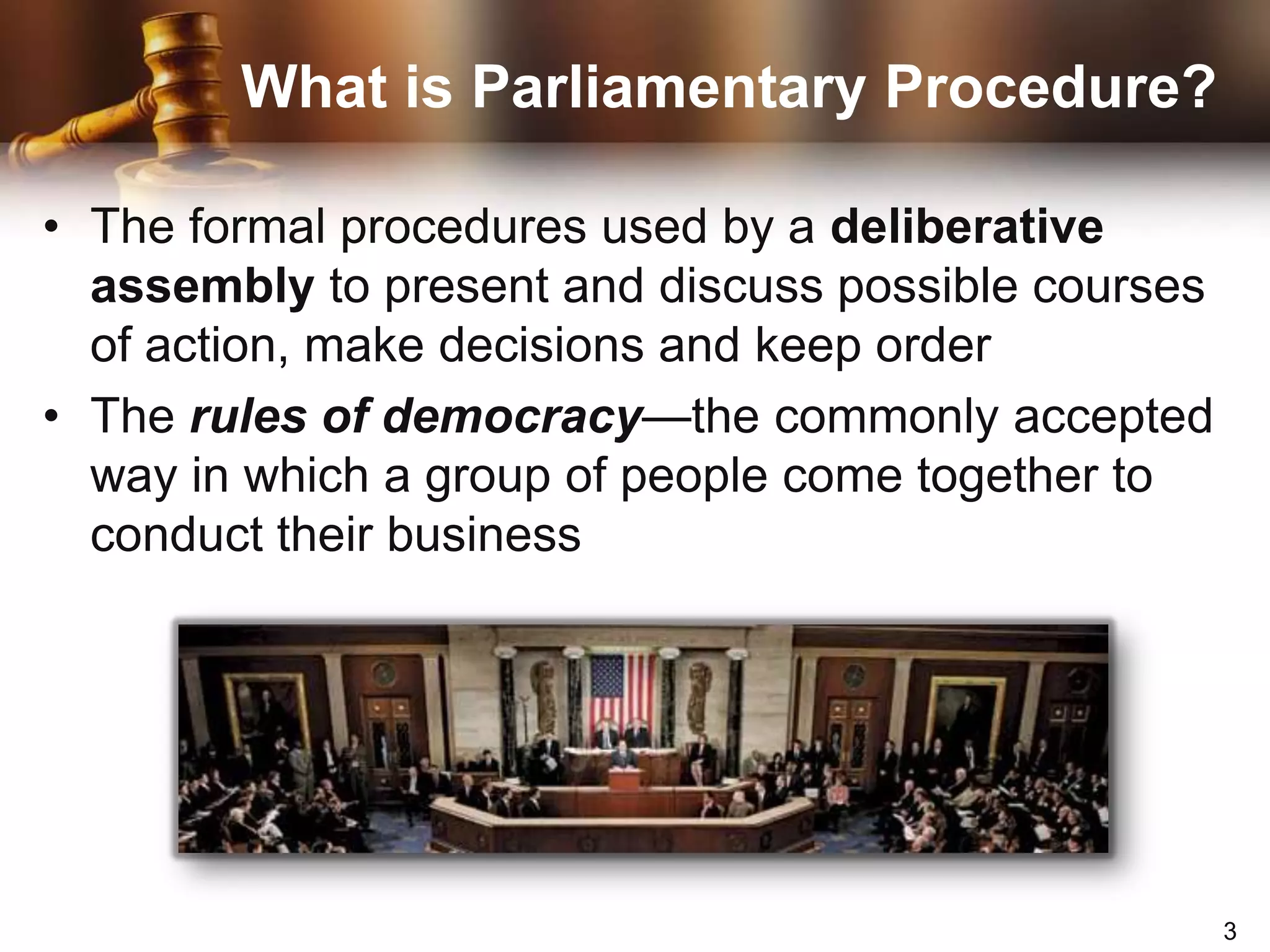
What is Parliamentary Procedure?The formal procedures used by a deliberative assembly to present and discuss possible courses of action, make decisions and keep orderThe rules of democracy—the commonly accepted way in which a group of people come together to conduct their business
BenefitsEnhanced leadership credibilityFaster and more efficient meetingsPrevention of illegal actionsImproved communication skills
The Basic PrinciplesCourtesy and justice for allConsideration of only one subject at a timeRights of absent members must be protectedThe minority must be heardThe will of the majority must prevail
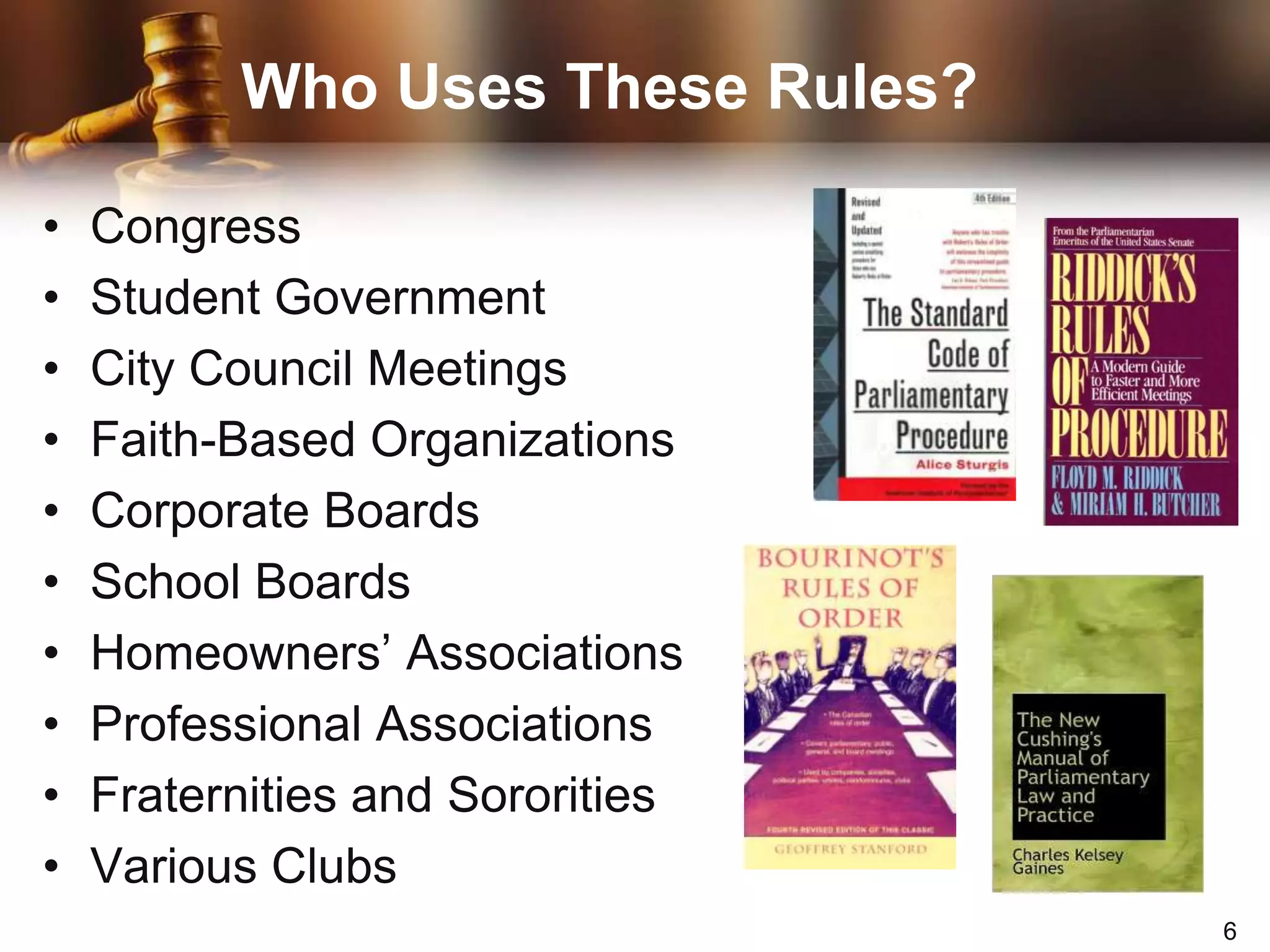
Who Uses These Rules?CongressStudent GovernmentCity Council MeetingsFaith-Based OrganizationsCorporate BoardsSchool BoardsHomeowners’ AssociationsProfessional AssociationsFraternities and SororitiesVarious Clubs
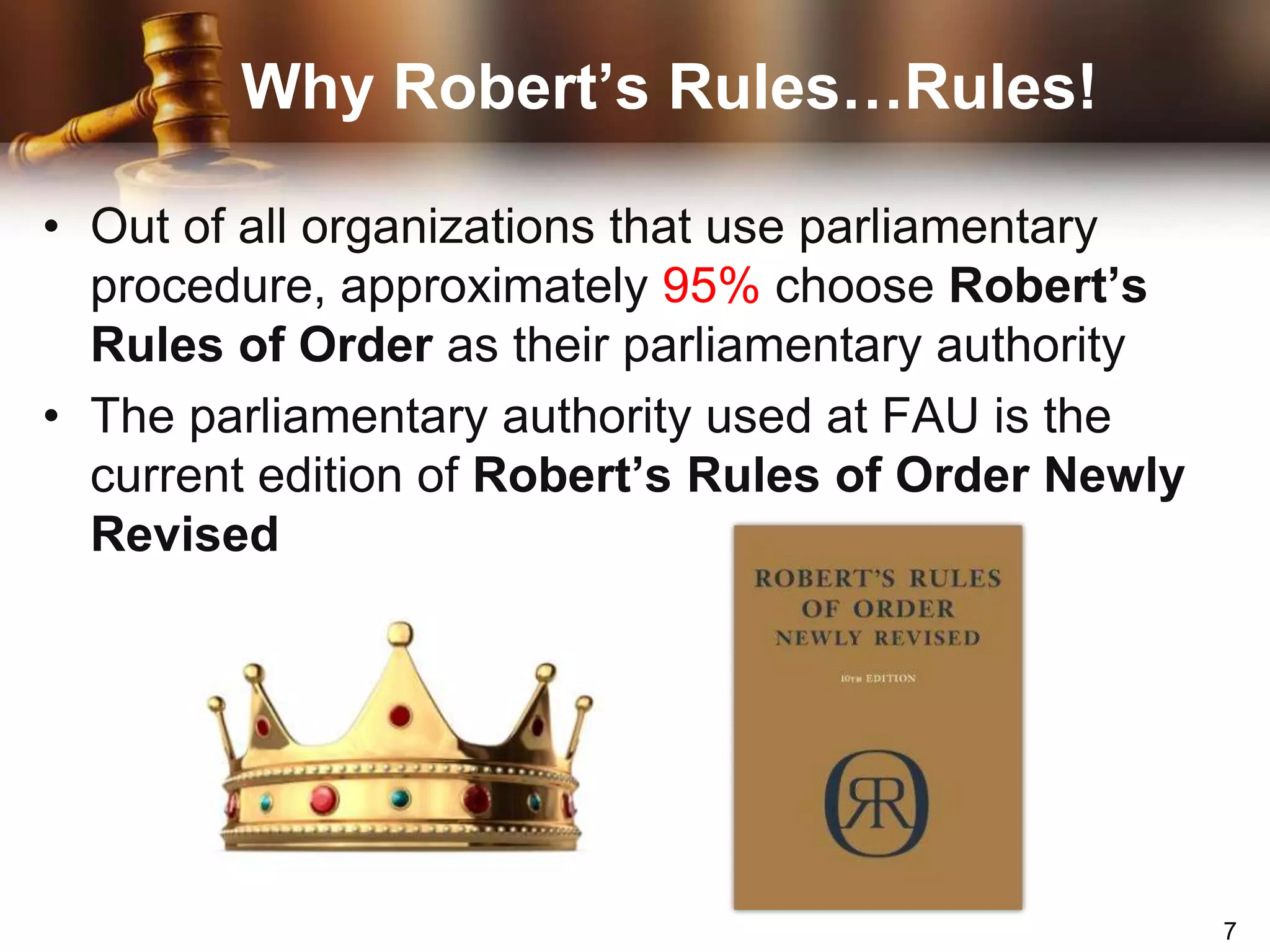
Why Robert’s Rules…Rules!Out of all organizations that use parliamentary procedure, approximately 95% choose Robert’s Rules of Order as their parliamentary authorityThe parliamentary authority used at FAU is the current edition of Robert’s Rules of Order Newly Revised
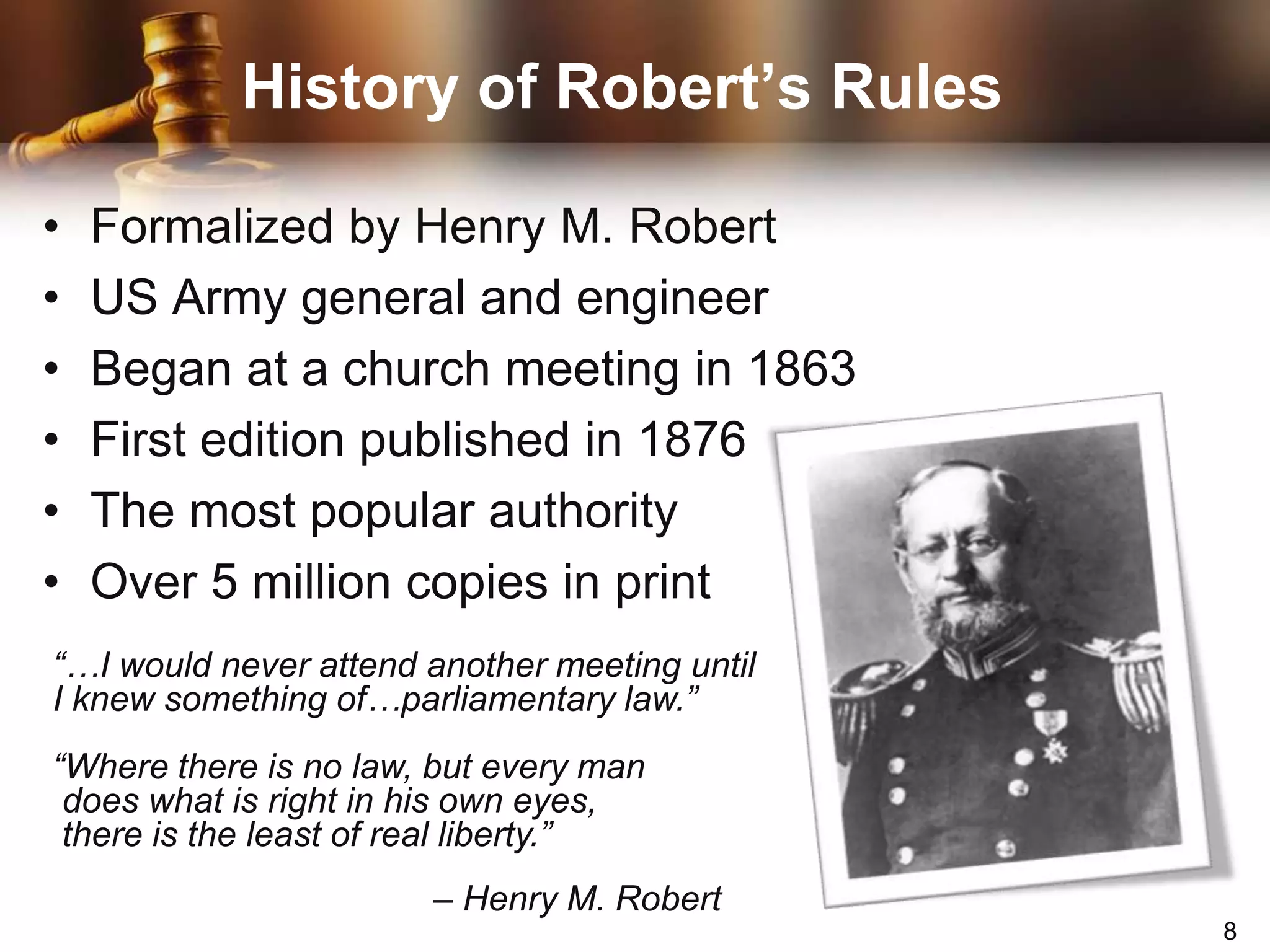
History of Robert’s RulesFormalized by Henry M. RobertUS Army general and engineerBegan at a church meeting in 1863First edition published in 1876The most popular authorityOver 5 million copies in print“…I would never attend another meeting until I knew something of…parliamentary law.”“Where there is no law, but every man does what is right in his own eyes, there is the least of real liberty.”			– Henry M. Robert
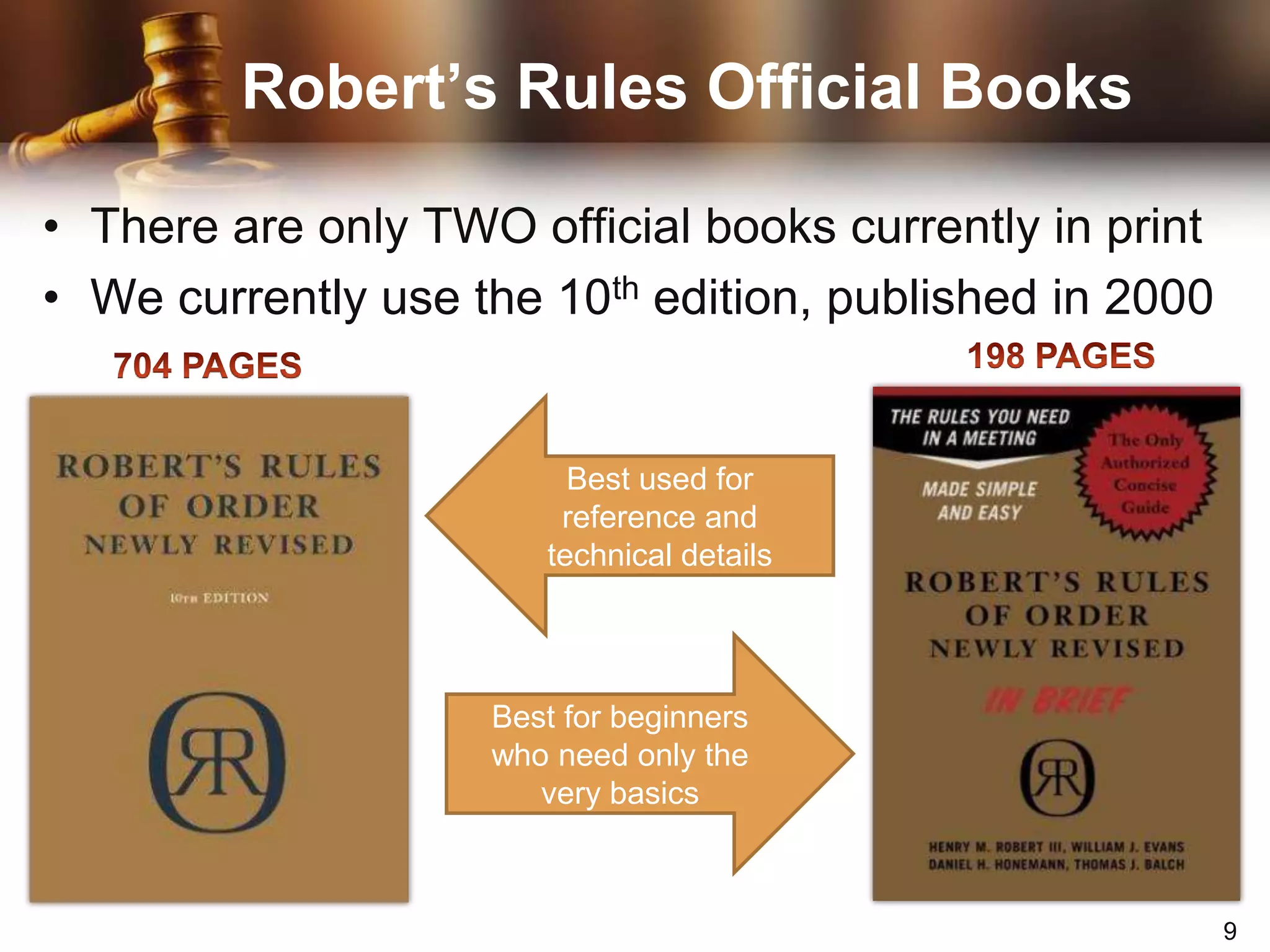
Robert’s Rules Official BooksThere are only TWO official books currently in printWe currently use the 10th edition, published in 2000198 PAGES704 PAGESBest used for reference and technical detailsBest for beginners who need only the very basics
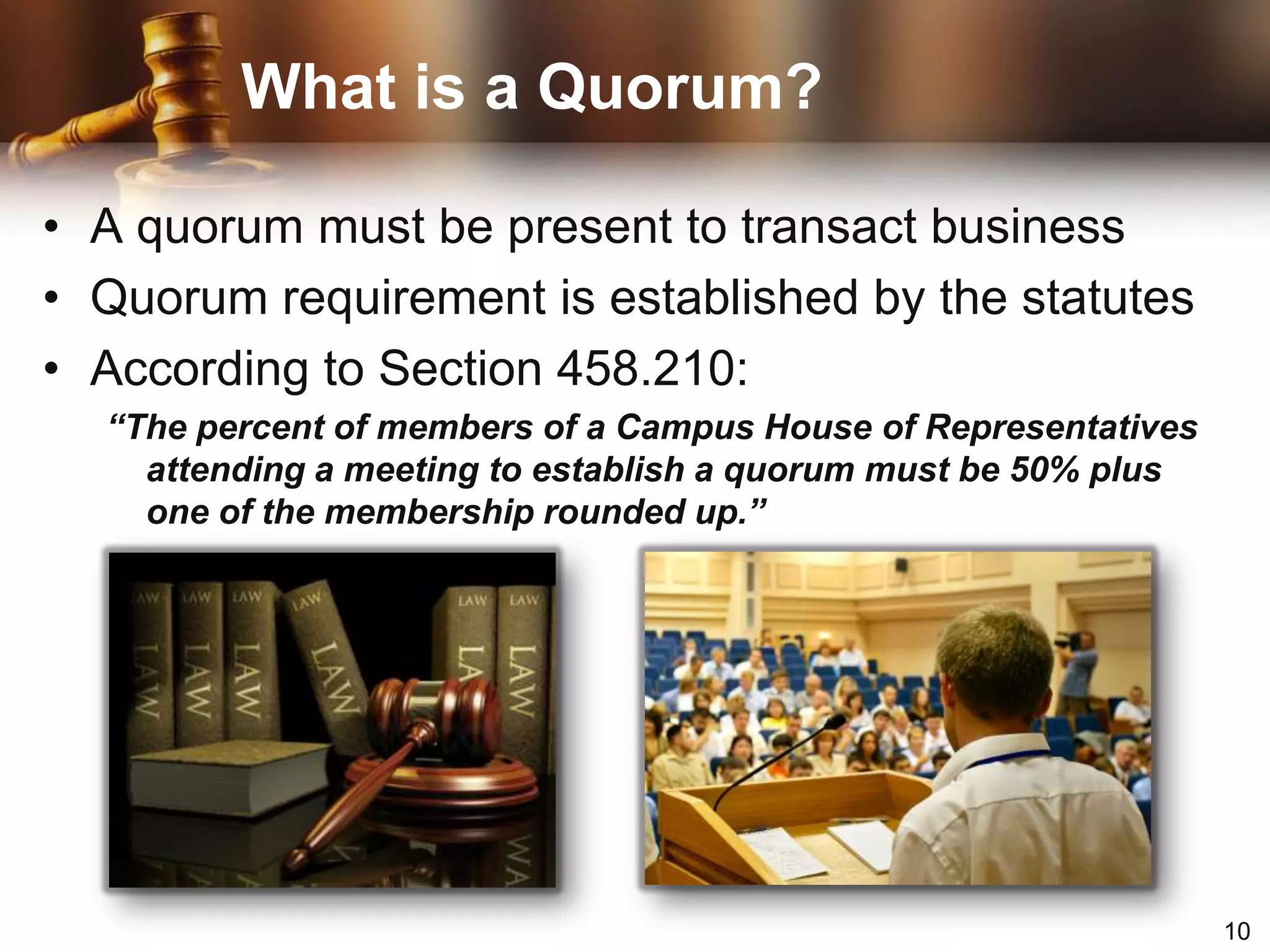
What is a Quorum?A quorum must be present to transact businessQuorum requirement is established by the statutesAccording to Section 458.210:“The percent of members of a Campus House of Representatives attending a meeting to establish a quorum must be 50% plus one of the membership rounded up.”
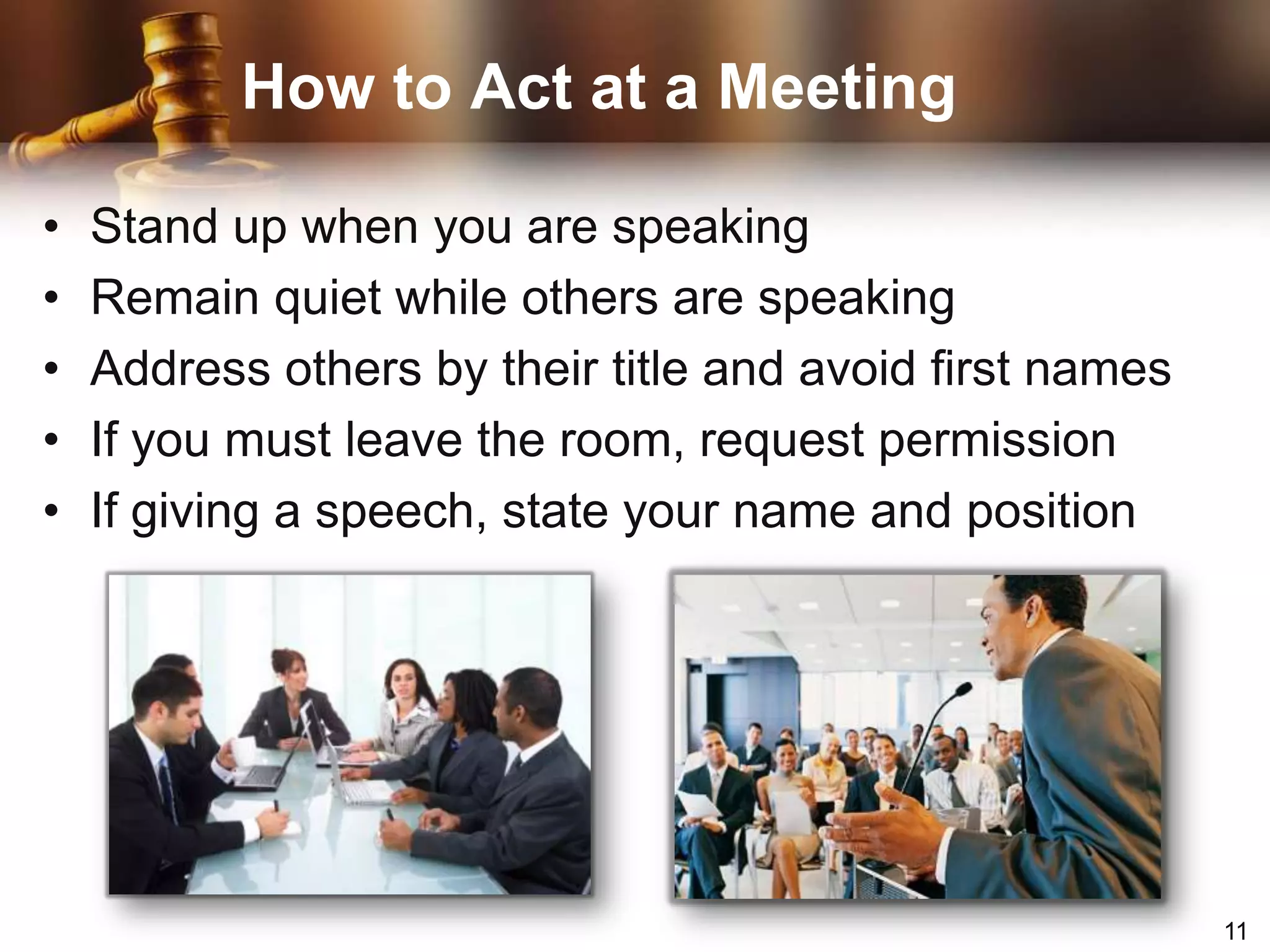
How to Act at a MeetingStand up when you are speakingRemain quiet while others are speakingAddress others by their title and avoid first namesIf you must leave the room, request permissionIf giving a speech, state your name and position
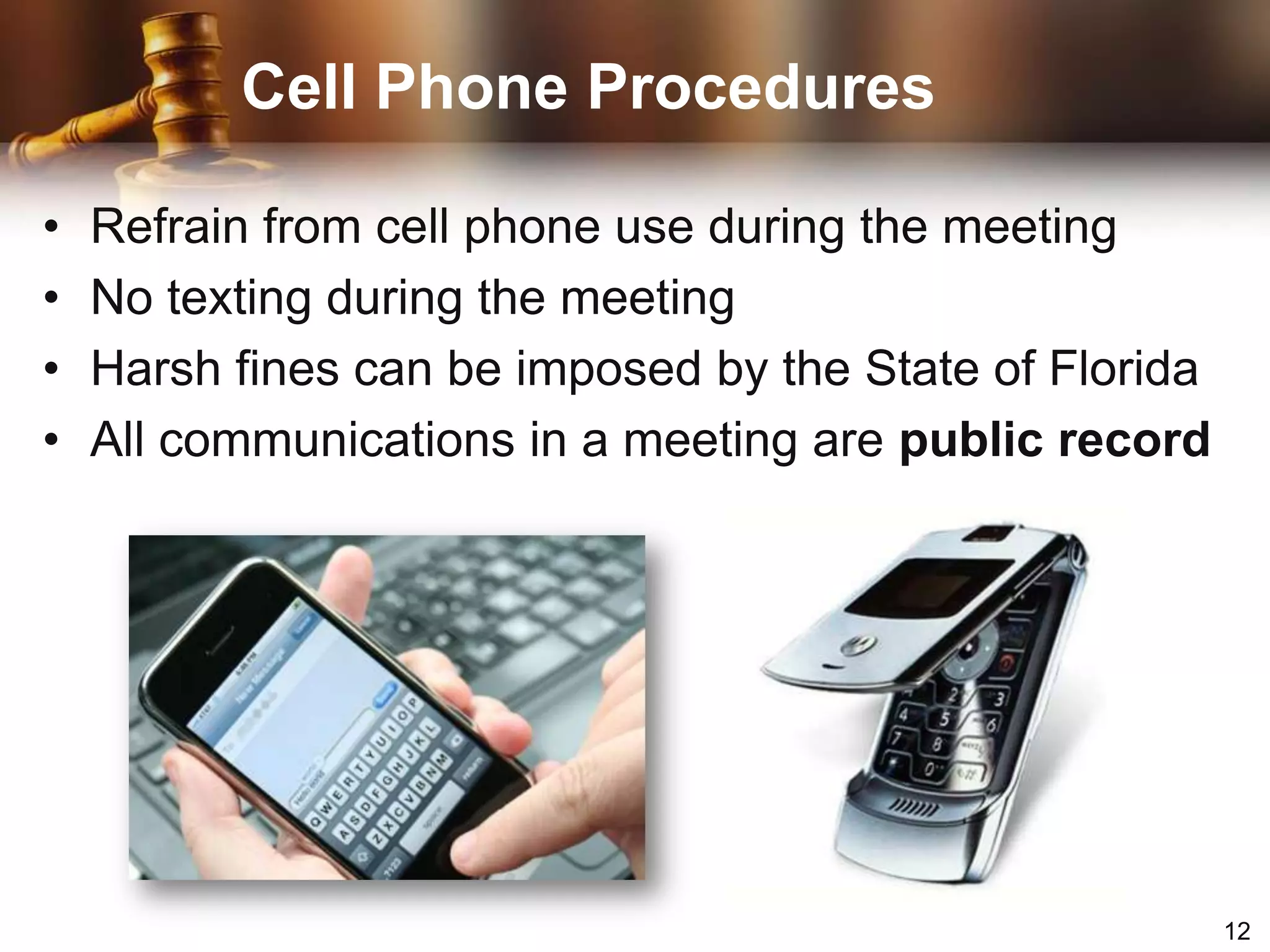
Cell Phone ProceduresRefrain from cell phone use during the meetingNo texting during the meetingHarsh fines can be imposed by the State of FloridaAll communications in a meeting are public record
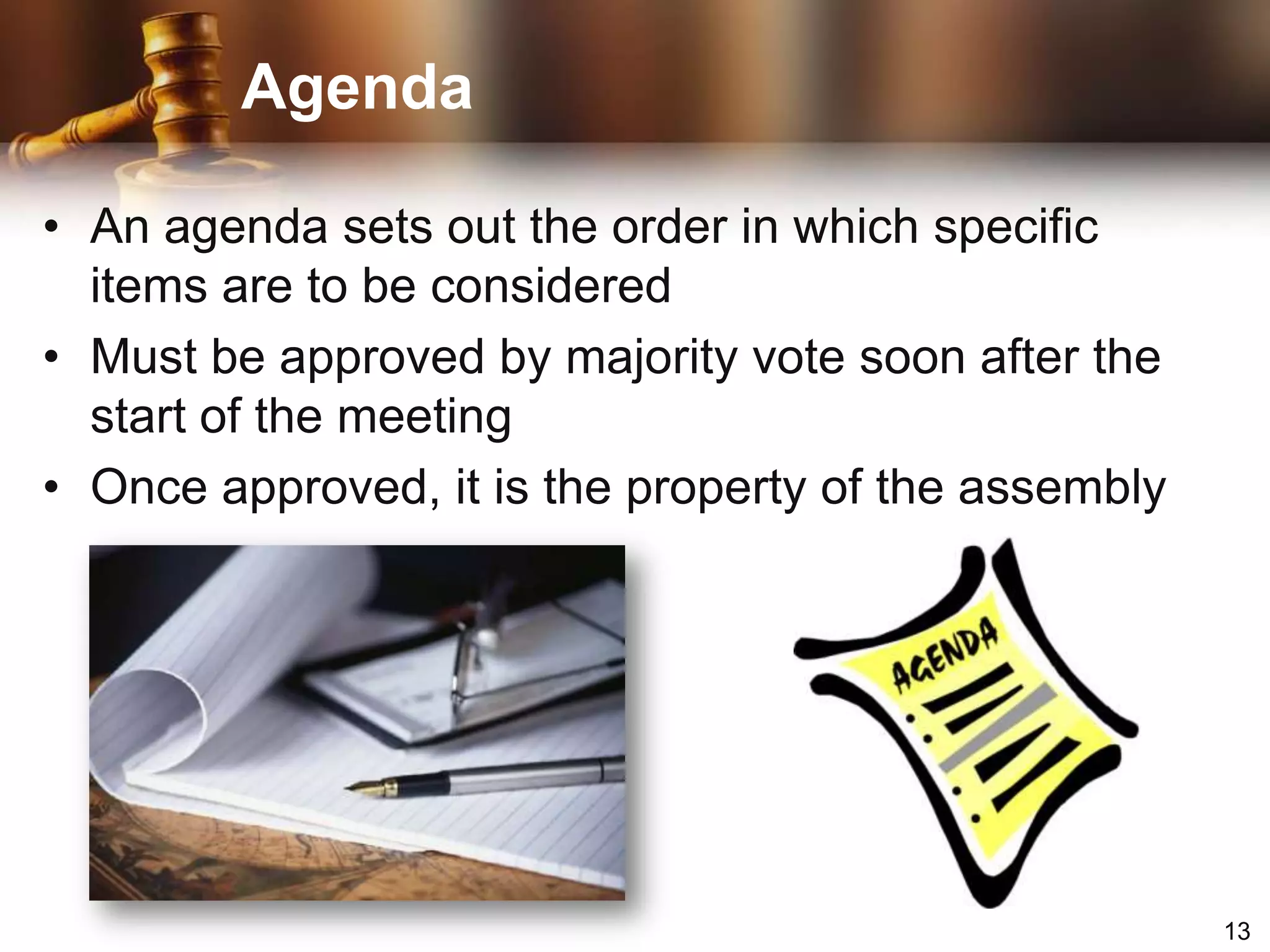
AgendaAn agenda sets out the order in which specific items are to be consideredMust be approved by majority vote soon after the start of the meetingOnce approved, it is the property of the assembly
Standard Order of BusinessStartCall to Order Pledge of AllegianceRoll CallApprovalsOpen ForumOfficer ReportsProgram ReportsSG Advisor’s ReportHouse ForumChair ReportsVetoed Business
Standard Order of BusinessTabled BusinessOld BusinessNew BusinessSpecial Order SpeechesOpen ForumLegislative ReportRemindersFinal Roll CallAdjournmentFinish
All About MotionsDefining a MotionA formal proposal for consideration and action
Only one subject can be considered at a time
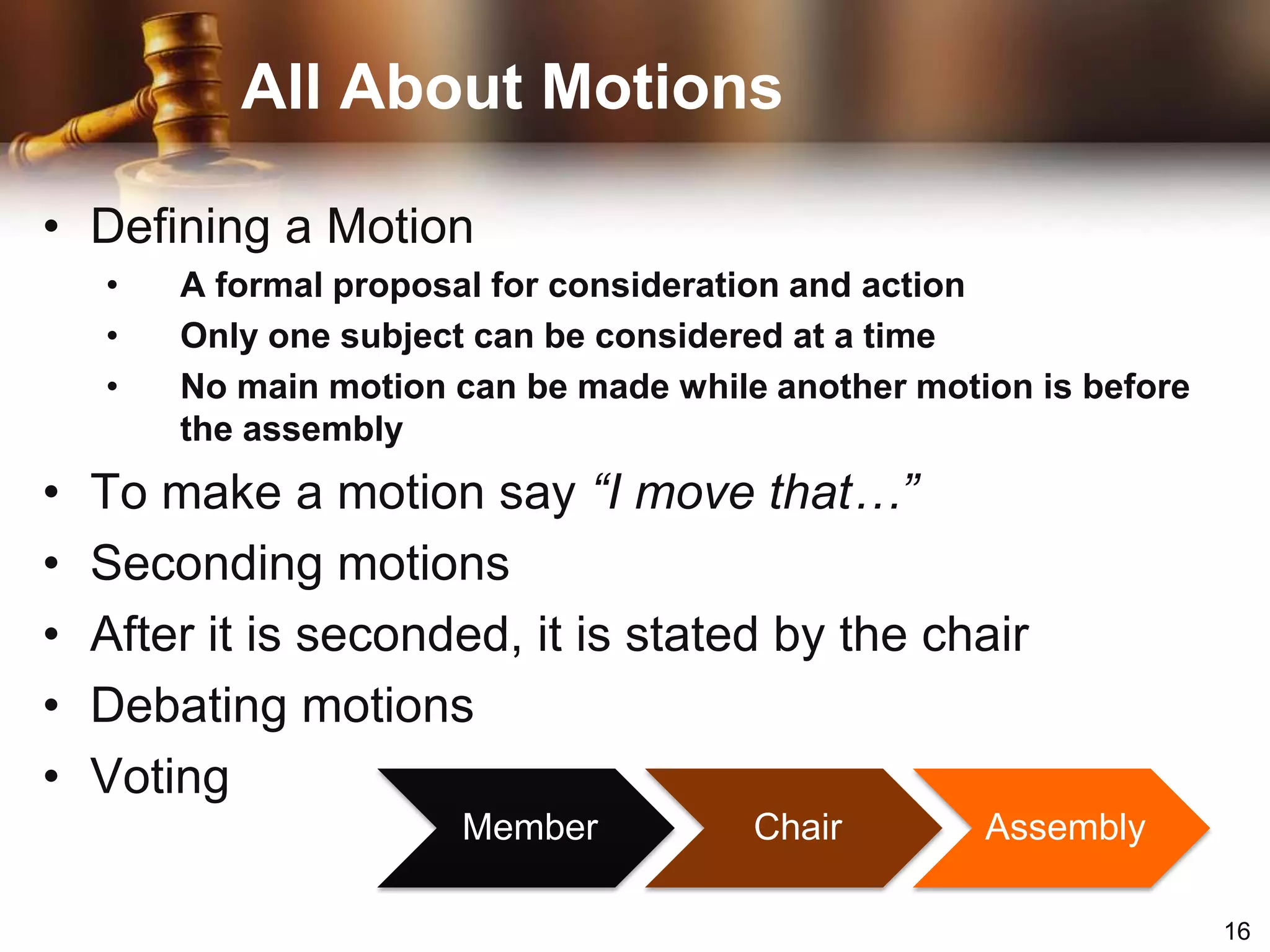
No main motion can be made while another motion is before the assemblyTo make a motion say “I move that…”Seconding motionsAfter it is seconded, it is stated by the chairDebating motionsVoting
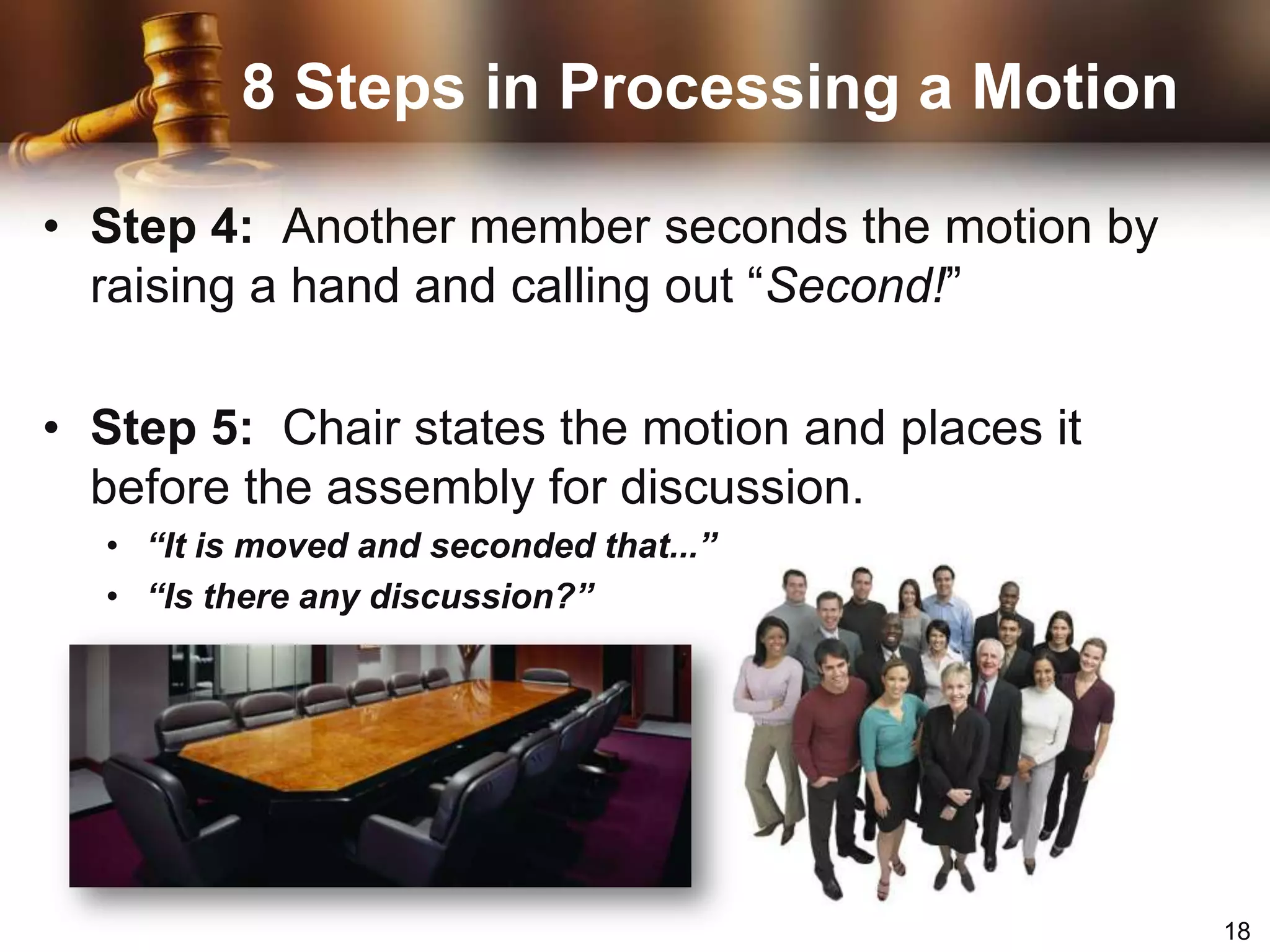
8 Steps in Processing a MotionStep 1:  Member rises and addresses the chair when nothing else is pendingSay: “Mr. / Madam Speaker”Step 2:  Chair recognizes member by nodding at the member or stating his/her nameChair replies: “Representative Smith”Step 3:  Member states his/her motionSay: “I move that…”8 Steps in Processing a MotionStep 4:  Another member seconds the motion by raising a hand and calling out “Second!”Step 5:  Chair states the motion and places it before the assembly for discussion. “It is moved and seconded that...”
“Is there any discussion?” 8 Steps in Processing a MotionStep 6:  Members have the right to get recognition and debate the motion.  During debate, subsidiary motions (i.e. amend, refer ) may be introduced to help the assembly make a final decisionStep 7:  Next, the chair puts the question to a vote“Are you ready for the question?”
“The question is on the adoption of the motion that...”
“Those in favor, say YES.”
“Those opposed, say NO.”
“Secretary, please take roll.”8 Steps in Processing a MotionStep 8:  Chair announces the results of the vote.“The affirmative [or negative] has it; the motion is adopted      [or lost];we will [not]…”“The next business in order is…”Types of MotionsMain Motion (Main)Brings new business (or next agenda item) before the assemblySubsidiary Motion (Sub)Changes or affects how a main motion is handledPrivileged Motion (Priv)Concerns matters of great importance or     urgency that are unrelated to pending businessIncidental Motion (Inc)Provides a means of questioning procedure concerning other motions and must be considered before the other motionFrequently Used MotionsAmend (Sub)Insert, strike out, or strike out and insert words
Used to clarify or improve the wording of the original motion
Must be germane to that motionCall for the Orders of the Day (Priv)A demand to return to the order of businessCommit or Refer (Sub)Refers question to a specific committeeLay on the Table (Sub)Temporarily suspends further action on pending questionFrequently Used MotionsLimit or extend limits of debate (Main)Modifies the rules of debate, such as length of speaking timePostpone Indefinitely (Sub)Rejects the main motion without bringing it to a direct voteReconsider (Special Class)Can be made only by a member of the prevailing	side who has changed position or viewSuspend the Rules (Inc)Allows for a violation of certain rules (depending on the context)
The object of the suspension must be specified Getting Your Point AcrossPoint of Order (Inc)Brings attention to an infraction of the rules of order
Must be raised immediately after the error is madePoint of Privilege (Priv)Pertains to noise, personal comfort, etc.
May interrupt only if necessary

Parliamentary Procedure Workshop

  • 1.
    Parliamentary Procedure WorkshopFAU Student Government Judicial Branch Florida Atlantic UniversityCreated and Presented byNicholas ScaliceMember, American Institute of Parliamentarians (AIP)
  • 2.
    OverviewWhat is ParliamentaryProcedure? BenefitsThe Basic PrinciplesWho Uses These Rules?Why Robert’s Rules…Rules!History of Robert’s Rules Robert’s Rules Official Books What is a Quorum? How to Act at a Meeting Cell Phone Procedures Agenda Standard Order of Business All About Motions 8 Steps in Processing a Motion Types of Motions Frequently Used Motions Getting Your Point Across Asking Questions Roll Call Voting Voting by Unanimous Consent Legislation For More Information Questions
  • 3.
    What is ParliamentaryProcedure?The formal procedures used by a deliberative assembly to present and discuss possible courses of action, make decisions and keep orderThe rules of democracy—the commonly accepted way in which a group of people come together to conduct their business
  • 4.
    BenefitsEnhanced leadership credibilityFasterand more efficient meetingsPrevention of illegal actionsImproved communication skills
  • 5.
    The Basic PrinciplesCourtesyand justice for allConsideration of only one subject at a timeRights of absent members must be protectedThe minority must be heardThe will of the majority must prevail
  • 6.
    Who Uses TheseRules?CongressStudent GovernmentCity Council MeetingsFaith-Based OrganizationsCorporate BoardsSchool BoardsHomeowners’ AssociationsProfessional AssociationsFraternities and SororitiesVarious Clubs
  • 7.
    Why Robert’s Rules…Rules!Outof all organizations that use parliamentary procedure, approximately 95% choose Robert’s Rules of Order as their parliamentary authorityThe parliamentary authority used at FAU is the current edition of Robert’s Rules of Order Newly Revised
  • 8.
    History of Robert’sRulesFormalized by Henry M. RobertUS Army general and engineerBegan at a church meeting in 1863First edition published in 1876The most popular authorityOver 5 million copies in print“…I would never attend another meeting until I knew something of…parliamentary law.”“Where there is no law, but every man does what is right in his own eyes, there is the least of real liberty.” – Henry M. Robert
  • 9.
    Robert’s Rules OfficialBooksThere are only TWO official books currently in printWe currently use the 10th edition, published in 2000198 PAGES704 PAGESBest used for reference and technical detailsBest for beginners who need only the very basics
  • 10.
    What is aQuorum?A quorum must be present to transact businessQuorum requirement is established by the statutesAccording to Section 458.210:“The percent of members of a Campus House of Representatives attending a meeting to establish a quorum must be 50% plus one of the membership rounded up.”
  • 11.
    How to Actat a MeetingStand up when you are speakingRemain quiet while others are speakingAddress others by their title and avoid first namesIf you must leave the room, request permissionIf giving a speech, state your name and position
  • 12.
    Cell Phone ProceduresRefrainfrom cell phone use during the meetingNo texting during the meetingHarsh fines can be imposed by the State of FloridaAll communications in a meeting are public record
  • 13.
    AgendaAn agenda setsout the order in which specific items are to be consideredMust be approved by majority vote soon after the start of the meetingOnce approved, it is the property of the assembly
  • 14.
    Standard Order ofBusinessStartCall to Order Pledge of AllegianceRoll CallApprovalsOpen ForumOfficer ReportsProgram ReportsSG Advisor’s ReportHouse ForumChair ReportsVetoed Business
  • 15.
    Standard Order ofBusinessTabled BusinessOld BusinessNew BusinessSpecial Order SpeechesOpen ForumLegislative ReportRemindersFinal Roll CallAdjournmentFinish
  • 16.
    All About MotionsDefininga MotionA formal proposal for consideration and action
  • 17.
    Only one subjectcan be considered at a time
  • 18.
    No main motioncan be made while another motion is before the assemblyTo make a motion say “I move that…”Seconding motionsAfter it is seconded, it is stated by the chairDebating motionsVoting
  • 19.
    8 Steps inProcessing a MotionStep 1: Member rises and addresses the chair when nothing else is pendingSay: “Mr. / Madam Speaker”Step 2: Chair recognizes member by nodding at the member or stating his/her nameChair replies: “Representative Smith”Step 3: Member states his/her motionSay: “I move that…”8 Steps in Processing a MotionStep 4: Another member seconds the motion by raising a hand and calling out “Second!”Step 5: Chair states the motion and places it before the assembly for discussion. “It is moved and seconded that...”
  • 20.
    “Is there anydiscussion?” 8 Steps in Processing a MotionStep 6: Members have the right to get recognition and debate the motion. During debate, subsidiary motions (i.e. amend, refer ) may be introduced to help the assembly make a final decisionStep 7: Next, the chair puts the question to a vote“Are you ready for the question?”
  • 21.
    “The question ison the adoption of the motion that...”
  • 22.
  • 23.
  • 24.
    “Secretary, please takeroll.”8 Steps in Processing a MotionStep 8: Chair announces the results of the vote.“The affirmative [or negative] has it; the motion is adopted [or lost];we will [not]…”“The next business in order is…”Types of MotionsMain Motion (Main)Brings new business (or next agenda item) before the assemblySubsidiary Motion (Sub)Changes or affects how a main motion is handledPrivileged Motion (Priv)Concerns matters of great importance or urgency that are unrelated to pending businessIncidental Motion (Inc)Provides a means of questioning procedure concerning other motions and must be considered before the other motionFrequently Used MotionsAmend (Sub)Insert, strike out, or strike out and insert words
  • 25.
    Used to clarifyor improve the wording of the original motion
  • 26.
    Must be germaneto that motionCall for the Orders of the Day (Priv)A demand to return to the order of businessCommit or Refer (Sub)Refers question to a specific committeeLay on the Table (Sub)Temporarily suspends further action on pending questionFrequently Used MotionsLimit or extend limits of debate (Main)Modifies the rules of debate, such as length of speaking timePostpone Indefinitely (Sub)Rejects the main motion without bringing it to a direct voteReconsider (Special Class)Can be made only by a member of the prevailing side who has changed position or viewSuspend the Rules (Inc)Allows for a violation of certain rules (depending on the context)
  • 27.
    The object ofthe suspension must be specified Getting Your Point AcrossPoint of Order (Inc)Brings attention to an infraction of the rules of order
  • 28.
    Must be raisedimmediately after the error is madePoint of Privilege (Priv)Pertains to noise, personal comfort, etc.
  • 29.
    May interrupt onlyif necessary
  • 30.
  • 31.
    Use this torequest to leave the room for any reason
  • 32.
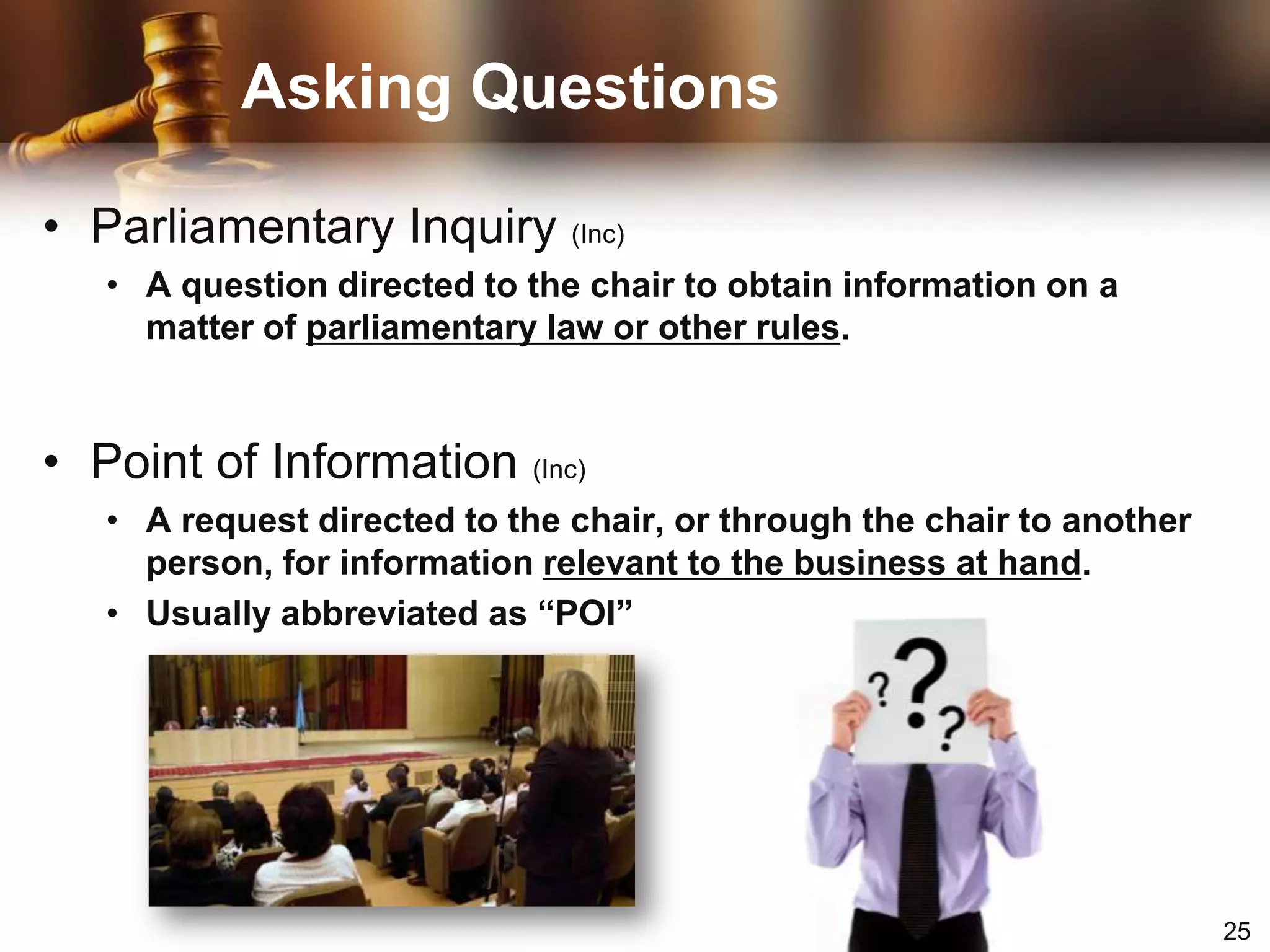
    Upon return, someoneshould motion to “Admit All Members”Asking QuestionsParliamentary Inquiry (Inc)A question directed to the chair to obtain information on a matter of parliamentary law or other rules.Point of Information (Inc)A request directed to the chair, or through the chair to another person, for information relevant to the business at hand.
  • 33.
    Usually abbreviated as“POI”Roll Call VotingMost votes are done by taking rollThree responses in which a member may vote:“For” (In favor of the motion or legislation)
  • 34.
    “Against” (Opposed tothe motion or legislation)
  • 35.
    “Abstain” (Neither fornor against)Members may abstain only if there is a distinct conflict of interestPassing on a vote
  • 36.
    Voting by UnanimousConsentFor certain parliamentary motions, the chair may simply ask the assembly if there is any objection to taking the desired action.If no member objects, the chair declares that the action has been agreed to.If even one member objects, the chair must then state the question and follow the complete voting guidelines.
  • 37.
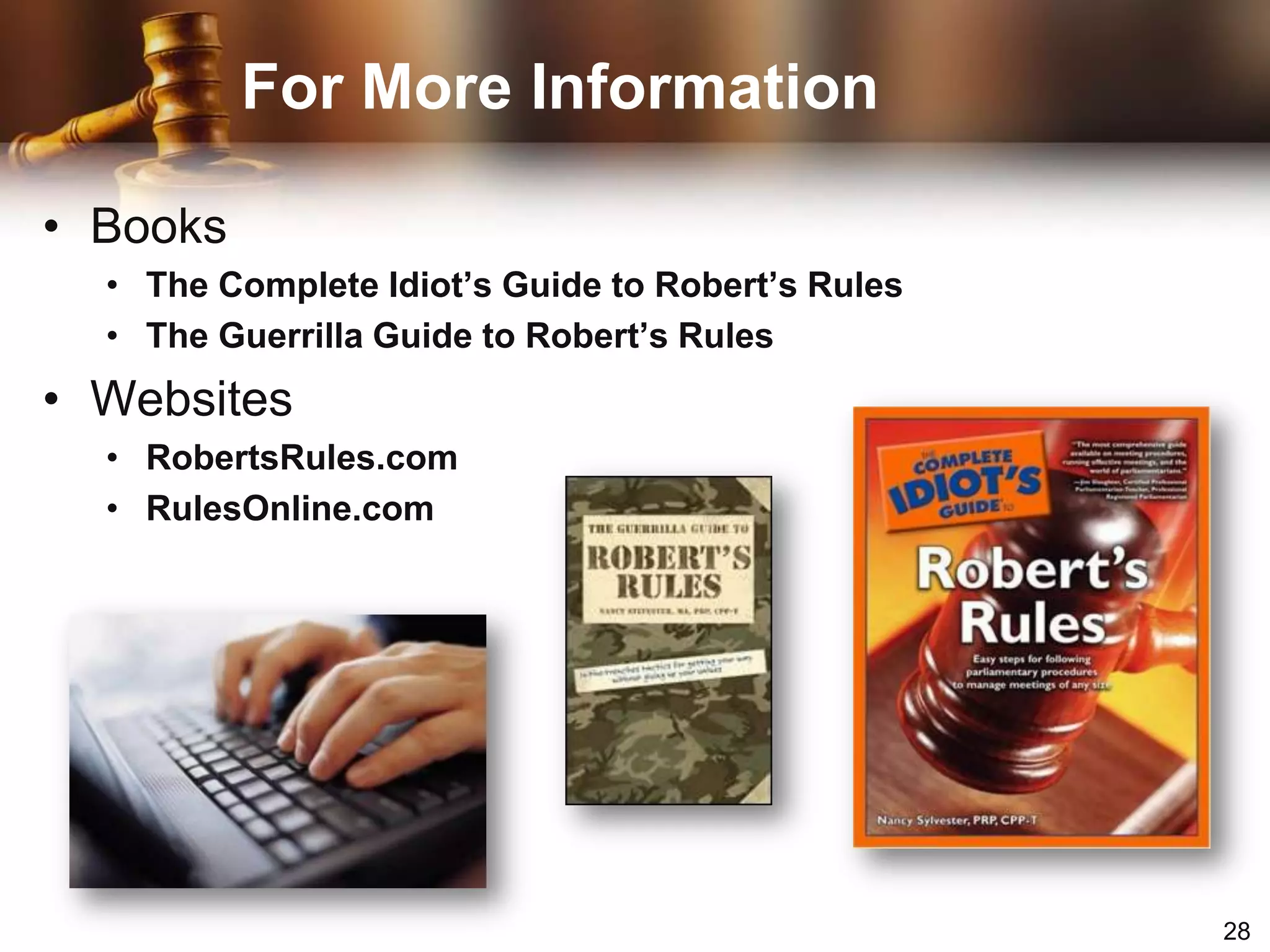
    For More InformationBooksTheComplete Idiot’s Guide to Robert’s Rules
  • 38.
    The Guerrilla Guideto Robert’s RulesWebsitesRobertsRules.com
  • 39.