Sonnet 116
William Shakespeare
Sonnet 116
Let me not to the marriage of true minds
Admit impediments. Love is not love
Which alters when it alteration finds,
Or bends with the remover to remove:
O no! it is an ever-fixed mark
That looks on tempests and is never shaken;
It is the star to every wandering bark,
Whose worth's unknown, although his height be taken.
Love's not Time's fool, though rosy lips and cheeks
Within his bending sickle's compass come:
Love alters not with his brief hours and weeks,
But bears it out even to the edge of doom.
If this be error and upon me proved,
I never writ, nor no man ever loved.
Sonnet 116 was first published in 1609 and is one of the most
famous sonnets in the world. It is about everlasting love and is
widely known for its idealistic vision of a loving relationship. It is
often read at marriage ceremonies.
Sonnet 116 attempts to define love, by explaining what it is and
what it is not. It is emphatic and didactic.
Essentially, this sonnet presents the extreme ideal of romantic love:
it never changes, it never fades, it outlasts death and admits no flaw.
What is more, it insists that this ideal is the only love that can be
called “true”—if love is mortal, changing, or impermanent, the
speaker writes, then no man ever loved.
Shakespeare’s Life
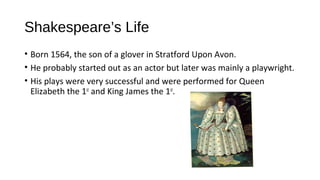
• Born 1564, the son of a glover in Stratford Upon Avon.
• He probably started out as an actor but later was mainly a playwright.
• His plays were very successful and were performed for Queen
Elizabeth the 1st
and King James the 1st
.
Structure
A Shakespearean sonnet consists of 14 lines made up of three
quatrains and a rhyming couplet.
The basic division of this poem’s argument into the various parts of the
sonnet form is extremely simple: the first quatrain says what love is not
(changeable), the second quatrain says what it is (a fixed guiding star
unshaken by tempests), the third quatrain says more specifically what
it is not (“time’s fool”—that is, subject to change in the passage of
time), and the couplet announces the speaker’s certainty.
First quatrain
Let me not to the marriage of true minds
Admit impediments. Love is not love
Which alters when it alteration finds,
Or bends with the remover to remove:
= Don’t let problems break up true love. And love
doesn’t move or bend when it hits obstacles: it
remains unaffected.
A strong caesura following
enjambment stresses the
power of the statement. It
is also an impediment to
the flow of the poem
Problems
Paired together – true love requires
two people being paired together.
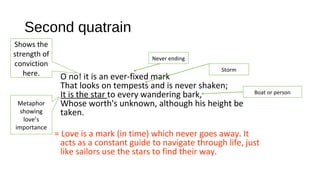
Second quatrain
O no! it is an ever-fixed mark
That looks on tempests and is never shaken;
It is the star to every wandering bark,
Whose worth's unknown, although his height be
taken.
= Love is a mark (in time) which never goes away. It
acts as a constant guide to navigate through life, just
like sailors use the stars to find their way.
Shows the
strength of
conviction
here.
Never ending
Storm
Boat or person
Metaphor
showing
love’s
importance
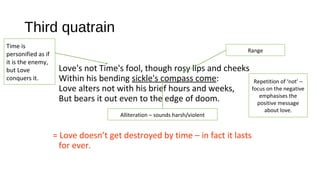
Third quatrain
Love's not Time's fool, though rosy lips and cheeks
Within his bending sickle's compass come:
Love alters not with his brief hours and weeks,
But bears it out even to the edge of doom.
= Love doesn’t get destroyed by time – in fact it lasts
for ever.
Range
Time is
personified as if
it is the enemy,
but Love
conquers it. Repetition of ‘not’ –
focus on the negative
emphasises the
positive message
about love.
Alliteration – sounds harsh/violent
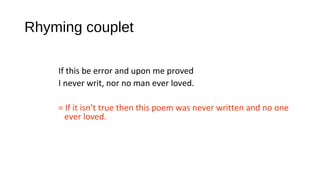
Rhyming couplet
If this be error and upon me proved
I never writ, nor no man ever loved.
= If it isn’t true then this poem was never written and no one
ever loved.
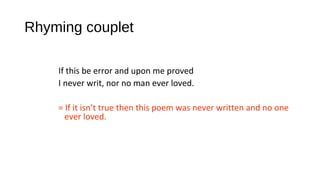
Rhyming couplet
If this be error and upon me proved
I never writ, nor no man ever loved.
= If it isn’t true then this poem was never written and no one
ever loved.

Sonnet 116

  • 1.
  • 2.
    Sonnet 116 Let menot to the marriage of true minds Admit impediments. Love is not love Which alters when it alteration finds, Or bends with the remover to remove: O no! it is an ever-fixed mark That looks on tempests and is never shaken; It is the star to every wandering bark, Whose worth's unknown, although his height be taken. Love's not Time's fool, though rosy lips and cheeks Within his bending sickle's compass come: Love alters not with his brief hours and weeks, But bears it out even to the edge of doom. If this be error and upon me proved, I never writ, nor no man ever loved.
  • 3.
    Sonnet 116 wasfirst published in 1609 and is one of the most famous sonnets in the world. It is about everlasting love and is widely known for its idealistic vision of a loving relationship. It is often read at marriage ceremonies. Sonnet 116 attempts to define love, by explaining what it is and what it is not. It is emphatic and didactic. Essentially, this sonnet presents the extreme ideal of romantic love: it never changes, it never fades, it outlasts death and admits no flaw. What is more, it insists that this ideal is the only love that can be called “true”—if love is mortal, changing, or impermanent, the speaker writes, then no man ever loved.
  • 4.
    Shakespeare’s Life • Born1564, the son of a glover in Stratford Upon Avon. • He probably started out as an actor but later was mainly a playwright. • His plays were very successful and were performed for Queen Elizabeth the 1st and King James the 1st .
  • 5.
    Structure A Shakespearean sonnetconsists of 14 lines made up of three quatrains and a rhyming couplet. The basic division of this poem’s argument into the various parts of the sonnet form is extremely simple: the first quatrain says what love is not (changeable), the second quatrain says what it is (a fixed guiding star unshaken by tempests), the third quatrain says more specifically what it is not (“time’s fool”—that is, subject to change in the passage of time), and the couplet announces the speaker’s certainty.
  • 6.
    First quatrain Let menot to the marriage of true minds Admit impediments. Love is not love Which alters when it alteration finds, Or bends with the remover to remove: = Don’t let problems break up true love. And love doesn’t move or bend when it hits obstacles: it remains unaffected. A strong caesura following enjambment stresses the power of the statement. It is also an impediment to the flow of the poem Problems Paired together – true love requires two people being paired together.
  • 7.
    Second quatrain O no!it is an ever-fixed mark That looks on tempests and is never shaken; It is the star to every wandering bark, Whose worth's unknown, although his height be taken. = Love is a mark (in time) which never goes away. It acts as a constant guide to navigate through life, just like sailors use the stars to find their way. Shows the strength of conviction here. Never ending Storm Boat or person Metaphor showing love’s importance
  • 8.
    Third quatrain Love's notTime's fool, though rosy lips and cheeks Within his bending sickle's compass come: Love alters not with his brief hours and weeks, But bears it out even to the edge of doom. = Love doesn’t get destroyed by time – in fact it lasts for ever. Range Time is personified as if it is the enemy, but Love conquers it. Repetition of ‘not’ – focus on the negative emphasises the positive message about love. Alliteration – sounds harsh/violent
  • 9.
    Rhyming couplet If thisbe error and upon me proved I never writ, nor no man ever loved. = If it isn’t true then this poem was never written and no one ever loved.
  • 10.
    Rhyming couplet If thisbe error and upon me proved I never writ, nor no man ever loved. = If it isn’t true then this poem was never written and no one ever loved.