Interpreting
Shakespearean
    Sonnets
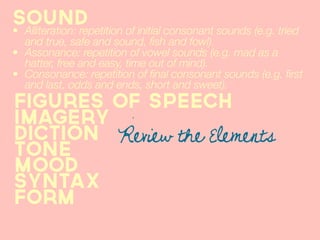
Sound
• Alliteration: repetition of initial consonant sounds (e.g. tried
  and true, safe and sound, fish and fowl).
• Assonance: repetition of vowel sounds (e.g. mad as a
  hatter, free and easy, time out of mind).
• Consonance: repetition of final consonant sounds (e.g. first
  and last, odds and ends, short and sweet).
figures of speech
imagery
diction Review the Elements
tone
Mood
syntax
form
Sonnet 116
1    Let me not to the marriage of true minds
2    Admit impediments, love is not love
3    Which alters when it alteration finds,
4    Or bends with the remover to remove.
5    O no, it is an ever-fixed mark
6    That looks on tempests and is never shaken;
7    It is the star to every wand'ring bark,
8    Whose worth's unknown, although his height be taken.
9    Love's not Time's fool, though rosy lips and cheeks
10   Within his bending sickle's compass come,
11   Love alters not with his brief hours and weeks,
12   But bears it out even to the edge of doom:
13   If this be error and upon me proved,
14   I never writ, nor no man ever loved.
1st Quatrain
Exposition of the main theme and main metaphor


  1   Let me not to the marriage of true minds
  2   Admit impediments, love is not love
  3   Which alters when it alteration finds,
  4   Or bends with the remover to remove.
2nd Quatrain
Theme and metaphor are extended; creative illustration is given


 5    O no, it is an ever-fixed mark
 6    That looks on tempests and is never shaken;
 7    It is the star to every wand'ring bark,
 8    Whose worth's unknown, although his height be taken.
3rd Quatrain
             Either the metaphor is extended
     or conflict is introduced through the turn or volta


9    Love's not Time's fool, though rosy lips and cheeks
10   Within his bending sickle's compass come,
11   Love alters not with his brief hours and weeks,
12   But bears it out even to the edge of doom:
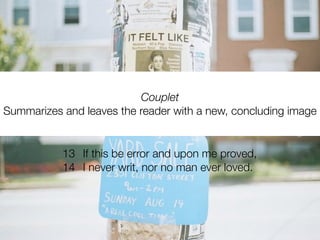
Couplet
Summarizes and leaves the reader with a new, concluding image


           13 If this be error and upon me proved,
           14 I never writ, nor no man ever loved.
Try your hand at it
Google docs: CN LN, I - Shakespearean Sonnet

1. Think of a topic. Explain what your sonnet is going to be
   about in 3-5 sentences.
2. The first two lines of your Shakespearean Sonnet are easy
   to write because they don’t have to rhyme yet. Try out a few
   ideas for your 1st line.
3. The 2nd line doesn’t have a fixed rhyme yet; try writing a
   second line.
4. Count each syllable, make sure you only have 10 syllables.
   Revise your work if it exceeds or is lacking in syllables. Do
   not forget to add color to make each line interesting. Also,
   revise your work to follow the iambic pentameter (– ‘).
Try your hand at it
Google docs: CN LN, I - Shakespearean Sonnet

5. The 3rd and 4th line will need to rhyme with those you
   already wrote; the 3rd with the 1st and the 4th with the 2nd.
   To aid you in writing these:
   a. Create a list of words that rhyme with the last word of the
      1st line.
   b. Create another list of words that rhyme with the last word
      of the 2nd line.
6. Write your ideas for the 3rd and 4th line.
7. Look over your 1st quatrain. Make sure all the lines have 10
   syllables and are following the metrical scheme of iambic
   pentameter.
Try your hand at it
Google docs: CN LN, I - Shakespearean Sonnet

8. Go over the same process for the two other quatrains and
   the couplet, remembering the essential composition of
   each:
   a. 2nd Quatrain: Theme and metaphor are extended;
      creative illustration is given.
   b. 3rd Quatrain: Either the metaphor is extended or conflict
      is introduced through the turn or volta.
   c. Couplet: Summarizes and leaves the reader with a new,
      concluding image.

You have now successfully created your first working
Shakespearean Sonnet draft!

Interpreting Shakespearean Sonnets

  • 1.
  • 2.
    Sound • Alliteration: repetitionof initial consonant sounds (e.g. tried and true, safe and sound, fish and fowl). • Assonance: repetition of vowel sounds (e.g. mad as a hatter, free and easy, time out of mind). • Consonance: repetition of final consonant sounds (e.g. first and last, odds and ends, short and sweet). figures of speech imagery diction Review the Elements tone Mood syntax form
  • 3.
    Sonnet 116 1 Let me not to the marriage of true minds 2 Admit impediments, love is not love 3 Which alters when it alteration finds, 4 Or bends with the remover to remove. 5 O no, it is an ever-fixed mark 6 That looks on tempests and is never shaken; 7 It is the star to every wand'ring bark, 8 Whose worth's unknown, although his height be taken. 9 Love's not Time's fool, though rosy lips and cheeks 10 Within his bending sickle's compass come, 11 Love alters not with his brief hours and weeks, 12 But bears it out even to the edge of doom: 13 If this be error and upon me proved, 14 I never writ, nor no man ever loved.
  • 4.
    1st Quatrain Exposition ofthe main theme and main metaphor 1 Let me not to the marriage of true minds 2 Admit impediments, love is not love 3 Which alters when it alteration finds, 4 Or bends with the remover to remove.
  • 5.
    2nd Quatrain Theme andmetaphor are extended; creative illustration is given 5 O no, it is an ever-fixed mark 6 That looks on tempests and is never shaken; 7 It is the star to every wand'ring bark, 8 Whose worth's unknown, although his height be taken.
  • 6.
    3rd Quatrain Either the metaphor is extended or conflict is introduced through the turn or volta 9 Love's not Time's fool, though rosy lips and cheeks 10 Within his bending sickle's compass come, 11 Love alters not with his brief hours and weeks, 12 But bears it out even to the edge of doom:
  • 7.
    Couplet Summarizes and leavesthe reader with a new, concluding image 13 If this be error and upon me proved, 14 I never writ, nor no man ever loved.
  • 8.
    Try your handat it Google docs: CN LN, I - Shakespearean Sonnet 1. Think of a topic. Explain what your sonnet is going to be about in 3-5 sentences. 2. The first two lines of your Shakespearean Sonnet are easy to write because they don’t have to rhyme yet. Try out a few ideas for your 1st line. 3. The 2nd line doesn’t have a fixed rhyme yet; try writing a second line. 4. Count each syllable, make sure you only have 10 syllables. Revise your work if it exceeds or is lacking in syllables. Do not forget to add color to make each line interesting. Also, revise your work to follow the iambic pentameter (– ‘).
  • 9.
    Try your handat it Google docs: CN LN, I - Shakespearean Sonnet 5. The 3rd and 4th line will need to rhyme with those you already wrote; the 3rd with the 1st and the 4th with the 2nd. To aid you in writing these: a. Create a list of words that rhyme with the last word of the 1st line. b. Create another list of words that rhyme with the last word of the 2nd line. 6. Write your ideas for the 3rd and 4th line. 7. Look over your 1st quatrain. Make sure all the lines have 10 syllables and are following the metrical scheme of iambic pentameter.
  • 10.
    Try your handat it Google docs: CN LN, I - Shakespearean Sonnet 8. Go over the same process for the two other quatrains and the couplet, remembering the essential composition of each: a. 2nd Quatrain: Theme and metaphor are extended; creative illustration is given. b. 3rd Quatrain: Either the metaphor is extended or conflict is introduced through the turn or volta. c. Couplet: Summarizes and leaves the reader with a new, concluding image. You have now successfully created your first working Shakespearean Sonnet draft!