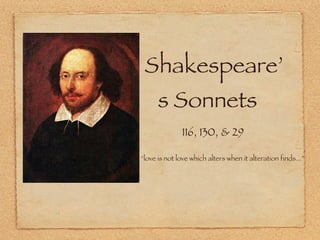
Shakespeare’s Sonnets 116, 130, & 29  “ love is not love which alters when it alteration finds...”
Shakespeare’s Poetry a collection of poems in sonnet form that deal with such themes as love, beauty, politics, and mortality.  they were probably written over a period of several years  all 154 poems appeared in a 1609 collection, entitled SHAKE-SPEARES SONNETS
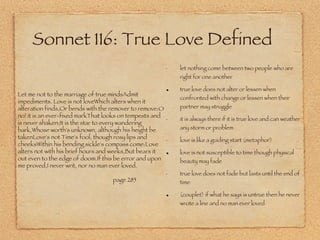
Sonnet 116: True Love Defined let nothing come between two people who are right for one another true love does not alter or lessen when confronted with change or lessen when their partner may struggle it is always there if it is true love and can weather any storm or problem love is like a guiding start (metaphor) love is not susceptible to time though physical beauty may fade true love does not fade but lasts until the end of time (couplet) if what he says is untrue then he never wrote a line and no man ever loved Let me not to the marriage of true mindsAdmit impediments. Love is not loveWhich alters when it alteration finds,Or bends with the remover to remove:O no! it is an ever-fixed markThat looks on tempests and is never shaken;It is the star to every wandering bark,Whose worth's unknown, although his height be takenLove's not Time's fool, though rosy lips and cheeksWithin his bending sickle's compass come:Love alters not with his brief hours and weeks,But bears it out even to the edge of doom.If this be error and upon me proved,I never writ, nor no man ever loved.  page 285
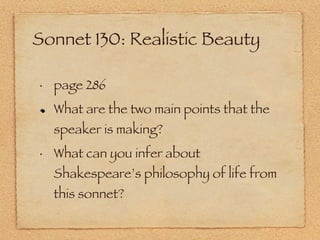
Sonnet 130: Realistic Beauty page 286 What are the two main points that the speaker is making? What can you infer about Shakespeare’s philosophy of life from this sonnet?
 
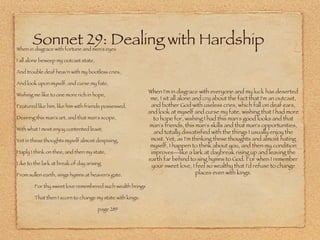
Sonnet 29: Dealing with Hardship When in disgrace with fortune and men's eyes I all alone beweep my outcast state, And trouble deaf heav'n with my bootless cries, And look upon myself, and curse my fate, Wishing me like to one more rich in hope, Featured like him, like him with friends possessed, Desiring this man's art, and that man's scope, With what I most enjoy contented least; Yet in these thoughts myself almost despising, Haply I think on thee, and then my state, Like to the lark at break of day arising From sullen earth, sings hymns at heaven's gate.   For thy sweet love remembered such wealth brings   That then I scorn to change my state with kings. page 289 When I'm in disgrace with everyone and my luck has deserted me, I sit all alone and cry about the fact that I'm an outcast, and bother God with useless cries, which fall on deaf ears, and look at myself and curse my fate, wishing that I had more to hope for, wishing I had this man's good looks and that man's friends, this man's skills and that man's opportunities, and totally dissatisfied with the things I usually enjoy the most. Yet, as I'm thinking these thoughts and almost hating myself, I happen to think about you, and then my condition improves—like a lark at daybreak rising up and leaving the earth far behind to sing hymns to God. For when I remember your sweet love, I feel so wealthy that I'd refuse to change places even with kings.

Shakespeares Sonnets

  • 1.
    Shakespeare’s Sonnets 116,130, & 29 “ love is not love which alters when it alteration finds...”
  • 2.
    Shakespeare’s Poetry acollection of poems in sonnet form that deal with such themes as love, beauty, politics, and mortality. they were probably written over a period of several years all 154 poems appeared in a 1609 collection, entitled SHAKE-SPEARES SONNETS
  • 3.
    Sonnet 116: TrueLove Defined let nothing come between two people who are right for one another true love does not alter or lessen when confronted with change or lessen when their partner may struggle it is always there if it is true love and can weather any storm or problem love is like a guiding start (metaphor) love is not susceptible to time though physical beauty may fade true love does not fade but lasts until the end of time (couplet) if what he says is untrue then he never wrote a line and no man ever loved Let me not to the marriage of true mindsAdmit impediments. Love is not loveWhich alters when it alteration finds,Or bends with the remover to remove:O no! it is an ever-fixed markThat looks on tempests and is never shaken;It is the star to every wandering bark,Whose worth's unknown, although his height be takenLove's not Time's fool, though rosy lips and cheeksWithin his bending sickle's compass come:Love alters not with his brief hours and weeks,But bears it out even to the edge of doom.If this be error and upon me proved,I never writ, nor no man ever loved. page 285
  • 4.
    Sonnet 130: RealisticBeauty page 286 What are the two main points that the speaker is making? What can you infer about Shakespeare’s philosophy of life from this sonnet?
  • 5.
  • 6.
    Sonnet 29: Dealingwith Hardship When in disgrace with fortune and men's eyes I all alone beweep my outcast state, And trouble deaf heav'n with my bootless cries, And look upon myself, and curse my fate, Wishing me like to one more rich in hope, Featured like him, like him with friends possessed, Desiring this man's art, and that man's scope, With what I most enjoy contented least; Yet in these thoughts myself almost despising, Haply I think on thee, and then my state, Like to the lark at break of day arising From sullen earth, sings hymns at heaven's gate. For thy sweet love remembered such wealth brings That then I scorn to change my state with kings. page 289 When I'm in disgrace with everyone and my luck has deserted me, I sit all alone and cry about the fact that I'm an outcast, and bother God with useless cries, which fall on deaf ears, and look at myself and curse my fate, wishing that I had more to hope for, wishing I had this man's good looks and that man's friends, this man's skills and that man's opportunities, and totally dissatisfied with the things I usually enjoy the most. Yet, as I'm thinking these thoughts and almost hating myself, I happen to think about you, and then my condition improves—like a lark at daybreak rising up and leaving the earth far behind to sing hymns to God. For when I remember your sweet love, I feel so wealthy that I'd refuse to change places even with kings.