Legal Citation
Labeling the Parts of a Basic Legal Citation


By the end of this
presentation, you will be
able to label the parts of
a basic legal citation.

Learning Objective
The two most common legal
sources that must be cited are
judicial opinions and statutes.

Common Legal Sources
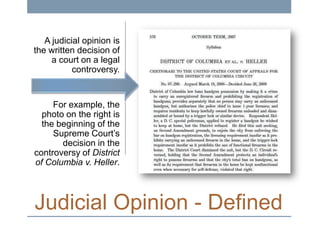
A judicial opinion is
the written decision of
a court on a legal
controversy.

For example, the
photo on the right is
the beginning of the
Supreme Court’s
decision in the
controversy of District
of Columbia v. Heller.

Judicial Opinion - Defined
5

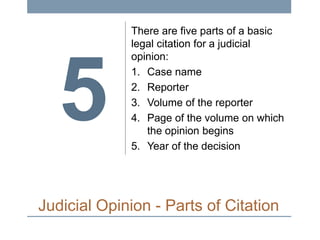
There are five parts of a basic
legal citation for a judicial
opinion:
1. Case name
2. Reporter
3. Volume of the reporter
4. Page of the volume on which
the opinion begins
5. Year of the decision

Judicial Opinion - Parts of Citation
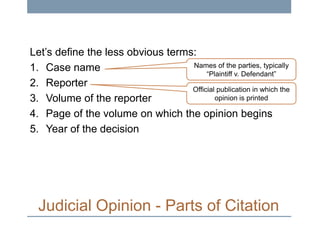
Let’s define the less obvious terms:
Names of the parties, typically
1. Case name
“Plaintiff v. Defendant”
2. Reporter
Official publication in which the
opinion is printed
3. Volume of the reporter
4. Page of the volume on which the opinion begins
5. Year of the decision

Judicial Opinion - Parts of Citation
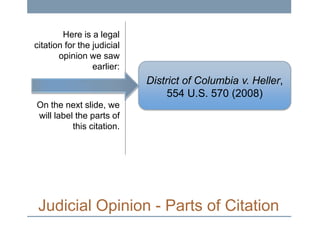
Here is a legal
citation for the judicial
opinion we saw
earlier:

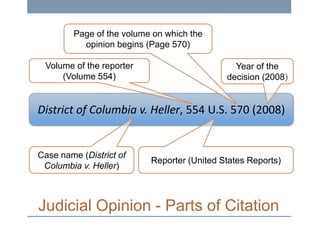
District of Columbia v. Heller,
554 U.S. 570 (2008)
On the next slide, we
will label the parts of
this citation.

Judicial Opinion - Parts of Citation
Page of the volume on which the
opinion begins (Page 570)
Volume of the reporter
(Volume 554)

Year of the
decision (2008)

District of Columbia v. Heller, 554 U.S. 570 (2008)

Case name (District of
Columbia v. Heller)

Reporter (United States Reports)

Judicial Opinion - Parts of Citation
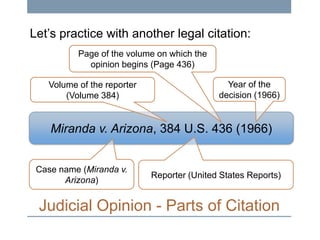
Let’s practice with another legal citation:
Page of the volume on which the
opinion begins (Page 436)
Volume of the reporter
(Volume 384)

Year of the
decision (1966)

Miranda v. Arizona, 384 U.S. 436 (1966)
Case name (Miranda v.
Arizona)

Reporter (United States Reports)

Judicial Opinion - Parts of Citation
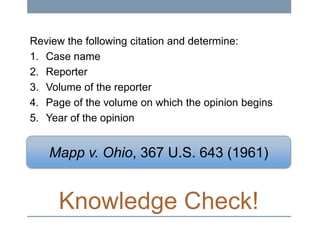
Review the following citation and determine:
1. Case name
2. Reporter
3. Volume of the reporter
4. Page of the volume on which the opinion begins
5. Year of the opinion

Mapp v. Ohio, 367 U.S. 643 (1961)

Knowledge Check!
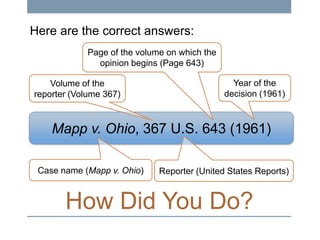
Here are the correct answers:
Page of the volume on which the
opinion begins (Page 643)
Volume of the
reporter (Volume 367)

Year of the
decision (1961)

Mapp v. Ohio, 367 U.S. 643 (1961)
Case name (Mapp v. Ohio)

Reporter (United States Reports)

How Did You Do?
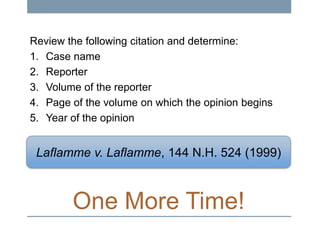
Review the following citation and determine:
1. Case name
2. Reporter
3. Volume of the reporter
4. Page of the volume on which the opinion begins
5. Year of the opinion

Laflamme v. Laflamme, 144 N.H. 524 (1999)

One More Time!
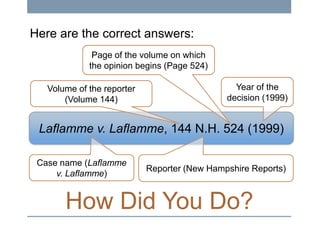
Here are the correct answers:
Page of the volume on which
the opinion begins (Page 524)
Volume of the reporter
(Volume 144)

Year of the
decision (1999)

Laflamme v. Laflamme, 144 N.H. 524 (1999)
Case name (Laflamme
v. Laflamme)

Reporter (New Hampshire Reports)

How Did You Do?
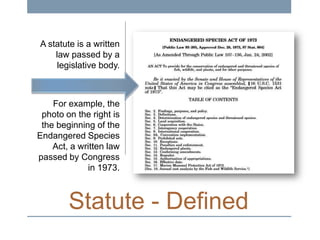
A statute is a written
law passed by a
legislative body.

For example, the
photo on the right is
the beginning of the
Endangered Species
Act, a written law
passed by Congress
in 1973.

Statute - Defined
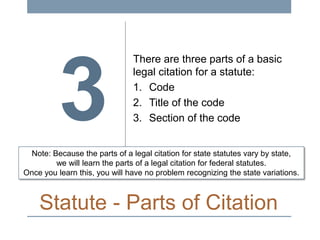
3

There are three parts of a basic
legal citation for a statute:
1. Code
2. Title of the code
3. Section of the code

Note: Because the parts of a legal citation for state statutes vary by state,
we will learn the parts of a legal citation for federal statutes.
Once you learn this, you will have no problem recognizing the state variations.

Statute - Parts of Citation
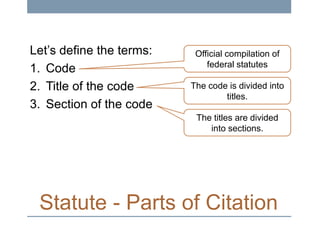
Let’s define the terms:
1. Code
2. Title of the code
3. Section of the code

Official compilation of
federal statutes
The code is divided into
titles.
The titles are divided
into sections.

Statute - Parts of Citation
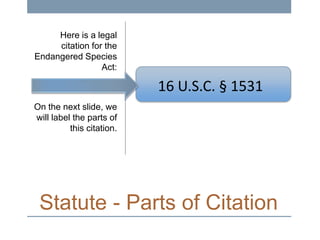
Here is a legal
citation for the
Endangered Species
Act:

16 U.S.C. § 1531
On the next slide, we
will label the parts of
this citation.

Statute - Parts of Citation
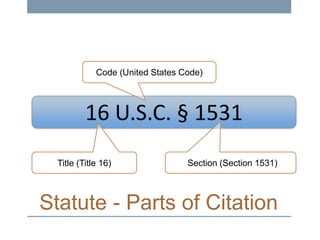
Code (United States Code)

16 U.S.C. § 1531
Title (Title 16)

Section (Section 1531)

Statute - Parts of Citation
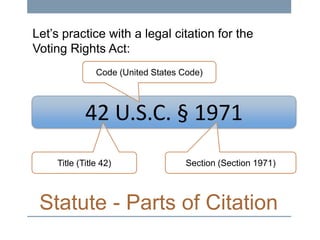
Let’s practice with a legal citation for the
Voting Rights Act:
Code (United States Code)

42 U.S.C. § 1971
Title (Title 42)

Section (Section 1971)

Statute - Parts of Citation
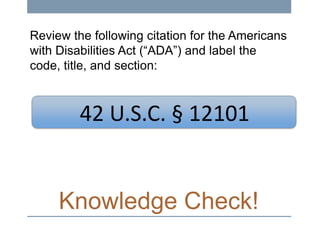
Review the following citation for the Americans
with Disabilities Act (“ADA”) and label the
code, title, and section:

42 U.S.C. § 12101

Knowledge Check!
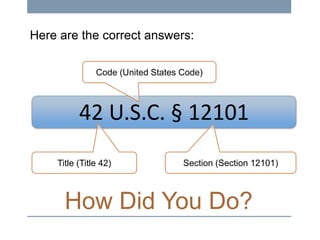
Here are the correct answers:
Code (United States Code)

42 U.S.C. § 12101
Title (Title 42)

Section (Section 12101)

How Did You Do?


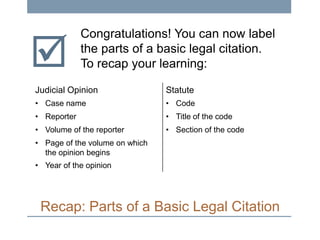
Congratulations! You can now label
the parts of a basic legal citation.
To recap your learning:

Judicial Opinion

Statute

• Case name

• Code

• Reporter

• Title of the code

• Volume of the reporter

• Section of the code

• Page of the volume on which
the opinion begins
• Year of the opinion

Recap: Parts of a Basic Legal Citation

Basic Legal Citation

  • 1.
    Legal Citation Labeling theParts of a Basic Legal Citation
  • 2.
     By the endof this presentation, you will be able to label the parts of a basic legal citation. Learning Objective
  • 3.
    The two mostcommon legal sources that must be cited are judicial opinions and statutes. Common Legal Sources
  • 4.
    A judicial opinionis the written decision of a court on a legal controversy. For example, the photo on the right is the beginning of the Supreme Court’s decision in the controversy of District of Columbia v. Heller. Judicial Opinion - Defined
  • 5.
    5 There are fiveparts of a basic legal citation for a judicial opinion: 1. Case name 2. Reporter 3. Volume of the reporter 4. Page of the volume on which the opinion begins 5. Year of the decision Judicial Opinion - Parts of Citation
  • 6.
    Let’s define theless obvious terms: Names of the parties, typically 1. Case name “Plaintiff v. Defendant” 2. Reporter Official publication in which the opinion is printed 3. Volume of the reporter 4. Page of the volume on which the opinion begins 5. Year of the decision Judicial Opinion - Parts of Citation
  • 7.
    Here is alegal citation for the judicial opinion we saw earlier: District of Columbia v. Heller, 554 U.S. 570 (2008) On the next slide, we will label the parts of this citation. Judicial Opinion - Parts of Citation
  • 8.
    Page of thevolume on which the opinion begins (Page 570) Volume of the reporter (Volume 554) Year of the decision (2008) District of Columbia v. Heller, 554 U.S. 570 (2008) Case name (District of Columbia v. Heller) Reporter (United States Reports) Judicial Opinion - Parts of Citation
  • 9.
    Let’s practice withanother legal citation: Page of the volume on which the opinion begins (Page 436) Volume of the reporter (Volume 384) Year of the decision (1966) Miranda v. Arizona, 384 U.S. 436 (1966) Case name (Miranda v. Arizona) Reporter (United States Reports) Judicial Opinion - Parts of Citation
  • 10.
    Review the followingcitation and determine: 1. Case name 2. Reporter 3. Volume of the reporter 4. Page of the volume on which the opinion begins 5. Year of the opinion Mapp v. Ohio, 367 U.S. 643 (1961) Knowledge Check!
  • 11.
    Here are thecorrect answers: Page of the volume on which the opinion begins (Page 643) Volume of the reporter (Volume 367) Year of the decision (1961) Mapp v. Ohio, 367 U.S. 643 (1961) Case name (Mapp v. Ohio) Reporter (United States Reports) How Did You Do?
  • 12.
    Review the followingcitation and determine: 1. Case name 2. Reporter 3. Volume of the reporter 4. Page of the volume on which the opinion begins 5. Year of the opinion Laflamme v. Laflamme, 144 N.H. 524 (1999) One More Time!
  • 13.
    Here are thecorrect answers: Page of the volume on which the opinion begins (Page 524) Volume of the reporter (Volume 144) Year of the decision (1999) Laflamme v. Laflamme, 144 N.H. 524 (1999) Case name (Laflamme v. Laflamme) Reporter (New Hampshire Reports) How Did You Do?
  • 14.
    A statute isa written law passed by a legislative body. For example, the photo on the right is the beginning of the Endangered Species Act, a written law passed by Congress in 1973. Statute - Defined
  • 15.
    3 There are threeparts of a basic legal citation for a statute: 1. Code 2. Title of the code 3. Section of the code Note: Because the parts of a legal citation for state statutes vary by state, we will learn the parts of a legal citation for federal statutes. Once you learn this, you will have no problem recognizing the state variations. Statute - Parts of Citation
  • 16.
    Let’s define theterms: 1. Code 2. Title of the code 3. Section of the code Official compilation of federal statutes The code is divided into titles. The titles are divided into sections. Statute - Parts of Citation
  • 17.
    Here is alegal citation for the Endangered Species Act: 16 U.S.C. § 1531 On the next slide, we will label the parts of this citation. Statute - Parts of Citation
  • 18.
    Code (United StatesCode) 16 U.S.C. § 1531 Title (Title 16) Section (Section 1531) Statute - Parts of Citation
  • 19.
    Let’s practice witha legal citation for the Voting Rights Act: Code (United States Code) 42 U.S.C. § 1971 Title (Title 42) Section (Section 1971) Statute - Parts of Citation
  • 20.
    Review the followingcitation for the Americans with Disabilities Act (“ADA”) and label the code, title, and section: 42 U.S.C. § 12101 Knowledge Check!
  • 21.
    Here are thecorrect answers: Code (United States Code) 42 U.S.C. § 12101 Title (Title 42) Section (Section 12101) How Did You Do?
  • 22.
     Congratulations! You cannow label the parts of a basic legal citation. To recap your learning: Judicial Opinion Statute • Case name • Code • Reporter • Title of the code • Volume of the reporter • Section of the code • Page of the volume on which the opinion begins • Year of the opinion Recap: Parts of a Basic Legal Citation