Privy council
in india..
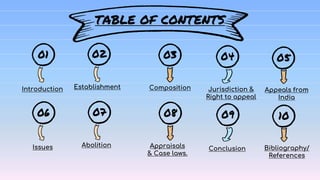
TABLE OF CONTENTS
02 03 04 05
Establishment Composition Jurisdiction &
Right to appeal
01
Introduction Appeals from
India
07 08 09 10
Abolition Appraisals
& Case laws.
Conclusion
06
Issues Bibliography/
References
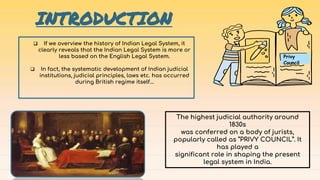
 If we overview the history of Indian Legal System, it
clearly reveals that the Indian Legal System is more or
less based on the English Legal System.
 In fact, the systematic development of Indian judicial
institutions, judicial principles, laws etc. has occurred
during British regime itself...
Privy
Council
INTRODUCTION
The highest judicial authority around
1830s
was conferred on a body of jurists,
popularly called as “PRIVY COUNCIL”. It
has played a
significant role in shaping the present
legal system in India.
This Journey of PRIVY COUNCIL with respect to India is
covered in this project.
Brief Outline of topic -
This Research Project analyses an episode in the
process of development of Indian Legal
System under the Colonial rule of Britishers.
Subsequent Charters & Acts are discussed for providing
readers with better knowledge on
the topic. The roles & drawbacks are elaborated
concisely.
Supreme Federal
Council of Normans
was known as
‘Curia’, acted as the
agency of Normans
to rule England.
Curia gets divided
into ‘Curia Regis’
and ‘Magnum
Concillium’.
Curia Regis came to be
considered as the
advisory body of the
King performing most of
the vital functions in the
field of judicial
administration. Finally,
during the regime of
Henry II
1) King-in-
Parliament i.e.
Court of King’s
Bench
2) King-in-
Counsel i.e.
Court of
Common Pleas
Historical
Backgrounds…
The Curia
Regis
Three Fold
Divisions
Judicial
system
 As far as India is considered, the Privy
Council acted merely as an appellate
body since
the establishment of Mayor’s court in India.
 Later, in the 18th century, with the growth
of
the British Empire the work of the
Committee of the Privy Council greatly
enhanced. But
the councilors, who presided over it, were
mostly laymen and attended office for the
period of 9 days a year. Lord Brougham
severely criticized this practice.
Establishment
Lord Brougham’s strong protest
against laymen hearing appeals
led to praising of the
JUDICIAL COMMITTEE ACT, 1833
by the British Parliament. This
legislation of
1833 established a statutory
permanent committee of legal
experts to hear appeals from
the British colonies and dispose
of their matter as referred to
them by His Majesty as per
the provisions of the Act
This statutory committee was
known as “The Judicial
Committee of the Privy Council”.
The first sitting of the newly
formed Judicial Committee of
the Privy Council took place
on 27th November; 1833. It was
also the “Last Court of Appeal
under the Throne”.
Composition of PRIV Y COUNCIL.
● The Judicial Committee of the Privy Council whose constitution has been
altered by the Acts of 1844, 1908, 1929 and other acts is now composed of
the :
1)Lord Chancellor
2) Existing and former lords
3)Presidents of the Council
4) Privy Councilors
5) The Lords of appeal .
6) Judges/ Former Judges of superior courts of Dominions as the crown may
appoint.
● Ordinarily, the quorum of the judicial committee is of three members but
in important cases generally five members preside over the committee
meeting to hear appeals.
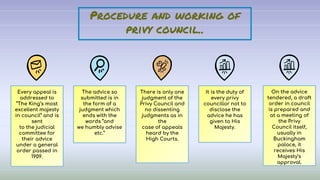
Every appeal is
addressed to
“The King’s most
excellent majesty
in council” and is
sent
to the judicial
committee for
their advice
under a general
order passed in
1909.
The advice so
submitted is in
the form of a
judgment which
ends with the
words “and
we humbly advise
etc.”
There is only one
judgment of the
Privy Council and
no dissenting
judgments as in
the
case of appeals
heard by the
High Courts.
It is the duty of
every privy
councillor not to
disclose the
advice he has
given to His
Majesty.
Procedure and working of
privy council..
On the advice
tendered, a draft
order in council
is prepared and
at a meeting of
the Privy
Council itself,
usually in
Buckingham
palace, it
receives His
Majesty’s
approval.
Privy Council determine not only upon the
questions of colonial law in plantation cases
but also sit as judges in the last resort of all
prize cases. This entire immense jurisdiction
over the rights of property and person, over
rights political and legal and over all
questions growing out of so vast an area is
exercised by Privy Council unaided and alone
The practice of invoking the exercise of the
Royal prerogative by way of appeal from any
court in His Majesty’s Dominions has long
obtained throughout the British Empire. In its
origin such an application may have been no
more than a petitionary appeal to the
sovereign, as the fountain of justice for
protection against the unjust administration
of
law.
JURISDICTION RIGHT TO APPEAL
JURISDICTION & RIGHT TO APPEAL
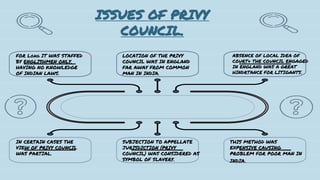
ISSUES OF PRIVY
COUNCIL.
FOR Long IT WAS STAFFED
BY ENGLISHMEN ONLY,
HAVING NO KNOWLEDGE
OF INDIAN LAWS.
LOCATION OF THE PRIVY
COUNCIL WAS IN ENGLAND
FAR AWAY FROM COMMON
MAN IN INDIA.
ABSENCE OF LOCAL IDEA OF
COURT& THE COUNCIL ENGAGED
IN ENGLAND WAS A GREAT
HINDRTANCE FOR LITIGANTS.
IN CERTAIN CASES THE
VIEW OF PRIVY COUNCIL
WAS PARTIAL.
SUBJECTION TO APPELLATE
JURISDICTION (PRIVY
COUNCIL) WAS CONSIDERED AS
SYMBOL OF SLAVERY.
THIS METHOD WAS
EXPENSIVE CAUSING
PROBLEM FOR POOR MAN IN
INDIA.
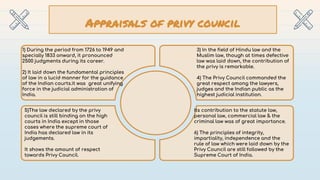
Appraisals of privy council
1) During the period from 1726 to 1949 and
specially 1833 onward, it pronounced
2500 judgments during its career.
2) It laid down the fundamental principles
of law in a lucid manner for the guidance
of the Indian courts.it was great unifying
force in the judicial administration of
India.
3) In the field of Hindu law and the
Muslim law, though at times defective
law was laid down, the contribution of
the privy is remarkable.
4) The Privy Council commanded the
great respect among the lawyers,
judges and the Indian public as the
highest judicial institution.
5)The law declared by the privy
council is still binding on the high
courts in India except in those
cases where the supreme court of
India has declared law in its
judgements.
It shows the amount of respect
towards Privy Council.
Its contribution to the statute law,
personal law, commercial law & the
criminal law was of great importance.
6) The principles of integrity,
impartiality, independence and the
rule of law which were laid down by the
Privy Council are still followed by the
Supreme Court of India.
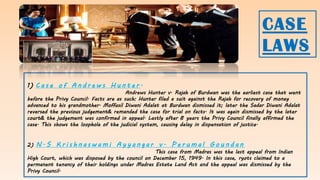
1) C a s e o f A n d r e w s H u n t e r .
Andrews Hunter v. Rajah of Burdwan was the earliest case that went
before the Privy Council. Facts are as such: Hunter filed a suit against the Rajah for recovery of money
advanced to his grandmother. Moffusil Diwani Adalat at Burdwan dismissed it; later the Sadar Diwani Adalat
reversed the previous judgement& remanded the case for trial on facts. It was again dismissed by the later
court& the judgement was confirmed in appeal. Lastly after 8 years the Privy Council finally affirmed the
case. This shows the loophole of the judicial system, causing delay in dispensation of justice.
2) N . S K r i s h n a s w a m i A y y a n g a r v . P e r u m a l G o u n d a n
This case from Madras was the last appeal from Indian
High Court, which was disposed by the council on December 15, 1949. In this case, ryots claimed to a
permanent tenancy of their holdings under Madras Estate Land Act and the appeal was dismissed by the
Privy Council.
CASE
LAWS
Abolition of Privy Council jurisdiction in respect of Indian cases.
In 1933, a white paper was issued by the British Government for
establishment of the Supreme Court in India so as to here appeal
from Indian high Courts. It was the first step.
Federal Court (Enlargement of Jurisdiction) Act, 1948
It abolished the old system of filing direct appeals from the High
Court to the Privy Council with or without Special leave.
Abolition of the Privy Council Jurisdiction Act, 1949
This Act accordingly abolished the jurisdiction of Privy Council to
entertain new appeals and petitions as well as to dispose of any
pending appeals & petitions. It provided for transfer of all cases
filed before Council to the Federal Court in India.
CREDITS: This presentation template was created by
Slidesgo, including icons by Flaticon, and infographics
& images by Freepik.
CONCLUSION
 From the above discussion, it reveals that
the Privy Council has rendered a meritorious
contribution in the development of Indian
legal system and judicial institutions
 It introduced many fundamental legal
principles in Indian legal system. It shaped
the judicial institutions in India. As a whole its
role is very significant in developing the legal
system in India as it exists presently.

Privy council

  • 1.
  • 2.
    TABLE OF CONTENTS 0203 04 05 Establishment Composition Jurisdiction & Right to appeal 01 Introduction Appeals from India 07 08 09 10 Abolition Appraisals & Case laws. Conclusion 06 Issues Bibliography/ References
  • 3.
     If weoverview the history of Indian Legal System, it clearly reveals that the Indian Legal System is more or less based on the English Legal System.  In fact, the systematic development of Indian judicial institutions, judicial principles, laws etc. has occurred during British regime itself... Privy Council INTRODUCTION The highest judicial authority around 1830s was conferred on a body of jurists, popularly called as “PRIVY COUNCIL”. It has played a significant role in shaping the present legal system in India.
  • 4.
    This Journey ofPRIVY COUNCIL with respect to India is covered in this project. Brief Outline of topic - This Research Project analyses an episode in the process of development of Indian Legal System under the Colonial rule of Britishers. Subsequent Charters & Acts are discussed for providing readers with better knowledge on the topic. The roles & drawbacks are elaborated concisely.
  • 5.
    Supreme Federal Council ofNormans was known as ‘Curia’, acted as the agency of Normans to rule England. Curia gets divided into ‘Curia Regis’ and ‘Magnum Concillium’. Curia Regis came to be considered as the advisory body of the King performing most of the vital functions in the field of judicial administration. Finally, during the regime of Henry II 1) King-in- Parliament i.e. Court of King’s Bench 2) King-in- Counsel i.e. Court of Common Pleas Historical Backgrounds… The Curia Regis Three Fold Divisions Judicial system
  • 6.
     As faras India is considered, the Privy Council acted merely as an appellate body since the establishment of Mayor’s court in India.  Later, in the 18th century, with the growth of the British Empire the work of the Committee of the Privy Council greatly enhanced. But the councilors, who presided over it, were mostly laymen and attended office for the period of 9 days a year. Lord Brougham severely criticized this practice. Establishment
  • 7.
    Lord Brougham’s strongprotest against laymen hearing appeals led to praising of the JUDICIAL COMMITTEE ACT, 1833 by the British Parliament. This legislation of 1833 established a statutory permanent committee of legal experts to hear appeals from the British colonies and dispose of their matter as referred to them by His Majesty as per the provisions of the Act
  • 8.
    This statutory committeewas known as “The Judicial Committee of the Privy Council”. The first sitting of the newly formed Judicial Committee of the Privy Council took place on 27th November; 1833. It was also the “Last Court of Appeal under the Throne”.
  • 9.
    Composition of PRIVY COUNCIL. ● The Judicial Committee of the Privy Council whose constitution has been altered by the Acts of 1844, 1908, 1929 and other acts is now composed of the : 1)Lord Chancellor 2) Existing and former lords 3)Presidents of the Council 4) Privy Councilors 5) The Lords of appeal . 6) Judges/ Former Judges of superior courts of Dominions as the crown may appoint. ● Ordinarily, the quorum of the judicial committee is of three members but in important cases generally five members preside over the committee meeting to hear appeals.
  • 10.
    Every appeal is addressedto “The King’s most excellent majesty in council” and is sent to the judicial committee for their advice under a general order passed in 1909. The advice so submitted is in the form of a judgment which ends with the words “and we humbly advise etc.” There is only one judgment of the Privy Council and no dissenting judgments as in the case of appeals heard by the High Courts. It is the duty of every privy councillor not to disclose the advice he has given to His Majesty. Procedure and working of privy council.. On the advice tendered, a draft order in council is prepared and at a meeting of the Privy Council itself, usually in Buckingham palace, it receives His Majesty’s approval.
  • 11.
    Privy Council determinenot only upon the questions of colonial law in plantation cases but also sit as judges in the last resort of all prize cases. This entire immense jurisdiction over the rights of property and person, over rights political and legal and over all questions growing out of so vast an area is exercised by Privy Council unaided and alone The practice of invoking the exercise of the Royal prerogative by way of appeal from any court in His Majesty’s Dominions has long obtained throughout the British Empire. In its origin such an application may have been no more than a petitionary appeal to the sovereign, as the fountain of justice for protection against the unjust administration of law. JURISDICTION RIGHT TO APPEAL JURISDICTION & RIGHT TO APPEAL
  • 12.
    ISSUES OF PRIVY COUNCIL. FORLong IT WAS STAFFED BY ENGLISHMEN ONLY, HAVING NO KNOWLEDGE OF INDIAN LAWS. LOCATION OF THE PRIVY COUNCIL WAS IN ENGLAND FAR AWAY FROM COMMON MAN IN INDIA. ABSENCE OF LOCAL IDEA OF COURT& THE COUNCIL ENGAGED IN ENGLAND WAS A GREAT HINDRTANCE FOR LITIGANTS. IN CERTAIN CASES THE VIEW OF PRIVY COUNCIL WAS PARTIAL. SUBJECTION TO APPELLATE JURISDICTION (PRIVY COUNCIL) WAS CONSIDERED AS SYMBOL OF SLAVERY. THIS METHOD WAS EXPENSIVE CAUSING PROBLEM FOR POOR MAN IN INDIA.
  • 13.
    Appraisals of privycouncil 1) During the period from 1726 to 1949 and specially 1833 onward, it pronounced 2500 judgments during its career. 2) It laid down the fundamental principles of law in a lucid manner for the guidance of the Indian courts.it was great unifying force in the judicial administration of India. 3) In the field of Hindu law and the Muslim law, though at times defective law was laid down, the contribution of the privy is remarkable. 4) The Privy Council commanded the great respect among the lawyers, judges and the Indian public as the highest judicial institution. 5)The law declared by the privy council is still binding on the high courts in India except in those cases where the supreme court of India has declared law in its judgements. It shows the amount of respect towards Privy Council. Its contribution to the statute law, personal law, commercial law & the criminal law was of great importance. 6) The principles of integrity, impartiality, independence and the rule of law which were laid down by the Privy Council are still followed by the Supreme Court of India.
  • 14.
    1) C as e o f A n d r e w s H u n t e r . Andrews Hunter v. Rajah of Burdwan was the earliest case that went before the Privy Council. Facts are as such: Hunter filed a suit against the Rajah for recovery of money advanced to his grandmother. Moffusil Diwani Adalat at Burdwan dismissed it; later the Sadar Diwani Adalat reversed the previous judgement& remanded the case for trial on facts. It was again dismissed by the later court& the judgement was confirmed in appeal. Lastly after 8 years the Privy Council finally affirmed the case. This shows the loophole of the judicial system, causing delay in dispensation of justice. 2) N . S K r i s h n a s w a m i A y y a n g a r v . P e r u m a l G o u n d a n This case from Madras was the last appeal from Indian High Court, which was disposed by the council on December 15, 1949. In this case, ryots claimed to a permanent tenancy of their holdings under Madras Estate Land Act and the appeal was dismissed by the Privy Council. CASE LAWS
  • 15.
    Abolition of PrivyCouncil jurisdiction in respect of Indian cases. In 1933, a white paper was issued by the British Government for establishment of the Supreme Court in India so as to here appeal from Indian high Courts. It was the first step. Federal Court (Enlargement of Jurisdiction) Act, 1948 It abolished the old system of filing direct appeals from the High Court to the Privy Council with or without Special leave. Abolition of the Privy Council Jurisdiction Act, 1949 This Act accordingly abolished the jurisdiction of Privy Council to entertain new appeals and petitions as well as to dispose of any pending appeals & petitions. It provided for transfer of all cases filed before Council to the Federal Court in India.
  • 16.
    CREDITS: This presentationtemplate was created by Slidesgo, including icons by Flaticon, and infographics & images by Freepik. CONCLUSION  From the above discussion, it reveals that the Privy Council has rendered a meritorious contribution in the development of Indian legal system and judicial institutions  It introduced many fundamental legal principles in Indian legal system. It shaped the judicial institutions in India. As a whole its role is very significant in developing the legal system in India as it exists presently.