




By : Celia Ferrag and Nadia Sarsam
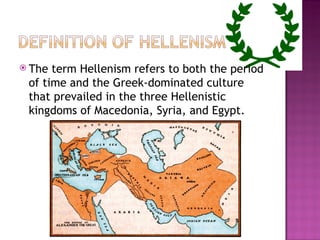
The term Hellenism refers to both the period of time and the Greek-dominated culture that prevailed in the three Hellenistic kingdoms of Macedonia, Syria, and Egypt.
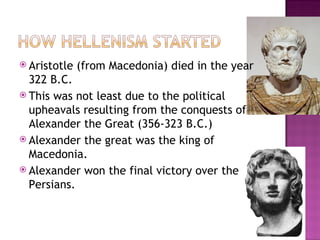
Aristotle (from Macedonia) died in the year 322 B.C.  This was not least due to the political upheavals resulting from the conquests of Alexander the Great (356-323 B.C.)  Alexander the great was the king of Macedonia.  Alexander won the final victory over the Persians.
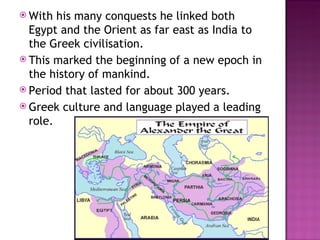
With his many conquests he linked both Egypt and the Orient as far east as India to the Greek civilisation.  This marked the beginning of a new epoch in the history of mankind. Period that lasted for about 300 years. Greek culture and language played a leading role.
From about the year 50 B.C., Rome secured the upper hand in military and political affairs. It slowly conquered all the Hellenistic kingdoms. From then, the Roman culture and the Latin language were predominant from Spain to Asia. This was the beginning of the Roman period (which we often refer to as late antiquity). Late antiquity was generally characterized by religious doubts, cultural dissolution, and pessimism. It was said that “the world has grown old”.
http://www.youtube.com/watch?v=6PR6C4UeYU8
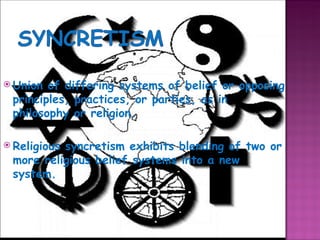
Union of differing systems of belief or opposing principles, practices, or parties, as in philosophy or religion. Religious syncretism exhibits blending of two or more religious belief systems into a new system.
 
Believers sometimes see syncretism as betrayal of their pure truth.  Adding an unsuited belief corrupts the original religion, making it no longer true and distort the original faith. People sometimes use the word "syncretism" as a disapproving description. Common feature between the new religions created during Hellenism period : frequently contained the teachings about how mankind could attain salvation from death.
Philosophy Moving in the direction of salvation and serenity.  Philosophical insight should also free mankind from pessimism and the fear of death.  New philosophic trends of Hellenism :  Cynicism, Stoicism, Epicureanism, Neoplatonism
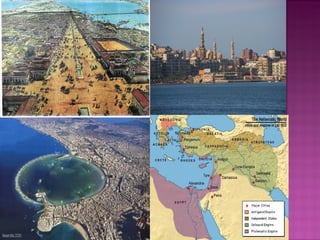
Influenced by a combined knowledge from past various cultures.  Alexandria played a key role as a meeting place between East and West.  became the center of science.  extensive library, it became the center of mathematics, astronomy, biology, and medicine.
 
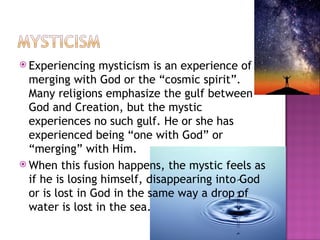
Experiencing mysticism is an experience of merging with God or the “cosmic spirit”. Many religions emphasize the gulf between God and Creation, but the mystic experiences no such gulf. He or she has experienced being “one with God” or “merging” with Him. When this fusion happens, the mystic feels as if he is losing himself, disappearing into God or is lost in God in the same way a drop of water is lost in the sea.
Mystical trends are found in all the great world religions. And these mystical experiences show a remarkable similarity across all cultural boundaries.  It is in the mystic’s attempt to provide a religious or philosophic interpretation of that experience that his cultural background reveals itself.
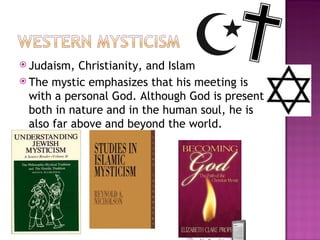
Judaism, Christianity, and Islam The mystic emphasizes that his meeting is with a personal God. Although God is present both in nature and in the human soul, he is also far above and beyond the world.
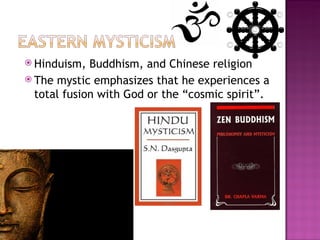
Hinduism, Buddhism, and Chinese religion The mystic emphasizes that he experiences a total fusion with God or the “cosmic spirit”.
Yours Truly, Enanos :D

Hellenism

  • 1.
    By : CeliaFerrag and Nadia Sarsam
  • 2.
    The term Hellenismrefers to both the period of time and the Greek-dominated culture that prevailed in the three Hellenistic kingdoms of Macedonia, Syria, and Egypt.
  • 3.
    Aristotle (from Macedonia)died in the year 322 B.C. This was not least due to the political upheavals resulting from the conquests of Alexander the Great (356-323 B.C.) Alexander the great was the king of Macedonia. Alexander won the final victory over the Persians.
  • 4.
    With his manyconquests he linked both Egypt and the Orient as far east as India to the Greek civilisation. This marked the beginning of a new epoch in the history of mankind. Period that lasted for about 300 years. Greek culture and language played a leading role.
  • 5.
    From about theyear 50 B.C., Rome secured the upper hand in military and political affairs. It slowly conquered all the Hellenistic kingdoms. From then, the Roman culture and the Latin language were predominant from Spain to Asia. This was the beginning of the Roman period (which we often refer to as late antiquity). Late antiquity was generally characterized by religious doubts, cultural dissolution, and pessimism. It was said that “the world has grown old”.
  • 6.
  • 7.
    Union of differingsystems of belief or opposing principles, practices, or parties, as in philosophy or religion. Religious syncretism exhibits blending of two or more religious belief systems into a new system.
  • 8.
  • 9.
    Believers sometimes seesyncretism as betrayal of their pure truth. Adding an unsuited belief corrupts the original religion, making it no longer true and distort the original faith. People sometimes use the word "syncretism" as a disapproving description. Common feature between the new religions created during Hellenism period : frequently contained the teachings about how mankind could attain salvation from death.
  • 10.
    Philosophy Moving inthe direction of salvation and serenity. Philosophical insight should also free mankind from pessimism and the fear of death. New philosophic trends of Hellenism : Cynicism, Stoicism, Epicureanism, Neoplatonism
  • 11.
    Influenced by acombined knowledge from past various cultures. Alexandria played a key role as a meeting place between East and West. became the center of science. extensive library, it became the center of mathematics, astronomy, biology, and medicine.
  • 12.
  • 13.
    Experiencing mysticism isan experience of merging with God or the “cosmic spirit”. Many religions emphasize the gulf between God and Creation, but the mystic experiences no such gulf. He or she has experienced being “one with God” or “merging” with Him. When this fusion happens, the mystic feels as if he is losing himself, disappearing into God or is lost in God in the same way a drop of water is lost in the sea.
  • 14.
    Mystical trends arefound in all the great world religions. And these mystical experiences show a remarkable similarity across all cultural boundaries. It is in the mystic’s attempt to provide a religious or philosophic interpretation of that experience that his cultural background reveals itself.
  • 15.
    Judaism, Christianity, andIslam The mystic emphasizes that his meeting is with a personal God. Although God is present both in nature and in the human soul, he is also far above and beyond the world.
  • 16.
    Hinduism, Buddhism, andChinese religion The mystic emphasizes that he experiences a total fusion with God or the “cosmic spirit”.
  • 17.