G-GSN- Gateway GPRS Support Node
Mustafa Golam
PART - 01
Table of Contents
Architecture
To Be Updated
AoB
GGSN– Gateway GPRS Support Node
Functionalities at a glance:
•Acts as an interface and a router to external networks
•It contains routing information for GPRS mobiles...
•Tunnel packets through the IP based internal backbone
•Collects charging data
•Packet filter for incoming traffic
•Packet inspection
•Gateway with online charging system
•Gateway with policy control server
Session Management
•PDP context activation
•PDP context modification
•Network Inititiated PDP
context deactivation
GGSN/EPG Hardware Overview [EPG-M]
M20
M120
M320
Three different platforms with Juniper HW for EPG-M
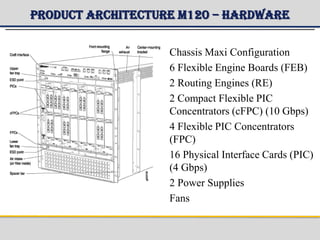
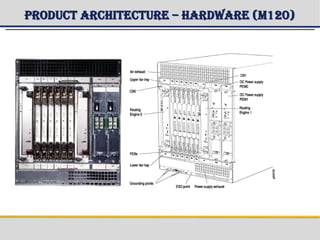
Product Architecture M120 – Hardware
Chassis Maxi Configuration
6 Flexible Engine Boards (FEB)
2 Routing Engines (RE)
2 Compact Flexible PIC
Concentrators (cFPC) (10 Gbps)
4 Flexible PIC Concentrators
(FPC)
16 Physical Interface Cards (PIC)
(4 Gbps)
2 Power Supplies
Fans
Product Architecture – Hardware (M120)
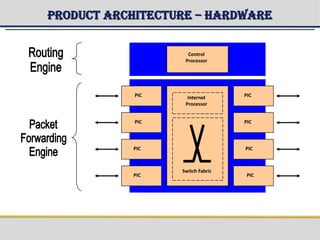
Product Architecture – Hardware
PIC
PIC
PIC
PIC
PIC
PIC
PIC
PIC
Switch Fabric
Internet
Processor
Control
Processor
Physical Interface Cards - PICs
GGSN Specific Service PICs
Provide GGSN control, user plane + inspection and tunneling services
(GGSN-C, GGSN–U and GGSN-T)
Purpose built hardware provides unparalleled performance
Network Interface PICs
Ethernet, ATM, Sonet/SDH, etc.
Juniper Platform Services PICs
Encryption, tunneling, NAT/NAPT, Statefull Firewall services etc.
GGSN-C Session & Node Controller
GGSN-C Node Controller
Handles communication towards the RE (route updates, management
information, statistics, etc)
Hosts the GGSN IP address on the Gn network
Validates and handles all primary PDP context requests
Load distributes traffic to GGSN-C and GGSN-U
Supervises the GGSN-C session controllers and the GGSN-U PICs and takes
action if there is a failure
GGSN-C Session Controller
Processes all PDP context control messages (create, update, delete)
Acts as proxy if RADIUS, DHCP are used
Creates charging ID, opens a CDR, handles charging data collection
Phoenix (new PIC) & Mint (old PIC) based C-PIC in M20
Stargate (M120 PIC) in GGSN based on M120/M320
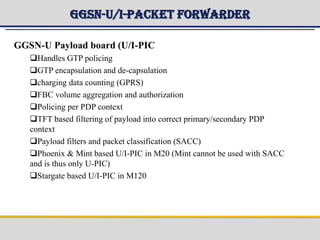
GGSN-U/I-Packet Forwarder
GGSN-U Payload board (U/I-PIC
Handles GTP policing
GTP encapsulation and de-capsulation
charging data counting (GPRS)
FBC volume aggregation and authorization
Policing per PDP context
TFT based filtering of payload into correct primary/secondary PDP
context
Payload filters and packet classification (SACC)
Phoenix & Mint based U/I-PIC in M20 (Mint cannot be used with SACC
and is thus only U-PIC)
Stargate based U/I-PIC in M120
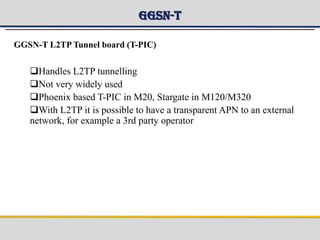
GGSN-T
GGSN-T L2TP Tunnel board (T-PIC)
Handles L2TP tunnelling
Not very widely used
Phoenix based T-PIC in M20, Stargate in M120/M320
With L2TP it is possible to have a transparent APN to an external
network, for example a 3rd party operator
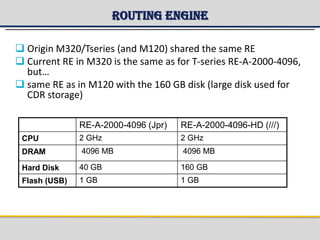
Routing Engine
RE-A-2000-4096 (Jpr) RE-A-2000-4096-HD (///)
CPU 2 GHz 2 GHz
DRAM 4096 MB 4096 MB
Hard Disk 40 GB 160 GB
Flash (USB) 1 GB 1 GB
 Origin M320/Tseries (and M120) shared the same RE
 Current RE in M320 is the same as for T-series RE-A-2000-4096,
but…
 same RE as in M120 with the 160 GB disk (large disk used for
CDR storage)
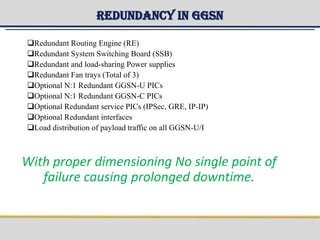
Redundancy in GGSN
Redundant Routing Engine (RE)
Redundant System Switching Board (SSB)
Redundant and load-sharing Power supplies
Redundant Fan trays (Total of 3)
Optional N:1 Redundant GGSN-U PICs
Optional N:1 Redundant GGSN-C PICs
Optional Redundant service PICs (IPSec, GRE, IP-IP)
Optional Redundant interfaces
Load distribution of payload traffic on all GGSN-U/I
With proper dimensioning No single point of
failure causing prolonged downtime.
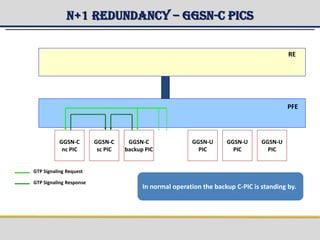
N+1 Redundancy – GGSN-C PICs
GGSN-C
PIC
GGSN-C
backup PIC
GGSN-C
sc PIC
PFE
RE
GGSN-U
PIC
GGSN-U
PIC
GGSN-U
PIC
GTP Signaling Request
GTP Signaling Response
GGSN-C
nc PIC
In normal operation the backup C-PIC is standing by.
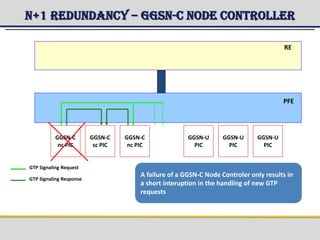
N+1 Redundancy – GGSN-C Node Controller
GGSN-C
PIC
GGSN-C
nc PIC
GGSN-C
sc PIC
PFE
RE
GGSN-U
PIC
GGSN-U
PIC
GGSN-U
PIC
GTP Signaling Request
GTP Signaling Response
GGSN-C
nc PIC
A failure of a GGSN-C Node Controler only results in
a short interuption in the handling of new GTP
requests
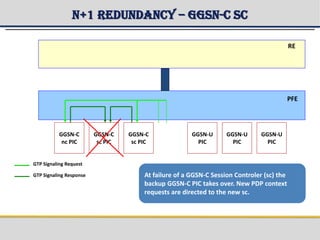
N+1 Redundancy – GGSN-C SC
GGSN-C
PIC
GGSN-C
sc PIC
GGSN-C
sc PIC
PFE
RE
GGSN-U
PIC
GGSN-U
PIC
GGSN-U
PIC
GTP Signaling Request
GTP Signaling Response
GGSN-C
nc PIC
At failure of a GGSN-C Session Controler (sc) the
backup GGSN-C PIC takes over. New PDP context
requests are directed to the new sc.
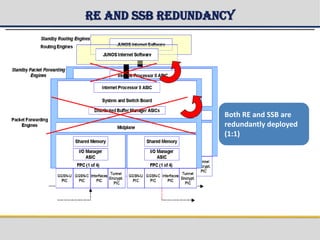
RE and SSB Redundancy
Both RE and SSB are
redundantly deployed
(1:1)
Sample Hardware Distribution
srayan@an1ggsn01-re0> show chassis hardware
Hardware inventory:
Item Version Part number Serial number Description
Chassis JN117A3FAAEA M120 [GGSN/EPG serial number for licensing]
Midplane REV 05 710-018041 RC8637 M120 Midplane
FPM Board REV 06 710-011407 YJ0593 M120 FPM Board
FPM Display REV 02 710-011405 YZ5056 M120 FPM Display
FPM CIP REV 05 710-011410 YY9162 M120 FPM CIP
PEM 0 Rev 10 740-011935 XB10310 DC Power Entry Module
PEM 1 Rev 10 740-011935 WL56066 DC Power Entry Module
Routing Engine 0 REV 04 740-017976 9009069636 RE-A-2000
Routing Engine 1 REV 04 740-017976 9009063056 RE-A-2000
CB 0 REV 11 710-011403 ZG0824 M120 Control Board
CB 1 REV 11 710-011403 ZD6746 M120 Control Board
FPC 2 REV 05 710-015837 YR7501 M120 FPC Type 2
PIC 0 REV 07 750-010616 YM6580 2x G/E SFP, 1000 BASE
Xcvr 0 REV 02 740-013111 B071687 SFP-T
Xcvr 1 REV 02 740-013111 B166055 SFP-T
PIC 1 REV 02 750-018000 ZA6800 GGSN Stargate Type2
PIC 3 REV 02 750-018000 ZB8185 GGSN Stargate Type2
Board B REV 05 710-015838 YR6619 M120 FPC Mezz Board
FPC 3 REV 05 710-015837 YY1420 M120 FPC Type 2
PIC 0 REV 07 750-010616 YM5177 2x G/E SFP, 1000 BASE
Xcvr 0 REV 02 740-013111 B071180 SFP-T
Xcvr 1 REV 02 740-013111 B071681 SFP-T
PIC 1 REV 02 750-018000 ZD0550 GGSN Stargate Type2
PIC 2 REV 03 750-018000 CACC7320 GGSN Stargate Type2
PIC 3 REV 02 750-018000 ZA6747 GGSN Stargate Type2
Board B REV 05 710-015838 YZ4666 M120 FPC Mezz Board
FEB 2 REV 01 710-025843 YZ1903 M120 FEB
FEB 3 REV 01 710-025843 ZC0308 M120 FEB
Fan Tray 0 Front Top Fan Tray
Fan Tray 1 Front Bottom Fan Tray
Fan Tray 2 Rear Top Fan Tray
Fan Tray 3 Rear Bottom Fan Tray
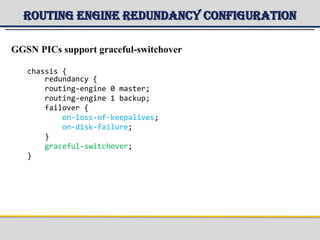
Routing Engine Redundancy Configuration
GGSN PICs support graceful-switchover
chassis {
redundancy {
routing-engine 0 master;
routing-engine 1 backup;
failover {
on-loss-of-keepalives;
on-disk-failure;
}
graceful-switchover;
}
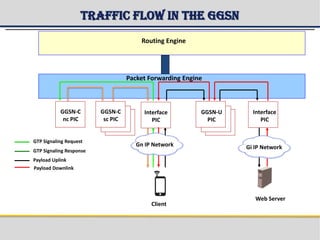
Traffic Flow in the GGSN
Payload Uplink
Interface
PIC
Interface
PIC
Packet Forwarding Engine
Payload Downlink
Gi IP Network
Routing Engine
Client
Web Server
GGSN-U
PIC
GGSN-C
nc PIC
GGSN-C
sc PIC
GTP Signaling Request
GTP Signaling Response
Gn IP Network
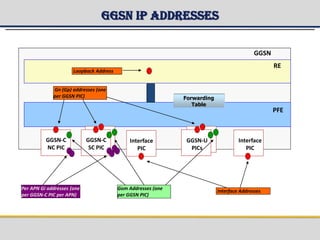
GGSN IP Addresses
Interface
PIC
Interface
PIC
PFE
RE
GGSN-C
NC PIC
GGSN
Interface Addresses
GGSN-U
PICs
Loopback Address
GGSN-C
SC PIC
Gn (Gp) addresses (one
per GGSN PIC)
Gom Addresses (one
per GGSN PIC)
Per APN Gi addresses (one
per GGSN-C PIC per APN)
Forwarding
Table
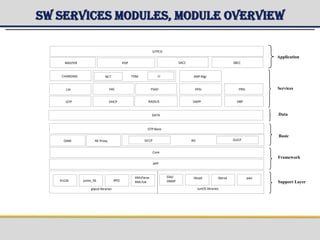
SW Services Modules, Module overview
GTPCD
GCCP GUCPIPCOAM
Core
APP
RE Proxy
GTP Basic
LIH
DHCP RADIUS
FSADSAC
CHARGING
GTP
ANP MgrNCT LITDM
MASTER PDP
SrvLib junos_lib RPD
XMLParse
XMLTok
gtpcd libraries
SSA/
SNMP
librpd libirsd pwc
JunOS libraries
Application
Services
Basic
Framework
Support Layer
SBCC
DBP
PRSIPPSI
SACC
DAPP
DATA Data
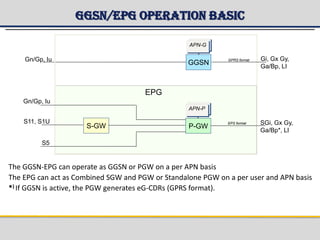
GGSN/EPG Operation Basic
The GGSN-EPG can operate as GGSN or PGW on a per APN basis
The EPG can act as Combined SGW and PGW or Standalone PGW on a per user and APN basis
*) If GGSN is active, the PGW generates eG-CDRs (GPRS format).
Gn/Gp, Iu
SGi, Gx Gy,
Ga/Bp*, LI
S11, S1U
Gn/Gp, Iu
Gi, Gx Gy,
Ga/Bp, LI
EPG
S-GW
S5
EPS format
GPRS format
APN-GAPN-G
GGSN
APN-GAPN-P
P-GW
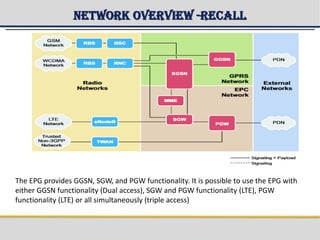
Network Overview -Recall
The EPG provides GGSN, SGW, and PGW functionality. It is possible to use the EPG with
either GGSN functionality (Dual access), SGW and PGW functionality (LTE), PGW
functionality (LTE) or all simultaneously (triple access)
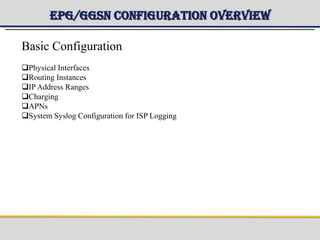
EPG/GGSN Configuration Overview
Basic Configuration
Physical Interfaces
Routing Instances
IP Address Ranges
Charging
APNs
System Syslog Configuration for ISP Logging
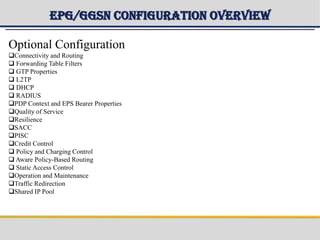
EPG/GGSN Configuration Overview
Optional Configuration
Connectivity and Routing
 Forwarding Table Filters
 GTP Properties
 L2TP
 DHCP
 RADIUS
PDP Context and EPS Bearer Properties
Quality of Service
Resilience
SACC
PISC
Credit Control
 Policy and Charging Control
 Aware Policy-Based Routing
 Static Access Control
Operation and Maintenance
Traffic Redirection
Shared IP Pool
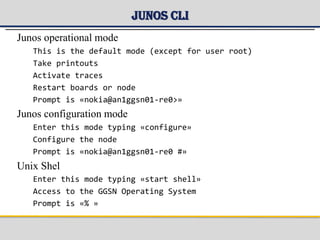
Junos CLI
Junos operational mode
This is the default mode (except for user root)
Take printouts
Activate traces
Restart boards or node
Prompt is «nokia@an1ggsn01-re0>»
Junos configuration mode
Enter this mode typing «configure»
Configure the node
Prompt is «nokia@an1ggsn01-re0 #»
Unix Shel
Enter this mode typing «start shell»
Access to the GGSN Operating System
Prompt is «% »
Junos CLI
? – list available commands and short help
?
Show ?
Show system ?
<tab> or <space> - completes the command
show ver [press space or tab] => show version
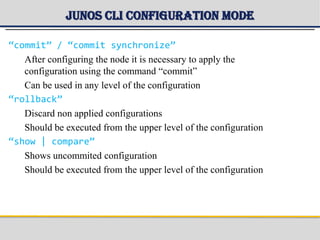
Junos CLI Configuration mode
“commit” / “commit synchronize”
After configuring the node it is necessary to apply the
configuration using the command “commit”
Can be used in any level of the configuration
“rollback”
Discard non applied configurations
Should be executed from the upper level of the configuration
“show | compare”
Shows uncommited configuration
Should be executed from the upper level of the configuration
Physical Interface Configuration
ge-2/0/0 {
description "an1ss01 6:12";
vlan-tagging;
unit 150 {
description Gn-R01;
vlan-id 150;
family inet {
address 10.77.96.6/28; [Physical interface address]
}
}
ge-3/0/0 {
unit 250 {
description Gn-R02;
vlan-id 250;
family inet {
address 10.77.96.22/28; [Physical interface address]
}
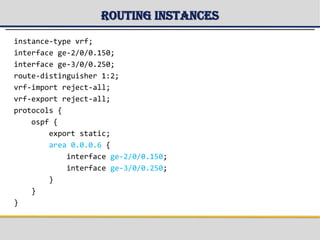
Routing Instances
instance-type vrf;
interface ge-2/0/0.150;
interface ge-3/0/0.250;
route-distinguisher 1:2;
vrf-import reject-all;
vrf-export reject-all;
protocols {
ospf {
export static;
area 0.0.0.6 {
interface ge-2/0/0.150;
interface ge-3/0/0.250;
}
}
}
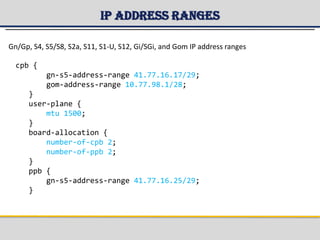
IP Address Ranges
Gn/Gp, S4, S5/S8, S2a, S11, S1-U, S12, Gi/SGi, and Gom IP address ranges
cpb {
gn-s5-address-range 41.77.16.17/29;
gom-address-range 10.77.98.1/28;
}
user-plane {
mtu 1500;
}
board-allocation {
number-of-cpb 2;
number-of-ppb 2;
}
ppb {
gn-s5-address-range 41.77.16.25/29;
}
Charging
cdr-attribute {
no-reduced-partial;
msisdn-always;
traffic-volumes {
qos-always;
}
charging-format 7;
charging-data-file {
user emmuser;
maximum-size 30720; [CDR log file maximum size]
maximum-age 15; [CDR log file maximum duration]
}
characteristics {
default profile8;
profile8 {
volume-limit 2000; [subscriber partial CDR wrap up limit
volume]
time-limit 15; [subscriber partial CDR wrap up limit time]
change-limit 5; [subscriber partial CDR wrap up event limit]
transfer-type ftp-pull; [no GTP prime/push]
}
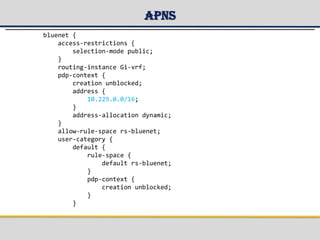
APNs
bluenet {
access-restrictions {
selection-mode public;
}
routing-instance Gi-vrf;
pdp-context {
creation unblocked;
address {
10.229.0.0/16;
}
address-allocation dynamic;
}
allow-rule-space rs-bluenet;
user-category {
default {
rule-space {
default rs-bluenet;
}
pdp-context {
creation unblocked;
}
}
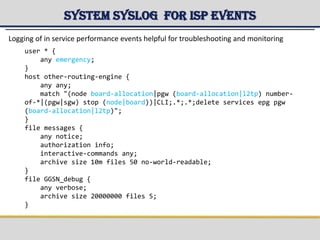
System Syslog for ISP events
user * {
any emergency;
}
host other-routing-engine {
any any;
match "(node board-allocation|pgw (board-allocation|l2tp) number-
of-*|(pgw|sgw) stop (node|board))|CLI;.*;.*;delete services epg pgw
(board-allocation|l2tp)";
}
file messages {
any notice;
authorization info;
interactive-commands any;
archive size 10m files 50 no-world-readable;
}
file GGSN_debug {
any verbose;
archive size 20000000 files 5;
}
Logging of in service performance events helpful for troubleshooting and monitoring
Further Study
3GPP Documentation
Google
When you’re confused
Q??

GGSN-Gateway GPRS Support Node

  • 1.
    G-GSN- Gateway GPRSSupport Node Mustafa Golam PART - 01
  • 2.
  • 3.
    GGSN– Gateway GPRSSupport Node Functionalities at a glance: •Acts as an interface and a router to external networks •It contains routing information for GPRS mobiles... •Tunnel packets through the IP based internal backbone •Collects charging data •Packet filter for incoming traffic •Packet inspection •Gateway with online charging system •Gateway with policy control server Session Management •PDP context activation •PDP context modification •Network Inititiated PDP context deactivation
  • 4.
    GGSN/EPG Hardware Overview[EPG-M] M20 M120 M320 Three different platforms with Juniper HW for EPG-M
  • 5.
    Product Architecture M120– Hardware Chassis Maxi Configuration 6 Flexible Engine Boards (FEB) 2 Routing Engines (RE) 2 Compact Flexible PIC Concentrators (cFPC) (10 Gbps) 4 Flexible PIC Concentrators (FPC) 16 Physical Interface Cards (PIC) (4 Gbps) 2 Power Supplies Fans
  • 6.
    Product Architecture –Hardware (M120)
  • 7.
    Product Architecture –Hardware PIC PIC PIC PIC PIC PIC PIC PIC Switch Fabric Internet Processor Control Processor
  • 8.
    Physical Interface Cards- PICs GGSN Specific Service PICs Provide GGSN control, user plane + inspection and tunneling services (GGSN-C, GGSN–U and GGSN-T) Purpose built hardware provides unparalleled performance Network Interface PICs Ethernet, ATM, Sonet/SDH, etc. Juniper Platform Services PICs Encryption, tunneling, NAT/NAPT, Statefull Firewall services etc.
  • 9.
    GGSN-C Session &Node Controller GGSN-C Node Controller Handles communication towards the RE (route updates, management information, statistics, etc) Hosts the GGSN IP address on the Gn network Validates and handles all primary PDP context requests Load distributes traffic to GGSN-C and GGSN-U Supervises the GGSN-C session controllers and the GGSN-U PICs and takes action if there is a failure GGSN-C Session Controller Processes all PDP context control messages (create, update, delete) Acts as proxy if RADIUS, DHCP are used Creates charging ID, opens a CDR, handles charging data collection Phoenix (new PIC) & Mint (old PIC) based C-PIC in M20 Stargate (M120 PIC) in GGSN based on M120/M320
  • 10.
    GGSN-U/I-Packet Forwarder GGSN-U Payloadboard (U/I-PIC Handles GTP policing GTP encapsulation and de-capsulation charging data counting (GPRS) FBC volume aggregation and authorization Policing per PDP context TFT based filtering of payload into correct primary/secondary PDP context Payload filters and packet classification (SACC) Phoenix & Mint based U/I-PIC in M20 (Mint cannot be used with SACC and is thus only U-PIC) Stargate based U/I-PIC in M120
  • 11.
    GGSN-T GGSN-T L2TP Tunnelboard (T-PIC) Handles L2TP tunnelling Not very widely used Phoenix based T-PIC in M20, Stargate in M120/M320 With L2TP it is possible to have a transparent APN to an external network, for example a 3rd party operator
  • 12.
    Routing Engine RE-A-2000-4096 (Jpr)RE-A-2000-4096-HD (///) CPU 2 GHz 2 GHz DRAM 4096 MB 4096 MB Hard Disk 40 GB 160 GB Flash (USB) 1 GB 1 GB  Origin M320/Tseries (and M120) shared the same RE  Current RE in M320 is the same as for T-series RE-A-2000-4096, but…  same RE as in M120 with the 160 GB disk (large disk used for CDR storage)
  • 13.
    Redundancy in GGSN RedundantRouting Engine (RE) Redundant System Switching Board (SSB) Redundant and load-sharing Power supplies Redundant Fan trays (Total of 3) Optional N:1 Redundant GGSN-U PICs Optional N:1 Redundant GGSN-C PICs Optional Redundant service PICs (IPSec, GRE, IP-IP) Optional Redundant interfaces Load distribution of payload traffic on all GGSN-U/I With proper dimensioning No single point of failure causing prolonged downtime.
  • 14.
    N+1 Redundancy –GGSN-C PICs GGSN-C PIC GGSN-C backup PIC GGSN-C sc PIC PFE RE GGSN-U PIC GGSN-U PIC GGSN-U PIC GTP Signaling Request GTP Signaling Response GGSN-C nc PIC In normal operation the backup C-PIC is standing by.
  • 15.
    N+1 Redundancy –GGSN-C Node Controller GGSN-C PIC GGSN-C nc PIC GGSN-C sc PIC PFE RE GGSN-U PIC GGSN-U PIC GGSN-U PIC GTP Signaling Request GTP Signaling Response GGSN-C nc PIC A failure of a GGSN-C Node Controler only results in a short interuption in the handling of new GTP requests
  • 16.
    N+1 Redundancy –GGSN-C SC GGSN-C PIC GGSN-C sc PIC GGSN-C sc PIC PFE RE GGSN-U PIC GGSN-U PIC GGSN-U PIC GTP Signaling Request GTP Signaling Response GGSN-C nc PIC At failure of a GGSN-C Session Controler (sc) the backup GGSN-C PIC takes over. New PDP context requests are directed to the new sc.
  • 17.
    RE and SSBRedundancy Both RE and SSB are redundantly deployed (1:1)
  • 18.
    Sample Hardware Distribution srayan@an1ggsn01-re0>show chassis hardware Hardware inventory: Item Version Part number Serial number Description Chassis JN117A3FAAEA M120 [GGSN/EPG serial number for licensing] Midplane REV 05 710-018041 RC8637 M120 Midplane FPM Board REV 06 710-011407 YJ0593 M120 FPM Board FPM Display REV 02 710-011405 YZ5056 M120 FPM Display FPM CIP REV 05 710-011410 YY9162 M120 FPM CIP PEM 0 Rev 10 740-011935 XB10310 DC Power Entry Module PEM 1 Rev 10 740-011935 WL56066 DC Power Entry Module Routing Engine 0 REV 04 740-017976 9009069636 RE-A-2000 Routing Engine 1 REV 04 740-017976 9009063056 RE-A-2000 CB 0 REV 11 710-011403 ZG0824 M120 Control Board CB 1 REV 11 710-011403 ZD6746 M120 Control Board FPC 2 REV 05 710-015837 YR7501 M120 FPC Type 2 PIC 0 REV 07 750-010616 YM6580 2x G/E SFP, 1000 BASE Xcvr 0 REV 02 740-013111 B071687 SFP-T Xcvr 1 REV 02 740-013111 B166055 SFP-T PIC 1 REV 02 750-018000 ZA6800 GGSN Stargate Type2 PIC 3 REV 02 750-018000 ZB8185 GGSN Stargate Type2 Board B REV 05 710-015838 YR6619 M120 FPC Mezz Board FPC 3 REV 05 710-015837 YY1420 M120 FPC Type 2 PIC 0 REV 07 750-010616 YM5177 2x G/E SFP, 1000 BASE Xcvr 0 REV 02 740-013111 B071180 SFP-T Xcvr 1 REV 02 740-013111 B071681 SFP-T PIC 1 REV 02 750-018000 ZD0550 GGSN Stargate Type2 PIC 2 REV 03 750-018000 CACC7320 GGSN Stargate Type2 PIC 3 REV 02 750-018000 ZA6747 GGSN Stargate Type2 Board B REV 05 710-015838 YZ4666 M120 FPC Mezz Board FEB 2 REV 01 710-025843 YZ1903 M120 FEB FEB 3 REV 01 710-025843 ZC0308 M120 FEB Fan Tray 0 Front Top Fan Tray Fan Tray 1 Front Bottom Fan Tray Fan Tray 2 Rear Top Fan Tray Fan Tray 3 Rear Bottom Fan Tray
  • 19.
    Routing Engine RedundancyConfiguration GGSN PICs support graceful-switchover chassis { redundancy { routing-engine 0 master; routing-engine 1 backup; failover { on-loss-of-keepalives; on-disk-failure; } graceful-switchover; }
  • 20.
    Traffic Flow inthe GGSN Payload Uplink Interface PIC Interface PIC Packet Forwarding Engine Payload Downlink Gi IP Network Routing Engine Client Web Server GGSN-U PIC GGSN-C nc PIC GGSN-C sc PIC GTP Signaling Request GTP Signaling Response Gn IP Network
  • 21.
    GGSN IP Addresses Interface PIC Interface PIC PFE RE GGSN-C NCPIC GGSN Interface Addresses GGSN-U PICs Loopback Address GGSN-C SC PIC Gn (Gp) addresses (one per GGSN PIC) Gom Addresses (one per GGSN PIC) Per APN Gi addresses (one per GGSN-C PIC per APN) Forwarding Table
  • 22.
    SW Services Modules,Module overview GTPCD GCCP GUCPIPCOAM Core APP RE Proxy GTP Basic LIH DHCP RADIUS FSADSAC CHARGING GTP ANP MgrNCT LITDM MASTER PDP SrvLib junos_lib RPD XMLParse XMLTok gtpcd libraries SSA/ SNMP librpd libirsd pwc JunOS libraries Application Services Basic Framework Support Layer SBCC DBP PRSIPPSI SACC DAPP DATA Data
  • 23.
    GGSN/EPG Operation Basic TheGGSN-EPG can operate as GGSN or PGW on a per APN basis The EPG can act as Combined SGW and PGW or Standalone PGW on a per user and APN basis *) If GGSN is active, the PGW generates eG-CDRs (GPRS format). Gn/Gp, Iu SGi, Gx Gy, Ga/Bp*, LI S11, S1U Gn/Gp, Iu Gi, Gx Gy, Ga/Bp, LI EPG S-GW S5 EPS format GPRS format APN-GAPN-G GGSN APN-GAPN-P P-GW
  • 24.
    Network Overview -Recall TheEPG provides GGSN, SGW, and PGW functionality. It is possible to use the EPG with either GGSN functionality (Dual access), SGW and PGW functionality (LTE), PGW functionality (LTE) or all simultaneously (triple access)
  • 25.
    EPG/GGSN Configuration Overview BasicConfiguration Physical Interfaces Routing Instances IP Address Ranges Charging APNs System Syslog Configuration for ISP Logging
  • 26.
    EPG/GGSN Configuration Overview OptionalConfiguration Connectivity and Routing  Forwarding Table Filters  GTP Properties  L2TP  DHCP  RADIUS PDP Context and EPS Bearer Properties Quality of Service Resilience SACC PISC Credit Control  Policy and Charging Control  Aware Policy-Based Routing  Static Access Control Operation and Maintenance Traffic Redirection Shared IP Pool
  • 27.
    Junos CLI Junos operationalmode This is the default mode (except for user root) Take printouts Activate traces Restart boards or node Prompt is «nokia@an1ggsn01-re0>» Junos configuration mode Enter this mode typing «configure» Configure the node Prompt is «nokia@an1ggsn01-re0 #» Unix Shel Enter this mode typing «start shell» Access to the GGSN Operating System Prompt is «% »
  • 28.
    Junos CLI ? –list available commands and short help ? Show ? Show system ? <tab> or <space> - completes the command show ver [press space or tab] => show version
  • 29.
    Junos CLI Configurationmode “commit” / “commit synchronize” After configuring the node it is necessary to apply the configuration using the command “commit” Can be used in any level of the configuration “rollback” Discard non applied configurations Should be executed from the upper level of the configuration “show | compare” Shows uncommited configuration Should be executed from the upper level of the configuration
  • 30.
    Physical Interface Configuration ge-2/0/0{ description "an1ss01 6:12"; vlan-tagging; unit 150 { description Gn-R01; vlan-id 150; family inet { address 10.77.96.6/28; [Physical interface address] } } ge-3/0/0 { unit 250 { description Gn-R02; vlan-id 250; family inet { address 10.77.96.22/28; [Physical interface address] }
  • 31.
    Routing Instances instance-type vrf; interfacege-2/0/0.150; interface ge-3/0/0.250; route-distinguisher 1:2; vrf-import reject-all; vrf-export reject-all; protocols { ospf { export static; area 0.0.0.6 { interface ge-2/0/0.150; interface ge-3/0/0.250; } } }
  • 32.
    IP Address Ranges Gn/Gp,S4, S5/S8, S2a, S11, S1-U, S12, Gi/SGi, and Gom IP address ranges cpb { gn-s5-address-range 41.77.16.17/29; gom-address-range 10.77.98.1/28; } user-plane { mtu 1500; } board-allocation { number-of-cpb 2; number-of-ppb 2; } ppb { gn-s5-address-range 41.77.16.25/29; }
  • 33.
    Charging cdr-attribute { no-reduced-partial; msisdn-always; traffic-volumes { qos-always; } charging-format7; charging-data-file { user emmuser; maximum-size 30720; [CDR log file maximum size] maximum-age 15; [CDR log file maximum duration] } characteristics { default profile8; profile8 { volume-limit 2000; [subscriber partial CDR wrap up limit volume] time-limit 15; [subscriber partial CDR wrap up limit time] change-limit 5; [subscriber partial CDR wrap up event limit] transfer-type ftp-pull; [no GTP prime/push] }
  • 34.
    APNs bluenet { access-restrictions { selection-modepublic; } routing-instance Gi-vrf; pdp-context { creation unblocked; address { 10.229.0.0/16; } address-allocation dynamic; } allow-rule-space rs-bluenet; user-category { default { rule-space { default rs-bluenet; } pdp-context { creation unblocked; } }
  • 35.
    System Syslog forISP events user * { any emergency; } host other-routing-engine { any any; match "(node board-allocation|pgw (board-allocation|l2tp) number- of-*|(pgw|sgw) stop (node|board))|CLI;.*;.*;delete services epg pgw (board-allocation|l2tp)"; } file messages { any notice; authorization info; interactive-commands any; archive size 10m files 50 no-world-readable; } file GGSN_debug { any verbose; archive size 20000000 files 5; } Logging of in service performance events helpful for troubleshooting and monitoring
  • 36.
  • 37.