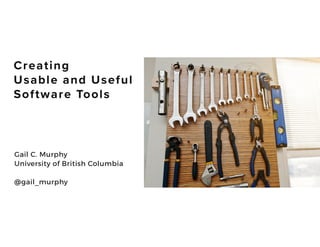
Creating


Usable and Useful
Software Tools
Gail C. Murphy


University of British Columbia


@gail_murphy
2
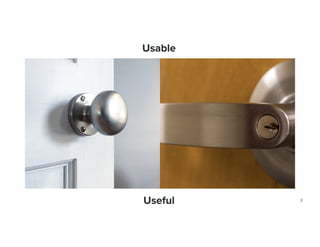
Useful
Usable
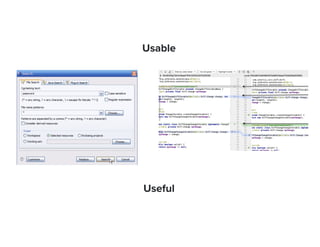
Useful
Usable
- X
Too often a gap exists between
developers’ needs and tools
- X
Attention to usability and
usefulness can bridge the gap
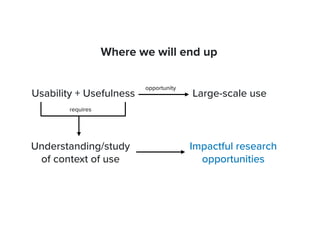
Where we will end up
Usability + Usefulness Large-scale use
opportunity
requires
Understanding/study


of context of use
Impactful research


opportunities
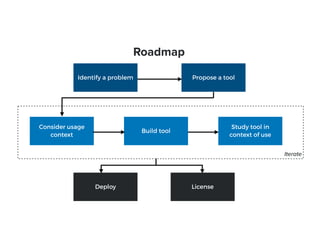
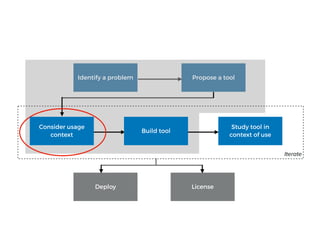
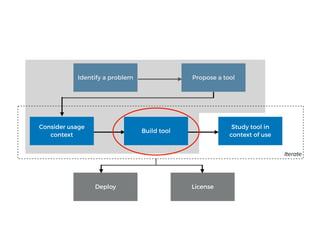
Identify a problem Propose a tool
Consider usage
context
Build tool
Study tool in


context of use
Deploy License
Iterate
Roadmap
Propose a tool
Study tool in


context of use
Deploy License
Iterate
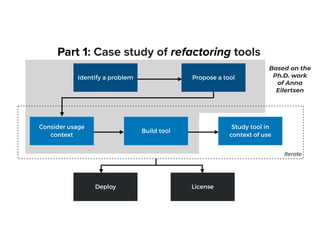
Part 1: Case study of refactoring tools
Based on the


Ph.D. work


of Anna


Eilertsen
Identify a problem
Build tool
Consider usage
context
Propose a tool
Study tool in


context of use
Deploy License
9
Iterate
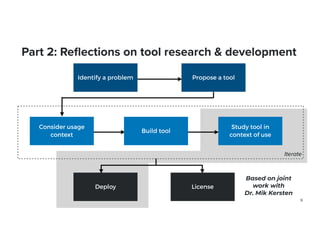
Part 2: Re
fl
ections on tool research & development
Based on joint


work with


Dr. Mik Kersten
Identify a problem
Consider usage
context
Build tool
Part I: Case study of refactoring tools
11
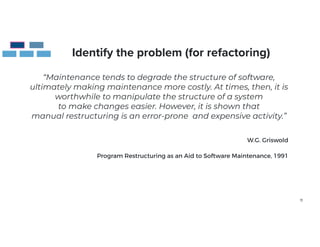
Identify the problem (for refactoring)
“Maintenance tends to degrade the structure of software,
ultimately making maintenance more costly. At times, then, it is
worthwhile to manipulate the structure of a system
to make changes easier. However, it is shown that
manual restructuring is an error-prone and expensive activity.”
W.G. Griswold


Program Restructuring as an Aid to Software Maintenance, 1991
12
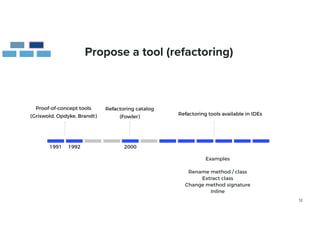
Propose a tool (refactoring)
Refactoring catalog


(Fowler)
Refactoring tools available in IDEs
1992
1991 2000
Proof-of-concept tools


(Griswold, Opdyke, Brandt)
Examples


Rename method / class


Extract class


Change method signature


Inline
13
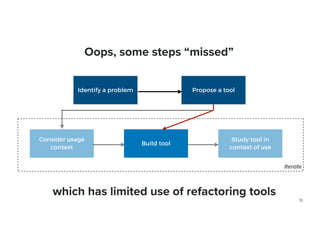
Identify a problem Propose a tool
Consider usage
context
Study tool in
fi
eld study of
refactoring challenges
and bene
fi
ts
“Developers said they
do 86% of refactoring
manually”
[MPB12] [KZN12] [SSS15]
Challenges to


and solutions for


refactoring adoption
“59% of the
respondents were
dissatis
fi
ed with the
quality of available
refactoring tools”
[STV16]
55% of developers
“answered that
refactoring was
performed manually
without tool support”
Why we refactor?
Confessions of GitHub
contributors
[MPB12] [KZN12] [SSG15] [STV16]
Refactoring tools are under-utilized
15
16
Awareness
[MPB09, V+12,
STV16]
Inability to select
code
[MB08]
Predictability [V+12]
Trust
[MBP09, L+15,
STV16]
And many other
reasons…
Why are refactoring tools


under-utilized?
Identify a problem Propose a tool
Study tool in


context of use
Deploy License
Iterate
Consider usage
context
Build tool
18
Furda meras
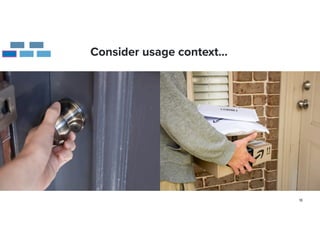
Consider usage context…
19
Furda meras
Consider usage context…
Can study tool invocation


Can help improve usability


e.g., [MB08]


Modi
fi
cations may still limit overall use
(and usefulness)
20
Furda meras
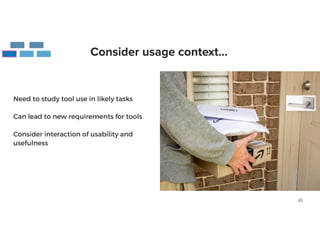
Consider usage context…
Need to study tool use in likely tasks


Can lead to new requirements for tools


Consider interaction of usability and
usefulness
21
A study of refactorings during
software change tasks
Organize test
methods
1
Removing


redundant
methods
2
Overloaded
method
reduction
3
Tasks
[Eilertsen and Murphy, JSEP 2021]
15 male and 2 female


Average 10 years of experience
Participants
System Replica of part of Apache Commons-Lang
78k lines of Java, 1335 JUnit tests
A study of refactorings during
software change tasks
Organize test
methods
1
Removing


redundant
methods
2
Overloaded
method
reduction
3
Tasks
Applicable


refactorings
move-metho
d

extract-class
inline-metho
d

safe-delet
e

inline-metho
d

remove-paramete
r

Observation and interviews, up to 1.5 hours
32 hours of video, transcribed to 13k words
Method
Data
[Eilertsen and Murphy, JSEP 2021]
23
A study of refactorings during
software change tasks
VSC-diffs Investigate how code was changed and verify change
structural-navigation
Understand code and locate code that needs to
change
refactoring-tool Change code and organize change
test-suite
Understand code, understand impact of changes,
verify a change is correct
debug-tool Understand what code does
text-search
Find references, callers and declarations of methods
and parameters
compiler-output
Errors and warnings used to navigate code,
understand impact of changes and verify changes
copy/cut/paste Used to edit code
Tools used
[Eilertsen and Murphy, JSEP 2021]
24
A study of refactorings during
software change tasks
Local
Changes guided by local and immediate

feedback, such as from the compiler
Structure
Changes guided by code structure, such as

callers and references
Execute Changes guided by executing the test suite
Strategy
[Eilertsen and Murphy, JSEP 2021]
A study of refactorings during
software change tasks
Participants
Tasks
Local
Structure
Execute
Strategies were distributed participants and tasks
Individual participants sometimes used different strategies
[Eilertsen and Murphy, JSEP 2021]
A study of refactorings during
software change tasks
Refactoring tool use dropped off from considering the tool to actually using the tool
[Eilertsen and Murphy, JSEP 2021]
27
A study of refactorings during
software change tasks
[Eilertsen and Murphy, JSEP 2021]
28
A study of refactorings during
software change tasks
[Eilertsen and Murphy, JSEP 2021]
29
Themes
Dif
fi
culties controlling impact Loss of knowledge of code
[Eilertsen and Murphy, JSEP 2021]
30
The extent to which a system, product or
service can be used by speci
fi
ed users to
achieve speci
fi
ed goals with e
ff
ectiveness,
e
ffi
ciency and satisfaction in a speci
fi
ed
context of use.
Usability
Software developers employ refactoring tools
to help prepare or complete functional changes
to a software system. Software developers
seek these tools to be reasonable to locate and
apply for a desired intent (e
ff
ective), reasonable
in terms of time and e
ff
ort required to use the
tool (e
ffi
cient), and to add value to the
development process (satisfying).


Proposal for refactoring tools:
ISO 9241-11
[Eilertsen and Murphy, SANER 2021]
31
Analysis of study transcripts
for usability
[Eilertsen and Murphy, SANER 2021]
32
Analysis of study transcripts
for usability
Code Description
E
ff
ective User experiences tool as successfully performing a desired result
E
ffi
cient User experiences the tool as being fast or increasing productivity
Satisfaction User experiences having their needs or wants met by the use of the tool
Trust User experiences the tools as trustworthy, safe or reliable
Predictable
User understands up-front what will happen by using the tool or indicates
lack of surprise when using tool
[Eilertsen and Murphy, SANER 2021]
33
Analysis of study transcripts
for usability
Participants commented frequently on
the predictability of refactoring tools
[Eilertsen and Murphy, SANER 2021]
34
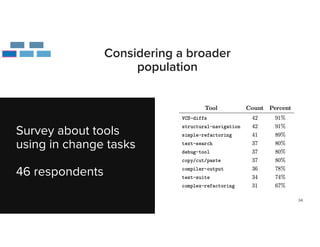
Considering a broader
population
Survey about tools


using in change tasks


46 respondents


35
Tool usability profiles
Copy-Cut-Paste Textual Search Compiler Output
Simple Refactoring


Tools
Developers do not think these


tools need to be satisfying
Simple refactoring tools (e.g., rename)


should be satisfying,


compiler should be trustworthy
[Eilertsen Ph.D. Thesis, to appear]
36
Tool usability profiles
Simple Refactoring


Tools
[Eilertsen Ph.D. Thesis, to appear]
Complex Refactoring


Tools
Note scales are slightly different on the top plots
37
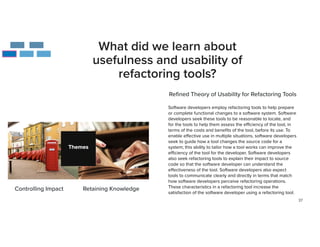
What did we learn about
usefulness and usability of
refactoring tools?
Re
fi
ned Theory of Usability for Refactoring Tools
Software developers employ refactoring tools to help prepare
or complete functional changes to a software system. Software
developers seek these tools to be reasonable to locate, and
for the tools to help them assess the e
ffi
ciency of the tool, in
terms of the costs and bene
fi
ts of the tool, before its use. To
enable e
ff
ective use in multiple situations, software developers
seek to guide how a tool changes the source code for a
system; this ability to tailor how a tool works can improve the
e
ffi
ciency of the tool for the developer. Software developers
also seek refactoring tools to explain their impact to source
code so that the software developer can understand the
e
ff
ectiveness of the tool. Software developers also expect
tools to communicate clearly and directly in terms that match
how software developers perceive refactoring operations.
These characteristics in a refactoring tool increase the
satisfaction of the software developer using a refactoring tool.


Controlling Impact Retaining Knowledge
Identify a problem Propose a tool
Study tool in


context of use
Deploy License
Iterate
Consider usage
context
Build tool
39
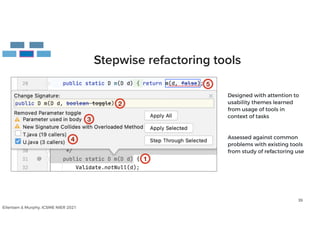
Stepwise refactoring tools
Designed with attention to


usability themes learned


from usage of tools in


context of tasks


Assessed against common


problems with existing tools


from study of refactoring use
Eilertsen & Murphy, ICSME NIER 2021
Identify a problem Propose a tool
Study tool in


context of use
Deploy License
40
Iterate
Consider usage
context
Build tool
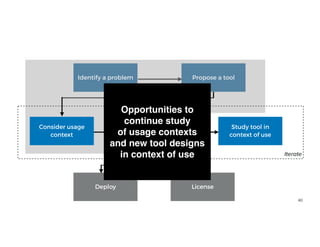
Opportunities to

continue study
 

of usage contexts
 

and new tool design
s

in context of use
Part 2: Re fl
ections on tool research & development
Propose a tool
Study tool in


context of use
Deploy License
42
Iterate
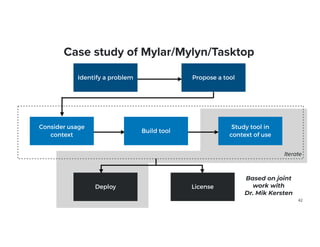
Based on joint


work with


Dr. Mik Kersten
Identify a problem
Consider usage
context
Build tool
Case study of Mylar/Mylyn/Tasktop
43
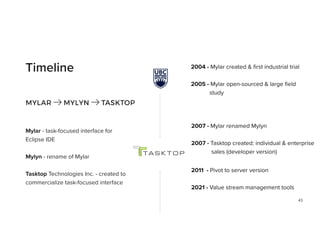
Timeline
MYLAR MYLYN TASKTOP
Mylar - task-focused interface for
Eclipse IDE


Mylyn - rename of Mylar 

Tasktop Technologies Inc. - created to
commercialize task-focused interface
2004 - Mylar created &
fi
rst industrial trial


2005 - Mylar open-sourced & large
fi
eld


study
2007 - Mylar renamed Mylyn


2007 - Tasktop created: individual & enterprise


sales (developer version)


2011 - Pivot to server version


2021 - Value stream management tools
44
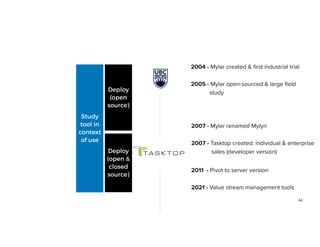
2004 - Mylar created &
fi
rst industrial trial


2005 - Mylar open-sourced & large
fi
eld


study
2007 - Mylar renamed Mylyn


2007 - Tasktop created: individual & enterprise


sales (developer version)


2011 - Pivot to server version


2021 - Value stream management tools
Study
tool in


context
of use
Deploy


(open
source)
Deploy


(open &


closed
source)
Propose a tool
Study tool in


context of use
Deploy License
45
Iterate
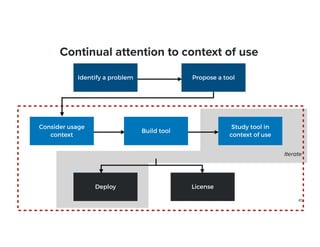
Continual attention to context of use
Identify a problem
Consider usage
context
Build tool
Summary
Special thanks to…
ANNA MARIA EILERTSEN DR. MIK KERSTEN
Organizers of
Fantastic students too numerous to name
Wonderful colleagues at Tasktop


NSERC for the support to discover
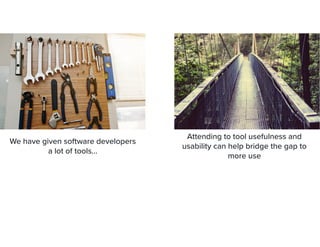
We have given software developers


a lot of tools…
Attending to tool usefulness and
usability can help bridge the gap to
more use
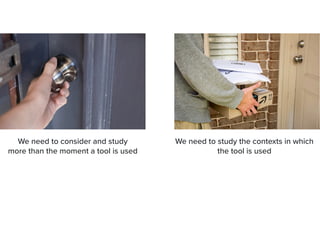
We need to consider and study


more than the moment a tool is used
We need to study the contexts in which
the tool is used
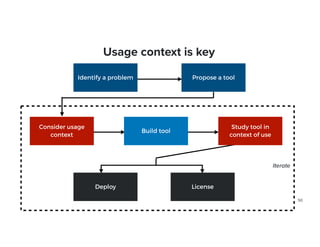
Propose a tool
Deploy License
50
Iterate
Usage context is key
Identify a problem
Consider usage
context
Build tool
Study tool in


context of use
51
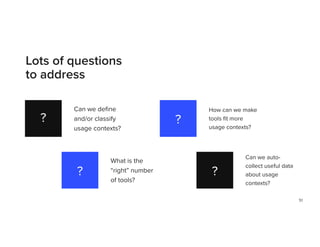
Lots of questions
to address
?
?
?
?
Can we de
fi
ne
and/or classify
usage contexts?
How can we make
tools
fi
t more
usage contexts?
What is the
“right” number
of tools?
Can we auto-
collect useful data
about usage
contexts?
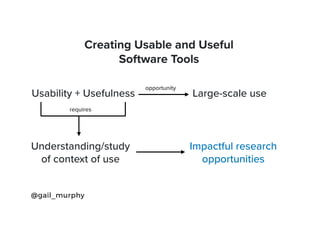
Creating Usable and Useful
Software Tools
Usability + Usefulness Large-scale use
opportunity
requires
Understanding/study


of context of use
Impactful research


opportunities
@gail_murphy
53
References
[KZN12] Kim, M., Zimmermann, T. and N. Nagappan. A
fi
eld study of refactoring challenges and bene ts. In Proc. Of FSE, 2012, 50:1-50:11.
[L+15] Leppänen, M., Mäkinen, S., Lahtinen, S., Sievi-Korte, O., Tuovinen, A.-P. and Männistö, T. Refactoring-a-shot in the dark?
IEEE Software, 2015, 32(6): 62-70.


[MB08] Murphy-Hill, E. and Black, A. Breaking the barriers to successful refactoring: Observations and tools for extract method.
In Proc. of ICSE, 2008, 421-430.


[MPB09] Murphy-Hill, E., Parnin, C. and Black, A.P. How we refactor, and how we know it. In Proc. Of ICSE, 2009, 287-297.
[MPB12] Murphy-Hill, E., Parnin, C. and Black, A.P. How we refactor, and how we know it. IEEE TSE, 2012, 38(1): 5-18.
[SSS15] Sharma, T., Suryanarayana, G. And Samarthyam, G. Challenges to and solutions for refactoring adoption: An industrial
perspective. IEEE Software, 32(6): 44-51.


[STV16] Silva, D., Tsantalis, N. and Valente, M.T. Why we refactor? Confessions of GitHub contributors. In Proc. Of FSE, 2016, 858-870.
[V+12] Vakilian, M., Chen, N., Negara, S., Rajkumar, B.A., Bailey, B.P. and Johnson, R.E. Use, disuse and misuse of automated
refactorings. In Proc. Of ICSE, 2012, 233-243.


Eilertsen, A.M. and Murphy, G.C., JSEP 2021. A study of refactorings during software change tasks.


Eilertsen, A.M. and Murphy, G.C., SANER 2021. The usability (or not) of refactoring tools.


Eilertsen, A.M. and Murphy, G.C., ICSME NIER 2021. Stepwise refactoring tools.


Eilertsen, A.M. Improving the usability of refactoring tools for software change tasks. Ph.D. thesis, University of Bergen, to appear.


Griswold 1991. Program restructuring as an aid to software maintenance, Ph.D. thesis, University of Washington.

Icsme 2021-keynote-creating-usable-and-useful-software-tools

  • 1.
    Creating 
 Usable and Useful SoftwareTools Gail C. Murphy University of British Columbia 
 
 @gail_murphy
  • 2.
  • 3.
  • 4.
    - X Too oftena gap exists between developers’ needs and tools
  • 5.
    - X Attention tousability and usefulness can bridge the gap
  • 6.
    Where we willend up Usability + Usefulness Large-scale use opportunity requires Understanding/study of context of use Impactful research opportunities
  • 7.
    Identify a problemPropose a tool Consider usage context Build tool Study tool in 
 context of use Deploy License Iterate Roadmap
  • 8.
    Propose a tool Studytool in 
 context of use Deploy License Iterate Part 1: Case study of refactoring tools Based on the Ph.D. work of Anna Eilertsen Identify a problem Build tool Consider usage context
  • 9.
    Propose a tool Studytool in 
 context of use Deploy License 9 Iterate Part 2: Re fl ections on tool research & development Based on joint work with 
 Dr. Mik Kersten Identify a problem Consider usage context Build tool
  • 10.
    Part I: Casestudy of refactoring tools
  • 11.
    11 Identify the problem(for refactoring) “Maintenance tends to degrade the structure of software, ultimately making maintenance more costly. At times, then, it is worthwhile to manipulate the structure of a system to make changes easier. However, it is shown that manual restructuring is an error-prone and expensive activity.” W.G. Griswold 
 Program Restructuring as an Aid to Software Maintenance, 1991
  • 12.
    12 Propose a tool(refactoring) Refactoring catalog 
 (Fowler) Refactoring tools available in IDEs 1992 1991 2000 Proof-of-concept tools 
 (Griswold, Opdyke, Brandt) Examples Rename method / class Extract class Change method signature Inline
  • 13.
    13 Identify a problemPropose a tool Consider usage context Study tool in
  • 14.
    fi eld study of refactoringchallenges and bene fi ts “Developers said they do 86% of refactoring manually” [MPB12] [KZN12] [SSS15] Challenges to and solutions for refactoring adoption “59% of the respondents were dissatis fi ed with the quality of available refactoring tools” [STV16] 55% of developers “answered that refactoring was performed manually without tool support” Why we refactor? Confessions of GitHub contributors
  • 15.
    [MPB12] [KZN12] [SSG15][STV16] Refactoring tools are under-utilized 15
  • 16.
    16 Awareness [MPB09, V+12, STV16] Inability toselect code [MB08] Predictability [V+12] Trust [MBP09, L+15, STV16] And many other reasons… Why are refactoring tools under-utilized?
  • 17.
    Identify a problemPropose a tool Study tool in 
 context of use Deploy License Iterate Consider usage context Build tool
  • 18.
  • 19.
    19 Furda meras Consider usagecontext… Can study tool invocation Can help improve usability e.g., [MB08] Modi fi cations may still limit overall use (and usefulness)
  • 20.
    20 Furda meras Consider usagecontext… Need to study tool use in likely tasks Can lead to new requirements for tools Consider interaction of usability and usefulness
  • 21.
    21 A study ofrefactorings during software change tasks Organize test methods 1 Removing redundant methods 2 Overloaded method reduction 3 Tasks [Eilertsen and Murphy, JSEP 2021] 15 male and 2 female Average 10 years of experience Participants System Replica of part of Apache Commons-Lang 78k lines of Java, 1335 JUnit tests
  • 22.
    A study ofrefactorings during software change tasks Organize test methods 1 Removing redundant methods 2 Overloaded method reduction 3 Tasks Applicable refactorings move-metho d extract-class inline-metho d safe-delet e inline-metho d remove-paramete r Observation and interviews, up to 1.5 hours 32 hours of video, transcribed to 13k words Method Data [Eilertsen and Murphy, JSEP 2021]
  • 23.
    23 A study ofrefactorings during software change tasks VSC-diffs Investigate how code was changed and verify change structural-navigation Understand code and locate code that needs to change refactoring-tool Change code and organize change test-suite Understand code, understand impact of changes, verify a change is correct debug-tool Understand what code does text-search Find references, callers and declarations of methods and parameters compiler-output Errors and warnings used to navigate code, understand impact of changes and verify changes copy/cut/paste Used to edit code Tools used [Eilertsen and Murphy, JSEP 2021]
  • 24.
    24 A study ofrefactorings during software change tasks Local Changes guided by local and immediate
 feedback, such as from the compiler Structure Changes guided by code structure, such as
 callers and references Execute Changes guided by executing the test suite Strategy [Eilertsen and Murphy, JSEP 2021]
  • 25.
    A study ofrefactorings during software change tasks Participants Tasks Local Structure Execute Strategies were distributed participants and tasks Individual participants sometimes used different strategies [Eilertsen and Murphy, JSEP 2021]
  • 26.
    A study ofrefactorings during software change tasks Refactoring tool use dropped off from considering the tool to actually using the tool [Eilertsen and Murphy, JSEP 2021]
  • 27.
    27 A study ofrefactorings during software change tasks [Eilertsen and Murphy, JSEP 2021]
  • 28.
    28 A study ofrefactorings during software change tasks [Eilertsen and Murphy, JSEP 2021]
  • 29.
    29 Themes Dif fi culties controlling impactLoss of knowledge of code [Eilertsen and Murphy, JSEP 2021]
  • 30.
    30 The extent towhich a system, product or service can be used by speci fi ed users to achieve speci fi ed goals with e ff ectiveness, e ffi ciency and satisfaction in a speci fi ed context of use. Usability Software developers employ refactoring tools to help prepare or complete functional changes to a software system. Software developers seek these tools to be reasonable to locate and apply for a desired intent (e ff ective), reasonable in terms of time and e ff ort required to use the tool (e ffi cient), and to add value to the development process (satisfying). Proposal for refactoring tools: ISO 9241-11 [Eilertsen and Murphy, SANER 2021]
  • 31.
    31 Analysis of studytranscripts for usability [Eilertsen and Murphy, SANER 2021]
  • 32.
    32 Analysis of studytranscripts for usability Code Description E ff ective User experiences tool as successfully performing a desired result E ffi cient User experiences the tool as being fast or increasing productivity Satisfaction User experiences having their needs or wants met by the use of the tool Trust User experiences the tools as trustworthy, safe or reliable Predictable User understands up-front what will happen by using the tool or indicates lack of surprise when using tool [Eilertsen and Murphy, SANER 2021]
  • 33.
    33 Analysis of studytranscripts for usability Participants commented frequently on the predictability of refactoring tools [Eilertsen and Murphy, SANER 2021]
  • 34.
    34 Considering a broader population Surveyabout tools using in change tasks 46 respondents 

  • 35.
    35 Tool usability profiles Copy-Cut-PasteTextual Search Compiler Output Simple Refactoring Tools Developers do not think these tools need to be satisfying Simple refactoring tools (e.g., rename) should be satisfying, compiler should be trustworthy [Eilertsen Ph.D. Thesis, to appear]
  • 36.
    36 Tool usability profiles SimpleRefactoring Tools [Eilertsen Ph.D. Thesis, to appear] Complex Refactoring Tools Note scales are slightly different on the top plots
  • 37.
    37 What did welearn about usefulness and usability of refactoring tools? Re fi ned Theory of Usability for Refactoring Tools Software developers employ refactoring tools to help prepare or complete functional changes to a software system. Software developers seek these tools to be reasonable to locate, and for the tools to help them assess the e ffi ciency of the tool, in terms of the costs and bene fi ts of the tool, before its use. To enable e ff ective use in multiple situations, software developers seek to guide how a tool changes the source code for a system; this ability to tailor how a tool works can improve the e ffi ciency of the tool for the developer. Software developers also seek refactoring tools to explain their impact to source code so that the software developer can understand the e ff ectiveness of the tool. Software developers also expect tools to communicate clearly and directly in terms that match how software developers perceive refactoring operations. These characteristics in a refactoring tool increase the satisfaction of the software developer using a refactoring tool. Controlling Impact Retaining Knowledge
  • 38.
    Identify a problemPropose a tool Study tool in 
 context of use Deploy License Iterate Consider usage context Build tool
  • 39.
    39 Stepwise refactoring tools Designedwith attention to 
 usability themes learned from usage of tools in context of tasks Assessed against common problems with existing tools from study of refactoring use Eilertsen & Murphy, ICSME NIER 2021
  • 40.
    Identify a problemPropose a tool Study tool in 
 context of use Deploy License 40 Iterate Consider usage context Build tool Opportunities to
 continue study of usage contexts and new tool design s in context of use
  • 41.
    Part 2: Refl ections on tool research & development
  • 42.
    Propose a tool Studytool in 
 context of use Deploy License 42 Iterate Based on joint work with 
 Dr. Mik Kersten Identify a problem Consider usage context Build tool Case study of Mylar/Mylyn/Tasktop
  • 43.
    43 Timeline MYLAR MYLYN TASKTOP Mylar- task-focused interface for Eclipse IDE 
 
 Mylyn - rename of Mylar Tasktop Technologies Inc. - created to commercialize task-focused interface 2004 - Mylar created & fi rst industrial trial 
 
 2005 - Mylar open-sourced & large fi eld 
 study 2007 - Mylar renamed Mylyn 
 
 2007 - Tasktop created: individual & enterprise 
 sales (developer version) 2011 - Pivot to server version 
 
 2021 - Value stream management tools
  • 44.
    44 2004 - Mylarcreated & fi rst industrial trial 
 
 2005 - Mylar open-sourced & large fi eld 
 study 2007 - Mylar renamed Mylyn 
 
 2007 - Tasktop created: individual & enterprise 
 sales (developer version) 2011 - Pivot to server version 
 
 2021 - Value stream management tools Study tool in 
 context of use Deploy (open source) Deploy (open & closed source)
  • 45.
    Propose a tool Studytool in 
 context of use Deploy License 45 Iterate Continual attention to context of use Identify a problem Consider usage context Build tool
  • 46.
  • 47.
    Special thanks to… ANNAMARIA EILERTSEN DR. MIK KERSTEN Organizers of Fantastic students too numerous to name Wonderful colleagues at Tasktop NSERC for the support to discover
  • 48.
    We have givensoftware developers 
 a lot of tools… Attending to tool usefulness and usability can help bridge the gap to more use
  • 49.
    We need toconsider and study more than the moment a tool is used We need to study the contexts in which the tool is used
  • 50.
    Propose a tool DeployLicense 50 Iterate Usage context is key Identify a problem Consider usage context Build tool Study tool in 
 context of use
  • 51.
    51 Lots of questions toaddress ? ? ? ? Can we de fi ne and/or classify usage contexts? How can we make tools fi t more usage contexts? What is the “right” number of tools? Can we auto- collect useful data about usage contexts?
  • 52.
    Creating Usable andUseful Software Tools Usability + Usefulness Large-scale use opportunity requires Understanding/study of context of use Impactful research opportunities @gail_murphy
  • 53.
    53 References [KZN12] Kim, M.,Zimmermann, T. and N. Nagappan. A fi eld study of refactoring challenges and bene ts. In Proc. Of FSE, 2012, 50:1-50:11. [L+15] Leppänen, M., Mäkinen, S., Lahtinen, S., Sievi-Korte, O., Tuovinen, A.-P. and Männistö, T. Refactoring-a-shot in the dark? IEEE Software, 2015, 32(6): 62-70. [MB08] Murphy-Hill, E. and Black, A. Breaking the barriers to successful refactoring: Observations and tools for extract method. In Proc. of ICSE, 2008, 421-430. [MPB09] Murphy-Hill, E., Parnin, C. and Black, A.P. How we refactor, and how we know it. In Proc. Of ICSE, 2009, 287-297. [MPB12] Murphy-Hill, E., Parnin, C. and Black, A.P. How we refactor, and how we know it. IEEE TSE, 2012, 38(1): 5-18. [SSS15] Sharma, T., Suryanarayana, G. And Samarthyam, G. Challenges to and solutions for refactoring adoption: An industrial perspective. IEEE Software, 32(6): 44-51. [STV16] Silva, D., Tsantalis, N. and Valente, M.T. Why we refactor? Confessions of GitHub contributors. In Proc. Of FSE, 2016, 858-870. [V+12] Vakilian, M., Chen, N., Negara, S., Rajkumar, B.A., Bailey, B.P. and Johnson, R.E. Use, disuse and misuse of automated refactorings. In Proc. Of ICSE, 2012, 233-243. 
 Eilertsen, A.M. and Murphy, G.C., JSEP 2021. A study of refactorings during software change tasks. 
 Eilertsen, A.M. and Murphy, G.C., SANER 2021. The usability (or not) of refactoring tools. 
 Eilertsen, A.M. and Murphy, G.C., ICSME NIER 2021. Stepwise refactoring tools. 
 Eilertsen, A.M. Improving the usability of refactoring tools for software change tasks. Ph.D. thesis, University of Bergen, to appear. 
 Griswold 1991. Program restructuring as an aid to software maintenance, Ph.D. thesis, University of Washington.