Architecting Flow
in Software Engineering
G a i l C . M u r p h y
U n i v e r s i t y o f B r i t i s h C o l u m b i a
except for images where noted
@gail_murphy
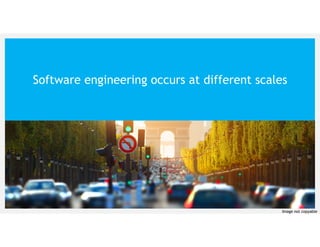
Software engineering occurs at different scales
Image not copyable
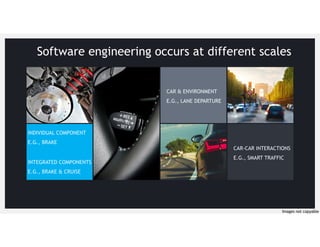
INDIVIDUAL COMPONENT
E.G., BRAKE
CAR & ENVIRONMENT
E.G., LANE DEPARTURE
CAR-CAR INTERACTIONS
E.G., SMART TRAFFIC
Software engineering occurs at different scales
INTEGRATED COMPONENTS
E.G., BRAKE & CRUISE
Images not copyable
Software engineering involves
multi-person multi-version development
— Brian Randell
[Parnas 2011]
Software engineering involves
multi-person multi-version development
And many more…
Tools to manage technical artifacts
Software engineering involves
multi-person multi-version development
And many more…
Tools to support social interaction
Software engineering involves
multi-person multi-version development
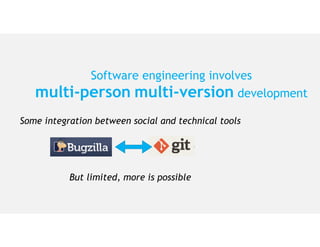
Some integration between social and technical tools
But limited, more is possible
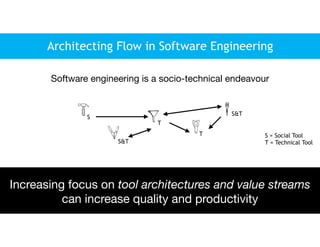
Architecting Flow in Software Engineering
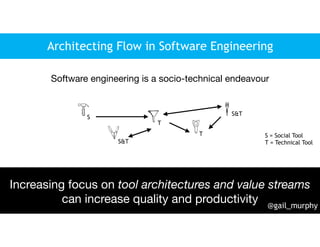
Software engineering is a socio-technical endeavour
T
V
Y
I
1
S
S&T
T
S&T
T
Increasing focus on tool architectures and value streams
can increase quality and productivity
S = Social Tool
T = Technical Tool
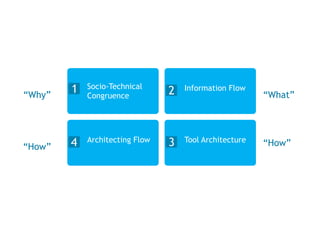
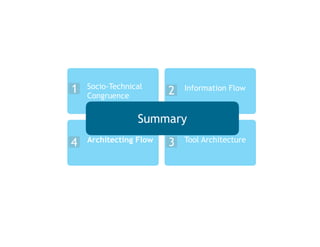
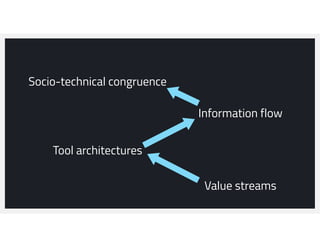
1 Socio-Technical
Congruence 2 Information Flow
3 Tool Architecture
4 Architecting Flow
“Why” “What”
“How”
“How”
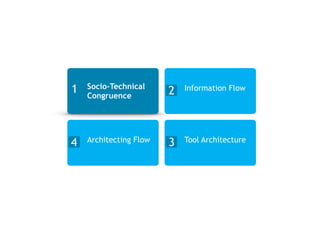
1 Socio-Technical
Congruence 2 Information Flow
3 Tool Architecture
4 Architecting Flow
Completely network collaborative
services via centric initiatives.
Completely network collaborative
services via centric initiatives.
Completely network collaborative
services via centric initiatives.
Socio-technical
congruence A
B
C
Technical dependencies between modules
Coordination needs between teams
Team
for A
Team
for C
Team
for B
Congruence leads to
improved productivity
Higher levels of congruence
associated with lower levels
of fault proneness
[Cataldo & Herbsleb, 2013]
Example 1: Within System
Cataldo & Herbsleb studied two developments in depth
- Project A - Distributed system for a data storage product
(114 developers, 5m lines of code, C & C++)
- Project B - Embedded system for automotive sector
(380 developers, 8 sites, 7m lines of code, C)
Less mature system
More mature system
finding that:
Higher-levels of socio-technical congruence are associated with better software quality. True for
both projects, but with more benefit for Project B (more mature).
Higher-levels of socio-technical congruence associated with improvements in productivity. True for
both projects, but with more benefit for Project A (less mature).
[Cataldo & Herbsleb, 2013]
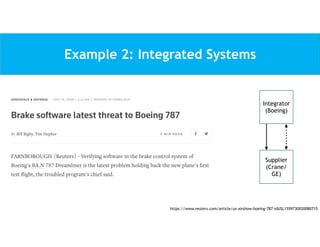
Example 2: Integrated Systems
Integrator
(Boeing)
Supplier
(Crane/
GE)
https://www.reuters.com/article/us-airshow-boeing-787-idUSL1559730020080715
Example 3: Between Systems
What happens in ecosystems that are weakly inter-connected, like Java?
Guava
mcMMO
Vault
Netty
Assertj
Junit
Appsgate
JSONassert
0%
25%
50%
75%
100%
4 32 256 2048
Number of user repositories
R
s
:
Ratio
of
user
repositories
having
a
social
link
Red Dots are Java projects
on GitHub.
The farther right, the more
other technically dependent
Java systems.
[Palyart, Murphy & Masrani, 2017]
Example 3: Between Systems
What happens in ecosystems that are weakly inter-connected, like Java?
Guava
mcMMO
Vault
Netty
Assertj
Junit
Appsgate
JSONassert
0%
25%
50%
75%
100%
4 32 256 2048
Number of user repositories
R
s
:
Ratio
of
user
repositories
having
a
social
link
This is a testing library
(JUnit) with lots of
systems using it.
[Palyart, Murphy & Masrani, 2017]
Example 3: Between Systems
What happens in ecosystems that are weakly inter-connected, like Java?
Guava
mcMMO
Vault
Netty
Assertj
Junit
Appsgate
JSONassert
0%
25%
50%
75%
100%
4 32 256 2048
Number of user repositories
R
s
:
Ratio
of
user
repositories
having
a
social
link
The vertical axis provides an
indication of how many of
the using systems have a
social dependence.
Reasonable number of using
systems and high-level of social
dependencies from those
systems.
Lots of users, less social
dependencies from those
systems.
[Palyart, Murphy & Masrani, 2017]
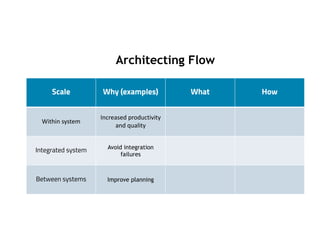
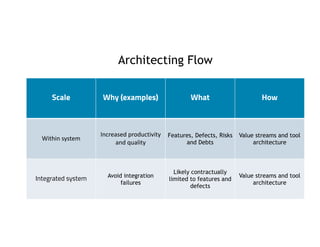
Scale Why (examples) What How
Within system
Increased productivity
and quality
Integrated system Avoid integration
failures
Between systems Improve planning
Architecting Flow
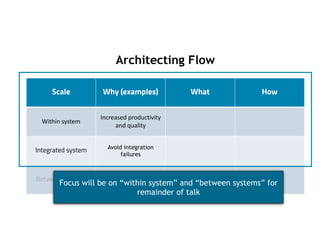
Scale Why (examples) What How
Within system
Increased productivity
and quality
Integrated system Avoid integration
failures
Between systems Improve planning
Architecting Flow
Focus will be on “within system” and “between systems” for
remainder of talk
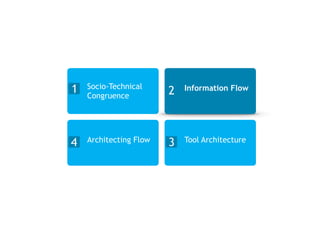
1 Socio-Technical
Congruence 2 Information Flow
3 Tool Architecture
4 Architecting Flow
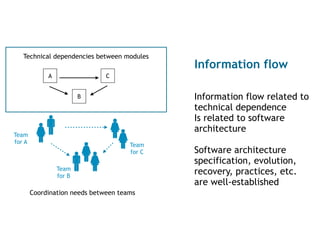
A
B
C
Technical dependencies between modules
Coordination needs between teams
Team
for A
Team
for C
Team
for B
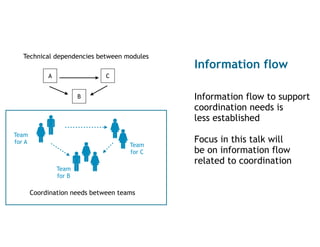
Information flow
Information flow related to
technical dependence
Is related to software
architecture
Software architecture
specification, evolution,
recovery, practices, etc.
are well-established
A
B
C
Technical dependencies between modules
Coordination needs between teams
Team
for A
Team
for C
Team
for B
Information flow
Information flow to support
coordination needs is
less established
Focus in this talk will
be on information flow
related to coordination
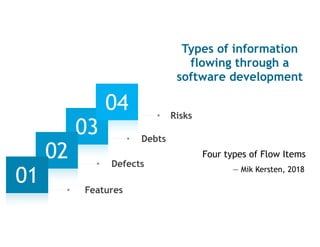
03
02
01
04
Features
Types of information
flowing through a
software development
Defects
Debts
Risks
Four types of Flow Items
— Mik Kersten, 2018
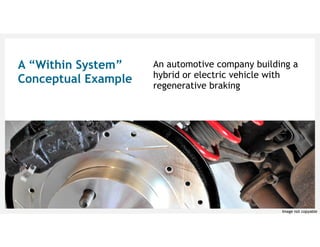
A “Within System”
Conceptual Example
An automotive company building a
hybrid or electric vehicle with
regenerative braking
Image not copyable
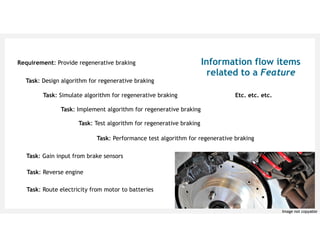
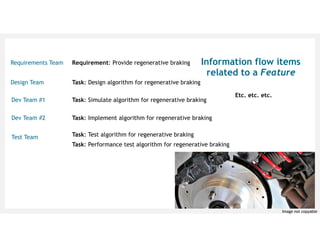
Requirement: Provide regenerative braking
Task: Design algorithm for regenerative braking
Task: Gain input from brake sensors
Task: Reverse engine
Task: Route electricity from motor to batteries
Task: Simulate algorithm for regenerative braking
Task: Implement algorithm for regenerative braking
Task: Test algorithm for regenerative braking
Task: Performance test algorithm for regenerative braking
Etc. etc. etc.
Information flow items
related to a Feature
Image not copyable
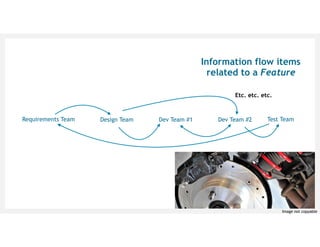
Requirement: Provide regenerative braking
Task: Design algorithm for regenerative braking
Task: Simulate algorithm for regenerative braking
Task: Implement algorithm for regenerative braking
Task: Test algorithm for regenerative braking
Task: Performance test algorithm for regenerative braking
Etc. etc. etc.
Information flow items
related to a Feature
Requirements Team
Design Team
Dev Team #1
Dev Team #2
Test Team
Image not copyable
Etc. etc. etc.
Information flow items
related to a Feature
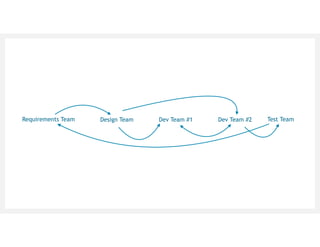
Requirements Team Design Team Dev Team #1 Dev Team #2 Test Team
Image not copyable
Etc. etc. etc.
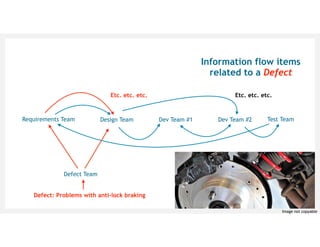
Information flow items
related to a Defect
Requirements Team Design Team Dev Team #1 Dev Team #2 Test Team
Defect Team
Defect: Problems with anti-lock braking
Etc. etc. etc.
Image not copyable
Etc. etc. etc.
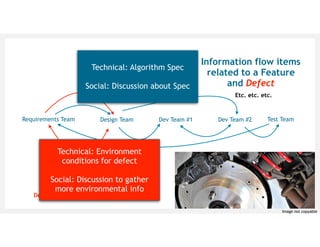
Information flow items
related to a Feature
and Defect
Requirements Team Design Team Dev Team #1 Dev Team #2 Test Team
Defect Team
Defect: Problems with anti-lock braking
Etc. etc. etc.
Technical: Algorithm Spec
Social: Discussion about Spec
Technical: Environment
conditions for defect
Social: Discussion to gather
more environmental info
Image not copyable
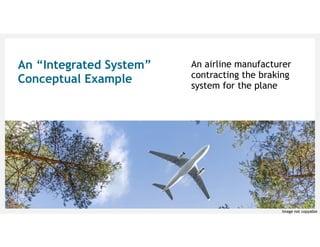
An “Integrated System”
Conceptual Example
An airline manufacturer
contracting the braking
system for the plane
Image not copyable
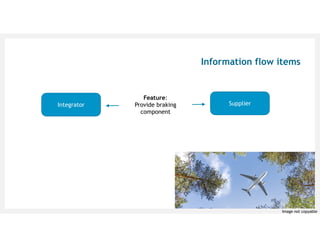
Information flow items
Feature:
Provide braking
component
Integrator Supplier
Image not copyable
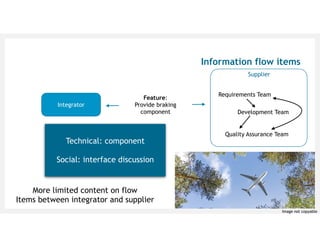
Information flow items
Feature:
Provide braking
component
Integrator
Supplier
Requirements Team
Development Team
Quality Assurance Team
Technical: component
Social: interface discussion
More limited content on flow
Items between integrator and supplier
Image not copyable
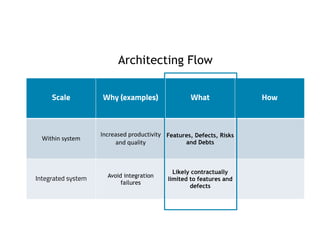
Scale Why (examples) What How
Within system
Increased productivity
and quality
Features, Defects, Risks
and Debts
Integrated system Avoid integration
failures
Likely contractually
limited to features and
defects
Architecting Flow
1 Socio-Technical
Congruence 2 Information Flow
3 Tool Architecture
4 Architecting Flow
Modularization of
software to reduce
team
interdependencies
degrades over time
Teams interchange
a variety of
technical and social
information during
development
Information flow is
constant, complex
and changing
Organization and
software structure
will not suffice
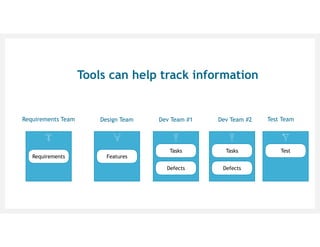
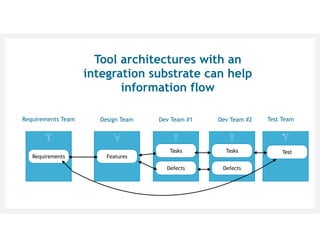
Requirements Team Design Team Dev Team #1 Dev Team #2 Test Team
Tools can help track information
T
Requirements
V
Features
I
Tasks
Defects
I
Tasks
Defects
Y
Test
Requirements Team Design Team Dev Team #1 Dev Team #2 Test Team
Tool architectures with an
integration substrate can help
information flow
T
Requirements
V
Features
I
Tasks
I
Tasks
Defects Defects
Y
Test
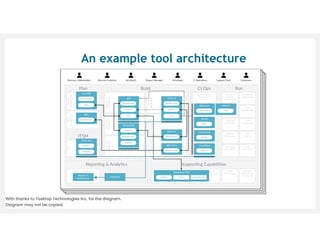
An example tool architecture
With thanks to Tasktop Technologies Inc. for the diagram.
Diagram may not be copied.
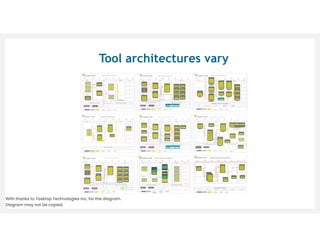
Tool architectures vary
With thanks to Tasktop Technologies Inc. for the diagram.
Diagram may not be copied.
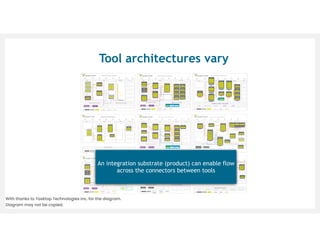
Tool architectures vary
With thanks to Tasktop Technologies Inc. for the diagram.
Diagram may not be copied.
An integration substrate (product) can enable flow
across the connectors between tools
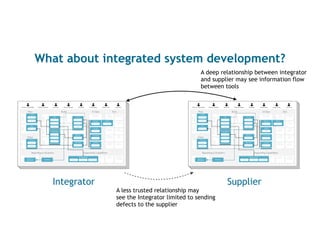
What about integrated system development?
Integrator Supplier
A deep relationship between integrator
and supplier may see information flow
between tools
A less trusted relationship may
see the Integrator limited to sending
defects to the supplier
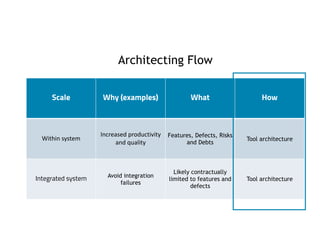
Scale Why (examples) What How
Within system
Increased productivity
and quality
Features, Defects, Risks
and Debts
Tool architecture
Integrated system Avoid integration
failures
Likely contractually
limited to features and
defects
Tool architecture
Architecting Flow
1 Socio-Technical
Congruence 2 Information Flow
3 Tool Architecture
4 Architecting Flow
Tool architectures
supported by an
integration
substrate enable
information flow
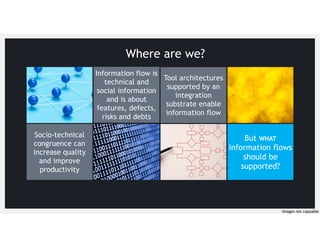
But WHAT
information flows
should be
supported?
Information flow is
technical and
social information
and is about
features, defects,
risks and debts
Socio-technical
congruence can
increase quality
and improve
productivity
Where are we?
Images not copyable
Completely network collaborative
services via centric initiatives.
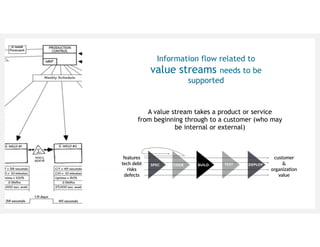
Information flow related to
value streams needs to be
supported
A value stream takes a product or service
from beginning through to a customer (who may
be internal or external)
Completely network collaborative
services via centric initiatives.
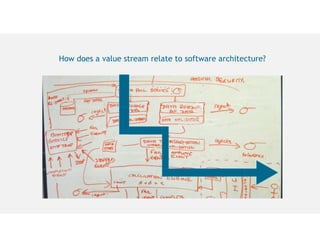
How does a value stream relate to software architecture?
47
Tasktop Viz
© Tasktop Technologies, Inc.
2017-2018. All rights reserved.
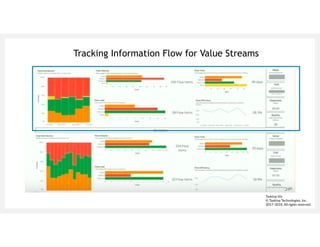
Tracking Information Flow for Value Streams
Scale
Within system
Integrated system
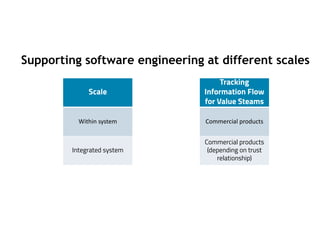
Supporting software engineering at different scales
Tracking
Information Flow
for Value Steams
Commercial products
Commercial products
(depending on trust
relationship)
Scale Why (examples) What How
Within system
Increased productivity
and quality
Features, Defects, Risks
and Debts
Value streams and tool
architecture
Integrated system Avoid integration
failures
Likely contractually
limited to features and
defects
Value streams and tool
architecture
Architecting Flow
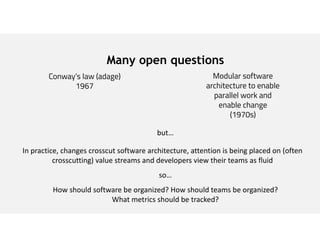
Many open questions
Conway’s law (adage)
1967
Modular software
architecture to enable
parallel work and
enable change
(1970s)
but…
In practice, changes crosscut software architecture, attention is being placed on (often
crosscutting) value streams and developers view their teams as fluid
so…
How should software be organized? How should teams be organized?
What metrics should be tracked?
T = Technical Tool
@gail_murphy
[Cataldo & Herbsleb, 2013] Cataldo, M. and Herbsleb, J. Coordination breakdowns and their
impact on development productivity and software failures. IEEE TSE, vol 39, no 3, 2013.
[Kersten, 2018] Kersten, M. Project to product: How to survive and thrive in the age of digital
disruption with the flow framework. IT Revolution Press, 2018.
[Palyart, Murphy & Masrani, 2017] Palyart, M., Murphy, G.C. and Masrani, V. A study of social interactions
in open source component use. IEEE TSE, vol 44, no 12, 2017.
[Parnas 2011] Parnas, D. Software engineering: Multi-person development of multi-version programs.
In Dependable and Historic Computing - Essays dedicated to Brian Randell on the Occasion of His 75th
Birthday. LNCS Vol. 6875, 2011.

Architecting-Flow-in-SE.pdf

  • 1.
    Architecting Flow in SoftwareEngineering G a i l C . M u r p h y U n i v e r s i t y o f B r i t i s h C o l u m b i a except for images where noted @gail_murphy
  • 2.
    Software engineering occursat different scales Image not copyable
  • 3.
    INDIVIDUAL COMPONENT E.G., BRAKE CAR& ENVIRONMENT E.G., LANE DEPARTURE CAR-CAR INTERACTIONS E.G., SMART TRAFFIC Software engineering occurs at different scales INTEGRATED COMPONENTS E.G., BRAKE & CRUISE Images not copyable
  • 4.
    Software engineering involves multi-personmulti-version development — Brian Randell [Parnas 2011]
  • 5.
    Software engineering involves multi-personmulti-version development And many more… Tools to manage technical artifacts
  • 6.
    Software engineering involves multi-personmulti-version development And many more… Tools to support social interaction
  • 7.
    Software engineering involves multi-personmulti-version development Some integration between social and technical tools But limited, more is possible
  • 8.
    Architecting Flow inSoftware Engineering Software engineering is a socio-technical endeavour T V Y I 1 S S&T T S&T T Increasing focus on tool architectures and value streams can increase quality and productivity S = Social Tool T = Technical Tool
  • 9.
    1 Socio-Technical Congruence 2Information Flow 3 Tool Architecture 4 Architecting Flow “Why” “What” “How” “How”
  • 10.
    1 Socio-Technical Congruence 2Information Flow 3 Tool Architecture 4 Architecting Flow
  • 11.
    Completely network collaborative servicesvia centric initiatives. Completely network collaborative services via centric initiatives. Completely network collaborative services via centric initiatives. Socio-technical congruence A B C Technical dependencies between modules Coordination needs between teams Team for A Team for C Team for B Congruence leads to improved productivity Higher levels of congruence associated with lower levels of fault proneness [Cataldo & Herbsleb, 2013]
  • 12.
    Example 1: WithinSystem Cataldo & Herbsleb studied two developments in depth - Project A - Distributed system for a data storage product (114 developers, 5m lines of code, C & C++) - Project B - Embedded system for automotive sector (380 developers, 8 sites, 7m lines of code, C) Less mature system More mature system finding that: Higher-levels of socio-technical congruence are associated with better software quality. True for both projects, but with more benefit for Project B (more mature). Higher-levels of socio-technical congruence associated with improvements in productivity. True for both projects, but with more benefit for Project A (less mature). [Cataldo & Herbsleb, 2013]
  • 13.
    Example 2: IntegratedSystems Integrator (Boeing) Supplier (Crane/ GE) https://www.reuters.com/article/us-airshow-boeing-787-idUSL1559730020080715
  • 14.
    Example 3: BetweenSystems What happens in ecosystems that are weakly inter-connected, like Java? Guava mcMMO Vault Netty Assertj Junit Appsgate JSONassert 0% 25% 50% 75% 100% 4 32 256 2048 Number of user repositories R s : Ratio of user repositories having a social link Red Dots are Java projects on GitHub. The farther right, the more other technically dependent Java systems. [Palyart, Murphy & Masrani, 2017]
  • 15.
    Example 3: BetweenSystems What happens in ecosystems that are weakly inter-connected, like Java? Guava mcMMO Vault Netty Assertj Junit Appsgate JSONassert 0% 25% 50% 75% 100% 4 32 256 2048 Number of user repositories R s : Ratio of user repositories having a social link This is a testing library (JUnit) with lots of systems using it. [Palyart, Murphy & Masrani, 2017]
  • 16.
    Example 3: BetweenSystems What happens in ecosystems that are weakly inter-connected, like Java? Guava mcMMO Vault Netty Assertj Junit Appsgate JSONassert 0% 25% 50% 75% 100% 4 32 256 2048 Number of user repositories R s : Ratio of user repositories having a social link The vertical axis provides an indication of how many of the using systems have a social dependence. Reasonable number of using systems and high-level of social dependencies from those systems. Lots of users, less social dependencies from those systems. [Palyart, Murphy & Masrani, 2017]
  • 17.
    Scale Why (examples)What How Within system Increased productivity and quality Integrated system Avoid integration failures Between systems Improve planning Architecting Flow
  • 18.
    Scale Why (examples)What How Within system Increased productivity and quality Integrated system Avoid integration failures Between systems Improve planning Architecting Flow Focus will be on “within system” and “between systems” for remainder of talk
  • 19.
    1 Socio-Technical Congruence 2Information Flow 3 Tool Architecture 4 Architecting Flow
  • 20.
    A B C Technical dependencies betweenmodules Coordination needs between teams Team for A Team for C Team for B Information flow Information flow related to technical dependence Is related to software architecture Software architecture specification, evolution, recovery, practices, etc. are well-established
  • 21.
    A B C Technical dependencies betweenmodules Coordination needs between teams Team for A Team for C Team for B Information flow Information flow to support coordination needs is less established Focus in this talk will be on information flow related to coordination
  • 22.
    03 02 01 04 Features Types of information flowingthrough a software development Defects Debts Risks Four types of Flow Items — Mik Kersten, 2018
  • 23.
    A “Within System” ConceptualExample An automotive company building a hybrid or electric vehicle with regenerative braking Image not copyable
  • 24.
    Requirement: Provide regenerativebraking Task: Design algorithm for regenerative braking Task: Gain input from brake sensors Task: Reverse engine Task: Route electricity from motor to batteries Task: Simulate algorithm for regenerative braking Task: Implement algorithm for regenerative braking Task: Test algorithm for regenerative braking Task: Performance test algorithm for regenerative braking Etc. etc. etc. Information flow items related to a Feature Image not copyable
  • 25.
    Requirement: Provide regenerativebraking Task: Design algorithm for regenerative braking Task: Simulate algorithm for regenerative braking Task: Implement algorithm for regenerative braking Task: Test algorithm for regenerative braking Task: Performance test algorithm for regenerative braking Etc. etc. etc. Information flow items related to a Feature Requirements Team Design Team Dev Team #1 Dev Team #2 Test Team Image not copyable
  • 26.
    Etc. etc. etc. Informationflow items related to a Feature Requirements Team Design Team Dev Team #1 Dev Team #2 Test Team Image not copyable
  • 27.
    Etc. etc. etc. Informationflow items related to a Defect Requirements Team Design Team Dev Team #1 Dev Team #2 Test Team Defect Team Defect: Problems with anti-lock braking Etc. etc. etc. Image not copyable
  • 28.
    Etc. etc. etc. Informationflow items related to a Feature and Defect Requirements Team Design Team Dev Team #1 Dev Team #2 Test Team Defect Team Defect: Problems with anti-lock braking Etc. etc. etc. Technical: Algorithm Spec Social: Discussion about Spec Technical: Environment conditions for defect Social: Discussion to gather more environmental info Image not copyable
  • 29.
    An “Integrated System” ConceptualExample An airline manufacturer contracting the braking system for the plane Image not copyable
  • 30.
    Information flow items Feature: Providebraking component Integrator Supplier Image not copyable
  • 31.
    Information flow items Feature: Providebraking component Integrator Supplier Requirements Team Development Team Quality Assurance Team Technical: component Social: interface discussion More limited content on flow Items between integrator and supplier Image not copyable
  • 32.
    Scale Why (examples)What How Within system Increased productivity and quality Features, Defects, Risks and Debts Integrated system Avoid integration failures Likely contractually limited to features and defects Architecting Flow
  • 33.
    1 Socio-Technical Congruence 2Information Flow 3 Tool Architecture 4 Architecting Flow
  • 34.
    Modularization of software toreduce team interdependencies degrades over time Teams interchange a variety of technical and social information during development Information flow is constant, complex and changing Organization and software structure will not suffice
  • 35.
    Requirements Team DesignTeam Dev Team #1 Dev Team #2 Test Team Tools can help track information T Requirements V Features I Tasks Defects I Tasks Defects Y Test
  • 36.
    Requirements Team DesignTeam Dev Team #1 Dev Team #2 Test Team
  • 37.
    Requirements Team DesignTeam Dev Team #1 Dev Team #2 Test Team Tool architectures with an integration substrate can help information flow T Requirements V Features I Tasks I Tasks Defects Defects Y Test
  • 38.
    An example toolarchitecture With thanks to Tasktop Technologies Inc. for the diagram. Diagram may not be copied.
  • 39.
    Tool architectures vary Withthanks to Tasktop Technologies Inc. for the diagram. Diagram may not be copied.
  • 40.
    Tool architectures vary Withthanks to Tasktop Technologies Inc. for the diagram. Diagram may not be copied. An integration substrate (product) can enable flow across the connectors between tools
  • 41.
    What about integratedsystem development? Integrator Supplier A deep relationship between integrator and supplier may see information flow between tools A less trusted relationship may see the Integrator limited to sending defects to the supplier
  • 42.
    Scale Why (examples)What How Within system Increased productivity and quality Features, Defects, Risks and Debts Tool architecture Integrated system Avoid integration failures Likely contractually limited to features and defects Tool architecture Architecting Flow
  • 43.
    1 Socio-Technical Congruence 2Information Flow 3 Tool Architecture 4 Architecting Flow
  • 44.
    Tool architectures supported byan integration substrate enable information flow But WHAT information flows should be supported? Information flow is technical and social information and is about features, defects, risks and debts Socio-technical congruence can increase quality and improve productivity Where are we? Images not copyable
  • 45.
    Completely network collaborative servicesvia centric initiatives. Information flow related to value streams needs to be supported A value stream takes a product or service from beginning through to a customer (who may be internal or external)
  • 46.
    Completely network collaborative servicesvia centric initiatives. How does a value stream relate to software architecture?
  • 47.
    47 Tasktop Viz © TasktopTechnologies, Inc. 2017-2018. All rights reserved. Tracking Information Flow for Value Streams
  • 48.
    Scale Within system Integrated system Supportingsoftware engineering at different scales Tracking Information Flow for Value Steams Commercial products Commercial products (depending on trust relationship)
  • 49.
    Scale Why (examples)What How Within system Increased productivity and quality Features, Defects, Risks and Debts Value streams and tool architecture Integrated system Avoid integration failures Likely contractually limited to features and defects Value streams and tool architecture Architecting Flow
  • 50.
    Many open questions Conway’slaw (adage) 1967 Modular software architecture to enable parallel work and enable change (1970s) but… In practice, changes crosscut software architecture, attention is being placed on (often crosscutting) value streams and developers view their teams as fluid so… How should software be organized? How should teams be organized? What metrics should be tracked?
  • 54.
    T = TechnicalTool @gail_murphy
  • 55.
    [Cataldo & Herbsleb,2013] Cataldo, M. and Herbsleb, J. Coordination breakdowns and their impact on development productivity and software failures. IEEE TSE, vol 39, no 3, 2013. [Kersten, 2018] Kersten, M. Project to product: How to survive and thrive in the age of digital disruption with the flow framework. IT Revolution Press, 2018. [Palyart, Murphy & Masrani, 2017] Palyart, M., Murphy, G.C. and Masrani, V. A study of social interactions in open source component use. IEEE TSE, vol 44, no 12, 2017. [Parnas 2011] Parnas, D. Software engineering: Multi-person development of multi-version programs. In Dependable and Historic Computing - Essays dedicated to Brian Randell on the Occasion of His 75th Birthday. LNCS Vol. 6875, 2011.