Supporting Collaborative Development and Collective Professional Autonomy
Stephen Murgatroyd, PhD FBPsS FRSA
Just a moment…
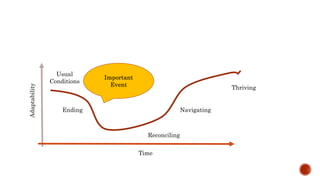
Time
Usual
Conditions
Ending
Reconciling
Navigating
Thriving
Adaptability
Supports
and
Enablers
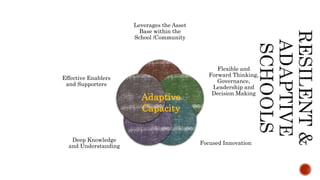
Leverages the Asset
Base within the
School /Community
Flexible and
Forward Thinking,
Governance,
Leadership and
Decision Making
Focused Innovation
Deep Knowledge
and Understanding
Effective Enablers
and Supporters
Adaptive
Capacity
RESILIENCE
OUR STUDENTS
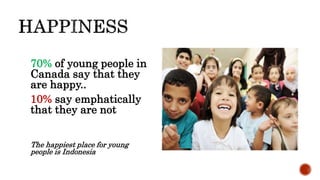
70% of young people in
Canada say that they
are happy..
10% say emphatically
that they are not
The happiest place for young
people is Indonesia
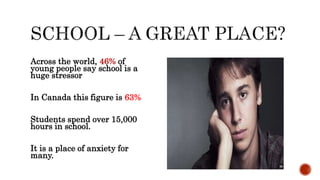
Across the world, 46% of
young people say school is a
huge stressor
In Canada this figure is 63%
Students spend over 15,000
hours in school.
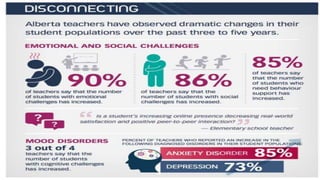
It is a place of anxiety for
many.
 Between 1978/79 and 2004, the
combined prevalence of obesity among
those aged 2 to 17 years in Canada
increased from 15 per cent to 26 per
cent.
 Increases were highest among youth,
aged 12 to 17 years, with overweight
and obesity more than doubling for
this age group, from 14 per cent to 29
per cent.
 Of young people diagnosed with Type 2
diabetes, 44% are First Nations, Metis
or Inuit.
Statistics Canada
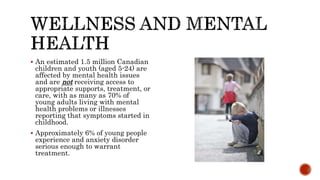
 An estimated 1.5 million Canadian
children and youth (aged 5-24) are
affected by mental health issues
and are not receiving access to
appropriate supports, treatment, or
care, with as many as 70% of
young adults living with mental
health problems or illnesses
reporting that symptoms started in
childhood.
 Approximately 6% of young people
experience and anxiety disorder
serious enough to warrant
treatment.
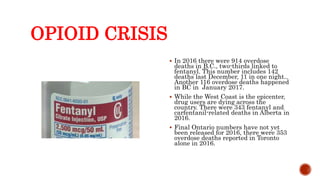
OPIOID CRISIS
 In 2016 there were 914 overdose
deaths in B.C., two-thirds linked to
fentanyl. This number includes 142
deaths last December, 11 in one night..
Another 116 overdose deaths happened
in BC in January 2017.
 While the West Coast is the epicenter,
drug users are dying across the
country. There were 343 fentanyl and
carfentanil-related deaths in Alberta in
2016.
 Final Ontario numbers have not yet
been released for 2016, there were 353
overdose deaths reported in Toronto
alone in 2016.
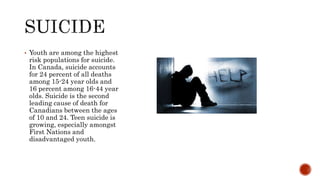
• Youth are among the highest
risk populations for suicide.
In Canada, suicide accounts
for 24 percent of all deaths
among 15-24 year olds and
16 percent among 16-44 year
olds. Suicide is the second
leading cause of death for
Canadians between the ages
of 10 and 24. Teen suicide is
growing, especially amongst
First Nations and
disadvantaged youth.
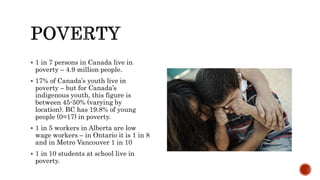
 1 in 7 persons in Canada live in
poverty – 4.9 million people.
 17% of Canada’s youth live in
poverty – but for Canada’s
indigenous youth, this figure is
between 45-50% (varying by
location). BC has 19.8% of young
people (0=17) in poverty.
 1 in 5 workers in Alberta are low
wage workers – in Ontario it is 1 in 8
and in Metro Vancouver 1 in 10
 1 in 10 students at school live in
poverty.
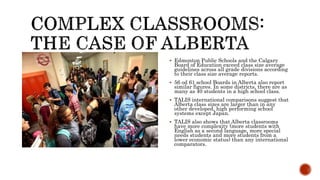
 Edmonton Public Schools and the Calgary
Board of Education exceed class size average
guidelines across all grade divisions according
to their class size average reports.
 56 od 61 school Boards in Alberta also report
similar figures. In some districts, there are as
many as 40 students in a high school class.
 TALIS international comparisons suggest that
Alberta class sizes are larger than in any
other developed, high performing school
systems except Japan.
 TALIS also shows that Alberta classrooms
have more complexity (more students with
English as a second language, more special
needs students and more students from a
lower economic status) than any international
comparators.
 Average annual pay of top 1% of
Canadians is $454,800 (2013) – they
take 10.6% of all Canadian earnings
 If we look at 2005-12, the top 10% of
Canadians saw income rise by 42%
while the bottom 10% saw it fall 15%
 The richest 60 Canadians hold 70%
of the country’s wealth.
 Because of..
 Technological advances
 Greater access to education across the
life-cycle
 Faster and easier communication
 Global sense of citizenship
 Youthful commitment to peace
 But are fearful of..
 Warmongering by the US
 Growing inequality in Canada
 Climate change / environment
 What they say:
 Authenticity
 Engagement
 Respect
 Richness of Experience
 What they want
 Authentic learning
 Compassion and respect for them as
persons - e.g. as part of the design of
learning
 Challenge
 Feedback which enables not disables
 Structure
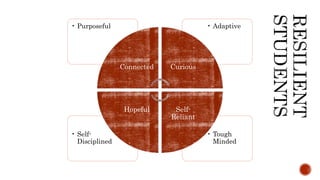
• Tough
Minded
• Self-
Disciplined
• Adaptive• Purposeful
Connected Curious
Self-
Reliant
Hopeful
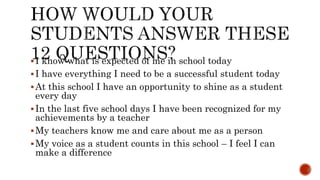
I know what is expected of me in school today
I have everything I need to be a successful student today
At this school I have an opportunity to shine as a student
every day
In the last five school days I have been recognized for my
achievements by a teacher
My teachers know me and care about me as a person
My voice as a student counts in this school – I feel I can
make a difference
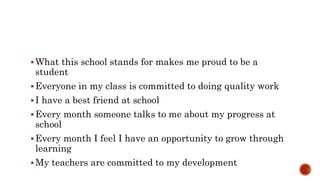
What this school stands for makes me proud to be a
student
Everyone in my class is committed to doing quality work
I have a best friend at school
Every month someone talks to me about my progress at
school
Every month I feel I have an opportunity to grow through
learning
My teachers are committed to my development
“The future isn’t what it used to be..” Yogi Berra
 Technological Change
 35% of all existing jobs will go by 2030 as a result of 3D printing, Robotics, Artificial
Intelligence and related technologies (stem-cells, graphene, etc.)
 Self-driving cars, buses, trains and trucks likely to replace current transport systems over
time – potential displacement of some 3.5 million North American workers by 2030
 570,000 surgeries in 2014 were robotically assisted
 Demographic Shifts
 By 2030, 30% of Canadians will be over 60 years of age
 There will be 2 working age people in Canada for each retiree – down from 4 in 2015.
 GDP could fall by as much as 52% (McKinsey)
 More seniors than students in K-12 for the first time.
 Austerity
 Per-capita investments in public education falling as complexity increases
 Economics
 By 2025 almost 50% of the world’s billion dollar companies will be headquartered in
emerging markets, not in North America or Europe (41% of them are already Asian
based)
 425 major cities will fuel the global economy – 315 of them are in Asia
 Environment
 Climate change and extreme weather events will change forests, rivers, habits and eco-
systems.
 9.5 Billion People will live on earth by 2050
 One impact of environmental change is increased migration, especially due to water
related issues
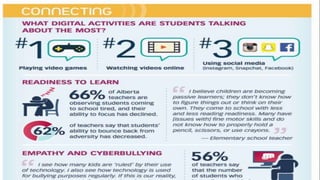
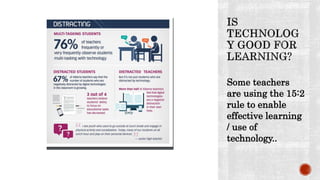
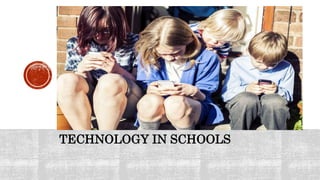
TECHNOLOGY IN SCHOOLS
Some teachers
are using the 15:2
rule to enable
effective learning
/ use of
technology..
…is NOT a
straight line
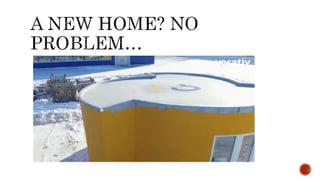
from the past…
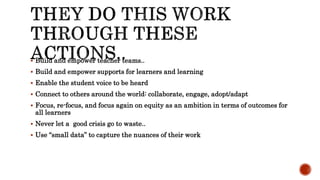
 Build and empower teacher teams..
 Build and empower supports for learners and learning
 Enable the student voice to be heard
 Connect to others around the world: collaborate, engage, adopt/adapt
 Focus, re-focus, and focus again on equity as an ambition in terms of outcomes for
all learners
 Never let a good crisis go to waste..
 Use “small data” to capture the nuances of their work
How changing language can change
behaviour. A school used to use the
language of “students at risk” and
sought to encourage faculty identify
students who were at risk. Few faculty
did so. But when they changed this
ask to “identify students with promise
whose promise is unfilled” not only did
they get a much larger response, they
also received a great many suggestions
from faculty about what an
appropriate response to the students
need might be.
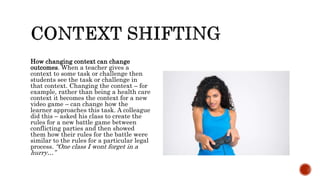
How changing context can change
outcomes. When a teacher gives a
context to some task or challenge then
students see the task or challenge in
that context. Changing the context – for
example, rather than being a health care
context it becomes the context for a new
video game – can change how the
learner approaches this task. A colleague
did this – asked his class to create the
rules for a new battle game between
conflicting parties and then showed
them how their rules for the battle were
similar to the rules for a particular legal
process. “One class I wont forget in a
hurry…”
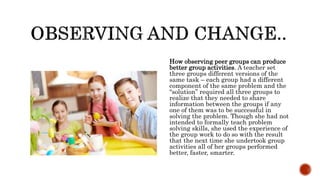
How observing peer groups can produce
better group activities. A teacher set
three groups different versions of the
same task – each group had a different
component of the same problem and the
“solution” required all three groups to
realize that they needed to share
information between the groups if any
one of them was to be successful in
solving the problem. Though she had not
intended to formally teach problem
solving skills, she used the experience of
the group work to do so with the result
that the next time she undertook group
activities all of her groups performed
better, faster, smarter.
How watching an individual student try
to master a complex problem can help
identify problem solving skills which can
be shared. The teacher sat with a
student who was struggling with some
basic chemistry. Rather than explain the
chemistry, the faculty member explored
how the student was thinking about the
work and what kind of processes they
were using to “solve” the problem. This
generated several insights not why this
and other students were struggling with
thinking like a chemist and led to
significant changes in the design and
delivery of these courses.
SENSE-MAKING….SO WHAT!
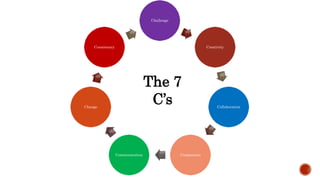
Challenge
Creativity
Collaboration
CompassionCommunication
Change
Consistency
The 7
C’s
1. “No one else is coming…” (Margaret Wheatley) – the school is “it” in terms of
impact on the lives of learners
2. Trying to manage and control professionals is like trying to build an aeroplan
in flight – professionals need to be engaged and own their work, we can help
them focus and align
3. Student voice matters – if we dont engage them in this work it is not
surprising that they disengage.
4. The future is now – many parents and students worry about “getting ready
for the future” (work, etc.). The future is now.
5. The real work of the school is to create a climate of trust, engagement and
enjoyment; to build resilience and adaptive capacity – it’s supposed to be fun!
murgatroydstephen@gmail.com
@murgatroydsteph

Abbotsford Whistler Presentation

  • 1.
    Supporting Collaborative Developmentand Collective Professional Autonomy Stephen Murgatroyd, PhD FBPsS FRSA
  • 3.
  • 16.
  • 18.
    Supports and Enablers Leverages the Asset Basewithin the School /Community Flexible and Forward Thinking, Governance, Leadership and Decision Making Focused Innovation Deep Knowledge and Understanding Effective Enablers and Supporters Adaptive Capacity
  • 19.
  • 20.
    70% of youngpeople in Canada say that they are happy.. 10% say emphatically that they are not The happiest place for young people is Indonesia
  • 21.
    Across the world,46% of young people say school is a huge stressor In Canada this figure is 63% Students spend over 15,000 hours in school. It is a place of anxiety for many.
  • 22.
     Between 1978/79and 2004, the combined prevalence of obesity among those aged 2 to 17 years in Canada increased from 15 per cent to 26 per cent.  Increases were highest among youth, aged 12 to 17 years, with overweight and obesity more than doubling for this age group, from 14 per cent to 29 per cent.  Of young people diagnosed with Type 2 diabetes, 44% are First Nations, Metis or Inuit. Statistics Canada
  • 23.
     An estimated1.5 million Canadian children and youth (aged 5-24) are affected by mental health issues and are not receiving access to appropriate supports, treatment, or care, with as many as 70% of young adults living with mental health problems or illnesses reporting that symptoms started in childhood.  Approximately 6% of young people experience and anxiety disorder serious enough to warrant treatment.
  • 24.
    OPIOID CRISIS  In2016 there were 914 overdose deaths in B.C., two-thirds linked to fentanyl. This number includes 142 deaths last December, 11 in one night.. Another 116 overdose deaths happened in BC in January 2017.  While the West Coast is the epicenter, drug users are dying across the country. There were 343 fentanyl and carfentanil-related deaths in Alberta in 2016.  Final Ontario numbers have not yet been released for 2016, there were 353 overdose deaths reported in Toronto alone in 2016.
  • 25.
    • Youth areamong the highest risk populations for suicide. In Canada, suicide accounts for 24 percent of all deaths among 15-24 year olds and 16 percent among 16-44 year olds. Suicide is the second leading cause of death for Canadians between the ages of 10 and 24. Teen suicide is growing, especially amongst First Nations and disadvantaged youth.
  • 26.
     1 in7 persons in Canada live in poverty – 4.9 million people.  17% of Canada’s youth live in poverty – but for Canada’s indigenous youth, this figure is between 45-50% (varying by location). BC has 19.8% of young people (0=17) in poverty.  1 in 5 workers in Alberta are low wage workers – in Ontario it is 1 in 8 and in Metro Vancouver 1 in 10  1 in 10 students at school live in poverty.
  • 27.
     Edmonton PublicSchools and the Calgary Board of Education exceed class size average guidelines across all grade divisions according to their class size average reports.  56 od 61 school Boards in Alberta also report similar figures. In some districts, there are as many as 40 students in a high school class.  TALIS international comparisons suggest that Alberta class sizes are larger than in any other developed, high performing school systems except Japan.  TALIS also shows that Alberta classrooms have more complexity (more students with English as a second language, more special needs students and more students from a lower economic status) than any international comparators.
  • 28.
     Average annualpay of top 1% of Canadians is $454,800 (2013) – they take 10.6% of all Canadian earnings  If we look at 2005-12, the top 10% of Canadians saw income rise by 42% while the bottom 10% saw it fall 15%  The richest 60 Canadians hold 70% of the country’s wealth.
  • 29.
     Because of.. Technological advances  Greater access to education across the life-cycle  Faster and easier communication  Global sense of citizenship  Youthful commitment to peace  But are fearful of..  Warmongering by the US  Growing inequality in Canada  Climate change / environment
  • 31.
     What theysay:  Authenticity  Engagement  Respect  Richness of Experience  What they want  Authentic learning  Compassion and respect for them as persons - e.g. as part of the design of learning  Challenge  Feedback which enables not disables  Structure
  • 32.
    • Tough Minded • Self- Disciplined •Adaptive• Purposeful Connected Curious Self- Reliant Hopeful
  • 33.
    I know whatis expected of me in school today I have everything I need to be a successful student today At this school I have an opportunity to shine as a student every day In the last five school days I have been recognized for my achievements by a teacher My teachers know me and care about me as a person My voice as a student counts in this school – I feel I can make a difference
  • 34.
    What this schoolstands for makes me proud to be a student Everyone in my class is committed to doing quality work I have a best friend at school Every month someone talks to me about my progress at school Every month I feel I have an opportunity to grow through learning My teachers are committed to my development
  • 35.
    “The future isn’twhat it used to be..” Yogi Berra
  • 37.
     Technological Change 35% of all existing jobs will go by 2030 as a result of 3D printing, Robotics, Artificial Intelligence and related technologies (stem-cells, graphene, etc.)  Self-driving cars, buses, trains and trucks likely to replace current transport systems over time – potential displacement of some 3.5 million North American workers by 2030  570,000 surgeries in 2014 were robotically assisted  Demographic Shifts  By 2030, 30% of Canadians will be over 60 years of age  There will be 2 working age people in Canada for each retiree – down from 4 in 2015.  GDP could fall by as much as 52% (McKinsey)  More seniors than students in K-12 for the first time.  Austerity  Per-capita investments in public education falling as complexity increases
  • 38.
     Economics  By2025 almost 50% of the world’s billion dollar companies will be headquartered in emerging markets, not in North America or Europe (41% of them are already Asian based)  425 major cities will fuel the global economy – 315 of them are in Asia  Environment  Climate change and extreme weather events will change forests, rivers, habits and eco- systems.  9.5 Billion People will live on earth by 2050  One impact of environmental change is increased migration, especially due to water related issues
  • 39.
  • 42.
    Some teachers are usingthe 15:2 rule to enable effective learning / use of technology..
  • 43.
    …is NOT a straightline from the past…
  • 45.
     Build andempower teacher teams..  Build and empower supports for learners and learning  Enable the student voice to be heard  Connect to others around the world: collaborate, engage, adopt/adapt  Focus, re-focus, and focus again on equity as an ambition in terms of outcomes for all learners  Never let a good crisis go to waste..  Use “small data” to capture the nuances of their work
  • 46.
    How changing languagecan change behaviour. A school used to use the language of “students at risk” and sought to encourage faculty identify students who were at risk. Few faculty did so. But when they changed this ask to “identify students with promise whose promise is unfilled” not only did they get a much larger response, they also received a great many suggestions from faculty about what an appropriate response to the students need might be.
  • 47.
    How changing contextcan change outcomes. When a teacher gives a context to some task or challenge then students see the task or challenge in that context. Changing the context – for example, rather than being a health care context it becomes the context for a new video game – can change how the learner approaches this task. A colleague did this – asked his class to create the rules for a new battle game between conflicting parties and then showed them how their rules for the battle were similar to the rules for a particular legal process. “One class I wont forget in a hurry…”
  • 48.
    How observing peergroups can produce better group activities. A teacher set three groups different versions of the same task – each group had a different component of the same problem and the “solution” required all three groups to realize that they needed to share information between the groups if any one of them was to be successful in solving the problem. Though she had not intended to formally teach problem solving skills, she used the experience of the group work to do so with the result that the next time she undertook group activities all of her groups performed better, faster, smarter.
  • 49.
    How watching anindividual student try to master a complex problem can help identify problem solving skills which can be shared. The teacher sat with a student who was struggling with some basic chemistry. Rather than explain the chemistry, the faculty member explored how the student was thinking about the work and what kind of processes they were using to “solve” the problem. This generated several insights not why this and other students were struggling with thinking like a chemist and led to significant changes in the design and delivery of these courses.
  • 50.
  • 52.
  • 53.
    1. “No oneelse is coming…” (Margaret Wheatley) – the school is “it” in terms of impact on the lives of learners 2. Trying to manage and control professionals is like trying to build an aeroplan in flight – professionals need to be engaged and own their work, we can help them focus and align 3. Student voice matters – if we dont engage them in this work it is not surprising that they disengage. 4. The future is now – many parents and students worry about “getting ready for the future” (work, etc.). The future is now. 5. The real work of the school is to create a climate of trust, engagement and enjoyment; to build resilience and adaptive capacity – it’s supposed to be fun!
  • 54.

Editor's Notes

  • #14 ECOSYSTEM Every child comes from a complex family, cultural and social system Every teacher comes from a different complex, family, cultural and social system coupled with assumptions about their role, professionalism and tasks Every school is placed in a community and communities have complex histories, biographies and dynamics Every school is part of a school system and no two schools within that system are the same and no two school systems are the same Every school has rhythms, disruptions and dynamics which change daily - superficially the same, always different
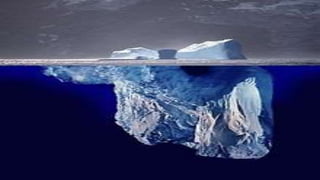
  • #15 We can see the surface – the “tip of the iceberg” But beneath this tip of the “iceberg” ecosystem are: Change and opportunity dynamics Resistance dynamics Expectations and performance dynamics The drama of the lives of students, teachers and leaders The failings of the school in terms of equity, performance and compassion Deviation dynamics – the exceptions, the “falling through the cracks” challenges
  • #19 Adaptive Capacity
  • #21 Source:Generation Z Global Citizenship Survey Varkey Foundation (January, 2017)
  • #31 STUDENT VOICE