Topic 2: Ethiopian Health Service
Program and Regulations
By: MULUGETA.D (BSC.HI)
Introduction
• The development and provision of equitable
and acceptable standard of health services to
all segments of the population of Ethiopia has
been a major objective of the National Health
Policy.
• The national health policy to be realized,
strategies have to be designed and
implemented.
Learning objectives
At the end of this topic, the learner should be
able to:
Understand the Ethiopian health policy
 Describe health service program of the
country
Identify health care system regulations
Explain health information system policies and
procedures
Ethiopian health policy
Policy: The set of basic principles formulated and
enforced by the governing body to direct and
limit actions
Health Policies: policy is decisions, plans, and
actions to achieve specific health care goals
(WHO)
 Outlining priorities and the expected roles of
different groups.
Building consensus and inform people.
Strategies: A method or plan chosen to bring
about a desired future, such as achievement of
goals or solution to a problem
Regulation: A legal provision that creates,
limits a duty, or allocates a responsibility.
Guideline: A guideline is a statement by which
to determine a course of action.
May be issued by and used by any organization
Rule: Rule refers to standards for activities
Procedure: A procedure is a document written
to support a policy. following the change of
gov’t in 1991 a new 1993 policy w/c has 20yrs
HSPD drafted
Facts Considered during Ethiopian Health Policy
Development
Life expectancy at birth is estimated 53 years
Parasitic and infectious diseases account for high
mortality and morbidity.
Malnutrition is prevalent
workers are exposed to accident and illness
Environmental problems great proportion of
communicable diseases
Modern health care systems are inadequate
pharmaceutical sector is not well developed
Indigenous health technologies that need
upgrade
Development of health needs support by
science & technology(HST)
uncoordinated h/activities led to duplication of
efforts and wastage of insufficient resources.
HST suffers lack of adequate infrastructure
Focus of comprehensive health policies are:
 Communicable diseases
Malnutrition
Improving maternal and child health
Basic Components Of Ethiopian Health Policy.
I. General policy
The main focus areas of the 1993 policy were:
1. Democratization and decentralization
2. Preventive and promotive components
3. Equitable and acceptable standard of healthcare
4. Strengthening inter-sectoral activities.
5. Conducive env’t strengthening national self-
reliance in health development
6. accessibility of health care for all segments
7. Working closely with neighboring countries
8. To develop appropriate capacity building
9. Provision of health care for the population on a
scheme of payment according to ability
II. Priorities of the policy
I.E.C(Information, Education and Communication)
to propagate the important concepts
Emphasis to control communicable, epidemics
and diseases related to poor living conditions
Appropriate support to curative and rehabilitative
 Attention to Traditional Medicine.
Applied health research addressing the major
health problems shall be emphasized.
Provision of essential medicines, medical supplies
and equipments
Emphasis on expansion of the number of
frontline and middle level health professionals
Special attention family those of neglected region
III. General strategies
Democratization-Budgeting,planning
implementation, M&E represent committee.
Decentralization
Inter-sectoral collaboration
Health Education – using all possible media
Promotive and Preventive: control of common
endemic and epidemic
Human Resource Development shall focus on:
Developing of the team approach and training
Availability of Drugs, Supplies and Equipment
TM shall be accorded appropriate attention
Health Systems Research shall be given due
emphasis
Referral System
Health Management Information System
Financing the Health Services
The following options shall be considered and
evaluated.
 Raising taxes and revenues
 Formal contributions of insurance by public
employees
 Legislative requirements of a contributory health
fund for employees of the private sector
 Individual or group health insurance
 Voluntary contributions
Health Service Development Program
HSDP differ phase to phase like HEW program
included since the second phase
HSDP is considered as a policy
implementation strategic document that
guides the development of plans and sets the
rule of engagement
The major objectives of the HSDP –I, II & III
 Increase access and coverage & utilization
Improve service quality through training and an
improved supply of necessary inputs
Strengthen management of health services at
Federal and Regional levels. And these led to
achievement of some programs like HIV/AIDS, TB,
malaria…….
HSDP phase IV
Unlike the previous phases government
developed the strategic plan for HSDP IV
(Marginal Budgeting for Bottleneck (MBB) &
BALANCED SCORE CARD)
The key components of the method used to
develop the HSDP IV.
These are:
1) Policy framework
2) Health sector strategic assessment
3) Strategy of HSDP
4) Strategic Objectives
5) Performance Measures and Strategic
Initiatives of HSDP IV
6) Costing & Financing of HSDP-IV
Policy framework
Objectives have set for effective health
interventions with the aim of reaching every
section of population 2015 G.C. (MDG)
This includes the national and other national
health related policies. Like HIV/AIDs, CDC,
population policy, women, transformations plan
goals number 1, 4, 5, 6,7and 8 are directly linked
to the health sector.(6 goals)
MDGS
TARGETS
Target1. Halve, between 1990 and 2015, the
proportion of people whose income is less
than one dollar a day.
Target 2. Halve, people suffer Hunger between
1990 and 2015
Target 4. Eliminate gender disparity in primary
and secondary education
Target5. Reduce child mortality by two thirds,
between 1990 and 2015, the under-five
mortality rate
Target 6. Reduce by three quarters, between
1990 and 2015, the maternal mortality ratio.
Target 7. Have halted by 2015 and begun to
reverse the spread of HIV/AIDS.
Target 8. Have halted by 2015 and begun to
reverse the incidence of malaria and other
major diseases.
Target 9. Integrate the principles of
sustainable development into country policies
and programs and reverse the loss of
environmental resources.
Target 10. Halve by 2015 the proportion of
people without sustainable access to safe
drinking water.
Target 18. In cooperation with the private
sector, make available the benefits of new
technologies, especially information and
communications.
Health sector strategic assessment
Mandates formally defined in the Ethiopian laws
and regulations for FMOH and RHB.
Some of the roles of administrative health
institutions are:
Role of Federal ministry of Health:
Initiate policies and laws, prepare plans and
budget, and upon approval implement same.
Causing the expansion of health services.
Establishing and administering referral hospitals
as well as study and research centers.
 Determining the qualifications of
professionals to engaged in public health
services
Undertaking the necessary quarantine control
to protect public health.
Determining standards to be maintained by
health services.
Devising/plan strategies, means and ways for
the implementation of prevention, control and
eradication of communicable diseases.
Role of Regional health bureau:
 Prepare, on the basis of the health policy of the country, the health
care plan and program for the people
 Organize and administer hospitals, research and training
institutions
 Issue license to health centers, clinics, laboratories and pharmacies
of all type
 Provision of vaccinations, and take other measures, to prevent and
eradicate CDC
 Participate in quarantine control for the protection of public health.
 Ascertain the nutritional value of foods.
Role of woreda health office:
In addition to FMOH; district H/admins play
crucial roles in implementation of HSDP IV, Some
of these include:
Providing political leadership for health.
Ensuring the community’s demand for health
care
Planning, resource mobilization and allocation,
M&E and the delivery of health services.
Facilitating inter-sectoral collaboration.
 Provide guidance to enhance the partnership
with NGOs, CSOs, private sector
Strategy of HSDP IV
Has three key elements. These are:
1. Customer’s core values= attributes that define
services
2. strategic themes= key areas to achieve vision &
Mission. These strategic themes are:
organization’s pillars of excellence!
 Excellence in Health Service Delivery and quality of
care
 Excellence in Leadership and Governance
 Excellence in Health Infrastructure and Resources
3. prospective has three relations
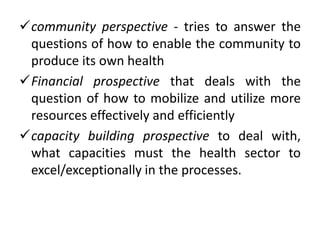
community perspective - tries to answer the
questions of how to enable the community to
produce its own health
Financial prospective that deals with the
question of how to mobilize and utilize more
resources effectively and efficiently
capacity building prospective to deal with,
what capacities must the health sector to
excel/exceptionally in the processes.
Strategic Objectives and Map for the Ethiopian
Health Sector
About ten strategic objectives for HSDP IV
development process
1. Improve Access to Health Services
Maternal, neonatal, child and adolescent health
Nutrition
Hygiene and Environmental Health
Prevention and Control of Major communicable
Diseases
Reduce Incidence and Prevalence of HIV/AIDS
Reduce Incidence and prevalence of TB & Leprosy
Reduce Incidence and prevalence of Malaria
Reduce Incidence and prevalence of other
communicable Disease
Prevention and Control of Non Communicable
Diseases
2. Improve community ownership
3. Maximize resource mobilization and utilization
4. Improve quality of health services
5. Improve Public Health Emergency Preparedness
and Reponses
6. Improve Pharmaceutical Supply and Services
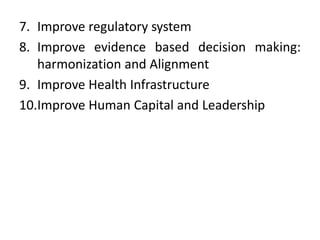
7. Improve regulatory system
8. Improve evidence based decision making:
harmonization and Alignment
9. Improve Health Infrastructure
10.Improve Human Capital and Leadership
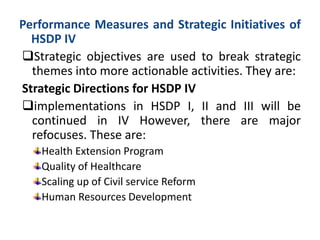
Performance Measures and Strategic Initiatives of
HSDP IV
Strategic objectives are used to break strategic
themes into more actionable activities. They are:
Strategic Directions for HSDP IV
implementations in HSDP I, II and III will be
continued in IV However, there are major
refocuses. These are:
Health Extension Program
Quality of Healthcare
Scaling up of Civil service Reform
Human Resources Development
Health Infrastructure (Construction and ICT)
Special Support to Emerging Regions
Climate Changes and Health
Gender Mainstreaming
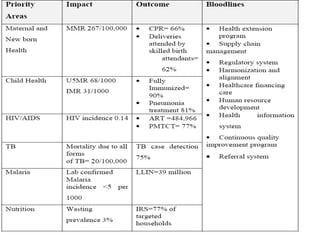
Table 2.1 Summarized priorities and targets of
HSDP IV (source: HSDP IV)
Health Extension Program
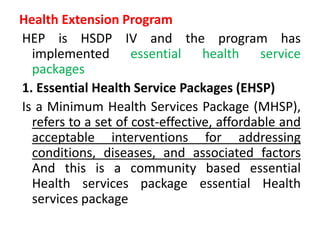
HEP is HSDP IV and the program has
implemented essential health service
packages
1. Essential Health Service Packages (EHSP)
Is a Minimum Health Services Package (MHSP),
refers to a set of cost-effective, affordable and
acceptable interventions for addressing
conditions, diseases, and associated factors
And this is a community based essential
Health services package essential Health
services package
The EHSP is organized into five components
1. Family health services
Maternal and New born care
◦ Antenatal care
◦ Delivery services
◦ Post natal care
Child health services
◦ Integrated management of Childhood Illnesses (IMCI)
◦ Growth Monitoring and Promotion
◦ Immunization
◦ Promotion of essential nutritional action (ENA)
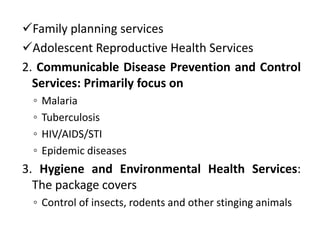
Family planning services
Adolescent Reproductive Health Services
2. Communicable Disease Prevention and Control
Services: Primarily focus on
◦ Malaria
◦ Tuberculosis
◦ HIV/AIDS/STI
◦ Epidemic diseases
3. Hygiene and Environmental Health Services:
The package covers
◦ Control of insects, rodents and other stinging animals
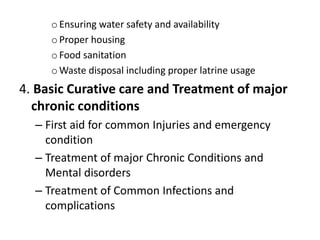
oEnsuring water safety and availability
oProper housing
oFood sanitation
oWaste disposal including proper latrine usage
4. Basic Curative care and Treatment of major
chronic conditions
– First aid for common Injuries and emergency
condition
– Treatment of major Chronic Conditions and
Mental disorders
– Treatment of Common Infections and
complications
5. Health Education and Communication
Services
IEC activities, a key component of EHSP, at all
levels integrated with all other components
Costing and Financing of HSDP-IV
Known obstacles to the proven high impact
interventions are lack of resources and weak
implementation capacity.
Major Health Related Legislations in Ethiopia
In 1886 yohannis allowed smallbox vaccination
but modern medicine back to the time of
emperor H/selassie 1930
On July 18, 1930 a law was passed to regulate
the practice of doctors, dentists, pharmacists,
midwives and veterinarians that no one
should practices these without deploma
Between 1941and present time, some 27
Public Health enactments were made
available, some of them were:
Public Health Proclamation (NG 91, 1947, 66-68)
Medical Practitioners Registration Proclamation
(NG 100, 1948, 1-3)
Establishment of Ethiopian Pharmaceutical
Manufacturing Factory NG 167/1994
Council of Minister of regulation established
regulation no (NG 174/1994) to provide for
licensing and supervision of Health service
Institution.
Establishment of the Pharmaceutical and Medical
supplies import and wholesome sale enterprise
(NG 176/1994)
Nutrition Research Institute Established under
council of ministry of regulation( NG 4/1996)
Establishment of Health Education Center NG
40/1998
Establishment of Ethiopian Health
Professional Council (NG 76/2002)
Establishment of FMHACA ( Regulation No
661/2009)
Currently, there are more health regulation
initiatives on the pipeline under FMHACA.
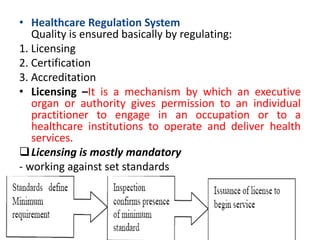
• Healthcare Regulation System
Quality is ensured basically by regulating:
1. Licensing
2. Certification
3. Accreditation
• Licensing –It is a mechanism by which an executive
organ or authority gives permission to an individual
practitioner to engage in an occupation or to a
healthcare institutions to operate and deliver health
services.
Licensing is mostly mandatory
- working against set standards
A. Facility Licensing
B. Health practitioners licensing
The regulatory body issuing license is
accountable to
1. Set standardized requirements
2. Examine applicants’ credentials meet the
preset legal and administrative requirement
3. Administration of examinations to test the
academic and practical qualifications
4. Granting of licenses
5. Investigation of charges of violation of
standards(suspension or revocation for
violators.)
2. Certification: Certification is a process by
which a recognized authority—either a
governmental agency or nongovernmental
organization—evaluates and recognizes an
individual provider or an organization as
having met pre-determined requirements,
usually to demonstrate competence in a
specialty area.
Evaluates and recognizes an individual
provider or an organization
Unlike licensing certification programs are
usually voluntary
3. Accreditation: A formal process by which a
recognized accrediting body assesses and
recognizes that a healthcare organization meets
pre-established performance.
• Accreditation standards are usually regarded as
optimal yet achievable and are designed to
encourage continuous improvement efforts
within accredited organizations.
Regulating Ethiopian Healthcare Facilities
operational procedures
Operational Standards for Patient Flow
1. Procedures are established to ensure efficient patient
flow at all units to reduce patient crowding
2. The health facility (hospital) has an Emergency Triage
well equipped
3. The health facility (hospital) has a Central Triage, well
equipped
4. All patients undergo triage(except laboring mothers)
5. Outpatient appointment systems are in place
6. Appointment systems are in place for elective
inpatient admissions in all disciplines
7. Hospital has a Liaison and Referral Service that:
◦ Manages bed occupancy,
– Facilitates emergency and non-emergency
– Receives referrals from, and makes referrals
8. Health facility (hospital) has a written
protocol for the admission and discharge
9. Health facility (hospital) has a Referrals
Service Directory
10. Criteria for the referral
11. Health facility (hospital) has a standardized
method for managing referrals.
12. Health facility staff members are familiar
with the referral systems
13. Health facility (hospital) promotes and
publicizes the referral system and Services
should be organized in such a way that:
– Minimizes patient travel time between services;
and
– Reduces the likelihood of patients getting lost
when going from place to place
Emergency Services: organized for Emergency
Service’s entrance
Emergency Triage: separate Emergency
Department entrance
Central Triage: assign each patient to an
appropriate case team
Outpatient Case Management: Patients enter the
OPD pathway from Central Triage
Inpatient Services: close proximity to the
emergency and outpatient with separate rooms
or area for sexes
Admission process: have a written protocol for
the admission (P/E,HX,..immediate mgt)
• Nursing Assessment should be completed
within 24 hrs and a Nursing Care Plan
developed.
Discharge Process: written protocol (discharge
summary , handling medical record
&counseling)
Patient death : confirmed by a physician
– A death summary
– the cause of death written &
– a post mortem examination
Maternity/Delivery Services: ANC, PNC, delivery
suite & neonatal unit.
Liaison and Referral Service:
Manage hospital bed occupancy (bed mgt)
 Facilitate emergency and non-emergency
(elective) admissions
Provide social service support to OPD, IPD,
Emergency Unit
• Manage the referral service, specifically:
– Coordinate the overall referral activities health
facility
– Record and report the referral activities to facility
mgt
– Compile, analyze and interpret data to improve
the referral service
– Take part in the quality assurance programs of the
referral system by participating in regular review
meetings within and outside the health facility
– Ensure feedback is sent back to the referring
health facility
HIS Policies and Procedures
 HIS legal issue, enables the establishment of
mechanisms to ensure data availability, exchange
and quality
 HIS unit in FMOH is established with HMIS but
lack policy regulations that is why this needed.
Health Information Related Initiatives
Objectives
Develop and implement a comprehensive and
standardized national HMIS and evidence based
planning and management of health services.
To review and strengthen the existing HMIS at all
levels
To achieve 80% completeness and timely
submission health and administrative reports.
Achieve 100% of evidence based planning at
woreda health office and hospital level.
The strategy for implementation of HMIS
objectives are:
Institutionalize HMIS at all levels.
Build capacity of health workers to analyze,
interpret and use health information for
decisions.
 Introduce appropriate HMIS technology at all
levels
 Define the minimum standard of inputs
required for HMIS at different levels.
 Initiate and sustain regular program review
and feedback system.
The breakdown of the plan are:
A. The key activities at the Woreda Health
Offices level are:
Establishment of HMIS posts and assignment of
appropriate personnel by national standard.
 Determination of the qualification
requirements, job descriptions for personnel
working on HMIS.
proper reporting and feedback mechanism
 necessary health and administrative reports
Allocate funds for HMIS
Implement and monitor HMIS with the RHBs.
 Collaborate on the expansion of the
geographic information system and woreda
connectivity.
B. Key Activities at the Regional Health Bureaus Level
 Adapt and implement in plan breakdown
Adapt and implement National HMIS Strategy, manuals
and standards developed at national level.
Conduct regular on-the-job training to HMIS focal
personnel, program managers and health workers.
Equip HMIS units at all levels.
Implement HMIS in collaboration with the FMOH.
Collaborate on the establishment of electronic network
from federal to woreda
 Initiate and sustain the development Indicators in the
regions.
 Advocate the allocation of adequate funds
C. Key Activities at the Federal Ministry of Health Level are:
 Assign a multidisciplinary team at Planning unit
 Develop and popularize the National HMIS Strategy
 Develop and popularize qualification requirements, job
descriptions, and career path and incentive
 Standardize HMIS indicators collect data by demographic
disaggregated.
 Develop, adapt and implement HMIS user-friendly
guidelines and revise ICD coding system.
 Initiate pre-service training on HMIS in health
professional training institutions.
 Implement HMIS on pilot basis before nationwide
Conduct system analysis for the application of
ICT to HMIS
Mobilize funds for implementation of National
HMIS.
 Monitor the implementation of program
review and research recommendations
through HMIS.
 Publish Health and Health Related Indictors
bulletin annually.
Be in your 1-5 grouping and do the following questions.
Every individual should actively participate and expected to
deliver his/her understanding of the questions.
1. What is the major objective of the national health policy of
Ethiopia ? 3pts
2. List at least 4 health enactments being taken in to account
during the national health policy development? 3pts
3. List the basic components of MHSPs? 4pts
4. Differentiate licensing, certification and accreditation ? 5pts
5. What are the strategies for implementation of HMIS
objectives ? 5pts
Topic 2

Topic 2

  • 1.
    Topic 2: EthiopianHealth Service Program and Regulations By: MULUGETA.D (BSC.HI)
  • 2.
    Introduction • The developmentand provision of equitable and acceptable standard of health services to all segments of the population of Ethiopia has been a major objective of the National Health Policy. • The national health policy to be realized, strategies have to be designed and implemented.
  • 3.
    Learning objectives At theend of this topic, the learner should be able to: Understand the Ethiopian health policy  Describe health service program of the country Identify health care system regulations Explain health information system policies and procedures
  • 4.
    Ethiopian health policy Policy:The set of basic principles formulated and enforced by the governing body to direct and limit actions Health Policies: policy is decisions, plans, and actions to achieve specific health care goals (WHO)  Outlining priorities and the expected roles of different groups. Building consensus and inform people. Strategies: A method or plan chosen to bring about a desired future, such as achievement of goals or solution to a problem
  • 5.
    Regulation: A legalprovision that creates, limits a duty, or allocates a responsibility. Guideline: A guideline is a statement by which to determine a course of action. May be issued by and used by any organization Rule: Rule refers to standards for activities Procedure: A procedure is a document written to support a policy. following the change of gov’t in 1991 a new 1993 policy w/c has 20yrs HSPD drafted
  • 6.
    Facts Considered duringEthiopian Health Policy Development Life expectancy at birth is estimated 53 years Parasitic and infectious diseases account for high mortality and morbidity. Malnutrition is prevalent workers are exposed to accident and illness Environmental problems great proportion of communicable diseases Modern health care systems are inadequate pharmaceutical sector is not well developed Indigenous health technologies that need upgrade
  • 7.
    Development of healthneeds support by science & technology(HST) uncoordinated h/activities led to duplication of efforts and wastage of insufficient resources. HST suffers lack of adequate infrastructure Focus of comprehensive health policies are:  Communicable diseases Malnutrition Improving maternal and child health
  • 8.
    Basic Components OfEthiopian Health Policy. I. General policy The main focus areas of the 1993 policy were: 1. Democratization and decentralization 2. Preventive and promotive components 3. Equitable and acceptable standard of healthcare 4. Strengthening inter-sectoral activities. 5. Conducive env’t strengthening national self- reliance in health development 6. accessibility of health care for all segments 7. Working closely with neighboring countries
  • 9.
    8. To developappropriate capacity building 9. Provision of health care for the population on a scheme of payment according to ability II. Priorities of the policy I.E.C(Information, Education and Communication) to propagate the important concepts Emphasis to control communicable, epidemics and diseases related to poor living conditions Appropriate support to curative and rehabilitative  Attention to Traditional Medicine. Applied health research addressing the major health problems shall be emphasized.
  • 10.
    Provision of essentialmedicines, medical supplies and equipments Emphasis on expansion of the number of frontline and middle level health professionals Special attention family those of neglected region III. General strategies Democratization-Budgeting,planning implementation, M&E represent committee. Decentralization Inter-sectoral collaboration Health Education – using all possible media
  • 11.
    Promotive and Preventive:control of common endemic and epidemic Human Resource Development shall focus on: Developing of the team approach and training Availability of Drugs, Supplies and Equipment TM shall be accorded appropriate attention Health Systems Research shall be given due emphasis Referral System Health Management Information System
  • 12.
    Financing the HealthServices The following options shall be considered and evaluated.  Raising taxes and revenues  Formal contributions of insurance by public employees  Legislative requirements of a contributory health fund for employees of the private sector  Individual or group health insurance  Voluntary contributions
  • 13.
    Health Service DevelopmentProgram HSDP differ phase to phase like HEW program included since the second phase HSDP is considered as a policy implementation strategic document that guides the development of plans and sets the rule of engagement The major objectives of the HSDP –I, II & III  Increase access and coverage & utilization Improve service quality through training and an improved supply of necessary inputs
  • 14.
    Strengthen management ofhealth services at Federal and Regional levels. And these led to achievement of some programs like HIV/AIDS, TB, malaria……. HSDP phase IV Unlike the previous phases government developed the strategic plan for HSDP IV (Marginal Budgeting for Bottleneck (MBB) & BALANCED SCORE CARD)
  • 15.
    The key componentsof the method used to develop the HSDP IV. These are: 1) Policy framework 2) Health sector strategic assessment 3) Strategy of HSDP 4) Strategic Objectives 5) Performance Measures and Strategic Initiatives of HSDP IV 6) Costing & Financing of HSDP-IV
  • 16.
    Policy framework Objectives haveset for effective health interventions with the aim of reaching every section of population 2015 G.C. (MDG) This includes the national and other national health related policies. Like HIV/AIDs, CDC, population policy, women, transformations plan goals number 1, 4, 5, 6,7and 8 are directly linked to the health sector.(6 goals)
  • 17.
  • 18.
    TARGETS Target1. Halve, between1990 and 2015, the proportion of people whose income is less than one dollar a day. Target 2. Halve, people suffer Hunger between 1990 and 2015 Target 4. Eliminate gender disparity in primary and secondary education Target5. Reduce child mortality by two thirds, between 1990 and 2015, the under-five mortality rate
  • 19.
    Target 6. Reduceby three quarters, between 1990 and 2015, the maternal mortality ratio. Target 7. Have halted by 2015 and begun to reverse the spread of HIV/AIDS. Target 8. Have halted by 2015 and begun to reverse the incidence of malaria and other major diseases. Target 9. Integrate the principles of sustainable development into country policies and programs and reverse the loss of environmental resources.
  • 20.
    Target 10. Halveby 2015 the proportion of people without sustainable access to safe drinking water. Target 18. In cooperation with the private sector, make available the benefits of new technologies, especially information and communications.
  • 21.
    Health sector strategicassessment Mandates formally defined in the Ethiopian laws and regulations for FMOH and RHB. Some of the roles of administrative health institutions are: Role of Federal ministry of Health: Initiate policies and laws, prepare plans and budget, and upon approval implement same. Causing the expansion of health services. Establishing and administering referral hospitals as well as study and research centers.
  • 22.
     Determining thequalifications of professionals to engaged in public health services Undertaking the necessary quarantine control to protect public health. Determining standards to be maintained by health services. Devising/plan strategies, means and ways for the implementation of prevention, control and eradication of communicable diseases.
  • 23.
    Role of Regionalhealth bureau:  Prepare, on the basis of the health policy of the country, the health care plan and program for the people  Organize and administer hospitals, research and training institutions  Issue license to health centers, clinics, laboratories and pharmacies of all type  Provision of vaccinations, and take other measures, to prevent and eradicate CDC  Participate in quarantine control for the protection of public health.  Ascertain the nutritional value of foods.
  • 24.
    Role of woredahealth office: In addition to FMOH; district H/admins play crucial roles in implementation of HSDP IV, Some of these include: Providing political leadership for health. Ensuring the community’s demand for health care Planning, resource mobilization and allocation, M&E and the delivery of health services. Facilitating inter-sectoral collaboration.  Provide guidance to enhance the partnership with NGOs, CSOs, private sector
  • 25.
    Strategy of HSDPIV Has three key elements. These are: 1. Customer’s core values= attributes that define services 2. strategic themes= key areas to achieve vision & Mission. These strategic themes are: organization’s pillars of excellence!  Excellence in Health Service Delivery and quality of care  Excellence in Leadership and Governance  Excellence in Health Infrastructure and Resources 3. prospective has three relations
  • 26.
    community perspective -tries to answer the questions of how to enable the community to produce its own health Financial prospective that deals with the question of how to mobilize and utilize more resources effectively and efficiently capacity building prospective to deal with, what capacities must the health sector to excel/exceptionally in the processes.
  • 27.
    Strategic Objectives andMap for the Ethiopian Health Sector About ten strategic objectives for HSDP IV development process 1. Improve Access to Health Services Maternal, neonatal, child and adolescent health Nutrition Hygiene and Environmental Health Prevention and Control of Major communicable Diseases Reduce Incidence and Prevalence of HIV/AIDS Reduce Incidence and prevalence of TB & Leprosy
  • 28.
    Reduce Incidence andprevalence of Malaria Reduce Incidence and prevalence of other communicable Disease Prevention and Control of Non Communicable Diseases 2. Improve community ownership 3. Maximize resource mobilization and utilization 4. Improve quality of health services 5. Improve Public Health Emergency Preparedness and Reponses 6. Improve Pharmaceutical Supply and Services
  • 29.
    7. Improve regulatorysystem 8. Improve evidence based decision making: harmonization and Alignment 9. Improve Health Infrastructure 10.Improve Human Capital and Leadership
  • 30.
    Performance Measures andStrategic Initiatives of HSDP IV Strategic objectives are used to break strategic themes into more actionable activities. They are: Strategic Directions for HSDP IV implementations in HSDP I, II and III will be continued in IV However, there are major refocuses. These are: Health Extension Program Quality of Healthcare Scaling up of Civil service Reform Human Resources Development
  • 31.
    Health Infrastructure (Constructionand ICT) Special Support to Emerging Regions Climate Changes and Health Gender Mainstreaming Table 2.1 Summarized priorities and targets of HSDP IV (source: HSDP IV)
  • 33.
    Health Extension Program HEPis HSDP IV and the program has implemented essential health service packages 1. Essential Health Service Packages (EHSP) Is a Minimum Health Services Package (MHSP), refers to a set of cost-effective, affordable and acceptable interventions for addressing conditions, diseases, and associated factors And this is a community based essential Health services package essential Health services package
  • 34.
    The EHSP isorganized into five components 1. Family health services Maternal and New born care ◦ Antenatal care ◦ Delivery services ◦ Post natal care Child health services ◦ Integrated management of Childhood Illnesses (IMCI) ◦ Growth Monitoring and Promotion ◦ Immunization ◦ Promotion of essential nutritional action (ENA)
  • 35.
    Family planning services AdolescentReproductive Health Services 2. Communicable Disease Prevention and Control Services: Primarily focus on ◦ Malaria ◦ Tuberculosis ◦ HIV/AIDS/STI ◦ Epidemic diseases 3. Hygiene and Environmental Health Services: The package covers ◦ Control of insects, rodents and other stinging animals
  • 36.
    oEnsuring water safetyand availability oProper housing oFood sanitation oWaste disposal including proper latrine usage 4. Basic Curative care and Treatment of major chronic conditions – First aid for common Injuries and emergency condition – Treatment of major Chronic Conditions and Mental disorders – Treatment of Common Infections and complications
  • 37.
    5. Health Educationand Communication Services IEC activities, a key component of EHSP, at all levels integrated with all other components Costing and Financing of HSDP-IV Known obstacles to the proven high impact interventions are lack of resources and weak implementation capacity.
  • 38.
    Major Health RelatedLegislations in Ethiopia In 1886 yohannis allowed smallbox vaccination but modern medicine back to the time of emperor H/selassie 1930 On July 18, 1930 a law was passed to regulate the practice of doctors, dentists, pharmacists, midwives and veterinarians that no one should practices these without deploma Between 1941and present time, some 27 Public Health enactments were made available, some of them were:
  • 39.
    Public Health Proclamation(NG 91, 1947, 66-68) Medical Practitioners Registration Proclamation (NG 100, 1948, 1-3) Establishment of Ethiopian Pharmaceutical Manufacturing Factory NG 167/1994 Council of Minister of regulation established regulation no (NG 174/1994) to provide for licensing and supervision of Health service Institution. Establishment of the Pharmaceutical and Medical supplies import and wholesome sale enterprise (NG 176/1994)
  • 40.
    Nutrition Research InstituteEstablished under council of ministry of regulation( NG 4/1996) Establishment of Health Education Center NG 40/1998 Establishment of Ethiopian Health Professional Council (NG 76/2002) Establishment of FMHACA ( Regulation No 661/2009) Currently, there are more health regulation initiatives on the pipeline under FMHACA.
  • 41.
    • Healthcare RegulationSystem Quality is ensured basically by regulating: 1. Licensing 2. Certification 3. Accreditation • Licensing –It is a mechanism by which an executive organ or authority gives permission to an individual practitioner to engage in an occupation or to a healthcare institutions to operate and deliver health services. Licensing is mostly mandatory - working against set standards A. Facility Licensing B. Health practitioners licensing
  • 42.
    The regulatory bodyissuing license is accountable to 1. Set standardized requirements 2. Examine applicants’ credentials meet the preset legal and administrative requirement 3. Administration of examinations to test the academic and practical qualifications 4. Granting of licenses 5. Investigation of charges of violation of standards(suspension or revocation for violators.)
  • 43.
    2. Certification: Certificationis a process by which a recognized authority—either a governmental agency or nongovernmental organization—evaluates and recognizes an individual provider or an organization as having met pre-determined requirements, usually to demonstrate competence in a specialty area. Evaluates and recognizes an individual provider or an organization Unlike licensing certification programs are usually voluntary
  • 44.
    3. Accreditation: Aformal process by which a recognized accrediting body assesses and recognizes that a healthcare organization meets pre-established performance. • Accreditation standards are usually regarded as optimal yet achievable and are designed to encourage continuous improvement efforts within accredited organizations. Regulating Ethiopian Healthcare Facilities operational procedures
  • 45.
    Operational Standards forPatient Flow 1. Procedures are established to ensure efficient patient flow at all units to reduce patient crowding 2. The health facility (hospital) has an Emergency Triage well equipped 3. The health facility (hospital) has a Central Triage, well equipped 4. All patients undergo triage(except laboring mothers) 5. Outpatient appointment systems are in place 6. Appointment systems are in place for elective inpatient admissions in all disciplines 7. Hospital has a Liaison and Referral Service that: ◦ Manages bed occupancy,
  • 46.
    – Facilitates emergencyand non-emergency – Receives referrals from, and makes referrals 8. Health facility (hospital) has a written protocol for the admission and discharge 9. Health facility (hospital) has a Referrals Service Directory 10. Criteria for the referral 11. Health facility (hospital) has a standardized method for managing referrals. 12. Health facility staff members are familiar with the referral systems
  • 47.
    13. Health facility(hospital) promotes and publicizes the referral system and Services should be organized in such a way that: – Minimizes patient travel time between services; and – Reduces the likelihood of patients getting lost when going from place to place
  • 48.
    Emergency Services: organizedfor Emergency Service’s entrance Emergency Triage: separate Emergency Department entrance Central Triage: assign each patient to an appropriate case team Outpatient Case Management: Patients enter the OPD pathway from Central Triage Inpatient Services: close proximity to the emergency and outpatient with separate rooms or area for sexes
  • 49.
    Admission process: havea written protocol for the admission (P/E,HX,..immediate mgt) • Nursing Assessment should be completed within 24 hrs and a Nursing Care Plan developed. Discharge Process: written protocol (discharge summary , handling medical record &counseling)
  • 50.
    Patient death :confirmed by a physician – A death summary – the cause of death written & – a post mortem examination Maternity/Delivery Services: ANC, PNC, delivery suite & neonatal unit. Liaison and Referral Service: Manage hospital bed occupancy (bed mgt)  Facilitate emergency and non-emergency (elective) admissions Provide social service support to OPD, IPD, Emergency Unit
  • 51.
    • Manage thereferral service, specifically: – Coordinate the overall referral activities health facility – Record and report the referral activities to facility mgt – Compile, analyze and interpret data to improve the referral service – Take part in the quality assurance programs of the referral system by participating in regular review meetings within and outside the health facility – Ensure feedback is sent back to the referring health facility
  • 52.
    HIS Policies andProcedures  HIS legal issue, enables the establishment of mechanisms to ensure data availability, exchange and quality  HIS unit in FMOH is established with HMIS but lack policy regulations that is why this needed. Health Information Related Initiatives Objectives Develop and implement a comprehensive and standardized national HMIS and evidence based planning and management of health services.
  • 53.
    To review andstrengthen the existing HMIS at all levels To achieve 80% completeness and timely submission health and administrative reports. Achieve 100% of evidence based planning at woreda health office and hospital level. The strategy for implementation of HMIS objectives are: Institutionalize HMIS at all levels. Build capacity of health workers to analyze, interpret and use health information for decisions.
  • 54.
     Introduce appropriateHMIS technology at all levels  Define the minimum standard of inputs required for HMIS at different levels.  Initiate and sustain regular program review and feedback system. The breakdown of the plan are: A. The key activities at the Woreda Health Offices level are: Establishment of HMIS posts and assignment of appropriate personnel by national standard.
  • 55.
     Determination ofthe qualification requirements, job descriptions for personnel working on HMIS. proper reporting and feedback mechanism  necessary health and administrative reports Allocate funds for HMIS Implement and monitor HMIS with the RHBs.  Collaborate on the expansion of the geographic information system and woreda connectivity.
  • 56.
    B. Key Activitiesat the Regional Health Bureaus Level  Adapt and implement in plan breakdown Adapt and implement National HMIS Strategy, manuals and standards developed at national level. Conduct regular on-the-job training to HMIS focal personnel, program managers and health workers. Equip HMIS units at all levels. Implement HMIS in collaboration with the FMOH. Collaborate on the establishment of electronic network from federal to woreda  Initiate and sustain the development Indicators in the regions.  Advocate the allocation of adequate funds
  • 57.
    C. Key Activitiesat the Federal Ministry of Health Level are:  Assign a multidisciplinary team at Planning unit  Develop and popularize the National HMIS Strategy  Develop and popularize qualification requirements, job descriptions, and career path and incentive  Standardize HMIS indicators collect data by demographic disaggregated.  Develop, adapt and implement HMIS user-friendly guidelines and revise ICD coding system.  Initiate pre-service training on HMIS in health professional training institutions.  Implement HMIS on pilot basis before nationwide
  • 58.
    Conduct system analysisfor the application of ICT to HMIS Mobilize funds for implementation of National HMIS.  Monitor the implementation of program review and research recommendations through HMIS.  Publish Health and Health Related Indictors bulletin annually.
  • 59.
    Be in your1-5 grouping and do the following questions. Every individual should actively participate and expected to deliver his/her understanding of the questions. 1. What is the major objective of the national health policy of Ethiopia ? 3pts 2. List at least 4 health enactments being taken in to account during the national health policy development? 3pts 3. List the basic components of MHSPs? 4pts 4. Differentiate licensing, certification and accreditation ? 5pts 5. What are the strategies for implementation of HMIS objectives ? 5pts

Editor's Notes

  • #3 What is the major objective of the national health policy of Ethiopia ? 3pts
  • #7 List at least 4 health enactments being taken in to account during the national health policy development? 3pts
  • #42 The goal of licensing is not to define desirable quality but to define the minimum acceptable level of capability to deliver service