
Prepared by
Iyad I. Shaqura
PhD Health Service Management
Tehran University of Medical Sciences
2018
Decentralization in Healthcare
OUTLINE
• Definition of Decentralization
• Why Decentralization?
• Forms/ Pillars of Decentralization.
• Factors affecting Decentralization.
• Objectives, Rationale and some Controversies of Health Decentralization.
• Advantages of Decentralization.
• Limitations of Decentralization.
• Challenges to Health Sector Decentralization.
What is Decentralization?
• Decentralization is the distribution or transfer of power, control
or authority form central government to local and regional
authority.
• Decentralization is the restructuring of authority so that there is
system of co-responsibility between institutions of governance at
the central, regional and local levels according to the principle of
solidarity, thus increasing the overall quality and effectiveness of
the systems of governance, while increasing the authority and
capabilities of sub-national levels. (UNDP)
Why Decentralization?
• Better coordination and corporation at action level.
• Improved implementation of health program.
• Better transparency and accountability.
• Ensures sustainability.
• Improves equity and quality of care.
• Reduction in duplication of health services.
• Improves delivery and utilization of health service.
• More community participation in health sector development
activities.
• Capacity for district health planning is improved.
Forms/ Pillars of Decentralization
• De-concentration: (transfer of responsibility/
authority to lower administrative level)
• Devolution: (transfer of responsibility/ authority to
lower political level)
• Delegation: (transfer of managerial responsibility)
• Privatization: (transfer of governmental function
to private ownership).
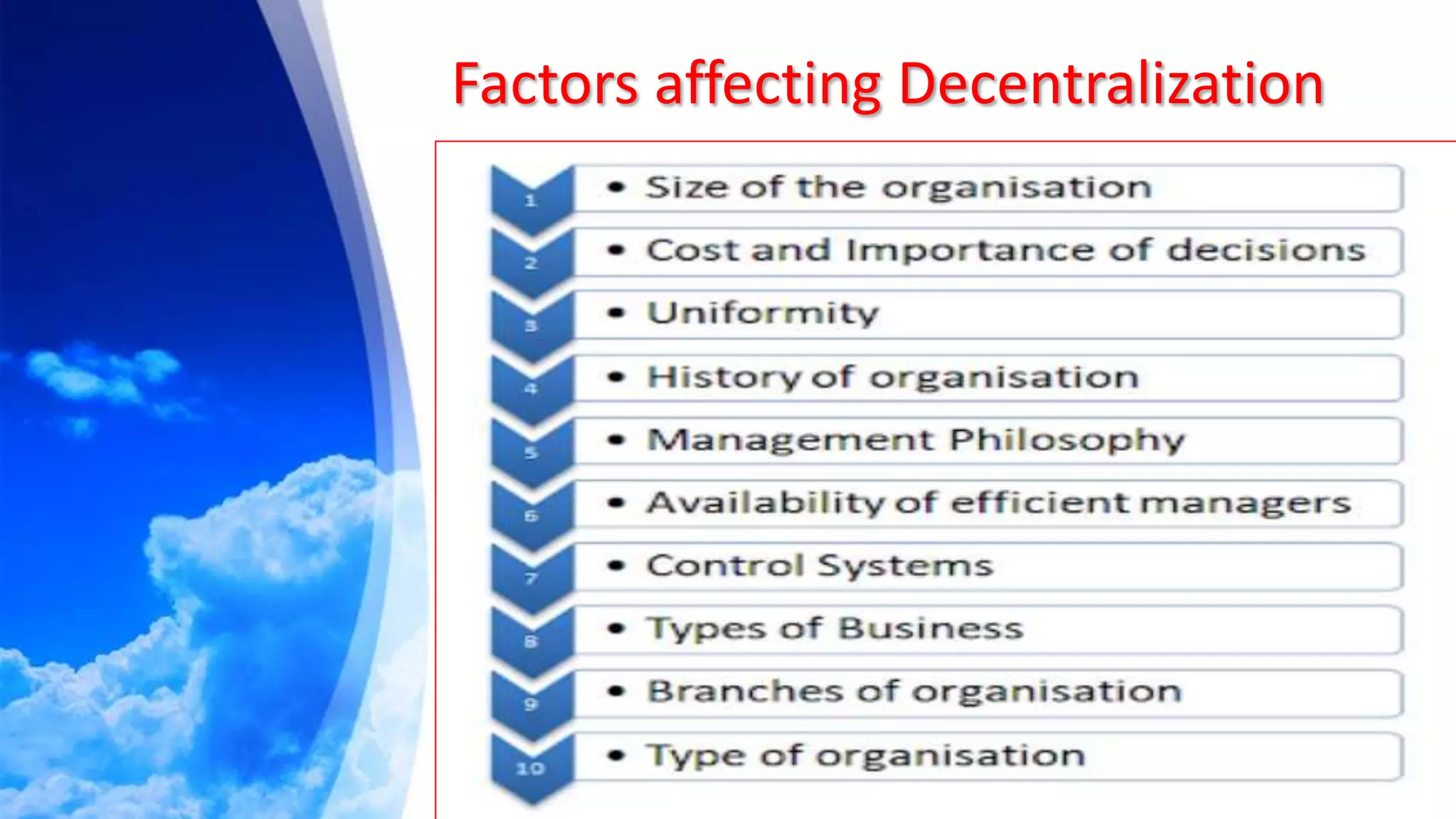
Factors affecting Decentralization
1. Size of the organization
• Large organization makes a lot of decisions. Their
decisions are taken at different levels. So large
organizations are more decentralized. Small
organization makes few decisions. All their
decisions are taken at the top level. So small
organizations are less decentralized.
• Thus, we can say, the bigger the organization, the
more the decentralization and vice-versa.
Factors affecting Decentralization
2. Cost and Importance of decisions
• The most costly and important decisions are
made by the top level of management.
• So, there is less decentralization of costly and
important decisions.
• Thus, we can say, the higher the cost and
importance of the decision the lesser the
decentralization and vice-versa.
Factors affecting Decentralization
3. Uniformity
• If the management wants more uniformity,
then there will be more centralization and less
decentralization.
• Thus, the more the uniformity in the
organization the less the decentralization.
Factors affecting Decentralization
4. History of organization
• An organization which expands from within has
more centralization.
• For e.g. Henry Ford made most of the decisions for
Ford Motors.
• However, an organization which expands with the
help of business combinations has more
decentralization.
Factors affecting Decentralization
5. Management Philosophy
• If the management wants to make all the
decisions themselves, then the organization
will be more centralized and vice-versa.
Factors affecting Decentralization
6. Availability of efficient managers
• If more efficient managers are available, then
there will be more decentralization.
• However, if there is a shortage of efficient
managers then there will be more
centralization.
Factors affecting Decentralization
7. Control Systems
• If there is a good control system in the
organization, then there will be more
decentralization.
• This is because authority cannot be
decentralized and delegated without proper
control techniques.
Factors affecting Decentralization
8. Types of Business
• If a business is old and slow moving, then it will
have more centralization.
• However, if the business is new and fast
moving, then it will have more
decentralization.
Factors affecting Decentralization
9. Branches of organization
• If an organization has many branches at
different places, then it will have more
decentralization.
• However, if the organization does not have any
branches, it may have more centralization.
Factors affecting Decentralization
10. Type of organization
• Joint-stock companies are generally more
decentralized compared to sole trading
concerns and partnership firms.
Objectives, Rationale and some Controversies of
Health decentralization
• De-concentration: (transfer of responsibility/
authority to lower administrative level)
• Devolution: (transfer of responsibility/ authority to
lower political level)
• Delegation: (transfer of managerial responsibility)
• Privatization: (transfer of governmental function to
private ownership).
Objectives, Rationale and some Controversies of
Health decentralization
Objectives, Rationale and some Controversies of
Health decentralization
Advantages of Decentralization
• Community/local needs are better identified and
fulfilled.
• Decision making is quick.
• Less bureaucracy.
• Lower level managers also gain experience in decision
making.
• Local units develop necessary skills to solve the problem.
• Development of ownership in local units and functions
improve.
Advantages of Decentralization
• More accountable.
• Load for top management is reduced.
• Effective control and supervision.
• Increased job satisfaction.
• Quick response and action in matters of urgency.
Limitations of Decentralization
• It may lead to coordination problem.
• It increases administrative cost.
• Maintaining global standards is difficult.
• Extra infrastructure cost is encountered.
• Complexity in coordination of decentralized unit.
• It may lead to absence of uniformity at
organizational level.
Challenges to Health Sector Decentralization
• Centralized and weak management and
programming practices of the government.
• Weak legal and institutional framework.
• Conflicting policy objectives.
• Lack of implementation strategy.
• Poor financial and human resource
management system.
Challenges to Health Sector Decentralization
• Lack of adequate preparation for managing
the reform.
• Weak capacity at all levels.
• Political instability.
• Poor implementation policy.
Decentralization in healthcare 2018

Decentralization in healthcare 2018

  • 1.
    Prepared by Iyad I.Shaqura PhD Health Service Management Tehran University of Medical Sciences 2018 Decentralization in Healthcare
  • 2.
    OUTLINE • Definition ofDecentralization • Why Decentralization? • Forms/ Pillars of Decentralization. • Factors affecting Decentralization. • Objectives, Rationale and some Controversies of Health Decentralization. • Advantages of Decentralization. • Limitations of Decentralization. • Challenges to Health Sector Decentralization.
  • 3.
    What is Decentralization? •Decentralization is the distribution or transfer of power, control or authority form central government to local and regional authority. • Decentralization is the restructuring of authority so that there is system of co-responsibility between institutions of governance at the central, regional and local levels according to the principle of solidarity, thus increasing the overall quality and effectiveness of the systems of governance, while increasing the authority and capabilities of sub-national levels. (UNDP)
  • 4.
    Why Decentralization? • Bettercoordination and corporation at action level. • Improved implementation of health program. • Better transparency and accountability. • Ensures sustainability. • Improves equity and quality of care. • Reduction in duplication of health services. • Improves delivery and utilization of health service. • More community participation in health sector development activities. • Capacity for district health planning is improved.
  • 5.
    Forms/ Pillars ofDecentralization • De-concentration: (transfer of responsibility/ authority to lower administrative level) • Devolution: (transfer of responsibility/ authority to lower political level) • Delegation: (transfer of managerial responsibility) • Privatization: (transfer of governmental function to private ownership).
  • 6.
  • 7.
    Factors affecting Decentralization 1.Size of the organization • Large organization makes a lot of decisions. Their decisions are taken at different levels. So large organizations are more decentralized. Small organization makes few decisions. All their decisions are taken at the top level. So small organizations are less decentralized. • Thus, we can say, the bigger the organization, the more the decentralization and vice-versa.
  • 8.
    Factors affecting Decentralization 2.Cost and Importance of decisions • The most costly and important decisions are made by the top level of management. • So, there is less decentralization of costly and important decisions. • Thus, we can say, the higher the cost and importance of the decision the lesser the decentralization and vice-versa.
  • 9.
    Factors affecting Decentralization 3.Uniformity • If the management wants more uniformity, then there will be more centralization and less decentralization. • Thus, the more the uniformity in the organization the less the decentralization.
  • 10.
    Factors affecting Decentralization 4.History of organization • An organization which expands from within has more centralization. • For e.g. Henry Ford made most of the decisions for Ford Motors. • However, an organization which expands with the help of business combinations has more decentralization.
  • 11.
    Factors affecting Decentralization 5.Management Philosophy • If the management wants to make all the decisions themselves, then the organization will be more centralized and vice-versa.
  • 12.
    Factors affecting Decentralization 6.Availability of efficient managers • If more efficient managers are available, then there will be more decentralization. • However, if there is a shortage of efficient managers then there will be more centralization.
  • 13.
    Factors affecting Decentralization 7.Control Systems • If there is a good control system in the organization, then there will be more decentralization. • This is because authority cannot be decentralized and delegated without proper control techniques.
  • 14.
    Factors affecting Decentralization 8.Types of Business • If a business is old and slow moving, then it will have more centralization. • However, if the business is new and fast moving, then it will have more decentralization.
  • 15.
    Factors affecting Decentralization 9.Branches of organization • If an organization has many branches at different places, then it will have more decentralization. • However, if the organization does not have any branches, it may have more centralization.
  • 16.
    Factors affecting Decentralization 10.Type of organization • Joint-stock companies are generally more decentralized compared to sole trading concerns and partnership firms.
  • 17.
    Objectives, Rationale andsome Controversies of Health decentralization • De-concentration: (transfer of responsibility/ authority to lower administrative level) • Devolution: (transfer of responsibility/ authority to lower political level) • Delegation: (transfer of managerial responsibility) • Privatization: (transfer of governmental function to private ownership).
  • 18.
    Objectives, Rationale andsome Controversies of Health decentralization
  • 19.
    Objectives, Rationale andsome Controversies of Health decentralization
  • 20.
    Advantages of Decentralization •Community/local needs are better identified and fulfilled. • Decision making is quick. • Less bureaucracy. • Lower level managers also gain experience in decision making. • Local units develop necessary skills to solve the problem. • Development of ownership in local units and functions improve.
  • 21.
    Advantages of Decentralization •More accountable. • Load for top management is reduced. • Effective control and supervision. • Increased job satisfaction. • Quick response and action in matters of urgency.
  • 22.
    Limitations of Decentralization •It may lead to coordination problem. • It increases administrative cost. • Maintaining global standards is difficult. • Extra infrastructure cost is encountered. • Complexity in coordination of decentralized unit. • It may lead to absence of uniformity at organizational level.
  • 23.
    Challenges to HealthSector Decentralization • Centralized and weak management and programming practices of the government. • Weak legal and institutional framework. • Conflicting policy objectives. • Lack of implementation strategy. • Poor financial and human resource management system.
  • 24.
    Challenges to HealthSector Decentralization • Lack of adequate preparation for managing the reform. • Weak capacity at all levels. • Political instability. • Poor implementation policy.