Refugee Camp Development &
Communications Technology


                        Mitchell Sipus 2008
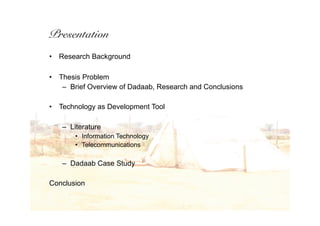
Presentation
•   Research Background

•   Thesis Problem
     – Brief Overview of Dadaab, Research and Conclusions

•   Technology as Development Tool

    – Literature
        • Information Technology
        • Telecommunications

    – Dadaab Case Study

Conclusion
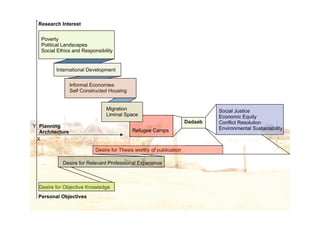
Research Interest

   Poverty
   Political Landscapes
   Social Ethics and Responsibility


         International Development

                 Informal Economies
                 Self Constructed Housing


                                Migration                                     Social Justice
                                Liminal Space                                 Economic Equity
                                                                     Dadaab   Conflict Resolution
Y Planning                                                                    Environmental Sustainability
  Architecture                              Refugee Camps
 X
                           Desire for Thesis worthy of publication

            Desire for Relevant Professional Experience


  Desire for Objective Knowledge
  Personal Objectives
Problem
• Although a great deal of literature exists
  for the planning of refugee camps, such
  camps continue to pose a threat to the
  natural environment and are
  concentrations of human inequity.
Problem
• If such camps will continue to exist, how
  can they be better planned to offset the
  negative environmental impact and
  support the empowerment of the
  refugee community?
Camp Planning Literature
•   Transitional Settlement / Displaced Persons, Oxfam and University of
    Cambridge 2005


•   UNHCR Handbook on Emergency Settlements, 2004

•   SPHERE – Human Charter and Minimum Standards in Disaster
    Response 2004

•   Temporary Human Settlement Planning for Displaced Populations in
    Emergencies, Overseas Development Institute 1998

•   Studies on Emergency and Disaster Relief: Shelter Provision and
    Settlement Policies for Refugees, Nordika Afrikaininstitutet 1995
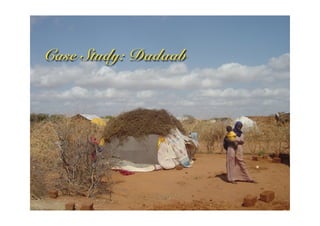
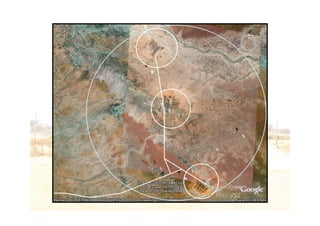
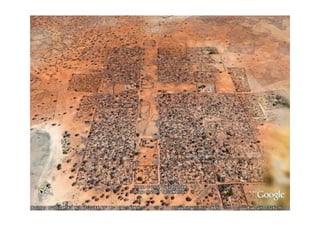
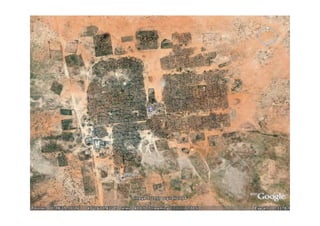
Case Study: Dadaab
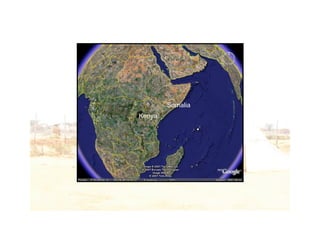
Somalia
Kenya
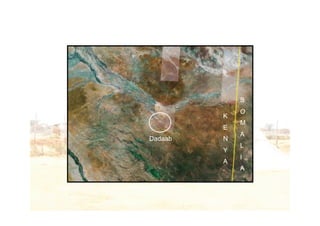
S
             O
         K
             M
         E
             A
Dadaab   N
             L
         Y
             I
         A
             A
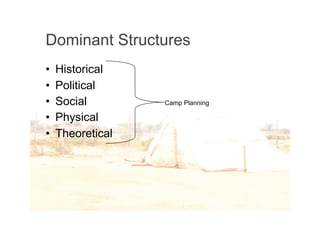
Dominant Structures
•   Historical
•   Political
•   Social        Camp Planning

•   Physical
•   Theoretical
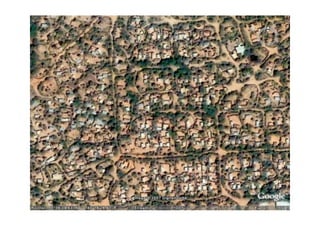
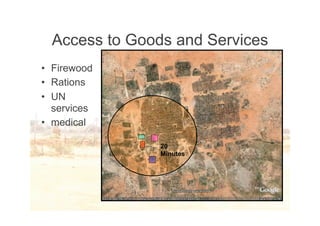
Access to Goods and Services
• Firewood
• Rations
• UN
  services
• medical

                20
                Minutes
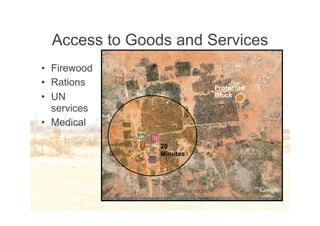
Access to Goods and Services
• Firewood
• Rations                 Protected
• UN                      Block

  services
• Medical

                20
                Minutes
Impact of Existing Plan
• Environmental Deterioration
• Aid Assistance vs. Aid Dependence
• Poor distribution of goods and services
• Segregation
• Reinforcements of existing power
  structures
• Lack of focus on development
• Presents complications to data collection
Social Consequences
• Violence
• Sexual Abuse
• Difficult to raise animals
• Incurs greater expense on refugees
• Deteriorates opportunities for agriculture
• Forces stronger security protocol by UNHCR, creating
  greater friction between agencies and refugees
• Breakdown of traditions, social institutions, and needless
  increase of poverty
Conclusion
•   Given the existing frameworks which determine refugee camp
    planning, a more sensitive approach to the local environment and
    existing social capital will reduce costs and need for security/
    protection measures for agencies as scarce resources will be more
    equitably distributed.

•   Solutions which redistribute the balance of power within existing
    structures are unlikely to ever be implemented

•   Thus there is a demand for creative solutions for Planning of
    refugee settlements

•   One strategy is to engage refugee camps as projects of community
    development, not as political fiascos.
Development Based Approach
•   Infrastructure can move beyond basic necessities: high technology,
    communications, money transfers, modern finance and judicial
    systems should be considered relevant options to refugee
    populations
•   Perhaps approach development as the removal of “bottlenecks” to
    development, vs. installation of expensive infrastructure and
    services, thus considering social overhead as a starting point and
    not a later consideration – after all, ‘building capacity’ is generally of
    greater interest to consultants and agencies than the actual
    populations.
Information & telecommunication
infrastructure as a method for
economic development
Four concepts for technology
based development strategies
•   Business development
•   Improved public services
•   Increased connectivity
•   Job creation


Spencer, James. “Technology and Urban Poverty: Understanding the Barriers to Equality,”
Projections MIT Student Journal of Planning, Vol. 2, Spring 2001, pp 24-50
Business Development
•   Provides opportunities for entrepreneurs to both start businesses
    and provide services in high-poverty neighborhoods where
    computer use is not high.

•   Ideal for heavy demand for connectivity but lack of infrastructure.

•   Example 1 - Grameen Phone, offshoot of Grameen Bank. Provides
    phones for farmers with phones to access up to date information
    about market prices, road conditions, potential buyers etc. able to
    circumvent middlemen.

•   Example 2 – ATMs for banking services in small shops where banks
    have otherwise disappeared from inner city areas (but not a
    sustainable solution).
Improved public services

•   Consideration of online access as a public good to equalize job prospects
    between upper and lower classes


•   More frequently considered in terms of Electronic Funds Transfer (EFT) for
    federal checks, cost benefits for government and consumer, further
    intended to integrate poor into banking and money management
     – problems with unfamiliarity of electronic media and computer access
Increased Connectivity

•    Reduction of “digital divide,” a potential equalizer for
    employment and education opportunities. Allows
    individuals to access resources outside of immediate
    location/society, assumed belief that this will be passed
    on into community and environment development
     – external factors more greatly determine the
       individuals ability to utilize this technology
Job Creation

• “High tech as Industrial Revolution of the 21st century”
  as technology stimulates supply and production
  dynamics of labor market

   – within existing research, there is the dominant belief
     in stronger secondary and tertiary impact of tech
     development for lower class
Information Technology
“Information Technology and Urban Poverty:
 The Role of Public Policy”
by Bish Sanyal


•   The poor must not be excluded from knowledge production

•   Government should ensure universal access: must consider
    provision of infrastructure, affordable hardware, user-friendly
    software, the ability and motivation to use software, and the periodic
    upgrading of hardware/software.

•   A key objective is to create better and equal public education for
    children and youth in low-income areas

•   Financial strengthening of public schools is a necessary but not
    sufficient lone condition for innovative use of IT for educational
    purposes

•   Public policies should target prospective entrepreneurs
    Sanyal, Bish ed. “Information Technology and Urban Poverty: The Role of Public Policy.” High
    Technology and Low-Income Communities: Prospects for the Positive Use of Advanced Information
    Technology. MIT Press; Cambridge, Massachusetts 1999
Strategies: “Approaches to Community Computing:
Bringing Technology to Low-Income Groups”
by Anne Beamish


•    Goal: Social empowerment through community networks
•    Establishing Neighborhood Technology Centers in Low-Income
     Communities
•    Equitable Access to the Internet


• Complications: software and hardware availability, training,
  technical assistance, access,
• Community generally consists of information consumers not
  producers.
• Frequent vagueness of community goals and assumption that new
  technology will improve lives of low income residents.

    Beamish, Anne. Strategies: “Approaches to Community Computing: Bringing Technology to Low-Income Groups”
    High Technology and Low-Income Communities: Prospects for the Positive Use of Advanced Information
    Technology. MIT Press; Cambridge, Massachusetts.
Telecommunications
Telecommunications Infrastructure and Economic
Development: A Simultaneous Approach by Lars-
Hendrik Roller and Leonard Waverman


• Telecommunications investment leads to growth
• demand for infrastructure
• economic returns higher the telecommunications returns
• telecommunication improvements reduce business costs
  and improve outputs
• allows better business management efficiency
• important spillovers and create externalities
• Appears to have same problems of general infrastructure
  in reverse causality and spurious correlations


Roller, Lars Hendrick and Leonard Waverman. “Telecommunications Infrastructure and Economic Development: A
Simultaneous Approach,” The American Economic Review, Vol. 91, No. 4 (Sep., 2001), pp. 909-923
Dadaab
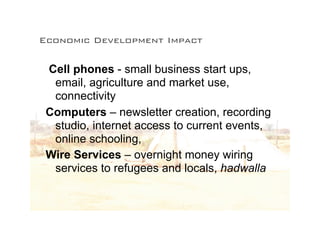
Economic Development Impact

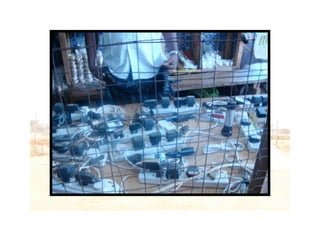
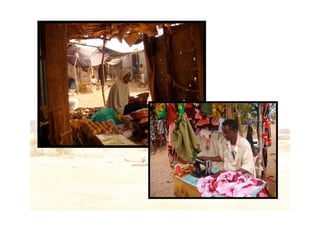
 Cell phones - small business start ups,
  email, agriculture and market use,
  connectivity
 Computers – newsletter creation, recording
  studio, internet access to current events,
  online schooling,
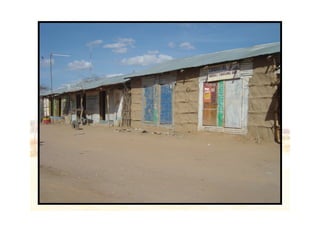
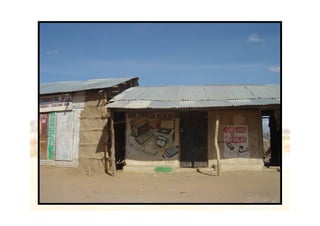
 Wire Services – overnight money wiring
  services to refugees and locals, hadwalla
Broad Policy Implications of
Technology Oriented Development
• - Like most Economic Development strategies, the use of high tech
  infrastructure is most feasible in relation to a well understood
  population
• - however, when look at individually, each one is inadequate to
  serve the lower class without the support of additional programs
• - in general terms, the lack of technology within areas of
  concentrated poverty is a reflection of other circumstances and
  policy makers need to take into consideration the compound effects
  of these circumstances when directing investments toward high-tech
  infrastructure and tech-oriented policies aimed at the poor.
Telecommunications:
Dadaab
• Positive Spillovers
  –   stimulation of markets and business startups,
  –   creation of tuition classes
  –   improved resettlement options
  –   family connectivity

• Complications
  – Lack of Basic Sector Activity, only extends multiplier
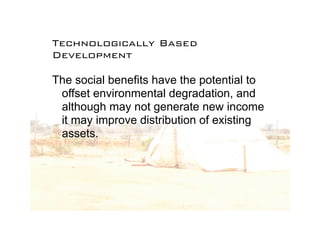
Technologically Based
Development

The social benefits have the potential to
 offset environmental degradation, and
 although may not generate new income
 it may improve distribution of existing
 assets.
Sources Cited
•   Beamish, Anne. Strategies: “Approaches to Community Computing: Bringing Technology to Low-Income Groups” High
    Technology and Low-Income Communities: Prospects for the Positive Use of Advanced Information Technology. MIT Press;
    Cambridge, Massachusetts.


•   Nordika Afrikaininstitutet, Studies on Emergency and Disaster Relief: Shelter Provision and Settlement Policies for Refugees,
    1995


•   Overseas Development Institute Temporary Human Settlement Planning for Displaced Populations in Emergencies, 1998


•   Roller, Lars Hendrick and Leonard Waverman. “Telecommunications Infrastructure and Economic Development: A
    Simultaneous Approach,” The American Economic Review, Vol. 91, No. 4 (Sep., 2001), pp. 909-923
                                                               Text
•   Sanyal, Bish ed. “Information Technology and Urban Poverty: The Role of Public Policy.” High Technology and Low-Income
    Communities: Prospects for the Positive Use of Advanced Information Technology. MIT Press; Cambridge, Massachusetts 1999


•   Spencer, James. “Technology and Urban Poverty: Understanding the Barriers to Equality,” Projections MIT Student Journal of
    Planning, Vol. 2, Spring 2001, pp 24-50


•   Transitional Settlement / Displaced Persons, Oxfam and University of Cambridge 2005


•   SPHERE, Human Charter and Minimum Standards in Disaster Response, 2004


•   UNHCR Handbook on Emergency Settlements, 2004

Technology Based Development Opportunity Within Dadaab Refugee Camp, Kenya

  • 1.
    Refugee Camp Development& Communications Technology Mitchell Sipus 2008
  • 2.
    Presentation • Research Background • Thesis Problem – Brief Overview of Dadaab, Research and Conclusions • Technology as Development Tool – Literature • Information Technology • Telecommunications – Dadaab Case Study Conclusion
  • 3.
    Research Interest Poverty Political Landscapes Social Ethics and Responsibility International Development Informal Economies Self Constructed Housing Migration Social Justice Liminal Space Economic Equity Dadaab Conflict Resolution Y Planning Environmental Sustainability Architecture Refugee Camps X Desire for Thesis worthy of publication Desire for Relevant Professional Experience Desire for Objective Knowledge Personal Objectives
  • 4.
    Problem • Although agreat deal of literature exists for the planning of refugee camps, such camps continue to pose a threat to the natural environment and are concentrations of human inequity.
  • 5.
    Problem • If suchcamps will continue to exist, how can they be better planned to offset the negative environmental impact and support the empowerment of the refugee community?
  • 6.
    Camp Planning Literature • Transitional Settlement / Displaced Persons, Oxfam and University of Cambridge 2005 • UNHCR Handbook on Emergency Settlements, 2004 • SPHERE – Human Charter and Minimum Standards in Disaster Response 2004 • Temporary Human Settlement Planning for Displaced Populations in Emergencies, Overseas Development Institute 1998 • Studies on Emergency and Disaster Relief: Shelter Provision and Settlement Policies for Refugees, Nordika Afrikaininstitutet 1995
  • 7.
  • 8.
  • 9.
    S O K M E A Dadaab N L Y I A A
  • 18.
    Dominant Structures • Historical • Political • Social Camp Planning • Physical • Theoretical
  • 19.
    Access to Goodsand Services • Firewood • Rations • UN services • medical 20 Minutes
  • 20.
    Access to Goodsand Services • Firewood • Rations Protected • UN Block services • Medical 20 Minutes
  • 21.
    Impact of ExistingPlan • Environmental Deterioration • Aid Assistance vs. Aid Dependence • Poor distribution of goods and services • Segregation • Reinforcements of existing power structures • Lack of focus on development • Presents complications to data collection
  • 22.
    Social Consequences • Violence •Sexual Abuse • Difficult to raise animals • Incurs greater expense on refugees • Deteriorates opportunities for agriculture • Forces stronger security protocol by UNHCR, creating greater friction between agencies and refugees • Breakdown of traditions, social institutions, and needless increase of poverty
  • 23.
    Conclusion • Given the existing frameworks which determine refugee camp planning, a more sensitive approach to the local environment and existing social capital will reduce costs and need for security/ protection measures for agencies as scarce resources will be more equitably distributed. • Solutions which redistribute the balance of power within existing structures are unlikely to ever be implemented • Thus there is a demand for creative solutions for Planning of refugee settlements • One strategy is to engage refugee camps as projects of community development, not as political fiascos.
  • 24.
    Development Based Approach • Infrastructure can move beyond basic necessities: high technology, communications, money transfers, modern finance and judicial systems should be considered relevant options to refugee populations • Perhaps approach development as the removal of “bottlenecks” to development, vs. installation of expensive infrastructure and services, thus considering social overhead as a starting point and not a later consideration – after all, ‘building capacity’ is generally of greater interest to consultants and agencies than the actual populations.
  • 25.
    Information & telecommunication infrastructureas a method for economic development
  • 26.
    Four concepts fortechnology based development strategies • Business development • Improved public services • Increased connectivity • Job creation Spencer, James. “Technology and Urban Poverty: Understanding the Barriers to Equality,” Projections MIT Student Journal of Planning, Vol. 2, Spring 2001, pp 24-50
  • 27.
    Business Development • Provides opportunities for entrepreneurs to both start businesses and provide services in high-poverty neighborhoods where computer use is not high. • Ideal for heavy demand for connectivity but lack of infrastructure. • Example 1 - Grameen Phone, offshoot of Grameen Bank. Provides phones for farmers with phones to access up to date information about market prices, road conditions, potential buyers etc. able to circumvent middlemen. • Example 2 – ATMs for banking services in small shops where banks have otherwise disappeared from inner city areas (but not a sustainable solution).
  • 28.
    Improved public services • Consideration of online access as a public good to equalize job prospects between upper and lower classes • More frequently considered in terms of Electronic Funds Transfer (EFT) for federal checks, cost benefits for government and consumer, further intended to integrate poor into banking and money management – problems with unfamiliarity of electronic media and computer access
  • 29.
    Increased Connectivity • Reduction of “digital divide,” a potential equalizer for employment and education opportunities. Allows individuals to access resources outside of immediate location/society, assumed belief that this will be passed on into community and environment development – external factors more greatly determine the individuals ability to utilize this technology
  • 30.
    Job Creation • “Hightech as Industrial Revolution of the 21st century” as technology stimulates supply and production dynamics of labor market – within existing research, there is the dominant belief in stronger secondary and tertiary impact of tech development for lower class
  • 31.
  • 32.
    “Information Technology andUrban Poverty: The Role of Public Policy” by Bish Sanyal • The poor must not be excluded from knowledge production • Government should ensure universal access: must consider provision of infrastructure, affordable hardware, user-friendly software, the ability and motivation to use software, and the periodic upgrading of hardware/software. • A key objective is to create better and equal public education for children and youth in low-income areas • Financial strengthening of public schools is a necessary but not sufficient lone condition for innovative use of IT for educational purposes • Public policies should target prospective entrepreneurs Sanyal, Bish ed. “Information Technology and Urban Poverty: The Role of Public Policy.” High Technology and Low-Income Communities: Prospects for the Positive Use of Advanced Information Technology. MIT Press; Cambridge, Massachusetts 1999
  • 33.
    Strategies: “Approaches toCommunity Computing: Bringing Technology to Low-Income Groups” by Anne Beamish • Goal: Social empowerment through community networks • Establishing Neighborhood Technology Centers in Low-Income Communities • Equitable Access to the Internet • Complications: software and hardware availability, training, technical assistance, access, • Community generally consists of information consumers not producers. • Frequent vagueness of community goals and assumption that new technology will improve lives of low income residents. Beamish, Anne. Strategies: “Approaches to Community Computing: Bringing Technology to Low-Income Groups” High Technology and Low-Income Communities: Prospects for the Positive Use of Advanced Information Technology. MIT Press; Cambridge, Massachusetts.
  • 34.
  • 35.
    Telecommunications Infrastructure andEconomic Development: A Simultaneous Approach by Lars- Hendrik Roller and Leonard Waverman • Telecommunications investment leads to growth • demand for infrastructure • economic returns higher the telecommunications returns • telecommunication improvements reduce business costs and improve outputs • allows better business management efficiency • important spillovers and create externalities • Appears to have same problems of general infrastructure in reverse causality and spurious correlations Roller, Lars Hendrick and Leonard Waverman. “Telecommunications Infrastructure and Economic Development: A Simultaneous Approach,” The American Economic Review, Vol. 91, No. 4 (Sep., 2001), pp. 909-923
  • 36.
  • 38.
    Economic Development Impact Cell phones - small business start ups, email, agriculture and market use, connectivity Computers – newsletter creation, recording studio, internet access to current events, online schooling, Wire Services – overnight money wiring services to refugees and locals, hadwalla
  • 44.
    Broad Policy Implicationsof Technology Oriented Development • - Like most Economic Development strategies, the use of high tech infrastructure is most feasible in relation to a well understood population • - however, when look at individually, each one is inadequate to serve the lower class without the support of additional programs • - in general terms, the lack of technology within areas of concentrated poverty is a reflection of other circumstances and policy makers need to take into consideration the compound effects of these circumstances when directing investments toward high-tech infrastructure and tech-oriented policies aimed at the poor.
  • 45.
    Telecommunications: Dadaab • Positive Spillovers – stimulation of markets and business startups, – creation of tuition classes – improved resettlement options – family connectivity • Complications – Lack of Basic Sector Activity, only extends multiplier
  • 46.
    Technologically Based Development The socialbenefits have the potential to offset environmental degradation, and although may not generate new income it may improve distribution of existing assets.
  • 47.
    Sources Cited • Beamish, Anne. Strategies: “Approaches to Community Computing: Bringing Technology to Low-Income Groups” High Technology and Low-Income Communities: Prospects for the Positive Use of Advanced Information Technology. MIT Press; Cambridge, Massachusetts. • Nordika Afrikaininstitutet, Studies on Emergency and Disaster Relief: Shelter Provision and Settlement Policies for Refugees, 1995 • Overseas Development Institute Temporary Human Settlement Planning for Displaced Populations in Emergencies, 1998 • Roller, Lars Hendrick and Leonard Waverman. “Telecommunications Infrastructure and Economic Development: A Simultaneous Approach,” The American Economic Review, Vol. 91, No. 4 (Sep., 2001), pp. 909-923 Text • Sanyal, Bish ed. “Information Technology and Urban Poverty: The Role of Public Policy.” High Technology and Low-Income Communities: Prospects for the Positive Use of Advanced Information Technology. MIT Press; Cambridge, Massachusetts 1999 • Spencer, James. “Technology and Urban Poverty: Understanding the Barriers to Equality,” Projections MIT Student Journal of Planning, Vol. 2, Spring 2001, pp 24-50 • Transitional Settlement / Displaced Persons, Oxfam and University of Cambridge 2005 • SPHERE, Human Charter and Minimum Standards in Disaster Response, 2004 • UNHCR Handbook on Emergency Settlements, 2004