ARCHITECTING AI
APPLICATIONS
O’REILLY AI CONF
LONDON, 2018
DR. MIKIO BRAUN
@mikiobraun
AI ARCHITECT
ZALANDO SE
11-OCT-2018
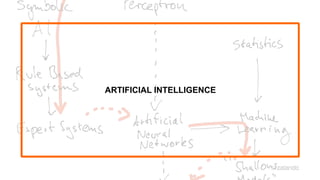
ARTIFICIAL INTELLIGENCE
!3
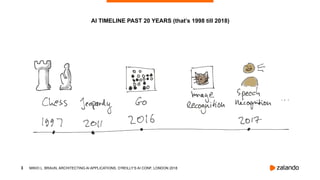
AI TIMELINE PAST 20 YEARS (that’s 1998 till 2018)
MIKIO L. BRAUN, ARCHITECTING AI APPLICATIONS, O’REILLY’S AI CONF, LONDON 2018
!4
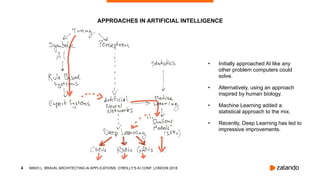
• Initially approached AI like any
other problem computers could
solve.
• Alternatively, using an approach
inspired by human biology.
• Machine Learning added a
statistical approach to the mix.
• Recently, Deep Learning has led to
impressive improvements.
APPROACHES IN ARTIFICIAL INTELLIGENCE
MIKIO L. BRAUN, ARCHITECTING AI APPLICATIONS, O’REILLY’S AI CONF, LONDON 2018
!5
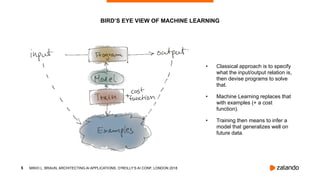
• Classical approach is to specify
what the input/output relation is,
then devise programs to solve
that.
• Machine Learning replaces that
with examples (+ a cost
function).
• Training then means to infer a
model that generalizes well on
future data.
BIRD’S EYE VIEW OF MACHINE LEARNING
MIKIO L. BRAUN, ARCHITECTING AI APPLICATIONS, O’REILLY’S AI CONF, LONDON 2018
!6
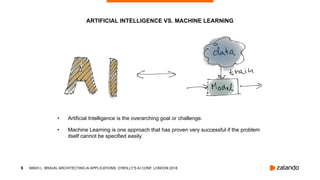
• Artificial Intelligence is the overarching goal or challenge.
• Machine Learning is one approach that has proven very successful if the problem
itself cannot be specified easily.
ARTIFICIAL INTELLIGENCE VS. MACHINE LEARNING
MIKIO L. BRAUN, ARCHITECTING AI APPLICATIONS, O’REILLY’S AI CONF, LONDON 2018
!7
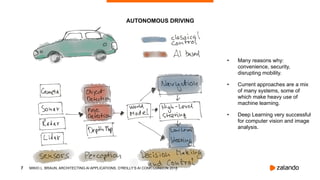
• Many reasons why:
convenience, security,
disrupting mobility.
• Current approaches are a mix
of many systems, some of
which make heavy use of
machine learning.
• Deep Learning very successful
for computer vision and image
analysis.
AUTONOMOUS DRIVING
MIKIO L. BRAUN, ARCHITECTING AI APPLICATIONS, O’REILLY’S AI CONF, LONDON 2018
!8
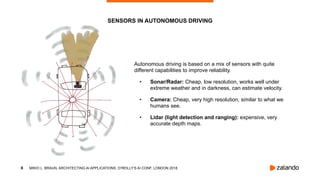
Autonomous driving is based on a mix of sensors with quite
different capabilities to improve reliability.
• Sonar/Radar: Cheap, low resolution, works well under
extreme weather and in darkness, can estimate velocity.
• Camera: Cheap, very high resolution, similar to what we
humans see.
• Lidar (light detection and ranging): expensive, very
accurate depth maps.
SENSORS IN AUTONOMOUS DRIVING
MIKIO L. BRAUN, ARCHITECTING AI APPLICATIONS, O’REILLY’S AI CONF, LONDON 2018
!9
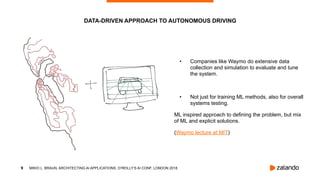
• Companies like Waymo do extensive data
collection and simulation to evaluate and tune
the system.
• Not just for training ML methods, also for overall
systems testing.
ML inspired approach to defining the problem, but mix
of ML and explicit solutions.
(Waymo lecture at MIT)
DATA-DRIVEN APPROACH TO AUTONOMOUS DRIVING
MIKIO L. BRAUN, ARCHITECTING AI APPLICATIONS, O’REILLY’S AI CONF, LONDON 2018
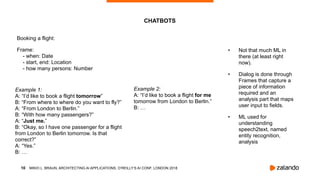
• Not that much ML in
there (at least right
now).
• Dialog is done through
Frames that capture a
piece of information
required and an
analysis part that maps
user input to fields.
• ML used for
understanding
speech2text, named
entity recognition,
analysis
!10
CHATBOTS
Example 1:

A: “I’d like to book a flight tomorrow”

B: “From where to where do you want to fly?”

A: “From London to Berlin.”

B: “With how many passengers?”

A: “Just me.”

B: “Okay, so I have one passenger for a flight
from London to Berlin tomorrow. Is that
correct?”

A: “Yes.”

B: …
Example 2:

A: “I’d like to book a flight for me
tomorrow from London to Berlin.”

B: …
Booking a flight:
Frame:

- when: Date

- start, end: Location

- how many persons: Number
!11
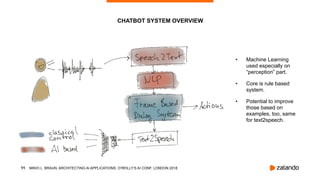
• Machine Learning
used especially on
“perception” part.
• Core is rule based
system.
• Potential to improve
those based on
examples, too, same
for text2speech.
CHATBOT SYSTEM OVERVIEW
MIKIO L. BRAUN, ARCHITECTING AI APPLICATIONS, O’REILLY’S AI CONF, LONDON 2018
!12
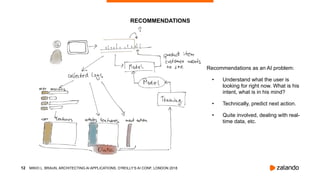
Recommendations as an AI problem:
• Understand what the user is
looking for right now. What is his
intent, what is in his mind?
• Technically, predict next action.
• Quite involved, dealing with real-
time data, etc.
RECOMMENDATIONS
MIKIO L. BRAUN, ARCHITECTING AI APPLICATIONS, O’REILLY’S AI CONF, LONDON 2018
!13
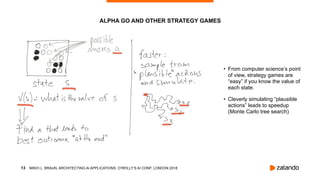
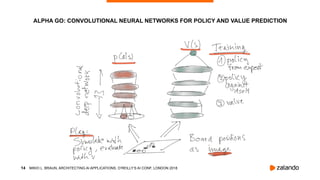
• From computer science’s point
of view, strategy games are
“easy” if you know the value of
each state.
• Cleverly simulating “plausible
actions” leads to speedup
(Monte Carlo tree search)
ALPHA GO AND OTHER STRATEGY GAMES
MIKIO L. BRAUN, ARCHITECTING AI APPLICATIONS, O’REILLY’S AI CONF, LONDON 2018
MIKIO L. BRAUN, ARCHITECTING AI APPLICATIONS, O’REILLY’S AI CONF, LONDON 2018!14
ALPHA GO: CONVOLUTIONAL NEURAL NETWORKS FOR POLICY AND VALUE PREDICTION
!15
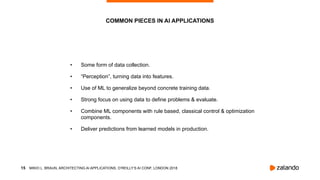
• Some form of data collection.
• “Perception”, turning data into features.
• Use of ML to generalize beyond concrete training data.
• Strong focus on using data to define problems & evaluate.
• Combine ML components with rule based, classical control & optimization
components.
• Deliver predictions from learned models in production.
COMMON PIECES IN AI APPLICATIONS
MIKIO L. BRAUN, ARCHITECTING AI APPLICATIONS, O’REILLY’S AI CONF, LONDON 2018
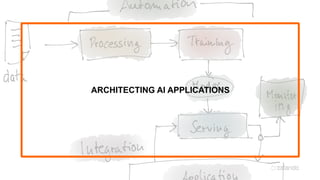
ARCHITECTING AI APPLICATIONS
!17
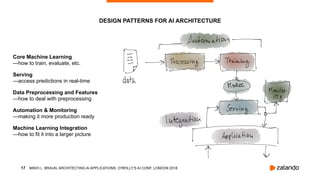
Core Machine Learning

—how to train, evaluate, etc.
Serving

—access predictions in real-time
Data Preprocessing and Features

—how to deal with preprocessing
Automation & Monitoring

—making it more production ready
Machine Learning Integration

—how to fit it into a larger picture
DESIGN PATTERNS FOR AI ARCHITECTURE
MIKIO L. BRAUN, ARCHITECTING AI APPLICATIONS, O’REILLY’S AI CONF, LONDON 2018
!18
Core Patterns:
• Preprocess data to extract
features, transform to fit to
ML model.
• Training/test split for model
selection and evaluation.
Leaving out how to do this part
effectively (notebooks, moving from
exploration to construction, etc.)
CORE MACHINE LEARNING
MIKIO L. BRAUN, ARCHITECTING AI APPLICATIONS, O’REILLY’S AI CONF, LONDON 2018
!19
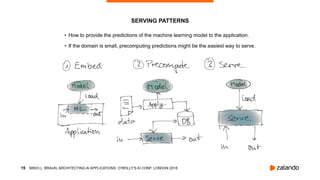
• How to provide the predictions of the machine learning model to the application.
• If the domain is small, precomputing predictions might be the easiest way to serve.
SERVING PATTERNS
MIKIO L. BRAUN, ARCHITECTING AI APPLICATIONS, O’REILLY’S AI CONF, LONDON 2018
!20
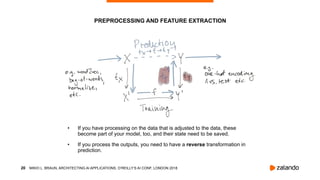
• If you have processing on the data that is adjusted to the data, these
become part of your model, too, and their state need to be saved.
• If you process the outputs, you need to have a reverse transformation in
prediction.
PREPROCESSING AND FEATURE EXTRACTION
MIKIO L. BRAUN, ARCHITECTING AI APPLICATIONS, O’REILLY’S AI CONF, LONDON 2018
!21
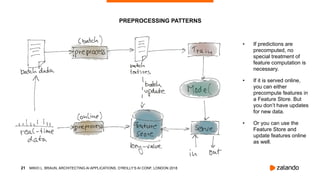
• If predictions are
precomputed, no
special treatment of
feature computation is
necessary.
• If it is served online,
you can either
precompute features in
a Feature Store. But
you don’t have updates
for new data.
• Or you can use the
Feature Store and
update features online
as well.
PREPROCESSING PATTERNS
MIKIO L. BRAUN, ARCHITECTING AI APPLICATIONS, O’REILLY’S AI CONF, LONDON 2018
!22
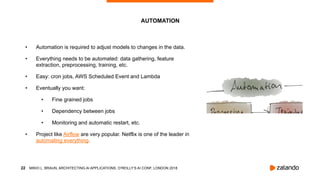
• Automation is required to adjust models to changes in the data.
• Everything needs to be automated: data gathering, feature
extraction, preprocessing, training, etc.
• Easy: cron jobs, AWS Scheduled Event and Lambda
• Eventually you want:
• Fine grained jobs
• Dependency between jobs
• Monitoring and automatic restart, etc.
• Project like Airflow are very popular. Netflix is one of the leader in
automating everything.
AUTOMATION
MIKIO L. BRAUN, ARCHITECTING AI APPLICATIONS, O’REILLY’S AI CONF, LONDON 2018
!23
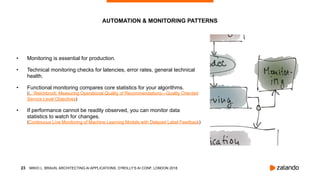
• Monitoring is essential for production.
• Technical monitoring checks for latencies, error rates, general technical
health.
• Functional monitoring compares core statistics for your algorithms.

(L. Weichbrodt, Measuring Operational Quality of Recommendations—Quality Oriented
Service Level Objectives)
• If performance cannot be readily observed, you can monitor data
statistics to watch for changes.

(Continuous Live Monitoring of Machine Learning Models with Delayed Label Feedback)
AUTOMATION & MONITORING PATTERNS
MIKIO L. BRAUN, ARCHITECTING AI APPLICATIONS, O’REILLY’S AI CONF, LONDON 2018
!24
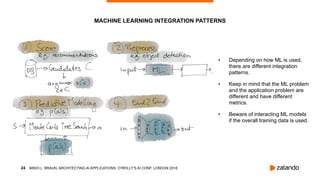
• Depending on how ML is used,
there are different integration
patterns.
• Keep in mind that the ML problem
and the application problem are
different and have different
metrics.
• Beware of interacting ML models
if the overall training data is used.
MACHINE LEARNING INTEGRATION PATTERNS
MIKIO L. BRAUN, ARCHITECTING AI APPLICATIONS, O’REILLY’S AI CONF, LONDON 2018
!25
• Modern AI Applications are a mix of ML and programmed components.
• It takes considerable effort to “productionize” ML applications.
• Recurring design patterns are evolving.
• Still a lot of room for new products & open source projects.
SUMMARY
MIKIO L. BRAUN, ARCHITECTING AI APPLICATIONS, O’REILLY’S AI CONF, LONDON 2018
MIKIO BRAUN
mikio.braun@zalando.de
11-10-2018
INFORMATION
AI ARCHITECT
This presentation and its contents are strictly confidential. It may not, in
whole or in part, be reproduced, redistributed, published or passed on to
any other person by the recipient.
The information in this presentation has not been independently verified. No
representation or warranty, express or implied, is made as to the accuracy
or completeness of the presentation and the information contained herein
and no reliance should be placed on such information. No responsibility is
accepted for any liability for any loss howsoever arising, directly or
indirectly, from this presentation or its contents.
DISCLAIMER
!27

Architecting AI Applications

  • 1.
    ARCHITECTING AI APPLICATIONS O’REILLY AICONF LONDON, 2018 DR. MIKIO BRAUN @mikiobraun AI ARCHITECT ZALANDO SE 11-OCT-2018
  • 2.
  • 3.
    !3 AI TIMELINE PAST20 YEARS (that’s 1998 till 2018) MIKIO L. BRAUN, ARCHITECTING AI APPLICATIONS, O’REILLY’S AI CONF, LONDON 2018
  • 4.
    !4 • Initially approachedAI like any other problem computers could solve. • Alternatively, using an approach inspired by human biology. • Machine Learning added a statistical approach to the mix. • Recently, Deep Learning has led to impressive improvements. APPROACHES IN ARTIFICIAL INTELLIGENCE MIKIO L. BRAUN, ARCHITECTING AI APPLICATIONS, O’REILLY’S AI CONF, LONDON 2018
  • 5.
    !5 • Classical approachis to specify what the input/output relation is, then devise programs to solve that. • Machine Learning replaces that with examples (+ a cost function). • Training then means to infer a model that generalizes well on future data. BIRD’S EYE VIEW OF MACHINE LEARNING MIKIO L. BRAUN, ARCHITECTING AI APPLICATIONS, O’REILLY’S AI CONF, LONDON 2018
  • 6.
    !6 • Artificial Intelligenceis the overarching goal or challenge. • Machine Learning is one approach that has proven very successful if the problem itself cannot be specified easily. ARTIFICIAL INTELLIGENCE VS. MACHINE LEARNING MIKIO L. BRAUN, ARCHITECTING AI APPLICATIONS, O’REILLY’S AI CONF, LONDON 2018
  • 7.
    !7 • Many reasonswhy: convenience, security, disrupting mobility. • Current approaches are a mix of many systems, some of which make heavy use of machine learning. • Deep Learning very successful for computer vision and image analysis. AUTONOMOUS DRIVING MIKIO L. BRAUN, ARCHITECTING AI APPLICATIONS, O’REILLY’S AI CONF, LONDON 2018
  • 8.
    !8 Autonomous driving isbased on a mix of sensors with quite different capabilities to improve reliability. • Sonar/Radar: Cheap, low resolution, works well under extreme weather and in darkness, can estimate velocity. • Camera: Cheap, very high resolution, similar to what we humans see. • Lidar (light detection and ranging): expensive, very accurate depth maps. SENSORS IN AUTONOMOUS DRIVING MIKIO L. BRAUN, ARCHITECTING AI APPLICATIONS, O’REILLY’S AI CONF, LONDON 2018
  • 9.
    !9 • Companies likeWaymo do extensive data collection and simulation to evaluate and tune the system. • Not just for training ML methods, also for overall systems testing. ML inspired approach to defining the problem, but mix of ML and explicit solutions. (Waymo lecture at MIT) DATA-DRIVEN APPROACH TO AUTONOMOUS DRIVING MIKIO L. BRAUN, ARCHITECTING AI APPLICATIONS, O’REILLY’S AI CONF, LONDON 2018
  • 10.
    MIKIO L. BRAUN,ARCHITECTING AI APPLICATIONS, O’REILLY’S AI CONF, LONDON 2018 • Not that much ML in there (at least right now). • Dialog is done through Frames that capture a piece of information required and an analysis part that maps user input to fields. • ML used for understanding speech2text, named entity recognition, analysis !10 CHATBOTS Example 1:
 A: “I’d like to book a flight tomorrow”
 B: “From where to where do you want to fly?”
 A: “From London to Berlin.”
 B: “With how many passengers?”
 A: “Just me.”
 B: “Okay, so I have one passenger for a flight from London to Berlin tomorrow. Is that correct?”
 A: “Yes.”
 B: … Example 2:
 A: “I’d like to book a flight for me tomorrow from London to Berlin.”
 B: … Booking a flight: Frame:
 - when: Date
 - start, end: Location
 - how many persons: Number
  • 11.
    !11 • Machine Learning usedespecially on “perception” part. • Core is rule based system. • Potential to improve those based on examples, too, same for text2speech. CHATBOT SYSTEM OVERVIEW MIKIO L. BRAUN, ARCHITECTING AI APPLICATIONS, O’REILLY’S AI CONF, LONDON 2018
  • 12.
    !12 Recommendations as anAI problem: • Understand what the user is looking for right now. What is his intent, what is in his mind? • Technically, predict next action. • Quite involved, dealing with real- time data, etc. RECOMMENDATIONS MIKIO L. BRAUN, ARCHITECTING AI APPLICATIONS, O’REILLY’S AI CONF, LONDON 2018
  • 13.
    !13 • From computerscience’s point of view, strategy games are “easy” if you know the value of each state. • Cleverly simulating “plausible actions” leads to speedup (Monte Carlo tree search) ALPHA GO AND OTHER STRATEGY GAMES MIKIO L. BRAUN, ARCHITECTING AI APPLICATIONS, O’REILLY’S AI CONF, LONDON 2018
  • 14.
    MIKIO L. BRAUN,ARCHITECTING AI APPLICATIONS, O’REILLY’S AI CONF, LONDON 2018!14 ALPHA GO: CONVOLUTIONAL NEURAL NETWORKS FOR POLICY AND VALUE PREDICTION
  • 15.
    !15 • Some formof data collection. • “Perception”, turning data into features. • Use of ML to generalize beyond concrete training data. • Strong focus on using data to define problems & evaluate. • Combine ML components with rule based, classical control & optimization components. • Deliver predictions from learned models in production. COMMON PIECES IN AI APPLICATIONS MIKIO L. BRAUN, ARCHITECTING AI APPLICATIONS, O’REILLY’S AI CONF, LONDON 2018
  • 16.
  • 17.
    !17 Core Machine Learning
 —howto train, evaluate, etc. Serving
 —access predictions in real-time Data Preprocessing and Features
 —how to deal with preprocessing Automation & Monitoring
 —making it more production ready Machine Learning Integration
 —how to fit it into a larger picture DESIGN PATTERNS FOR AI ARCHITECTURE MIKIO L. BRAUN, ARCHITECTING AI APPLICATIONS, O’REILLY’S AI CONF, LONDON 2018
  • 18.
    !18 Core Patterns: • Preprocessdata to extract features, transform to fit to ML model. • Training/test split for model selection and evaluation. Leaving out how to do this part effectively (notebooks, moving from exploration to construction, etc.) CORE MACHINE LEARNING MIKIO L. BRAUN, ARCHITECTING AI APPLICATIONS, O’REILLY’S AI CONF, LONDON 2018
  • 19.
    !19 • How toprovide the predictions of the machine learning model to the application. • If the domain is small, precomputing predictions might be the easiest way to serve. SERVING PATTERNS MIKIO L. BRAUN, ARCHITECTING AI APPLICATIONS, O’REILLY’S AI CONF, LONDON 2018
  • 20.
    !20 • If youhave processing on the data that is adjusted to the data, these become part of your model, too, and their state need to be saved. • If you process the outputs, you need to have a reverse transformation in prediction. PREPROCESSING AND FEATURE EXTRACTION MIKIO L. BRAUN, ARCHITECTING AI APPLICATIONS, O’REILLY’S AI CONF, LONDON 2018
  • 21.
    !21 • If predictionsare precomputed, no special treatment of feature computation is necessary. • If it is served online, you can either precompute features in a Feature Store. But you don’t have updates for new data. • Or you can use the Feature Store and update features online as well. PREPROCESSING PATTERNS MIKIO L. BRAUN, ARCHITECTING AI APPLICATIONS, O’REILLY’S AI CONF, LONDON 2018
  • 22.
    !22 • Automation isrequired to adjust models to changes in the data. • Everything needs to be automated: data gathering, feature extraction, preprocessing, training, etc. • Easy: cron jobs, AWS Scheduled Event and Lambda • Eventually you want: • Fine grained jobs • Dependency between jobs • Monitoring and automatic restart, etc. • Project like Airflow are very popular. Netflix is one of the leader in automating everything. AUTOMATION MIKIO L. BRAUN, ARCHITECTING AI APPLICATIONS, O’REILLY’S AI CONF, LONDON 2018
  • 23.
    !23 • Monitoring isessential for production. • Technical monitoring checks for latencies, error rates, general technical health. • Functional monitoring compares core statistics for your algorithms.
 (L. Weichbrodt, Measuring Operational Quality of Recommendations—Quality Oriented Service Level Objectives) • If performance cannot be readily observed, you can monitor data statistics to watch for changes.
 (Continuous Live Monitoring of Machine Learning Models with Delayed Label Feedback) AUTOMATION & MONITORING PATTERNS MIKIO L. BRAUN, ARCHITECTING AI APPLICATIONS, O’REILLY’S AI CONF, LONDON 2018
  • 24.
    !24 • Depending onhow ML is used, there are different integration patterns. • Keep in mind that the ML problem and the application problem are different and have different metrics. • Beware of interacting ML models if the overall training data is used. MACHINE LEARNING INTEGRATION PATTERNS MIKIO L. BRAUN, ARCHITECTING AI APPLICATIONS, O’REILLY’S AI CONF, LONDON 2018
  • 25.
    !25 • Modern AIApplications are a mix of ML and programmed components. • It takes considerable effort to “productionize” ML applications. • Recurring design patterns are evolving. • Still a lot of room for new products & open source projects. SUMMARY MIKIO L. BRAUN, ARCHITECTING AI APPLICATIONS, O’REILLY’S AI CONF, LONDON 2018
  • 26.
  • 27.
    This presentation andits contents are strictly confidential. It may not, in whole or in part, be reproduced, redistributed, published or passed on to any other person by the recipient. The information in this presentation has not been independently verified. No representation or warranty, express or implied, is made as to the accuracy or completeness of the presentation and the information contained herein and no reliance should be placed on such information. No responsibility is accepted for any liability for any loss howsoever arising, directly or indirectly, from this presentation or its contents. DISCLAIMER !27