Full Day of Applied AI
Morning
Session 1 Intro to Artificial Intelligence
09:00-09:45 Introduction to Applied AI
09:45-10:00 Coffee and break
Session 2 Live Coding a machine learning app
10:00-10:10 Getting your machine ready for machine learning
10:10-10.20 Training and evaluating the model
10.20-10.50 Improving the model
10.50-11.00 Coffee and break
Session 3 Machine learning in the wild - deployment
11:00-11.15 Coding exercise continued
11:15-11:45 Serving your own machine learning model | Code
11:45-11:55 How to solve problems | interactive exercise
11:55-12:00 Q and A
Lunch
12:00-13:00 Lunch
Afternoon
Session 4 Hello World Deep Learning (MNIST)
13:00-13:15 Deep Learning intro
13:00-13.15 Image recognition and CNNs | Talk |
13:15-13:45 Building your own convolutional neural network | Code |
13:45-14:00 Coffee and break
Session 5 Natural Language Processing
14:00-14.30 Natural language processing | Talk |
14:30-14:45 Working with language | Code |
14:45-15:00 Coffee and break
Session 6 Conversational interfaces and Time Series
14:00-14.20 Conversational interfaces
14:20-14:45 Time Series prediction
14:45-15:00 Coffee and break
Session 7 Generative models and style transfer
16:00-16.30 Generative models | Talk |
16:30-16:45 Trying out GANS and style transfer | Code |
16:45-17:00 Coffee and break
Anton Osika AI Research Engineer Sana Labs AB
anton.osika@gmail.com
Birger Moëll Machine Learning Engineer
birger.moell@gmail.com
What is AI?
What is AI?
The scope of AI is disputed: as machines become
increasingly capable, tasks considered as requiring
"intelligence" are often removed from the definition of AI, a
phenomenon known as the AI effect
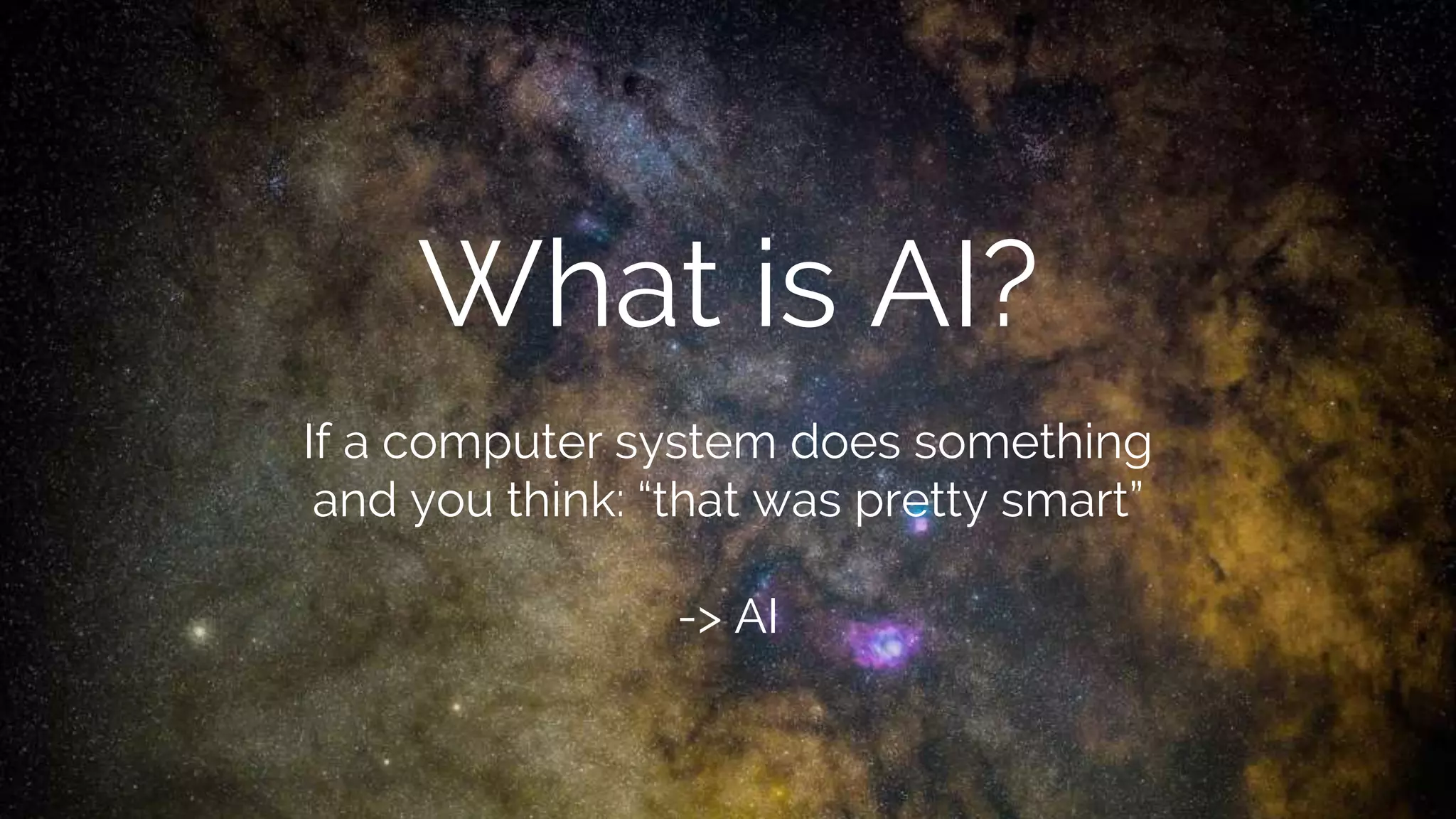
What is AI?
If a computer system does something
and you think: “that was pretty smart”
-> AI
jj
Artificial Intelligence, Machine Learning and Deep Learning
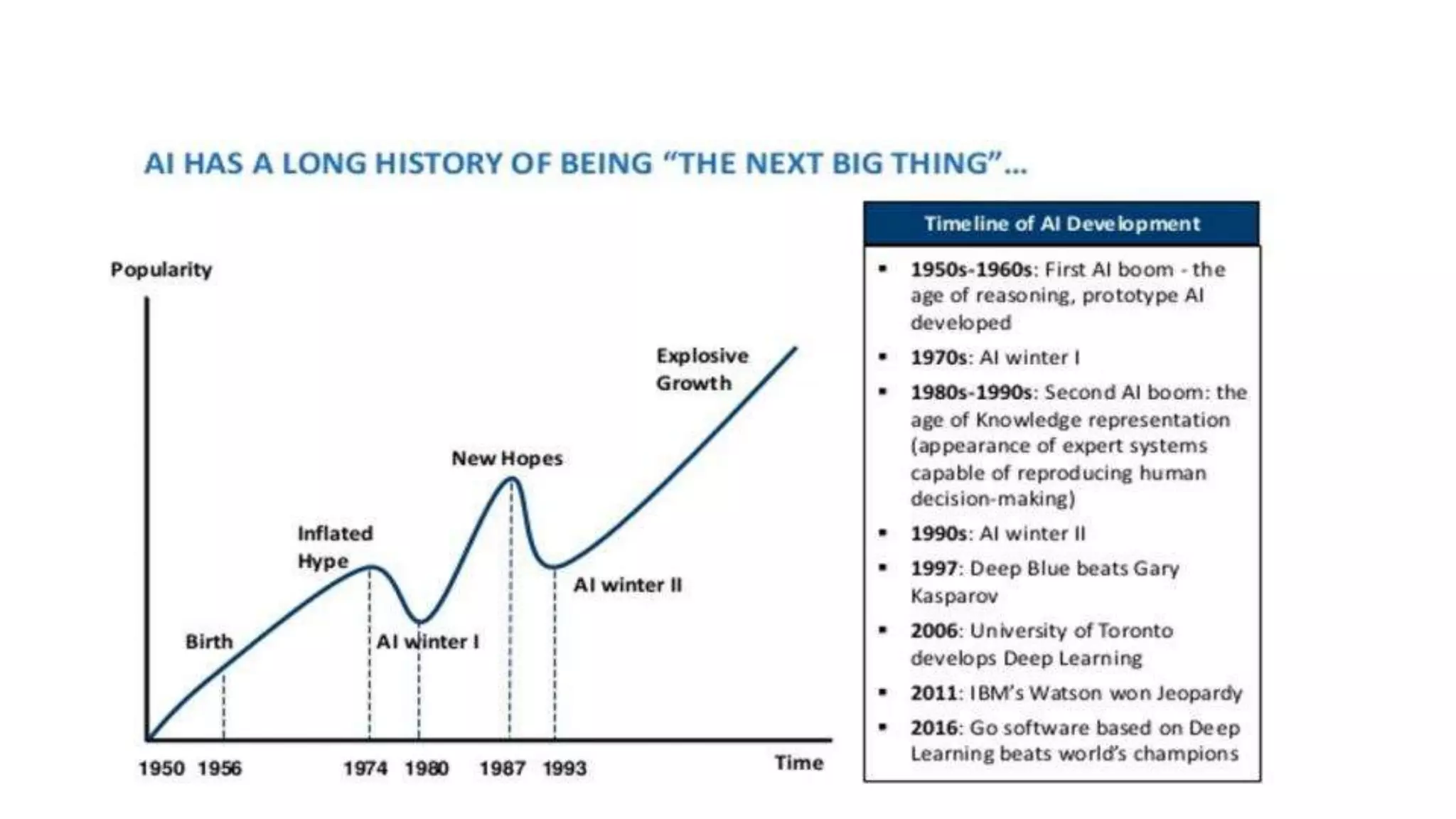
AI hype and AI winters
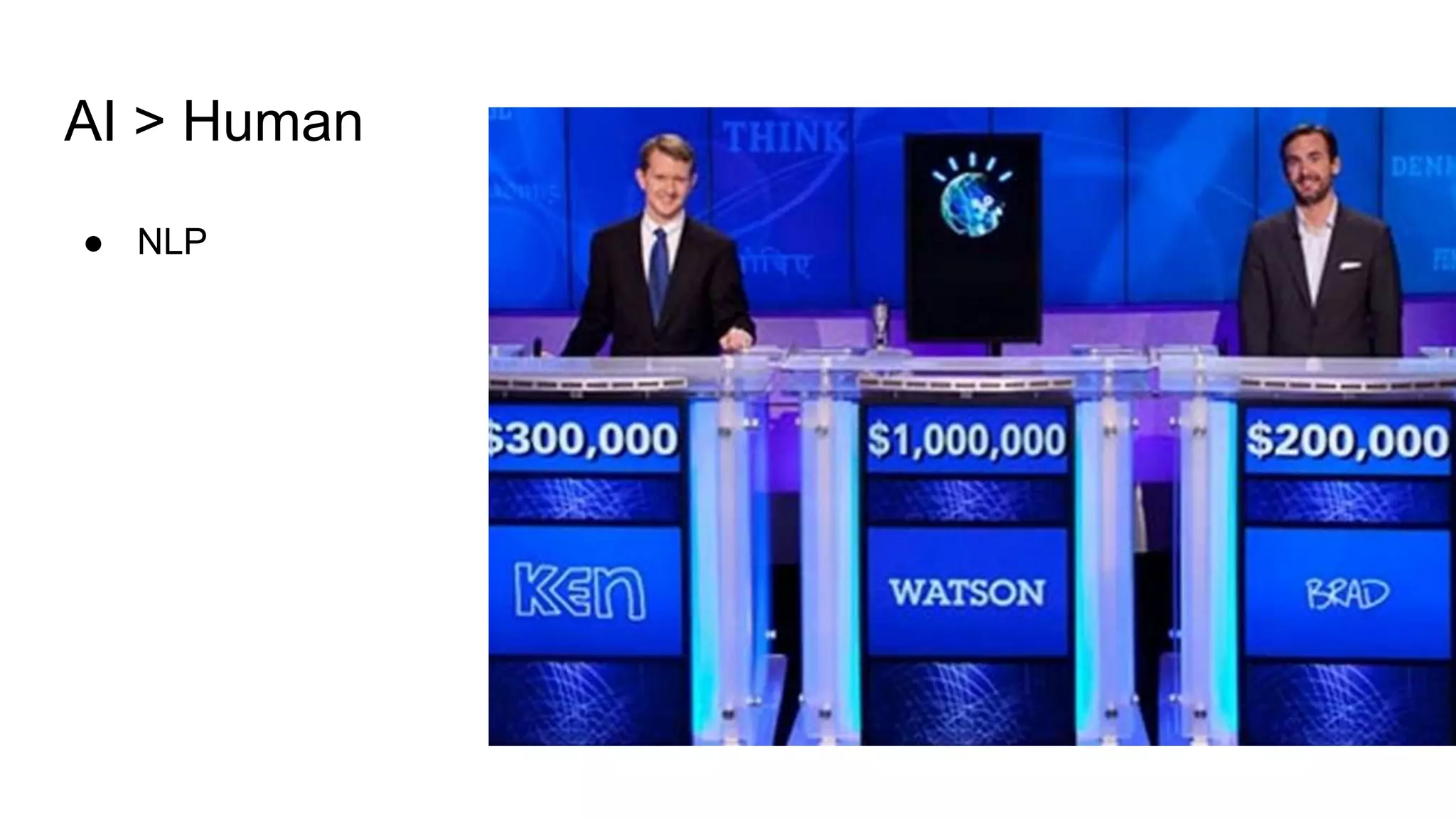
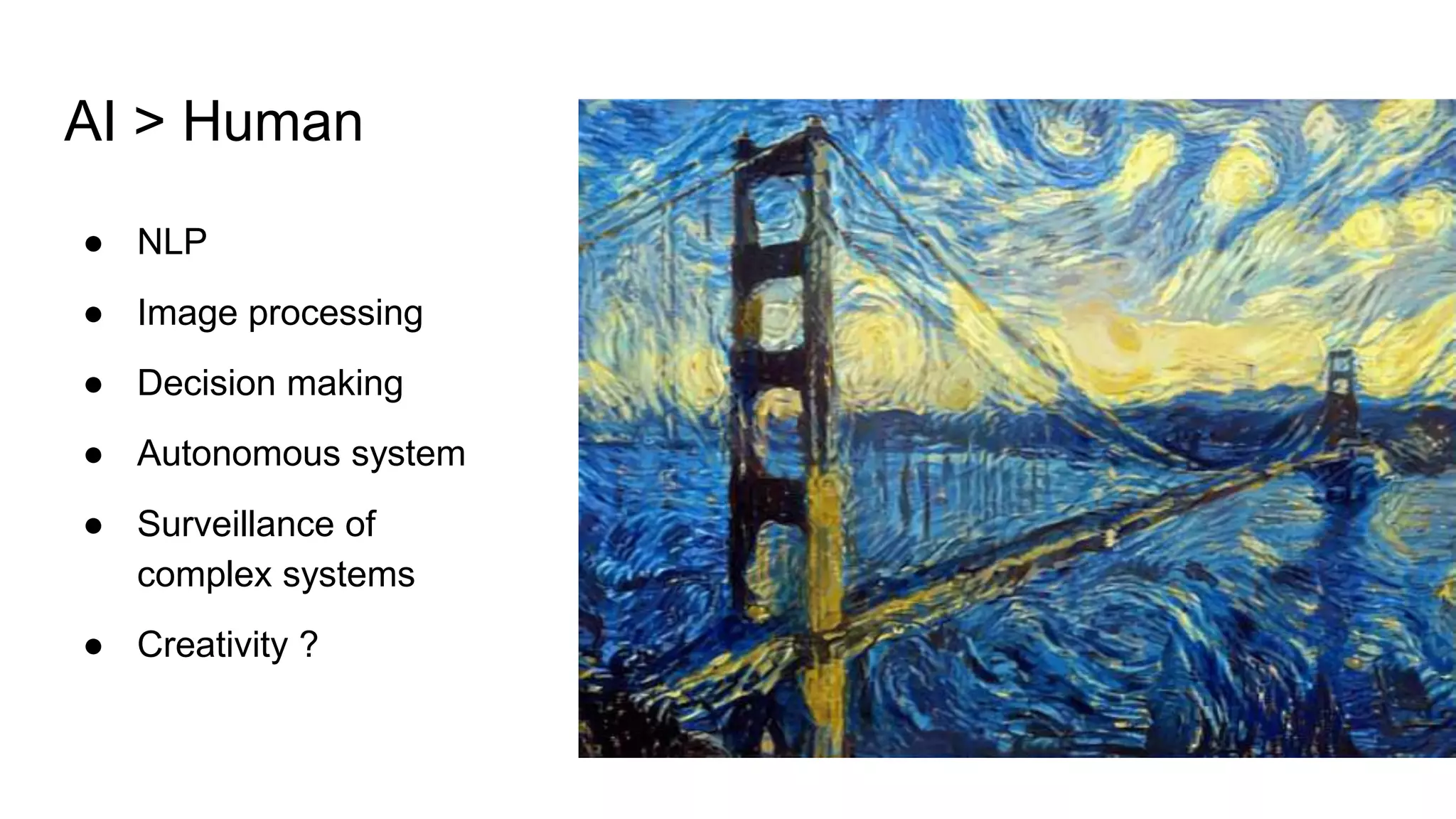
AI > Human
● NLP
AI > Human
● NLP
● Image processing
AI > Human
● NLP
● Image processing
AI > Human
● NLP
● Image processing
● Decision making
AI > Human
● NLP
● Image processing
● Decision making
AI > Human
● NLP
● Image processing
● Decision making
● Autonomous system
AI > Human
● NLP
● Image processing
● Decision making
● Autonomous system
AI > Human
● NLP
● Image processing
● Decision making
● Autonomous system
● Surveillance of
complex systems
AI > Human
● NLP
● Image processing
● Decision making
● Autonomous system
● Surveillance of
complex systems
● Creativity ?
Supervised learning: x ↦ y
Examples:
● Image recognition. x = image, y = label (cat, dog, apple, ...)
● Predicting house prices. x = [neighborhood, m², ...], y = price
● Spam detection. x = email text, y = spam/not spam
● Speech recognition. x = audio, y = transcribed text
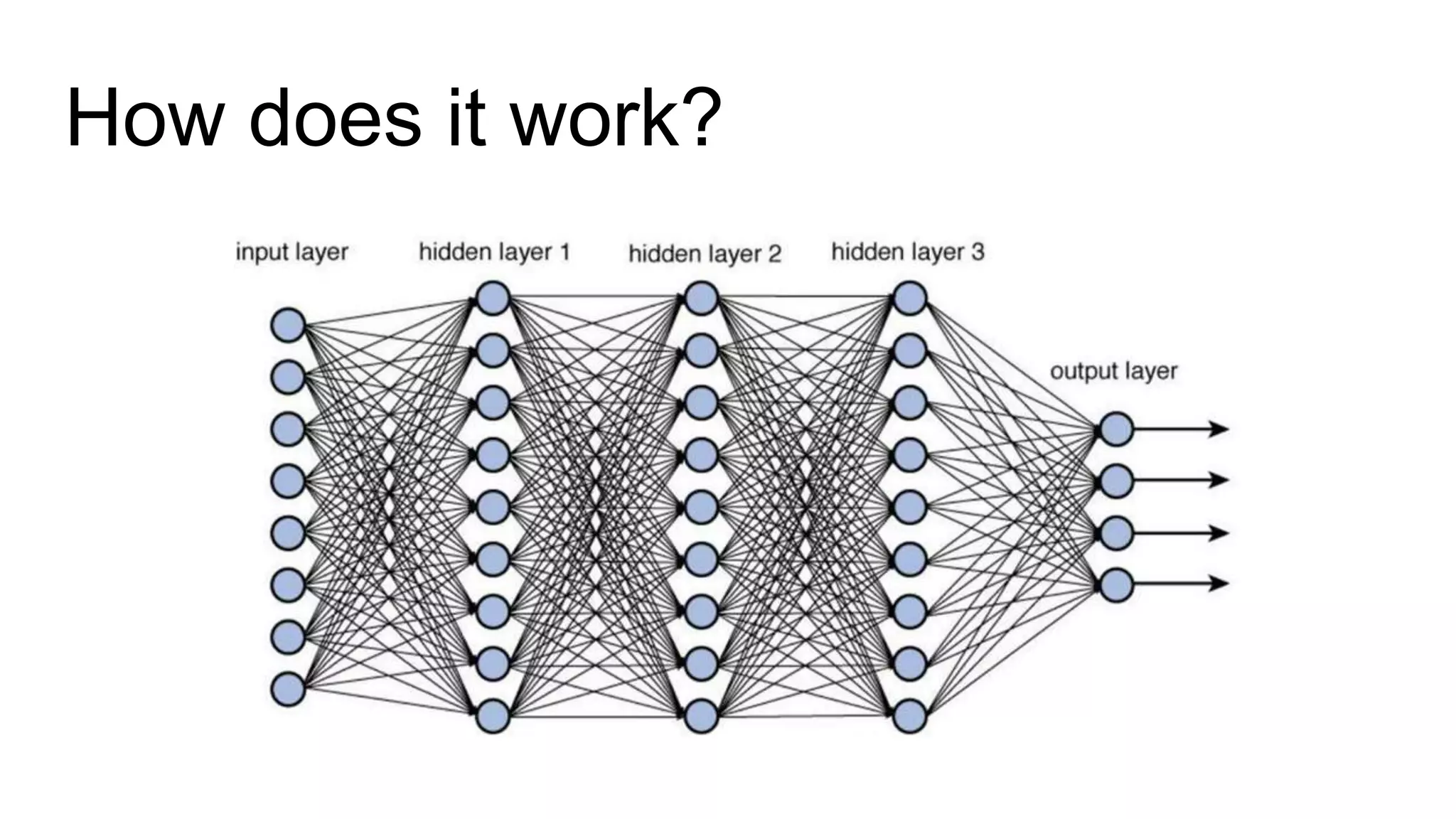
How does it work?
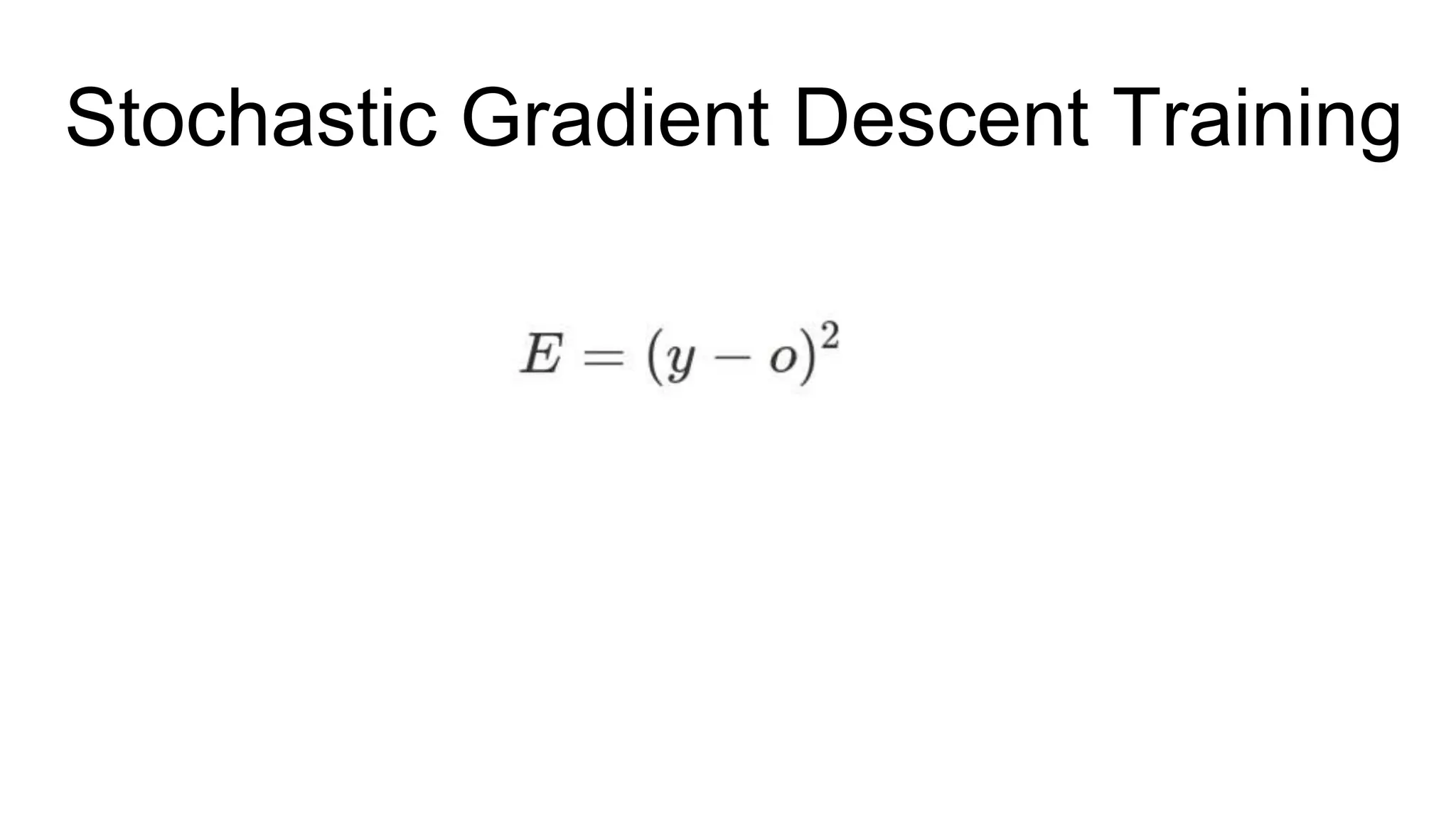
Stochastic Gradient Descent Training
At each step the gradient of the error
between prediction and label is used to
determine how to change connections
towards a smaller error.
Stochastic Gradient Descent Training
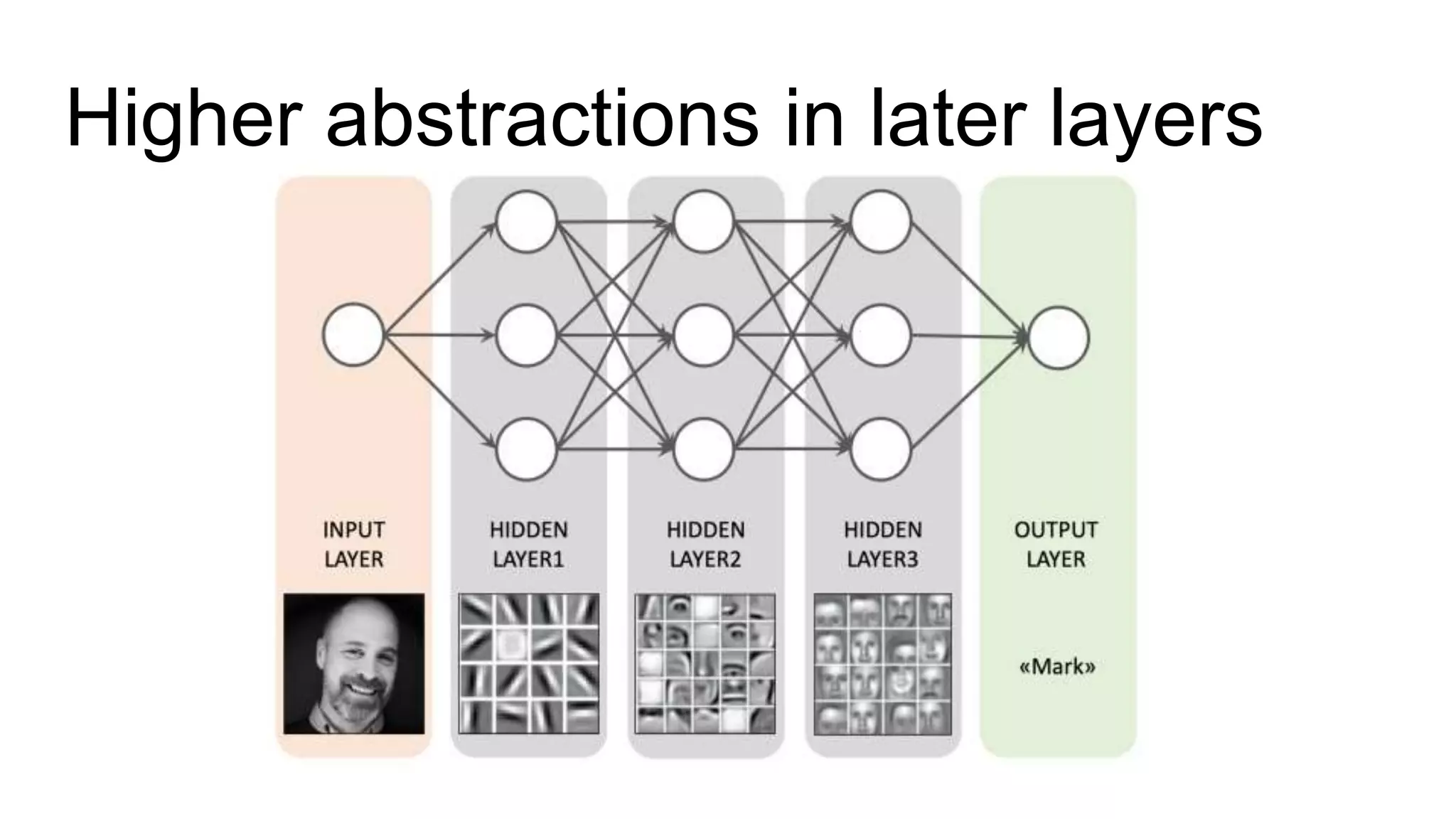
Higher abstractions in later layers
Pre-trained models
Parts of machine learning
Applying Machine Learning (ML)
The ML Surprise - Effort Allocation
Most common pitfalls
1. Evaluate simple heuristics without ML first
2. Use a ML API
3. Find a pre-trained open source model
4. Finetune a pre-trained model
5. Use open source code to train a model on your data
6. Build a model from scratch
Priority list when applying ML
Deep Learning vs other approaches
● Image recognition. x = image, y = label (cat, dog, apple, ...) Visual ✅
● Speech recognition. x = audio, y = transcribed text Audio ✅
● Text classification. x = email text, y = spam/not spam NLP ✅
● Predicting house prices. x = [neighborhood, m², ...], y = price Tabular❌
Deep Learning vs other approaches
Deep Learning:
● Image recognition. x = image, y = label (cat, dog, apple, ...) Visual ✅
● Speech recognition. x = audio, y = transcribed text Audio ✅
● Text classification. x = email text, y = spam/not spam NLP ✅
Decision trees, linear models, nearest neighbour:
● Predicting house prices. x = [neighborhood, m², ...], y = price Tabular❌
Deep Learning in action
RNNs predicting text continuation
RNNs predicting text continuation (simple)
Workflow for adding a ML feature
1. Define evaluation criteria and evaluation data
2. Find model with sufficient performance
3. Create container with web server, model and parameters
4. Deploy container in cloud
5. Send features over HTTP from main service
6. Receive predictions
7. ...profit $
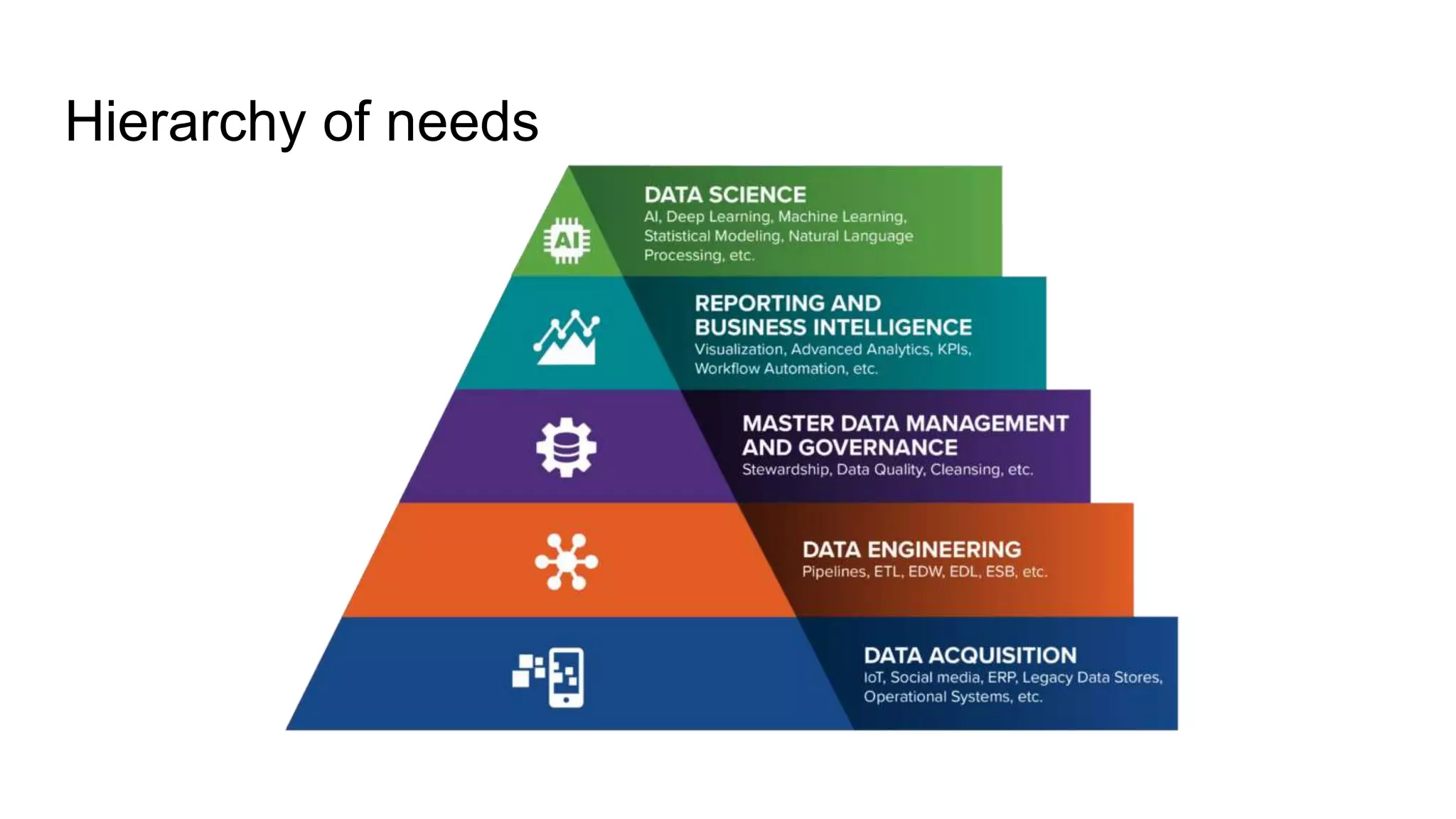
Hierarchy of needs
Being productive with machine learning doesn’t
require a deep understanding of the mathematics
Recommended reading list
Applying Machine Learning
People + AI Guidebook - Google - build great products with ML
http://martin.zinkevich.org/rules_of_ml/rules_of_ml.pdf - best practices when productionizing ML
Machine Learning Yearning - Andrew Ng - applied ML research strategy
Cloud provider APIs (e.g. AWS)
Advanced modelling
Deep Learning for Coders - fast.ai course
100 page ML book
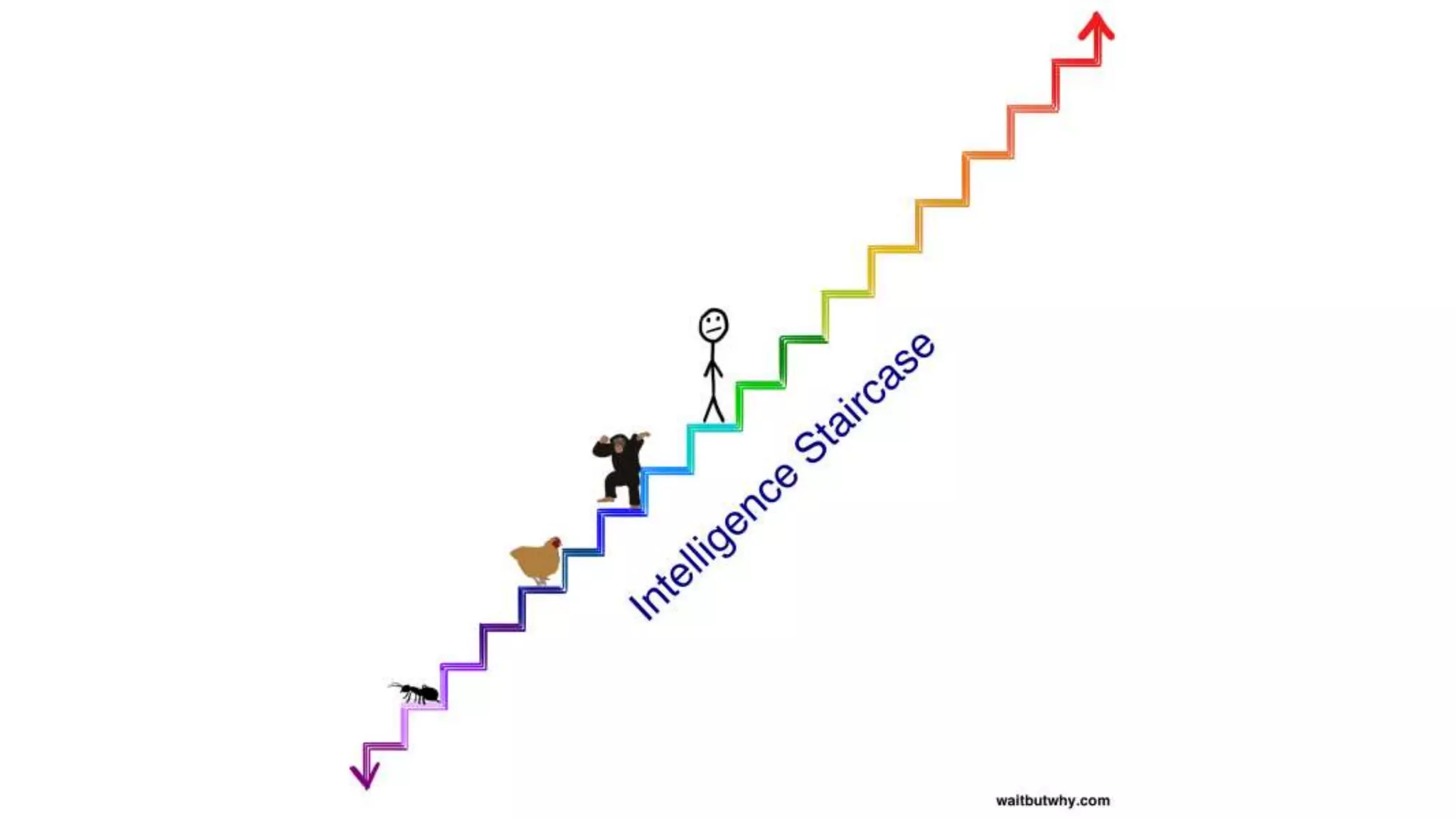
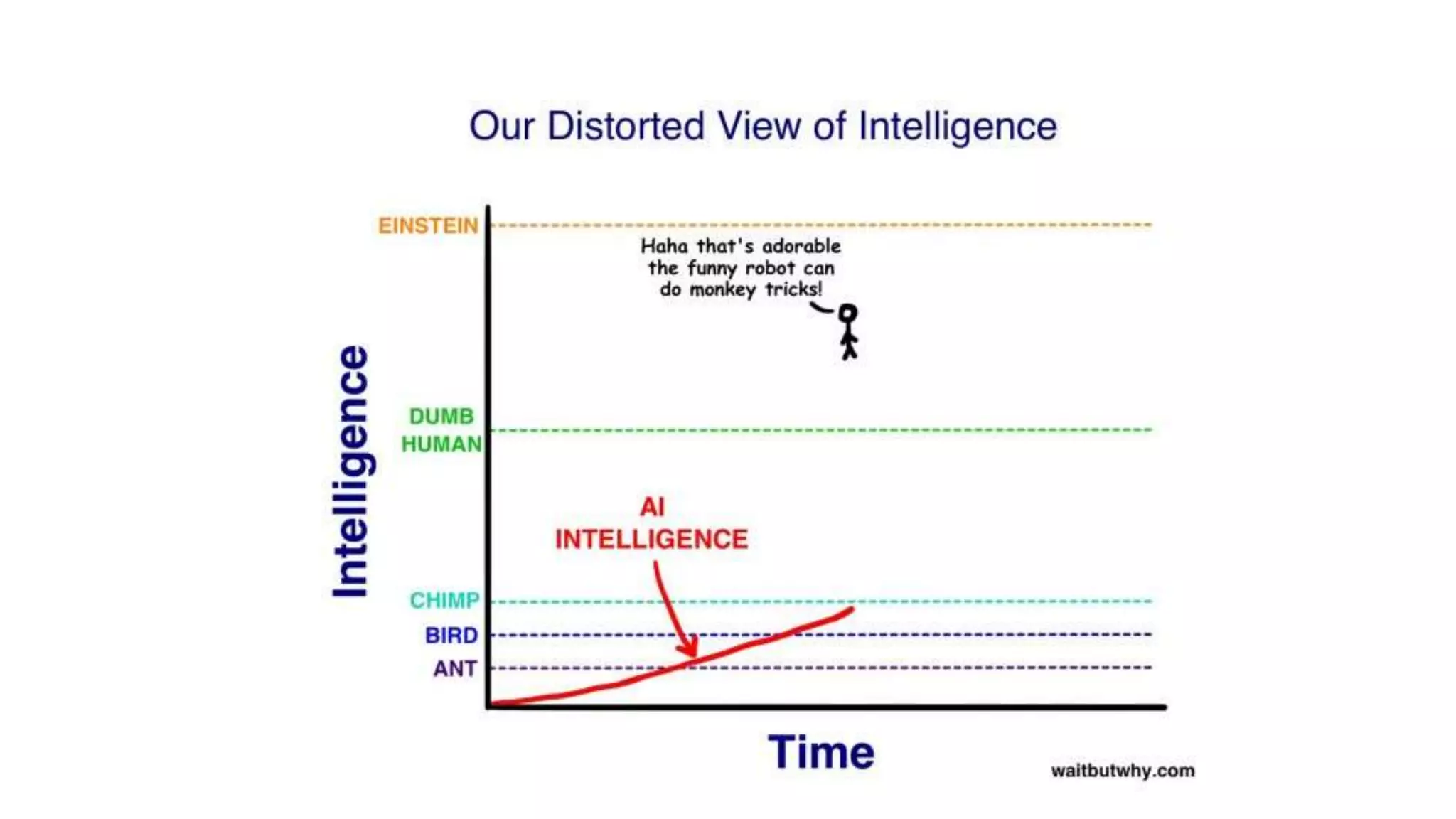
Extra:How long to AI takeover?
Success stories
Success stories
ML Success stories

Artificial intelligence

  • 1.
    Full Day ofApplied AI Morning Session 1 Intro to Artificial Intelligence 09:00-09:45 Introduction to Applied AI 09:45-10:00 Coffee and break Session 2 Live Coding a machine learning app 10:00-10:10 Getting your machine ready for machine learning 10:10-10.20 Training and evaluating the model 10.20-10.50 Improving the model 10.50-11.00 Coffee and break Session 3 Machine learning in the wild - deployment 11:00-11.15 Coding exercise continued 11:15-11:45 Serving your own machine learning model | Code 11:45-11:55 How to solve problems | interactive exercise 11:55-12:00 Q and A Lunch 12:00-13:00 Lunch Afternoon Session 4 Hello World Deep Learning (MNIST) 13:00-13:15 Deep Learning intro 13:00-13.15 Image recognition and CNNs | Talk | 13:15-13:45 Building your own convolutional neural network | Code | 13:45-14:00 Coffee and break Session 5 Natural Language Processing 14:00-14.30 Natural language processing | Talk | 14:30-14:45 Working with language | Code | 14:45-15:00 Coffee and break Session 6 Conversational interfaces and Time Series 14:00-14.20 Conversational interfaces 14:20-14:45 Time Series prediction 14:45-15:00 Coffee and break Session 7 Generative models and style transfer 16:00-16.30 Generative models | Talk | 16:30-16:45 Trying out GANS and style transfer | Code | 16:45-17:00 Coffee and break Anton Osika AI Research Engineer Sana Labs AB anton.osika@gmail.com Birger Moëll Machine Learning Engineer birger.moell@gmail.com
  • 2.
  • 3.
    What is AI? Thescope of AI is disputed: as machines become increasingly capable, tasks considered as requiring "intelligence" are often removed from the definition of AI, a phenomenon known as the AI effect
  • 4.
    What is AI? Ifa computer system does something and you think: “that was pretty smart” -> AI
  • 5.
    jj Artificial Intelligence, MachineLearning and Deep Learning
  • 6.
    AI hype andAI winters
  • 7.
  • 8.
    AI > Human ●NLP ● Image processing
  • 9.
    AI > Human ●NLP ● Image processing
  • 10.
    AI > Human ●NLP ● Image processing ● Decision making
  • 11.
    AI > Human ●NLP ● Image processing ● Decision making
  • 12.
    AI > Human ●NLP ● Image processing ● Decision making ● Autonomous system
  • 13.
    AI > Human ●NLP ● Image processing ● Decision making ● Autonomous system
  • 14.
    AI > Human ●NLP ● Image processing ● Decision making ● Autonomous system ● Surveillance of complex systems
  • 15.
    AI > Human ●NLP ● Image processing ● Decision making ● Autonomous system ● Surveillance of complex systems ● Creativity ?
  • 16.
    Supervised learning: x↦ y Examples: ● Image recognition. x = image, y = label (cat, dog, apple, ...) ● Predicting house prices. x = [neighborhood, m², ...], y = price ● Spam detection. x = email text, y = spam/not spam ● Speech recognition. x = audio, y = transcribed text
  • 17.
  • 18.
  • 19.
  • 20.
    At each stepthe gradient of the error between prediction and label is used to determine how to change connections towards a smaller error. Stochastic Gradient Descent Training
  • 21.
  • 22.
  • 23.
  • 24.
  • 25.
  • 26.
    The ML Surprise- Effort Allocation
  • 27.
    The ML Surprise- Effort Allocation
  • 28.
  • 29.
    1. Evaluate simpleheuristics without ML first 2. Use a ML API 3. Find a pre-trained open source model 4. Finetune a pre-trained model 5. Use open source code to train a model on your data 6. Build a model from scratch Priority list when applying ML
  • 30.
    Deep Learning vsother approaches ● Image recognition. x = image, y = label (cat, dog, apple, ...) Visual ✅ ● Speech recognition. x = audio, y = transcribed text Audio ✅ ● Text classification. x = email text, y = spam/not spam NLP ✅ ● Predicting house prices. x = [neighborhood, m², ...], y = price Tabular❌
  • 31.
    Deep Learning vsother approaches Deep Learning: ● Image recognition. x = image, y = label (cat, dog, apple, ...) Visual ✅ ● Speech recognition. x = audio, y = transcribed text Audio ✅ ● Text classification. x = email text, y = spam/not spam NLP ✅ Decision trees, linear models, nearest neighbour: ● Predicting house prices. x = [neighborhood, m², ...], y = price Tabular❌
  • 32.
    Deep Learning inaction RNNs predicting text continuation RNNs predicting text continuation (simple)
  • 33.
    Workflow for addinga ML feature 1. Define evaluation criteria and evaluation data 2. Find model with sufficient performance 3. Create container with web server, model and parameters 4. Deploy container in cloud 5. Send features over HTTP from main service 6. Receive predictions 7. ...profit $
  • 34.
  • 35.
    Being productive withmachine learning doesn’t require a deep understanding of the mathematics
  • 36.
    Recommended reading list ApplyingMachine Learning People + AI Guidebook - Google - build great products with ML http://martin.zinkevich.org/rules_of_ml/rules_of_ml.pdf - best practices when productionizing ML Machine Learning Yearning - Andrew Ng - applied ML research strategy Cloud provider APIs (e.g. AWS) Advanced modelling Deep Learning for Coders - fast.ai course 100 page ML book
  • 37.
    Extra:How long toAI takeover?
  • 42.
  • 43.
  • 44.

Editor's Notes

  • #3 I will give a brief more intro, speak about getting value out of AI and a focus on machine learning. System
  • #4 I will give a brief more intro, speak about getting value out of AI and a focus on machine learning. System
  • #5 I will give a brief more intro, speak about getting value out of AI and a focus on machine learning. System
  • #6 Machine Learning is a subset of AI Old technology → Machine Learning → Deep Learning Deep Learning is usually the type of AI you will hear about today.
  • #7 I’m not sure if you have noticed but there is quite a bit of AI hype!
  • #8 Betona att många genombrott leder till väldigt många tillämpningar. Gradvis process: Automatisering IoT etc NLP: Taligenkänning och språkförståelse: Alexa/Google Assistant. Stanford reading comprehension test superhuman Alibaba & Microsoft. Läsa juridiska dokument, hitta kryphål i lagen. Medicin/läkare Bildigenkänning: Väsentligen ett löst problem. Beslutsfattning: Schack & Go Självkörande bilar: Redan ute på vägarna. Övervakning: Nästa slide Kina. Tillsynes inga gränser: Kognitiva uppgifter människa vs AI. Bild: Style transfer Golden Gate Bridge Van Gogh
  • #9 Betona att många genombrott leder till väldigt många tillämpningar. Gradvis process: Automatisering IoT etc NLP: Taligenkänning och språkförståelse: Alexa/Google Assistant. Stanford reading comprehension test superhuman Alibaba & Microsoft. Läsa juridiska dokument, hitta kryphål i lagen. Medicin/läkare Bildigenkänning: Väsentligen ett löst problem. Beslutsfattning: Schack & Go Självkörande bilar: Redan ute på vägarna. Övervakning: Nästa slide Kina. Tillsynes inga gränser: Kognitiva uppgifter människa vs AI. Bild: Style transfer Golden Gate Bridge Van Gogh
  • #10 Betona att många genombrott leder till väldigt många tillämpningar. Gradvis process: Automatisering IoT etc NLP: Taligenkänning och språkförståelse: Alexa/Google Assistant. Stanford reading comprehension test superhuman Alibaba & Microsoft. Läsa juridiska dokument, hitta kryphål i lagen. Medicin/läkare Bildigenkänning: Väsentligen ett löst problem. Beslutsfattning: Schack & Go Självkörande bilar: Redan ute på vägarna. Övervakning: Nästa slide Kina. Tillsynes inga gränser: Kognitiva uppgifter människa vs AI. Bild: Style transfer Golden Gate Bridge Van Gogh
  • #11 Betona att många genombrott leder till väldigt många tillämpningar. Gradvis process: Automatisering IoT etc NLP: Taligenkänning och språkförståelse: Alexa/Google Assistant. Stanford reading comprehension test superhuman Alibaba & Microsoft. Läsa juridiska dokument, hitta kryphål i lagen. Medicin/läkare Bildigenkänning: Väsentligen ett löst problem. Beslutsfattning: Schack & Go Självkörande bilar: Redan ute på vägarna. Övervakning: Nästa slide Kina. Tillsynes inga gränser: Kognitiva uppgifter människa vs AI. Bild: Style transfer Golden Gate Bridge Van Gogh
  • #12 Betona att många genombrott leder till väldigt många tillämpningar. Gradvis process: Automatisering IoT etc NLP: Taligenkänning och språkförståelse: Alexa/Google Assistant. Stanford reading comprehension test superhuman Alibaba & Microsoft. Läsa juridiska dokument, hitta kryphål i lagen. Medicin/läkare Bildigenkänning: Väsentligen ett löst problem. Beslutsfattning: Schack & Go Självkörande bilar: Redan ute på vägarna. Övervakning: Nästa slide Kina. Tillsynes inga gränser: Kognitiva uppgifter människa vs AI. Bild: Style transfer Golden Gate Bridge Van Gogh
  • #13 Betona att många genombrott leder till väldigt många tillämpningar. Gradvis process: Automatisering IoT etc NLP: Taligenkänning och språkförståelse: Alexa/Google Assistant. Stanford reading comprehension test superhuman Alibaba & Microsoft. Läsa juridiska dokument, hitta kryphål i lagen. Medicin/läkare Bildigenkänning: Väsentligen ett löst problem. Beslutsfattning: Schack & Go Självkörande bilar: Redan ute på vägarna. Övervakning: Nästa slide Kina. Tillsynes inga gränser: Kognitiva uppgifter människa vs AI. Bild: Style transfer Golden Gate Bridge Van Gogh
  • #14 Betona att många genombrott leder till väldigt många tillämpningar. Gradvis process: Automatisering IoT etc NLP: Taligenkänning och språkförståelse: Alexa/Google Assistant. Stanford reading comprehension test superhuman Alibaba & Microsoft. Läsa juridiska dokument, hitta kryphål i lagen. Medicin/läkare Bildigenkänning: Väsentligen ett löst problem. Beslutsfattning: Schack & Go Självkörande bilar: Redan ute på vägarna. Övervakning: Nästa slide Kina. Tillsynes inga gränser: Kognitiva uppgifter människa vs AI. Bild: Style transfer Golden Gate Bridge Van Gogh
  • #15 Betona att många genombrott leder till väldigt många tillämpningar. Gradvis process: Automatisering IoT etc NLP: Taligenkänning och språkförståelse: Alexa/Google Assistant. Stanford reading comprehension test superhuman Alibaba & Microsoft. Läsa juridiska dokument, hitta kryphål i lagen. Medicin/läkare Bildigenkänning: Väsentligen ett löst problem. Beslutsfattning: Schack & Go Självkörande bilar: Redan ute på vägarna. Övervakning: Nästa slide Kina. Tillsynes inga gränser: Kognitiva uppgifter människa vs AI. Bild: Style transfer Golden Gate Bridge Van Gogh
  • #16 Betona att många genombrott leder till väldigt många tillämpningar. Gradvis process: Automatisering IoT etc NLP: Taligenkänning och språkförståelse: Alexa/Google Assistant. Stanford reading comprehension test superhuman Alibaba & Microsoft. Läsa juridiska dokument, hitta kryphål i lagen. Medicin/läkare Bildigenkänning: Väsentligen ett löst problem. Beslutsfattning: Schack & Go Självkörande bilar: Redan ute på vägarna. Övervakning: Nästa slide Kina. Tillsynes inga gränser: Kognitiva uppgifter människa vs AI. Bild: Style transfer Golden Gate Bridge Van Gogh
  • #18 How does this work? Each layer has “higher level representations A network can learn any function with enough datapoints
  • #19 Makes sense so far?
  • #20 Makes sense so far?
  • #21 Makes sense so far?
  • #22 How does this work? Each layer has “higher level representations A network can learn any function with enough datapoints
  • #23 How does this work? Each layer has “higher level representations A network can learn any function with enough datapoints
  • #28 Applying ML is like ordinary software (which takes time) - but output is a lot less predictable. That’s why you want to take shortcuts.
  • #29 Applying ML is like ordinary software (which takes time) - but output is a lot less predictable. That’s why you want to take shortcuts.
  • #32 When recommending movies: Recommend the highest rated not-yet-seen movie in the same category. When classifying emails: Use regular expressions searching for keywords.
  • #35 As I mentioned, you can use APIs. But it is more flexible and often faster to iterate with your own code from scratch
  • #41 The above are systems, where code and machine learning is connected. But: most ML starts with some other supervised
  • #42 The above are systems, where code and machine learning is connected. But: most ML starts with some other supervised
  • #43 The above are systems, where code and machine learning is connected. But: most ML starts with some other supervised
  • #44 The above are systems, where code and machine learning is connected. But: most ML starts with some other supervised
  • #45 The above are systems, where code and machine learning is connected. But: most ML starts with some other supervised
  • #46 The above are systems, where code and machine learning is connected. But: most ML starts with some other supervised
  • #47 The above are systems, where code and machine learning is connected. But: most ML starts with some other supervised