© Waher Data AB, 2018.
Smart City Lecture 1
How to build a Smart City
© Waher Data AB, 2018.
1. Smart?
© Waher Data AB, 2018.
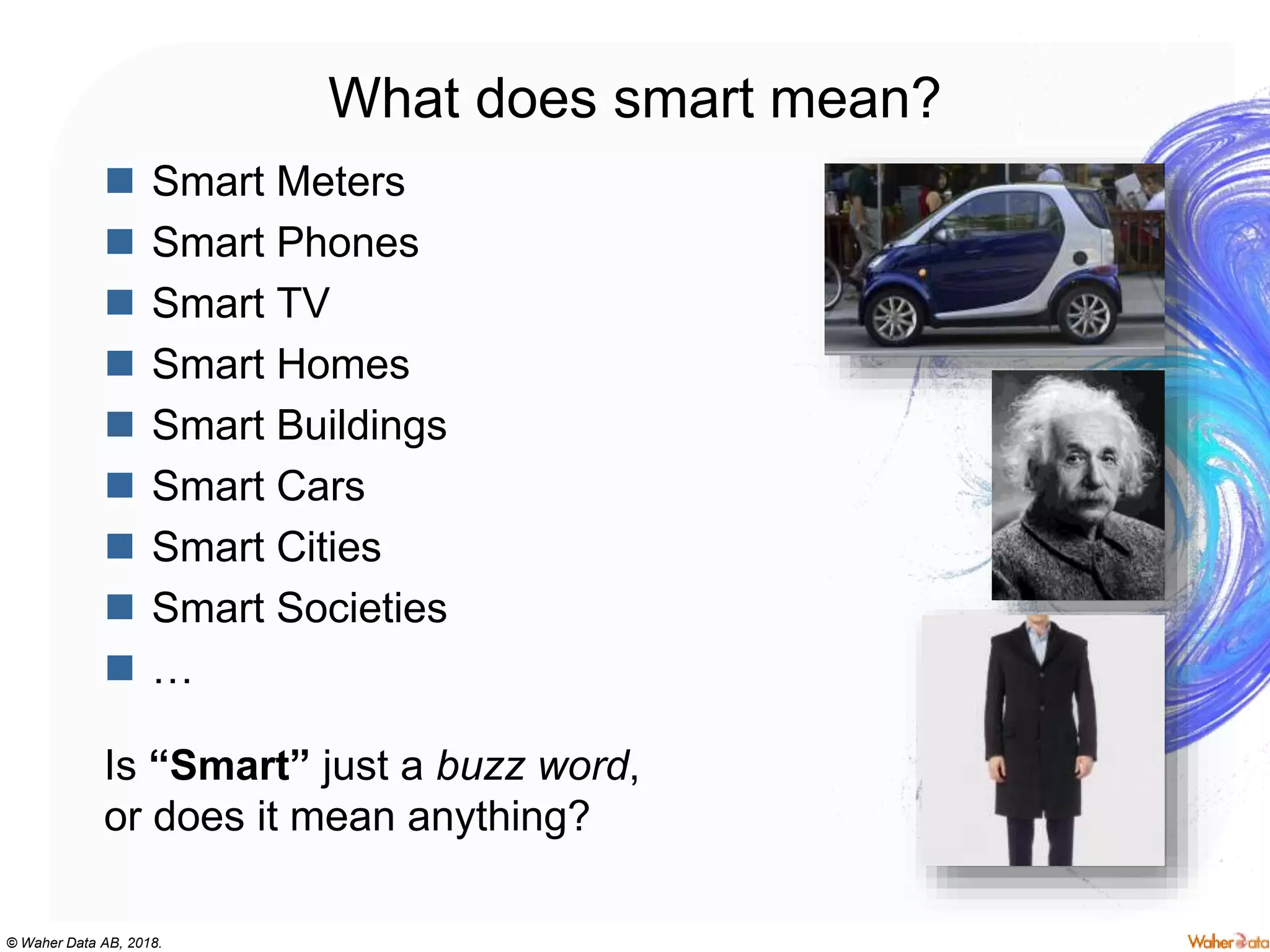
What does smart mean?
 Smart Meters
 Smart Phones
 Smart TV
 Smart Homes
 Smart Buildings
 Smart Cars
 Smart Cities
 Smart Societies
 …
Is “Smart” just a buzz word,
or does it mean anything?
© Waher Data AB, 2018.
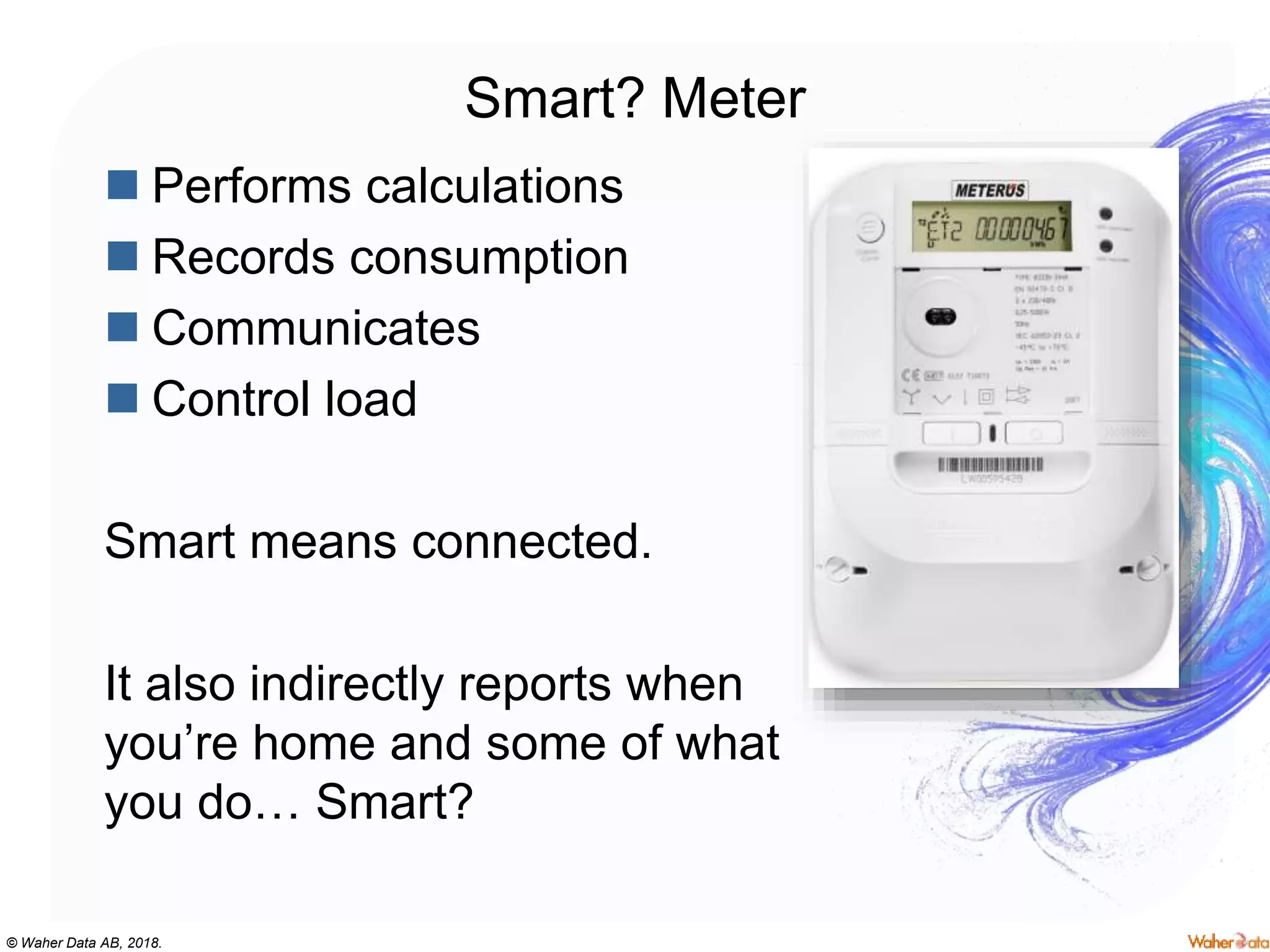
Smart? Meter
 Performs calculations
 Records consumption
 Communicates
 Control load
Smart means connected.
It also indirectly reports when
you’re home and some of what
you do… Smart?
© Waher Data AB, 2018.
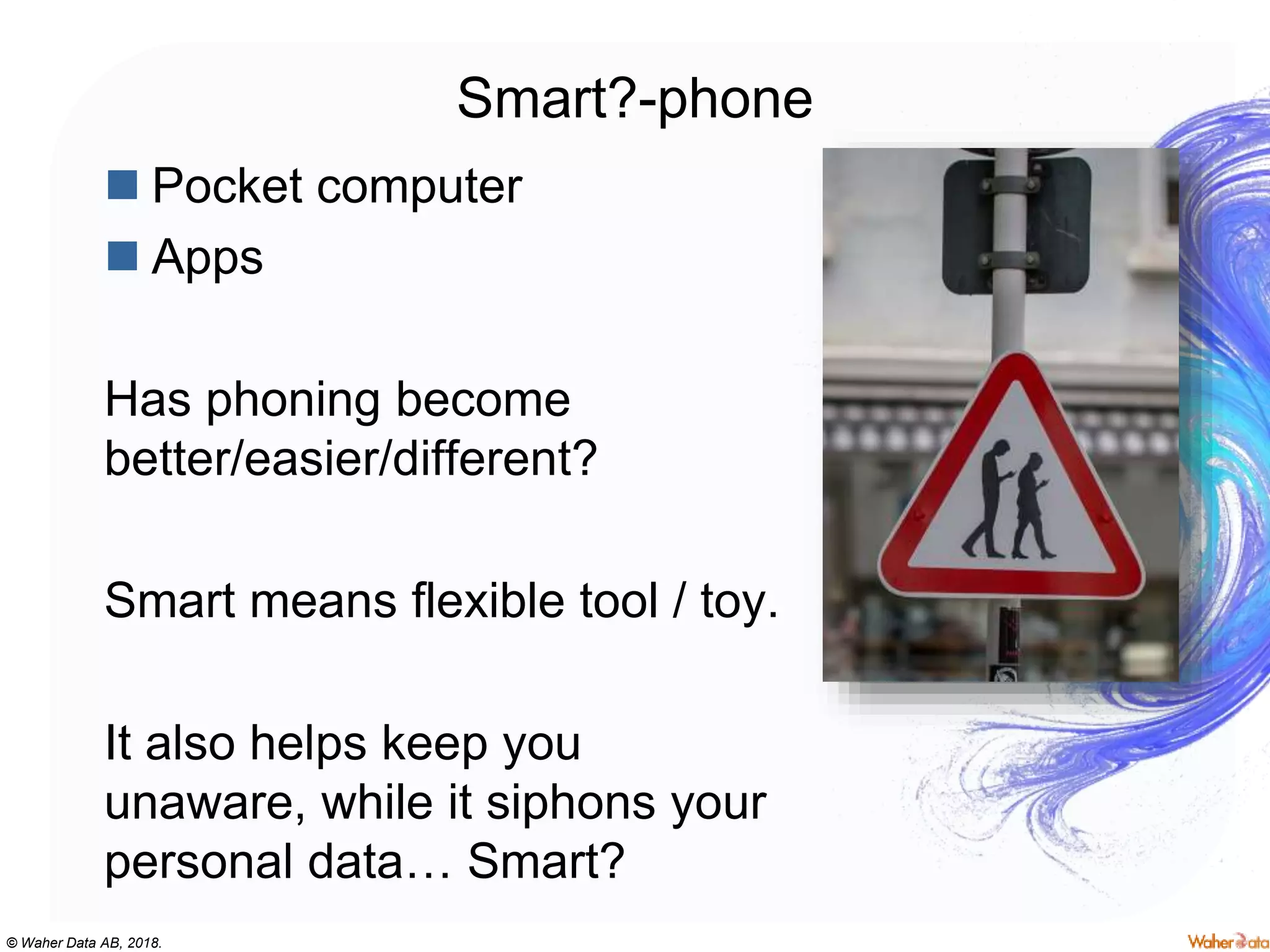
Smart?-phone
 Pocket computer
 Apps
Has phoning become
better/easier/different?
Smart means flexible tool / toy.
It also helps keep you
unaware, while it siphons your
personal data… Smart?
© Waher Data AB, 2018.
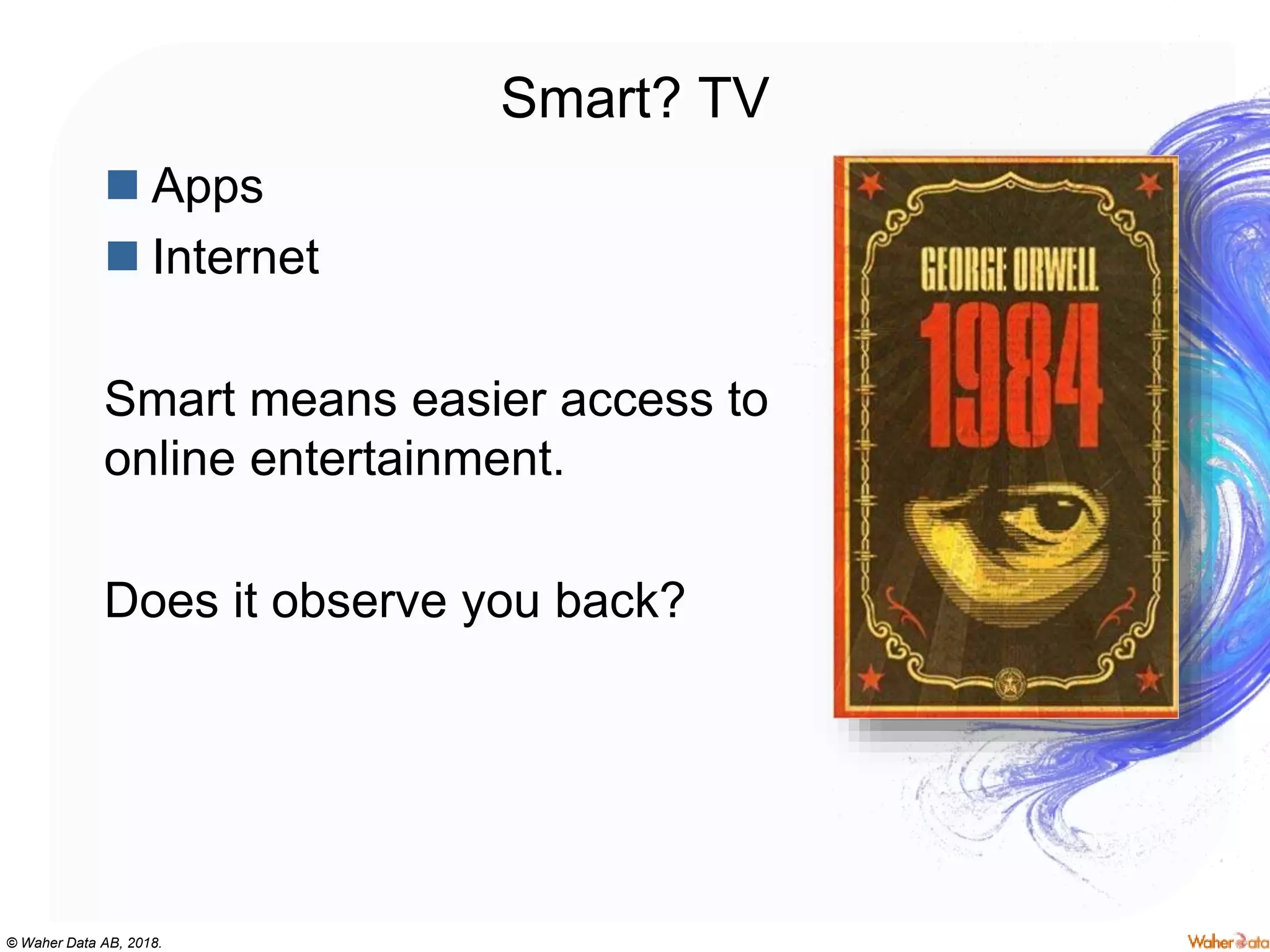
Smart? TV
 Apps
 Internet
Smart means easier access to
online entertainment.
Does it observe you back?
© Waher Data AB, 2018.
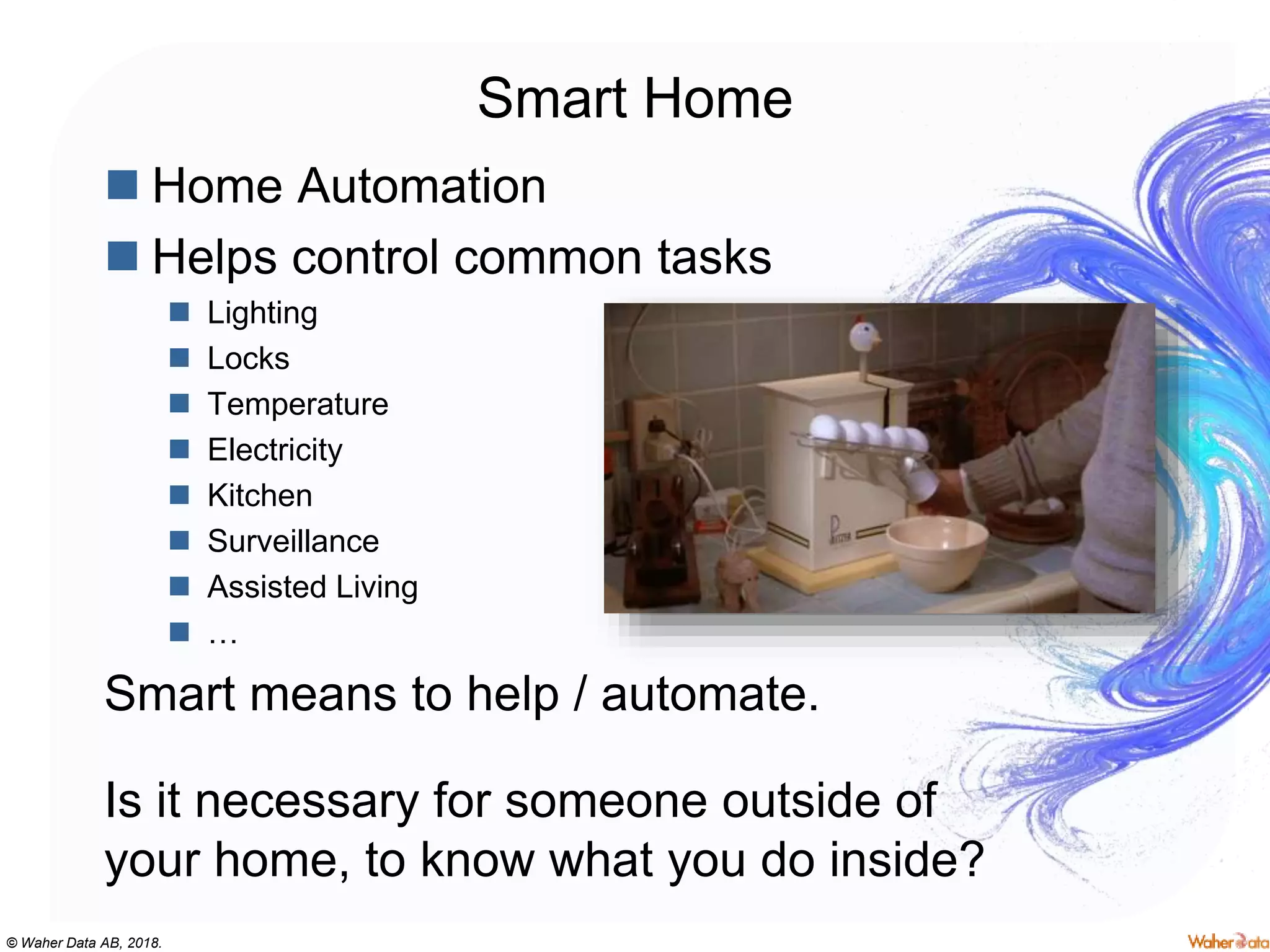
Smart Home
 Home Automation
 Helps control common tasks
 Lighting
 Locks
 Temperature
 Electricity
 Kitchen
 Surveillance
 Assisted Living
 …
Smart means to help / automate.
Is it necessary for someone outside of
your home, to know what you do inside?
© Waher Data AB, 2018.
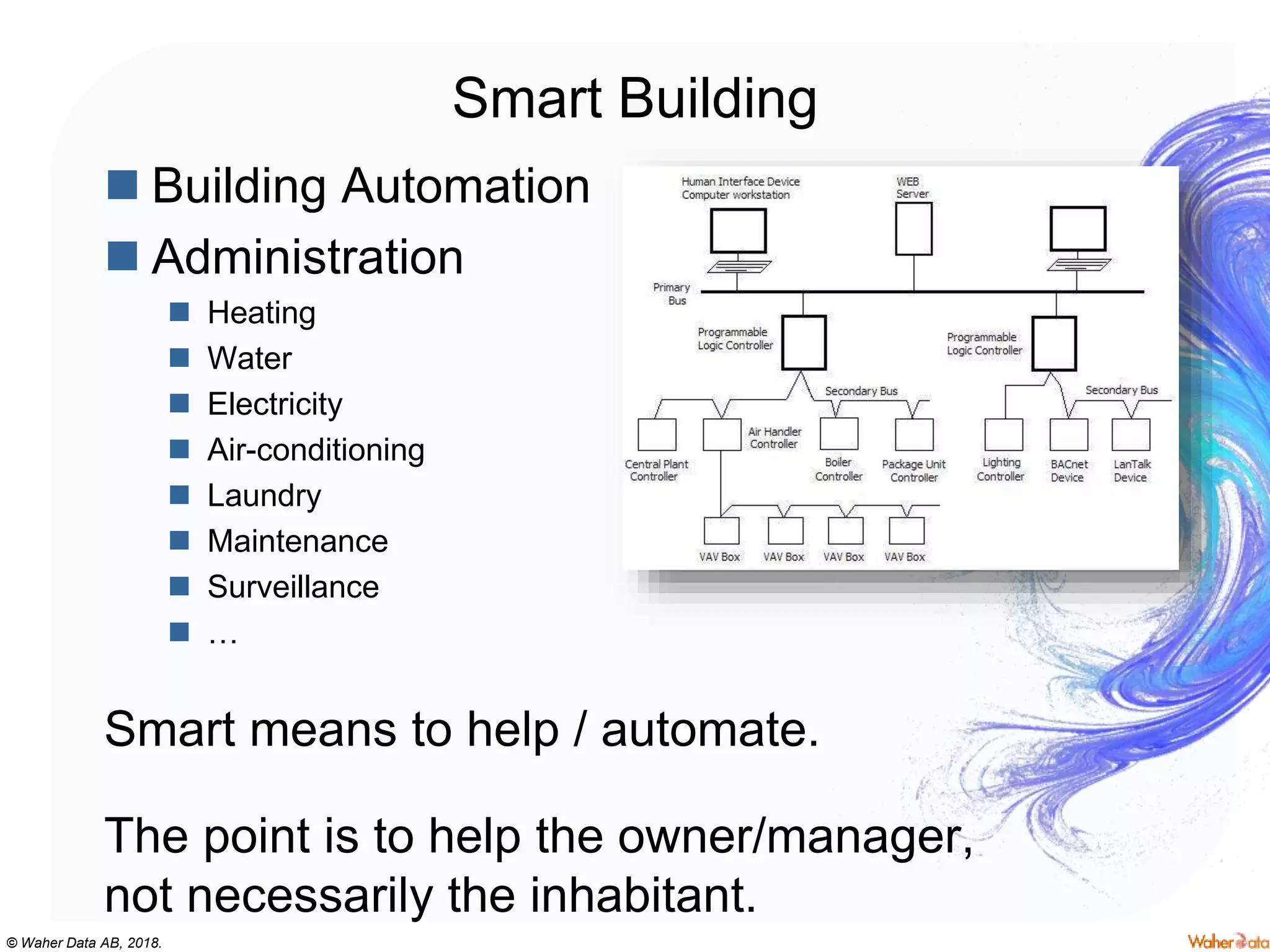
Smart Building
 Building Automation
 Administration
 Heating
 Water
 Electricity
 Air-conditioning
 Laundry
 Maintenance
 Surveillance
 …
Smart means to help / automate.
The point is to help the owner/manager,
not necessarily the inhabitant.
© Waher Data AB, 2018.
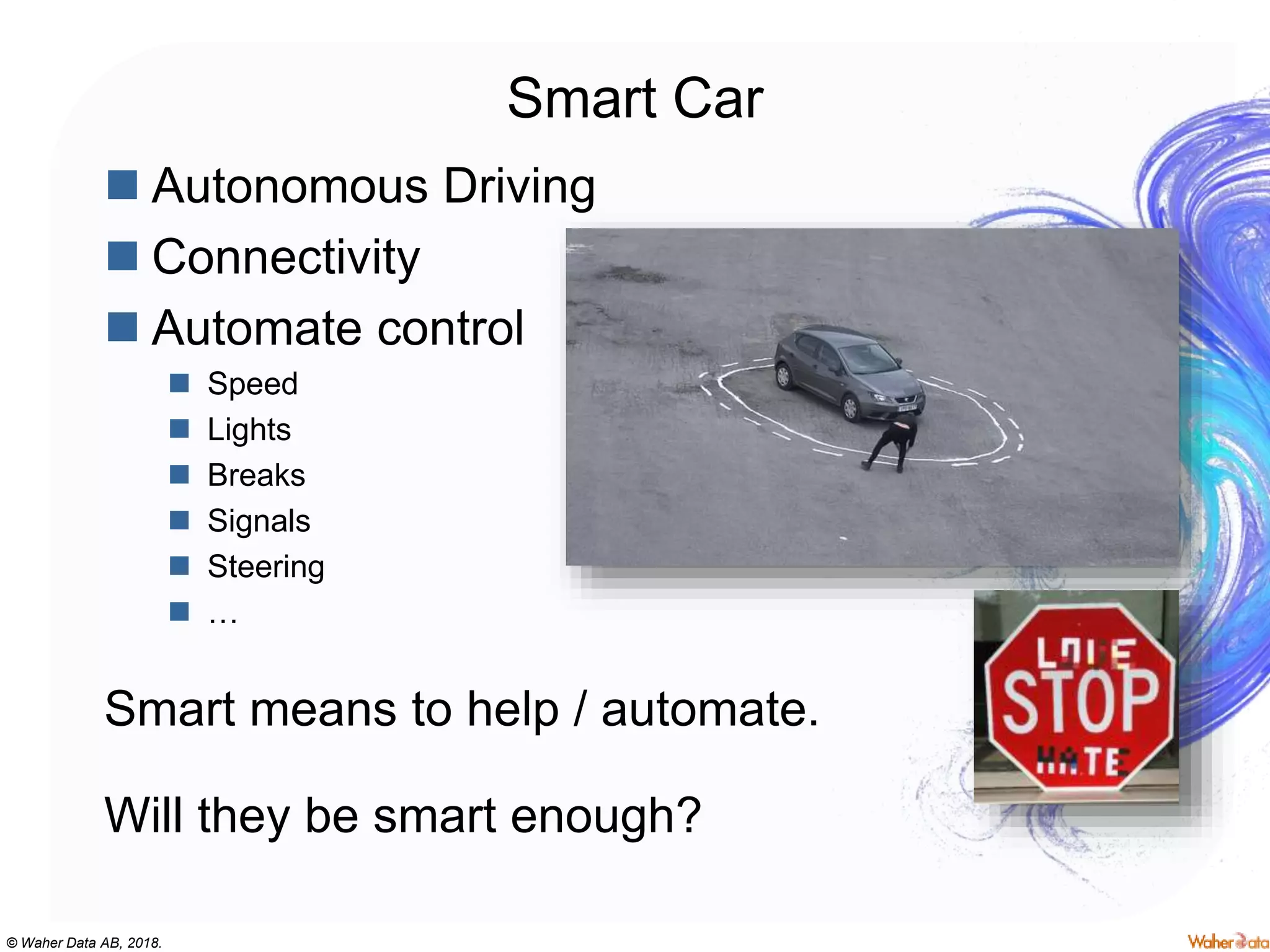
Smart Car
 Autonomous Driving
 Connectivity
 Automate control
 Speed
 Lights
 Breaks
 Signals
 Steering
 …
Smart means to help / automate.
Will they be smart enough?
© Waher Data AB, 2018.
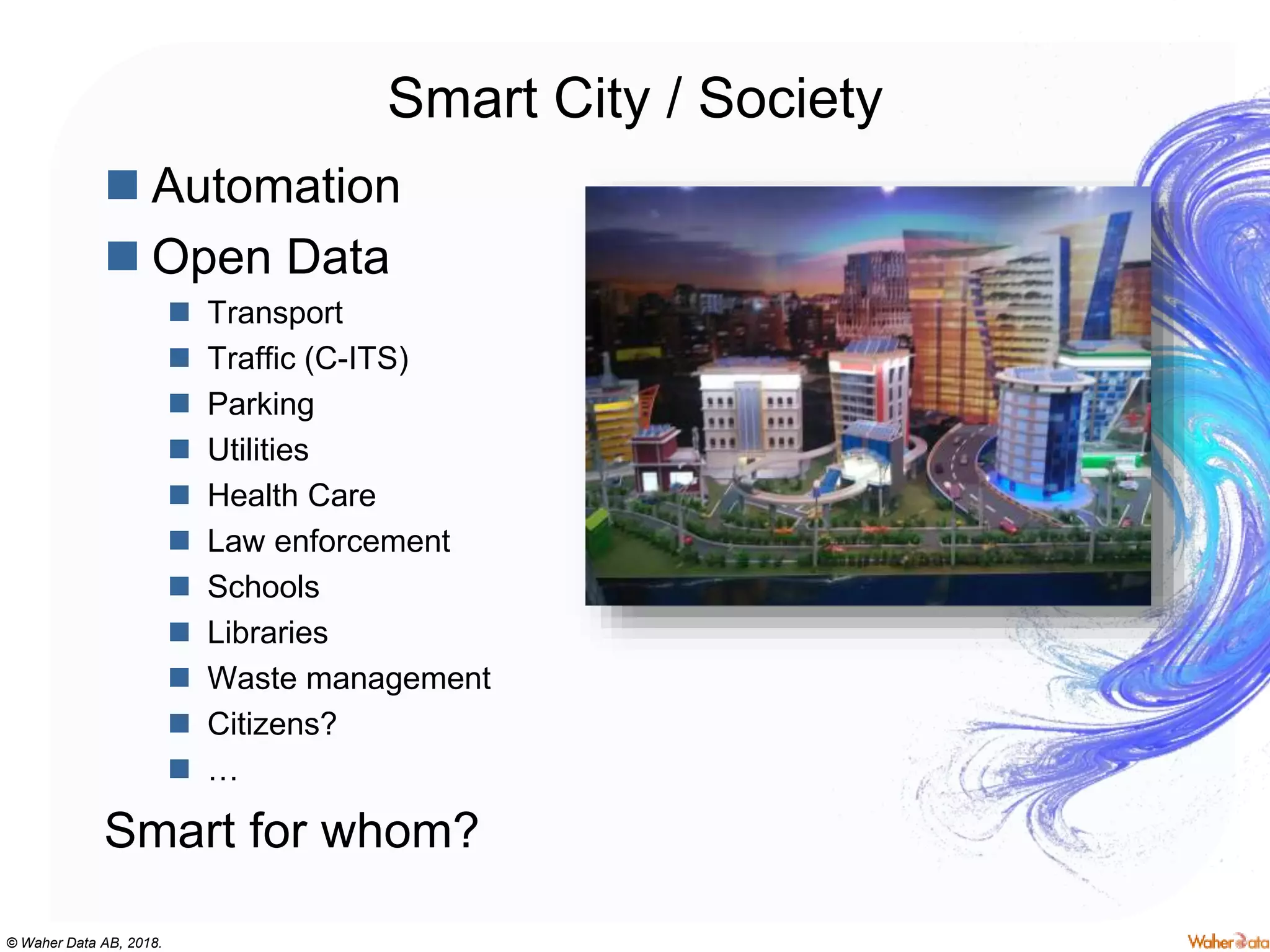
Smart City / Society
 Automation
 Open Data
 Transport
 Traffic (C-ITS)
 Parking
 Utilities
 Health Care
 Law enforcement
 Schools
 Libraries
 Waste management
 Citizens?
 …
Smart for whom?
© Waher Data AB, 2018.
Common Denominators
 Automation
 Optimization
 Connectivity
Sufficient for labeling something as
“smart”?
“Smart” is a great buzz word. It helps
vendors appear better, and
consumers feel better, even if the
technology happens to be “stupid”.
© Waher Data AB, 2018.
2. Delirium
© Waher Data AB, 2018.
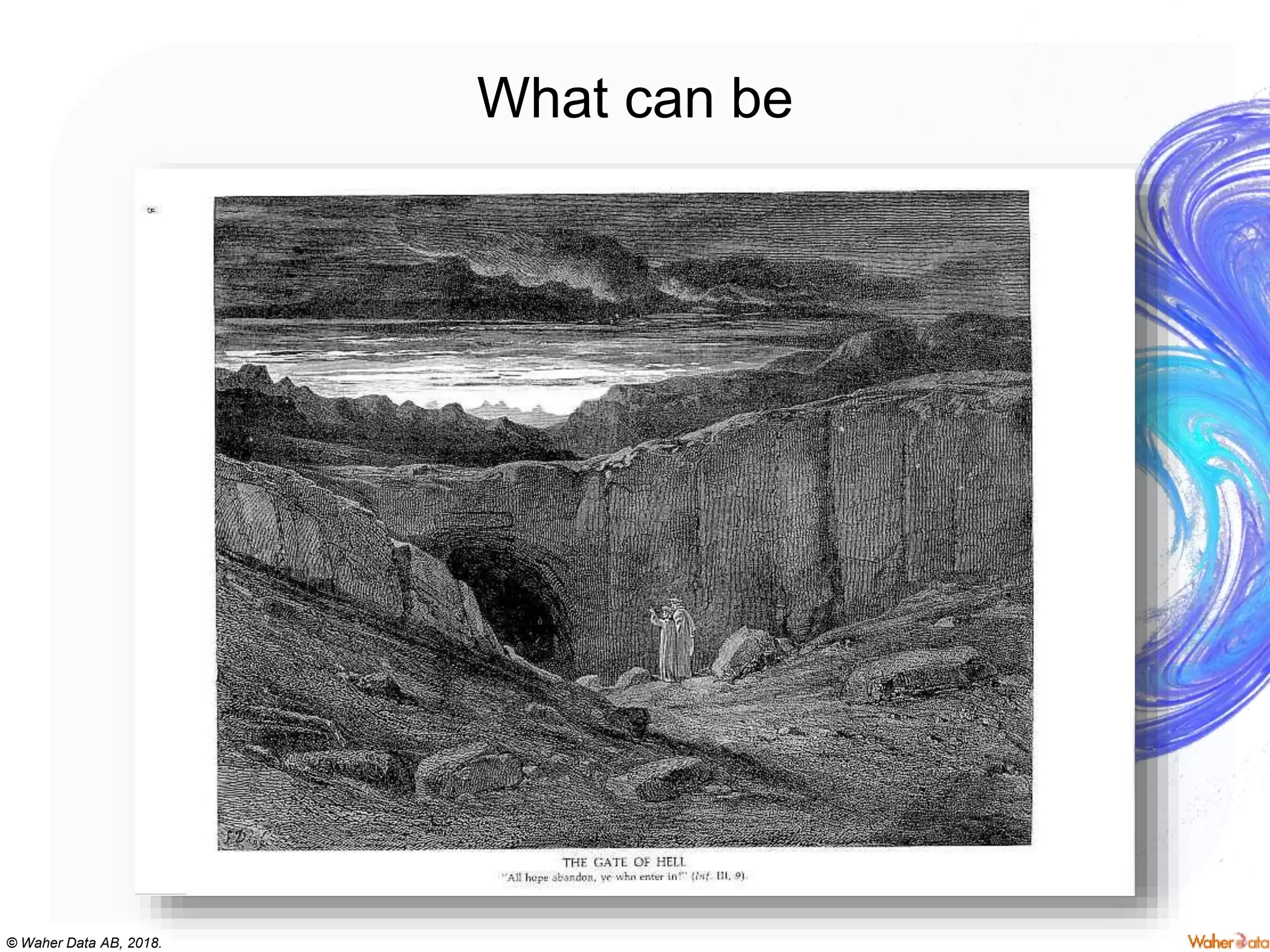
What can be
© Waher Data AB, 2018.
Chinese Social Credit System
(World’s most?) ambitious “Smart City”
project.
Calculates economic and social
reputation, based on mass surveillance
and AI:
 Honesty
 Commercial Integrity
 Social Integrity
 Judicial Credibility
© Waher Data AB, 2018.
Chinese Social Credit System
Collects data from:
 Online activity
 Searches
 Shopping behavior
 Locations
 Friends
 Health
 Bank accounts
 Messages
 Smart Home appliances
 News sources
 Dating
 …
© Waher Data AB, 2018.
Chinese Social Credit System
Affects:
 Job positions
 Salaries
 Living
 Travel restrictions
 Visa restrictions
 Access to schools
 Social status
 Loans
 Internet bandwidth
 …
© Waher Data AB, 2018.
Bad idea?
How about:
 Environmental impact rating?
 Diversity index?
 Common value compliance?
 …
© Waher Data AB, 2018.
Universal Declaration of Human Rights
Article 12:
No one shall be subjected to arbitrary
interference with his privacy, family,
home or correspondence, nor to attacks
upon his honour and reputation. Everyone
has the right to the protection of the
law against such interference or
attacks.
https://www.un.org/en/universal-declaration-human-rights/
Well… it all depends on how you choose to interpret
“arbitrary” and “attack”…
© Waher Data AB, 2018.
Will the surveillance state prevail?
Is the Chinese system better or worse
than the western system?
Some criticize the western model, by
claiming it does similar things, but not
transparently.
© Waher Data AB, 2018.
Authoritarian regimes (Top/Down)
 Easy to make decisions
 Laws
 Ubiquitous
 Sacrifices individual freedoms
Freedom of expression
Creativity
Smart for whom? The state.
© Waher Data AB, 2018.
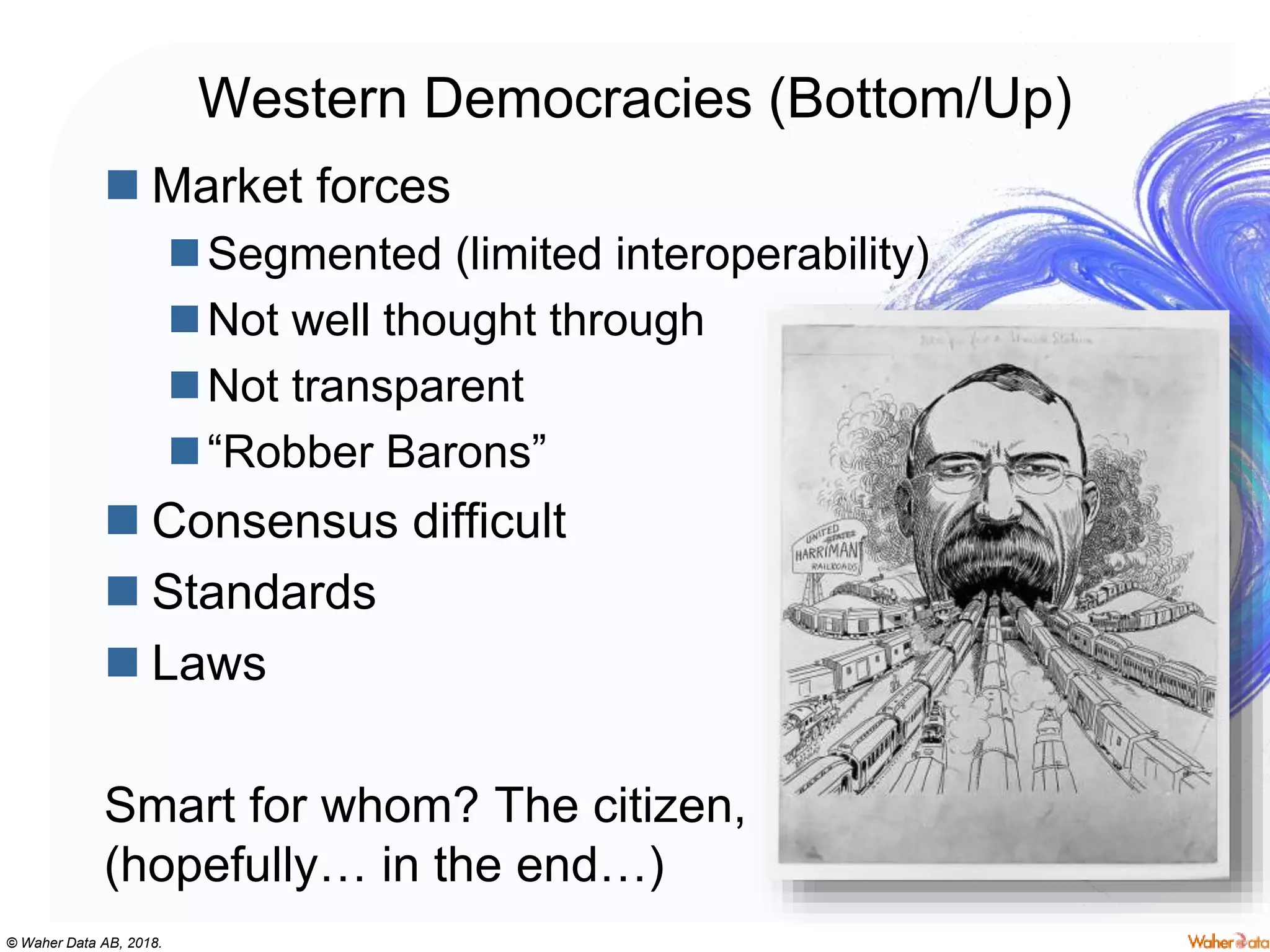
Western Democracies (Bottom/Up)
 Market forces
Segmented (limited interoperability)
Not well thought through
Not transparent
“Robber Barons”
 Consensus difficult
 Standards
 Laws
Smart for whom? The citizen,
(hopefully… in the end…)
© Waher Data AB, 2018.
3. Vision
© Waher Data AB, 2018.
Ownership of Information
Robber Barons appear in new areas
of enterprise, where there is no
effective legislation available.
Processing of information is one such
area. Ownership of information is not
legally defined (yet).
We need to define and protect
ownership of information.
© Waher Data AB, 2018.
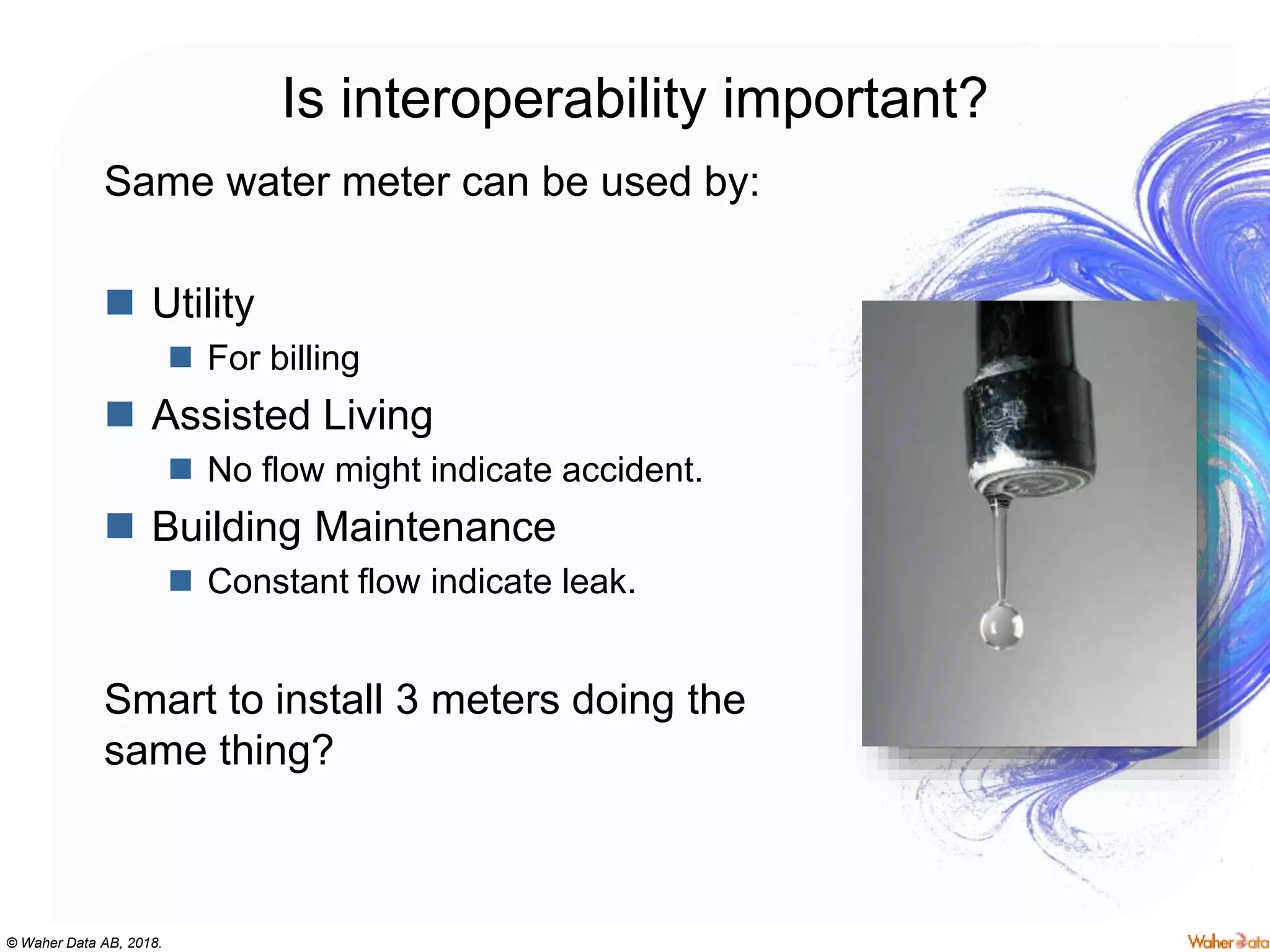
Is interoperability important?
Same water meter can be used by:
 Utility
 For billing
 Assisted Living
 No flow might indicate accident.
 Building Maintenance
 Constant flow indicate leak.
Smart to install 3 meters doing the
same thing?
© Waher Data AB, 2018.
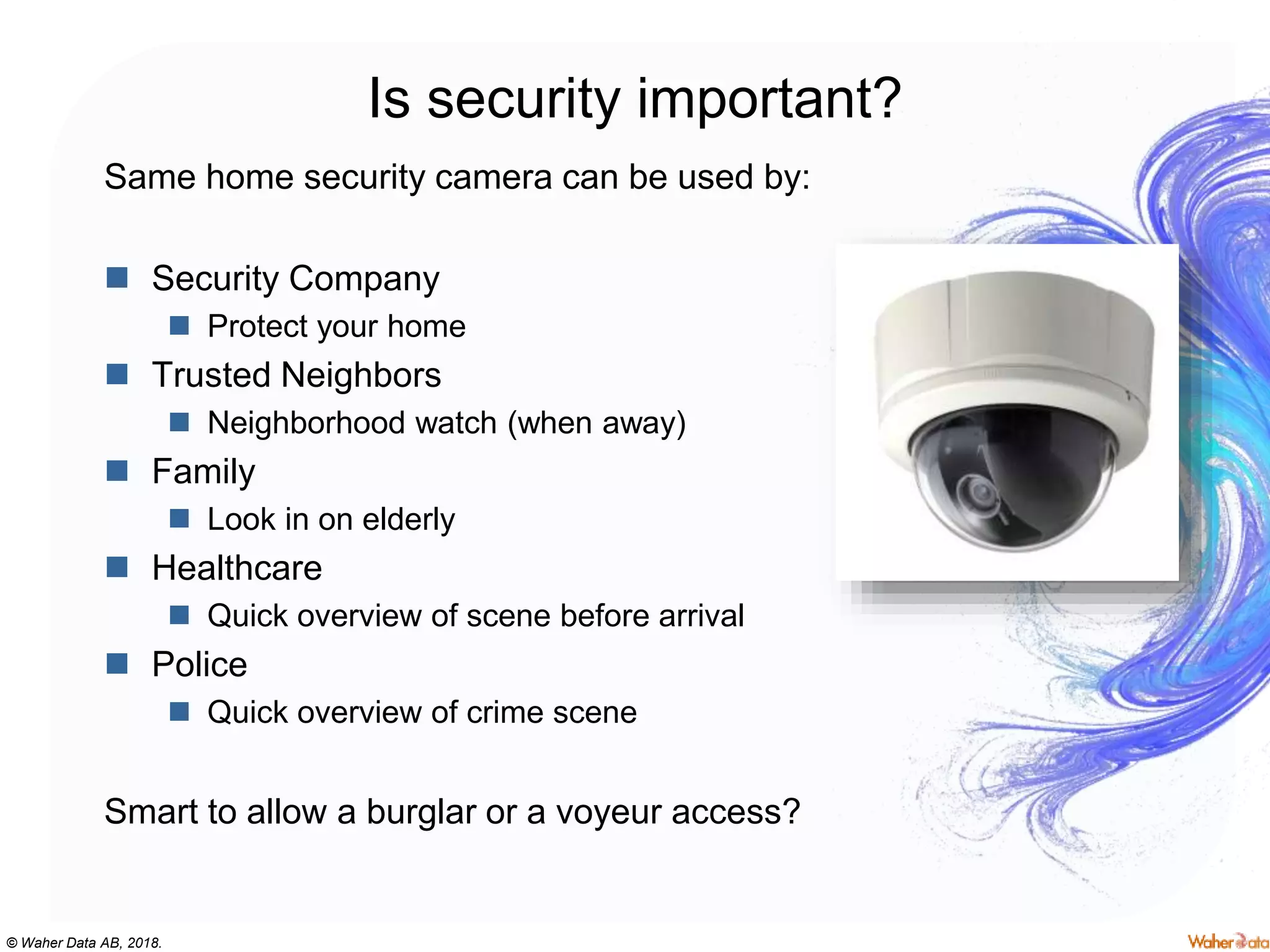
Is security important?
Same home security camera can be used by:
 Security Company
 Protect your home
 Trusted Neighbors
 Neighborhood watch (when away)
 Family
 Look in on elderly
 Healthcare
 Quick overview of scene before arrival
 Police
 Quick overview of crime scene
Smart to allow a burglar or a voyeur access?
© Waher Data AB, 2018.
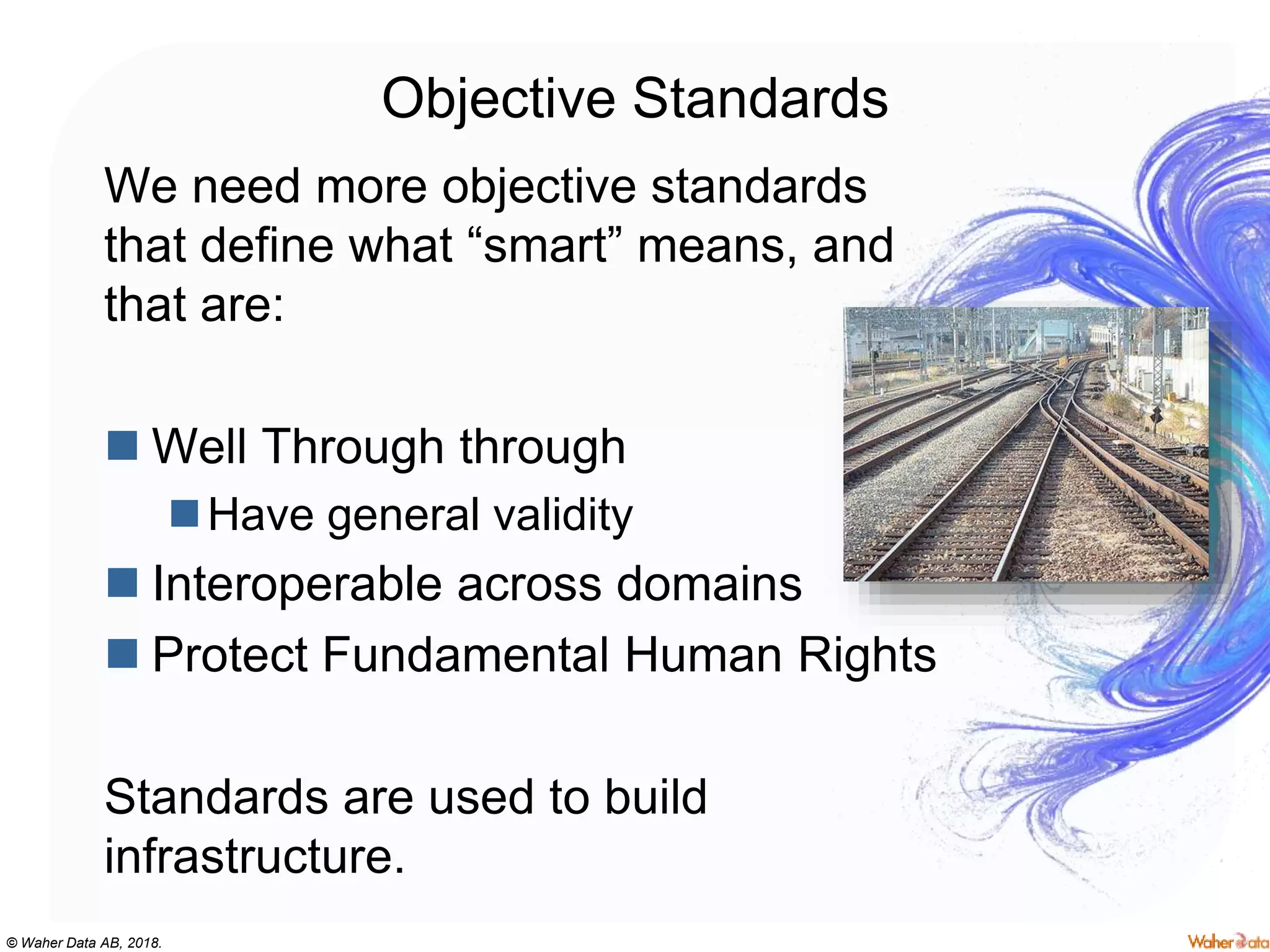
Objective Standards
We need more objective standards
that define what “smart” means, and
that are:
 Well Through through
Have general validity
 Interoperable across domains
 Protect Fundamental Human Rights
Standards are used to build
infrastructure.
© Waher Data AB, 2018.
Incentives?
Why would you allow others access to
your things or your data? It would:
 Add load to your systems
 Decrease its performance
 Allow competitors to compete,
without investing in your equipment
Cross-domain interoperability requires
open markets of things and data.
Open ≠ Free
© Waher Data AB, 2018.
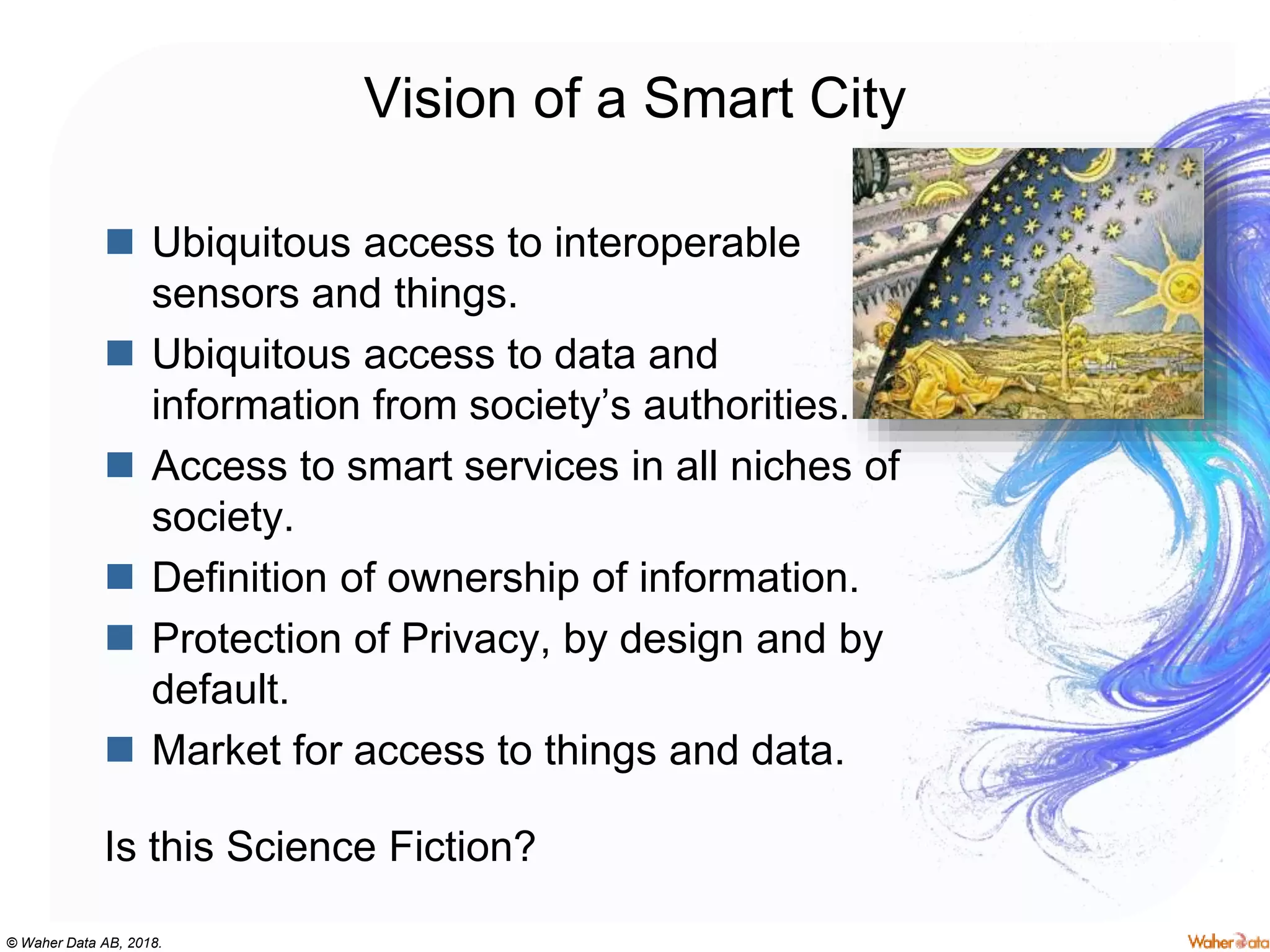
Vision of a Smart City
 Ubiquitous access to interoperable
sensors and things.
 Ubiquitous access to data and
information from society’s authorities.
 Access to smart services in all niches of
society.
 Definition of ownership of information.
 Protection of Privacy, by design and by
default.
 Market for access to things and data.
Is this Science Fiction?
© Waher Data AB, 2018.
Ubiquitous Computing
 Ubiquitous access to sensors and
things.
 Ubiquitous access to data and
information from society’s authorities.
 Access to smart services in all niches of
society.
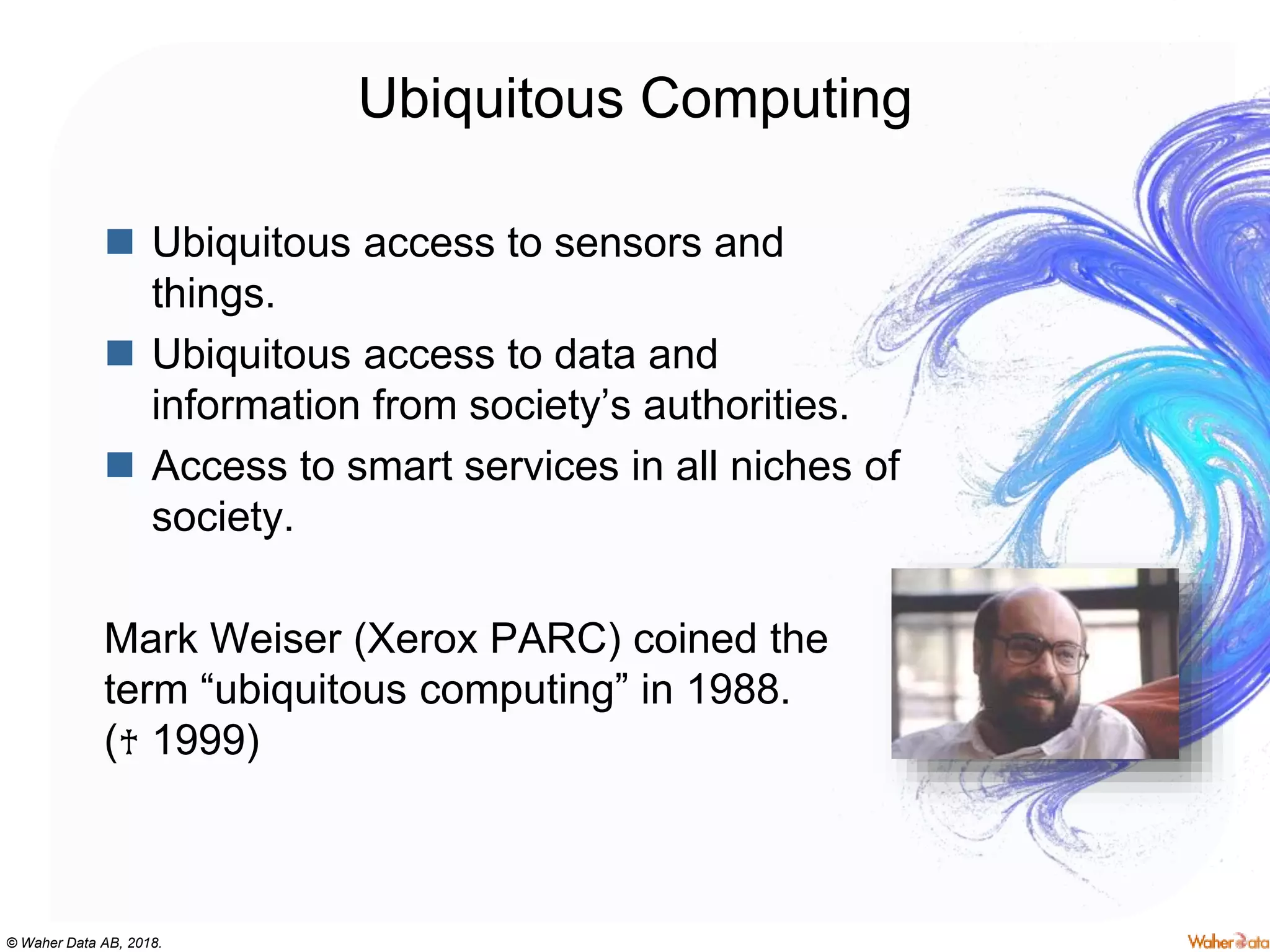
Mark Weiser (Xerox PARC) coined the
term “ubiquitous computing” in 1988.
(♰ 1999)
© Waher Data AB, 2018.
IEEE IoT Harmonization
 Interoperability
 Definition of ownership of information
 Protection of Privacy, by design and by
default
 Market for access to things and data*
(*) Funded by Swedish Internet Fund.
© Waher Data AB, 2018.
4. Ownership
© Waher Data AB, 2018.
Who owns the data?
Who is the owner of data?
 The person/entity generating (inventing) the data?
 The person/entity storing (controlling) the data?
 The person about whom the data relates to?
Is it important?
© Waher Data AB, 2018.
Legislation
Which law is applicable?
 Copyright?
 Trade secrets?
 Intellectual Property?
 Privacy?
Enforcing ownership through legal means
is difficult.
© Waher Data AB, 2018.
Ownership of things
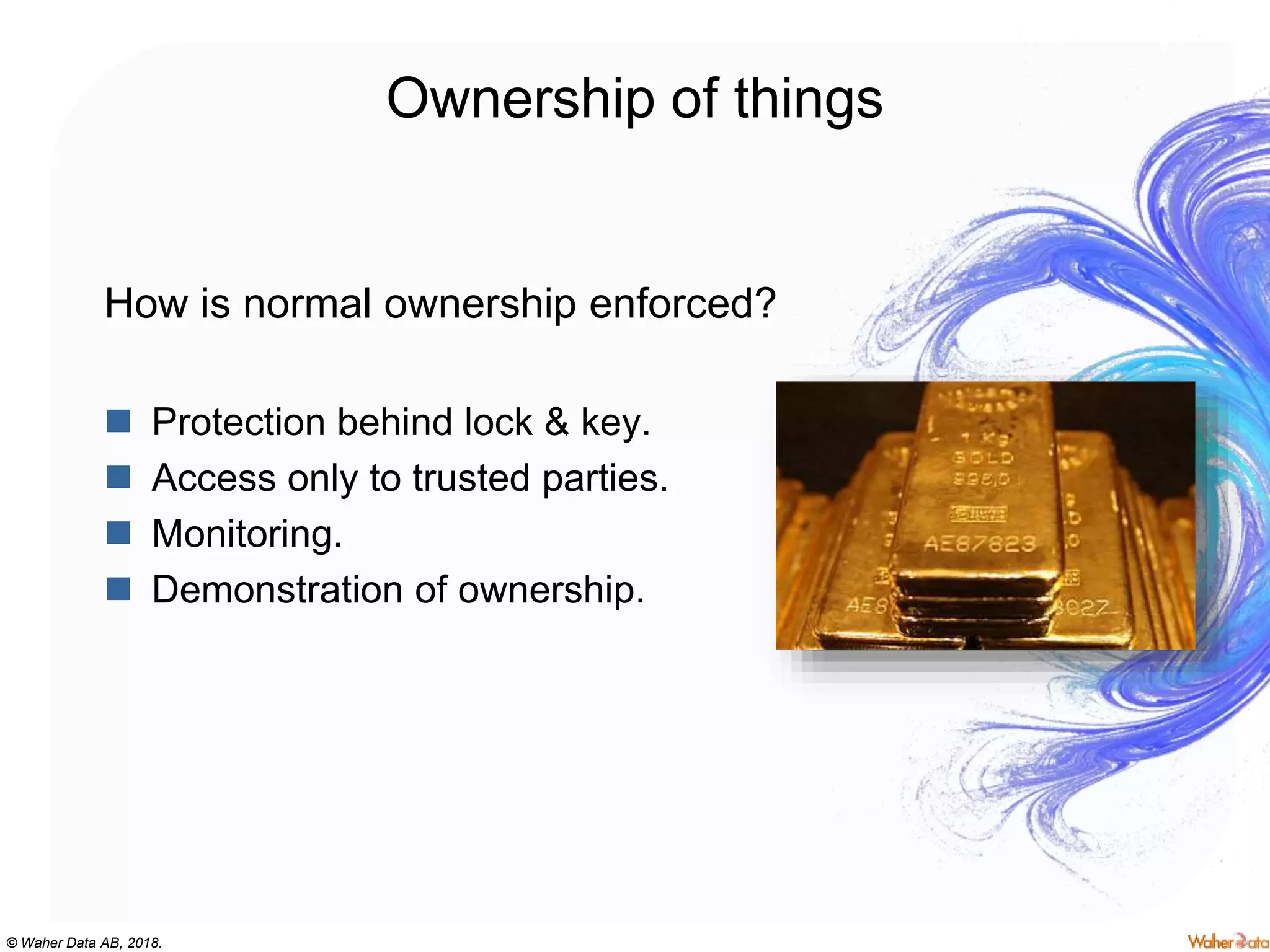
How is normal ownership enforced?
 Protection behind lock & key.
 Access only to trusted parties.
 Monitoring.
 Demonstration of ownership.
© Waher Data AB, 2018.
Ownership of data
Why treat data differently?
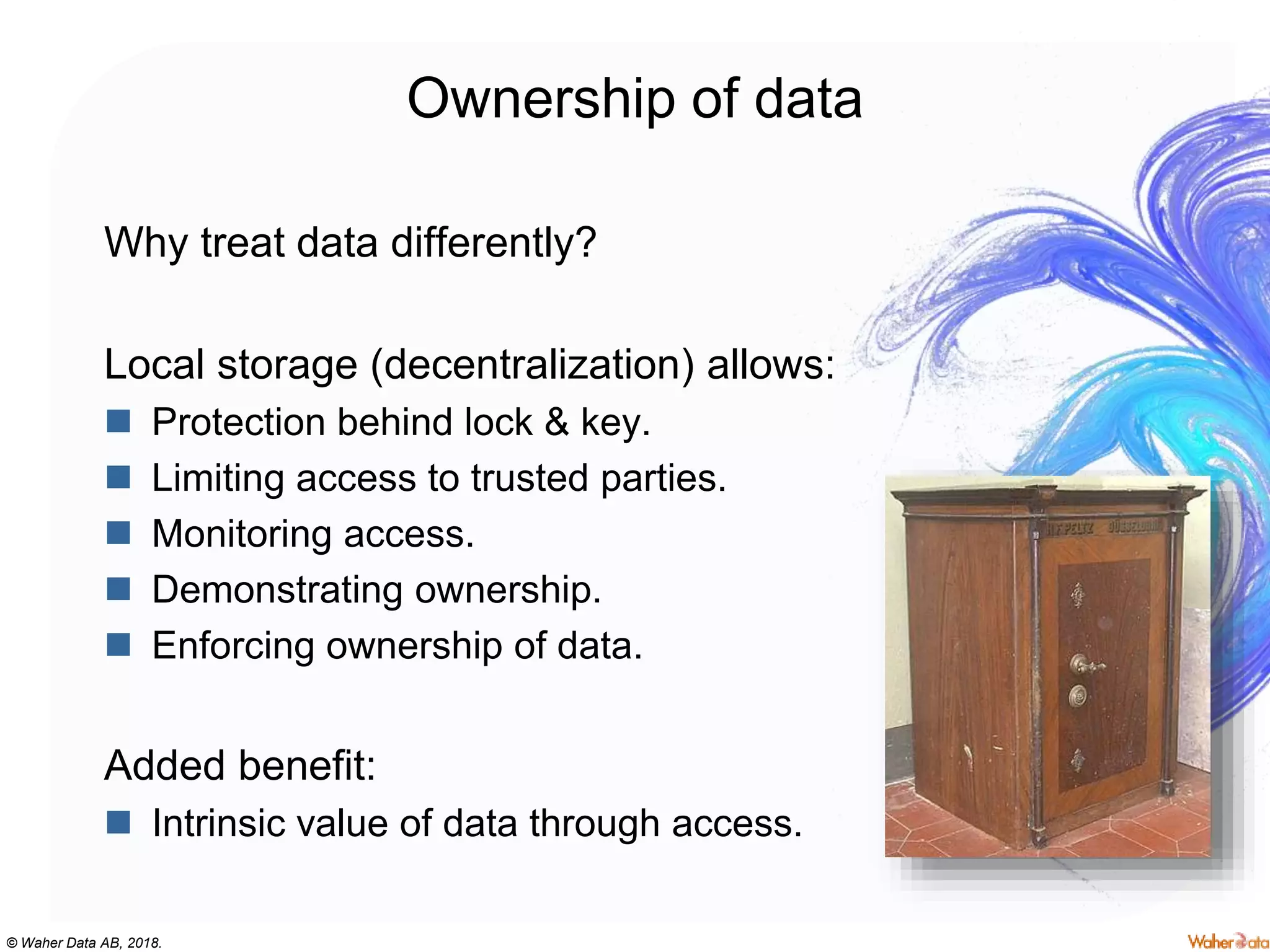
Local storage (decentralization) allows:
 Protection behind lock & key.
 Limiting access to trusted parties.
 Monitoring access.
 Demonstrating ownership.
 Enforcing ownership of data.
Added benefit:
 Intrinsic value of data through access.
© Waher Data AB, 2018.
Edge Computing
Processing “on the Edge” instead of
“in the Cloud” allows:
 Access = Value
 Scalability
 Resilience
 Security
© Waher Data AB, 2018.
5. Data Protection
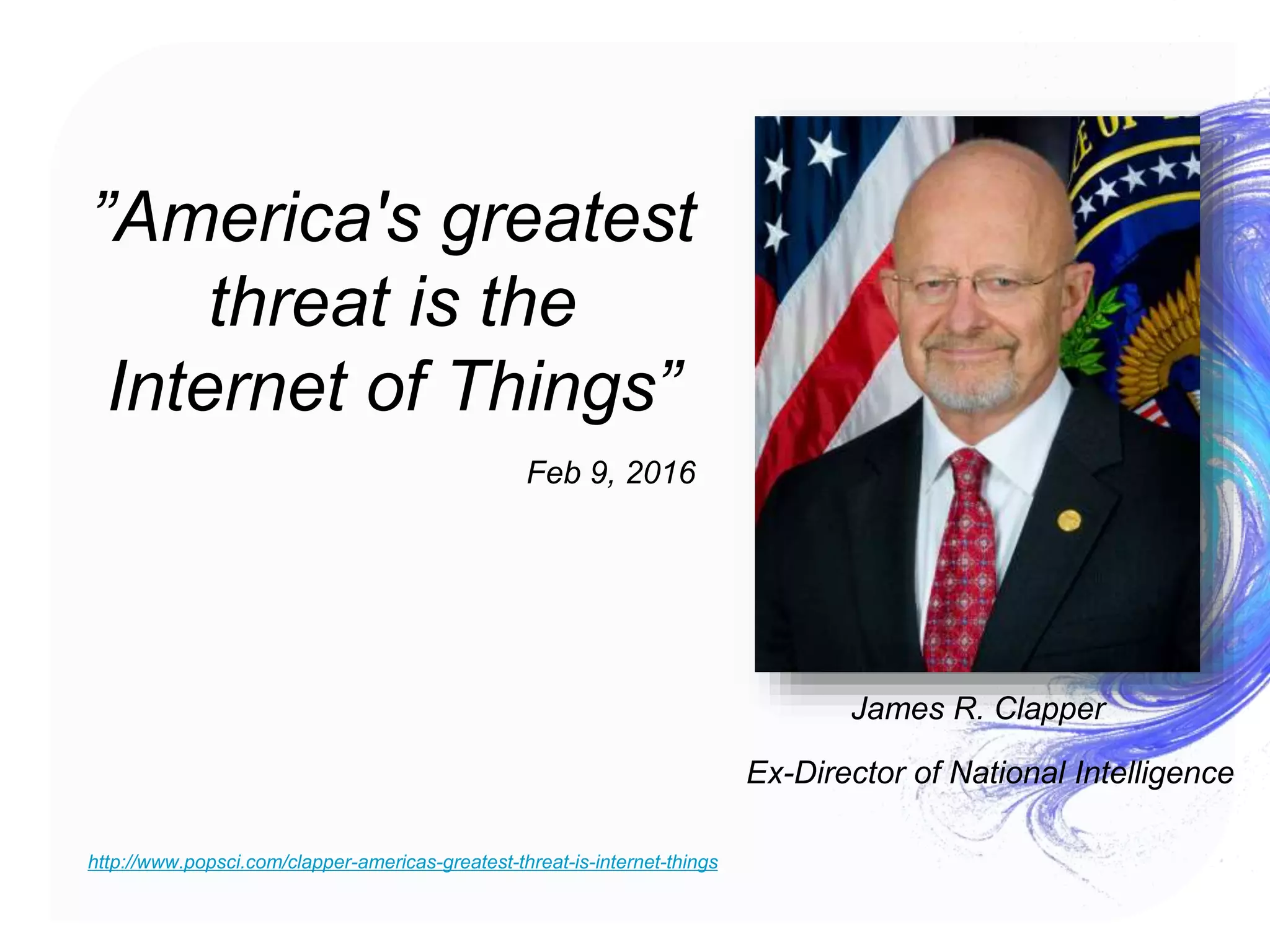
Ex-Director of National Intelligence
James R. Clapper
http://www.popsci.com/clapper-americas-greatest-threat-is-internet-things
”America's greatest
threat is the
Internet of Things”
Feb 9, 2016
© Waher Data AB, 2018.
Vulnerabilities
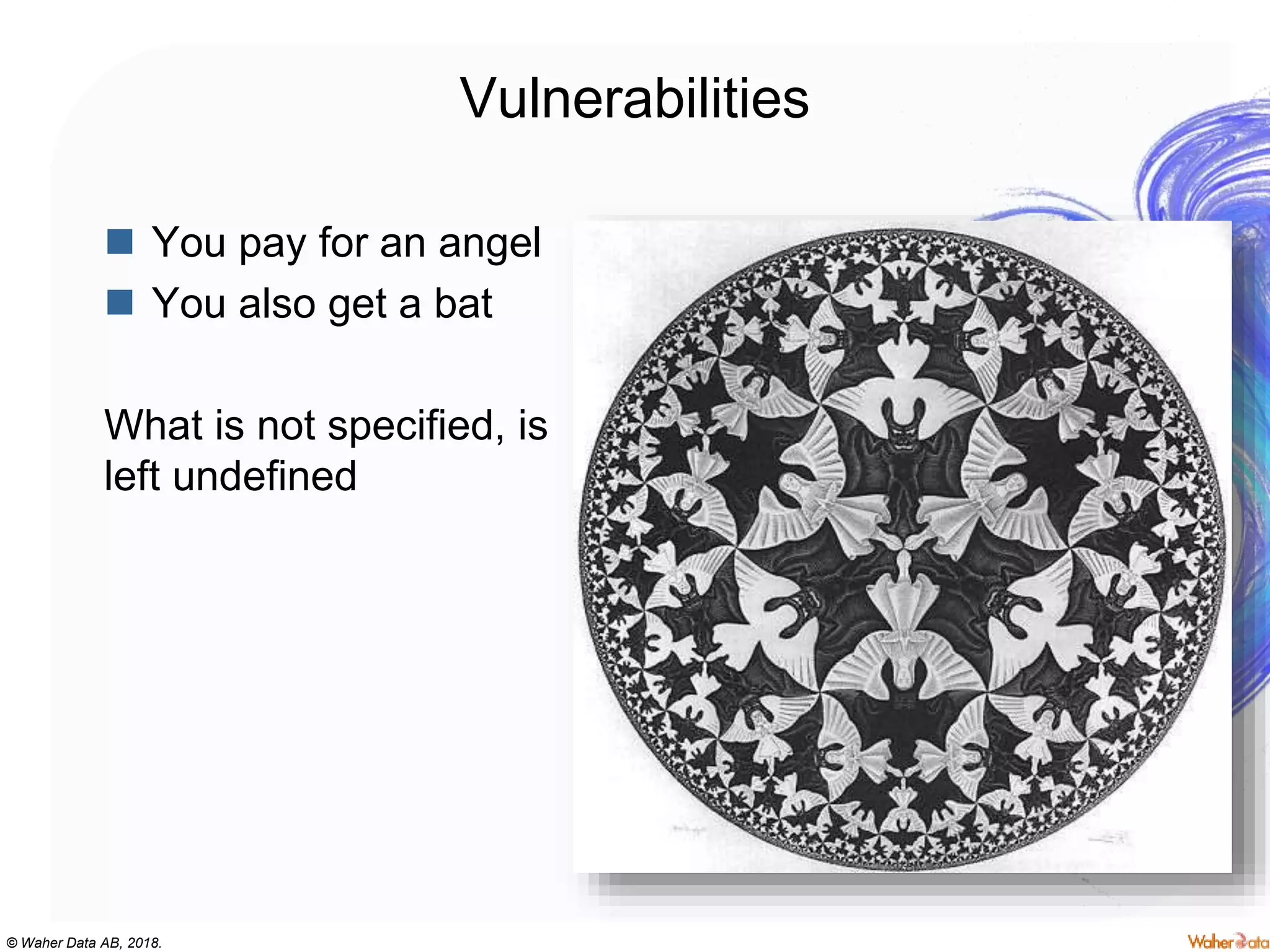
 You pay for an angel
 You also get a bat
What is not specified, is
left undefined
© Waher Data AB, 2018.
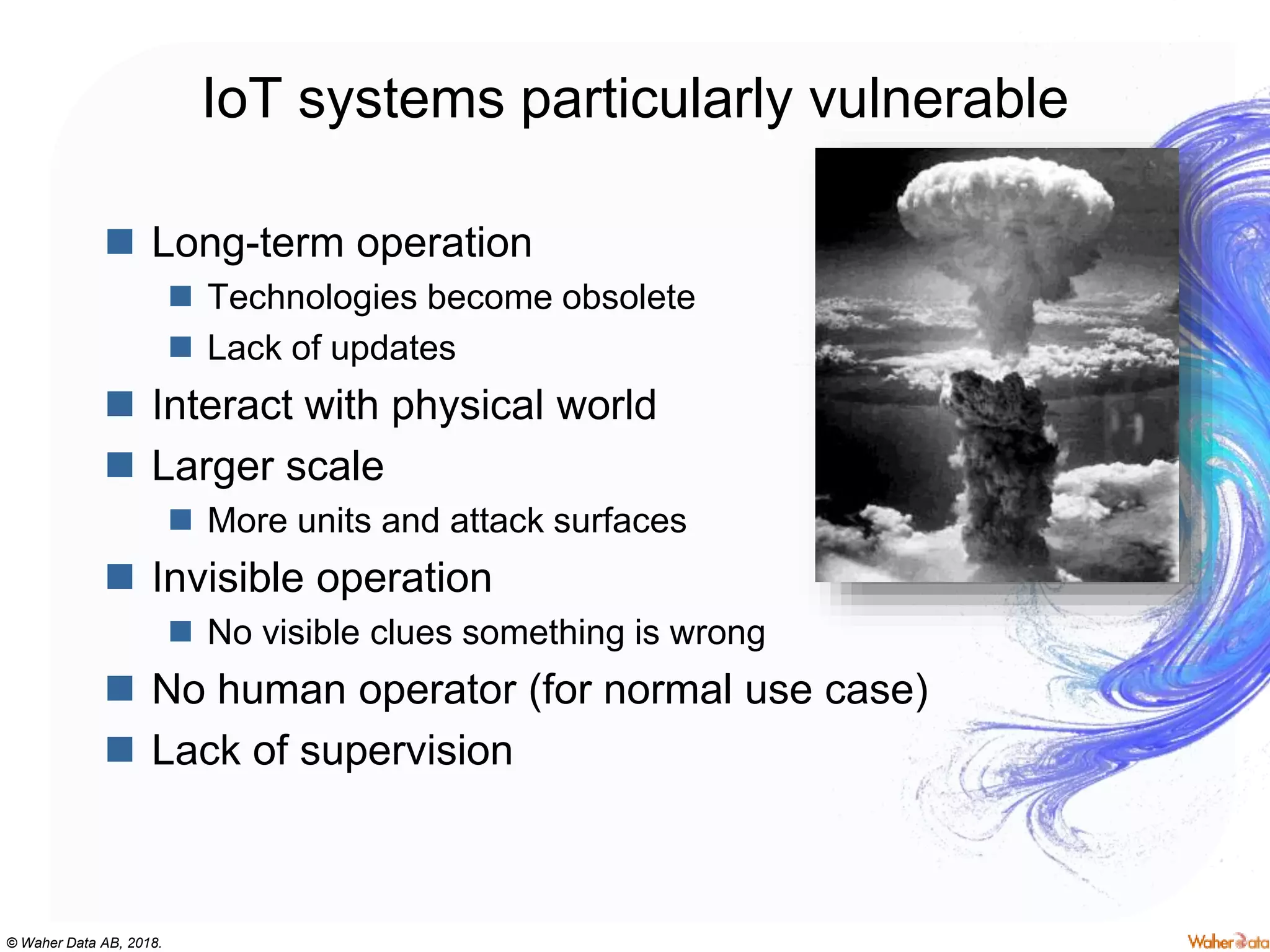
IoT systems particularly vulnerable
 Long-term operation
 Technologies become obsolete
 Lack of updates
 Interact with physical world
 Larger scale
 More units and attack surfaces
 Invisible operation
 No visible clues something is wrong
 No human operator (for normal use case)
 Lack of supervision
© Waher Data AB, 2018.
Decentralization & security
 More attack surfaces
 But value of each node is small
 Value/Effort ratio small
 Easier to protect
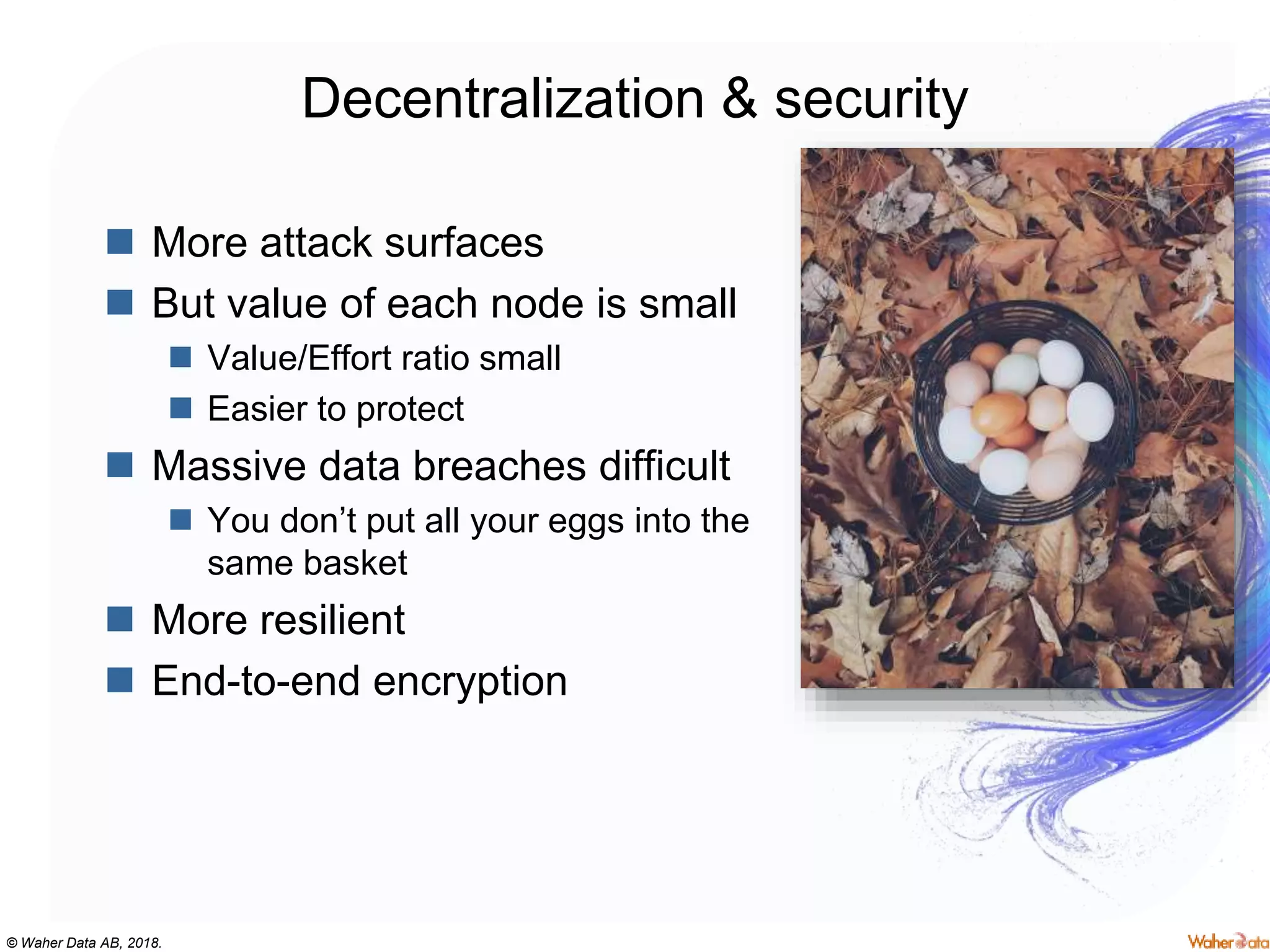
 Massive data breaches difficult
 You don’t put all your eggs into the
same basket
 More resilient
 End-to-end encryption
© Waher Data AB, 2018.
Anonymization vs. Strong Identities
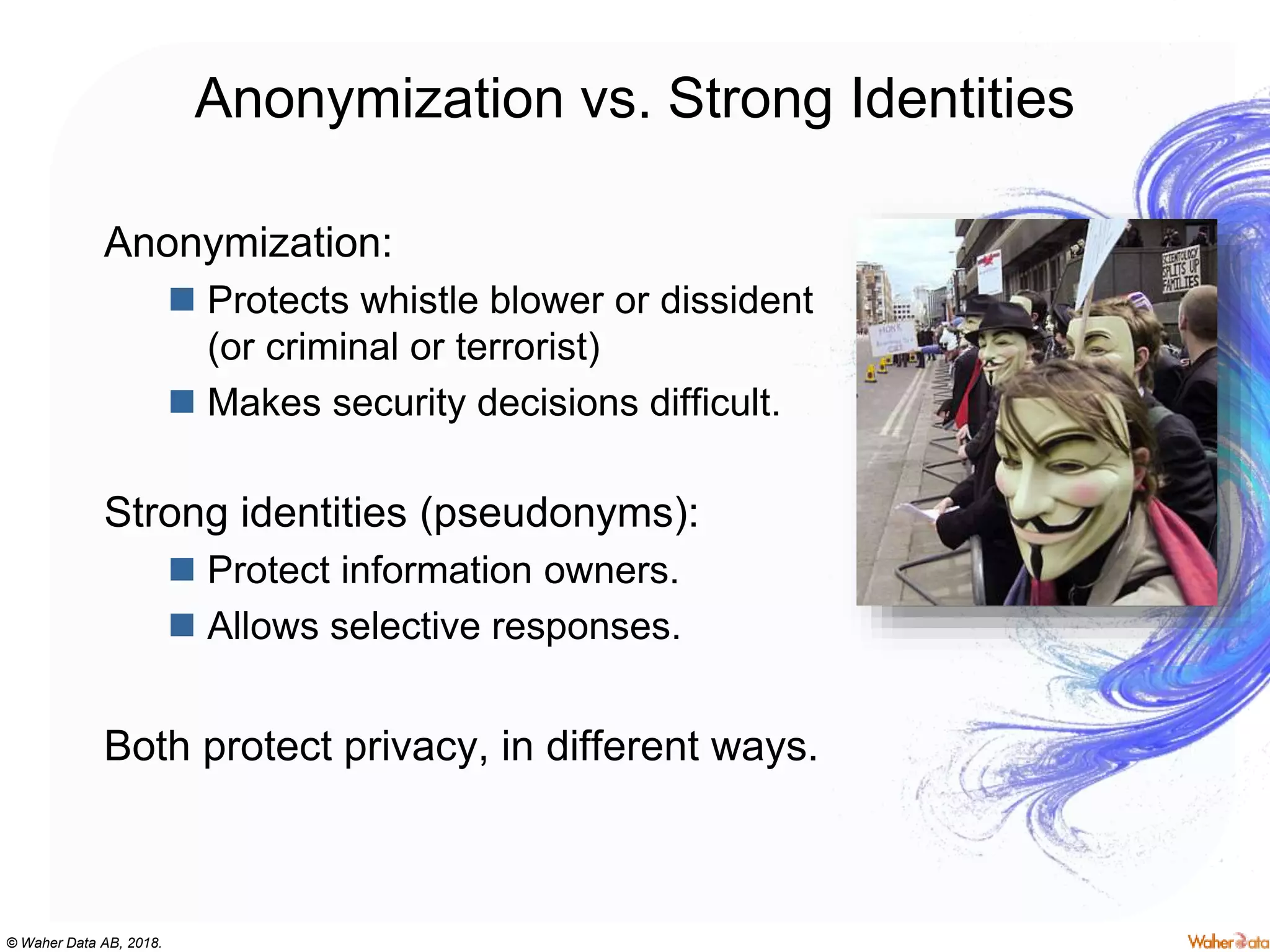
Anonymization:
 Protects whistle blower or dissident
(or criminal or terrorist)
 Makes security decisions difficult.
Strong identities (pseudonyms):
 Protect information owners.
 Allows selective responses.
Both protect privacy, in different ways.
© Waher Data AB, 2018.
IEEE IoT Harmonization
 Decentralization
 Global Identities
 Authentication
 Authorization
 Ownership
 Discovery
 Decision Support
 Provisioning
 Smart Contracts*
 Economic Feedback*
(*) Funded by Swedish Internet Fund.
© Waher Data AB, 2018.
6. Events
© Waher Data AB, 2018.
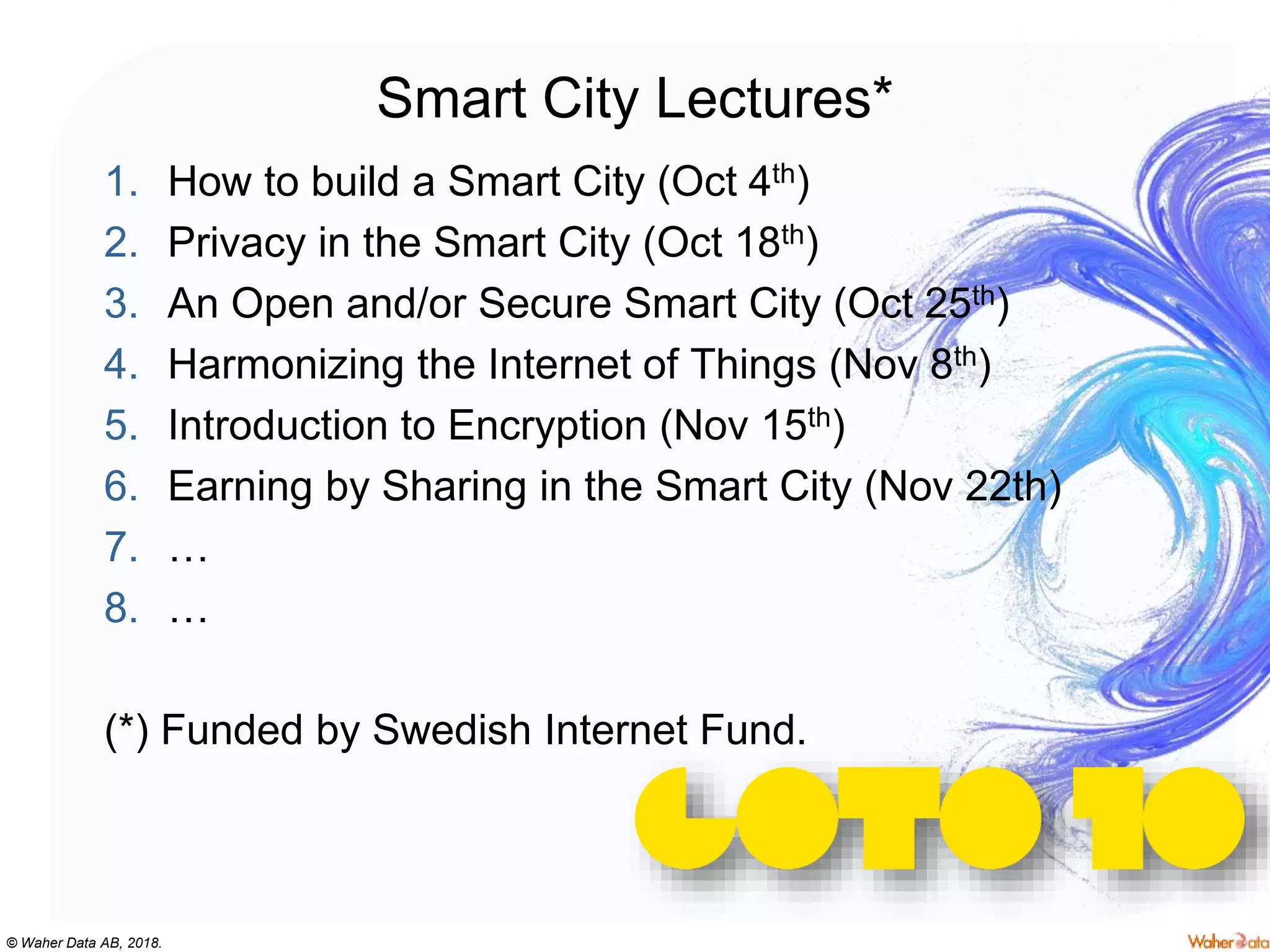
Smart City Lectures*
1. How to build a Smart City (Oct 4th)
2. Privacy in the Smart City (Oct 18th)
3. An Open and/or Secure Smart City (Oct 25th)
4. Harmonizing the Internet of Things (Nov 8th)
5. Introduction to Encryption (Nov 15th)
6. Earning by Sharing in the Smart City (Nov 22th)
7. …
8. …
(*) Funded by Swedish Internet Fund.
© Waher Data AB, 2018.
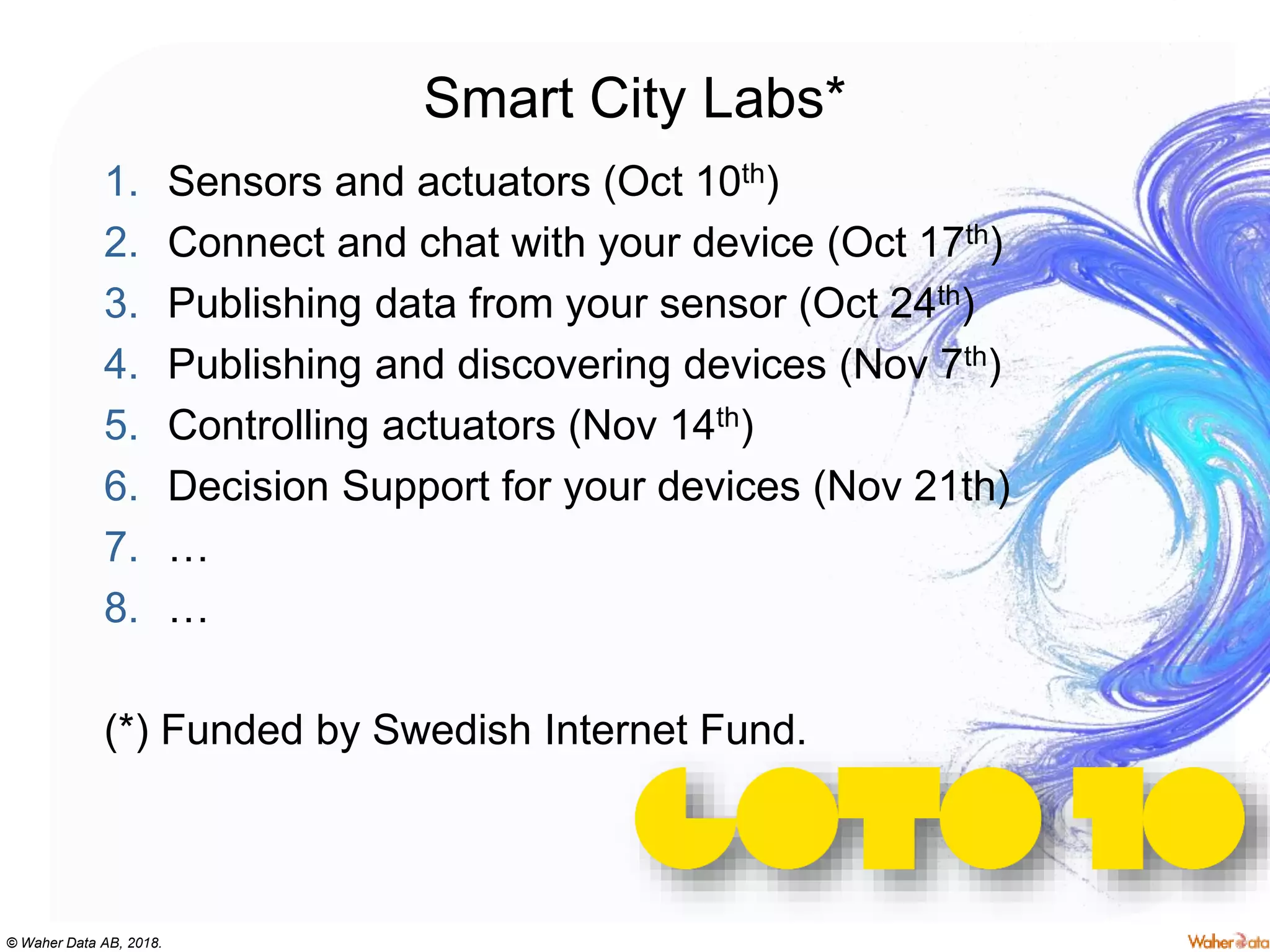
Smart City Labs*
1. Sensors and actuators (Oct 10th)
2. Connect and chat with your device (Oct 17th)
3. Publishing data from your sensor (Oct 24th)
4. Publishing and discovering devices (Nov 7th)
5. Controlling actuators (Nov 14th)
6. Decision Support for your devices (Nov 21th)
7. …
8. …
(*) Funded by Swedish Internet Fund.
© Waher Data AB, 2018.
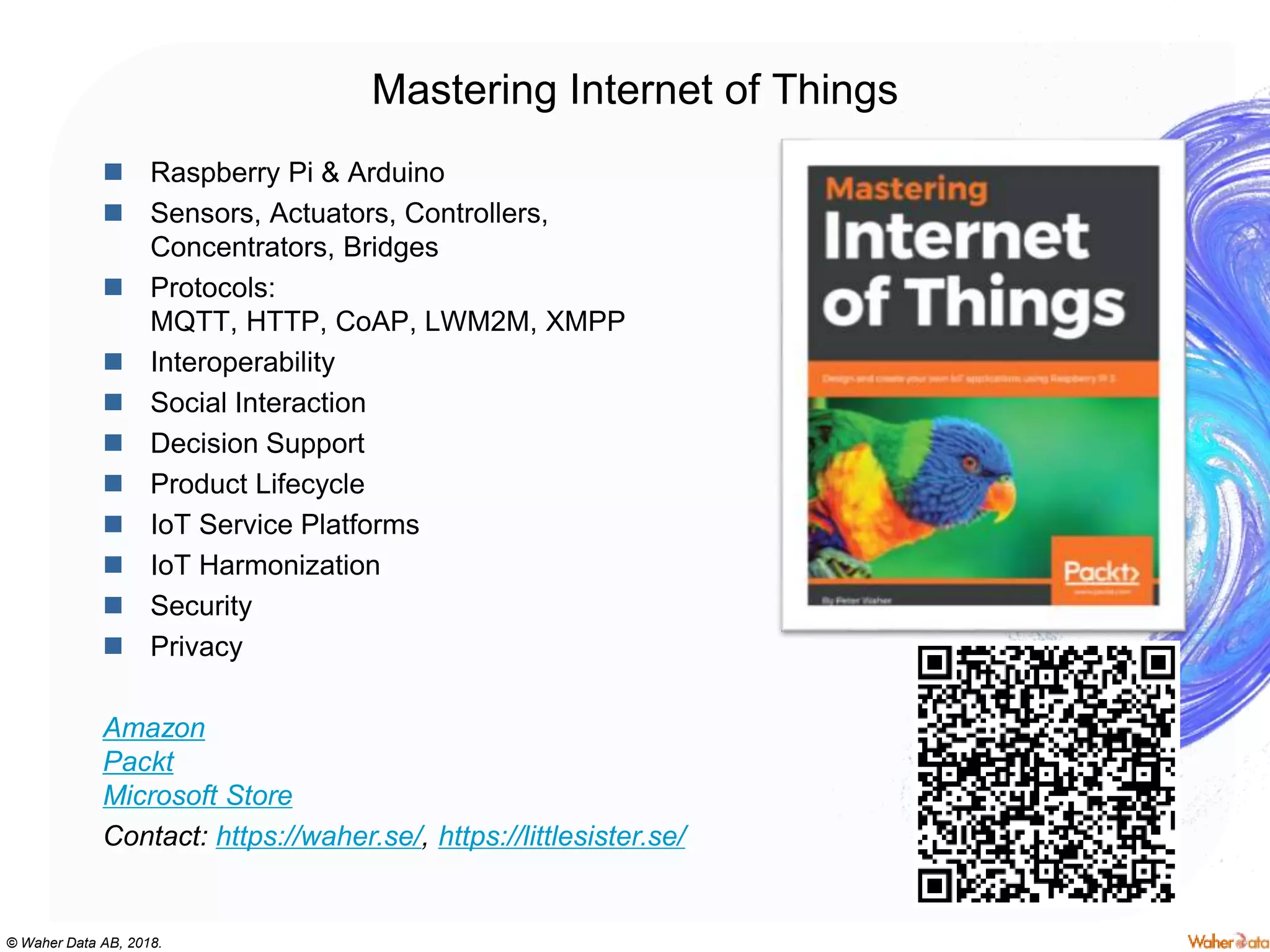
 Raspberry Pi & Arduino
 Sensors, Actuators, Controllers,
Concentrators, Bridges
 Protocols:
MQTT, HTTP, CoAP, LWM2M, XMPP
 Interoperability
 Social Interaction
 Decision Support
 Product Lifecycle
 IoT Service Platforms
 IoT Harmonization
 Security
 Privacy
Amazon
Packt
Microsoft Store
Contact: https://waher.se/, https://littlesister.se/
Mastering Internet of Things
© Waher Data AB, 2018.
7. Open Discussion
Ownership?
Privacy?
Security?
Surveillance?
Interoperability?
Cool stuff?
Qué?
Where’s the Money?
Who pays?
What could go wrong?
Little Sister?
Harmonization?

Smart City Lecture 1: How to build a Smart City

  • 1.
    © Waher DataAB, 2018. Smart City Lecture 1 How to build a Smart City
  • 2.
    © Waher DataAB, 2018. 1. Smart?
  • 3.
    © Waher DataAB, 2018. What does smart mean?  Smart Meters  Smart Phones  Smart TV  Smart Homes  Smart Buildings  Smart Cars  Smart Cities  Smart Societies  … Is “Smart” just a buzz word, or does it mean anything?
  • 4.
    © Waher DataAB, 2018. Smart? Meter  Performs calculations  Records consumption  Communicates  Control load Smart means connected. It also indirectly reports when you’re home and some of what you do… Smart?
  • 5.
    © Waher DataAB, 2018. Smart?-phone  Pocket computer  Apps Has phoning become better/easier/different? Smart means flexible tool / toy. It also helps keep you unaware, while it siphons your personal data… Smart?
  • 6.
    © Waher DataAB, 2018. Smart? TV  Apps  Internet Smart means easier access to online entertainment. Does it observe you back?
  • 7.
    © Waher DataAB, 2018. Smart Home  Home Automation  Helps control common tasks  Lighting  Locks  Temperature  Electricity  Kitchen  Surveillance  Assisted Living  … Smart means to help / automate. Is it necessary for someone outside of your home, to know what you do inside?
  • 8.
    © Waher DataAB, 2018. Smart Building  Building Automation  Administration  Heating  Water  Electricity  Air-conditioning  Laundry  Maintenance  Surveillance  … Smart means to help / automate. The point is to help the owner/manager, not necessarily the inhabitant.
  • 9.
    © Waher DataAB, 2018. Smart Car  Autonomous Driving  Connectivity  Automate control  Speed  Lights  Breaks  Signals  Steering  … Smart means to help / automate. Will they be smart enough?
  • 10.
    © Waher DataAB, 2018. Smart City / Society  Automation  Open Data  Transport  Traffic (C-ITS)  Parking  Utilities  Health Care  Law enforcement  Schools  Libraries  Waste management  Citizens?  … Smart for whom?
  • 11.
    © Waher DataAB, 2018. Common Denominators  Automation  Optimization  Connectivity Sufficient for labeling something as “smart”? “Smart” is a great buzz word. It helps vendors appear better, and consumers feel better, even if the technology happens to be “stupid”.
  • 12.
    © Waher DataAB, 2018. 2. Delirium
  • 13.
    © Waher DataAB, 2018. What can be
  • 14.
    © Waher DataAB, 2018. Chinese Social Credit System (World’s most?) ambitious “Smart City” project. Calculates economic and social reputation, based on mass surveillance and AI:  Honesty  Commercial Integrity  Social Integrity  Judicial Credibility
  • 15.
    © Waher DataAB, 2018. Chinese Social Credit System Collects data from:  Online activity  Searches  Shopping behavior  Locations  Friends  Health  Bank accounts  Messages  Smart Home appliances  News sources  Dating  …
  • 16.
    © Waher DataAB, 2018. Chinese Social Credit System Affects:  Job positions  Salaries  Living  Travel restrictions  Visa restrictions  Access to schools  Social status  Loans  Internet bandwidth  …
  • 17.
    © Waher DataAB, 2018. Bad idea? How about:  Environmental impact rating?  Diversity index?  Common value compliance?  …
  • 18.
    © Waher DataAB, 2018. Universal Declaration of Human Rights Article 12: No one shall be subjected to arbitrary interference with his privacy, family, home or correspondence, nor to attacks upon his honour and reputation. Everyone has the right to the protection of the law against such interference or attacks. https://www.un.org/en/universal-declaration-human-rights/ Well… it all depends on how you choose to interpret “arbitrary” and “attack”…
  • 19.
    © Waher DataAB, 2018. Will the surveillance state prevail? Is the Chinese system better or worse than the western system? Some criticize the western model, by claiming it does similar things, but not transparently.
  • 20.
    © Waher DataAB, 2018. Authoritarian regimes (Top/Down)  Easy to make decisions  Laws  Ubiquitous  Sacrifices individual freedoms Freedom of expression Creativity Smart for whom? The state.
  • 21.
    © Waher DataAB, 2018. Western Democracies (Bottom/Up)  Market forces Segmented (limited interoperability) Not well thought through Not transparent “Robber Barons”  Consensus difficult  Standards  Laws Smart for whom? The citizen, (hopefully… in the end…)
  • 22.
    © Waher DataAB, 2018. 3. Vision
  • 23.
    © Waher DataAB, 2018. Ownership of Information Robber Barons appear in new areas of enterprise, where there is no effective legislation available. Processing of information is one such area. Ownership of information is not legally defined (yet). We need to define and protect ownership of information.
  • 24.
    © Waher DataAB, 2018. Is interoperability important? Same water meter can be used by:  Utility  For billing  Assisted Living  No flow might indicate accident.  Building Maintenance  Constant flow indicate leak. Smart to install 3 meters doing the same thing?
  • 25.
    © Waher DataAB, 2018. Is security important? Same home security camera can be used by:  Security Company  Protect your home  Trusted Neighbors  Neighborhood watch (when away)  Family  Look in on elderly  Healthcare  Quick overview of scene before arrival  Police  Quick overview of crime scene Smart to allow a burglar or a voyeur access?
  • 26.
    © Waher DataAB, 2018. Objective Standards We need more objective standards that define what “smart” means, and that are:  Well Through through Have general validity  Interoperable across domains  Protect Fundamental Human Rights Standards are used to build infrastructure.
  • 27.
    © Waher DataAB, 2018. Incentives? Why would you allow others access to your things or your data? It would:  Add load to your systems  Decrease its performance  Allow competitors to compete, without investing in your equipment Cross-domain interoperability requires open markets of things and data. Open ≠ Free
  • 28.
    © Waher DataAB, 2018. Vision of a Smart City  Ubiquitous access to interoperable sensors and things.  Ubiquitous access to data and information from society’s authorities.  Access to smart services in all niches of society.  Definition of ownership of information.  Protection of Privacy, by design and by default.  Market for access to things and data. Is this Science Fiction?
  • 29.
    © Waher DataAB, 2018. Ubiquitous Computing  Ubiquitous access to sensors and things.  Ubiquitous access to data and information from society’s authorities.  Access to smart services in all niches of society. Mark Weiser (Xerox PARC) coined the term “ubiquitous computing” in 1988. (♰ 1999)
  • 30.
    © Waher DataAB, 2018. IEEE IoT Harmonization  Interoperability  Definition of ownership of information  Protection of Privacy, by design and by default  Market for access to things and data* (*) Funded by Swedish Internet Fund.
  • 31.
    © Waher DataAB, 2018. 4. Ownership
  • 32.
    © Waher DataAB, 2018. Who owns the data? Who is the owner of data?  The person/entity generating (inventing) the data?  The person/entity storing (controlling) the data?  The person about whom the data relates to? Is it important?
  • 33.
    © Waher DataAB, 2018. Legislation Which law is applicable?  Copyright?  Trade secrets?  Intellectual Property?  Privacy? Enforcing ownership through legal means is difficult.
  • 34.
    © Waher DataAB, 2018. Ownership of things How is normal ownership enforced?  Protection behind lock & key.  Access only to trusted parties.  Monitoring.  Demonstration of ownership.
  • 35.
    © Waher DataAB, 2018. Ownership of data Why treat data differently? Local storage (decentralization) allows:  Protection behind lock & key.  Limiting access to trusted parties.  Monitoring access.  Demonstrating ownership.  Enforcing ownership of data. Added benefit:  Intrinsic value of data through access.
  • 36.
    © Waher DataAB, 2018. Edge Computing Processing “on the Edge” instead of “in the Cloud” allows:  Access = Value  Scalability  Resilience  Security
  • 37.
    © Waher DataAB, 2018. 5. Data Protection
  • 38.
    Ex-Director of NationalIntelligence James R. Clapper http://www.popsci.com/clapper-americas-greatest-threat-is-internet-things ”America's greatest threat is the Internet of Things” Feb 9, 2016
  • 39.
    © Waher DataAB, 2018. Vulnerabilities  You pay for an angel  You also get a bat What is not specified, is left undefined
  • 40.
    © Waher DataAB, 2018. IoT systems particularly vulnerable  Long-term operation  Technologies become obsolete  Lack of updates  Interact with physical world  Larger scale  More units and attack surfaces  Invisible operation  No visible clues something is wrong  No human operator (for normal use case)  Lack of supervision
  • 41.
    © Waher DataAB, 2018. Decentralization & security  More attack surfaces  But value of each node is small  Value/Effort ratio small  Easier to protect  Massive data breaches difficult  You don’t put all your eggs into the same basket  More resilient  End-to-end encryption
  • 42.
    © Waher DataAB, 2018. Anonymization vs. Strong Identities Anonymization:  Protects whistle blower or dissident (or criminal or terrorist)  Makes security decisions difficult. Strong identities (pseudonyms):  Protect information owners.  Allows selective responses. Both protect privacy, in different ways.
  • 43.
    © Waher DataAB, 2018. IEEE IoT Harmonization  Decentralization  Global Identities  Authentication  Authorization  Ownership  Discovery  Decision Support  Provisioning  Smart Contracts*  Economic Feedback* (*) Funded by Swedish Internet Fund.
  • 44.
    © Waher DataAB, 2018. 6. Events
  • 45.
    © Waher DataAB, 2018. Smart City Lectures* 1. How to build a Smart City (Oct 4th) 2. Privacy in the Smart City (Oct 18th) 3. An Open and/or Secure Smart City (Oct 25th) 4. Harmonizing the Internet of Things (Nov 8th) 5. Introduction to Encryption (Nov 15th) 6. Earning by Sharing in the Smart City (Nov 22th) 7. … 8. … (*) Funded by Swedish Internet Fund.
  • 46.
    © Waher DataAB, 2018. Smart City Labs* 1. Sensors and actuators (Oct 10th) 2. Connect and chat with your device (Oct 17th) 3. Publishing data from your sensor (Oct 24th) 4. Publishing and discovering devices (Nov 7th) 5. Controlling actuators (Nov 14th) 6. Decision Support for your devices (Nov 21th) 7. … 8. … (*) Funded by Swedish Internet Fund.
  • 47.
    © Waher DataAB, 2018.  Raspberry Pi & Arduino  Sensors, Actuators, Controllers, Concentrators, Bridges  Protocols: MQTT, HTTP, CoAP, LWM2M, XMPP  Interoperability  Social Interaction  Decision Support  Product Lifecycle  IoT Service Platforms  IoT Harmonization  Security  Privacy Amazon Packt Microsoft Store Contact: https://waher.se/, https://littlesister.se/ Mastering Internet of Things
  • 48.
    © Waher DataAB, 2018. 7. Open Discussion Ownership? Privacy? Security? Surveillance? Interoperability? Cool stuff? Qué? Where’s the Money? Who pays? What could go wrong? Little Sister? Harmonization?