What is Jigsaw?
• Multi-step strategy in which students cooperatively learn
about a topic.
• Students break into small group and each member becomes
an “expert” in a specific subtopic that relates to the topic.
• Once they master the important information from the
specific sub topic, they meet with members from the other
groups in class who are experts in that same topic.
• Return back to their home base group teach the information
to all members of the group.
Why use Jigsaw?
• Helps to build comprehension
• Encourages cooperative learning and collaboration with
classmates
• Can help to improve listening, communication, and problem-
solving skills.
• Allows students to become experts, and teachers.
• All students feel are a vital part of the group.
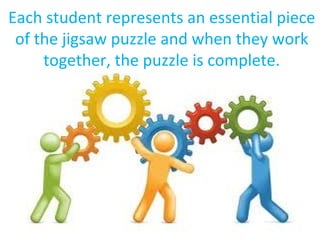
Each student represents an essential piece
of the jigsaw puzzle and when they work
together, the puzzle is complete.
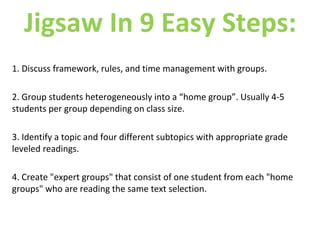
Jigsaw In 9 Easy Steps:
1. Discuss framework, rules, and time management with groups.
2. Group students heterogeneously into a “home group”. Usually 4-5
students per group depending on class size.
3. Identify a topic and four different subtopics with appropriate grade
leveled readings.
4. Create "expert groups" that consist of one student from each "home
groups" who are reading the same text selection.
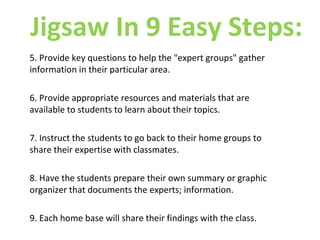
5. Provide key questions to help the "expert groups" gather
information in their particular area.
6. Provide appropriate resources and materials that are
available to students to learn about their topics.
7. Instruct the students to go back to their home groups to
share their expertise with classmates.
8. Have the students prepare their own summary or graphic
organizer that documents the experts; information.
9. Each home base will share their findings with the class.
Jigsaw In 9 Easy Steps:
Example:
Possible Topics For Jigsaw
• Life cycle of a plant
• Water Cycle
• Peer Editing Steps
• The Writing Process
• Seasons
• Authors
• Characteristics of a specific Genre
Etc…

Jigsaw Strategy

  • 2.
    What is Jigsaw? •Multi-step strategy in which students cooperatively learn about a topic. • Students break into small group and each member becomes an “expert” in a specific subtopic that relates to the topic. • Once they master the important information from the specific sub topic, they meet with members from the other groups in class who are experts in that same topic. • Return back to their home base group teach the information to all members of the group.
  • 3.
    Why use Jigsaw? •Helps to build comprehension • Encourages cooperative learning and collaboration with classmates • Can help to improve listening, communication, and problem- solving skills. • Allows students to become experts, and teachers. • All students feel are a vital part of the group.
  • 4.
    Each student representsan essential piece of the jigsaw puzzle and when they work together, the puzzle is complete.
  • 5.
    Jigsaw In 9Easy Steps: 1. Discuss framework, rules, and time management with groups. 2. Group students heterogeneously into a “home group”. Usually 4-5 students per group depending on class size. 3. Identify a topic and four different subtopics with appropriate grade leveled readings. 4. Create "expert groups" that consist of one student from each "home groups" who are reading the same text selection.
  • 6.
    5. Provide keyquestions to help the "expert groups" gather information in their particular area. 6. Provide appropriate resources and materials that are available to students to learn about their topics. 7. Instruct the students to go back to their home groups to share their expertise with classmates. 8. Have the students prepare their own summary or graphic organizer that documents the experts; information. 9. Each home base will share their findings with the class. Jigsaw In 9 Easy Steps:
  • 7.
  • 8.
    Possible Topics ForJigsaw • Life cycle of a plant • Water Cycle • Peer Editing Steps • The Writing Process • Seasons • Authors • Characteristics of a specific Genre Etc…