Surveys	in	
Software	Engineering	
Rafael Maiani de Mello
Marco Torchiano
Daniel Méndez Guilherme H. Travassos
Further coaches
Ground rules for today
1. Whenever you have a question/remark:
share them with the group!
2. Stay flexible
3. There are no further rules J
Feel	free	to…	
copy,	share,	and	alter,
film	and	photograph	(as	long	as	we	look	great)
tweet	and	live	blog
today’s	presentations	given	that	you	attribute	
it	to	its	author(s)	and	respect	its	right	and	
licenses	of	its	parts.
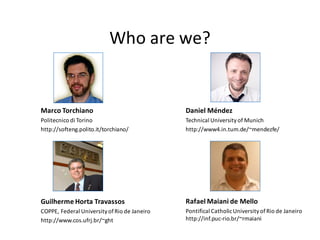
Who	are we?
Marco	Torchiano
Politecnico di	Torino
http://softeng.polito.it/torchiano/
Rafael	Maiani de	Mello
Pontifical	Catholic	University	of	Rio	de	Janeiro	
http://inf.puc-rio.br/~rmaiani
Guilherme Horta Travassos
COPPE,	Federal	University	of	Rio	de	Janeiro
http://www.cos.ufrj.br/~ght
Daniel	Méndez
Technical	University	of	Munich
http://www4.in.tum.de/~mendezfe/
Who	are	you?
Quick round:
• Who are you?
• What is your experience in conducting survey
research?
• What are your expectations?
What do	you think?
Why	do	we	need	survey	research	
in	software	engineering?
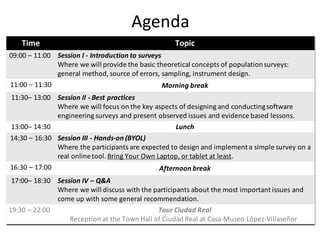
Agenda
Time Topic
09:00	– 11:00 Session	I	- Introduction	to	surveys
Where	we	will	provide	the	basic	theoretical	concepts	of	population	surveys:	
general	method,	source	of	errors,	sampling,	instrument	design.
11:00	– 11:30	 Morning	break
11:30– 13:00	 Session	II	- Best	practices	
Where	we	will	focus	on	the	key	aspects	of	designing	and	conducting	software	
engineering	surveys	and	present	observed	issues	and	evidence	based	lessons.
13:00– 14:30 Lunch
14:30	– 16:30 Session	III	- Hands-on	(BYOL)
Where	the	participants	are	expected	to	design	and	implement	a	simple	survey	on	a	
real	online	tool.	Bring	Your	Own	Laptop,	or	tablet	at	least.
16:30	– 17:00 Afternoon	break
17:00– 18:30 Session	IV	– Q&A
Where	we	will	discuss	with	the	participants	about	the	most	important	issues	and	
come	up	with	some	general	recommendation.
19:30	– 22:00 Tour	Ciudad	Real
Reception	at	the	Town	Hall	of	Ciudad	Real	at	Casa-Museo López-Villaseñor
Session	I
Introduction	to	Survey	Research
Session I
Introduction to Survey research
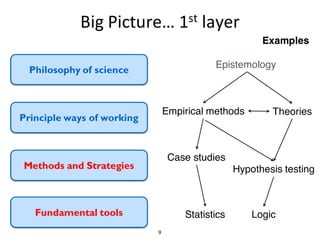
Big	Picture…	1st layer
9
Philosophy of science
Principle ways of working
Methods and Strategies
Fundamental tools
Epistemology
Empirical methods
Statistics
Hypothesis testing
Case studies
Logic
Examples
Theories
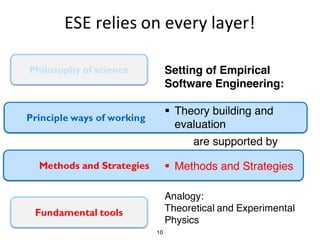
ESE	relies	on	every	layer!
10
Philosophy of science
Principle ways of working
Methods and Strategies
Fundamental tools
Setting of Empirical
Software Engineering:
§ Theory building and
evaluation
are supported by
§ Methods and Strategies
Analogy:
Theoretical and Experimental
Physics
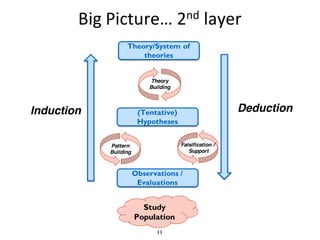
Big	Picture…	2nd layer
11
Theory/System of
theories
(Tentative)
Hypotheses
Observations /
Evaluations
Study
Population
Induction
Pattern
Building
Deduction
Falsification /
Support
Theory
Building
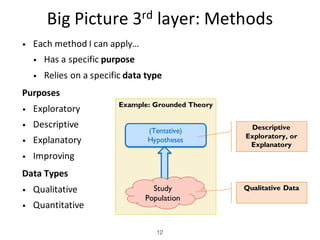
Big	Picture	3rd layer:	Methods
12
• Each	method	I	can	apply…
• Has	a	specific	purpose
• Relies	on	a	specific	data	type
Purposes
• Exploratory
• Descriptive
• Explanatory
• Improving
Data	Types
• Qualitative
• Quantitative
Example: Grounded Theory
(Tentative)
Hypotheses
Study
Population
Qualitative Data
Descriptive
Exploratory, or
Explanatory
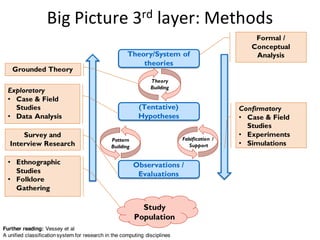
Further reading: Vessey et al
A unified classificationsystem for research in the computing disciplines
Theory/System of
theories
(Tentative)
Hypotheses
Observations /
Evaluations
Study
Population
Pattern
Building
Falsification /
Support
Theory
Building
Big	Picture	3rd layer:	Methods
Formal /
Conceptual
Analysis
Grounded Theory
Confirmatory
• Case & Field
Studies
• Experiments
• Simulations
Survey and
Interview Research
• Ethnographic
Studies
• Folklore
Gathering
Exploratory
• Case & Field
Studies
• Data Analysis
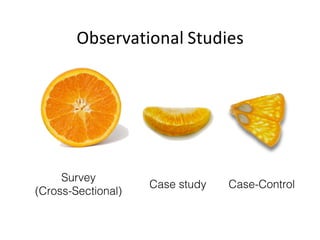
Observational	Studies
Survey
(Cross-Sectional)
Case study Case-Control
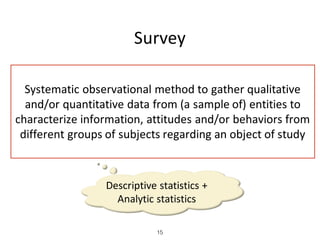
Survey
Systematic	observational	method	to	gather	qualitative	
and/or	quantitative	data	from	(a	sample	of)	entities	to	
characterize	information,	attitudes	and/or	behaviors	from	
different	groups	of	subjects	regarding	an	object	of	study
15
Descriptive	statistics	+	
Analytic	statistics
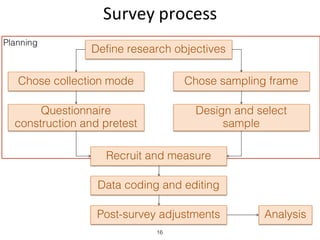
Planning
Survey	process
16
Define research objectives
Chose collection mode Chose sampling frame
Questionnaire
construction and pretest
Design and select
sample
Recruit and measure
Data coding and editing
AnalysisPost-survey adjustments
Survey	process
17
Define research objectives
Chose collection mode Chose sampling frame
Questionnaire
construction and pretest
Design and select
sample
Recruit and measure
Data coding and editing
AnalysisPost-survey adjustments
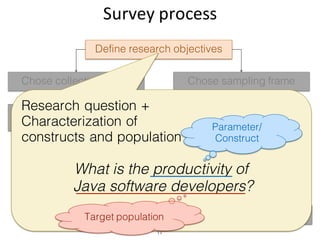
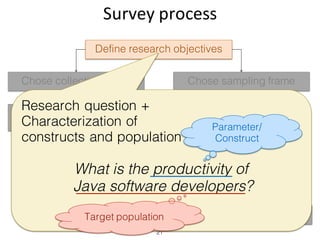
Research question +
Characterization of
constructs and population
What is the productivity of
Java software developers?
Parameter/
Construct
Target population
Survey	process
18
Define research objectives
Chose collection mode Chose sampling frame
Questionnaire
construction and pretest
Design and select
sample
Recruit and measure
Data coding and editing
AnalysisPost-survey adjustments
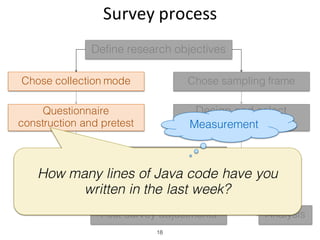
How many lines of Java code have you
written in the last week?
Measurement
Survey	process
19
Define research objectives
Chose collection mode Chose sampling frame
Questionnaire
construction and pretest
Design and select
sample
Recruit and measure
Data coding and editing
AnalysisPost-survey adjustments
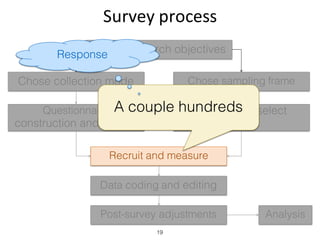
A couple hundreds
Response
Survey	process
20
Define research objectives
Chose collection mode Chose sampling frame
Questionnaire
construction and pretest
Design and select
sample
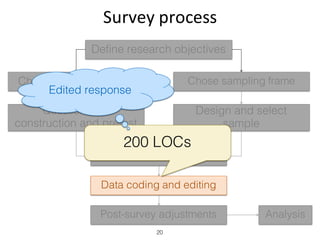
Recruit and measure
Data coding and editing
AnalysisPost-survey adjustments
200 LOCs
Edited response
Survey	process
21
Define research objectives
Chose collection mode Chose sampling frame
Questionnaire
construction and pretest
Design and select
sample
Recruit and measure
Data coding and editing
AnalysisPost-survey adjustments
Research question +
Characterization of
constructs and population
What is the productivity of
Java software developers?
Parameter/
Construct
Target population
Survey	process
22
Define research objectives
Chose collection mode Chose sampling frame
Questionnaire
construction and pretest
Design and select
sample
Recruit and measure
Data coding and editing
AnalysisPost-survey adjustments
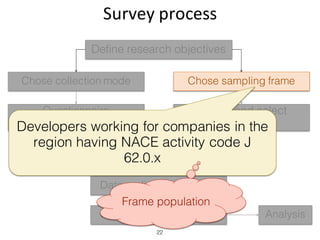
Developers working for companies in the
region having NACE activity code J
62.0.x
Frame population
Survey	process
23
Define research objectives
Chose collection mode Chose sampling frame
Questionnaire
construction and pretest
Design and select sample
Recruit and measure
Data coding and editing
AnalysisPost-survey adjustments
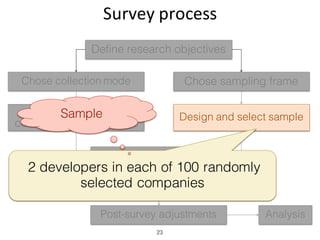
2 developers in each of 100 randomly
selected companies
Sample
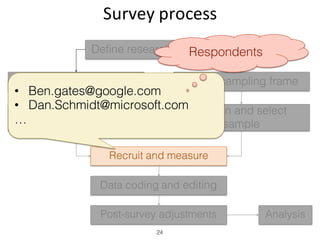
Survey	process
24
Define research objectives
Chose collection mode Chose sampling frame
Questionnaire
construction and pretest
Design and select
sample
Recruit and measure
Data coding and editing
AnalysisPost-survey adjustments
• Ben.gates@google.com
• Dan.Schmidt@microsoft.com
…
Respondents
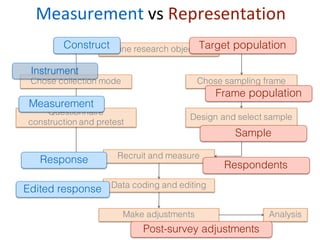
Measurement	vs Representation
25
Define research objectives
Chose collection mode Chose sampling frame
Questionnaire
construction and pretest
Design and select sample
Recruit and measure
Data coding and editing
AnalysisMake adjustments
Construct Target population
Measurement
Response
Edited response
Frame population
Sample
Respondents
Post-survey adjustments
Instrument
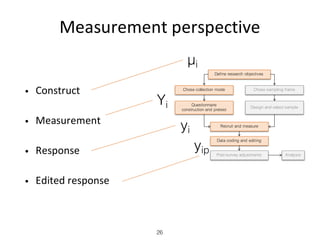
Measurement	perspective
• Construct
• Measurement
• Response
• Edited	response
26
Define research objectives
Chose collection mode Chose sampling frame
Questionnaire
construction and pretest
Design and select sample
Recruit and measure
Data coding and editing
AnalysisPost-survey adjustments
μi
Yi
yi
yip
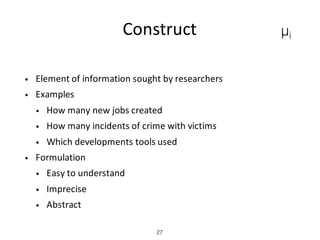
Construct
• Element	of	information	sought	by	researchers
• Examples
• How	many	new	jobs	created
• How	many	incidents	of	crime	with	victims
• Which	developments	tools	used
• Formulation
• Easy	to	understand
• Imprecise
• Abstract
27
μi
Construct
• Level	of	Abstraction	/	Measurement	perspective
• Directly	observable
• E.g.	Staff	for	a	project
• A	few	defined	ways	to	measure
• Non	directly	observable
• Intention	to	adopt	a	technology
• No	single	well-defined	measure
28
Measurement
• How	to	gather	information	about	constructs
• Objective	measures
• Electronic
• Physical
• Answers	to	questions
• Visual	(formal	questionnaires)
• Oral	(structured	or	semi-structured	interviews)
29
Yi
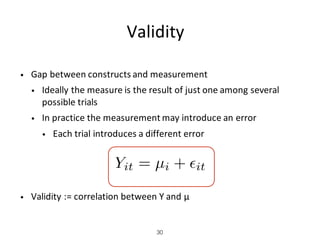
Validity
• Gap	between	constructs	and	measurement
• Ideally	the	measure	is	the	result	of	just	one	among	several	
possible	trials
• In	practice	the	measurement	may	introduce	an	error
• Each	trial	introduces	a	different	error
• Validity	:=	correlation	between	Y	and	μ		
30
Yit = µi + ✏it
Response
• The	actual	data	collected	through	the	survey
• A	question	may	require
• Search	own	memory
• Access	records
• Ask	other	persons
• Closed	questions	already	contain	possible	answers
• Sometimes	a	response	is	not	provided
31
yi
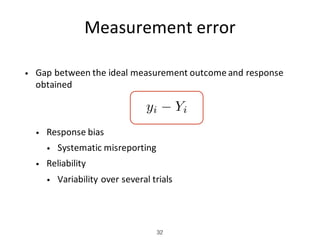
• Gap	between	the	ideal	measurement	outcome	and	response	
obtained
• Response	bias
• Systematic	misreporting
• Reliability
• Variability	over	several	trials
Measurement	error
32
yi Yi
Edited	response
• Review	process	before	using	data
• Range	checks
• Consistency	checks
• Illegible	answers	detection
• Skipped	questions
• Outlier	detection
33
yip
Processing	error
• Gap	between	variables	used	in	analysis	and	those	provided	by	
the	respondent
• Erroneous	outlier	identification
• Coding	error
34
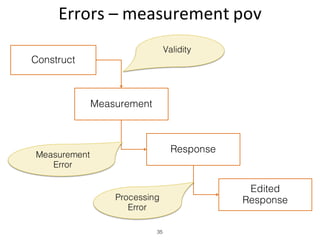
Errors	– measurement	pov
35
Construct
Measurement
Response
Edited
ResponseProcessing
Error
Measurement
Error
Validity
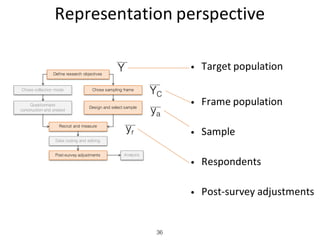
Representation	perspective
36
• Target	population
• Frame	population
• Sample
• Respondents
• Post-survey	adjustments
Define research objectives
Chose collection mode Chose sampling frame
Questionnaire
construction and pretest
Design and select sample
Recruit and measure
Data coding and editing
AnalysisPost-survey adjustments
Y
YC
ya
yr
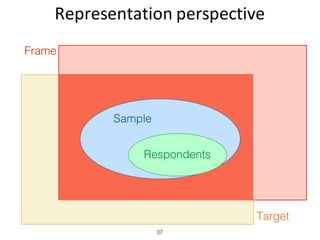
Representation	perspective
37
Target
Frame
Sample
Respondents
Target	population
• The	set	of	units	to	be	studied
• Abstract	population	definition
• E.g.	software	projects
• Time?
• In	software	companies	only?
• Italian	companies	only?
• Completed	or	just	started	projects?
38
Frame	population
• All	units	in	the	sampling	frame	constitute	the	frame	population
• In	theory
• The	subset	of	target	population	that	has	a	chance	to	be	
selected
• In	practice	
• a	set	of	units	imperfectly	linked	to	the	target	population	
members
• E.g.	telephone	numbers
39
Framing	instrument
• The	(conceptual)	instrument	used	to	identify	the	units	of	study
• Household	phone	numbers	to	get	persons
• Company	records	to	get	employees
• Customer	IDs	to	get	customers
• Social	Network	IDs	to	get	members
• Warning:	often	the	frame	elements	are	indirectly	linked	to	the	
units	of	analysis,	through	respondents.	E.g.
• UoA:	software	projects	(UoA)	
• Respondents:	developers
• Frame	elements:		software	companies
40
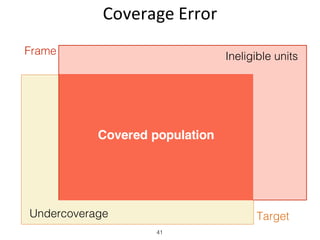
Target
Frame
Coverage	Error
41
Undercoverage
Ineligible units
Covered population
Reality	check
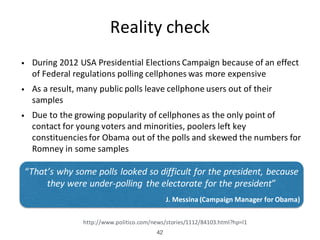
• During	2012	USA	Presidential	Elections	Campaign	because	of	an	effect	
of	Federal	regulations	polling	cellphones	was	more	expensive
• As	a	result,	many	public	polls	leave	cellphone	users	out	of	their	
samples
• Due	to	the	growing	popularity	of	cellphones	as	the	only	point	of	
contact	for	young	voters	and	minorities,	poolers	left	key	
constituencies	for	Obama	out	of	the	polls	and	skewed	the	numbers	for	
Romney	in	some	samples
42
http://www.politico.com/news/stories/1112/84103.html?hp=l1
“That’s	why	some	polls	looked	so	difficult	for	the	president,	because	
they	were	under-polling	the	electorate	for	the	president”	
J.	Messina	(Campaign	Manager	for	Obama)
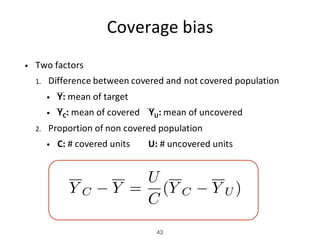
Coverage	bias
• Two	factors
1. Difference	between	covered	and	not	covered	population
• Y: mean	of	target
• YC: mean	of	covered			 YU: mean	of	uncovered
2. Proportion	of	non	covered	population
• C:	#	covered	units								U:	#	uncovered	units	
43
Y C Y =
U
C
(Y C Y U )
Sample
• Units	selected	from	the	frame	population
• Time	and	cost	opportunity
• Sampling	:==	Deliberate	non-observation
• May	introduce	deviation	between
• Sample	statistic
• Full	frame	statistic
44
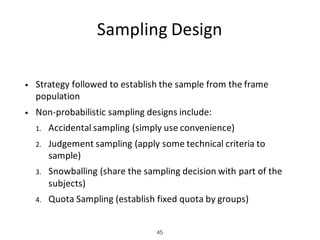
Sampling	Design
• Strategy	followed	to	establish	the	sample	from	the	frame	
population
• Non-probabilistic	sampling	designs	include:
1. Accidental	sampling	(simply	use	convenience)
2. Judgement	sampling	(apply	some	technical	criteria	to	
sample)
3. Snowballing	(share	the	sampling	decision	with	part	of	the	
subjects)
4. Quota	Sampling	(establish	fixed	quota	by	groups)
45
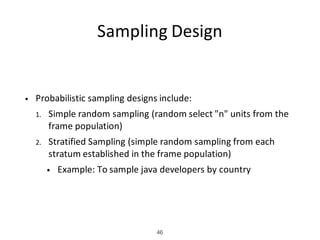
Sampling	Design
• Probabilistic	sampling	designs	include:
1. Simple	random	sampling	(random	select	"n"	units	from	the	
frame	population)
2. Stratified	Sampling	(simple	random	sampling	from	each	
stratum	established	in	the	frame	population)
• Example:	To	sample	java	developers	by	country
46
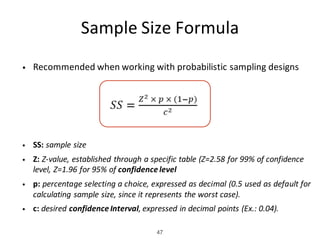
Sample	Size	Formula
• Recommended	when	working	with	probabilistic	sampling	designs
• SS:	sample	size	
• Z: Z-value,	established	through	a	specific	table	(Z=2.58	for	99%	of	confidence	
level,	Z=1.96	for	95%	of	confidence	level
• p: percentage selecting a choice, expressed as decimal (0.5 used as default for
calculating sample size, since it represents the worst case).
• c:	desired	confidence	Interval,	expressed	in	decimal	points	(Ex.:	0.04).
47
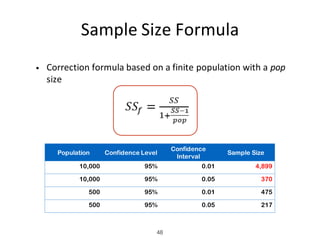
Sample	Size	Formula
• Correction	formula	based	on	a	finite	population	with	a	pop
size
48
Population Confidence Level
Confidence
Interval
Sample Size
10,000 95% 0.01 4,899
10,000 95% 0.05 370
500 95% 0.01 475
500 95% 0.05 217
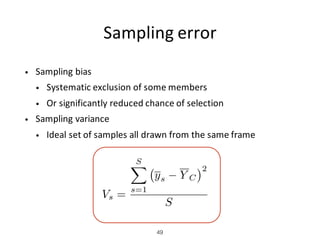
Sampling	error
• Sampling	bias
• Systematic	exclusion	of	some	members
• Or	significantly	reduced	chance	of	selection
• Sampling	variance
• Ideal	set	of	samples	all	drawn	from	the	same	frame
49
Vs =
SX
s=1
ys Y C
2
S
Sampling	error	reduction
• Probabilistic	sampling
ü All	units	have	non	zero	selection	probability
• Stratified	sampling
ü Representation	of	key	sub-populations	is	controlled
• Element	samples
ü As	opposed	to	cluster	samples
• Sample	size
50
Respondents
• The	subset	of	sample	for	which	a	measurement	could	be	
collected
ü Item	missing	data:	incomplete	measures
• Full	participation	(i.e.	100%	response	rate)	realistically	possible	
only	for	inanimate	units
51
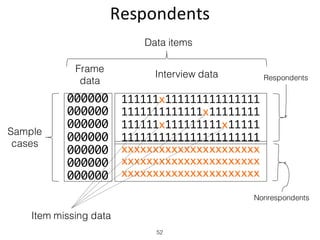
Respondents
52
000000
000000
000000
000000
000000
000000
000000
111111x111111111111111
1111111111111x11111111
111111x111111111x11111
1111111111111111111111
xxxxxxxxxxxxxxxxxxxxxx
Frame
data
Interview data
Data items
Sample
cases
Respondents
Nonrespondents
Item missing data
Non-response	error
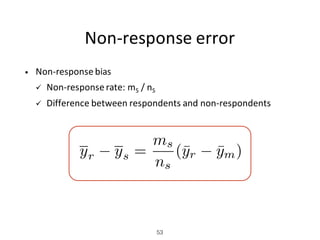
• Non-response	bias
ü Non-response	rate:	mS /	nS
ü Difference	between	respondents	and	non-respondents
53
yr ys =
ms
ns
(¯yr ¯ym)
Post-survey	adjustment
• Weighting
ü Compensate	under-representation	due	to
ü Non	response	patterns
ü Mismatch	between	frame	and	target	population
• Imputation
ü Item	missing	data	are	replaced	by	estimations
54
Session II
Best Practices on Planning Surveys
Disclaimer
There is no universal silver bullet!
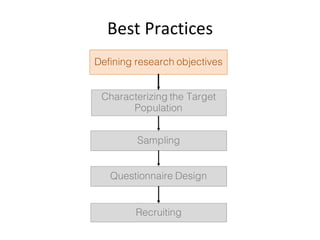
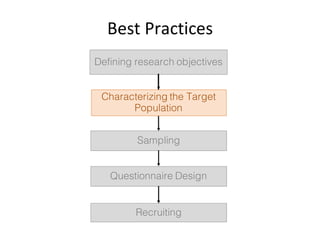
Best	Practices
Defining research objectives
Sampling
Questionnaire Design
Recruiting
Characterizing the Target
Population
Design	research	objectives
Challenge:
Know	the	limitations	of	survey	research
à Survey	research	opts	for	answers	that	rely	on	experiences,	opinions,	
and	observations	(folklore)	of	the	respondents
• Develop	internal	questions	to	help	you	depicting	the	research	
objective
• Opt	for	descriptive	questions	(“what	is	happening?”)	or	explanatory	
questions	(“why	is	this	happening?”)	rather	than	normative	questions	
(“what	should	we	do?”)
Design	research	objectives
Challenge:
Identify	the	real	target	population
à Avoid	to	restrict	the	target	population	based	on	factors		such	as	its	
size	or	its	availability.
• Based	on	the	research	objectives,	answer	the	following		question:	
“Who	can	best	provide	you	with	the	information	you	need?”,	instead	
of	answering	“Who	are	probably	available	to	participate?"
Best	Practices
Defining research objectives
Sampling
Questionnaire Design
Recruiting
Characterizing the Target
Population
Characterizing	the	Target	
Population
Challenge:	
Identifying	the	survey	unit	of	analysis
à The	survey	subjects	(individuals)	are	typically	the	survey	unit	of	analysis.	
However,	in	some	cases	it	may	be	a	group	of	individuals,	such	as	
households	or	organizational	units/	project	teams	in	SE	research
• Based	on	the	research	objective,	identify	which	entity	should	be	used	to	
guide	sampling	and	data	analysing
• For	instance,	investigating Java	developers programming	practice	is	a	research	
objective	different	from	investigating	java	programming	practice	in	software	
houses
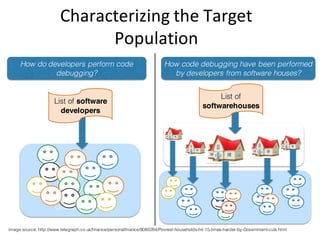
Unit of analysis
Characterizing	the	Target	
Population
Image source: http://www.telegraph.co.uk/finance/personalfinance/8080294/Poorest-households-hit-15-times-harder-by-Government-cuts.html
How do developers perform code
debugging?
How code debugging have been performed
by developers from software houses?
List of software
developers
List of
softwarehouses
Challenge:	
Characterizing	the	subjects	and	units	of	analysis	in	SE	surveys	
à Different	research	objectives	may	demand	different	attributes	to	
characterizing	individuals/	groups	of	individuals	involved	in	the	
surveys
à What	attributes	are	necessary	to	identify	a	“representative”	
population?
• Standards	can	be	especially	helpful	to	provide	scales	and	even	
nominal	values
• For	instance,	CMMI-DEV	maturity	level			can			be			used			to			characterize	
organizational	units	regarding	their	maturity	in	software	process.	RUP	
roles	can	be	used	to	characterize	subjects’	current	position
Characterizing	the	Target	
Population
Characterizing	the	Target	
Population
Challenge:	
Characterizing	the	subjects	and	units	of	analysis	in	SE	surveys	
• Individuals can	be	characterized	through	attributes	such	as:	experience	in	the	
research	context,	experience	in	SE,	current	professional	role,	location	and	
higher	academic	degree]
• Organizations can	be	characterized	through	attributes	such	as:	size	(scale	
typically	based	in	the	number	of	employees),	industry	segment	(software	
factory,	avionics,	finance,	health,	telecommunications,	 etc.),	location	and	
organization	type	(government,	private	company,	university,	etc.)
• Project	teams can	be	characterized	through	attributes	such	as	project	size;	
team	size,	client/product	domain	(avionics,	finance,	health,	
telecommunications,	 etc.)	and	physical	distribution
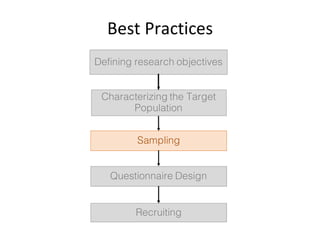
Best	Practices
Defining research objectives
Sampling
Questionnaire Design
Recruiting
Characterizing the Target
Population
Sampling
Challenge:
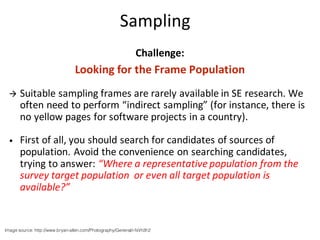
Looking	for	the	Frame	Population
à Suitable	sampling	frames	are	rarely	available	in	SE	research.	We	
often	need	to	perform	“indirect	sampling”	(for	instance,	there	is	
no	yellow	pages	for	software	projects	in	a	country).
• First	of	all,	you	should	search	for	candidates	of	sources	of	
population.	Avoid	the	convenience	on	searching	candidates,	
trying	to	answer:	“Where	a	representative	population	from	the	
survey	target	population		or	even	all	target	population	is	
available?”
Image source: http://www.bryan-allen.com/Photography/General/i-fsVh3h2
Sampling
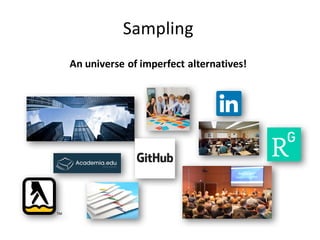
An	universe	of	imperfect	alternatives!
Sampling
A	good	source	of	population...
• ...should not intentionally represent a segregated subset from the target
population, i.e., for a target population audience “X”, it is not adequate to
search for units from a source intentionally designed to compose a specific
subset of “X”
• ...should not present any bias on including on its database preferentially only
subsets from the target population. Unequal criteria for including search units
mean unequal sampling opportunities
• … allow identifying all source of population’ units by a distinct logical or
numerical id
• ...should allow accessing all its units. If there are hidden elements, it is not
possible to contextualize the population
Sampling
Challenge:
Looking	for	the	Frame	Population
• In	the	case	of	surveys	having	SE	researchers	as	target	population,	you	
can	use	results	from		previously		conducted	systematic	literature	
reviews	(SLR)	regarding		your	research		theme		
• Social	networks	addressed	to	integrate	academics	such	as	ResearchGate and	
Academia.edu can	be	also	useful	in		this	context.
Sampling
Challenge:
Looking	for	the	Frame	Population
• Look	for	catalogues	provided	by	recognized	institutes/	associations/	
governments	to	retrieve	relevant	set	of	SE	professionals/	organizations.		
Some	examples:
• SEI	(www.sei.cmu.edu) institute	provides	an	open	list	of	organizations	
and	organizational	units	certified	in	each	CMMI-DEV	level.	
• FIPA	(www.tivia.fi/in-english)		provides	information	regarding	Finland	IT	
organizations	and	its	professionals.	
• CAPES	(www.capes.gov.br/) provides	a	tool	for	accessing	information	
regarding	Brazilian	research	groups.
Sampling
Challenge:
Looking	for	the	Frame	Population
• Sources	available	in	the	web	such	as	discussion	groups,	projects	
repositories and	worldwide	professional	social	networks can	be	helpful	
to	identify	representative	populations	composed	by	SE	professionals	
Such sources can restrict at
any moment the access to the
content available!
Sampling
Challenge:
Looking	for	the	Frame	Population
• How	to	find	the	frame	population	in	the	source	of	population?	
• Once	you	have	identified	a	source	of	population,	you	need	to	establish	
steps/procedures	to	systematically	depicting	the	survey	sampling	
frame.	
• Such	practice	is	important	to	assess	the	samples	representativeness,	
also	supporting	future	re-executions
Sampling
Challenge:
Establishing	the	survey	sample	size
• Participation	rates	in	voluntary	surveys	in	SE	performed	over	random	
samples	tend	to	be	small	(lower	than	10%).	What	are	the	implications	
on	response	rates,	but	also	on	representativeness?	
• Take	preference	to	probabilistic	sampling	designs.	
• Independent	from	the	amount	of	respondents,	it	will	be	possible	to	calculate	
the	results	confidence
• In	voluntary	surveys	with	practitioners,	establish	significantly	higher	
sample	sizes,	considering	the	expectation	of	a	very	low	participation	
rate
Image source:http://www.playbuzz.com/viralpx/a-what-do-people-really-think-about-you
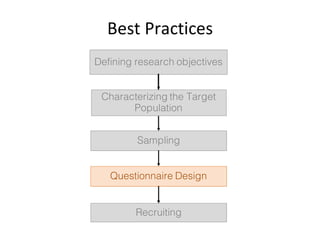
Best	Practices
Defining research objectives
Sampling
Questionnaire Design
Recruiting
Characterizing the Target
Population
Questionnaire	Design
Challenge:
To	design	a	clear,	simple	and	consistent	survey	questionnaire
Remember:
Bad questionnaires can led subjects initially
willing to participate to give up!
Questionnaire	Design
Challenge:
To	design	a	clear,	simple	and	consistent	survey	questionnaire
• Use	simple	and	appropriate	wording	for	the	survey	questions
• Avoid	technical	terms	as	much	as	possible	or	define	them	in	the	
questionnaire,	according	to	the	survey	target	population
• Take	preference	to	design	short	questions	regarding	a	single	concept
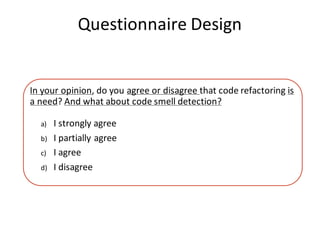
• Avoid	double	barreled	questions
• Avoid	vague	sentences	while	writing	survey	questions
Image source: http://www.fooj.it/wp-content/uploads/2015/07/boring-office.jpg
Questionnaire	Design
In	your	opinion,	do	you	agree	or	disagree	that	code	refactoring	is	
a	need?	And	what	about	code	smell	detection?
a) I	strongly	agree
b) I	partially	agree
c) I	agree
d) I	disagree
Questionnaire	Design
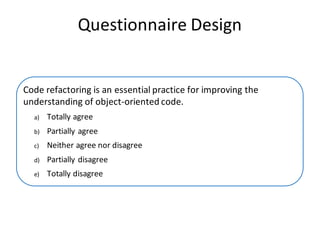
Code	refactoring	is	an	essential	practice	for	improving	the	
understanding	of	object-oriented	code.
a) Totally	agree
b) Partially	agree
c) Neither	agree	nor	disagree
d) Partially	disagree
e) Totally	disagree
Questionnaire	Design
Challenge:	
To	design	a	clear,	simple	and	consistent	survey	questionnaire
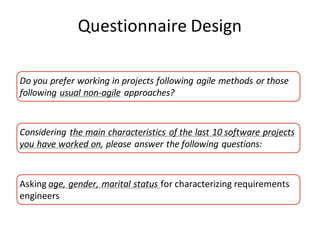
• Avoid	biased questions,	which	can	be	done	by	carefully	phrasing	the	
questions	that	do	not	suggest	likely	answers	or	responses
• Avoiding	sensitive questions
• In	SE	context,	the	sensitive	questions	can	be	about	respondents	income,	
opinion	about	organization	or	management,	etc.
• Avoid	to	ask	about	far	past	events
Questionnaire	Design
Do	you	prefer	working	in	projects	following	agile	methods	or	those	
following	usual	non-agile approaches?
Considering	the	main	characteristics	of	the	last	10	software	projects	
you	have	worked	on,	please	answer	the	following	questions:
Asking	age,	gender,	marital	status	for	characterizing	requirements	
engineers
Questionnaire	Design
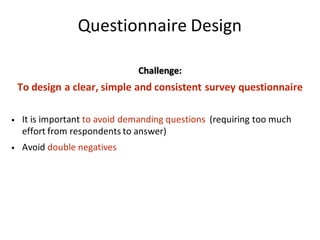
Challenge:
To	design	a	clear,	simple	and	consistent	survey	questionnaire
• It	is	important	to	avoid	demanding	questions		(requiring	too	much	
effort	from	respondents	to	answer)	
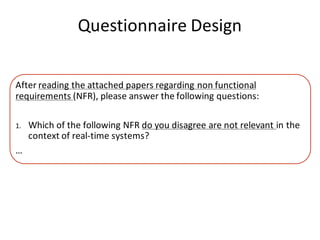
• Avoid	double	negatives
Questionnaire	Design
After	reading	the	attached	papers	regarding	non	functional	
requirements	(NFR),	please	answer	the	following	questions:
1. Which	of	the	following	NFR	do	you	disagree	are	not	relevant	in	the	
context	of	real-time	systems?
…
Questionnaire	Design
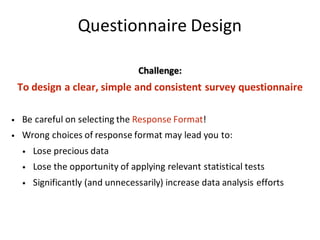
Challenge:
To	design	a	clear,	simple	and	consistent	survey	questionnaire
• Be	careful	on	selecting	the Response	Format!	
• Wrong	choices	of	response	format	may	lead	you	to:
• Lose	precious	data
• Lose	the	opportunity	of	applying	relevant	statistical	tests
• Significantly	(and	unnecessarily)	increase	data	analysis	efforts
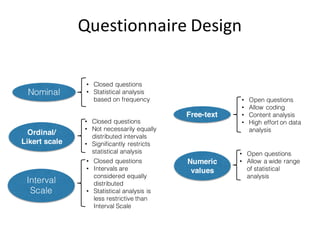
Questionnaire	Design
Free-text
Numeric
values
• Open questions
• Allow coding
• Content analysis
• High effort on data
analysis
• Open questions
• Allow a wide range
of statistical
analysis
Interval
Scale
• Closed questions
• Not necessarily equally
distributed intervals
• Significantly restricts
statistical analysis
Ordinal/
Likert scale
• Closed questions
• Intervals are
considered equally
distributed
• Statistical analysis is
less restrictive than
Interval Scale
Nominal
• Closed questions
• Statistical analysis
based on frequency
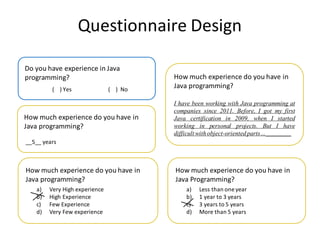
Questionnaire	Design
How	much	experience	do	you	have	in	
Java	programming?
a) Very	High	experience
b) High	Experience
c) Few	Experience
d) Very	Few	experience
How	much	experience	do	you	have	in	
Java	Programming?
a) Less	than	one	year
b) 1	year	to	3	years
c) 3	years	to	5	years
d) More	than	5	years
How	much	experience	do	you	have	in	
Java	programming?
__5__	years
How	much	experience	do	you	have	in	
Java	programming?
I have been working with Java programming at
companies since 2011. Before, I got my first
Java certification in 2009, when I started
working in personal projects. But I have
difficult withobject-orientedparts…_________
Do	you	have	experience	in	Java	
programming?
(				)	Yes																										(				)		No
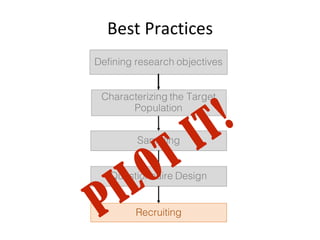
Best	Practices
Defining research objectives
Sampling
Questionnaire Design
Recruiting
Characterizing the Target
Population
Recruiting
Challenge:
Controlling	recruitment	and	participation
• Send	individual	but	standard	invitation	messages
• It	is	expected	that	great	most	of	the	individual	messages	sent	will	be	read
• Avoid	"spreading	spree":	mailing	lists,	forum	invitation	messages,	
crowdsourcing	tools	(such	as	Amazon	MechanicalTurk)
• You	will	have	few	or	no	control	on	who	read	the	invitation.	So,	who	was	
effectively	recruited?
• Never	allow	forwarding	(which	is	different	from	snowballing)!
• It	will	violate	the	sample
• Send	a	questionnaire’s	individual	token	to	each	subject
Recruiting
Challenge:
Stimulating	participation
• Reminders	should	be	used	with	care.
• Avoid	reminding	who	already	had	participated
• Avoid	reminding	more	than	once
• The	invitation	message	should	clearly	characterize	the	involved	
researchers,	the	research	context	and	present	the	recruitment	
parameters
• Include	in	the	invitation	message	a	compliment	and	an	observation	
regarding	the	relevance	of	subject	participation	
Image source: http://quotesgram.com/you-are-important-to-me-quotes/
Challenge:
Stimulating	participation
• Establish	a	finite	and	not	long	period	to	answer	the	survey
• One-two	weeks
• Offer	rewards	(raffles,	donations,	payments,	sharing	results)
• Take	into	account	the	local	policies
Image source: http://quotesgram.com/you-are-important-to-me-quotes/
Recruiting
Best	Practices
Defining research objectives
Sampling
Questionnaire Design
Recruiting
Characterizing the Target
Population
Piloting	the	Survey
Challenge:
You	have	only	one	shot!	Once	you	started	the	survey,	there	is	
usually	no	way	back
• Pilot	the	population	and	sampling	activities
ü Use	a	(smaller)	sample	of	the	sampling	frame,	reproducing	all	planned	steps
ü Will	allow	you	to	check	the	adequacy	of	the	frame	population	to	your	survey.
• Pilot	the	questionnaire
ü Is	it	clear,	unambiguous,	did	you	maybe	miss	some	questions?
• Pilot	the	recruitment
ü Does	it	is	working	effectively?
• Pilot	the	data	analysis
ü Do	you	have	planned	for	the	proper	data	analysis	techniques?	What	is	the	necessary	
data	quantity	and quality?
Session	III
Hands-On
Session III
Hands-On!
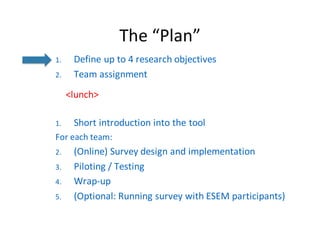
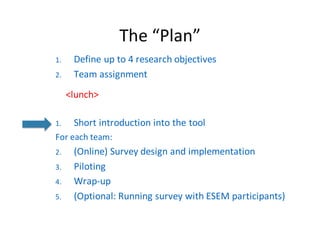
The	“Plan”
1. Define	up	to	4	research	objectives
2. Team	assignment
<lunch>
1. Short	introduction	into	the	tool
For each team:
2. (Online)	Survey	design	and implementation
3. Piloting /	Testing
4. Wrap-up
5. (Optional:	Running survey with ESEM	participants)
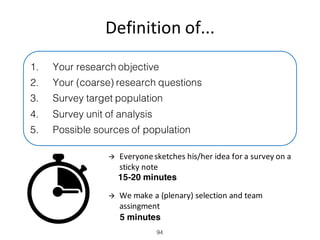
1. Your research objective
2. Your (coarse) research questions
3. Survey target population
4. Survey unit of analysis
5. Possible sources of population
Definition	of...
à Everyonesketches	his/her	idea for a	survey	on	a	
sticky note
à We	make	a	(plenary)	selection and team	
assingment
94
15-20 minutes
5 minutes
Break
Back-Up	Questions
• Are functional and non-functional requirements really
distinct?
• Can current software testing techniques support the test
of context awareness systems?
• What development practices can contribute more to
decrease the software technical debt?
• What could be the software engineering gap when
developing scientific (e-science) software?
• What is the impact of Continuous Software Engineering
on software productivity and quality?
• What is software?
The	“Plan”
1. Define	up	to	4	research	objectives
2. Team	assignment
<lunch>
1. Short	introduction	into	the	tool
For each team:
2. (Online)	Survey	design	and implementation
3. Piloting
4. Wrap-up
5. (Optional:	Running survey with ESEM	participants)
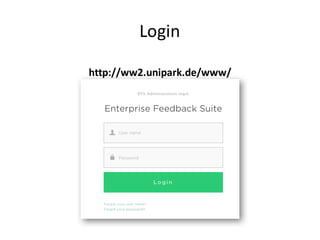
Login
http://ww2.unipark.de/www/
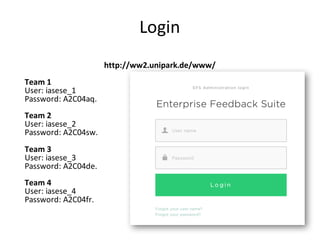
Login
http://ww2.unipark.de/www/
Team	1
User:	iasese_1
Password:	A2C04aq.
Team	2
User:	iasese_2
Password:	A2C04sw.
Team	3
User:	iasese_3
Password:	A2C04de.
Team	4
User:	iasese_4
Password:	A2C04fr.
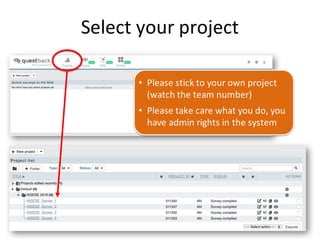
Select	your	project
• Please	stick	to	your	own	project	
(watch	the	team	number)
• Please	take	care	what	you	do,	you	
have	admin	rights	in	the	system
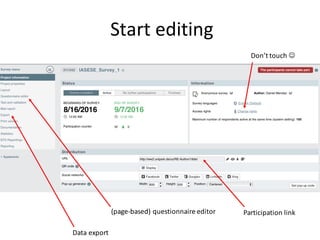
Start	editing
Participation	link(page-based)	questionnaire	editor
Data	export
Don’t	touch	J
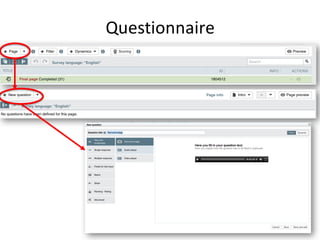
Questionnaire
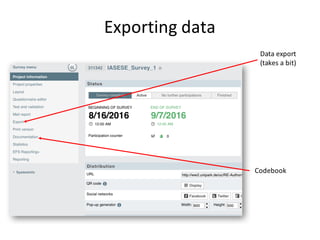
Exporting	data
Data	export
(takes	a	bit)
Codebook
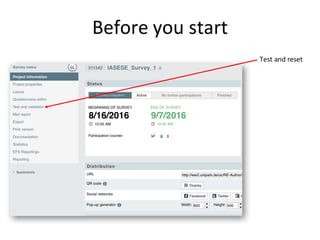
Before	you	start
Test	and	reset
Acclimatization	phase
Team	1
User:	iasese_1
Password:	A2C04aq.
Team	2
User:	iasese_2
Password:	A2C04sw.
à Every	team	gets to know the tool
à In	case	of	questions,	ask	J
Team	3
User:	iasese_3
Password:	A2C04de.
Team	4
User:	iasese_4
Password:	A2C04fr.
10 minutes
http://ww2.unipark.de/www/
The	“Plan”
1. Define	up	to	4	research	objectives
2. Team	assignment
<lunch>
1. Short	introduction	into	the	tool
For each team:
2. (Online)	Survey	design	and implementation
3. Piloting
4. Wrap-up
5. (Optional:	Running survey with ESEM	participants)
The	“Plan”
1. Define	up	to	4	research	objectives
2. Team	assignment
<lunch>
1. Short	introduction	into	the	tool
For each team:
2. (Online)	Survey	design	and implementation
3. Piloting
4. Wrap-up
5. (Optional:	Running survey with ESEM	participants)
The	“Plan”
1. Define	up	to	4	research	objectives
2. Team	assignment
<lunch>
1. Short	introduction	into	the	tool
For each team:
2. (Online)	Survey	design	and implementation
3. Piloting
4. Wrap-up
5. (Optional:	Running survey with ESEM	participants)
Wrap-Up
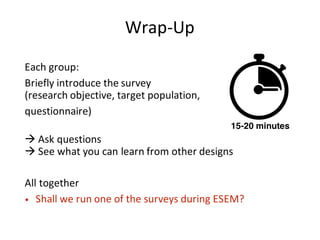
Each	group:
Briefly	introduce	the	survey	
(research	objective,	target	population,
questionnaire)
à Ask	questions
à See	what	you	can	learn	from	other	designs
All	together
• Shall	we	run	one	of	the	surveys	during	ESEM?
15-20 minutes
Session IV
Q&A
Further	reading…
• Groves, Fowler, Couper, Lepkowski, Singer and Torangeau, 2009.
“Survey Methodology – 2nd edition” John Wiley and Sons
• Conradi R., Li J., Slyngstad O. P. N., Kampenes V. B., Bunse C., Morisio M., Torchiano M.
“Reflections on conducting an international survey of CBSE in ICT industry” IEEE 4th
International Symposium on Empirical Software Engineering November, 2005
• Linåker, J. Sulaman, S. M., de Mello, R. M. and Höst, M. 2015. Guidelines for Conducting
Surveys in Software Engineering. TR 5366801, Lund University Publications.
http://lup.lub.lu.se/record/5366801/file/5366839.pdf
• de Mello, R. M. and Travassos, G. H. 2016. Surveys in Software Engineering: Identifying
Representative Samples. Proc. of 10th ACM/IEEE ESEM, Ciudad Real.
• de Mello, R. M. 2016. Conceptual Framework for Supporting the Identification of
Representative Samples for Surveys in Software Engineering. Doctoral Thesis, COPPE/UFRJ,
138p. http://www.cos.ufrj.br/uploadfile/publicacao/2611.pdf

Surveys in Software Engineering