Pure Culture Preservation Methods
By
Dr C R Meera
Assistant Professor & HOD
Department of Microbiology
St. Mary’s College, Thrissur
Pure culture preservation methods, Dr C R Meera, St.Mary’s
Why do we need culture preservation methods?
 Stock culture maintenance for laboratory classes, research works, or for
other particular procedures in Microbiology Labs
 For maintenance of reference strains for taxonomic studies
• American Type Culture Collection (ATCC)
• Microbial Type Culture Collection & Gene Bank (MTCC)
Objectives of Culture Preservation
 Maintenance of microorganisms for extended period of time in viable
condition
 No contamination
 No lose of genetic and morphological characteristics.
 Preservation methods either stop or slow down the metabolism
and multiplication of microbes.
Pure culture preservation methods, Dr C R Meera, St.Mary’s
Types of Culture Preservation
Based on the period of storage, culture preservation is divided into Short term
methods and Long term preservation methods.
Short term methods Long term methods
 Agar slant cultures
(Sub culturing) & Refrigeration
 Mineral Oil or Liquid Paraffin Method
 Saline suspension storage
 Drying in vacuum
 Storage at low temperatures
(Cryopreservation)
 Lyophilization (Freeze drying)
Pure culture preservation methods, Dr C R Meera, St.Mary’s
Short Term Preservation Method
Agar slant cultures (Sub-culturing) and Refrigeration
Pure culture preservation methods, Dr C R Meera, St.Mary’s
 Maintenance of pure culture by periodic aseptic sub-
culturing to the suitable media- called stock cultures.
 Type of media, storage temperature and interval
between sub-culturing depends on the bacterial species.
 Solid media is preferred as the toxic material produced
by organisms diffuse into slant and thus away from
microbial growth. Image Courtesy- ncbe.reading.ac.uk
Agar slant cultures (Sub-culturing)
and Refrigeration
Pure culture preservation methods, Dr C R Meera, St.Mary’s
 Most heterotrophs can be easily maintained on nutrient agar.
 Nutrient agar slants in screw capped bottles are preferred as it prevent drying of
the media.
 Disadvantage is that repeated sub-culturing leads to mutation in the strains.
 Prepared stock culture on getting sufficient growth are stored in cool dry place or
refrigerator till use.
 Low temperature like 4o C slow down the growth and metabolism of
microorganisms- Nutrient use reduced
 Periodic sub-culturing is needed as bacterial waste products accumulate
Long Term Preservation Methods
1. Mineral Oil or Liquid Paraffin Method
Pure culture preservation methods, Dr C R Meera, St.Mary’s
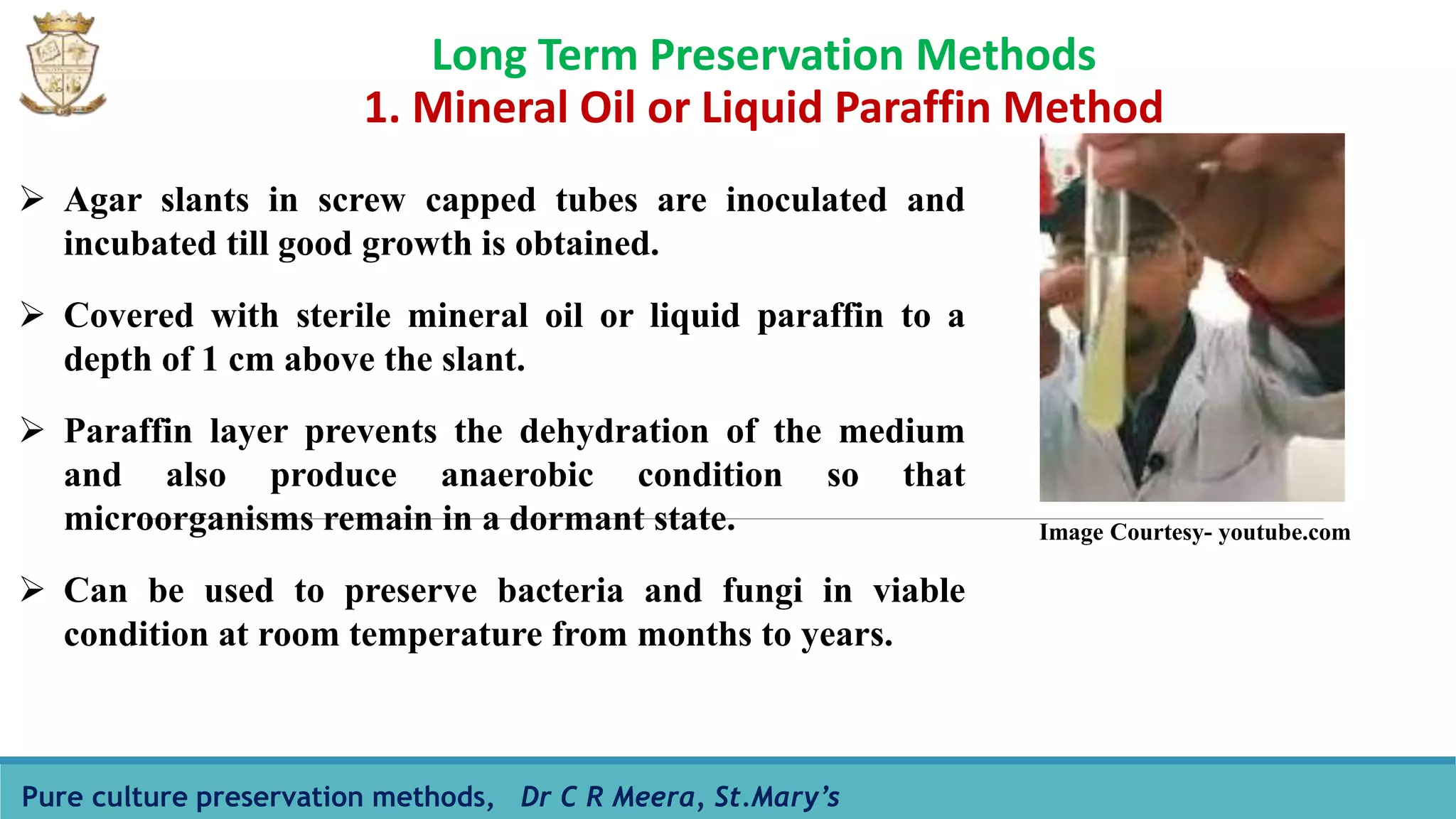
 Agar slants in screw capped tubes are inoculated and
incubated till good growth is obtained.
 Covered with sterile mineral oil or liquid paraffin to a
depth of 1 cm above the slant.
 Paraffin layer prevents the dehydration of the medium
and also produce anaerobic condition so that
microorganisms remain in a dormant state.
 Can be used to preserve bacteria and fungi in viable
condition at room temperature from months to years.
Image Courtesy- youtube.com
Mineral Oil or Liquid Paraffin Method- Advantages
Pure culture preservation methods, Dr C R Meera, St.Mary’s
 The unique advantage of the method is that sub-culturing can be done without
affecting the stock culture. (Sub-culturing is done by taking loopful of growth under the oil
from these slants, touching the loop to the glass surface of tube to drain off excess oil and then
inoculating to fresh medium).
 Many species remain viable for longer periods under oil than in tubes without
oil.
 Useful for strains susceptible to mutations on repeated sub-culturing
 Simple and economical method as equipment like dessicator, vaccum pump etc
are not needed.
Pure culture preservation methods, Dr C R Meera, St.Mary’s
Long Term Preservation Methods
2. Saline suspension storage
 Sodium chloride in high concentration is inhibitory to the microbes.
 1% salt solution (sub lethal concentration) is useful for culture
preservation
 Bacteria are suspended in salt solutions in screw capped tubes to
avoid evaporation.
 Tubes can be stored at room temperature and when required, can be
sub-cultured to agar slants.
 Easy method for storing bacterial cultures for 2-3 years
 Particularly useful in labs with limited equipment facility.
Image Courtesy- thomassci.com
Pure culture preservation methods, Dr C R Meera, St.Mary’s
Long Term Preservation Methods
3. Drying in Vaccum
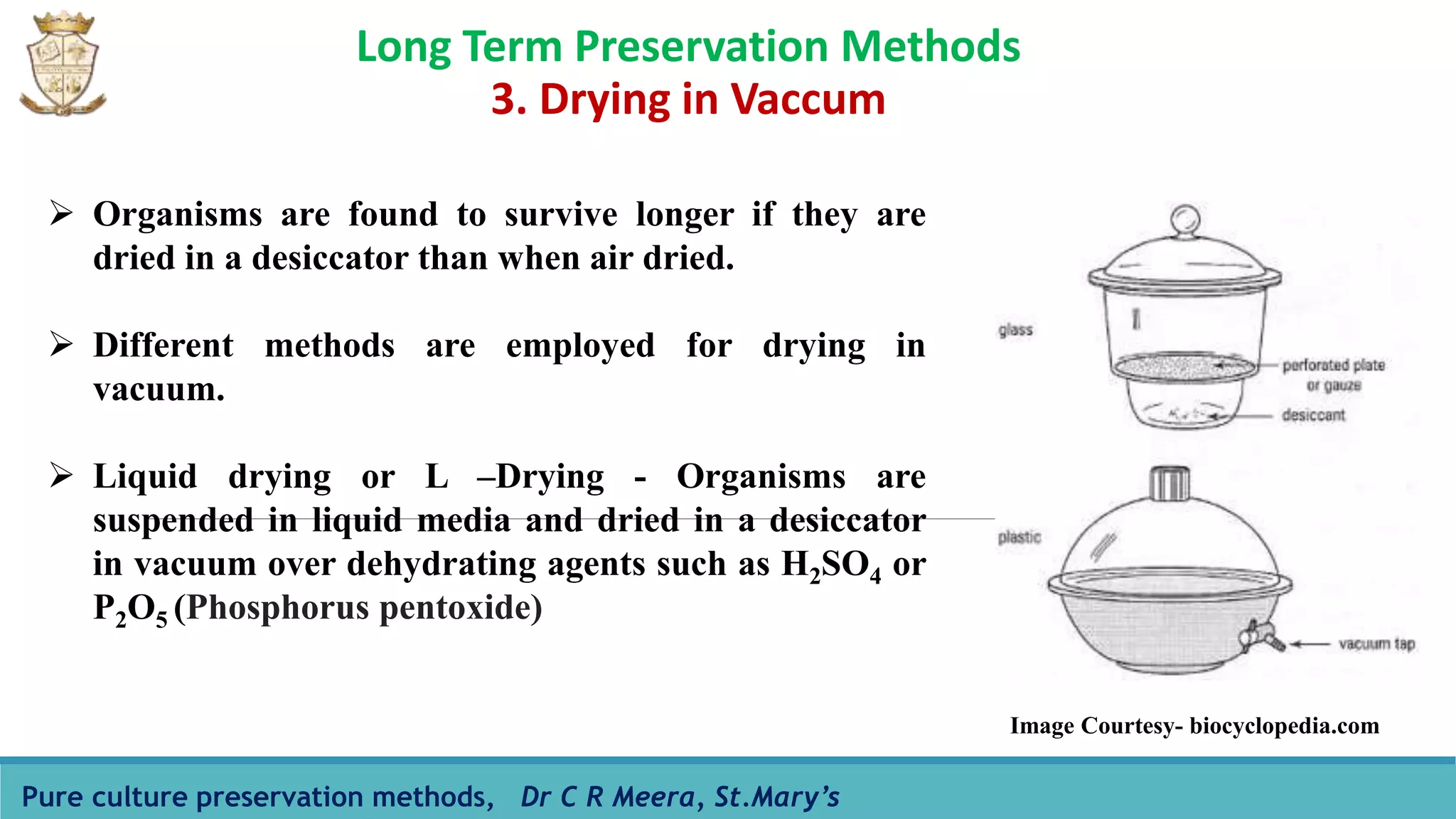
 Organisms are found to survive longer if they are
dried in a desiccator than when air dried.
 Different methods are employed for drying in
vacuum.
 Liquid drying or L –Drying - Organisms are
suspended in liquid media and dried in a desiccator
in vacuum over dehydrating agents such as H2SO4 or
P2O5 (Phosphorus pentoxide)
Image Courtesy- biocyclopedia.com
Pure culture preservation methods, Dr C R Meera, St.Mary’s
Long Term Methods
3. Drying in Vaccum
 L –Drying -Particularly useful for microbes which
are sensitive to freeze drying as this method
involves vacuum-drying of samples from the liquid
state without freezing
 The microbial suspensions can be also dried on
sterile coverslips, filter paper, in small test-tubes, or
more conveniently in sterile ampoules which can
subsequently be sealed off in vacuo
Image Courtesy- tedpella.com
Pure culture preservation methods, Dr C R Meera, St.Mary’s
Long Term Methods
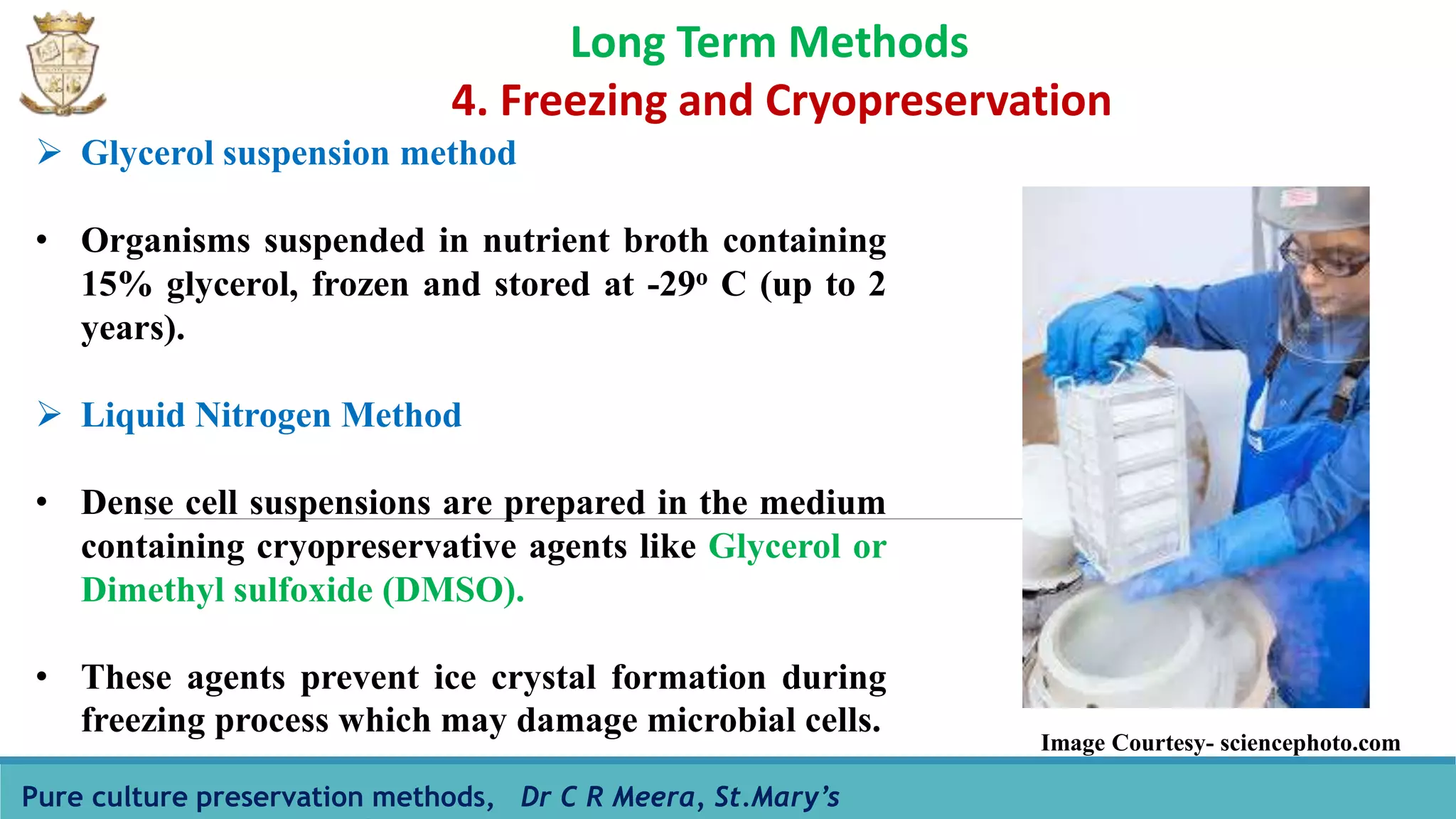
4. Freezing and Cryopreservation
 Glycerol suspension method
• Organisms suspended in nutrient broth containing
15% glycerol, frozen and stored at -29o C (up to 2
years).
 Liquid Nitrogen Method
• Dense cell suspensions are prepared in the medium
containing cryopreservative agents like Glycerol or
Dimethyl sulfoxide (DMSO).
• These agents prevent ice crystal formation during
freezing process which may damage microbial cells.
Image Courtesy- sciencephoto.com
Pure culture preservation methods, Dr C R Meera, St.Mary’s
Long Term Methods
4. Freezing and Cryopreservation
 Microbial suspension is sealed into small ampoules or vials and then frozen at
controlled rate to -150 o C.
 Ampoules or vials stored in a liquid nitrogen refrigerator either by immersion in
liquid nitrogen (-196°C) or by storage in a gas phase above liquid nitrogen (-150 o C).
 Useful for preservation of organisms that cannot withstand freeze drying.
 Cultures can be maintained for 10-30 years or more without any change in the
characteristics of microbes.
 Disadvantage: Expensive method as liquid nitrogen has to be replenished at regular
intervals to replace the loss due to evaporation.
Pure culture preservation methods, Dr C R Meera, St.Mary’s
Long Term Methods
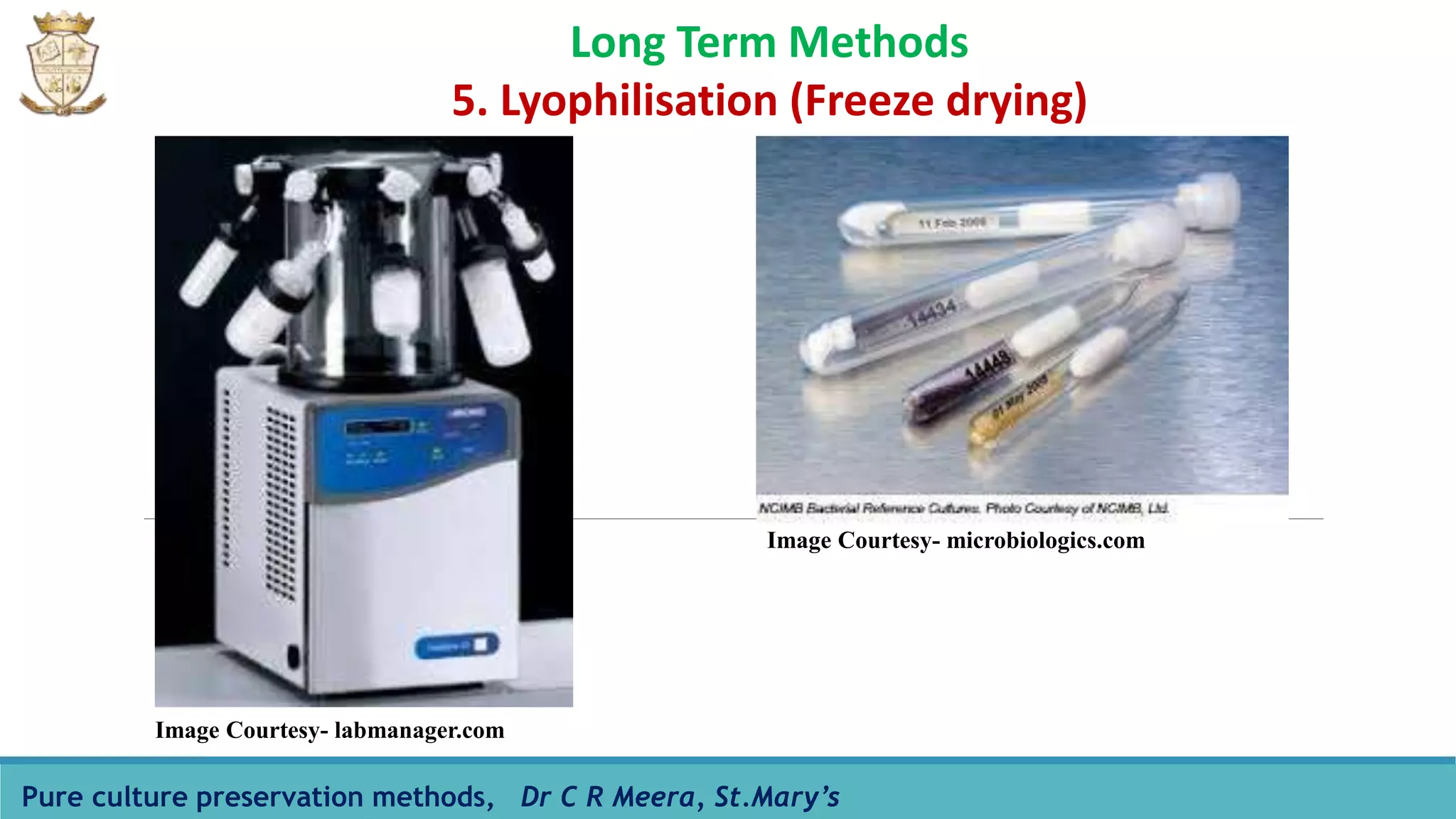
5. Lyophilisation (Freeze drying)
 Mainly useful to preserve organisms that would be killed by ordinary
drying process.
 Dense microbial cell suspension is prepared in small vials and frozen at
- 60 to - 78o C.
 Vials are connected to high vacuum so that ice present in frozen culture
undergo sublimation under vacuum.
 Sublimation is transition of substance directly from solid to gas state
without passing through liquid state.
 This causes dehydration of bacteria with minimum damage to delicate cell
structure.
Pure culture preservation methods, Dr C R Meera, St.Mary’s
Long Term Methods
5. Lyophilisation (Freeze drying)
 Vials are then sealed under vaccum and stored in refrigerator.
 Many species of bacteria can be preserved by this method for more than 30
years in viable condition without any change in characteristics.
 Minimal storage place is required for lyophilised cultures as they are in
powder form.
 Vials are also convenient to mail in sealed containers to other laboratories.
 Lyophilised cultures are revived by rehydrating the opened vials by adding
liquid medium and then transferring it to the suitable media.
Pure culture preservation methods, Dr C R Meera, St.Mary’s
Long Term Methods
5. Lyophilisation (Freeze drying)
Image Courtesy- labmanager.com
Image Courtesy- microbiologics.com
Pure culture preservation methods, Dr C R Meera, St.Mary’s

Pure Culture preservation Methods

  • 1.
    Pure Culture PreservationMethods By Dr C R Meera Assistant Professor & HOD Department of Microbiology St. Mary’s College, Thrissur
  • 2.
    Pure culture preservationmethods, Dr C R Meera, St.Mary’s Why do we need culture preservation methods?  Stock culture maintenance for laboratory classes, research works, or for other particular procedures in Microbiology Labs  For maintenance of reference strains for taxonomic studies • American Type Culture Collection (ATCC) • Microbial Type Culture Collection & Gene Bank (MTCC)
  • 3.
    Objectives of CulturePreservation  Maintenance of microorganisms for extended period of time in viable condition  No contamination  No lose of genetic and morphological characteristics.  Preservation methods either stop or slow down the metabolism and multiplication of microbes. Pure culture preservation methods, Dr C R Meera, St.Mary’s
  • 4.
    Types of CulturePreservation Based on the period of storage, culture preservation is divided into Short term methods and Long term preservation methods. Short term methods Long term methods  Agar slant cultures (Sub culturing) & Refrigeration  Mineral Oil or Liquid Paraffin Method  Saline suspension storage  Drying in vacuum  Storage at low temperatures (Cryopreservation)  Lyophilization (Freeze drying) Pure culture preservation methods, Dr C R Meera, St.Mary’s
  • 5.
    Short Term PreservationMethod Agar slant cultures (Sub-culturing) and Refrigeration Pure culture preservation methods, Dr C R Meera, St.Mary’s  Maintenance of pure culture by periodic aseptic sub- culturing to the suitable media- called stock cultures.  Type of media, storage temperature and interval between sub-culturing depends on the bacterial species.  Solid media is preferred as the toxic material produced by organisms diffuse into slant and thus away from microbial growth. Image Courtesy- ncbe.reading.ac.uk
  • 6.
    Agar slant cultures(Sub-culturing) and Refrigeration Pure culture preservation methods, Dr C R Meera, St.Mary’s  Most heterotrophs can be easily maintained on nutrient agar.  Nutrient agar slants in screw capped bottles are preferred as it prevent drying of the media.  Disadvantage is that repeated sub-culturing leads to mutation in the strains.  Prepared stock culture on getting sufficient growth are stored in cool dry place or refrigerator till use.  Low temperature like 4o C slow down the growth and metabolism of microorganisms- Nutrient use reduced  Periodic sub-culturing is needed as bacterial waste products accumulate
  • 7.
    Long Term PreservationMethods 1. Mineral Oil or Liquid Paraffin Method Pure culture preservation methods, Dr C R Meera, St.Mary’s  Agar slants in screw capped tubes are inoculated and incubated till good growth is obtained.  Covered with sterile mineral oil or liquid paraffin to a depth of 1 cm above the slant.  Paraffin layer prevents the dehydration of the medium and also produce anaerobic condition so that microorganisms remain in a dormant state.  Can be used to preserve bacteria and fungi in viable condition at room temperature from months to years. Image Courtesy- youtube.com
  • 8.
    Mineral Oil orLiquid Paraffin Method- Advantages Pure culture preservation methods, Dr C R Meera, St.Mary’s  The unique advantage of the method is that sub-culturing can be done without affecting the stock culture. (Sub-culturing is done by taking loopful of growth under the oil from these slants, touching the loop to the glass surface of tube to drain off excess oil and then inoculating to fresh medium).  Many species remain viable for longer periods under oil than in tubes without oil.  Useful for strains susceptible to mutations on repeated sub-culturing  Simple and economical method as equipment like dessicator, vaccum pump etc are not needed.
  • 9.
    Pure culture preservationmethods, Dr C R Meera, St.Mary’s Long Term Preservation Methods 2. Saline suspension storage  Sodium chloride in high concentration is inhibitory to the microbes.  1% salt solution (sub lethal concentration) is useful for culture preservation  Bacteria are suspended in salt solutions in screw capped tubes to avoid evaporation.  Tubes can be stored at room temperature and when required, can be sub-cultured to agar slants.  Easy method for storing bacterial cultures for 2-3 years  Particularly useful in labs with limited equipment facility. Image Courtesy- thomassci.com
  • 10.
    Pure culture preservationmethods, Dr C R Meera, St.Mary’s Long Term Preservation Methods 3. Drying in Vaccum  Organisms are found to survive longer if they are dried in a desiccator than when air dried.  Different methods are employed for drying in vacuum.  Liquid drying or L –Drying - Organisms are suspended in liquid media and dried in a desiccator in vacuum over dehydrating agents such as H2SO4 or P2O5 (Phosphorus pentoxide) Image Courtesy- biocyclopedia.com
  • 11.
    Pure culture preservationmethods, Dr C R Meera, St.Mary’s Long Term Methods 3. Drying in Vaccum  L –Drying -Particularly useful for microbes which are sensitive to freeze drying as this method involves vacuum-drying of samples from the liquid state without freezing  The microbial suspensions can be also dried on sterile coverslips, filter paper, in small test-tubes, or more conveniently in sterile ampoules which can subsequently be sealed off in vacuo Image Courtesy- tedpella.com
  • 12.
    Pure culture preservationmethods, Dr C R Meera, St.Mary’s Long Term Methods 4. Freezing and Cryopreservation  Glycerol suspension method • Organisms suspended in nutrient broth containing 15% glycerol, frozen and stored at -29o C (up to 2 years).  Liquid Nitrogen Method • Dense cell suspensions are prepared in the medium containing cryopreservative agents like Glycerol or Dimethyl sulfoxide (DMSO). • These agents prevent ice crystal formation during freezing process which may damage microbial cells. Image Courtesy- sciencephoto.com
  • 13.
    Pure culture preservationmethods, Dr C R Meera, St.Mary’s Long Term Methods 4. Freezing and Cryopreservation  Microbial suspension is sealed into small ampoules or vials and then frozen at controlled rate to -150 o C.  Ampoules or vials stored in a liquid nitrogen refrigerator either by immersion in liquid nitrogen (-196°C) or by storage in a gas phase above liquid nitrogen (-150 o C).  Useful for preservation of organisms that cannot withstand freeze drying.  Cultures can be maintained for 10-30 years or more without any change in the characteristics of microbes.  Disadvantage: Expensive method as liquid nitrogen has to be replenished at regular intervals to replace the loss due to evaporation.
  • 14.
    Pure culture preservationmethods, Dr C R Meera, St.Mary’s Long Term Methods 5. Lyophilisation (Freeze drying)  Mainly useful to preserve organisms that would be killed by ordinary drying process.  Dense microbial cell suspension is prepared in small vials and frozen at - 60 to - 78o C.  Vials are connected to high vacuum so that ice present in frozen culture undergo sublimation under vacuum.  Sublimation is transition of substance directly from solid to gas state without passing through liquid state.  This causes dehydration of bacteria with minimum damage to delicate cell structure.
  • 15.
    Pure culture preservationmethods, Dr C R Meera, St.Mary’s Long Term Methods 5. Lyophilisation (Freeze drying)  Vials are then sealed under vaccum and stored in refrigerator.  Many species of bacteria can be preserved by this method for more than 30 years in viable condition without any change in characteristics.  Minimal storage place is required for lyophilised cultures as they are in powder form.  Vials are also convenient to mail in sealed containers to other laboratories.  Lyophilised cultures are revived by rehydrating the opened vials by adding liquid medium and then transferring it to the suitable media.
  • 16.
    Pure culture preservationmethods, Dr C R Meera, St.Mary’s Long Term Methods 5. Lyophilisation (Freeze drying) Image Courtesy- labmanager.com Image Courtesy- microbiologics.com
  • 17.
    Pure culture preservationmethods, Dr C R Meera, St.Mary’s