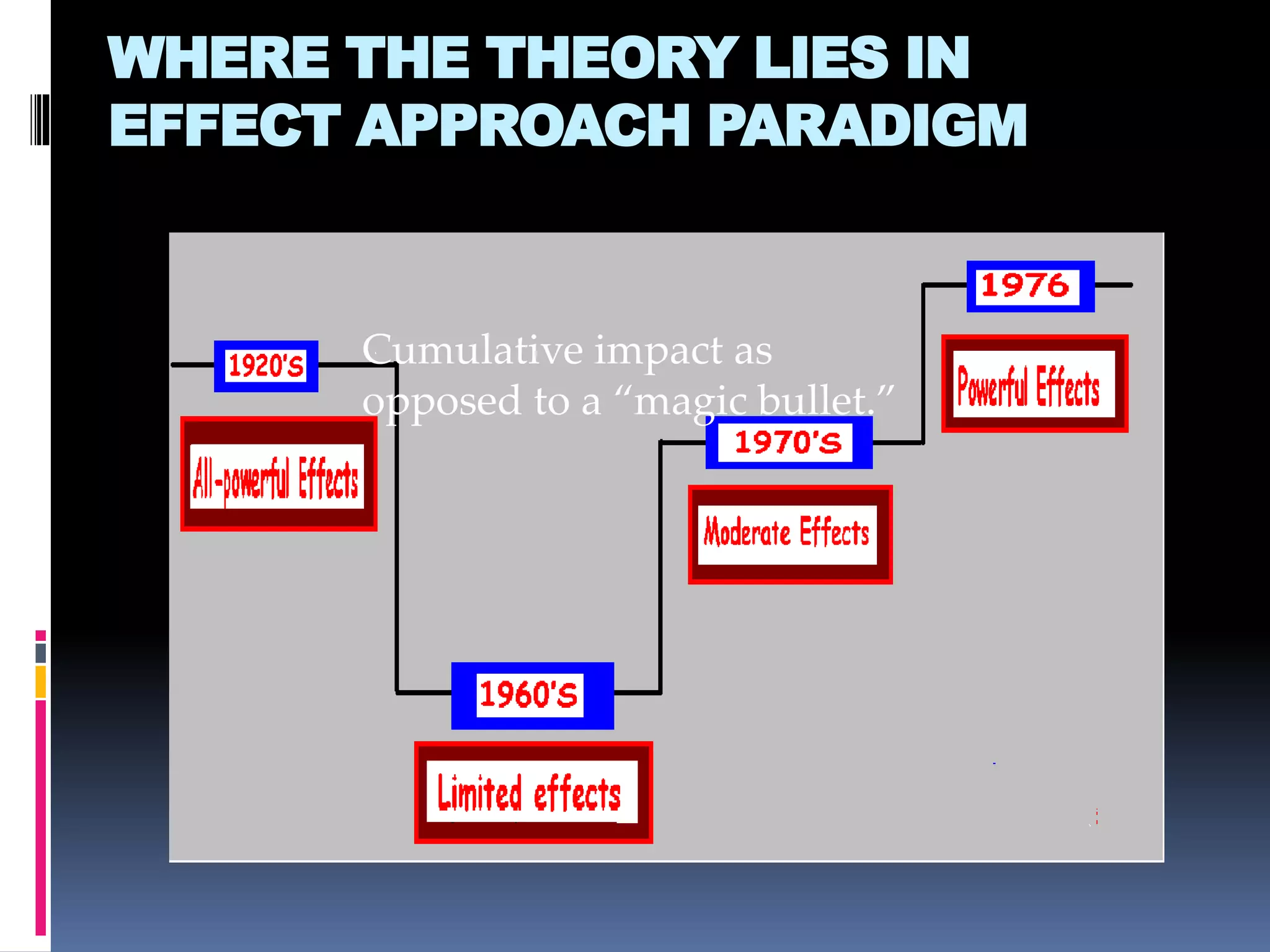
WHERE THE THEORY LIES IN
EFFECT APPROACH PARADIGM
Cumulative impact as
opposed to a “magic bullet.”
Introduction
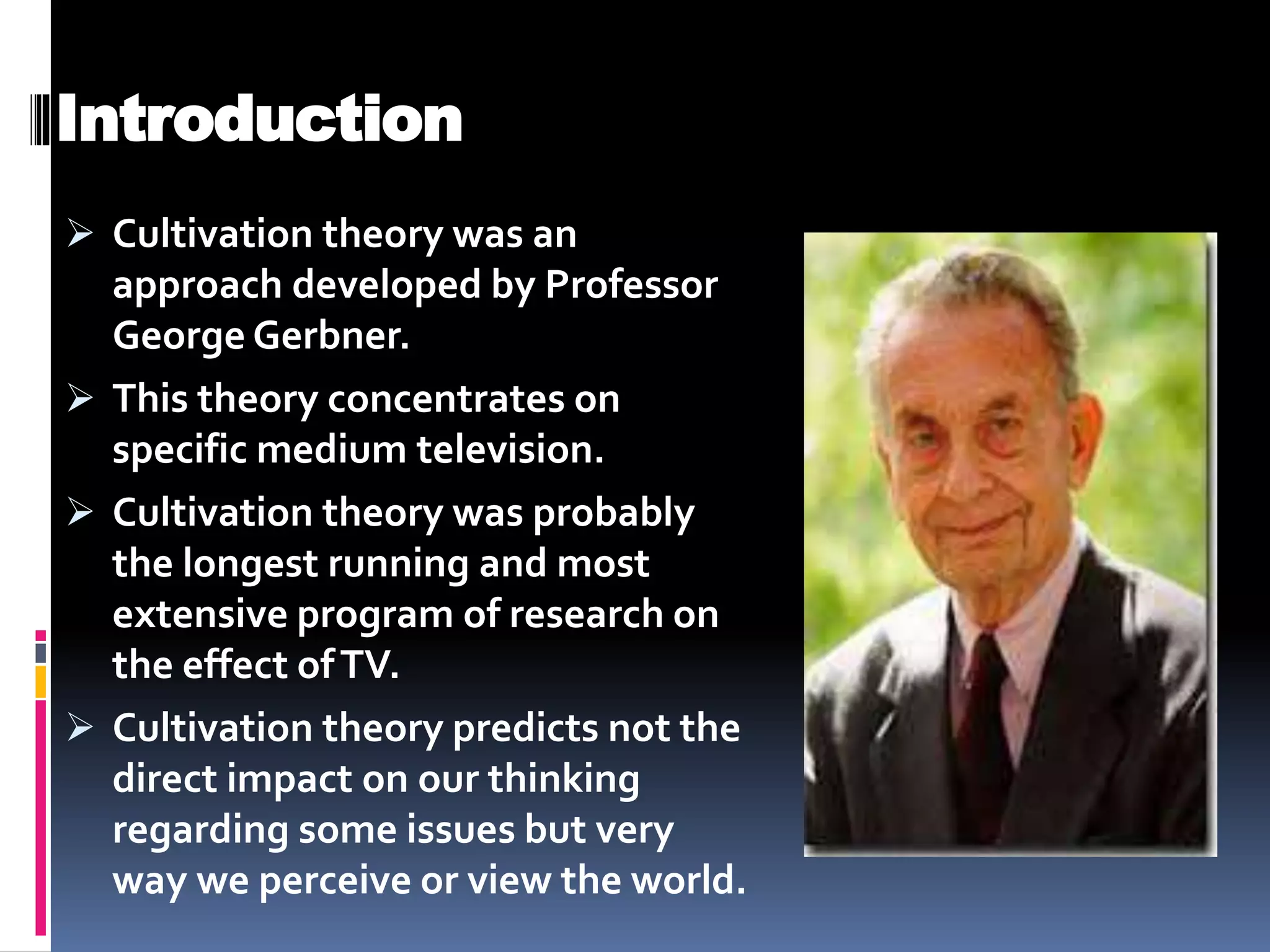
 Cultivation theory was an
approach developed by Professor
George Gerbner.
 This theory concentrates on
specific medium television.
 Cultivation theory was probably
the longest running and most
extensive program of research on
the effect ofTV.
 Cultivation theory predicts not the
direct impact on our thinking
regarding some issues but very
way we perceive or view the world.
Cultivation theory has both
narrow and broadened aspects ;
narrow in the sense of that it
only focuses on one medium
that is television and broadened
in the sense it addresses the
macroscopic question about
Media role in society.
The theory focuses on the
effect thatTV and movie
violence has on our perception
of reality. The cultivation theory
says that the moreTV a person
watch, the harsher perception
they will have of the real world.
Gerbner gives many Assumptions of
Cultivation Theory:
Television world is “NOT
A WINDOW ON or
REFLECTION OFTHE
WORLD" but “A WOLD IN
ITS SELF”.
“The television set has
become a key member
of the family,
the one who tells most
of the stories most of
the time."
Television is a unique
medium requiring a special
approach to study.TV is
essentially and
fundamentally different
from others forms of mass
media. It is 98% of all
Americans homes
TV is the central cultural
arm of American society.
• The mass media cultivate
attitudes and values,
which are already present
in a culture.
• Television has become the
main source of storytelling
in today’s society
• The overuse of television
creates a homogenous
and fearful environment.
 He claimed that
becauseTV contains so
much violence, people
who spend the most
time in front of the
tube develop and
exaggerated belief in a
mean and scary world.
violence is one of the
major staples of theTV
world
Gerbner’s framework as a three-
pronged plug leading to a TV set to
tell us something different about
the world of TV.
 The first PRONG- institutional process
analysis
 The second PRONG- message system
analysis
 The third prong- cultivation analysis
Institutional Process Analysis: The first PRONG
“Scholarship that penetrates behind the scenes of
media organizations in an effort to understand
what policies or practices might be lurking there.”
Message system analysis: The second PRONG
Scholarship that involves careful, systematic study of
TV content usually employing content analysis as a
research method.
Cultivation analysis: The third PRONG
“Research designed to find support for the motion
that those who spend more time watching TV are
more likely to see the real world through TV’s
lens”
Testing the Cultivation
Hypothesis:
 Gerbner presents research
supporting cultivation theory
that is based on compression
of heavy viewer or light
viewer
 Gerbner analyzed answer to
question posed in surveys
and found that heavy and
light viewer typically give
answer that are closer to the
way the world is portrayed
on television.
Cultivation theory Model
Gerbner broke viewers down
in to three categories
Viewers
Moderate
Viewer
LightViewersHeavy
Viewers
• Heavy viewer:Those who watch four or more hours a day
are labeled heavy television viewers.The heavy television
viewers often give answers that are closer to the way he
world is portrayed on television.
• Light viewer:Those who view less than four hours per day,
according to Gerbner are light viewers.
• Moderate viewer:Those who watch television, not more
than four hour, not less than two hour.They watch
television in between them called moderate viewer.
•
Gerbner predicted that heavy viewers saw the world
as more dangerous than light viewers.
TV Answers vs. Real-World
Answer
SURVEY NO #01
• The first survey question was:
“what percentage of the world's
population lives in the United state? ”
• The correct answer is 6.
• Heavy viewers overestimated much more
as compared to light viewer.
SURVEY NO #02
• 2nd survey question was that:
• “ what percentage of Americans who have
jobs work in law enforcement”
• The correct answer was 1 percent.
• Heavy viewers give the answer of 20
percent that is too much exaggerated.
SURVEY NO #3
• Another question asked of heavy and light
viewer was this:
• “ during any week what are your chances
of being involved in some type of of
violence.”
• The correct answer is 1 percent or less
than 1 percent.
• But heavy viewers give the answer about
10% that is also very high than the real
ones.-
SURVEY NO #4
• The next survey question was “Can people
be trusted?”
• The heavy viewers are more likely to
check a response such as “Cant be too
careful.”
Cultivation Analysis:
 In the actual world, 0.41 violent crimes
occur per 100 Americans or less than 1 in
200.
 In the world, prime time televisions more
than 64% all characteristic are involved in
violence.
 Therefore, the response to such question
suggested that heavy television viewers
are getting a heightened sense of risk
and insecurity from television. Television
may be leading heavy viewers to
perceive a “mean world.”
MEAN WORLD SYNDROME is one of the main
effects of the cultivation theory
• On the small screen, content analysis tells us, crime
ranges about ten times more often than in real life.
So, the chances of this type of syndrome are more
in heavy viewers of television.
HIRSCH CRITICISM:
 Hirsch criticized this theory in 1980 and he
was of the view:
“Gerbner has shown that the difference between
heavy viewer and light television viewers show
up even across a number of other important
variables, including
Age,
Education,
News reading and
Gender.
 That is Gerbner realized
that the relationship
between television viewing
and different views of
world could be actually
caused by other variables,
and he attempted to
control for those variable,
the effect that is left can
be attributed to television
become very small”.
MODIFICATION OF CULTIVATION
THEORY BY ADDING TWO CONCEPTS:
 In response to Hirsch’s
criticism, Gerbner has
revised cultivation
theory. He has added two
additional concepts:
 Mainstreaming
 Resonance.
MAINSTREAMING
 Mainstreaming occurs when heavy
viewing leads to the convergence of view
points across groups which includes
differences in perspective and behavior that
stem from other social, cultural and
demographic influences.
 For instance heavy viewers low and high
income as well as low income of light viewers
have same point of view about that fear of
crime is a serious problem but light viewers
of high income don’t have this point of view.
EXPLAINATION OF MAINSTREAMING
BY GIVING THE EXAMPLE THROUGH
A FLOW CHART
Heavy viewers Light viewers
High
income
Low
income
Low
income
High
income
they tend to more vulnerable
But on the other hand high income
Of light viewers cant do precautions.
RESONANCE
 Resonance occurs when cultivation
effects is boosted for a certain group
of population.
 For instance , heavy viewers male
and females and light viewers
female have same tendency towards
the fear of crime. However, the
males with light exposure do not.
 However the group that agree the
most strongly is female who are
heavy viewer, because their
particular vulnerability to crime is
said to Resonate.
EXPLAINATION OF RESONANCE BY
GIVING THE EXAMPLE THROUGH A
FLOW CHART
Heavy viewers Light viewers
male female female male
they tend to more vulnerable
Because of their instincts
Rubin, Perse, and Taylor
Criticism
• Rubin, Perse, and Taylor (1988) cast
further doubt on cultivation In their survey
of viewers, they found effect of television
viewing on perception of social reality, but
the effects were program specific. They
also found that age, gender,
socioeconomic status, viewing intention
and perceived realism were better
predictors of faith in others than television
exposure.
DENIS MCQUAIL’S
CRITICISM
• “Audience behavior and audience view, given the
many intervening and powerful social background
factors. our attitudes are likely to be influenced
not only by TV but also by other media, by direct
experience, by other people and so on.”
• And this criticism was given due to the over
simplification of the theory.
Strengths:
• Combines micro and macro level theories
• Provide detailed explanations ofTV’s unique role
• Applies empirical study to widely held humanistic
assumptions
• Redefines effect as more than observable behavior
change.
• Applies to wide variety of effects issues.
• Provided basis for social change.
Weaknesses:
• Is methodologically troubling to many.
• Assumes homogeneity ofTV content.
• Focus on heavy users ofTV.
• Is difficult to apply to Media used less heavily than
TV.

Cultivation Theory

  • 2.
    WHERE THE THEORYLIES IN EFFECT APPROACH PARADIGM Cumulative impact as opposed to a “magic bullet.”
  • 3.
    Introduction  Cultivation theorywas an approach developed by Professor George Gerbner.  This theory concentrates on specific medium television.  Cultivation theory was probably the longest running and most extensive program of research on the effect ofTV.  Cultivation theory predicts not the direct impact on our thinking regarding some issues but very way we perceive or view the world.
  • 4.
    Cultivation theory hasboth narrow and broadened aspects ; narrow in the sense of that it only focuses on one medium that is television and broadened in the sense it addresses the macroscopic question about Media role in society. The theory focuses on the effect thatTV and movie violence has on our perception of reality. The cultivation theory says that the moreTV a person watch, the harsher perception they will have of the real world.
  • 5.
    Gerbner gives manyAssumptions of Cultivation Theory: Television world is “NOT A WINDOW ON or REFLECTION OFTHE WORLD" but “A WOLD IN ITS SELF”. “The television set has become a key member of the family, the one who tells most of the stories most of the time."
  • 6.
    Television is aunique medium requiring a special approach to study.TV is essentially and fundamentally different from others forms of mass media. It is 98% of all Americans homes TV is the central cultural arm of American society.
  • 7.
    • The massmedia cultivate attitudes and values, which are already present in a culture. • Television has become the main source of storytelling in today’s society • The overuse of television creates a homogenous and fearful environment.
  • 8.
     He claimedthat becauseTV contains so much violence, people who spend the most time in front of the tube develop and exaggerated belief in a mean and scary world. violence is one of the major staples of theTV world
  • 9.
    Gerbner’s framework asa three- pronged plug leading to a TV set to tell us something different about the world of TV.  The first PRONG- institutional process analysis  The second PRONG- message system analysis  The third prong- cultivation analysis
  • 10.
    Institutional Process Analysis:The first PRONG “Scholarship that penetrates behind the scenes of media organizations in an effort to understand what policies or practices might be lurking there.” Message system analysis: The second PRONG Scholarship that involves careful, systematic study of TV content usually employing content analysis as a research method. Cultivation analysis: The third PRONG “Research designed to find support for the motion that those who spend more time watching TV are more likely to see the real world through TV’s lens”
  • 11.
    Testing the Cultivation Hypothesis: Gerbner presents research supporting cultivation theory that is based on compression of heavy viewer or light viewer  Gerbner analyzed answer to question posed in surveys and found that heavy and light viewer typically give answer that are closer to the way the world is portrayed on television.
  • 12.
  • 13.
    Gerbner broke viewersdown in to three categories Viewers Moderate Viewer LightViewersHeavy Viewers
  • 14.
    • Heavy viewer:Thosewho watch four or more hours a day are labeled heavy television viewers.The heavy television viewers often give answers that are closer to the way he world is portrayed on television. • Light viewer:Those who view less than four hours per day, according to Gerbner are light viewers. • Moderate viewer:Those who watch television, not more than four hour, not less than two hour.They watch television in between them called moderate viewer. • Gerbner predicted that heavy viewers saw the world as more dangerous than light viewers.
  • 15.
    TV Answers vs.Real-World Answer SURVEY NO #01 • The first survey question was: “what percentage of the world's population lives in the United state? ” • The correct answer is 6. • Heavy viewers overestimated much more as compared to light viewer. SURVEY NO #02 • 2nd survey question was that: • “ what percentage of Americans who have jobs work in law enforcement” • The correct answer was 1 percent. • Heavy viewers give the answer of 20 percent that is too much exaggerated.
  • 16.
    SURVEY NO #3 •Another question asked of heavy and light viewer was this: • “ during any week what are your chances of being involved in some type of of violence.” • The correct answer is 1 percent or less than 1 percent. • But heavy viewers give the answer about 10% that is also very high than the real ones.- SURVEY NO #4 • The next survey question was “Can people be trusted?” • The heavy viewers are more likely to check a response such as “Cant be too careful.”
  • 17.
    Cultivation Analysis:  Inthe actual world, 0.41 violent crimes occur per 100 Americans or less than 1 in 200.  In the world, prime time televisions more than 64% all characteristic are involved in violence.  Therefore, the response to such question suggested that heavy television viewers are getting a heightened sense of risk and insecurity from television. Television may be leading heavy viewers to perceive a “mean world.”
  • 18.
    MEAN WORLD SYNDROMEis one of the main effects of the cultivation theory • On the small screen, content analysis tells us, crime ranges about ten times more often than in real life. So, the chances of this type of syndrome are more in heavy viewers of television.
  • 19.
    HIRSCH CRITICISM:  Hirschcriticized this theory in 1980 and he was of the view: “Gerbner has shown that the difference between heavy viewer and light television viewers show up even across a number of other important variables, including Age, Education, News reading and Gender.
  • 20.
     That isGerbner realized that the relationship between television viewing and different views of world could be actually caused by other variables, and he attempted to control for those variable, the effect that is left can be attributed to television become very small”.
  • 21.
    MODIFICATION OF CULTIVATION THEORYBY ADDING TWO CONCEPTS:  In response to Hirsch’s criticism, Gerbner has revised cultivation theory. He has added two additional concepts:  Mainstreaming  Resonance.
  • 22.
    MAINSTREAMING  Mainstreaming occurswhen heavy viewing leads to the convergence of view points across groups which includes differences in perspective and behavior that stem from other social, cultural and demographic influences.  For instance heavy viewers low and high income as well as low income of light viewers have same point of view about that fear of crime is a serious problem but light viewers of high income don’t have this point of view.
  • 23.
    EXPLAINATION OF MAINSTREAMING BYGIVING THE EXAMPLE THROUGH A FLOW CHART Heavy viewers Light viewers High income Low income Low income High income they tend to more vulnerable But on the other hand high income Of light viewers cant do precautions.
  • 24.
    RESONANCE  Resonance occurswhen cultivation effects is boosted for a certain group of population.  For instance , heavy viewers male and females and light viewers female have same tendency towards the fear of crime. However, the males with light exposure do not.  However the group that agree the most strongly is female who are heavy viewer, because their particular vulnerability to crime is said to Resonate.
  • 25.
    EXPLAINATION OF RESONANCEBY GIVING THE EXAMPLE THROUGH A FLOW CHART Heavy viewers Light viewers male female female male they tend to more vulnerable Because of their instincts
  • 26.
    Rubin, Perse, andTaylor Criticism • Rubin, Perse, and Taylor (1988) cast further doubt on cultivation In their survey of viewers, they found effect of television viewing on perception of social reality, but the effects were program specific. They also found that age, gender, socioeconomic status, viewing intention and perceived realism were better predictors of faith in others than television exposure.
  • 27.
    DENIS MCQUAIL’S CRITICISM • “Audiencebehavior and audience view, given the many intervening and powerful social background factors. our attitudes are likely to be influenced not only by TV but also by other media, by direct experience, by other people and so on.” • And this criticism was given due to the over simplification of the theory.
  • 28.
    Strengths: • Combines microand macro level theories • Provide detailed explanations ofTV’s unique role • Applies empirical study to widely held humanistic assumptions • Redefines effect as more than observable behavior change. • Applies to wide variety of effects issues. • Provided basis for social change. Weaknesses: • Is methodologically troubling to many. • Assumes homogeneity ofTV content. • Focus on heavy users ofTV. • Is difficult to apply to Media used less heavily than TV.