PHP and Web Services:
   Perfect Partners
About Me
●
    Lorna Jane Mitchell
●
    PHP Developer/Trainer/Consultant at Ibuildings
    ●
        Hosting DPC
    ●
        Editor at techPortal

●
    http://lornajane.net
●
    @lornajane
PHP
●
    PHP: "solving the web problem"
●
    The problem evolves
●
    PHP evolves
PHP
●
    Server
●
    Client
●
    Web application tool
●
    Command line tool
●
    GTK ...
PHP
●
    Ubiquitous
●
    Runs on your platform
    ●
        *nix
    ●
        mac
    ●
        windows (yes really, rather well!)

●
    Can talk to your other systems
Web Services
●
    "scalable, reusable libraries"
●
    Interface over HTTP
●
    Modular application design
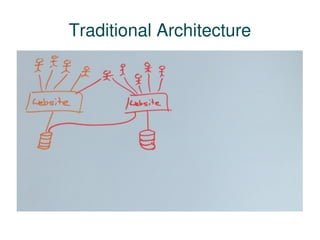
Architecture
Traditional Architecture
Additional Channels
Services Architecture
Inside The Service Layer
Data Formats
JSON
●
    JavaScript Object Notation
●
    Natively read/write in most languages
●
    Very simple! (we like simple)
●
    Limitations
    ●
        no data typing
    ●
        no distinction between object and array
Writing JSON from PHP
   1   <?php
   2
   3   $menu['starter'] = array( "prawn cocktail",
   4                             "soup of the day");
   5   $menu['main course'] = array( "roast chicken",
   6                                 "fish 'n' chips",
   7                                 "macaroni cheese");
   8   $menu['pudding'] = array( "cheesecake",
   9                             "treacle sponge");
  10
  11   echo json_encode($menu);


{"starter":["prawn cocktail","soup of the day"],"main 
course":["roast chicken","fish 'n' chips","macaroni 
cheese"],"pudding":["cheesecake","treacle sponge"]}
Reading JSON from PHP
    1 <?php
    2
    3 $json = '{"starter":["prawn cocktail","soup of the
day"],"main course":["roast chicken","fish 'n'
chips","macaroni cheese"],"pudding":["cheesecake","treacle
sponge"]}';
    4
    5 print_r(json_decode($json));
Reading JSON from PHP
stdClass Object
(
    [starter] => Array
        (
            [0] => prawn cocktail
            [1] => soup of the day
        )
    [main course] => Array
        (
            [0] => roast chicken
            [1] => fish 'n' chips
            [2] => macaroni cheese
        )
    [pudding] => Array
        (
            [0] => cheesecake
            [1] => treacle sponge
        )
)
XML
●
    eXtensible Markup Language
●
    Familiar
●
    Can give more detail than JSON
●
    Native read/write in most languages
Working with XML from PHP
●
    Lots of options
●
    SimpleXML
●
    DOM
SimpleXML Example
 1   <?php
 2
 3   $xml = <<< XML
 4   <?xml version="1.0" ?>
 5   <menus>
 6        <menu>Lunch</menu>
 7        <menu>Dinner</menu>
 8        <menu>Dessert</menu>
 9        <menu>Drinks</menu>
10   </menus>
11   XML;
12
13   $simplexml = new SimpleXMLElement($xml);
14   var_dump($simplexml);
SimpleXML Example
object(SimpleXMLElement)#1 (1) {
  ["menu"]=>
  array(5) {
    [0]=>
    string(5) "Lunch"
    [1]=>
    string(6) "Dinner"
    [2]=>
    string(7) "Dessert"
    [3]=>
    string(6) "Drinks"
  }
}
SimpleXML Example
    1 <?php
    2
    3 $simplexml = simplexml_load_string('<?xml version="1.0"
?><menus/>');
    4 $simplexml->addChild('menu','Lunch');
    5 $simplexml->addChild('menu','Dinner');
    6 $simplexml->addChild('menu','Drinks');
    7 $simplexml->addChild('menu','Dessert');
    8
    9 echo $simplexml->asXML();
SimpleXML Example

<?xml version="1.0"?>
<menus>
    <menu>Lunch</menu>
    <menu>Dinner</menu>
    <menu>Dessert</menu>
    <menu>Drinks</menu>
</menus>
Service Types
Service Types
●
    *-RPC
    – XML-RPC

    – JSON-RPC

●
    SOAP
●
    REST
RPC
●
    All URLs point to a single endpoint
●
    Parameters give method names
●
    Request body can take a variety of formats
Example RPC services
●
    Using Flickr's XML-RPC
●
    Test method: just echoes back to user
●
    XML formatted data
Flickr Echo Example: XML
<?xml version="1.0"?>
<methodCall>
  <methodName>flickr.test.echo</methodName>
  <params>
    <param>
      <value>
        <struct>
           <member>
             <name>api_key</name>
             <value>....</value>
           </member>
        </struct>
      </value>
    </param>
  </params>
</methodCall>
RPC from PHP: curl
 1   <?php
 2
 3   // $xml is existing SimpleXMLElement Object
 4   $url = 'http://api.flickr.com/services/xmlrpc/';
 5   $ch = curl_init($url);
 6
 7   curl_setopt($ch, CURLOPT_POST, 1);
 8   curl_setopt($ch, CURLOPT_POSTFIELDS, $xml->asXML());
 9
10   $response = curl_exec($ch);
11   curl_close($ch);
RPC from PHP: pecl_http
 1   <?php
 2
 3   $url = 'http://api.flickr.com/services/xmlrpc/';
 4
 5   // procedural method
 6   $response = http_post_data($url, $xml->asXML());
 7
 8   // alternative method
 9   $request = new HTTPRequest($url, HTTP_METH_POST);
10   $request->setRawPostData($xml->asXML());
11   $request->send();
12   $response = $request->getResponseBody();
13
14   var_dump($response);
Flickr Response
<?xml version="1.0" encoding="utf-8" ?>
<methodResponse>
  <params>
    <param>
      <value>
        <string>&lt;api_key&gt;54rt346&lt;/api_key&gt;
        </string>
      </value>
    </param>
  </params>
</methodResponse>
RPC Advantages
●
    RPC is a great format for wrapping existing
    functionality
●
    Can abstract between existing systems
●
    Familiar functional paradigm
Delivering RPC
●
    Consumers will need
    – Service URL

    – Docs of functions and arguments

    – If this was an existing system, existing docs may
     suffice
Wrapping RPC
●
    RPC is a library-like interface
●
    Can easily wrap existing libraries to call like this
●
    Can wrap an interface to an RPC service to
    look like a library
Wrapping RPC Example
 1   <?php
 2
 3   class Handler
 4   {
 5    function __call($method, $args) {
 6       $ch = curl_init('http://localhost');
 7       $data['method'] = $method;
 8       foreach($args as $a) $data[$a] = $a;
 9
10      curl_setopt($ch, CURLOPT_POST,1);
11      curl_setopt($ch, CURLOPT_POSTFIELDS, $data);
12      $response = curl_exec($ch); curl_close($ch);
13
14      var_dump($response);
15    }
16   }
17   $h = new Handler();
18   $h->dance('cat','dog','rabbit','penguin');
19
SOAP
●
    Special case of RPC using XML
●
    Has given formats for messages and errors
●
    Libraries exist for creating server and client in
    most languages
PHP SOAP Server Example

require_once('lib/myClass.php');


$server = new SoapServer("service.wsdl");
$server->setClass("MyClass");
$server->handle();
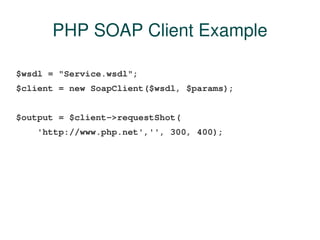
PHP SOAP Client Example

$wsdl = "Service.wsdl";
$client = new SoapClient($wsdl, $params);


$output = $client->requestShot(
    'http://www.php.net','', 300, 400);
WSDL
●
    Web Service Description Language
●
    Widely used with SOAP
●
    Describes the methods, arguments and data
    types available
●
    IDEs can read this and hint
●
    Validity of requests is checked before they are
    sent
WSDL
<?xml version ='1.0' encoding ='UTF-8' ?>
 <definitions name='MyClass'      targetNamespace='urn:MyClassInventory'     xmlns:tns='urn:MyClassInventory'    xmlns:soap='http://schemas.xmlsoap.org/wsdl/soap/'   xmlns:xsd='http://www.w3.org/2001/XMLSchema'   xmlns:soapenc='
http://schemas.xmlsoap.org/soap/encoding/'      xmlns:wsdl='http://schemas.xmlsoap.org/wsdl/'   xmlns='http://schemas.xmlsoap.org/wsdl/'>
 <message name='getAccountStatusRequest'>
   <part name='accountID' type='xsd:string'/>
 </message>
 <message name='getAccountStatusResponse'>
   <part name='accountID' type='xsd:string'/>
   <part name='counter' type='xsd:float' />
 </message>
 <portType name='MyClassPortType'>
   <operation name='getAccountStatus'>
    <input message='tns:getAccountStatusRequest'/>
    <output message='tns:getAccountStatusResponse'/>
   </operation>
 </portType>
 <binding name='MyClassBinding' type='tns:MyClassPortType'>
   <soap:binding style='rpc'
    transport='http://schemas.xmlsoap.org/soap/http'/>
   <operation name='getAccountStatus'>
    <soap:operation soapAction='urn:xmethods-delayed-quotes#getAccountStatus'/>
    <input>
     <soap:body use='encoded' namespace='urn:xmethods-delayed-quotes'             encodingStyle='http://schemas.xmlsoap.org/soap/encoding/'/>
    </input>
    <output>
     <soap:body use='encoded' namespace='urn:xmethods-delayed-quotes'
      encodingStyle='http://schemas.xmlsoap.org/soap/encoding/'/>
    </output>
   </operation>
 </binding>
 <service name='MyClassService'>
   <port name='MyClassPort' binding='tns:MyClassBinding'>
    <soap:address location='http://rivendell.local:10002/MyClassServiceServer.php'/>
   </port>
 </service>
 </definitions>
Delivering SOAP
●
    In WSDL mode, only the WSDL needs to be
    supplied
●
    Otherwise method names, arguments and
    types will be needed
REST
●
    A series of concepts
●
    Generally uses HTTP (HyperText Transfer
    Protocol)
●
    URLs are resource locations
●
    Verbs tell the service what to do
●
    Status codes indicate what the outcome was
Implementing REST
●
    Standard application architecture
●
    Routing to map requests to internal functionality
●
    Output not always HTML
REST CRUD
Action     HTTP Verb


Retrieve   GET

Create     POST

Update     PUT

Delete     DELETE
REST Examples
●
    GET
    ●
        http://localhost/users
    ●
        http://localhost/users/harry

●
    POST
    ●
        http://localhost/users

●
    PUT
    ●
        http://localhost/users/harry
REST from PHP: GET
1 <?php
2
3 $result = file_get_contents('http://localhost/users');
4 var_dump($result);
REST from PHP: GET
    1 <?php
    2
    3 $ch = curl_init('http://localhost/users');
    4
    5 curl_exec($ch);


●
    Health Warning!
    ●
        curl will echo output
    ●
        use CURLOPT_RETURNTRANSFER to capture it
        instead
REST from PHP: POST
 1   <?php
 2
 3   $ch = curl_init('http://localhost/users');
 4
 5   $data = array ("name" => "Cho Chang",
 6               "house" => "Ravenclaw");
 7
 8   curl_setopt($ch, CURLOPT_POST, 1);
 9   curl_setopt($ch, CURLOPT_POSTFIELDS, $data);
10
11   curl_exec($ch);
REST from PHP: PUT
 1   <?php
 2
 3   $ch = curl_init('http://localhost/users/cho');
 4
 5   $data = array ("name" => "Cho Chang",
 6               "house" => "Ravenclaw"
 7               "age" => 15);
 8
 9   curl_setopt($handle, CURLOPT_CUSTOMREQUEST, 'PUT');
10   curl_setopt($ch, CURLOPT_POSTFIELDS, $data);
11
12   curl_exec($ch);
13
REST from PHP: DELETE
1   <?php
2
3   $ch = curl_init('http://localhost/users/ginny');
4
5   curl_setopt($ch, CURLOPT_CUSTOMREQUEST, 'DELETE');
6
7   curl_exec($ch);
Delivering REST
●
    Full documentation including URL formats, data
    types, and response formats
●
    Must include information about error handling
REST as an inspiration
●
    RESTful is a strict definition
●
    REST is full of great ideas
●
    REST is great for clean, simple, robust services
●
    Cherry-pick the bits that work
    ●
        Just don't call it "RESTful" :)
Resources
●
    RESTful Web Services – Leonard Richardson
    and Sam Ruby
●
    http://php.net
●
    http://benramsey.com
●
    http://lornajane.net
Questions ???
Thankyou
●
    Lorna Jane Mitchell
●
    http://ibuildings.com
●
    http://lornajane.net
●
    @lornajane


●
    http://slideshare.net/lornajane

PHP And Web Services: Perfect Partners

  • 1.
    PHP and WebServices: Perfect Partners
  • 2.
    About Me ● Lorna Jane Mitchell ● PHP Developer/Trainer/Consultant at Ibuildings ● Hosting DPC ● Editor at techPortal ● http://lornajane.net ● @lornajane
  • 3.
    PHP ● PHP: "solving the web problem" ● The problem evolves ● PHP evolves
  • 4.
    PHP ● Server ● Client ● Web application tool ● Command line tool ● GTK ...
  • 5.
    PHP ● Ubiquitous ● Runs on your platform ● *nix ● mac ● windows (yes really, rather well!) ● Can talk to your other systems
  • 6.
    Web Services ● "scalable, reusable libraries" ● Interface over HTTP ● Modular application design
  • 7.
  • 8.
  • 9.
  • 10.
  • 11.
  • 12.
  • 13.
  • 14.
    JSON ● JavaScript Object Notation ● Natively read/write in most languages ● Very simple! (we like simple) ● Limitations ● no data typing ● no distinction between object and array
  • 15.
    Writing JSON fromPHP 1 <?php 2 3 $menu['starter'] = array( "prawn cocktail", 4 "soup of the day"); 5 $menu['main course'] = array( "roast chicken", 6 "fish 'n' chips", 7 "macaroni cheese"); 8 $menu['pudding'] = array( "cheesecake", 9 "treacle sponge"); 10 11 echo json_encode($menu); {"starter":["prawn cocktail","soup of the day"],"main  course":["roast chicken","fish 'n' chips","macaroni  cheese"],"pudding":["cheesecake","treacle sponge"]}
  • 16.
    Reading JSON fromPHP 1 <?php 2 3 $json = '{"starter":["prawn cocktail","soup of the day"],"main course":["roast chicken","fish 'n' chips","macaroni cheese"],"pudding":["cheesecake","treacle sponge"]}'; 4 5 print_r(json_decode($json));
  • 17.
    Reading JSON fromPHP stdClass Object ( [starter] => Array ( [0] => prawn cocktail [1] => soup of the day ) [main course] => Array ( [0] => roast chicken [1] => fish 'n' chips [2] => macaroni cheese ) [pudding] => Array ( [0] => cheesecake [1] => treacle sponge ) )
  • 18.
    XML ● eXtensible Markup Language ● Familiar ● Can give more detail than JSON ● Native read/write in most languages
  • 19.
    Working with XMLfrom PHP ● Lots of options ● SimpleXML ● DOM
  • 20.
    SimpleXML Example 1 <?php 2 3 $xml = <<< XML 4 <?xml version="1.0" ?> 5 <menus> 6 <menu>Lunch</menu> 7 <menu>Dinner</menu> 8 <menu>Dessert</menu> 9 <menu>Drinks</menu> 10 </menus> 11 XML; 12 13 $simplexml = new SimpleXMLElement($xml); 14 var_dump($simplexml);
  • 21.
    SimpleXML Example object(SimpleXMLElement)#1 (1){ ["menu"]=> array(5) { [0]=> string(5) "Lunch" [1]=> string(6) "Dinner" [2]=> string(7) "Dessert" [3]=> string(6) "Drinks" } }
  • 22.
    SimpleXML Example 1 <?php 2 3 $simplexml = simplexml_load_string('<?xml version="1.0" ?><menus/>'); 4 $simplexml->addChild('menu','Lunch'); 5 $simplexml->addChild('menu','Dinner'); 6 $simplexml->addChild('menu','Drinks'); 7 $simplexml->addChild('menu','Dessert'); 8 9 echo $simplexml->asXML();
  • 23.
    SimpleXML Example <?xml version="1.0"?> <menus> <menu>Lunch</menu> <menu>Dinner</menu> <menu>Dessert</menu> <menu>Drinks</menu> </menus>
  • 24.
  • 25.
    Service Types ● *-RPC – XML-RPC – JSON-RPC ● SOAP ● REST
  • 26.
    RPC ● All URLs point to a single endpoint ● Parameters give method names ● Request body can take a variety of formats
  • 27.
    Example RPC services ● Using Flickr's XML-RPC ● Test method: just echoes back to user ● XML formatted data
  • 28.
    Flickr Echo Example:XML <?xml version="1.0"?> <methodCall> <methodName>flickr.test.echo</methodName> <params> <param> <value> <struct> <member> <name>api_key</name> <value>....</value> </member> </struct> </value> </param> </params> </methodCall>
  • 29.
    RPC from PHP:curl 1 <?php 2 3 // $xml is existing SimpleXMLElement Object 4 $url = 'http://api.flickr.com/services/xmlrpc/'; 5 $ch = curl_init($url); 6 7 curl_setopt($ch, CURLOPT_POST, 1); 8 curl_setopt($ch, CURLOPT_POSTFIELDS, $xml->asXML()); 9 10 $response = curl_exec($ch); 11 curl_close($ch);
  • 30.
    RPC from PHP:pecl_http 1 <?php 2 3 $url = 'http://api.flickr.com/services/xmlrpc/'; 4 5 // procedural method 6 $response = http_post_data($url, $xml->asXML()); 7 8 // alternative method 9 $request = new HTTPRequest($url, HTTP_METH_POST); 10 $request->setRawPostData($xml->asXML()); 11 $request->send(); 12 $response = $request->getResponseBody(); 13 14 var_dump($response);
  • 31.
    Flickr Response <?xml version="1.0"encoding="utf-8" ?> <methodResponse> <params> <param> <value> <string>&lt;api_key&gt;54rt346&lt;/api_key&gt; </string> </value> </param> </params> </methodResponse>
  • 32.
    RPC Advantages ● RPC is a great format for wrapping existing functionality ● Can abstract between existing systems ● Familiar functional paradigm
  • 33.
    Delivering RPC ● Consumers will need – Service URL – Docs of functions and arguments – If this was an existing system, existing docs may suffice
  • 34.
    Wrapping RPC ● RPC is a library-like interface ● Can easily wrap existing libraries to call like this ● Can wrap an interface to an RPC service to look like a library
  • 35.
    Wrapping RPC Example 1 <?php 2 3 class Handler 4 { 5 function __call($method, $args) { 6 $ch = curl_init('http://localhost'); 7 $data['method'] = $method; 8 foreach($args as $a) $data[$a] = $a; 9 10 curl_setopt($ch, CURLOPT_POST,1); 11 curl_setopt($ch, CURLOPT_POSTFIELDS, $data); 12 $response = curl_exec($ch); curl_close($ch); 13 14 var_dump($response); 15 } 16 } 17 $h = new Handler(); 18 $h->dance('cat','dog','rabbit','penguin'); 19
  • 36.
    SOAP ● Special case of RPC using XML ● Has given formats for messages and errors ● Libraries exist for creating server and client in most languages
  • 37.
    PHP SOAP ServerExample require_once('lib/myClass.php'); $server = new SoapServer("service.wsdl"); $server->setClass("MyClass"); $server->handle();
  • 38.
    PHP SOAP ClientExample $wsdl = "Service.wsdl"; $client = new SoapClient($wsdl, $params); $output = $client->requestShot( 'http://www.php.net','', 300, 400);
  • 39.
    WSDL ● Web Service Description Language ● Widely used with SOAP ● Describes the methods, arguments and data types available ● IDEs can read this and hint ● Validity of requests is checked before they are sent
  • 40.
    WSDL <?xml version ='1.0'encoding ='UTF-8' ?> <definitions name='MyClass' targetNamespace='urn:MyClassInventory' xmlns:tns='urn:MyClassInventory' xmlns:soap='http://schemas.xmlsoap.org/wsdl/soap/' xmlns:xsd='http://www.w3.org/2001/XMLSchema' xmlns:soapenc=' http://schemas.xmlsoap.org/soap/encoding/' xmlns:wsdl='http://schemas.xmlsoap.org/wsdl/' xmlns='http://schemas.xmlsoap.org/wsdl/'> <message name='getAccountStatusRequest'> <part name='accountID' type='xsd:string'/> </message> <message name='getAccountStatusResponse'> <part name='accountID' type='xsd:string'/> <part name='counter' type='xsd:float' /> </message> <portType name='MyClassPortType'> <operation name='getAccountStatus'> <input message='tns:getAccountStatusRequest'/> <output message='tns:getAccountStatusResponse'/> </operation> </portType> <binding name='MyClassBinding' type='tns:MyClassPortType'> <soap:binding style='rpc' transport='http://schemas.xmlsoap.org/soap/http'/> <operation name='getAccountStatus'> <soap:operation soapAction='urn:xmethods-delayed-quotes#getAccountStatus'/> <input> <soap:body use='encoded' namespace='urn:xmethods-delayed-quotes' encodingStyle='http://schemas.xmlsoap.org/soap/encoding/'/> </input> <output> <soap:body use='encoded' namespace='urn:xmethods-delayed-quotes' encodingStyle='http://schemas.xmlsoap.org/soap/encoding/'/> </output> </operation> </binding> <service name='MyClassService'> <port name='MyClassPort' binding='tns:MyClassBinding'> <soap:address location='http://rivendell.local:10002/MyClassServiceServer.php'/> </port> </service> </definitions>
  • 41.
    Delivering SOAP ● In WSDL mode, only the WSDL needs to be supplied ● Otherwise method names, arguments and types will be needed
  • 42.
    REST ● A series of concepts ● Generally uses HTTP (HyperText Transfer Protocol) ● URLs are resource locations ● Verbs tell the service what to do ● Status codes indicate what the outcome was
  • 43.
    Implementing REST ● Standard application architecture ● Routing to map requests to internal functionality ● Output not always HTML
  • 44.
    REST CRUD Action HTTP Verb Retrieve GET Create POST Update PUT Delete DELETE
  • 45.
    REST Examples ● GET ● http://localhost/users ● http://localhost/users/harry ● POST ● http://localhost/users ● PUT ● http://localhost/users/harry
  • 46.
    REST from PHP:GET 1 <?php 2 3 $result = file_get_contents('http://localhost/users'); 4 var_dump($result);
  • 47.
    REST from PHP:GET 1 <?php 2 3 $ch = curl_init('http://localhost/users'); 4 5 curl_exec($ch); ● Health Warning! ● curl will echo output ● use CURLOPT_RETURNTRANSFER to capture it instead
  • 48.
    REST from PHP:POST 1 <?php 2 3 $ch = curl_init('http://localhost/users'); 4 5 $data = array ("name" => "Cho Chang", 6 "house" => "Ravenclaw"); 7 8 curl_setopt($ch, CURLOPT_POST, 1); 9 curl_setopt($ch, CURLOPT_POSTFIELDS, $data); 10 11 curl_exec($ch);
  • 49.
    REST from PHP:PUT 1 <?php 2 3 $ch = curl_init('http://localhost/users/cho'); 4 5 $data = array ("name" => "Cho Chang", 6 "house" => "Ravenclaw" 7 "age" => 15); 8 9 curl_setopt($handle, CURLOPT_CUSTOMREQUEST, 'PUT'); 10 curl_setopt($ch, CURLOPT_POSTFIELDS, $data); 11 12 curl_exec($ch); 13
  • 50.
    REST from PHP:DELETE 1 <?php 2 3 $ch = curl_init('http://localhost/users/ginny'); 4 5 curl_setopt($ch, CURLOPT_CUSTOMREQUEST, 'DELETE'); 6 7 curl_exec($ch);
  • 51.
    Delivering REST ● Full documentation including URL formats, data types, and response formats ● Must include information about error handling
  • 52.
    REST as aninspiration ● RESTful is a strict definition ● REST is full of great ideas ● REST is great for clean, simple, robust services ● Cherry-pick the bits that work ● Just don't call it "RESTful" :)
  • 53.
    Resources ● RESTful Web Services – Leonard Richardson and Sam Ruby ● http://php.net ● http://benramsey.com ● http://lornajane.net
  • 54.
  • 55.
    Thankyou ● Lorna Jane Mitchell ● http://ibuildings.com ● http://lornajane.net ● @lornajane ● http://slideshare.net/lornajane