Services +
REST and OAuth
The purpose of services
Create a Drupal API for exposing web API:s
The official version
- Create a unified Drupal API for web
services to be exposed in a variety of
different server formats.

- Provide a service browser to be able to
test methods.

- Allow distribution of API keys for developer
access.
Services
Functionality split into three kinds of
modules that provides:

✦   Servers
✦   Services
✦   Authentication mechanisms (new in 2.x)
Servers
✦   REST
✦   XMLRPC
✦   JSONRPC
✦   SOAP
✦   AMF (Binary Flash RPC protocol)
Services
✦       That exposes core
    ✦    Node, user, taxonomy, menu, file,
✦       That exposes other modules
    ✦    Views
✦       And additional services implemented in other
        contrib modules that I cant remember right
        now.
Authentication
✦   OAuth
✦   Key authentication
Implementing services
✦   Either as methods
✦   ...or (since version 2.x) as resources
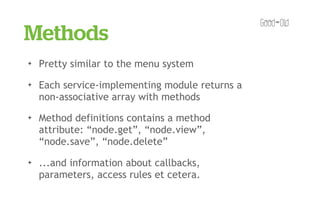
Methods
✦   Pretty similar to the menu system
✦   Each service-implementing module returns a
    non-associative array with methods
✦   Method definitions contains a method
    attribute: “node.get”, “node.view”,
    “node.save”, “node.delete”
✦   ...and information about callbacks,
    parameters, access rules et cetera.
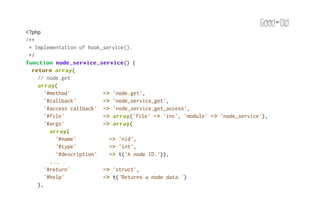
<?php
/**
 * Implementation of hook_service().
 */
function node_service_service
          node_service_service() {
  return array
          array(
    // node.get
    array
    array(
      '#method'           => 'node.get',
      '#callback'         => 'node_service_get',
      '#access callback' => 'node_service_get_access',
      '#file'             => array
                             array('file' => 'inc', 'module' => 'node_service'),
      '#args'             => array
                             array(
        array
        array(
          '#name'           => 'nid',
          '#type'           => 'int',
          '#description'    => t('A node ID.')),
        ...
      '#return'           => 'struct',
      '#help'             => t('Returns a node data.')
    ),
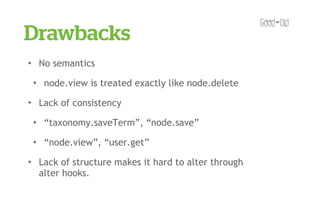
Drawbacks
✦       No semantics
    ✦    node.view is treated exactly like node.delete
✦       Lack of consistency
    ✦    “taxonomy.saveTerm”, “node.save”
    ✦    “node.view”, “user.get”
✦       Lack of structure makes it hard to alter through
        alter hooks.
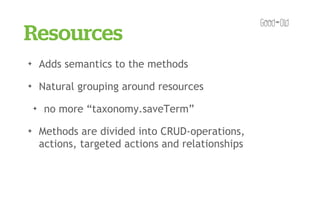
Resources
✦       Adds semantics to the methods
✦       Natural grouping around resources
    ✦    no more “taxonomy.saveTerm”
✦       Methods are divided into CRUD-operations,
        actions, targeted actions and relationships
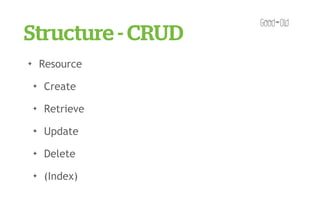
Structure - CRUD
✦       Resource
    ✦   Create
    ✦   Retrieve
    ✦   Update
    ✦   Delete
    ✦   (Index)
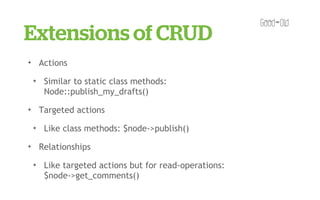
Extensions of CRUD
✦       Actions
    ✦    Similar to static class methods:
         Node::publish_my_drafts()
✦       Targeted actions
    ✦    Like class methods: $node->publish()
✦       Relationships
    ✦    Like targeted actions but for read-operations:
         $node->get_comments()
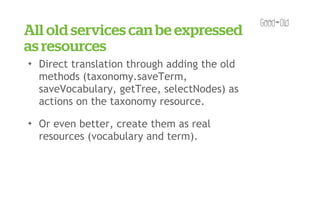
All old services can be expressed
as resources
✦   Direct translation through adding the old
    methods (taxonomy.saveTerm,
    saveVocabulary, getTree, selectNodes) as
    actions on the taxonomy resource.
✦   Or even better, create them as real
    resources (vocabulary and term).
OAuth
✦       Secure protocol for avoiding “the
        password anti-pattern”.
✦       A strong emerging standard.
✦       Client implementations available
        for most small and large
        languages.
    ✦    See http://oauth.net/code
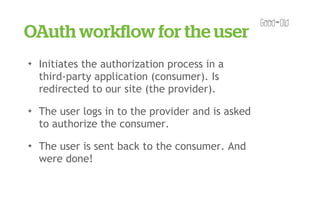
OAuth workflow for the user
✦   Initiates the authorization process in a
    third-party application (consumer). Is
    redirected to our site (the provider).
✦   The user logs in to the provider and is asked
    to authorize the consumer.
✦   The user is sent back to the consumer. And
    were done!
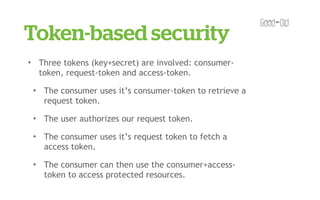
Token-based security
✦       Three tokens (key+secret) are involved: consumer-
        token, request-token and access-token.
    ✦    The consumer uses it’s consumer-token to retrieve a
         request token.
    ✦    The user authorizes our request token.
    ✦    The consumer uses it’s request token to fetch a
         access token.
    ✦    The consumer can then use the consumer+access-
         token to access protected resources.
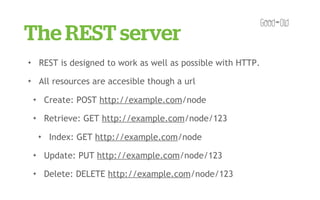
The REST server
✦       REST is designed to work as well as possible with HTTP.
✦       All resources are accesible though a url
    ✦       Create: POST http://example.com/node
    ✦       Retrieve: GET http://example.com/node/123
        ✦    Index: GET http://example.com/node
    ✦       Update: PUT http://example.com/node/123
    ✦       Delete: DELETE http://example.com/node/123
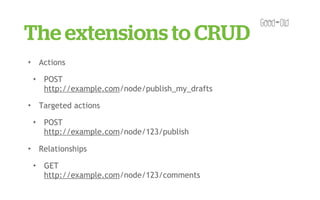
The extensions to CRUD
✦       Actions
    ✦    POST
         http://example.com/node/publish_my_drafts
✦       Targeted actions
    ✦    POST
         http://example.com/node/123/publish
✦       Relationships
    ✦    GET
         http://example.com/node/123/comments
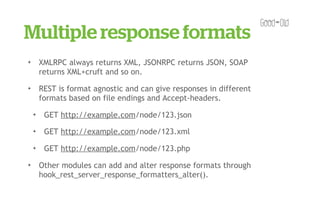
Multiple response formats
✦       XMLRPC always returns XML, JSONRPC returns JSON, SOAP
        returns XML+cruft and so on.
✦       REST is format agnostic and can give responses in different
        formats based on file endings and Accept-headers.
    ✦    GET http://example.com/node/123.json
    ✦    GET http://example.com/node/123.xml
    ✦    GET http://example.com/node/123.php
✦       Other modules can add and alter response formats through
        hook_rest_server_response_formatters_alter().
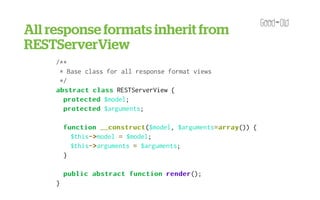
All response formats inherit from
RESTServerView
      <?php

     /**
      * Base class for all response format views
      */
     abstract class RESTServerView {
       protected $model;
       protected $arguments;

         function __construct
                   __construct($model, $arguments= array
                                                 = array()) {
           $this->
                ->model = $model;
           $this->
                ->arguments = $arguments;
         }

         public abstract function render
                                  render();
     }
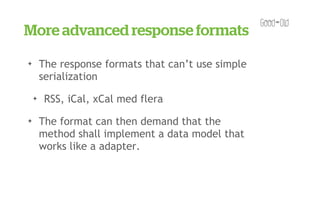
More advanced response formats
✦       The response formats that can’t use simple
        serialization
    ✦    RSS, iCal, xCal med flera
✦       The format can then demand that the
        method shall implement a data model that
        works like a adapter.
'XCalFormatView' => array
                               array(
             'file' => 'XCalFormatView.inc',
          ),
Example from xCal
 }
     );


 function xcal_..._formatters_alter &$formatters) {
            xcal_..._formatters_alter(&
   $formatters['xcal'] = array
                          array(
      'model' => 'ResourceTimeFeedModel',
      'mime types' => array
                      array('application/xcal+xml'),
      'view' => 'XCalFormatView',
   );
   $formatters['ical'] = array
                          array(
      'model' => 'ResourceTimeFeedModel',
      'mime types' => array
                      array('text/calendar'),
      'view' => 'XCalFormatView',
      'view arguments' => array
                          array('transform'=>
                                           =>'ical'),
   );
 }
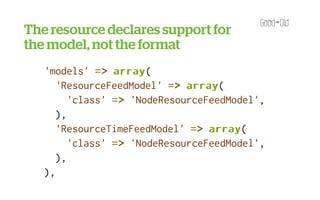
The resource declares support for
     ),
the model, not the format
   ),
   'models' => array
                 array(
      'ResourceFeedModel' => array
                              array(
         'class' => 'NodeResourceFeedModel',
      ),
      'ResourceTimeFeedModel' => array
                                  array(
         'class' => 'NodeResourceFeedModel',
      ),
   ),
   'access arguments' => array
                           array('access content'),
Multiple input-formats
✦       Built in support for x-www-form-urlencoded, yaml, json and
        serialized php.
✦       Can be extended through
        hook_rest_server_request_parsers_alter().
✦       Determined by the Content-type-header for the call and
        therefore matched to mime-types:
    ✦    'application/json' => 'RESTServer::parseJSON',
    ✦    'application/vnd.php.serialized' => 'RESTServer::parsePHP',
My view on the future of services -
3.x
✦       The old RPC-oriented methods are
        completely removed and are replaced by
        resources.
    ✦    Possibly support translation of method
         declarations to a resource with actions.
✦       Endpoints: modules and administrators will
        be able to publish and configure servers on
        arbitrary locations in the menu system.
Why endpoints?
Today all installed services are
always available on all installed
servers and they all have to use
the same auth method.
Why Endpoints?
✦       Today it’s not possible for modules to use services
        to expose an API.
    ✦    API = services + server + authentication
         mechanism
✦       Or rather - only one API can be exposed at a time
✦       This becomes a problem if services is going to be
        used as a framework for other modules to publish
        API:s
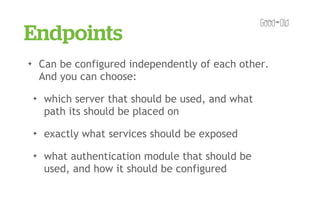
Endpoints
✦       Can be configured independently of each other.
        And you can choose:
    ✦    which server that should be used, and what
         path its should be placed on
    ✦    exactly what services should be exposed
    ✦    what authentication module that should be
         used, and how it should be configured
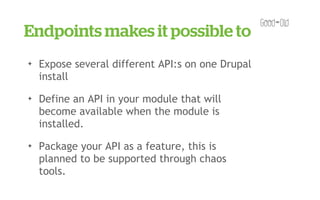
Endpoints makes it possible to
✦   Expose several different API:s on one Drupal
    install
✦   Define an API in your module that will
    become available when the module is
    installed.
✦   Package your API as a feature, this is
    planned to be supported through chaos
    tools.
Example of
a endpoint-
declaration
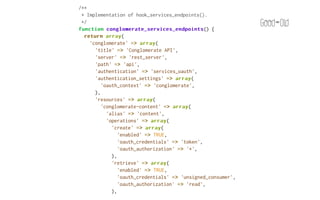
/**
 * Implementation of hook_services_endpoints().
 */
function conglomerate_services_endpoints
           conglomerate_services_endpoints() {
  return array
           array(
    'conglomerate' => array
                       array(
      'title' => 'Conglomerate API',
      'server' => 'rest_server',
      'path' => 'api',
      'authentication' => 'services_oauth',
      'authentication_settings' => array
                                    array(
         'oauth_context' => 'conglomerate',
      ),
      'resources' => array
                      array(
         'conglomerate-content' => array
                                   array(
           'alias' => 'content',
           'operations' => array
                           array(
             'create' => array
                         array(
               'enabled' => TRUE,
               'oauth_credentials' => 'token',
               'oauth_authorization' => '*',
             ),
             'retrieve' => array
                           array(
               'enabled' => TRUE,
               'oauth_credentials' => 'unsigned_consumer',
               'oauth_authorization' => 'read',
             ),
             'update' => array
                         array(
OAuth and Endpoints
✦       OAuth now has support for contexts.
    ✦    Consumers are always placed in a context
    ✦    Authentications are therefore only valid
         within this context.
    ✦    Each context has it’s own authorization levels
✦       Endpoints in services can either use separate
        contexts or share contexts.
OAuth context declaration in code
<?php

/**
  * Implementation of hook_oauth_default_contexts().
  */
function conglomerate_oauth_default_contexts
            conglomerate_oauth_default_contexts() {
   return array
            array(
      'conglomerate' => array
                         array(
        '*' => array
               array(
          'title' => 'Yes, I want to connect !appname to !sitename',
          'description' => 'This will allow your site !appname to push content to !sitename',
          'weight' => - 1,
        ),
        'read' => array
                  array(
          'title' => 'I want to connect, but just to get stuff from !sitename',
          'description' => 'This will allow !appname to fetch content from !sitename, but it will not
allow any information to be pushed to !sitename.',
          'weight' => 0,
        ),
      )
   );
}

/**
Hugo Wetterberg
            @hugowett
         hugo@goodold.se
http://github.com/hugowetterberg

Services Drupalcamp Stockholm 2009

  • 2.
  • 3.
    The purpose ofservices Create a Drupal API for exposing web API:s
  • 4.
    The official version -Create a unified Drupal API for web services to be exposed in a variety of different server formats. - Provide a service browser to be able to test methods. - Allow distribution of API keys for developer access.
  • 5.
    Services Functionality split intothree kinds of modules that provides: ✦ Servers ✦ Services ✦ Authentication mechanisms (new in 2.x)
  • 6.
    Servers ✦ REST ✦ XMLRPC ✦ JSONRPC ✦ SOAP ✦ AMF (Binary Flash RPC protocol)
  • 7.
    Services ✦ That exposes core ✦ Node, user, taxonomy, menu, file, ✦ That exposes other modules ✦ Views ✦ And additional services implemented in other contrib modules that I cant remember right now.
  • 8.
    Authentication ✦ OAuth ✦ Key authentication
  • 9.
    Implementing services ✦ Either as methods ✦ ...or (since version 2.x) as resources
  • 10.
    Methods ✦ Pretty similar to the menu system ✦ Each service-implementing module returns a non-associative array with methods ✦ Method definitions contains a method attribute: “node.get”, “node.view”, “node.save”, “node.delete” ✦ ...and information about callbacks, parameters, access rules et cetera.
  • 11.
    <?php /** * Implementationof hook_service(). */ function node_service_service node_service_service() { return array array( // node.get array array( '#method' => 'node.get', '#callback' => 'node_service_get', '#access callback' => 'node_service_get_access', '#file' => array array('file' => 'inc', 'module' => 'node_service'), '#args' => array array( array array( '#name' => 'nid', '#type' => 'int', '#description' => t('A node ID.')), ... '#return' => 'struct', '#help' => t('Returns a node data.') ),
  • 12.
    Drawbacks ✦ No semantics ✦ node.view is treated exactly like node.delete ✦ Lack of consistency ✦ “taxonomy.saveTerm”, “node.save” ✦ “node.view”, “user.get” ✦ Lack of structure makes it hard to alter through alter hooks.
  • 13.
    Resources ✦ Adds semantics to the methods ✦ Natural grouping around resources ✦ no more “taxonomy.saveTerm” ✦ Methods are divided into CRUD-operations, actions, targeted actions and relationships
  • 14.
    Structure - CRUD ✦ Resource ✦ Create ✦ Retrieve ✦ Update ✦ Delete ✦ (Index)
  • 15.
    Extensions of CRUD ✦ Actions ✦ Similar to static class methods: Node::publish_my_drafts() ✦ Targeted actions ✦ Like class methods: $node->publish() ✦ Relationships ✦ Like targeted actions but for read-operations: $node->get_comments()
  • 16.
    All old servicescan be expressed as resources ✦ Direct translation through adding the old methods (taxonomy.saveTerm, saveVocabulary, getTree, selectNodes) as actions on the taxonomy resource. ✦ Or even better, create them as real resources (vocabulary and term).
  • 17.
    OAuth ✦ Secure protocol for avoiding “the password anti-pattern”. ✦ A strong emerging standard. ✦ Client implementations available for most small and large languages. ✦ See http://oauth.net/code
  • 18.
    OAuth workflow forthe user ✦ Initiates the authorization process in a third-party application (consumer). Is redirected to our site (the provider). ✦ The user logs in to the provider and is asked to authorize the consumer. ✦ The user is sent back to the consumer. And were done!
  • 19.
    Token-based security ✦ Three tokens (key+secret) are involved: consumer- token, request-token and access-token. ✦ The consumer uses it’s consumer-token to retrieve a request token. ✦ The user authorizes our request token. ✦ The consumer uses it’s request token to fetch a access token. ✦ The consumer can then use the consumer+access- token to access protected resources.
  • 20.
    The REST server ✦ REST is designed to work as well as possible with HTTP. ✦ All resources are accesible though a url ✦ Create: POST http://example.com/node ✦ Retrieve: GET http://example.com/node/123 ✦ Index: GET http://example.com/node ✦ Update: PUT http://example.com/node/123 ✦ Delete: DELETE http://example.com/node/123
  • 21.
    The extensions toCRUD ✦ Actions ✦ POST http://example.com/node/publish_my_drafts ✦ Targeted actions ✦ POST http://example.com/node/123/publish ✦ Relationships ✦ GET http://example.com/node/123/comments
  • 22.
    Multiple response formats ✦ XMLRPC always returns XML, JSONRPC returns JSON, SOAP returns XML+cruft and so on. ✦ REST is format agnostic and can give responses in different formats based on file endings and Accept-headers. ✦ GET http://example.com/node/123.json ✦ GET http://example.com/node/123.xml ✦ GET http://example.com/node/123.php ✦ Other modules can add and alter response formats through hook_rest_server_response_formatters_alter().
  • 23.
    All response formatsinherit from RESTServerView <?php /** * Base class for all response format views */ abstract class RESTServerView { protected $model; protected $arguments; function __construct __construct($model, $arguments= array = array()) { $this-> ->model = $model; $this-> ->arguments = $arguments; } public abstract function render render(); }
  • 24.
    More advanced responseformats ✦ The response formats that can’t use simple serialization ✦ RSS, iCal, xCal med flera ✦ The format can then demand that the method shall implement a data model that works like a adapter.
  • 25.
    'XCalFormatView' => array array( 'file' => 'XCalFormatView.inc', ), Example from xCal } ); function xcal_..._formatters_alter &$formatters) { xcal_..._formatters_alter(& $formatters['xcal'] = array array( 'model' => 'ResourceTimeFeedModel', 'mime types' => array array('application/xcal+xml'), 'view' => 'XCalFormatView', ); $formatters['ical'] = array array( 'model' => 'ResourceTimeFeedModel', 'mime types' => array array('text/calendar'), 'view' => 'XCalFormatView', 'view arguments' => array array('transform'=> =>'ical'), ); }
  • 26.
    The resource declaressupport for ), the model, not the format ), 'models' => array array( 'ResourceFeedModel' => array array( 'class' => 'NodeResourceFeedModel', ), 'ResourceTimeFeedModel' => array array( 'class' => 'NodeResourceFeedModel', ), ), 'access arguments' => array array('access content'),
  • 27.
    Multiple input-formats ✦ Built in support for x-www-form-urlencoded, yaml, json and serialized php. ✦ Can be extended through hook_rest_server_request_parsers_alter(). ✦ Determined by the Content-type-header for the call and therefore matched to mime-types: ✦ 'application/json' => 'RESTServer::parseJSON', ✦ 'application/vnd.php.serialized' => 'RESTServer::parsePHP',
  • 28.
    My view onthe future of services - 3.x ✦ The old RPC-oriented methods are completely removed and are replaced by resources. ✦ Possibly support translation of method declarations to a resource with actions. ✦ Endpoints: modules and administrators will be able to publish and configure servers on arbitrary locations in the menu system.
  • 29.
    Why endpoints? Today allinstalled services are always available on all installed servers and they all have to use the same auth method.
  • 30.
    Why Endpoints? ✦ Today it’s not possible for modules to use services to expose an API. ✦ API = services + server + authentication mechanism ✦ Or rather - only one API can be exposed at a time ✦ This becomes a problem if services is going to be used as a framework for other modules to publish API:s
  • 31.
    Endpoints ✦ Can be configured independently of each other. And you can choose: ✦ which server that should be used, and what path its should be placed on ✦ exactly what services should be exposed ✦ what authentication module that should be used, and how it should be configured
  • 32.
    Endpoints makes itpossible to ✦ Expose several different API:s on one Drupal install ✦ Define an API in your module that will become available when the module is installed. ✦ Package your API as a feature, this is planned to be supported through chaos tools.
  • 33.
  • 34.
    /** * Implementationof hook_services_endpoints(). */ function conglomerate_services_endpoints conglomerate_services_endpoints() { return array array( 'conglomerate' => array array( 'title' => 'Conglomerate API', 'server' => 'rest_server', 'path' => 'api', 'authentication' => 'services_oauth', 'authentication_settings' => array array( 'oauth_context' => 'conglomerate', ), 'resources' => array array( 'conglomerate-content' => array array( 'alias' => 'content', 'operations' => array array( 'create' => array array( 'enabled' => TRUE, 'oauth_credentials' => 'token', 'oauth_authorization' => '*', ), 'retrieve' => array array( 'enabled' => TRUE, 'oauth_credentials' => 'unsigned_consumer', 'oauth_authorization' => 'read', ), 'update' => array array(
  • 35.
    OAuth and Endpoints ✦ OAuth now has support for contexts. ✦ Consumers are always placed in a context ✦ Authentications are therefore only valid within this context. ✦ Each context has it’s own authorization levels ✦ Endpoints in services can either use separate contexts or share contexts.
  • 36.
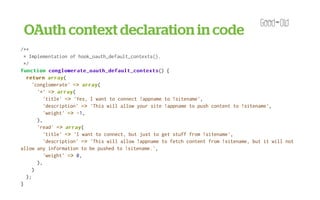
    OAuth context declarationin code <?php /** * Implementation of hook_oauth_default_contexts(). */ function conglomerate_oauth_default_contexts conglomerate_oauth_default_contexts() { return array array( 'conglomerate' => array array( '*' => array array( 'title' => 'Yes, I want to connect !appname to !sitename', 'description' => 'This will allow your site !appname to push content to !sitename', 'weight' => - 1, ), 'read' => array array( 'title' => 'I want to connect, but just to get stuff from !sitename', 'description' => 'This will allow !appname to fetch content from !sitename, but it will not allow any information to be pushed to !sitename.', 'weight' => 0, ), ) ); } /**
  • 37.
    Hugo Wetterberg @hugowett hugo@goodold.se http://github.com/hugowetterberg