System Dynamics Modeling and Its
Applications on Urban
Environmental Management
Marion Micah R. Tinio
Master of Science in Environmental Science
1
Outline
• Systems Thinking
• Feedback Loops
• System Dynamics Modelling
• Applications of SD Modelling in Urban
Environmental Management
2
Systems Thinking
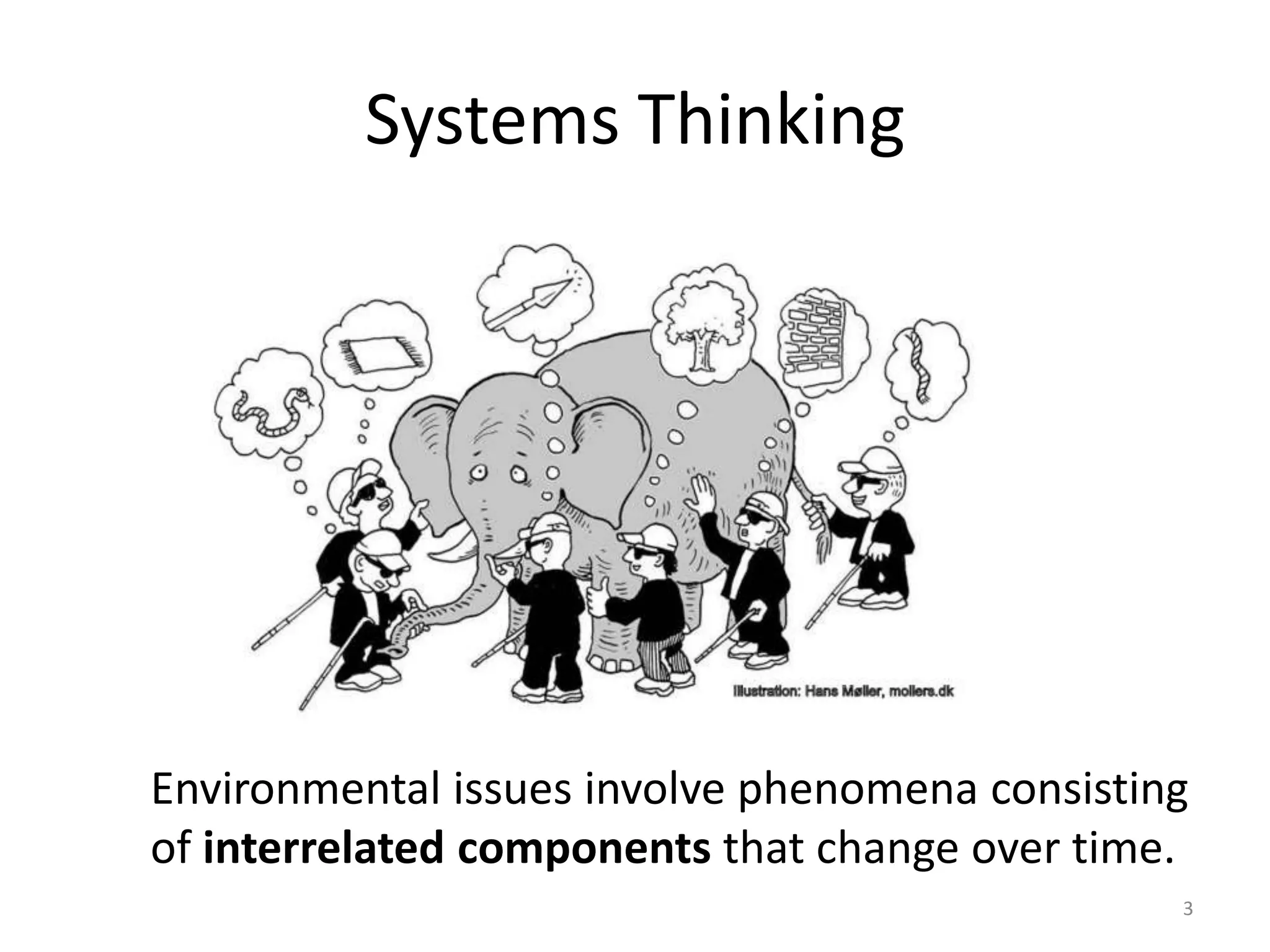
Environmental issues involve phenomena consisting
of interrelated components that change over time.
3
Characteristics of Systems Thinking
1. Begins with a global description, then move toward
the specific.
2. Focuses on dynamic processes – changes over time
3. Seeks a closed-loop explanation – set scope and
limitations; behavior of the system is only
dependent on elements within system
4. Identifies feedback loops
5. Looks for checks, balances, and runaway processes.
6. Focuses on cause-effect relationships
4
Deaton and Winebrake (2000)
Resolving Environmental Issues
• Environmental issues are complex and
different elements have interrelationships.
– OVERPOPULATION
– URBANIZATION
– CLIMATE CHANGE ADAPTATION AND MITIGATION
– RESOURCE MANAGEMENT
5
Feedback Loops
• Definition
– A closed-loop circle of cause and effect
– Conditions in one part cause results elsewhere,
which will act on the original conditions
– Feedback loops help to understand which
elements have high and low impacts to the
system.
6
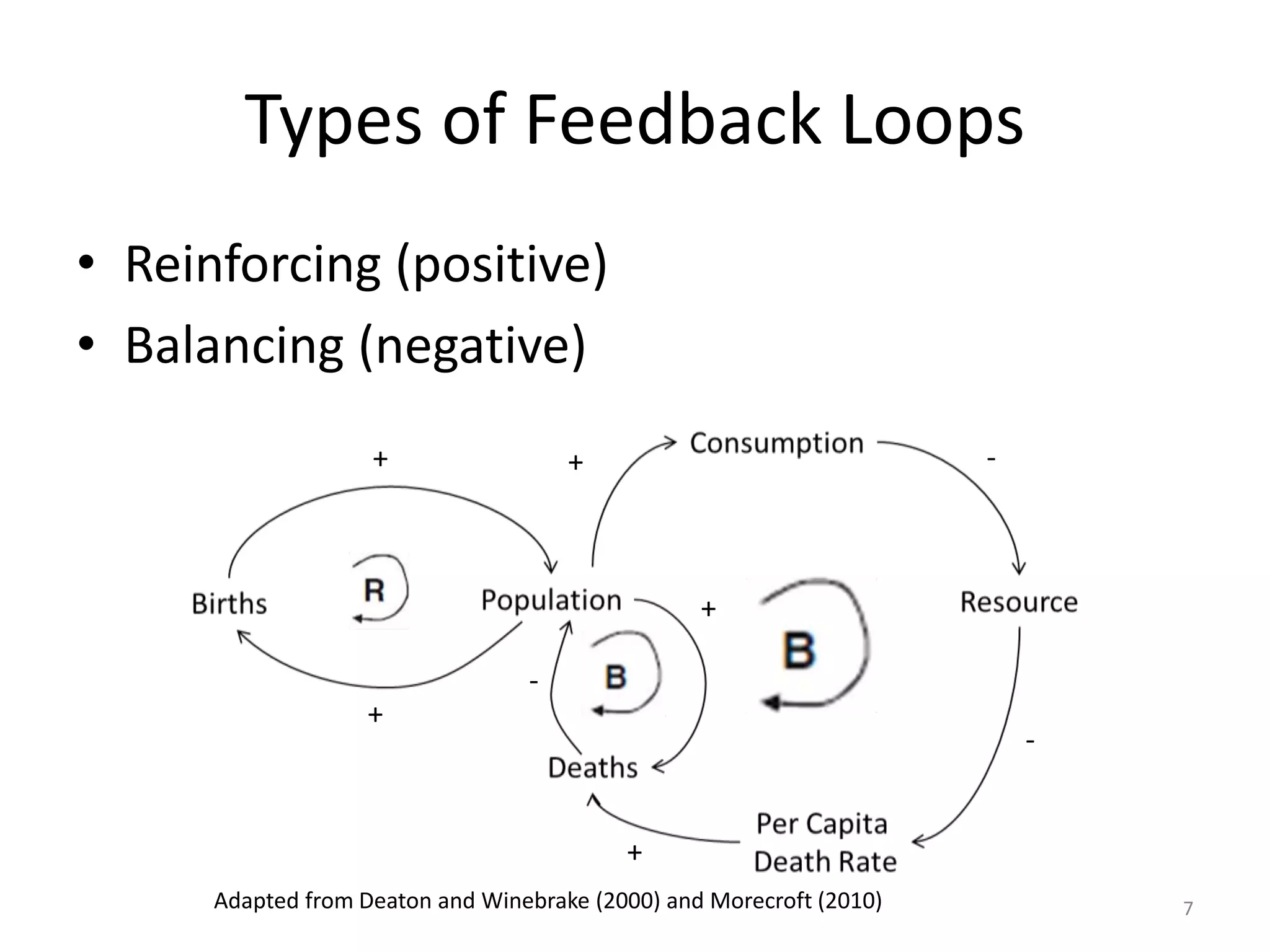
Types of Feedback Loops
• Reinforcing (positive)
• Balancing (negative)
Adapted from Deaton and Winebrake (2000) and Morecroft (2010)
+
+
+ -
-
+
-
+
7
System dynamics modeling
• Developed by Jay Forrester in the 1950s
• A methodology in which simulation is governed
entirely by changes over time, used for studying
and managing complex feedback systems
• When initial conditions are assigned for variables,
the model would produce related consequences
based on the initiation of action and flow of
information.
• It is used to understand how a system works and
to predict its performance.
8
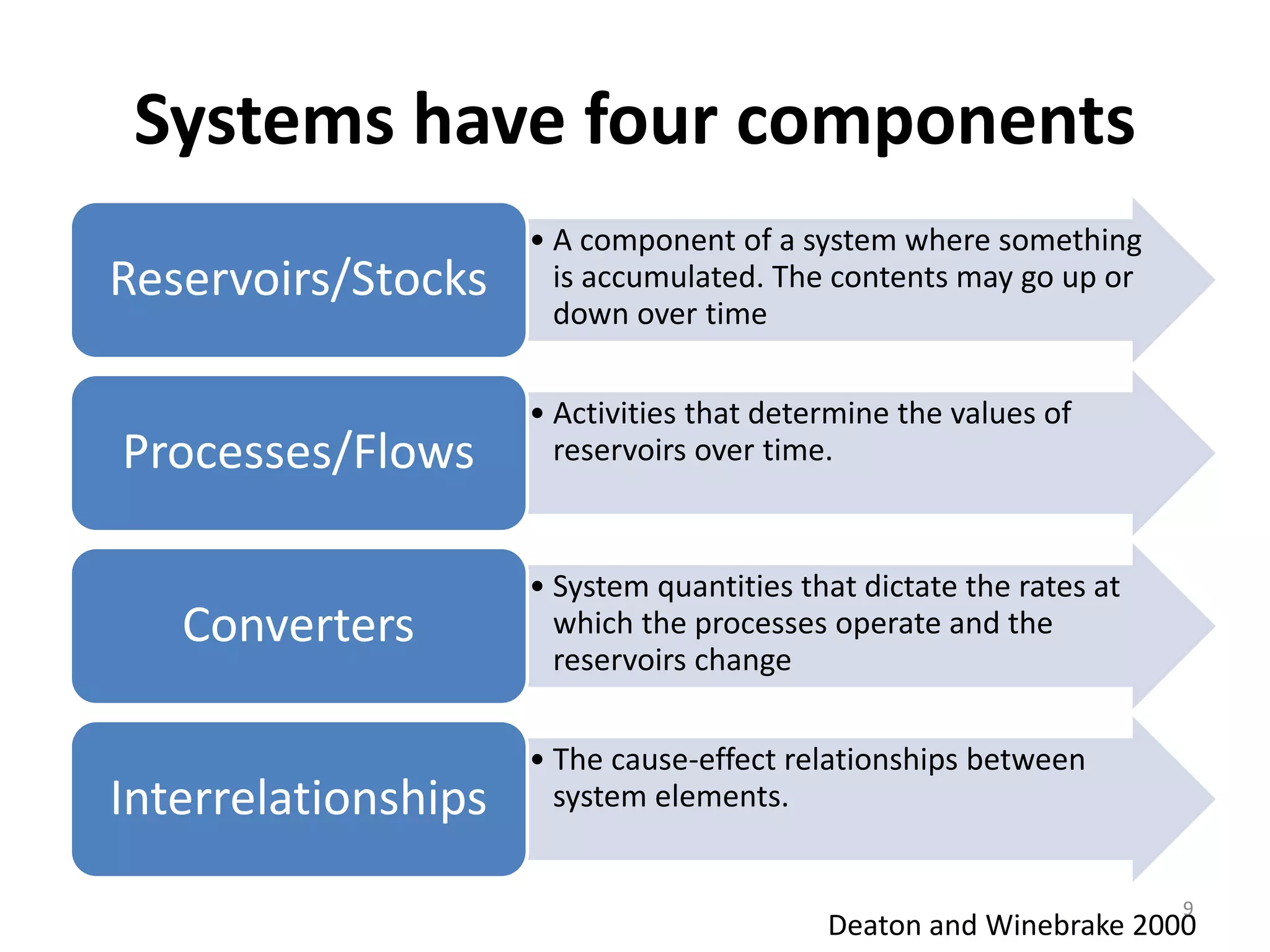
Systems have four components
• A component of a system where something
is accumulated. The contents may go up or
down over time
Reservoirs/Stocks
• Activities that determine the values of
reservoirs over time.Processes/Flows
• System quantities that dictate the rates at
which the processes operate and the
reservoirs change
Converters
• The cause-effect relationships between
system elements.Interrelationships
Deaton and Winebrake 2000
9
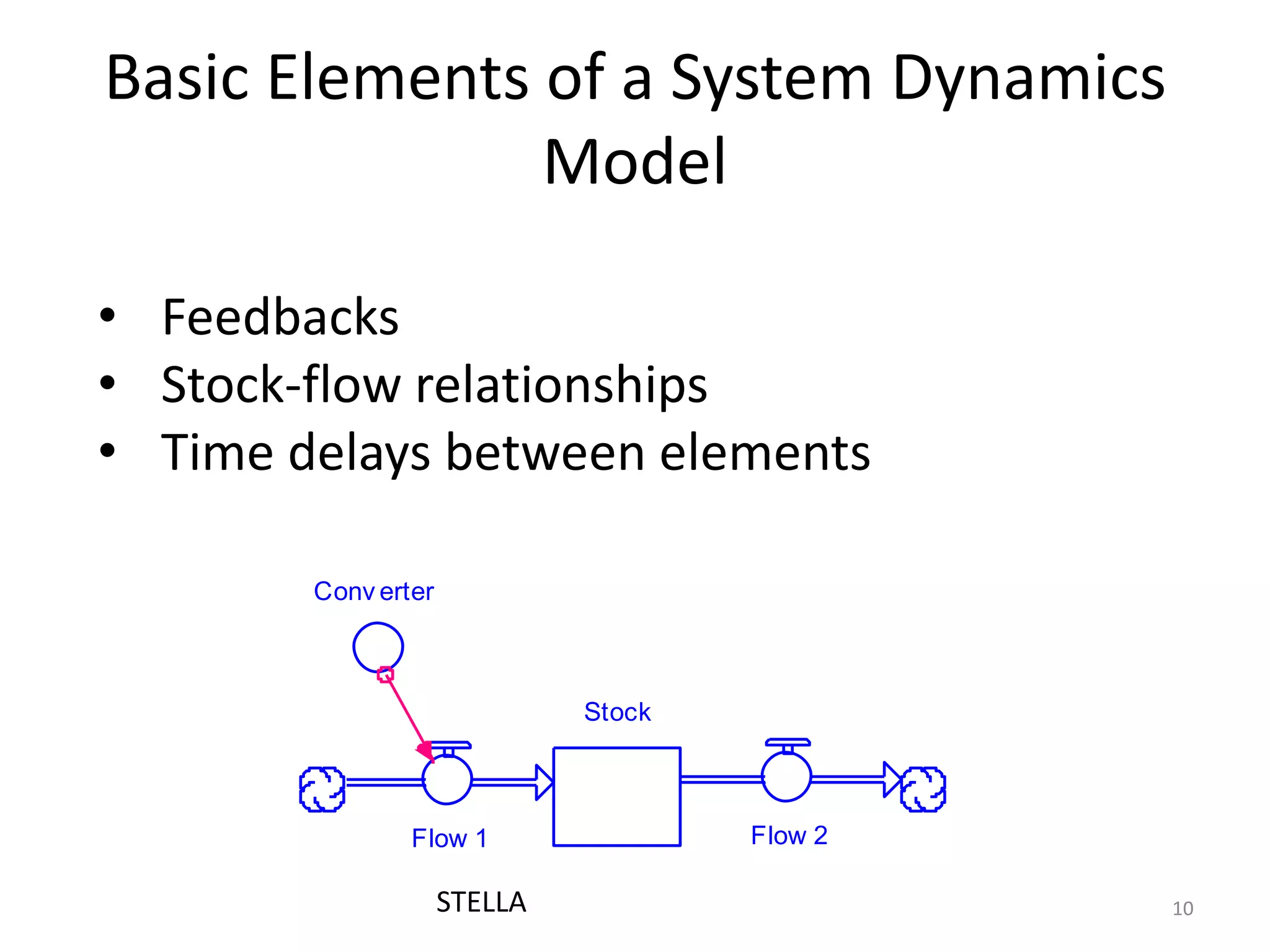
Basic Elements of a System Dynamics
Model
Flow 1
Conv erter
Stock
Flow 2
• Feedbacks
• Stock-flow relationships
• Time delays between elements
10STELLA
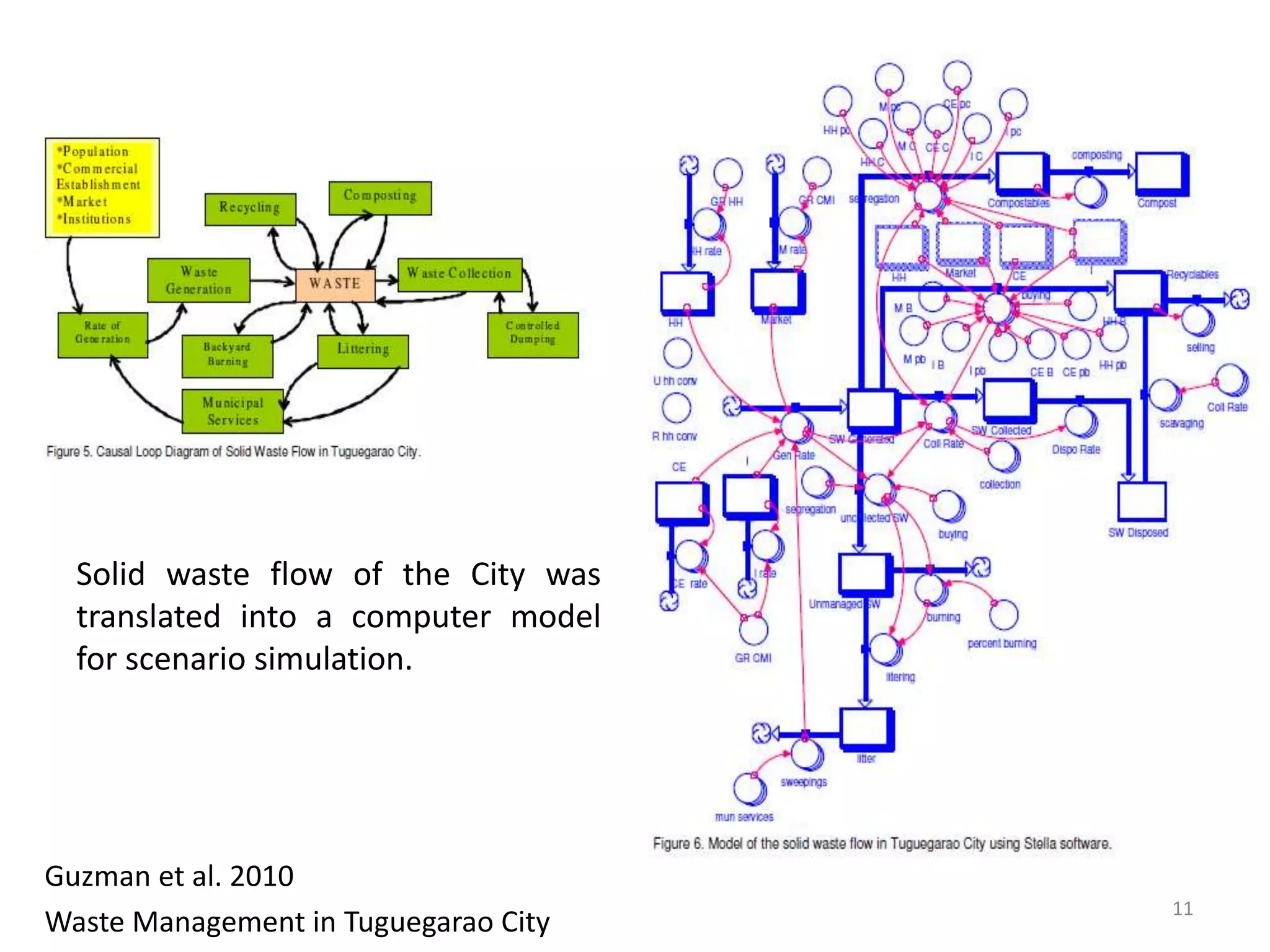
Guzman et al. 2010
Waste Management in Tuguegarao City
11
Solid waste flow of the City was
translated into a computer model
for scenario simulation.
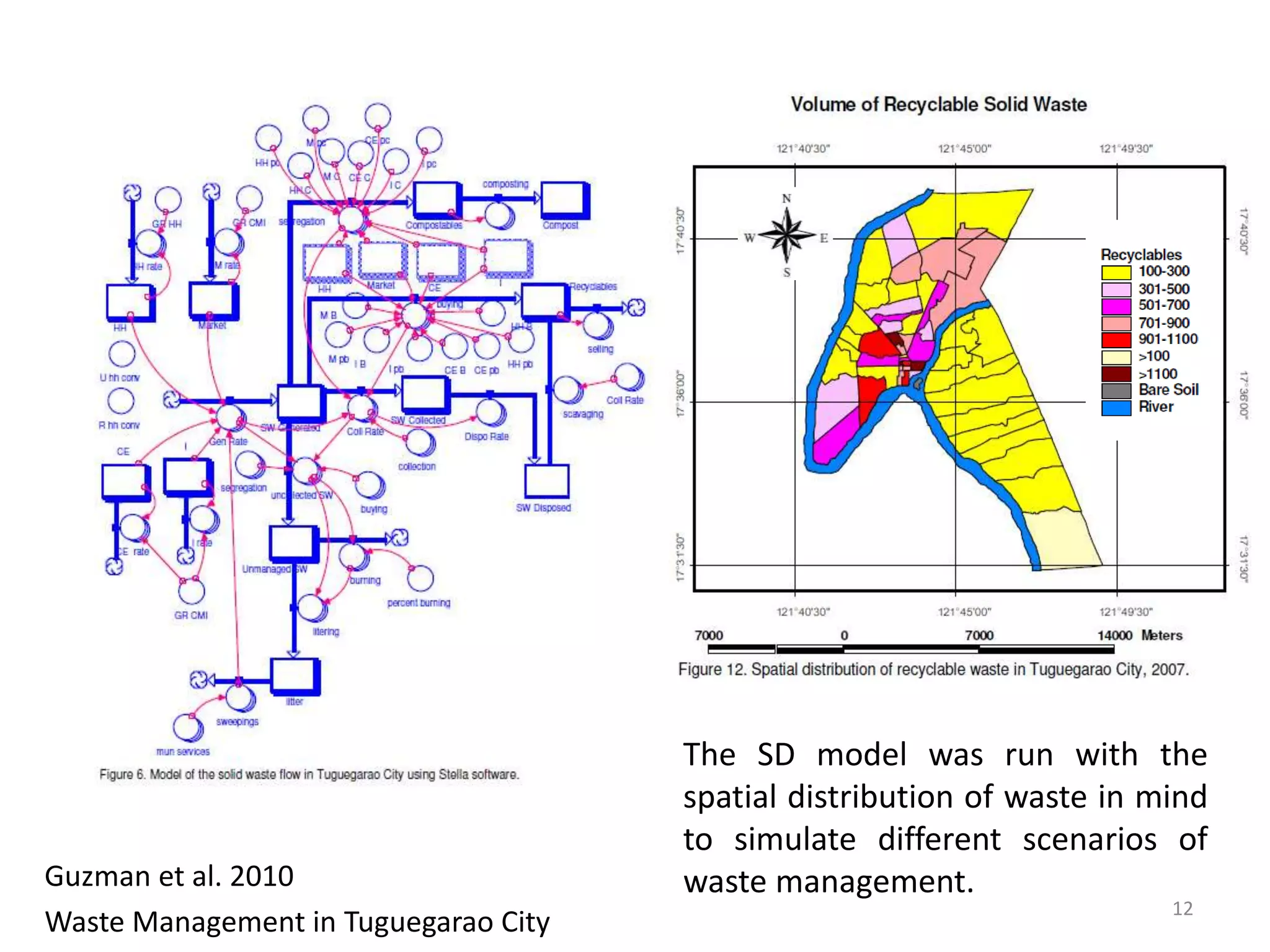
Guzman et al. 2010
Waste Management in Tuguegarao City
12
The SD model was run with the
spatial distribution of waste in mind
to simulate different scenarios of
waste management.
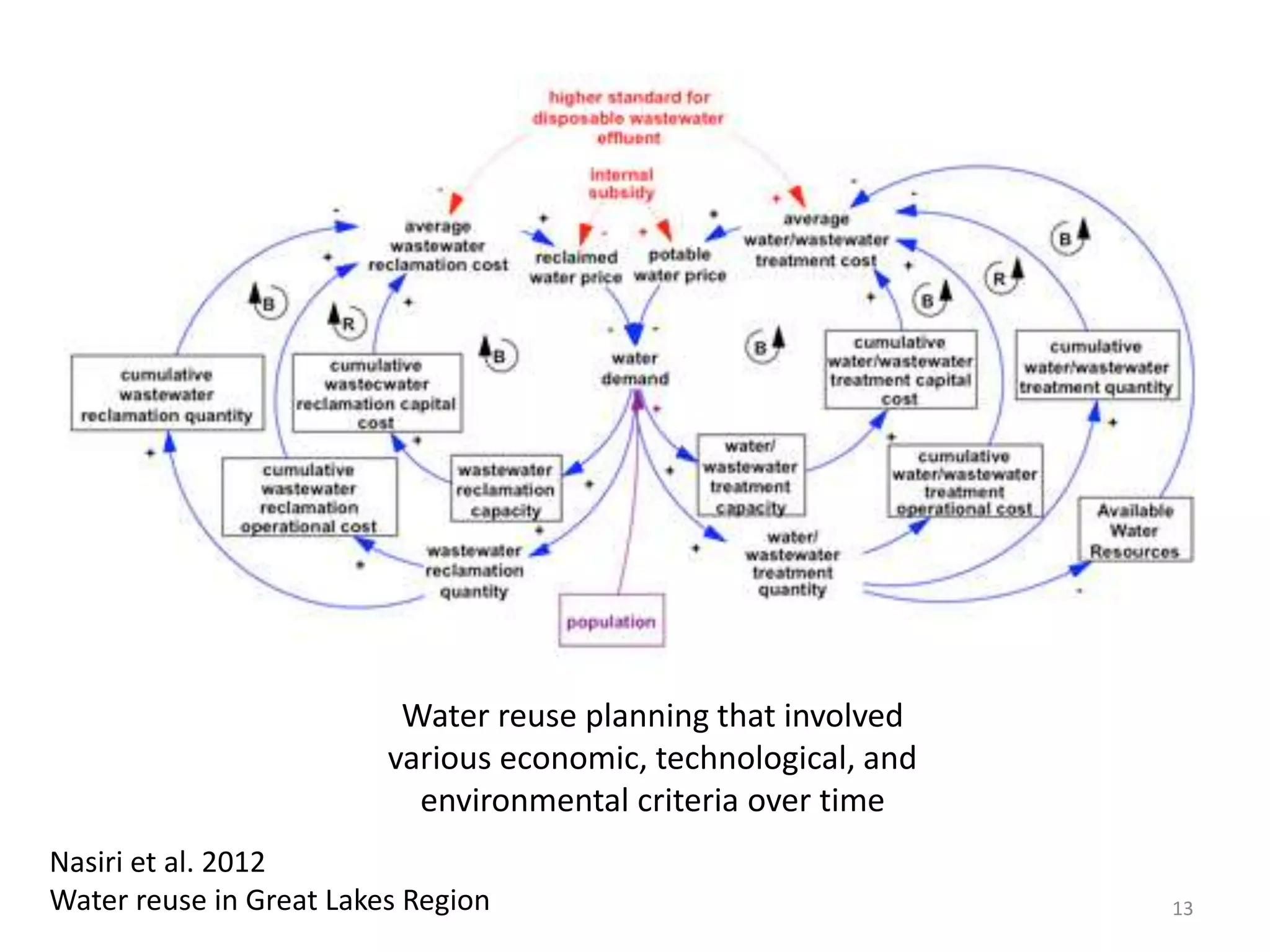
Nasiri et al. 2012
Water reuse in Great Lakes Region
Water reuse planning that involved
various economic, technological, and
environmental criteria over time
13
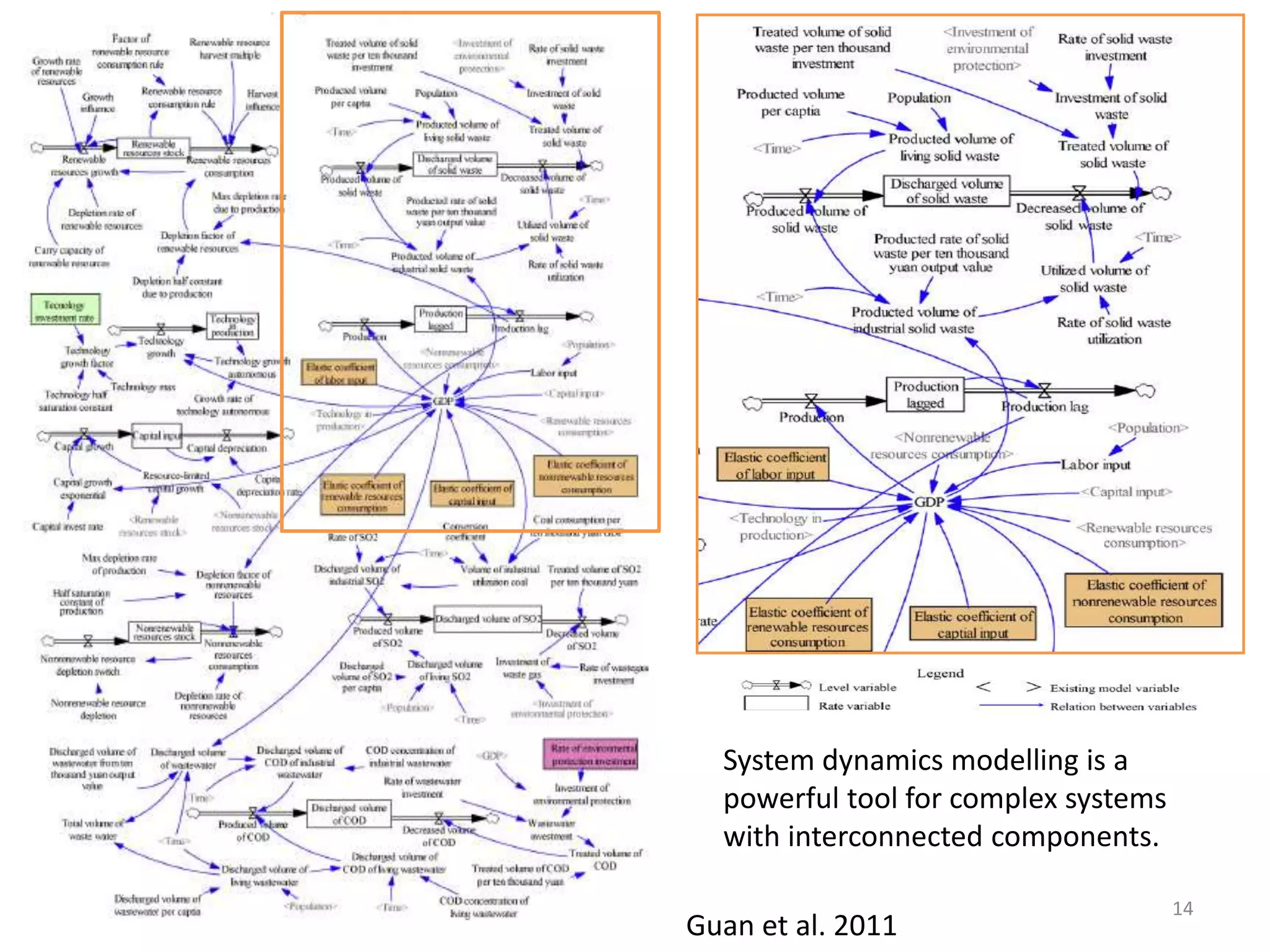
Guan et al. 2011
14
System dynamics modelling is a
powerful tool for complex systems
with interconnected components.
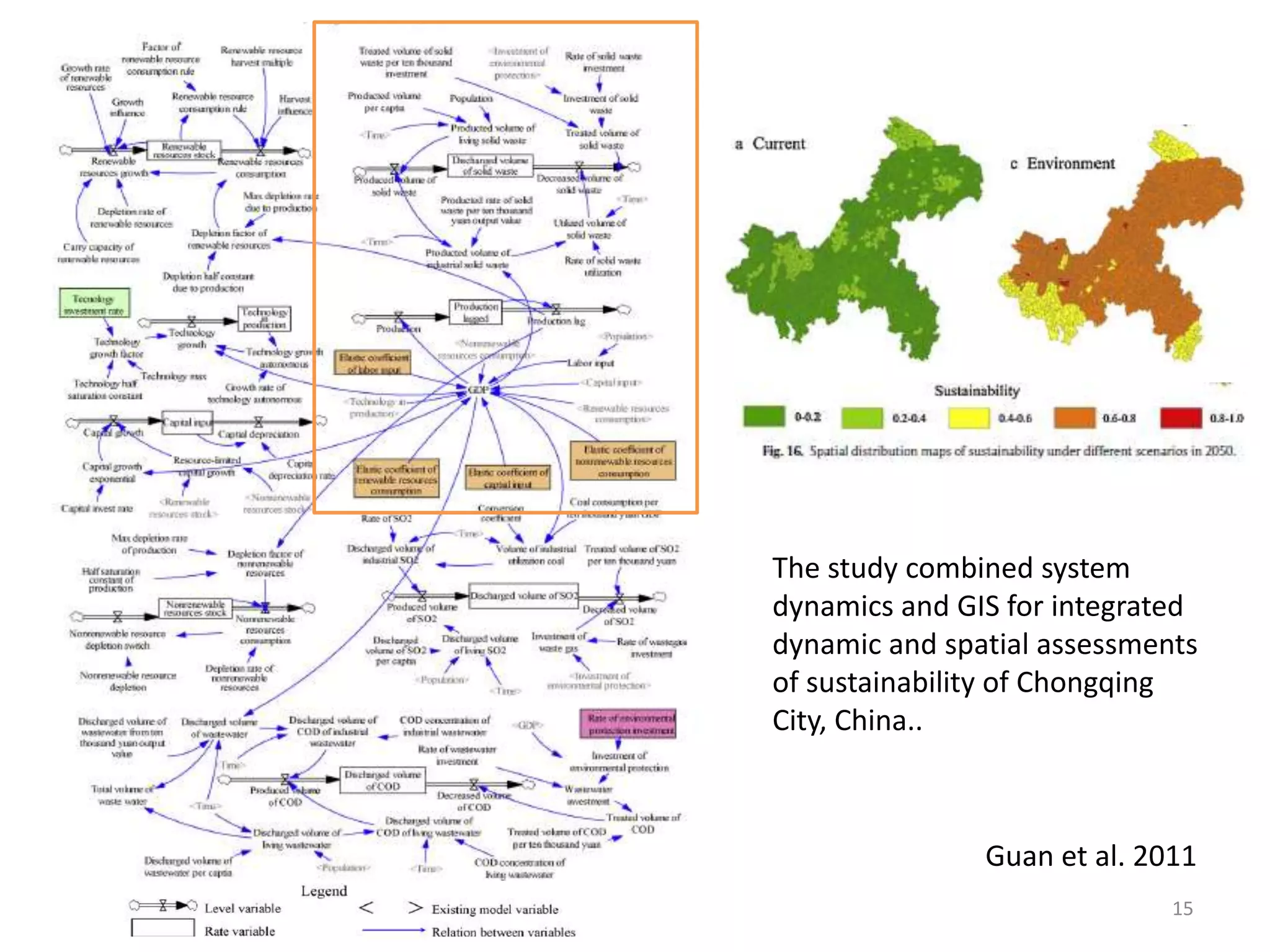
Guan et al. 2011
The study combined system
dynamics and GIS for integrated
dynamic and spatial assessments
of sustainability of Chongqing
City, China..
15
Summary
• Environmental issues cannot be simplified
because of the interrelated components affecting
the systems over time.
• Basic elements of system dynamics modelling
– Feedback loops
– Stock-flow relationships
– Time delays
• System dynamics modelling is a frontier towards
resolving Philippine environmental issues.
16

System dynamics modeling and its applications on urban environmental management

  • 1.
    System Dynamics Modelingand Its Applications on Urban Environmental Management Marion Micah R. Tinio Master of Science in Environmental Science 1
  • 2.
    Outline • Systems Thinking •Feedback Loops • System Dynamics Modelling • Applications of SD Modelling in Urban Environmental Management 2
  • 3.
    Systems Thinking Environmental issuesinvolve phenomena consisting of interrelated components that change over time. 3
  • 4.
    Characteristics of SystemsThinking 1. Begins with a global description, then move toward the specific. 2. Focuses on dynamic processes – changes over time 3. Seeks a closed-loop explanation – set scope and limitations; behavior of the system is only dependent on elements within system 4. Identifies feedback loops 5. Looks for checks, balances, and runaway processes. 6. Focuses on cause-effect relationships 4 Deaton and Winebrake (2000)
  • 5.
    Resolving Environmental Issues •Environmental issues are complex and different elements have interrelationships. – OVERPOPULATION – URBANIZATION – CLIMATE CHANGE ADAPTATION AND MITIGATION – RESOURCE MANAGEMENT 5
  • 6.
    Feedback Loops • Definition –A closed-loop circle of cause and effect – Conditions in one part cause results elsewhere, which will act on the original conditions – Feedback loops help to understand which elements have high and low impacts to the system. 6
  • 7.
    Types of FeedbackLoops • Reinforcing (positive) • Balancing (negative) Adapted from Deaton and Winebrake (2000) and Morecroft (2010) + + + - - + - + 7
  • 8.
    System dynamics modeling •Developed by Jay Forrester in the 1950s • A methodology in which simulation is governed entirely by changes over time, used for studying and managing complex feedback systems • When initial conditions are assigned for variables, the model would produce related consequences based on the initiation of action and flow of information. • It is used to understand how a system works and to predict its performance. 8
  • 9.
    Systems have fourcomponents • A component of a system where something is accumulated. The contents may go up or down over time Reservoirs/Stocks • Activities that determine the values of reservoirs over time.Processes/Flows • System quantities that dictate the rates at which the processes operate and the reservoirs change Converters • The cause-effect relationships between system elements.Interrelationships Deaton and Winebrake 2000 9
  • 10.
    Basic Elements ofa System Dynamics Model Flow 1 Conv erter Stock Flow 2 • Feedbacks • Stock-flow relationships • Time delays between elements 10STELLA
  • 11.
    Guzman et al.2010 Waste Management in Tuguegarao City 11 Solid waste flow of the City was translated into a computer model for scenario simulation.
  • 12.
    Guzman et al.2010 Waste Management in Tuguegarao City 12 The SD model was run with the spatial distribution of waste in mind to simulate different scenarios of waste management.
  • 13.
    Nasiri et al.2012 Water reuse in Great Lakes Region Water reuse planning that involved various economic, technological, and environmental criteria over time 13
  • 14.
    Guan et al.2011 14 System dynamics modelling is a powerful tool for complex systems with interconnected components.
  • 15.
    Guan et al.2011 The study combined system dynamics and GIS for integrated dynamic and spatial assessments of sustainability of Chongqing City, China.. 15
  • 16.
    Summary • Environmental issuescannot be simplified because of the interrelated components affecting the systems over time. • Basic elements of system dynamics modelling – Feedback loops – Stock-flow relationships – Time delays • System dynamics modelling is a frontier towards resolving Philippine environmental issues. 16

Editor's Notes

  • #13 The SD model was run with the spatial distribution of waste in mind to simulate different scenarios of waste management.