DSM 5.0
(Just in Time or Too Late)

Laurence P. Karper, M.D.
Vice-Chair, Department of Psychiatry
What I’m not Going to Do
• I will not discuss subspecialty areas that require
focused review and attention
– Neurodevelopmental Disorders
– Neurocognitive Disorders
– Childhood-Onset Disorders

• I am only touching upon other areas without clinical
relevance to general inpatient or outpatient practice or
that merit more in-depth treatment (e.g. Somatic
Symptoms and Related Disorders, Trauma- and
Stressor-Related Disorders, etc.)
• I will not focus on ICD 10, Forensic, or Insurance Issues
Insurance Considerations
• Not the focus of this presentation
• DSM-5 is fully compatible with ICD-9 and 10
but the transition to ICD-10-CM is very
complicated and will need further delineation
• Crosswalks are currently available for your
delectation
• Since the codes are what drives insurance use
them and list the name separately (e.g.
hoarding disorder vs. OCD; both 300.3)
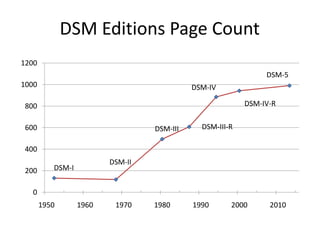
DSM Editions Page Count
1200
DSM-5
1000

DSM-IV
DSM-IV-R

800
600

DSM-III

DSM-III-R

400
200

DSM-II

DSM-I

0
1950

1960

1970

1980

1990

2000

2010
For More Information
• http://www.psychiatry.org/dsm5
– Assessment Measures
– Extensive Fact Sheets
– Videos of Thought Leaders
– News Articles
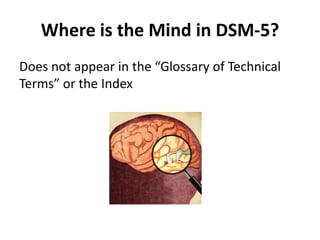
Where is the Mind in DSM-5?
Does not appear in the “Glossary of Technical
Terms” or the Index
Definition of a Mental Disorder
A mental disorder is a syndrome characterized
by clinically significant disturbance in an
individual’s cognition, emotional regulation, or
behavior that reflects a dysfunction in the
psychological, biological, or developmental
processes underlying mental functioning…. An
expectable or culturally approved response to a
common stressor or loss, such as the death of a
loved one, is not a mental disorder.
Who/What is Disordered?
“All drugs that are taken in excess have in
common direct activation of the brain reward
system…. They produce such an intense
activation of the reward system that normal
activities may be neglected. …[The] roots of
substance use disorders for some persons can
be seen in behaviors long before the onset of
actual substance use itself.” DSM-5, p. 481.
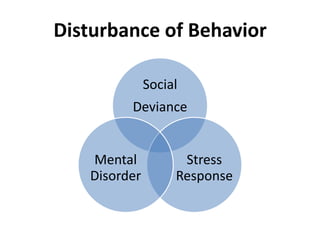
Disturbance of Behavior
Social
Deviance

Mental
Disorder

Stress
Response
The Primacy of Reliability
• A measure is said to have a high reliability if it
produces similar results under consistent
conditions.
• Validity is the extent to which a
concept, conclusion, or measurement is wellfounded and corresponds accurately to the
real world.
Multiaxial System: Deleted
• “DSM-5 has moved to a non-axial documentation of
diagnosis.” p.16
• Never needed in DSM-IV-TR
• GAF dropped due to “conceptual lack of clarity” and
“questionable psychometrics in routine practice.” Instead
WHODAS 2.0 is to be used
• The principal diagnosis (reason for visit) is listed first
• In the case of mental disorders due to another medical
condition “ICD coding rules requires that the etiological
medical condition be listed first.” p.23
• The phrase “general medical condition” is replaced in DSM-5
with “another medical condition” where relevant across all
disorders.
Changes: Schizophrenia
• Removal of subtypes of schizophrenia (dimensional measures)
• Two changes were made to DSM-IV Criterion A for schizophrenia.
The first change is the elimination of the special attribution of
bizarre delusions and Schneiderian first-rank auditory hallucinations
(e.g., two or more voices conversing). In DSM-IV, only one such
symptom was needed to meet the diagnostic requirement for
Criterion A, instead of two of the other listed symptoms. This
special attribution removed due to the non-specificity of
Schneiderian symptoms and the poor reliability in distinguishing
bizarre from non-bizarre delusions. Therefore, in DSM-5, two
Criterion A symptoms are required for any diagnosis of
schizophrenia. The second change is the addition of a requirement
in Criterion A that the individual must have at least one of these
three symptoms: delusions, hallucinations, and disorganized
speech. At least one of these core “positive symptoms” is necessary
for a reliable diagnosis of schizophrenia
Changes: Bipolar Disorders
• Bipolar disorders now include both changes in
mood and changes in activity or energy
• Mixed Type is Deleted
• Specifiers “with mixed features” and “anxious
distress” are added
Changes: Depressive Disorders
• Premenstrual Dysphoric Disorder (625.4) is
promoted from Appendix B
• Dysthymia is replace by Persistent Depressive
Disorder (dysthymia) (300.4)
• Specifiers “with mixed features” and “anxious
distress” are added
• Bereavement exclusion omitted
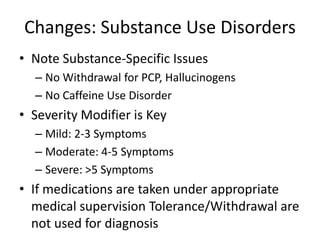
Changes: Substance Use Disorders
• Note Substance-Specific Issues
– No Withdrawal for PCP, Hallucinogens
– No Caffeine Use Disorder

• Severity Modifier is Key
– Mild: 2-3 Symptoms
– Moderate: 4-5 Symptoms
– Severe: >5 Symptoms

• If medications are taken under appropriate
medical supervision Tolerance/Withdrawal are
not used for diagnosis
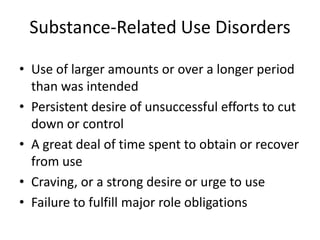
Substance-Related Use Disorders
• Use of larger amounts or over a longer period
than was intended
• Persistent desire of unsuccessful efforts to cut
down or control
• A great deal of time spent to obtain or recover
from use
• Craving, or a strong desire or urge to use
• Failure to fulfill major role obligations
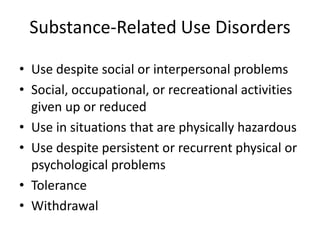
Substance-Related Use Disorders
• Use despite social or interpersonal problems
• Social, occupational, or recreational activities
given up or reduced
• Use in situations that are physically hazardous
• Use despite persistent or recurrent physical or
psychological problems
• Tolerance
• Withdrawal
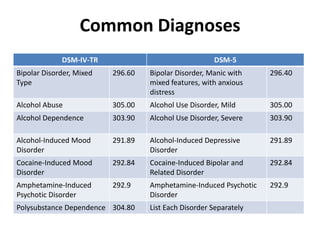
Common Diagnoses
DSM-IV-TR

DSM-5

Bipolar Disorder, Mixed
Type

296.60

Bipolar Disorder, Manic with
mixed features, with anxious
distress

296.40

Alcohol Abuse

305.00

Alcohol Use Disorder, Mild

305.00

Alcohol Dependence

303.90

Alcohol Use Disorder, Severe

303.90

Alcohol-Induced Mood
Disorder

291.89

Alcohol-Induced Depressive
Disorder

291.89

Cocaine-Induced Mood
Disorder

292.84

Cocaine-Induced Bipolar and
Related Disorder

292.84

Amphetamine-Induced
Psychotic Disorder

292.9

Amphetamine-Induced Psychotic
Disorder

292.9

Polysubstance Dependence 304.80

List Each Disorder Separately
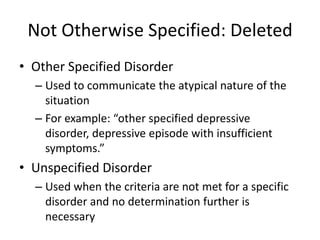
Not Otherwise Specified: Deleted
• Other Specified Disorder
– Used to communicate the atypical nature of the
situation
– For example: “other specified depressive
disorder, depressive episode with insufficient
symptoms.”

• Unspecified Disorder
– Used when the criteria are not met for a specific
disorder and no determination further is
necessary
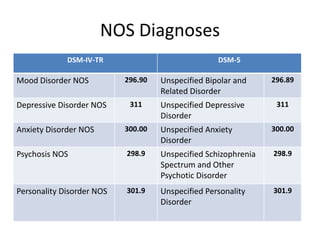
NOS Diagnoses
DSM-IV-TR

Mood Disorder NOS
Depressive Disorder NOS

DSM-5
296.90

Unspecified Bipolar and
Related Disorder

296.89

311

Unspecified Depressive
Disorder

311

Anxiety Disorder NOS

300.00

Unspecified Anxiety
Disorder

300.00

Psychosis NOS

298.9

Unspecified Schizophrenia
Spectrum and Other
Psychotic Disorder

298.9

Personality Disorder NOS

301.9

Unspecified Personality
Disorder

301.9
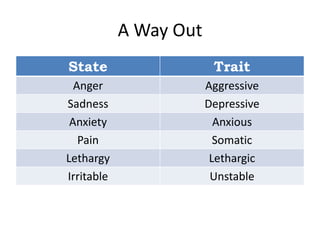
A Way Out
State

Trait

Anger
Sadness
Anxiety
Pain
Lethargy
Irritable

Aggressive
Depressive
Anxious
Somatic
Lethargic
Unstable
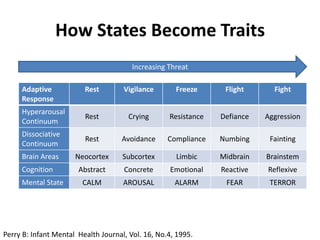
How States Become Traits
Increasing Threat
Adaptive
Response

Rest

Vigilance

Freeze

Flight

Fight

Hyperarousal
Continuum

Rest

Crying

Resistance

Defiance

Aggression

Dissociative
Continuum

Rest

Avoidance

Compliance

Numbing

Fainting

Brain Areas

Neocortex

Subcortex

Limbic

Midbrain

Brainstem

Abstract

Concrete

Emotional

Reactive

Reflexive

CALM

AROUSAL

ALARM

FEAR

TERROR

Cognition
Mental State

Perry B: Infant Mental Health Journal, Vol. 16, No.4, 1995.
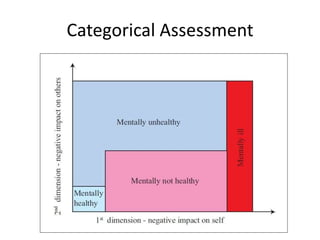
DSM-IV-TR: Categorical Method
• “The naming of categories is the traditional
method of organizing and transmitting
information in everyday life and has been the
fundamental approach used in all systems of
medical diagnosis.” p. xxxi
• “…[I]t is possible that the increasing research
on, and familiarity with, dimensional systems
may eventually result in their greater acceptance
both as a method of conveying clinical
information and as a research tool.” p. xxxii
Categorical Assessment
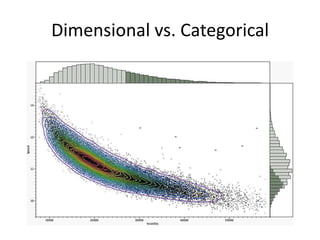
Dimensional vs. Categorical
DSM-5: A Dimensional Approach To
Diagnosis Begins
• “…[T]he once plausible goal of identifying
homogeneous populations for treatment and
research resulted in narrow diagnostic
categories that did not capture clinical
reality…. The historical aspiration of achieving
diagnostic homogeneity by progressive
subtyping with disorder categories no longer
is sensible….” DSM-5, p. 12
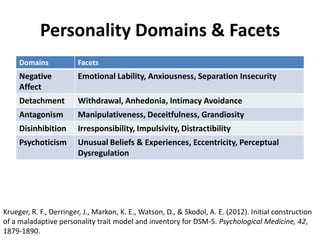
Personality Domains & Facets
Domains

Facets

Negative
Affect

Emotional Lability, Anxiousness, Separation Insecurity

Detachment

Withdrawal, Anhedonia, Intimacy Avoidance

Antagonism

Manipulativeness, Deceitfulness, Grandiosity

Disinhibition

Irresponsibility, Impulsivity, Distractibility

Psychoticism

Unusual Beliefs & Experiences, Eccentricity, Perceptual
Dysregulation

Krueger, R. F., Derringer, J., Markon, K. E., Watson, D., & Skodol, A. E. (2012). Initial construction
of a maladaptive personality trait model and inventory for DSM-5. Psychological Medicine, 42,
1879-1890.
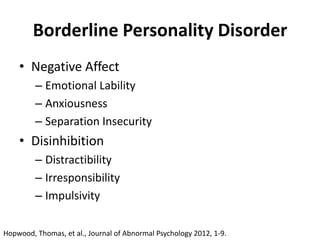
Borderline Personality Disorder
• Negative Affect
– Emotional Lability
– Anxiousness
– Separation Insecurity

• Disinhibition
– Distractibility
– Irresponsibility
– Impulsivity
Hopwood, Thomas, et al., Journal of Abnormal Psychology 2012, 1-9.
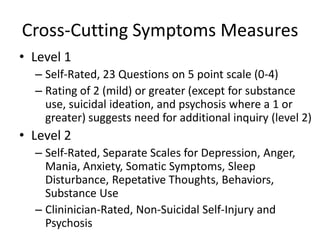
Cross-Cutting Symptoms Measures
• Level 1
– Self-Rated, 23 Questions on 5 point scale (0-4)
– Rating of 2 (mild) or greater (except for substance
use, suicidal ideation, and psychosis where a 1 or
greater) suggests need for additional inquiry (level 2)

• Level 2
– Self-Rated, Separate Scales for Depression, Anger,
Mania, Anxiety, Somatic Symptoms, Sleep
Disturbance, Repetative Thoughts, Behaviors,
Substance Use
– Clininician-Rated, Non-Suicidal Self-Injury and
Psychosis
Self-Reflection
• Cosmetic Changes Reflecting a Putative
Revolution in Thought
• Cross-Cutting Symptoms Measures
• Personality Domains & Facet Measures
• Caring for the Psyche as Psychiatric Treatment

Introduction to the New DSM-5 Manual

  • 1.
    DSM 5.0 (Just inTime or Too Late) Laurence P. Karper, M.D. Vice-Chair, Department of Psychiatry
  • 2.
    What I’m notGoing to Do • I will not discuss subspecialty areas that require focused review and attention – Neurodevelopmental Disorders – Neurocognitive Disorders – Childhood-Onset Disorders • I am only touching upon other areas without clinical relevance to general inpatient or outpatient practice or that merit more in-depth treatment (e.g. Somatic Symptoms and Related Disorders, Trauma- and Stressor-Related Disorders, etc.) • I will not focus on ICD 10, Forensic, or Insurance Issues
  • 3.
    Insurance Considerations • Notthe focus of this presentation • DSM-5 is fully compatible with ICD-9 and 10 but the transition to ICD-10-CM is very complicated and will need further delineation • Crosswalks are currently available for your delectation • Since the codes are what drives insurance use them and list the name separately (e.g. hoarding disorder vs. OCD; both 300.3)
  • 4.
    DSM Editions PageCount 1200 DSM-5 1000 DSM-IV DSM-IV-R 800 600 DSM-III DSM-III-R 400 200 DSM-II DSM-I 0 1950 1960 1970 1980 1990 2000 2010
  • 5.
    For More Information •http://www.psychiatry.org/dsm5 – Assessment Measures – Extensive Fact Sheets – Videos of Thought Leaders – News Articles
  • 6.
    Where is theMind in DSM-5? Does not appear in the “Glossary of Technical Terms” or the Index
  • 7.
    Definition of aMental Disorder A mental disorder is a syndrome characterized by clinically significant disturbance in an individual’s cognition, emotional regulation, or behavior that reflects a dysfunction in the psychological, biological, or developmental processes underlying mental functioning…. An expectable or culturally approved response to a common stressor or loss, such as the death of a loved one, is not a mental disorder.
  • 8.
    Who/What is Disordered? “Alldrugs that are taken in excess have in common direct activation of the brain reward system…. They produce such an intense activation of the reward system that normal activities may be neglected. …[The] roots of substance use disorders for some persons can be seen in behaviors long before the onset of actual substance use itself.” DSM-5, p. 481.
  • 9.
  • 10.
    The Primacy ofReliability • A measure is said to have a high reliability if it produces similar results under consistent conditions. • Validity is the extent to which a concept, conclusion, or measurement is wellfounded and corresponds accurately to the real world.
  • 11.
    Multiaxial System: Deleted •“DSM-5 has moved to a non-axial documentation of diagnosis.” p.16 • Never needed in DSM-IV-TR • GAF dropped due to “conceptual lack of clarity” and “questionable psychometrics in routine practice.” Instead WHODAS 2.0 is to be used • The principal diagnosis (reason for visit) is listed first • In the case of mental disorders due to another medical condition “ICD coding rules requires that the etiological medical condition be listed first.” p.23 • The phrase “general medical condition” is replaced in DSM-5 with “another medical condition” where relevant across all disorders.
  • 12.
    Changes: Schizophrenia • Removalof subtypes of schizophrenia (dimensional measures) • Two changes were made to DSM-IV Criterion A for schizophrenia. The first change is the elimination of the special attribution of bizarre delusions and Schneiderian first-rank auditory hallucinations (e.g., two or more voices conversing). In DSM-IV, only one such symptom was needed to meet the diagnostic requirement for Criterion A, instead of two of the other listed symptoms. This special attribution removed due to the non-specificity of Schneiderian symptoms and the poor reliability in distinguishing bizarre from non-bizarre delusions. Therefore, in DSM-5, two Criterion A symptoms are required for any diagnosis of schizophrenia. The second change is the addition of a requirement in Criterion A that the individual must have at least one of these three symptoms: delusions, hallucinations, and disorganized speech. At least one of these core “positive symptoms” is necessary for a reliable diagnosis of schizophrenia
  • 13.
    Changes: Bipolar Disorders •Bipolar disorders now include both changes in mood and changes in activity or energy • Mixed Type is Deleted • Specifiers “with mixed features” and “anxious distress” are added
  • 14.
    Changes: Depressive Disorders •Premenstrual Dysphoric Disorder (625.4) is promoted from Appendix B • Dysthymia is replace by Persistent Depressive Disorder (dysthymia) (300.4) • Specifiers “with mixed features” and “anxious distress” are added • Bereavement exclusion omitted
  • 15.
    Changes: Substance UseDisorders • Note Substance-Specific Issues – No Withdrawal for PCP, Hallucinogens – No Caffeine Use Disorder • Severity Modifier is Key – Mild: 2-3 Symptoms – Moderate: 4-5 Symptoms – Severe: >5 Symptoms • If medications are taken under appropriate medical supervision Tolerance/Withdrawal are not used for diagnosis
  • 16.
    Substance-Related Use Disorders •Use of larger amounts or over a longer period than was intended • Persistent desire of unsuccessful efforts to cut down or control • A great deal of time spent to obtain or recover from use • Craving, or a strong desire or urge to use • Failure to fulfill major role obligations
  • 17.
    Substance-Related Use Disorders •Use despite social or interpersonal problems • Social, occupational, or recreational activities given up or reduced • Use in situations that are physically hazardous • Use despite persistent or recurrent physical or psychological problems • Tolerance • Withdrawal
  • 18.
    Common Diagnoses DSM-IV-TR DSM-5 Bipolar Disorder,Mixed Type 296.60 Bipolar Disorder, Manic with mixed features, with anxious distress 296.40 Alcohol Abuse 305.00 Alcohol Use Disorder, Mild 305.00 Alcohol Dependence 303.90 Alcohol Use Disorder, Severe 303.90 Alcohol-Induced Mood Disorder 291.89 Alcohol-Induced Depressive Disorder 291.89 Cocaine-Induced Mood Disorder 292.84 Cocaine-Induced Bipolar and Related Disorder 292.84 Amphetamine-Induced Psychotic Disorder 292.9 Amphetamine-Induced Psychotic Disorder 292.9 Polysubstance Dependence 304.80 List Each Disorder Separately
  • 19.
    Not Otherwise Specified:Deleted • Other Specified Disorder – Used to communicate the atypical nature of the situation – For example: “other specified depressive disorder, depressive episode with insufficient symptoms.” • Unspecified Disorder – Used when the criteria are not met for a specific disorder and no determination further is necessary
  • 20.
    NOS Diagnoses DSM-IV-TR Mood DisorderNOS Depressive Disorder NOS DSM-5 296.90 Unspecified Bipolar and Related Disorder 296.89 311 Unspecified Depressive Disorder 311 Anxiety Disorder NOS 300.00 Unspecified Anxiety Disorder 300.00 Psychosis NOS 298.9 Unspecified Schizophrenia Spectrum and Other Psychotic Disorder 298.9 Personality Disorder NOS 301.9 Unspecified Personality Disorder 301.9
  • 21.
  • 22.
    How States BecomeTraits Increasing Threat Adaptive Response Rest Vigilance Freeze Flight Fight Hyperarousal Continuum Rest Crying Resistance Defiance Aggression Dissociative Continuum Rest Avoidance Compliance Numbing Fainting Brain Areas Neocortex Subcortex Limbic Midbrain Brainstem Abstract Concrete Emotional Reactive Reflexive CALM AROUSAL ALARM FEAR TERROR Cognition Mental State Perry B: Infant Mental Health Journal, Vol. 16, No.4, 1995.
  • 23.
    DSM-IV-TR: Categorical Method •“The naming of categories is the traditional method of organizing and transmitting information in everyday life and has been the fundamental approach used in all systems of medical diagnosis.” p. xxxi • “…[I]t is possible that the increasing research on, and familiarity with, dimensional systems may eventually result in their greater acceptance both as a method of conveying clinical information and as a research tool.” p. xxxii
  • 24.
  • 25.
  • 26.
    DSM-5: A DimensionalApproach To Diagnosis Begins • “…[T]he once plausible goal of identifying homogeneous populations for treatment and research resulted in narrow diagnostic categories that did not capture clinical reality…. The historical aspiration of achieving diagnostic homogeneity by progressive subtyping with disorder categories no longer is sensible….” DSM-5, p. 12
  • 27.
    Personality Domains &Facets Domains Facets Negative Affect Emotional Lability, Anxiousness, Separation Insecurity Detachment Withdrawal, Anhedonia, Intimacy Avoidance Antagonism Manipulativeness, Deceitfulness, Grandiosity Disinhibition Irresponsibility, Impulsivity, Distractibility Psychoticism Unusual Beliefs & Experiences, Eccentricity, Perceptual Dysregulation Krueger, R. F., Derringer, J., Markon, K. E., Watson, D., & Skodol, A. E. (2012). Initial construction of a maladaptive personality trait model and inventory for DSM-5. Psychological Medicine, 42, 1879-1890.
  • 28.
    Borderline Personality Disorder •Negative Affect – Emotional Lability – Anxiousness – Separation Insecurity • Disinhibition – Distractibility – Irresponsibility – Impulsivity Hopwood, Thomas, et al., Journal of Abnormal Psychology 2012, 1-9.
  • 29.
    Cross-Cutting Symptoms Measures •Level 1 – Self-Rated, 23 Questions on 5 point scale (0-4) – Rating of 2 (mild) or greater (except for substance use, suicidal ideation, and psychosis where a 1 or greater) suggests need for additional inquiry (level 2) • Level 2 – Self-Rated, Separate Scales for Depression, Anger, Mania, Anxiety, Somatic Symptoms, Sleep Disturbance, Repetative Thoughts, Behaviors, Substance Use – Clininician-Rated, Non-Suicidal Self-Injury and Psychosis
  • 30.
    Self-Reflection • Cosmetic ChangesReflecting a Putative Revolution in Thought • Cross-Cutting Symptoms Measures • Personality Domains & Facet Measures • Caring for the Psyche as Psychiatric Treatment