MINDMAPPING “Connect With the Best” Adjunct Academy 2007 Paula Finch, M.S.Ed. w/interdisciplinary studies in counseling
A mind map will help your students visualize ideas, tasks, solutions, or how specific information is structured. A mind map can serve as a non-linear,interactive strategy for brainstorming and a visual map that supports learning. MINDMAPPING CREATOR: Tony Buzan, The Brain
Create a Mindmap The basic laws or the 3 A’s Accept No preconceptions Follow the laws Imitate Models Apply To be an expert – 100 mind maps Notes Taking  Making  Adapt Ongoing Development Personal Style
Techniques Emphasis Central Image Lots of Images Colors Dimension Big  Medium  small Senses Spacing Tall Short
Techniques cont. Association Arrows Colors Codes = !@#$%^&* Be Clean Add blank lines Ask Questions Add Images
Techniques cont. Be Clear Do not scribble One word per line Print the length of the line Paper holding/upright printing Key words on thicker lines
Techniques cont. Develop A Personal Style More colors 3-deminsional Imaginative Beautiful
Studying the Mindmap Study 10 – 30 minutes per day Review once a week Review once a month Review every three months Review every six months = Long Term Memory Storage
Types of Mindmaps Self-Analysis Making Choices Stress Problem Solving Group Mind Maps Meetings Presentations Studying
Create One You will need white construction paper or clean newspaper print. Colored markers. Thin and Thick Highlighters
PLAYTIME GROUP MINDMAPPING RULES Environment Should be the best. Should be comfortable. Should be attractive. Quick Fire / All ideas are accepted and supported. B.O.I.’s = Basic Ordering of Information Reconstruction  Revision
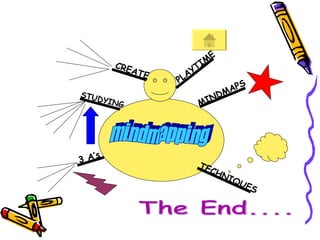
mindmapping TECHNIQUES PLAYTIME STUDYING MINDMAPS 3 A’s CREATE The End....

Mindmapping

  • 1.
    MINDMAPPING “Connect Withthe Best” Adjunct Academy 2007 Paula Finch, M.S.Ed. w/interdisciplinary studies in counseling
  • 2.
    A mind mapwill help your students visualize ideas, tasks, solutions, or how specific information is structured. A mind map can serve as a non-linear,interactive strategy for brainstorming and a visual map that supports learning. MINDMAPPING CREATOR: Tony Buzan, The Brain
  • 3.
    Create a MindmapThe basic laws or the 3 A’s Accept No preconceptions Follow the laws Imitate Models Apply To be an expert – 100 mind maps Notes Taking Making Adapt Ongoing Development Personal Style
  • 4.
    Techniques Emphasis CentralImage Lots of Images Colors Dimension Big Medium small Senses Spacing Tall Short
  • 5.
    Techniques cont. AssociationArrows Colors Codes = !@#$%^&* Be Clean Add blank lines Ask Questions Add Images
  • 6.
    Techniques cont. BeClear Do not scribble One word per line Print the length of the line Paper holding/upright printing Key words on thicker lines
  • 7.
    Techniques cont. DevelopA Personal Style More colors 3-deminsional Imaginative Beautiful
  • 8.
    Studying the MindmapStudy 10 – 30 minutes per day Review once a week Review once a month Review every three months Review every six months = Long Term Memory Storage
  • 9.
    Types of MindmapsSelf-Analysis Making Choices Stress Problem Solving Group Mind Maps Meetings Presentations Studying
  • 10.
    Create One Youwill need white construction paper or clean newspaper print. Colored markers. Thin and Thick Highlighters
  • 11.
    PLAYTIME GROUP MINDMAPPINGRULES Environment Should be the best. Should be comfortable. Should be attractive. Quick Fire / All ideas are accepted and supported. B.O.I.’s = Basic Ordering of Information Reconstruction Revision
  • 12.
    mindmapping TECHNIQUES PLAYTIMESTUDYING MINDMAPS 3 A’s CREATE The End....