
ARGUMENT MAPPING AS TOOL TO
 STIMULATE CRITICAL THINKING
                                        P   AU S W E 2 0 1 3
                           L E AH H A       M I L T O N , M S W , P H D
    AS S I S T AN T   P R O F E S S O R      AN D F I E L D E D U C A T I O N   D I R E C T O R
                                    J U N   I AT A C O L L E G E
WHAT IS ARGUMENT MAPPING?

 • Definition: “Argument mapping is a way to visually
   show the logical structure of arguments. You break
   up an argument into its constituent claims, and use
   lines, boxes… and location to indicate the
   relationships between the various parts. The
   resulting map allows us to see exactly how each
   part of an argument is related to every other part.”


Source: Ostwald, J. (2013). Argument mapping-The basics. Retrieved from
http://www.jostwald.com/ArgumentMapping/ARGUMENT%20MAPPING.pdf.
WHY USE ARGUMENT MAPPING?

             • Human have
               evolved to be
               “pattern seeking,
               story-telling
               animals”.
             • If a statement
               makes intuitive
               sense, it will be
               believed.
WHY USE ARGUMENT MAPPING?

• Most people do not
  naturally exhibit
  critical thinking.
• Most people are
  unable to provide
  reasons for their
  opinions.
• Critical thinking is a
  learned skill.
WHY USE ARGUMENT MAPPING?

             • There is no “magic
               bullet.”
             • Critical thinking is
               not learned by
               osmosis.
             • Argument mapping
               is associated with
               improved critical
               thinking.
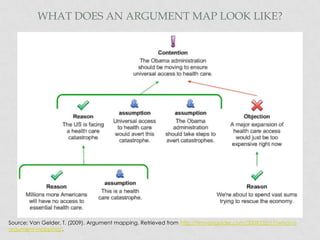
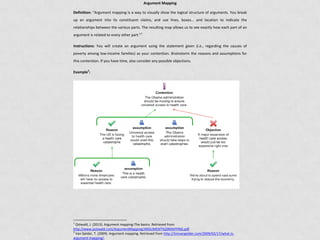
WHAT DOES AN ARGUMENT MAP LOOK LIKE?


Source: Van Gelder, T. (2009). Argument mapping. Retrieved from http://timvangelder.com/2009/02/17/what-is-
argument-mapping/.
THE ASSIGNMENT: 4 RANDOMLY
           ASSIGNED GROUPS
• Group 1: Choose a speaker for your group. As a group, you will prepare
  your speaker to defend the following statement. “Deficient values in poor
  families are responsible for the poverty experienced by this population.”
  As a group, prepare talking points for your speaker to use in a larger
  classroom debate.
• Group 2: Choose a speaker for your group. As a group, you will prepare
  your speaker to defend the following statement. “Deficient values in poor
  families are responsible for the poverty experienced by this population.”
  As a group, you will create an argument map (see instructions attached)
  to prepare your speaker for a larger classroom debate.
• Group 3: Choose a speaker for your group. As a group, you will prepare
  your speaker to defend the following statement. “Internal
  colonization/economic marginalization are responsible for the poverty
  experienced by poor families.” As a group, prepare talking points for your
  speaker to use in a larger classroom debate.
• Group 4: Choose a speaker for your group. As a group, you will prepare
  your speaker to defend the following statement. “Internal
  colonization/economic marginalization are responsible for the poverty
  experienced by poor families.” As a group, you will create an argument
  map (see instructions attached) to prepare your speaker for a larger
  classroom debate.
Argument Mapping

Definition: “Argument mapping is a way to visually show the logical structure of arguments. You break
up an argument into its constituent claims, and use lines, boxes… and location to indicate the
relationships between the various parts. The resulting map allows us to see exactly how each part of an
argument is related to every other part.”1

Instructions: You will create an argument using the statement given (i.e., regarding the causes of
poverty among low-income families) as your contention. Brainstorm the reasons and assumptions for
this contention. If you have time, also consider any possible objections.

Example2:


1
  Ostwald, J. (2013). Argument mapping-The basics. Retrieved from
http://www.jostwald.com/ArgumentMapping/ARGUMENT%20MAPPING.pdf.
2
  Van Gelder, T. (2009). Argument mapping. Retrieved from http://timvangelder.com/2009/02/17/what-is-
argument-mapping/.
PRETEST

 • ID# (Choose a random 3 digit number. Save this
   number in your notes for future reference.):
 • Group # (circle one):                1       2       3       4
 • Please indicate (circle one) the degree to
   which you personally agree with the statement
   that your group has been assigned to defend:
1------------------2-----------------3---------------4---------------5
Strongly         Agree         Neutral         Disagree Strongly
agree                                                  disagree
POSTTEST

 • ID# (Include the same 3 digit number from your pretest):
 • Group # (circle one):                       1          2           3          4
 • Please indicate (circle one) the degree to which you personally
    agree with the statement that your group has been assigned to
    defend:
1--------------------------2-------------------3------------------------4----------------------------5
Strongly               Agree            Neutral              Disagree                      Strongly
agree                                                                                    disagree
 • How did this activity influence your original opinion on the issue (circle
    one)?
     1.   My opinion did not change at all.
     2.   My opinion did not change, but this activity did cause me to question some of my
          previous assumptions.
     3.    This activity has caused me to question my previous assumptions and now I am not
          sure how I feel about the issue.
     4.   During this activity, my opinion on the issue changed.
TALKING POINTS VS. ARGUMENT
               MAPPING
 3                                                  2.714
2.5
                                           2
 2

1.5

 1                    0.7857
0.5        0.2857
 0
      Opinion Change Average (Q1)   Nature of Influence Average
                                                 (Q2)
                Talking Points   Argument Mapping
VALUES VS. MARGINALIZATION

3.5                                                 3.1667
 3
2.5
 2                                        1.75
1.5
 1                    0.6667
           0.4375
0.5
 0
      Opinion Change Average (Q1)   Nature of Influence Average
                                                 (Q2)
                     Values    Marginalization
REFERENCES & DISCUSSION

• Van Gelder, T. (2005). Teaching Critical Thinking:
  Some Lessons From Cognitive Science. College
  Teaching, 53(1), 41–48. doi:10.3200/CTCH.53.1.41-48
• Van Gelder, T., Bissett, M., & Cumming, G. (2004).
  Cultivating expertise in informal reasoning.
  Canadian journal of experimental
  psychology, 58(2), 142–52. Retrieved from
  http://www.ncbi.nlm.nih.gov/pubmed/15285604

• Are there better ways to measure this activity?
• Would this activity be applicable in your classes?
• Are there other ways for students to practice the art
  of critical thinking?
CONTACT INFORMATION

• Email: hamilton@juniata.edu
• Slides at leahhamilton.net

Argument mapping

  • 1.
    ARGUMENT MAPPING ASTOOL TO STIMULATE CRITICAL THINKING P AU S W E 2 0 1 3 L E AH H A M I L T O N , M S W , P H D AS S I S T AN T P R O F E S S O R AN D F I E L D E D U C A T I O N D I R E C T O R J U N I AT A C O L L E G E
  • 2.
    WHAT IS ARGUMENTMAPPING? • Definition: “Argument mapping is a way to visually show the logical structure of arguments. You break up an argument into its constituent claims, and use lines, boxes… and location to indicate the relationships between the various parts. The resulting map allows us to see exactly how each part of an argument is related to every other part.” Source: Ostwald, J. (2013). Argument mapping-The basics. Retrieved from http://www.jostwald.com/ArgumentMapping/ARGUMENT%20MAPPING.pdf.
  • 3.
    WHY USE ARGUMENTMAPPING? • Human have evolved to be “pattern seeking, story-telling animals”. • If a statement makes intuitive sense, it will be believed.
  • 4.
    WHY USE ARGUMENTMAPPING? • Most people do not naturally exhibit critical thinking. • Most people are unable to provide reasons for their opinions. • Critical thinking is a learned skill.
  • 5.
    WHY USE ARGUMENTMAPPING? • There is no “magic bullet.” • Critical thinking is not learned by osmosis. • Argument mapping is associated with improved critical thinking.
  • 6.
    WHAT DOES ANARGUMENT MAP LOOK LIKE? Source: Van Gelder, T. (2009). Argument mapping. Retrieved from http://timvangelder.com/2009/02/17/what-is- argument-mapping/.
  • 7.
    THE ASSIGNMENT: 4RANDOMLY ASSIGNED GROUPS • Group 1: Choose a speaker for your group. As a group, you will prepare your speaker to defend the following statement. “Deficient values in poor families are responsible for the poverty experienced by this population.” As a group, prepare talking points for your speaker to use in a larger classroom debate. • Group 2: Choose a speaker for your group. As a group, you will prepare your speaker to defend the following statement. “Deficient values in poor families are responsible for the poverty experienced by this population.” As a group, you will create an argument map (see instructions attached) to prepare your speaker for a larger classroom debate. • Group 3: Choose a speaker for your group. As a group, you will prepare your speaker to defend the following statement. “Internal colonization/economic marginalization are responsible for the poverty experienced by poor families.” As a group, prepare talking points for your speaker to use in a larger classroom debate. • Group 4: Choose a speaker for your group. As a group, you will prepare your speaker to defend the following statement. “Internal colonization/economic marginalization are responsible for the poverty experienced by poor families.” As a group, you will create an argument map (see instructions attached) to prepare your speaker for a larger classroom debate.
  • 8.
    Argument Mapping Definition: “Argumentmapping is a way to visually show the logical structure of arguments. You break up an argument into its constituent claims, and use lines, boxes… and location to indicate the relationships between the various parts. The resulting map allows us to see exactly how each part of an argument is related to every other part.”1 Instructions: You will create an argument using the statement given (i.e., regarding the causes of poverty among low-income families) as your contention. Brainstorm the reasons and assumptions for this contention. If you have time, also consider any possible objections. Example2: 1 Ostwald, J. (2013). Argument mapping-The basics. Retrieved from http://www.jostwald.com/ArgumentMapping/ARGUMENT%20MAPPING.pdf. 2 Van Gelder, T. (2009). Argument mapping. Retrieved from http://timvangelder.com/2009/02/17/what-is- argument-mapping/.
  • 9.
    PRETEST • ID#(Choose a random 3 digit number. Save this number in your notes for future reference.): • Group # (circle one): 1 2 3 4 • Please indicate (circle one) the degree to which you personally agree with the statement that your group has been assigned to defend: 1------------------2-----------------3---------------4---------------5 Strongly Agree Neutral Disagree Strongly agree disagree
  • 10.
    POSTTEST • ID#(Include the same 3 digit number from your pretest): • Group # (circle one): 1 2 3 4 • Please indicate (circle one) the degree to which you personally agree with the statement that your group has been assigned to defend: 1--------------------------2-------------------3------------------------4----------------------------5 Strongly Agree Neutral Disagree Strongly agree disagree • How did this activity influence your original opinion on the issue (circle one)? 1. My opinion did not change at all. 2. My opinion did not change, but this activity did cause me to question some of my previous assumptions. 3. This activity has caused me to question my previous assumptions and now I am not sure how I feel about the issue. 4. During this activity, my opinion on the issue changed.
  • 11.
    TALKING POINTS VS.ARGUMENT MAPPING 3 2.714 2.5 2 2 1.5 1 0.7857 0.5 0.2857 0 Opinion Change Average (Q1) Nature of Influence Average (Q2) Talking Points Argument Mapping
  • 12.
    VALUES VS. MARGINALIZATION 3.5 3.1667 3 2.5 2 1.75 1.5 1 0.6667 0.4375 0.5 0 Opinion Change Average (Q1) Nature of Influence Average (Q2) Values Marginalization
  • 13.
    REFERENCES & DISCUSSION •Van Gelder, T. (2005). Teaching Critical Thinking: Some Lessons From Cognitive Science. College Teaching, 53(1), 41–48. doi:10.3200/CTCH.53.1.41-48 • Van Gelder, T., Bissett, M., & Cumming, G. (2004). Cultivating expertise in informal reasoning. Canadian journal of experimental psychology, 58(2), 142–52. Retrieved from http://www.ncbi.nlm.nih.gov/pubmed/15285604 • Are there better ways to measure this activity? • Would this activity be applicable in your classes? • Are there other ways for students to practice the art of critical thinking?
  • 14.
    CONTACT INFORMATION • Email:hamilton@juniata.edu • Slides at leahhamilton.net

Editor's Notes

  • #4 Human beings did not evolve into critical thinkers. Human have evolved to be “pattern seeking, story-telling animals”.In other words, if a statement makes intuitive sense, it will be believed.
  • #5 Most people do not naturally exhibit critical thinking.Most people are unable to provide reasons for their opinions.Critical thinking is a learned skill.Critical thinking is a difficult skill that must be developed with practice.
  • #6 There is no “magic bullet.” Most faculty assume that students will gain the skills of critical thinking by osmosis. Instead, this needs to be a practiced skill. Students in an undergraduate Critical Thinking course performed much better when the course included a heavy use of argument mapping (Van Gelder, Bissett, & Cumming, 2004). The concept of critical thinking is especially salient in social work education courses where we address common stereotypes about client populations and inequality.
  • #8 Groups assigned alphabetically
  • #9 A handout for the argument mappers:
  • #12 Because I had a small N (14), my results are far from significant. I didn’t even test for significance. Instead, I looked at the average degrees of change. So, if a student originally answered that they were “neutral” on the issue, which is coded as a 3, but ended at a 4 (disagree), there rate of change was 1. In this graph, I looked at the differences between groups that were assigned talking points versus argument mapping. 1st question (to what degree do you agree with this statement?): Students who were assigned to create talking points had an average change rate of .2875. Students assigned to create an argument map had an average rate of change of .7857.2nd question (how did this activity influence your original opinion?): talking points reported an average of 2 (My opinion did not change, but this activity did cause me to question some of my previous assumptions.) argument mapping reported an average of 2.714, which is closer to 3 (This activity has caused me to question my previous assumptions and now I am not sure how I feel about the issue.)
  • #13 In this chart, I looked at students who were assigned to look at the values versus marginalization statements. 1st question (to what degree do you agree with this statement?): students defending the values statement had an average rate of change of .4375, marginalization=.6667.2nd question (how did this activity influence your original opinion?): students defending the values statement reported an average of 1.75, close to 2 (My opinion did not change, but this activity did cause me to question some of my previous assumptions) and those defending the marginalization argument reported an average of 3.1667 (This activity has caused me to question my previous assumptions and now I am not sure how I feel about the issue.)