Unless there is a collapse of China, I would predict that
within ten years or so, we will see as many books in the
United States and Europe entitled “Secrets of Chinese
Management” as, during the last ten years, we have
seen books entitled “Secrets of Japanese
Management.”
The Chinese are developing a distinct and quite
different management style and management structure.
The secret of Chinese management may well consist in
the ability of the Chinese to make the family into a
modern corporation.
Peter Drucker
November 10, 1994
Innovative Markets
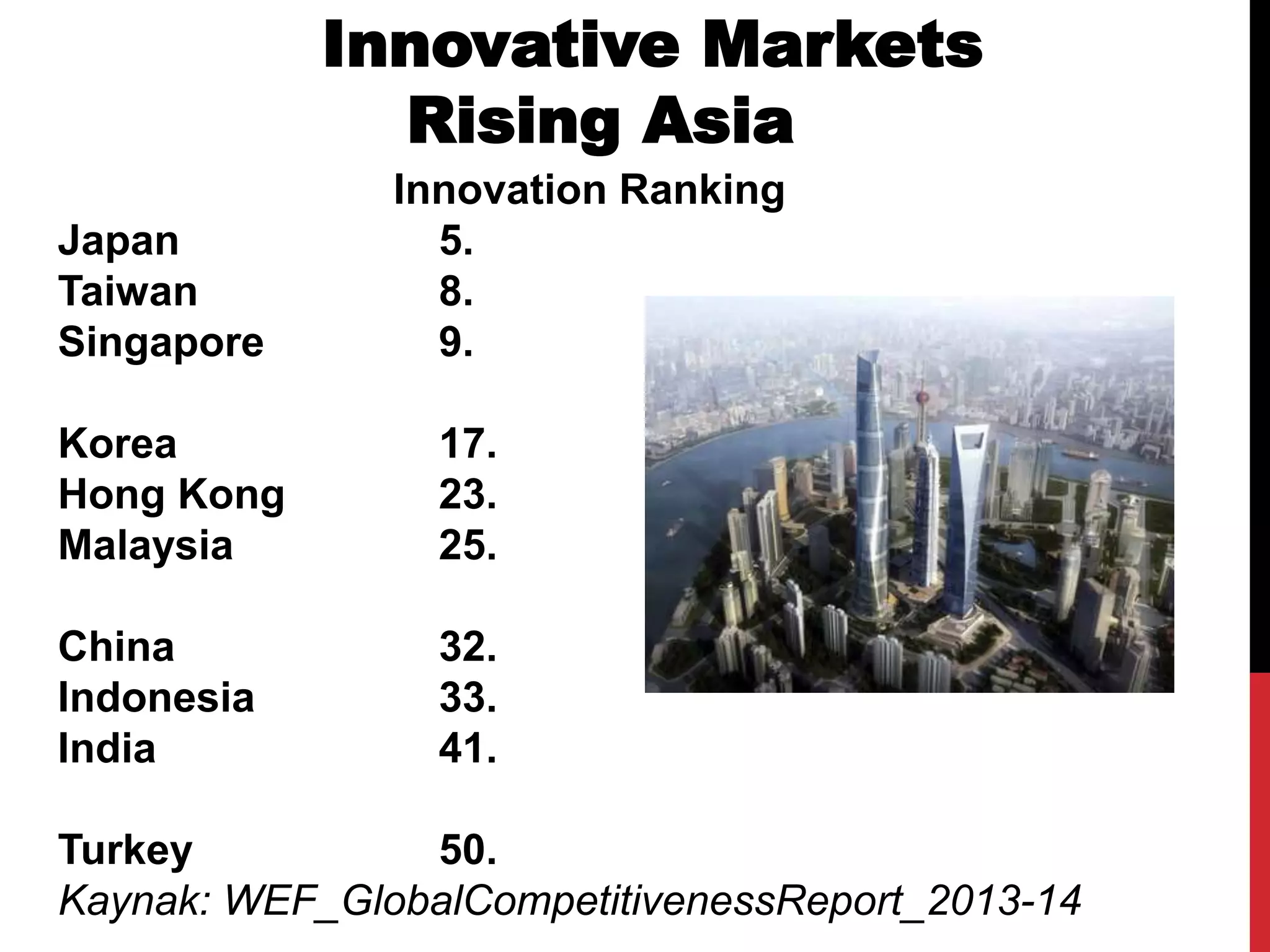
Rising Asia
Innovation Ranking
Japan 5.
Taiwan 8.
Singapore 9.
Korea 17.
Hong Kong 23.
Malaysia 25.
China 32.
Indonesia 33.
India 41.
Turkey 50.
Kaynak: WEF_GlobalCompetitivenessReport_2013-14
I am confident that a third economic miracle will happen in
Japan.
In the next five or ten years, every developed country and
every major business within it, will have to learn to innovate.
Also, every country will have to learn how to encourage and
develop entrepreneurs. This is by no means limited to
Japan, but the need may be greatest in Japan, and most
difficult to satisfy.
The great successes of Japan, which made Japan, a world
leader and an economic power of the first rank, were largely
in industries which were developed well before World War II,
and mostly in the 1920s: automobiles, consumer
electronics, steel, ship building and so on.
Amongst the developed countries, Japan has the most
successful entrepreneurial performance after the Pacific
War. In Japan, there are signs of diminishing entrepreneurial
vigor just when we need it most.
We actually know what is needed. There is, in fact, no
excuse for any country, for any economy, for any industry, for
any company, not to be innovative.
İnnovative Markets
We know, first that we face two parallel but seperate challenges.
We need entrepreneurs, who can start new businesses outside
established companies.
We need people like Honda, like Morito Akio of Sony, and many
others- the people who created today’s Japanese economy and
society, and did it by building businesses outside the existing
system.
We also need to build into the existing business a capacity to
innovate.
If the existing system does not learn to become entrepreneurial
and innovative, we face far too much social dislocation.
Secondly, we know how to organize for entrepreneurship and
innovation. We have the discipline for it, although forty years ago,
when you started, it did not exist. We know that innovation
begins with looking at the changes that have already happened
in economy, in society and in technology, in order to find the
opportunities for successful innovation. As you know, I wrote a
book on this, some ten years ago. The title is Innovation and
Entrepreneurship, so I shall not bore you or our readers by
repeating what this book reported as a result of my forty years of
work in this area. It is not difficult, in fact, to become innovative.
İnnovative Markets
Young people are required
The next issue is something else again, at least for Japan.
Innovation and entrepreneurship require young people.
Unless you start to innovate in your twenties or, at the
latest, in your early thirties, you will never do it.
You yourself, if I may say so, were barely thirty when you
started to build what is now Daiei. Morita was twenty seven
or twenty eight when he began to build what is now Sony.
Honda was not much older. Matsushita was even younger.
And the men of the Meiji period were all in their late
twenties when they began. Shibusawa Eiichi (whom I
consider the real father of modern Japan), founded the
first modern Japanese bank when he was thirty. Fukuzawa
Yukichi published his first important book when he was
twenty six, and founded Keio University when he was thirty
seven. Iwasaki Yataro established what is now known as
Mitsubishi when he was twenty six.
The same is true in every country. Innovators and
entrepreneurs have to start early.
Innovative Markets
This may be the greatest challenge for Japan. It requires
changes in the financial system so that young
entrepreneurs can have access to capital. To the best of
my knowledge, there is no way of obtaining venture capital
in Japan, today. But, above all, it requires tremendous
changes in the way big companies are organized, especially
drastic changes in the way existing companies manage their
younger people. That it can be done is demonstrated by the
example of two American companies that are among the
world’s largest businesses but which have managed to
remain innovative.
One is 3M, the world’s leader in half a dozen different
industries; the other one is Johnson & Johnson, the
world’s leader in a wide variety of health-care products. In
both you cannot gain admission to senior management
unless you proposed a new product before you were
thirty, and then built a successful business on it.
How do you build this approach into the existing successful,
large company? I am not talking of Japanese companies
alone. We have the same problem in the United States and
in Europe.
Innovative Markets
Innovative Markets
Innovators do not work in a team
In Japan the problem may be most difficult and most acute. One
reason is that innovators are not team-players. Innovation cannot
be done by committee. As you exemplify, it is highly individual
and very lonely. Successful innovators build teams, but they do
not work in a team. They work alone and by themselves. This is
not what existing, large companies want and tolerate, let alone
encourage. Yet, it is what they will have to learn to do.
It requires changes in rewards. It requires that young people, in the
first ten years of work within a company, are challenged to step out of
line and make radical suggestions for change – and that the
company then encourages them and sets them up to perform what
they have promised. It requires that society values and respects
the individual entrepreneur who starts a business on his own,
rather than give all approval to the organization man.
Role of pioneers
You may say that these are radical changes, and changes which are
all but impossible for Japanese companies, and Japanese society. In
fact, when I discuss these things with my friends, I am being told that
I am talking of a cultural revolution. My American or German friends
are very often just as skeptical as my Japanese friends. But what
happened in Japan in the Meiji era, and what happened forty years
ago in the 1950s, represent even more radical cultural
revolutions. In fact, we do not need to have every company change
the way it manages to bring about such a cultural revolution.
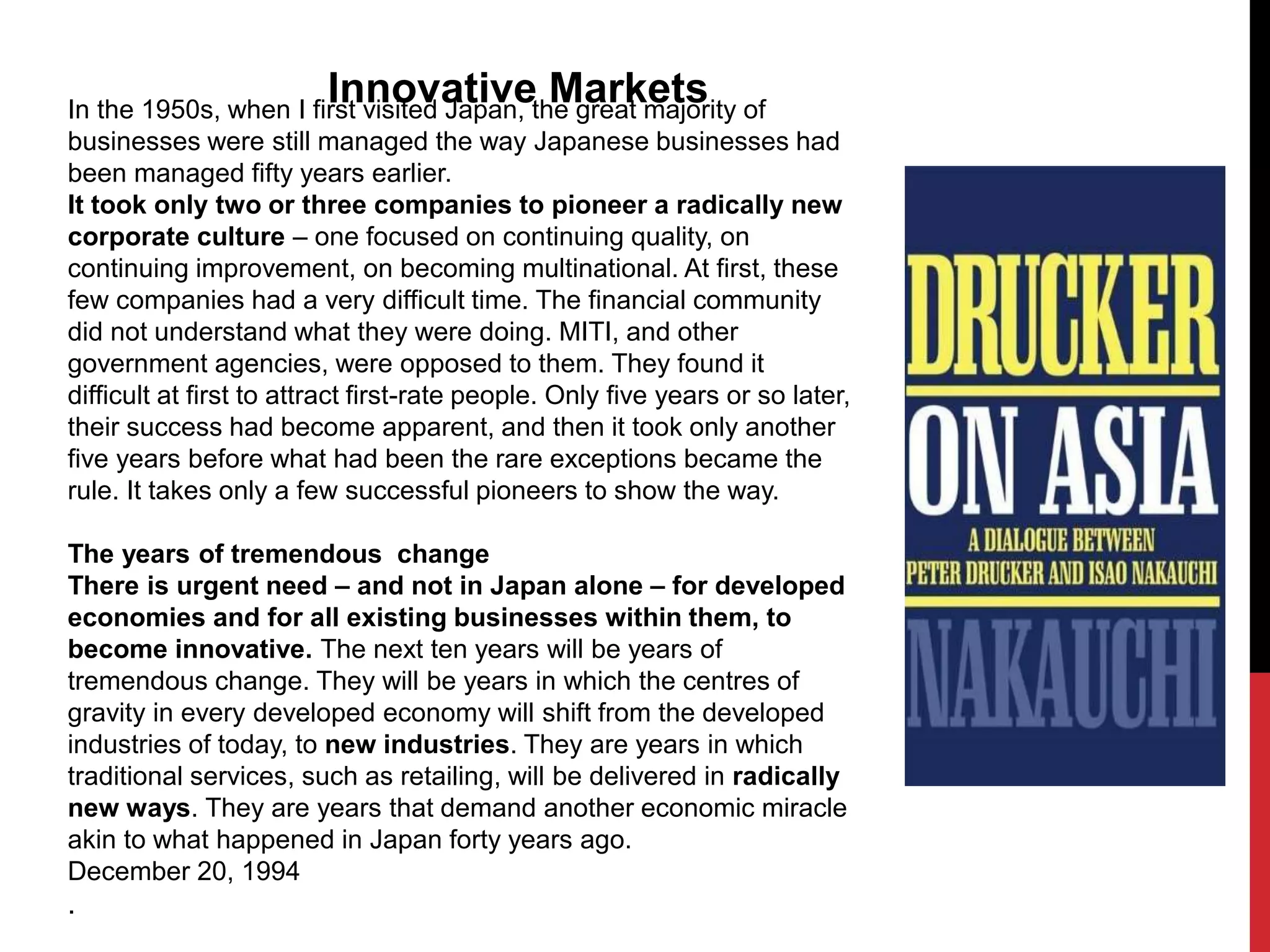
In the 1950s, when I first visited Japan, the great majority of
businesses were still managed the way Japanese businesses had
been managed fifty years earlier.
It took only two or three companies to pioneer a radically new
corporate culture – one focused on continuing quality, on
continuing improvement, on becoming multinational. At first, these
few companies had a very difficult time. The financial community
did not understand what they were doing. MITI, and other
government agencies, were opposed to them. They found it
difficult at first to attract first-rate people. Only five years or so later,
their success had become apparent, and then it took only another
five years before what had been the rare exceptions became the
rule. It takes only a few successful pioneers to show the way.
The years of tremendous change
There is urgent need – and not in Japan alone – for developed
economies and for all existing businesses within them, to
become innovative. The next ten years will be years of
tremendous change. They will be years in which the centres of
gravity in every developed economy will shift from the developed
industries of today, to new industries. They are years in which
traditional services, such as retailing, will be delivered in radically
new ways. They are years that demand another economic miracle
akin to what happened in Japan forty years ago.
December 20, 1994
.
Innovative Markets
Innovation
Drucker’s Five Principles of Innovation
1. “Purposeful, systematic innovation begins with the analysis of the
opportunities. It begins with thinking through…the sources of innovative
opportunities.”
2. “Innovation is both conceptual and perceptual… Successful
innovators…look at figures, and they look at people. They work out
analytically what the innovation has to be to satisfy an opportunity. And
then they go out and look at the customers, the users, to see what their
expectations, their values, their needs are.”
3. “An innovation, to be effective, has to be simple and it has to be focused.
It should do only one thing, otherwise, it confuses. All effective innovations are
breath takingly simple. Indeed, the greatest praise an innovation can receive is
for people to say: ‘This is obvious. Why didn’t I think of it?’”
4. “Effective innovations start small… They try to do one specific thing.”
5. “A successful innovation aims at leadership [within a given market or
industry]… If an innovation does not aim at leadership from the beginning, it
is unlikely to be innovative enough, and therefore unlikely to be capable of
establishing itself.”
From Innovation and Entrepreneurship by Peter F. Drucker
Innovation
Drucker viewed innovation……
Peter Drucker viewed innovation as the tool or instrument used by
entrepreneurs to exploit change as an opportunity.
He argued that innovation, as a discipline, is capable of being learned, as well as
practiced.
While he never agreed to a theory of innovation, he realized enough was
known to develop it as a practice – a practice based on when, where and
how one looks systematically for (innovative) opportunities and how one
judges the chances for their success or the risks of their failure.
From Drucker’s perspective, systematic innovation consisted of the
purposeful and organized search for changes, and in the systematic
analysis of the opportunities such changes might offer for economic or
social innovation.
As such, innovation of the 1980s took place in large corporate R&D departments,
as well as academic institutions. Now when people want to innovate and be
entrepreneurial, they leave the corporate world and set out on their own. They
get money for their start-up ventures from a variety of sources, sometimes even
mortgaging their homes. Often they take substantial risks to follow their dreams,
which is where the term “lifestyle entrepreneur” was born.
Drucker on Innovation in the Social Sector
“Innovation is change that creates a new
dimension of performance. All nonprofit
organizations must be governed by
performance, not merely good intentions… In
the social sector, as in business and
government, performance is the ultimate test
of an organization.
Every nonprofit organization exists for the
sake of performance in changing people
and society…
In the years ahead, America 's nonprofits will
become even more important. As government
retrenches, Americans will look increasingly to
the nonprofits to tackle the problems of a fast-
changing society. These challenges will
demand innovation.”
Peter F. Drucker, remarks on the Peter F.
Drucker Award for Nonprofit Innovation

Drucker and Innovation

  • 1.
    Unless there isa collapse of China, I would predict that within ten years or so, we will see as many books in the United States and Europe entitled “Secrets of Chinese Management” as, during the last ten years, we have seen books entitled “Secrets of Japanese Management.” The Chinese are developing a distinct and quite different management style and management structure. The secret of Chinese management may well consist in the ability of the Chinese to make the family into a modern corporation. Peter Drucker November 10, 1994
  • 2.
    Innovative Markets Rising Asia InnovationRanking Japan 5. Taiwan 8. Singapore 9. Korea 17. Hong Kong 23. Malaysia 25. China 32. Indonesia 33. India 41. Turkey 50. Kaynak: WEF_GlobalCompetitivenessReport_2013-14
  • 3.
    I am confidentthat a third economic miracle will happen in Japan. In the next five or ten years, every developed country and every major business within it, will have to learn to innovate. Also, every country will have to learn how to encourage and develop entrepreneurs. This is by no means limited to Japan, but the need may be greatest in Japan, and most difficult to satisfy. The great successes of Japan, which made Japan, a world leader and an economic power of the first rank, were largely in industries which were developed well before World War II, and mostly in the 1920s: automobiles, consumer electronics, steel, ship building and so on. Amongst the developed countries, Japan has the most successful entrepreneurial performance after the Pacific War. In Japan, there are signs of diminishing entrepreneurial vigor just when we need it most. We actually know what is needed. There is, in fact, no excuse for any country, for any economy, for any industry, for any company, not to be innovative. İnnovative Markets
  • 4.
    We know, firstthat we face two parallel but seperate challenges. We need entrepreneurs, who can start new businesses outside established companies. We need people like Honda, like Morito Akio of Sony, and many others- the people who created today’s Japanese economy and society, and did it by building businesses outside the existing system. We also need to build into the existing business a capacity to innovate. If the existing system does not learn to become entrepreneurial and innovative, we face far too much social dislocation. Secondly, we know how to organize for entrepreneurship and innovation. We have the discipline for it, although forty years ago, when you started, it did not exist. We know that innovation begins with looking at the changes that have already happened in economy, in society and in technology, in order to find the opportunities for successful innovation. As you know, I wrote a book on this, some ten years ago. The title is Innovation and Entrepreneurship, so I shall not bore you or our readers by repeating what this book reported as a result of my forty years of work in this area. It is not difficult, in fact, to become innovative. İnnovative Markets
  • 5.
    Young people arerequired The next issue is something else again, at least for Japan. Innovation and entrepreneurship require young people. Unless you start to innovate in your twenties or, at the latest, in your early thirties, you will never do it. You yourself, if I may say so, were barely thirty when you started to build what is now Daiei. Morita was twenty seven or twenty eight when he began to build what is now Sony. Honda was not much older. Matsushita was even younger. And the men of the Meiji period were all in their late twenties when they began. Shibusawa Eiichi (whom I consider the real father of modern Japan), founded the first modern Japanese bank when he was thirty. Fukuzawa Yukichi published his first important book when he was twenty six, and founded Keio University when he was thirty seven. Iwasaki Yataro established what is now known as Mitsubishi when he was twenty six. The same is true in every country. Innovators and entrepreneurs have to start early. Innovative Markets
  • 6.
    This may bethe greatest challenge for Japan. It requires changes in the financial system so that young entrepreneurs can have access to capital. To the best of my knowledge, there is no way of obtaining venture capital in Japan, today. But, above all, it requires tremendous changes in the way big companies are organized, especially drastic changes in the way existing companies manage their younger people. That it can be done is demonstrated by the example of two American companies that are among the world’s largest businesses but which have managed to remain innovative. One is 3M, the world’s leader in half a dozen different industries; the other one is Johnson & Johnson, the world’s leader in a wide variety of health-care products. In both you cannot gain admission to senior management unless you proposed a new product before you were thirty, and then built a successful business on it. How do you build this approach into the existing successful, large company? I am not talking of Japanese companies alone. We have the same problem in the United States and in Europe. Innovative Markets
  • 7.
    Innovative Markets Innovators donot work in a team In Japan the problem may be most difficult and most acute. One reason is that innovators are not team-players. Innovation cannot be done by committee. As you exemplify, it is highly individual and very lonely. Successful innovators build teams, but they do not work in a team. They work alone and by themselves. This is not what existing, large companies want and tolerate, let alone encourage. Yet, it is what they will have to learn to do. It requires changes in rewards. It requires that young people, in the first ten years of work within a company, are challenged to step out of line and make radical suggestions for change – and that the company then encourages them and sets them up to perform what they have promised. It requires that society values and respects the individual entrepreneur who starts a business on his own, rather than give all approval to the organization man. Role of pioneers You may say that these are radical changes, and changes which are all but impossible for Japanese companies, and Japanese society. In fact, when I discuss these things with my friends, I am being told that I am talking of a cultural revolution. My American or German friends are very often just as skeptical as my Japanese friends. But what happened in Japan in the Meiji era, and what happened forty years ago in the 1950s, represent even more radical cultural revolutions. In fact, we do not need to have every company change the way it manages to bring about such a cultural revolution.
  • 8.
    In the 1950s,when I first visited Japan, the great majority of businesses were still managed the way Japanese businesses had been managed fifty years earlier. It took only two or three companies to pioneer a radically new corporate culture – one focused on continuing quality, on continuing improvement, on becoming multinational. At first, these few companies had a very difficult time. The financial community did not understand what they were doing. MITI, and other government agencies, were opposed to them. They found it difficult at first to attract first-rate people. Only five years or so later, their success had become apparent, and then it took only another five years before what had been the rare exceptions became the rule. It takes only a few successful pioneers to show the way. The years of tremendous change There is urgent need – and not in Japan alone – for developed economies and for all existing businesses within them, to become innovative. The next ten years will be years of tremendous change. They will be years in which the centres of gravity in every developed economy will shift from the developed industries of today, to new industries. They are years in which traditional services, such as retailing, will be delivered in radically new ways. They are years that demand another economic miracle akin to what happened in Japan forty years ago. December 20, 1994 . Innovative Markets
  • 9.
    Innovation Drucker’s Five Principlesof Innovation 1. “Purposeful, systematic innovation begins with the analysis of the opportunities. It begins with thinking through…the sources of innovative opportunities.” 2. “Innovation is both conceptual and perceptual… Successful innovators…look at figures, and they look at people. They work out analytically what the innovation has to be to satisfy an opportunity. And then they go out and look at the customers, the users, to see what their expectations, their values, their needs are.” 3. “An innovation, to be effective, has to be simple and it has to be focused. It should do only one thing, otherwise, it confuses. All effective innovations are breath takingly simple. Indeed, the greatest praise an innovation can receive is for people to say: ‘This is obvious. Why didn’t I think of it?’” 4. “Effective innovations start small… They try to do one specific thing.” 5. “A successful innovation aims at leadership [within a given market or industry]… If an innovation does not aim at leadership from the beginning, it is unlikely to be innovative enough, and therefore unlikely to be capable of establishing itself.” From Innovation and Entrepreneurship by Peter F. Drucker
  • 10.
    Innovation Drucker viewed innovation…… PeterDrucker viewed innovation as the tool or instrument used by entrepreneurs to exploit change as an opportunity. He argued that innovation, as a discipline, is capable of being learned, as well as practiced. While he never agreed to a theory of innovation, he realized enough was known to develop it as a practice – a practice based on when, where and how one looks systematically for (innovative) opportunities and how one judges the chances for their success or the risks of their failure. From Drucker’s perspective, systematic innovation consisted of the purposeful and organized search for changes, and in the systematic analysis of the opportunities such changes might offer for economic or social innovation. As such, innovation of the 1980s took place in large corporate R&D departments, as well as academic institutions. Now when people want to innovate and be entrepreneurial, they leave the corporate world and set out on their own. They get money for their start-up ventures from a variety of sources, sometimes even mortgaging their homes. Often they take substantial risks to follow their dreams, which is where the term “lifestyle entrepreneur” was born.
  • 11.
    Drucker on Innovationin the Social Sector “Innovation is change that creates a new dimension of performance. All nonprofit organizations must be governed by performance, not merely good intentions… In the social sector, as in business and government, performance is the ultimate test of an organization. Every nonprofit organization exists for the sake of performance in changing people and society… In the years ahead, America 's nonprofits will become even more important. As government retrenches, Americans will look increasingly to the nonprofits to tackle the problems of a fast- changing society. These challenges will demand innovation.” Peter F. Drucker, remarks on the Peter F. Drucker Award for Nonprofit Innovation