Transitions at farm level in the years to come
Krijn J. Poppe Agreenium, Dijon
Wageningen UR April 2019
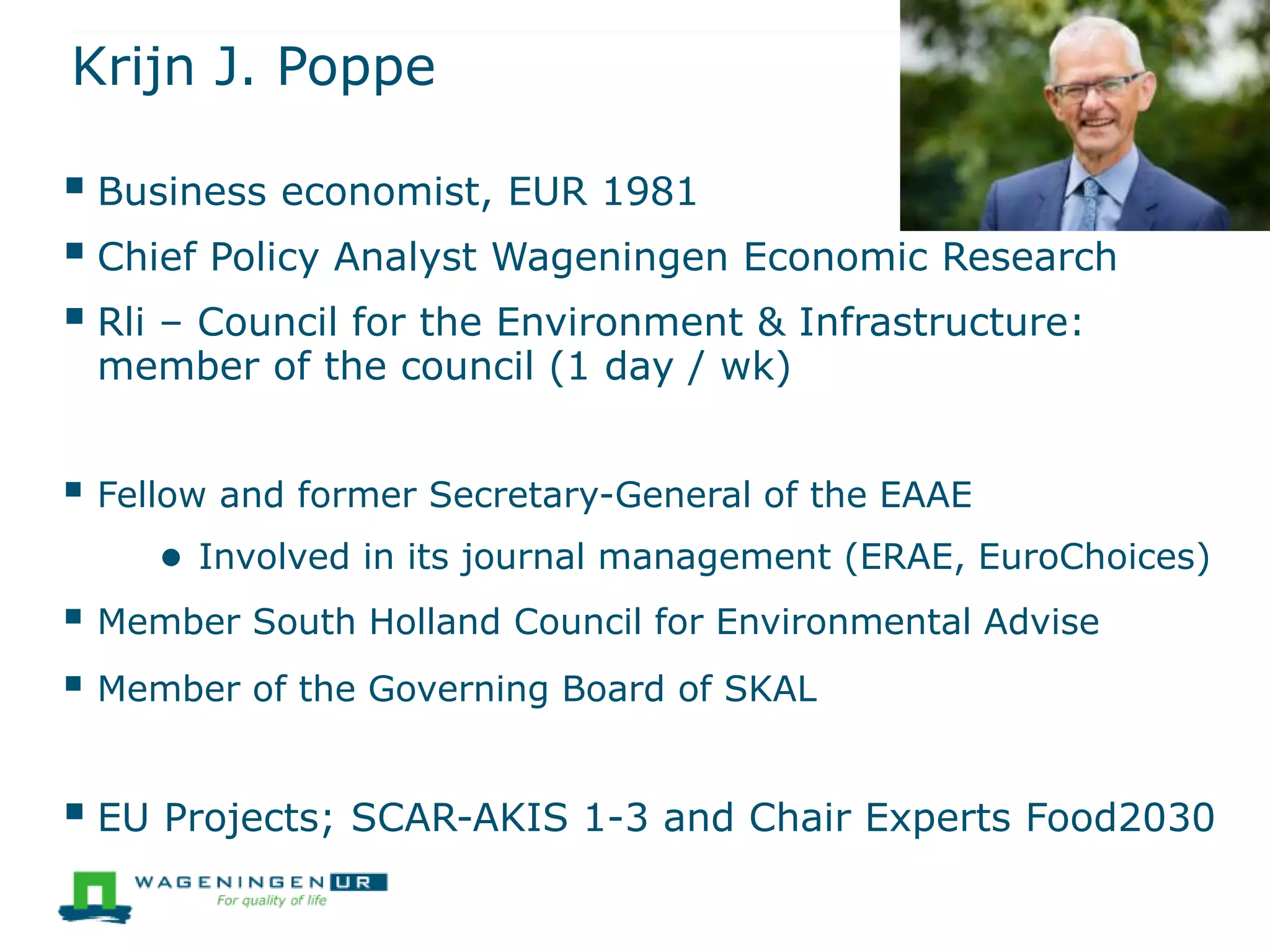
Krijn J. Poppe
 Business economist, EUR 1981
 Chief Policy Analyst Wageningen Economic Research
 Rli – Council for the Environment & Infrastructure:
member of the council (1 day / wk)
 Fellow and former Secretary-General of the EAAE
● Involved in its journal management (ERAE, EuroChoices)
 Member South Holland Council for Environmental Advise
 Member of the Governing Board of SKAL
 EU Projects; SCAR-AKIS 1-3 and Chair Experts Food2030
Content
 It’s the economy, stupid.
 Need for a food system approach
 Climate change and - policy
 Key innovation challenges
 The role of ICT – and why now
 Future farm organisation
 Three scenarios
tijd
Mate van verspreiding
van technologische revolutie
Installatie periode
Volgende
golf
Uitrol periode
Draai-
punt
INDRINGER
EXTASE
SYNERGIE
RIJPHEID
Door-
braak
Werkeloosheid
Stilstand oude bedrijfstakken
Kapitaal zoekt nieuwe techniek
Financiele bubble
Onevenwichtigheden
Polarisatie arm en rijk
Gouden eeuw
Coherente groei
Toenemende externalities
Techniek bereikt grenzen
Marktverzadiging
Teleurstelling en gemakzucht
Institutionele
innovatie
Naar Perez, 2002
Crash
2008
1929
1893
1847
1797
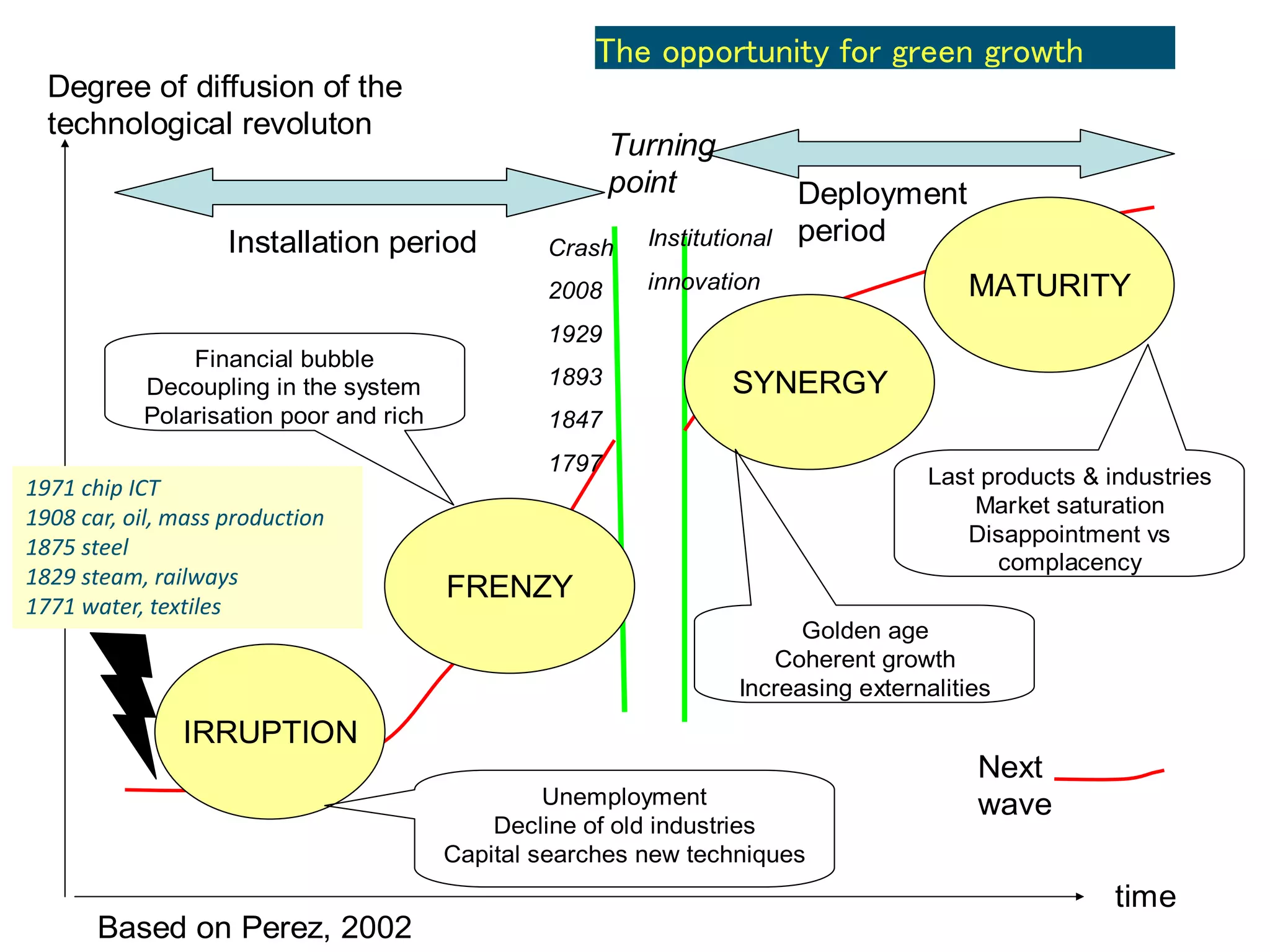
time
Degree of diffusion of the
technological revoluton
Installation period
Next
wave
Deployment
period
Turning
point
IRRUPTION
FRENZY
SYNERGY
MATURITY
Big Bang
Unemployment
Decline of old industries
Capital searches new techniques
Financial bubble
Decoupling in the system
Polarisation poor and rich
Golden age
Coherent growth
Increasing externalities
Last products & industries
Market saturation
Disappointment vs
complacency
Crash
2008
1929
1893
1847
1797
Institutional
innovation
Based on Perez, 2002
The opportunity for green growth
1971 chip ICT
1908 car, oil, mass production
1875 steel
1829 steam, railways
1771 water, textiles
Food chain: 2 weak spots – opportunity?
Input industriesFarmerFood processorConsumer Retail
• Public health issues –
obesity, Diabetes-2 etc.
• Climate change asks for
changes in diet
• Strong structural change
• Environmental costs
need to be internalised
• Climate change (GHG)
strengthens this
Is it coincidence that these 2 are the weakest groups?
Are these issues business opportunities / market failure?
Or system failure and lack of transformative capacity?
Key
Innovation
Challenges
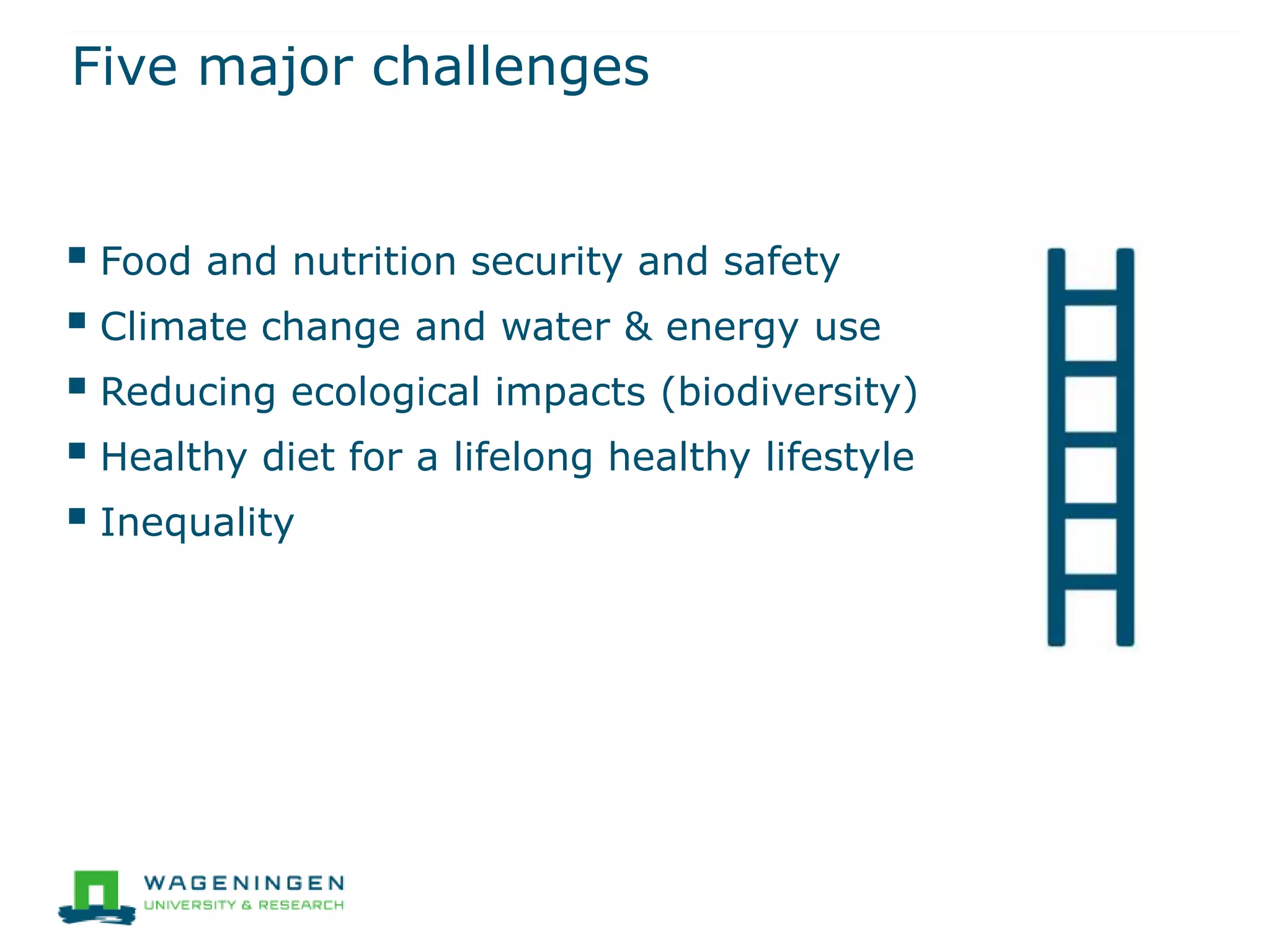
Five major challenges
 Food and nutrition security and safety
 Climate change and water & energy use
 Reducing ecological impacts (biodiversity)
 Healthy diet for a lifelong healthy lifestyle
 Inequality
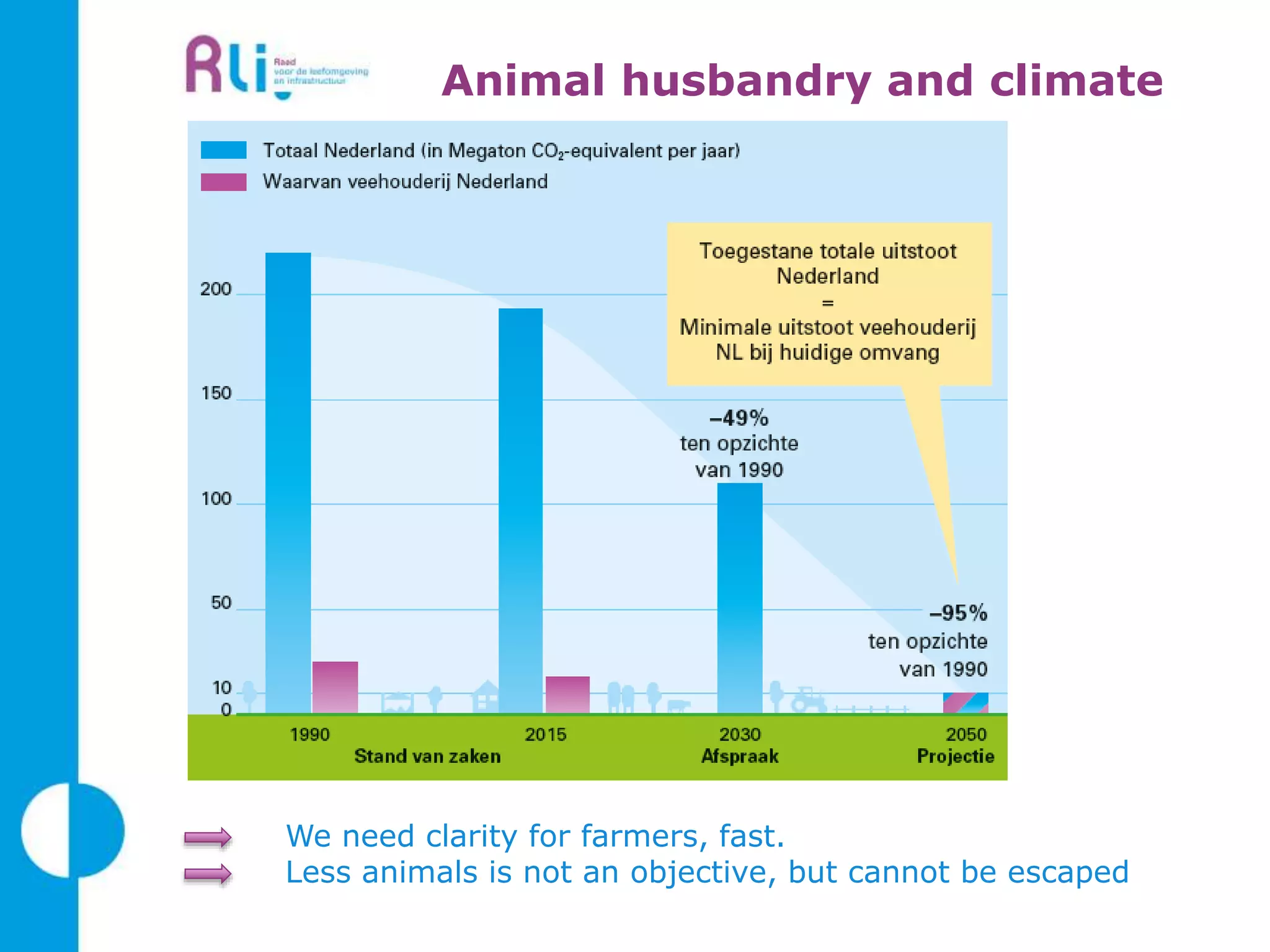
We need clarity for farmers, fast.
Less animals is not an objective, but cannot be escaped
Animal husbandry and climate
We need clarity for farmers, fast.
• After 30 years milk quota, >40 years manure policy, this is the
new issue and limit to growth
• Innovation must start up (feed, slurry/manure, breeding,
stables)
• Risk of ‘stranded assets’, for the chain, for banks
• Current government intentions are only the beginning, starts
with low hanging fruit.
Less animals is not an objective, but cannot be escaped
• Innovation is needed, with lower number of animals these are
not by definition more sustainable.
• Objective is so big that other farm systems with more value
added per kg, with less animals should be taken into account.
Number of animals or export is not a purpose in itself, value
added matters.
• Contribution of lower consumption is more than welcome
• Dutch government starts already to restructure pig farming
Five major innovation areas
 Genetics
 Digitalisation and big data
 Energy and bio-based transitions
 Redesigning the food chain
 Social innovations
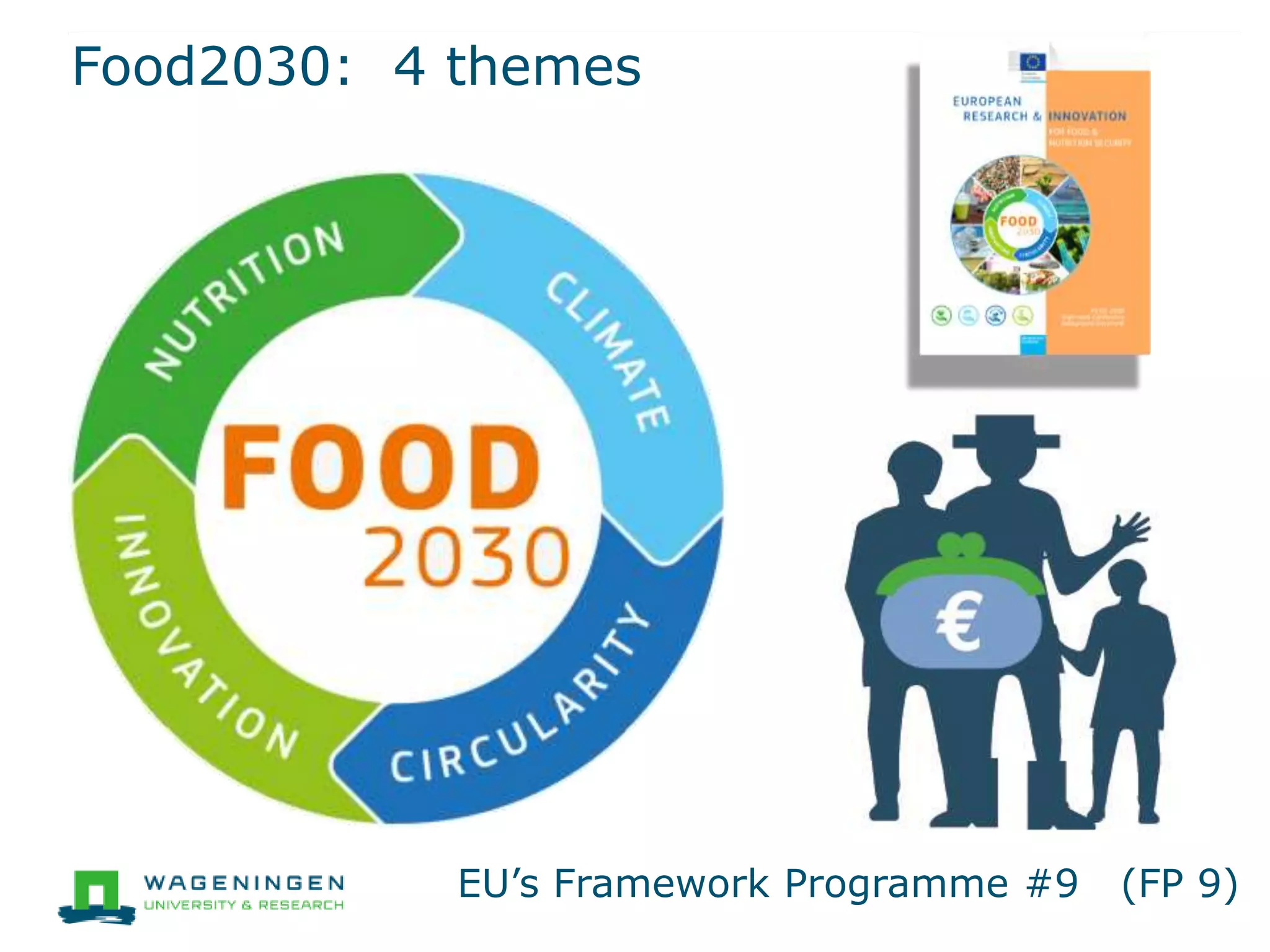
Food2030: 4 themes
EU’s Framework Programme #9 (FP 9)
Recipe for change:
An agenda for a climate-smart and
sustainable food system
for a healthy Europe
Krijn Poppe,
Chair Food 2030 Expert Group
https://publications.europa.eu/en/publication-detail/-/publication/d0c725de-6f7c-
11e8-9483-01aa75ed71a1/language-en
Grand challenge:
A climate-smart, sustainable food system for a
healthy Europe
3 mission-type approaches
(with 17 focus areas):
A.Improve dietary patterns and lifestyles for a 50%
reduction in the incidence of Non-Communicable
Diseases in 2030, while reducing the environmental
impact of food consumption
B. Create a resource-smart food system with 50% lower
GHG-emissions by 2030
C. Realise trust and inclusive governance for a resilient
and safe food system
13
Misunderstandings in social debate: one
as a solution of everything, -where??
Productivism paradigm
 Focus on more supply
 Calories for the world
 Eco-efficiency per kg
Sufficiency paradigm
 Food is more than calories
 Changes in menu needed
for sustainability
 Local effects, emissions
per ha count too.
@SCAR 3rd foresight
• Put fewer forks on the table –
Thomas Maltus (1798, An
essay on the principles of
population)
• Bake a bigger pie - Marquis
de Condorcet
• Teach everyone better table
manners – William Godwin
© Warren Belasco: Meals to come – a
history of the future of food
INPUT
INDUSTRY
FOOD
PROCESSING
FARMERS ICT
RETAIL
& OUT
of
HOME,
Food
Procesng
Health
sector
+ Cities
CONSU-
MERS
Less animal
based:
• Reduce GHG cattle
• Improve sustainb.
pigs and poultry
• New (lab) meat
and feed (insects,
algae etc.)
More plant based:
• Improve soil management
• Cope with climate change (water)
• Less chemicals, more biodiversity
• Improve factory farming
CIRCULAR PRINCIPLES
• Less waste
• More resource efficiency
• Close P-cycle
Help
Consumers
Change:
* personalised
nutrition
Green,
Healthy
Cities
Peri-urban
multifunctional
farms with short
supply chains
Help Empty
Rural Regions
Climate
change
Healthy diet
for a
healthy life
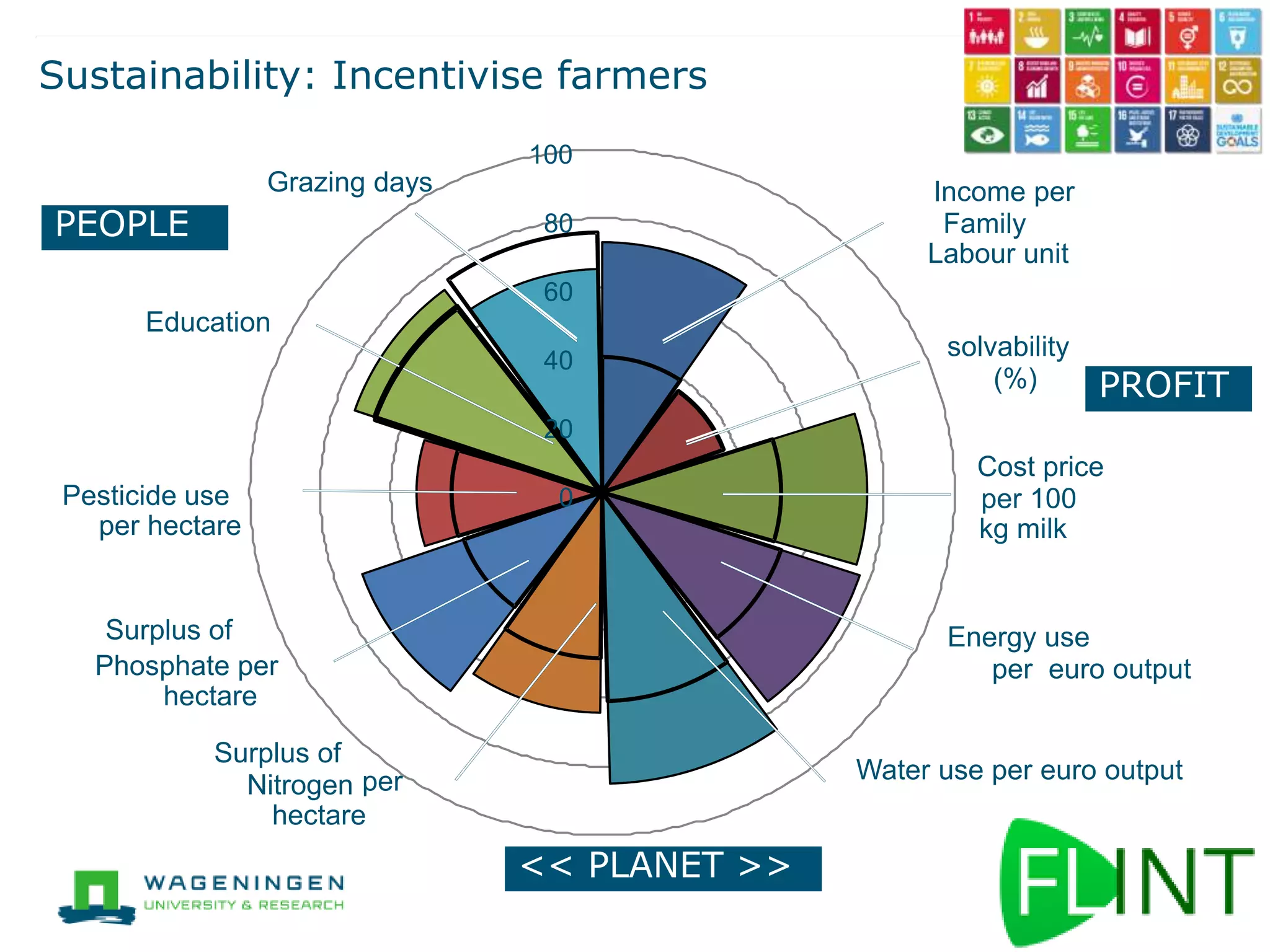
Sustainability: Incentivise farmers
0
20
40
60
80
100
Cost price
per 100
kg milk
Income per
Family
Labour unit
solvability
(%)
Energy use
per euro output
Water use per euro output
Pesticide use
per hectare
Grazing days
Education
Surplus of
Phosphate per
hectare
Surplus of
Nitrogen per
hectare
PEOPLE
PROFIT
<< PLANET >>
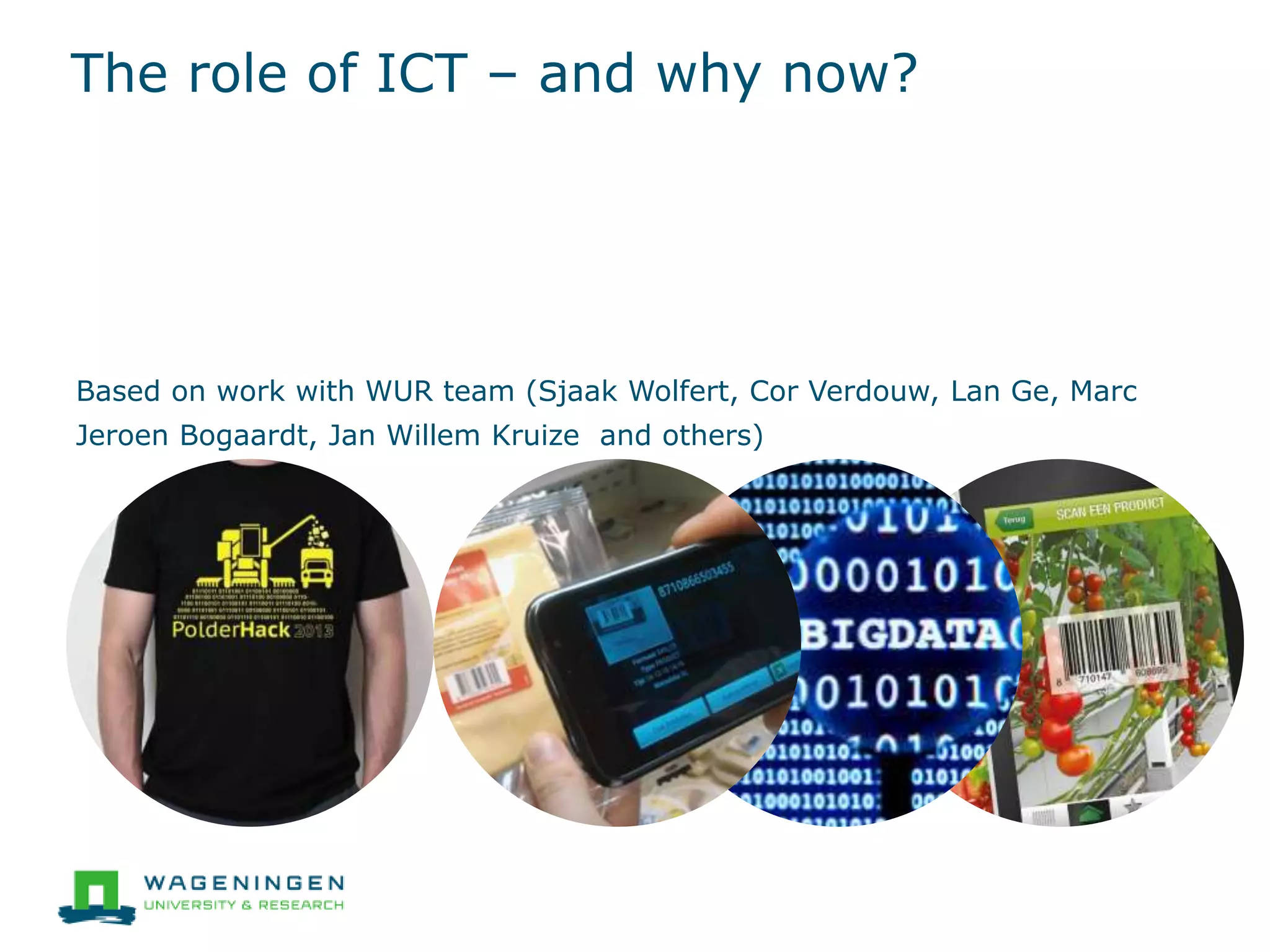
The role of ICT – and why now?
Based on work with WUR team (Sjaak Wolfert, Cor Verdouw, Lan Ge, Marc
Jeroen Bogaardt, Jan Willem Kruize and others)
Disruptive ICT Trends:
 Mobile/Cloud Computing – smart phones, wearables,
incl. sensors
 Internet of Things – everything gets connected in the
internet (virtualisation, M2M, autonomous devices)
 Location-based monitoring - satellite and remote sensing
technology, geo information, drones, etc.
 Social media - Facebook, Twitter, Wiki, etc.
 Block Chain – Tracing & Tracking, Contracts.
Big Data - Web of Data, Linked Open Data, Big data
algorithms
High Potential for unprecedented innovations!
everywhere
anything
anywhere
everybody
Drones, Big Data and
Agriculture 19
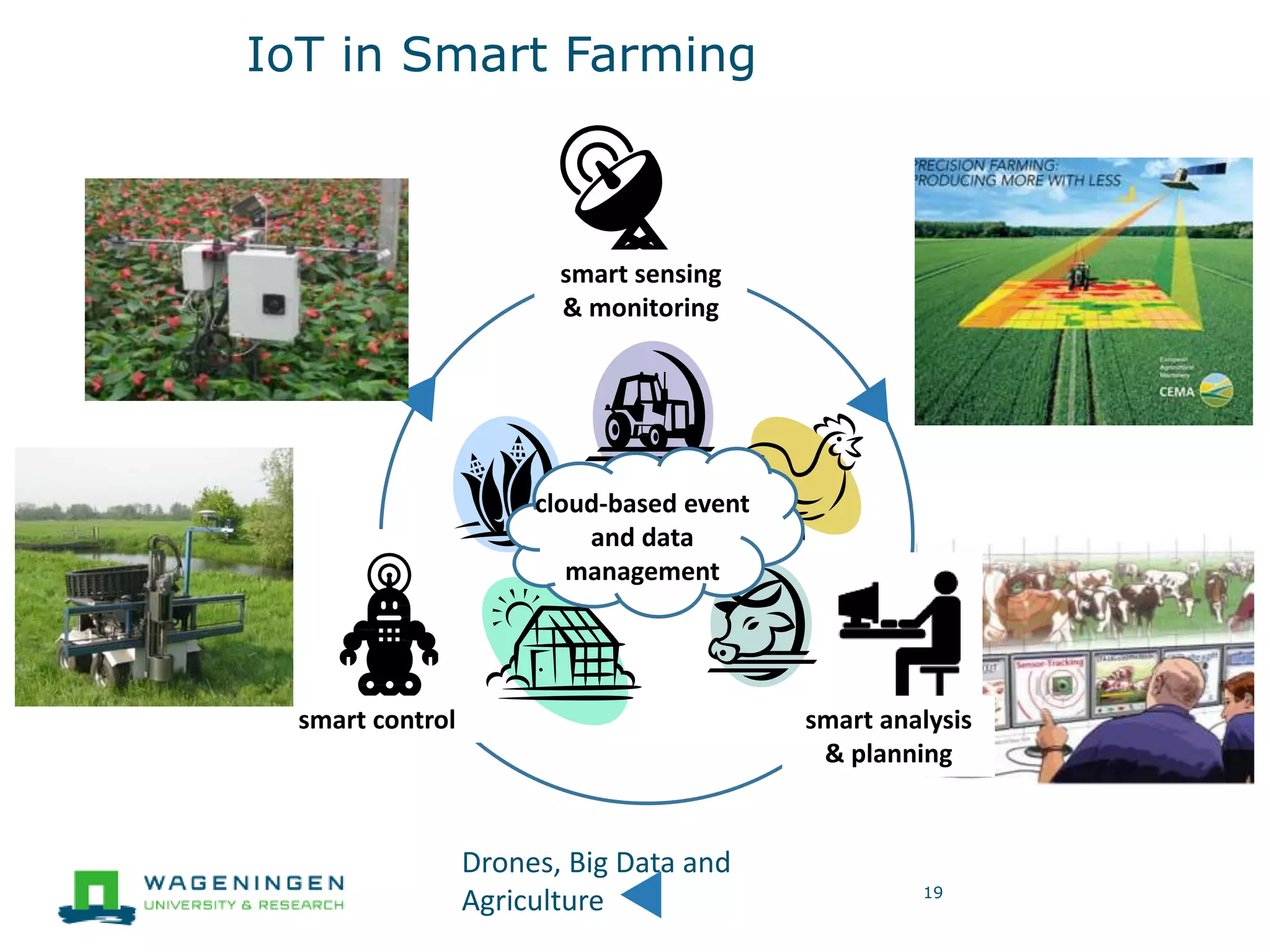
IoT in Smart Farming
cloud-based event
and data
management
smart sensing
& monitoring
smart analysis
& planning
smart control
Towards smart autonomous objects
Source: Deloitte (2014), IT Trends en Innovatie Survey
Tracking &
Tracing
Monitoring
I am thirsty: water
me within 1 hour!
I am product X at
locatie L of Z
My vaselife is
optimal at a
temperature of
4,3 °C.
I am too warm:
lower the
temperature by
3 °C
Event
Management
I am too warm: I lower
the cooling of my truck
X by 2 °C.
I don’t want to
stand besides
that banana!
I am thirsty!
I am warm!
Optimalisation
Autonomy
There is a need for
ABCDEFs:
Agri-Business
Collaboration & Data
Exchange Facilities
• Large organisations have
gone digital, with ERP
systems
• But between organisations
(especially with SMEs) data
exchange and
interoperability is still poor
• ABCDEF platforms help
• Our focus: data governance
law & regulation
innovation
geographic
cluster
horizontal
fulfillment
Vertical
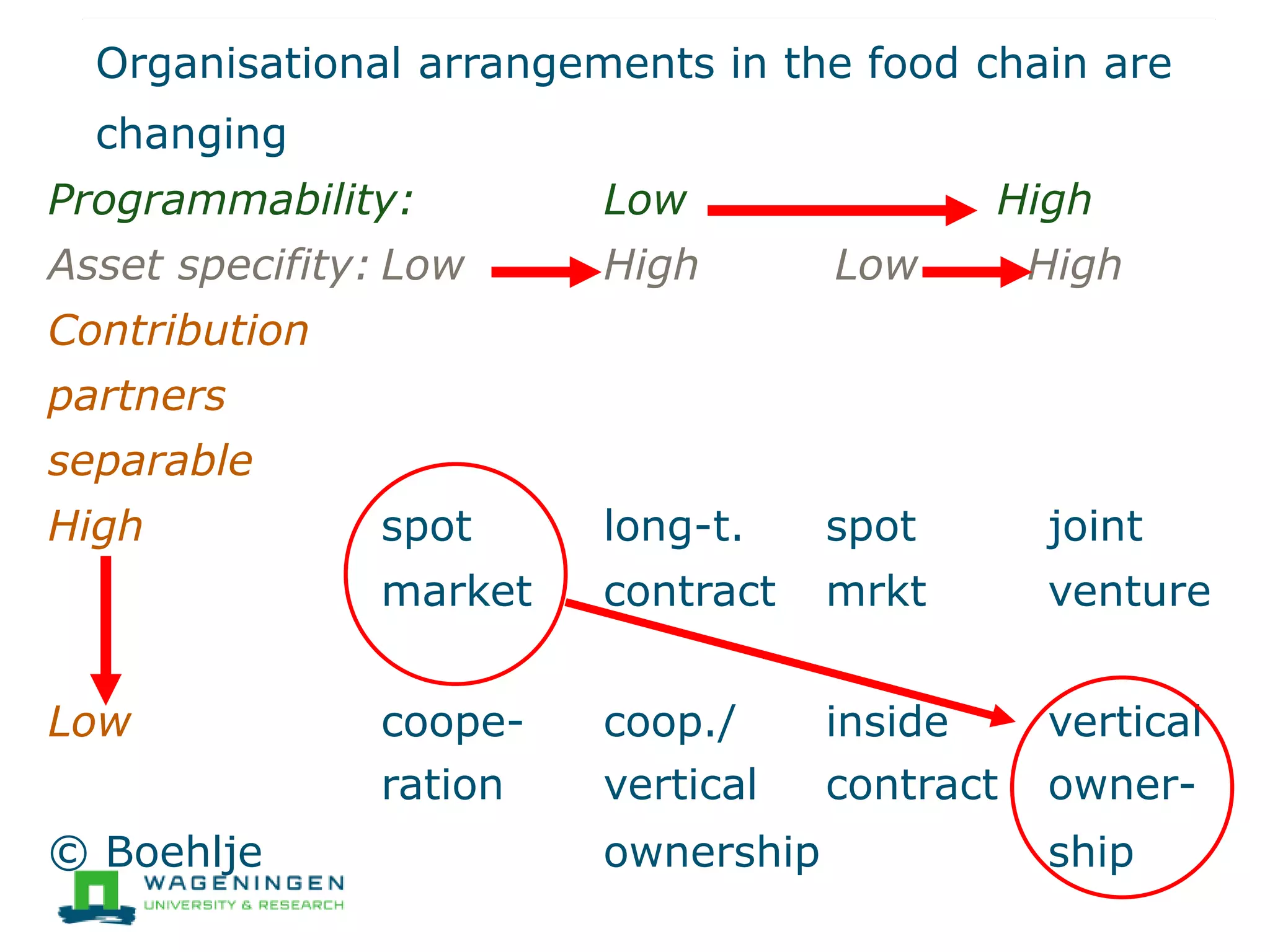
Programmability: Low High
Asset specifity: Low High Low High
Contribution
partners
separable
High spot long-t. spot joint
market contract mrkt venture
Low coope- coop./ inside vertical
ration vertical contract owner-
© Boehlje ownership ship
Organisational arrangements in the food chain are
changing
Chain organisation changes (©Gereffi et al., 2005)
inputsEndproduct
PRICE
Shops
Complete
Integration
Lead
company
Lead
company
Turnkey
supplier
Relational
supplier
Market Modular Relational Captive Hierarchy
Low Degree of explicit coordination and power asymmetry High
Lead
company
Farmers
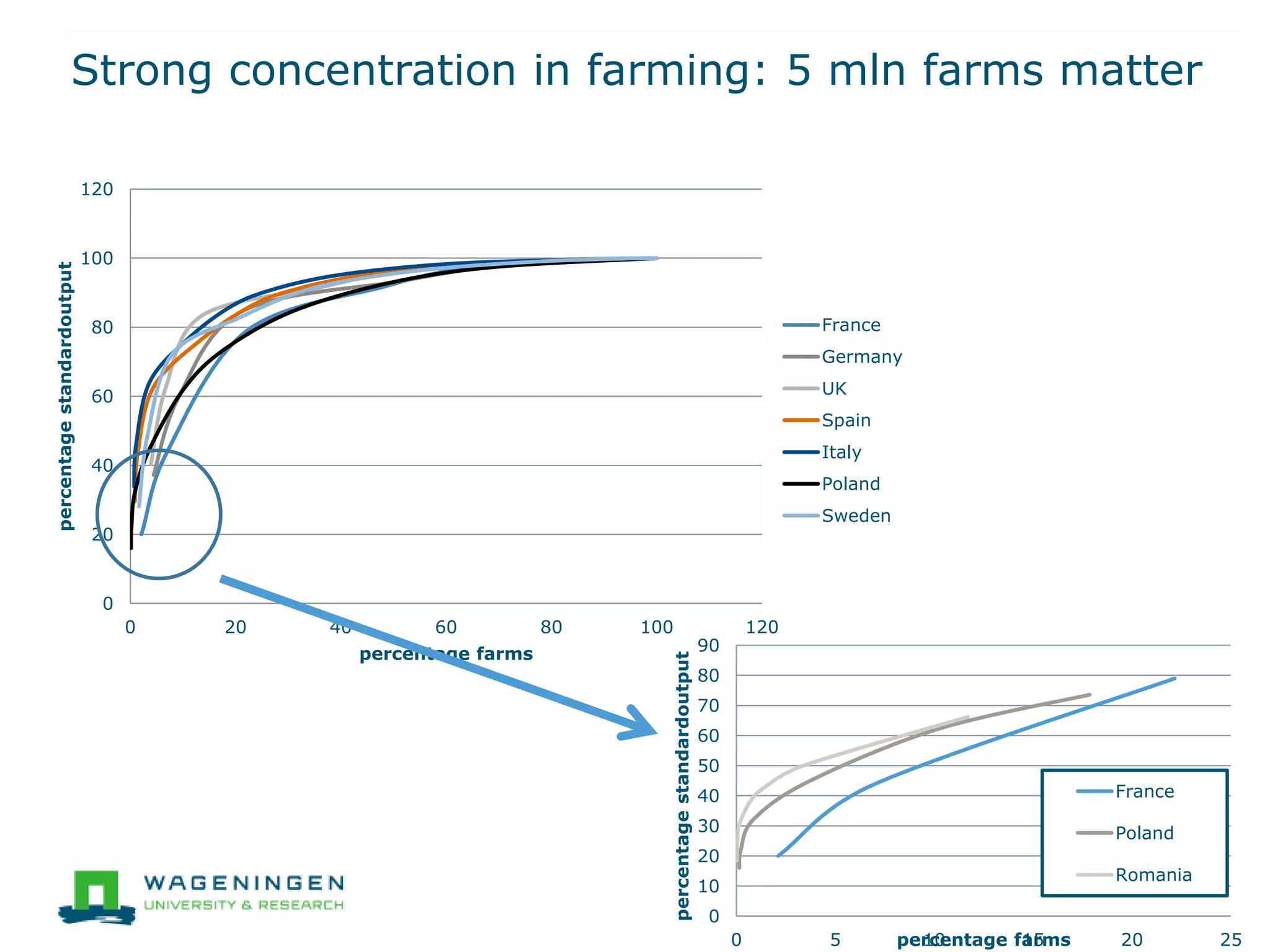
Strong concentration in farming: 5 mln farms matter
0
20
40
60
80
100
120
0 20 40 60 80 100 120
percentagestandardoutput
percentage farms
France
Germany
UK
Spain
Italy
Poland
Sweden
0
10
20
30
40
50
60
70
80
90
0 5 10 15 20 25
percentagestandardoutput
percentage farms
France
Poland
Romania
And the average farm size increases (NL):
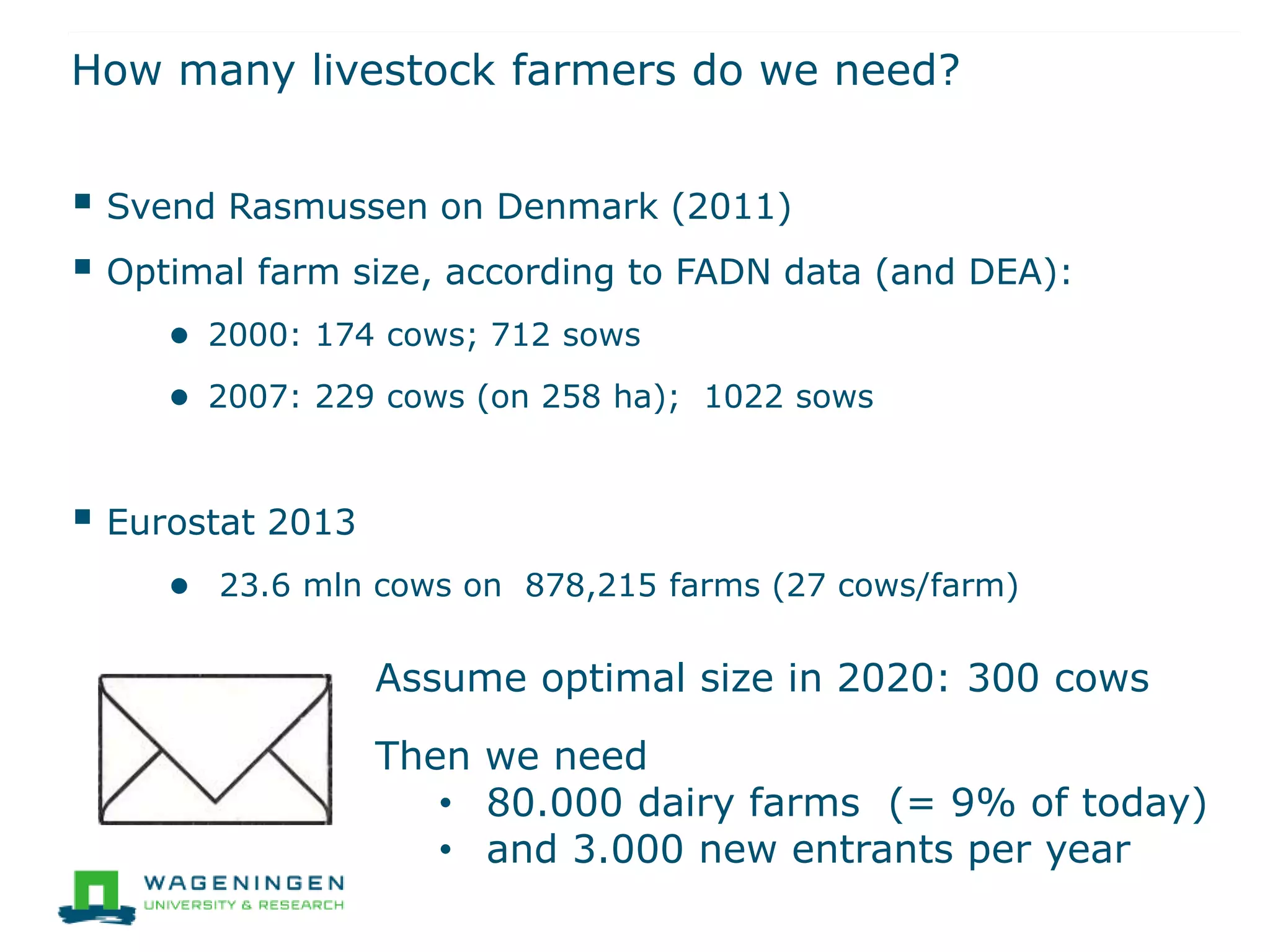
How many livestock farmers do we need?
 Svend Rasmussen on Denmark (2011)
 Optimal farm size, according to FADN data (and DEA):
● 2000: 174 cows; 712 sows
● 2007: 229 cows (on 258 ha); 1022 sows
 Eurostat 2013
● 23.6 mln cows on 878,215 farms (27 cows/farm)
Assume optimal size in 2020: 300 cows
Then we need
• 80.000 dairy farms (= 9% of today)
• and 3.000 new entrants per year
Europe towards
2030
3 scenarios to
explore the future
of EU agriculture +
implications for
Agricultural
Knowledge and
Innovation
Systems
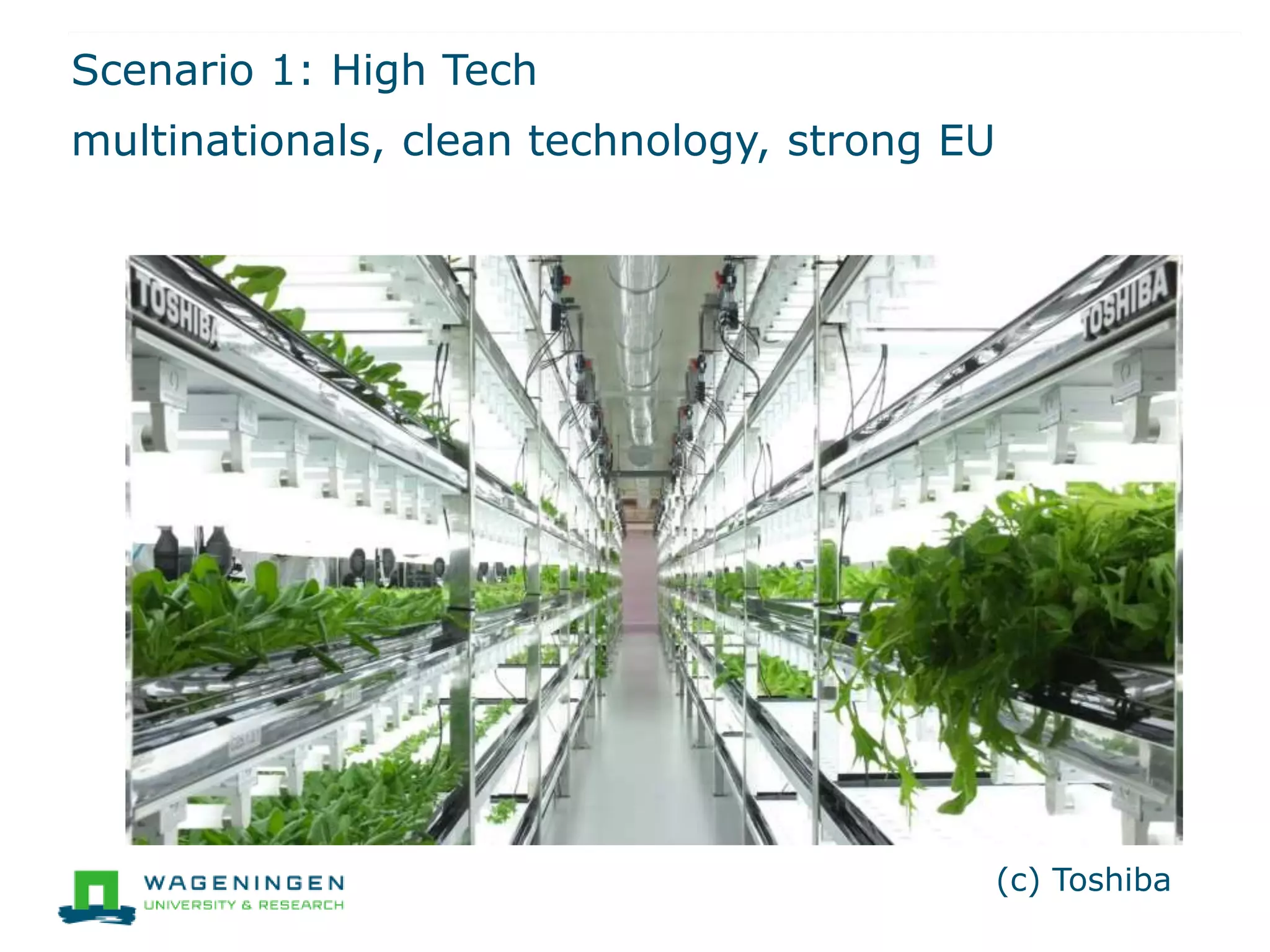
 HighTech: strong influence new technology owned by
multinationals. Driverless tractors, contract farming and a
rural exodus. US of Europe. Rich society with inequality.
Sustainability issues solved. Bio-boom scenario.
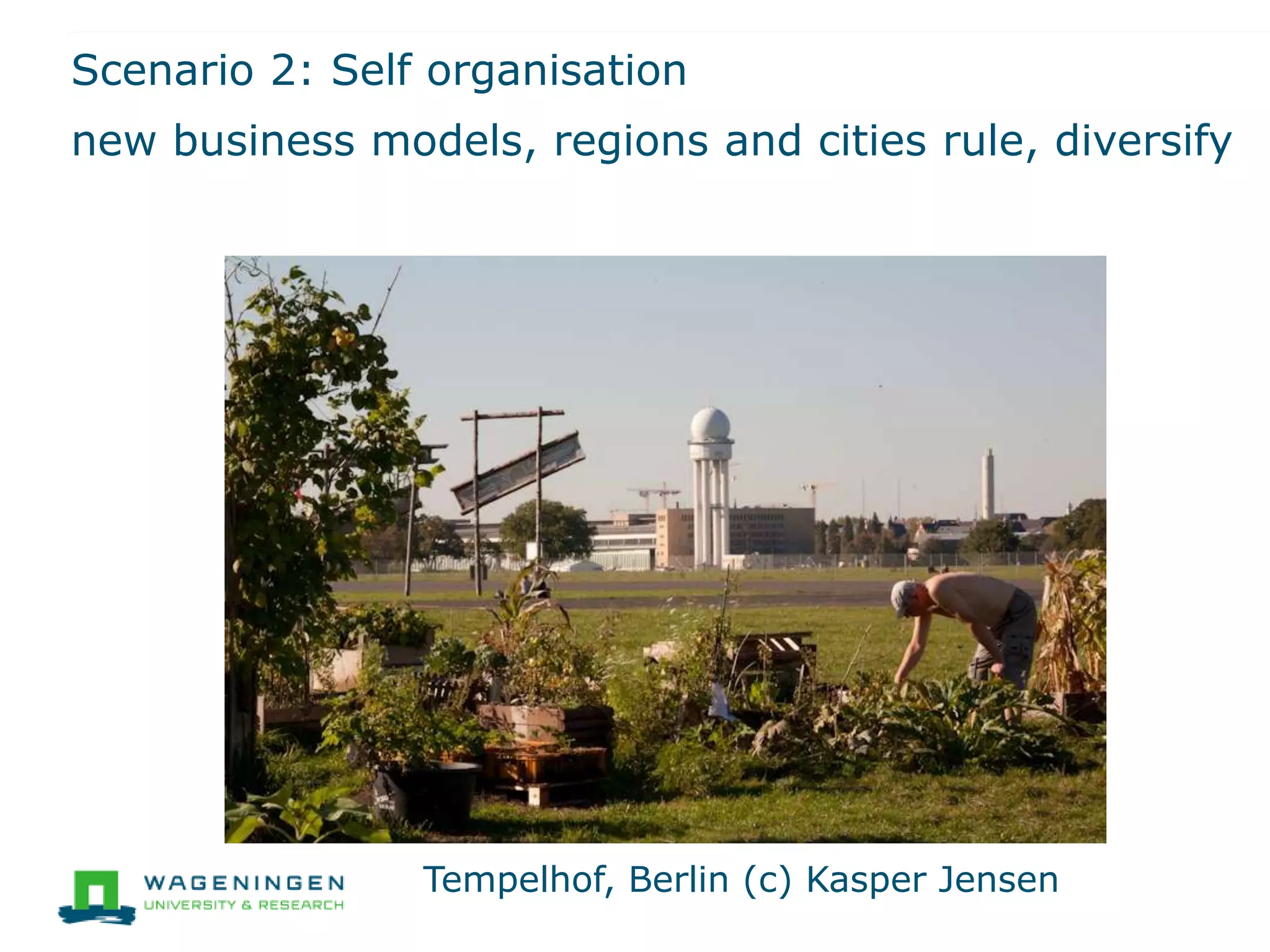
 Self-organisation: Europe of regions where new ICT
technologies with disruptive business models lead to self-
organisation, bottom-up democracy, short-supply chains,
multi-functional agriculture. European institutions are weak,
regions and cities rule. Inequalities between regions,
depending on endowments.
 Collapse: Big climate change effects, mass-migration and
political turbulence leads to a collapse of institutions and
European integration. Regional and local communities look
for self-sufficiency. Bio-scarcity and labour intensive
agriculture. Technology development becomes dependent on
science in China, India, Brazil.
Scenario 1: High Tech
multinationals, clean technology, strong EU
(c) Toshiba
... Or outside in stripfarming with robots
Scenario 2: Self organisation
new business models, regions and cities rule, diversify
Tempelhof, Berlin (c) Kasper Jensen
Scenario 3: Collapse
climate change, migration, breaking up of the EU
Resilience is defined as:
see: https://magazines.wur.nl/resilience-en/welcome/
 Capacity to bounce back to normal functioning after
perturbation
 Ability of a system to maintain specific functions in the
face of changes
 Capacity to tolerate disturbance without collapsing
 Capacity of a system to absorb disturbances and
reorganize while undergoing change in order to retain
essentially the same function, structure and feedback
 Capacity of a complex system to deal with change and
continue to develop
33
Adaptive capacity of a system
to prevent collapse
Thanks for your
attention
krijn.poppe@wur.nl
www.wur.nl

Trends for future farming

  • 1.
    Transitions at farmlevel in the years to come Krijn J. Poppe Agreenium, Dijon Wageningen UR April 2019
  • 2.
    Krijn J. Poppe Business economist, EUR 1981  Chief Policy Analyst Wageningen Economic Research  Rli – Council for the Environment & Infrastructure: member of the council (1 day / wk)  Fellow and former Secretary-General of the EAAE ● Involved in its journal management (ERAE, EuroChoices)  Member South Holland Council for Environmental Advise  Member of the Governing Board of SKAL  EU Projects; SCAR-AKIS 1-3 and Chair Experts Food2030
  • 3.
    Content  It’s theeconomy, stupid.  Need for a food system approach  Climate change and - policy  Key innovation challenges  The role of ICT – and why now  Future farm organisation  Three scenarios
  • 4.
    tijd Mate van verspreiding vantechnologische revolutie Installatie periode Volgende golf Uitrol periode Draai- punt INDRINGER EXTASE SYNERGIE RIJPHEID Door- braak Werkeloosheid Stilstand oude bedrijfstakken Kapitaal zoekt nieuwe techniek Financiele bubble Onevenwichtigheden Polarisatie arm en rijk Gouden eeuw Coherente groei Toenemende externalities Techniek bereikt grenzen Marktverzadiging Teleurstelling en gemakzucht Institutionele innovatie Naar Perez, 2002 Crash 2008 1929 1893 1847 1797 time Degree of diffusion of the technological revoluton Installation period Next wave Deployment period Turning point IRRUPTION FRENZY SYNERGY MATURITY Big Bang Unemployment Decline of old industries Capital searches new techniques Financial bubble Decoupling in the system Polarisation poor and rich Golden age Coherent growth Increasing externalities Last products & industries Market saturation Disappointment vs complacency Crash 2008 1929 1893 1847 1797 Institutional innovation Based on Perez, 2002 The opportunity for green growth 1971 chip ICT 1908 car, oil, mass production 1875 steel 1829 steam, railways 1771 water, textiles
  • 5.
    Food chain: 2weak spots – opportunity? Input industriesFarmerFood processorConsumer Retail • Public health issues – obesity, Diabetes-2 etc. • Climate change asks for changes in diet • Strong structural change • Environmental costs need to be internalised • Climate change (GHG) strengthens this Is it coincidence that these 2 are the weakest groups? Are these issues business opportunities / market failure? Or system failure and lack of transformative capacity?
  • 6.
  • 7.
    Five major challenges Food and nutrition security and safety  Climate change and water & energy use  Reducing ecological impacts (biodiversity)  Healthy diet for a lifelong healthy lifestyle  Inequality
  • 8.
    We need clarityfor farmers, fast. Less animals is not an objective, but cannot be escaped Animal husbandry and climate
  • 9.
    We need clarityfor farmers, fast. • After 30 years milk quota, >40 years manure policy, this is the new issue and limit to growth • Innovation must start up (feed, slurry/manure, breeding, stables) • Risk of ‘stranded assets’, for the chain, for banks • Current government intentions are only the beginning, starts with low hanging fruit. Less animals is not an objective, but cannot be escaped • Innovation is needed, with lower number of animals these are not by definition more sustainable. • Objective is so big that other farm systems with more value added per kg, with less animals should be taken into account. Number of animals or export is not a purpose in itself, value added matters. • Contribution of lower consumption is more than welcome • Dutch government starts already to restructure pig farming
  • 10.
    Five major innovationareas  Genetics  Digitalisation and big data  Energy and bio-based transitions  Redesigning the food chain  Social innovations
  • 11.
    Food2030: 4 themes EU’sFramework Programme #9 (FP 9)
  • 12.
    Recipe for change: Anagenda for a climate-smart and sustainable food system for a healthy Europe Krijn Poppe, Chair Food 2030 Expert Group https://publications.europa.eu/en/publication-detail/-/publication/d0c725de-6f7c- 11e8-9483-01aa75ed71a1/language-en
  • 13.
    Grand challenge: A climate-smart,sustainable food system for a healthy Europe 3 mission-type approaches (with 17 focus areas): A.Improve dietary patterns and lifestyles for a 50% reduction in the incidence of Non-Communicable Diseases in 2030, while reducing the environmental impact of food consumption B. Create a resource-smart food system with 50% lower GHG-emissions by 2030 C. Realise trust and inclusive governance for a resilient and safe food system 13
  • 14.
    Misunderstandings in socialdebate: one as a solution of everything, -where?? Productivism paradigm  Focus on more supply  Calories for the world  Eco-efficiency per kg Sufficiency paradigm  Food is more than calories  Changes in menu needed for sustainability  Local effects, emissions per ha count too. @SCAR 3rd foresight • Put fewer forks on the table – Thomas Maltus (1798, An essay on the principles of population) • Bake a bigger pie - Marquis de Condorcet • Teach everyone better table manners – William Godwin © Warren Belasco: Meals to come – a history of the future of food
  • 15.
    INPUT INDUSTRY FOOD PROCESSING FARMERS ICT RETAIL & OUT of HOME, Food Procesng Health sector +Cities CONSU- MERS Less animal based: • Reduce GHG cattle • Improve sustainb. pigs and poultry • New (lab) meat and feed (insects, algae etc.) More plant based: • Improve soil management • Cope with climate change (water) • Less chemicals, more biodiversity • Improve factory farming CIRCULAR PRINCIPLES • Less waste • More resource efficiency • Close P-cycle Help Consumers Change: * personalised nutrition Green, Healthy Cities Peri-urban multifunctional farms with short supply chains Help Empty Rural Regions Climate change Healthy diet for a healthy life
  • 16.
    Sustainability: Incentivise farmers 0 20 40 60 80 100 Costprice per 100 kg milk Income per Family Labour unit solvability (%) Energy use per euro output Water use per euro output Pesticide use per hectare Grazing days Education Surplus of Phosphate per hectare Surplus of Nitrogen per hectare PEOPLE PROFIT << PLANET >>
  • 17.
    The role ofICT – and why now? Based on work with WUR team (Sjaak Wolfert, Cor Verdouw, Lan Ge, Marc Jeroen Bogaardt, Jan Willem Kruize and others)
  • 18.
    Disruptive ICT Trends: Mobile/Cloud Computing – smart phones, wearables, incl. sensors  Internet of Things – everything gets connected in the internet (virtualisation, M2M, autonomous devices)  Location-based monitoring - satellite and remote sensing technology, geo information, drones, etc.  Social media - Facebook, Twitter, Wiki, etc.  Block Chain – Tracing & Tracking, Contracts. Big Data - Web of Data, Linked Open Data, Big data algorithms High Potential for unprecedented innovations! everywhere anything anywhere everybody
  • 19.
    Drones, Big Dataand Agriculture 19 IoT in Smart Farming cloud-based event and data management smart sensing & monitoring smart analysis & planning smart control
  • 20.
    Towards smart autonomousobjects Source: Deloitte (2014), IT Trends en Innovatie Survey Tracking & Tracing Monitoring I am thirsty: water me within 1 hour! I am product X at locatie L of Z My vaselife is optimal at a temperature of 4,3 °C. I am too warm: lower the temperature by 3 °C Event Management I am too warm: I lower the cooling of my truck X by 2 °C. I don’t want to stand besides that banana! I am thirsty! I am warm! Optimalisation Autonomy
  • 21.
    There is aneed for ABCDEFs: Agri-Business Collaboration & Data Exchange Facilities • Large organisations have gone digital, with ERP systems • But between organisations (especially with SMEs) data exchange and interoperability is still poor • ABCDEF platforms help • Our focus: data governance law & regulation innovation geographic cluster horizontal fulfillment Vertical
  • 22.
    Programmability: Low High Assetspecifity: Low High Low High Contribution partners separable High spot long-t. spot joint market contract mrkt venture Low coope- coop./ inside vertical ration vertical contract owner- © Boehlje ownership ship Organisational arrangements in the food chain are changing
  • 23.
    Chain organisation changes(©Gereffi et al., 2005) inputsEndproduct PRICE Shops Complete Integration Lead company Lead company Turnkey supplier Relational supplier Market Modular Relational Captive Hierarchy Low Degree of explicit coordination and power asymmetry High Lead company Farmers
  • 24.
    Strong concentration infarming: 5 mln farms matter 0 20 40 60 80 100 120 0 20 40 60 80 100 120 percentagestandardoutput percentage farms France Germany UK Spain Italy Poland Sweden 0 10 20 30 40 50 60 70 80 90 0 5 10 15 20 25 percentagestandardoutput percentage farms France Poland Romania
  • 25.
    And the averagefarm size increases (NL):
  • 26.
    How many livestockfarmers do we need?  Svend Rasmussen on Denmark (2011)  Optimal farm size, according to FADN data (and DEA): ● 2000: 174 cows; 712 sows ● 2007: 229 cows (on 258 ha); 1022 sows  Eurostat 2013 ● 23.6 mln cows on 878,215 farms (27 cows/farm) Assume optimal size in 2020: 300 cows Then we need • 80.000 dairy farms (= 9% of today) • and 3.000 new entrants per year
  • 27.
    Europe towards 2030 3 scenariosto explore the future of EU agriculture + implications for Agricultural Knowledge and Innovation Systems
  • 28.
     HighTech: stronginfluence new technology owned by multinationals. Driverless tractors, contract farming and a rural exodus. US of Europe. Rich society with inequality. Sustainability issues solved. Bio-boom scenario.  Self-organisation: Europe of regions where new ICT technologies with disruptive business models lead to self- organisation, bottom-up democracy, short-supply chains, multi-functional agriculture. European institutions are weak, regions and cities rule. Inequalities between regions, depending on endowments.  Collapse: Big climate change effects, mass-migration and political turbulence leads to a collapse of institutions and European integration. Regional and local communities look for self-sufficiency. Bio-scarcity and labour intensive agriculture. Technology development becomes dependent on science in China, India, Brazil.
  • 29.
    Scenario 1: HighTech multinationals, clean technology, strong EU (c) Toshiba
  • 30.
    ... Or outsidein stripfarming with robots
  • 31.
    Scenario 2: Selforganisation new business models, regions and cities rule, diversify Tempelhof, Berlin (c) Kasper Jensen
  • 32.
    Scenario 3: Collapse climatechange, migration, breaking up of the EU
  • 33.
    Resilience is definedas: see: https://magazines.wur.nl/resilience-en/welcome/  Capacity to bounce back to normal functioning after perturbation  Ability of a system to maintain specific functions in the face of changes  Capacity to tolerate disturbance without collapsing  Capacity of a system to absorb disturbances and reorganize while undergoing change in order to retain essentially the same function, structure and feedback  Capacity of a complex system to deal with change and continue to develop 33 Adaptive capacity of a system to prevent collapse
  • 34.

Editor's Notes

  • #9 Toelichten omvang opgave en tijdpad, ook of juist na 2030
  • #20 better monitoring of production (resource use, crop development, animal behaviour) better understanding of the specific farming conditions (e.g. weather and environmental conditions, emergence of pests, weeds and diseases) Those sensors, either wired or wireless, integrated into an IoT system gather all the individual data needed for monitoring, control and treatment on farms located in a particular region.
  • #22 21
  • #23 22
  • #30 Characterised by the key words.
  • #32 Characterised by the key words.
  • #33 Characterised by the key words.