A Framework for Evaluating and Utilizing 
Medical Terminology Mappings 
EHR4CR – Open PHACTS, SALUS and W3C collaboration 
Sajjad Hussain1, Hong Sun2, Ali Anil Sinaci3, Gokce Banu Laleci Erturkmen3, Charlie Mead4, 
Alasdair Gray5, Deborah McGuinness6, Eric Prud’Hommeaux7, Christel Daniel1, Kerstin Forsberg8 
MIE2014 2-Sept-2014 
EHR4CR: 1INSERM UMRS 1142, Paris, France; 8 AstraZeneca, R&D Information, Mölndal Sweden 
Open PHACTS: 5School of Mathematical and Computer Sciences, Heriot-Watt University 
SALUS: 3Software Research, Development and Consultancy, Ankara, Turkey, 
2Advanced Clinical Applications Research Group, Agfa HealthCare, Gent, Belgium 
W3C: 4Health Care and Life Sciences IG, 7MIT, Cambridge, MA, USA, 
6Department of Computer Science, Rensselaer Polytechnic Institute, Troy, US 
1 
2014 Medical Informatics Europe 
Version 1.0 http://slideshare.net/kerfors/MIE2014
Objective 
• Show the challenging nature of mapping 
utilization among different terminologies. 
• A framework built upon existing terminology 
mappings to: 
– Infer new mappings for different use cases. 
– Present provenance of the mappings together 
with the justification information. 
– Perform mapping validation in order to show 
that inferred mappings can be erroneous. 
• Enable a more collaborative semantic landscape 
with providers and consumers of terminology 
mappings. 
2 
2014 Medical Informatics Europe 
http://slideshare.net/kerfors/MIE2014
Semantic landscape 1(3) 
3 
For more information about these see the reference 
slides in the end of this slide deck. 
2014 Medical Informatics Europe 
http://slideshare.net/kerfors/MIE2014 
Consumers and, somewhat 
reluctant, creators of mappings
Semantic landscape 2(3) 
4 
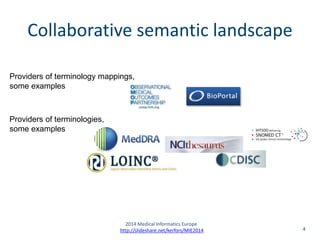
Providers of terminology mappings, 
some examples 
2014 Medical Informatics Europe 
http://slideshare.net/kerfors/MIE2014 
Consumers and, somewhat 
reluctant, creators of mappings
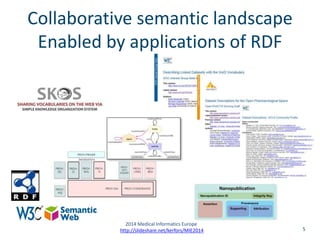
Semantic landscape 3(3) 
5 
Providers of terminology mappings, 
some examples 
Providers of terminologies, 
some examples 
2014 Medical Informatics Europe 
http://slideshare.net/kerfors/MIE2014 
Consumers and, somewhat 
reluctant, creators of mappings
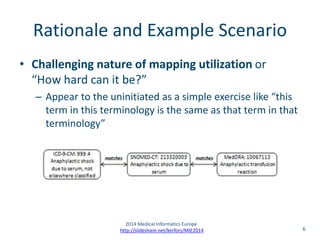
Rationale 
• Challenging nature of mapping utilization, or 
“How hard can it be?” 
– Appear to the uninitiated as a simple exercise like “this 
term in this terminology is the same as that term in that 
terminology” 
6 
2014 Medical Informatics Europe 
http://slideshare.net/kerfors/MIE2014
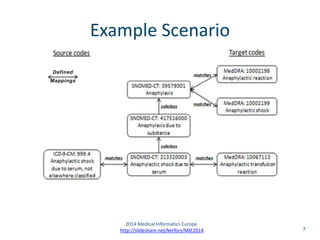
Example Scenario 
• Challenging nature of mapping utilization, or 
“How hard can it be?” 
– Appear to the uninitiated as a simple exercise like “this 
term in this terminology is the same as that term in that 
terminology” 
7
Example Scenario 1(3) 
8 
Defined 
Mappings
Example Scenario 2(3) 
9 
matches 
matches 
matches 
Defined 
Mappings 
Inferred 
Mappings
Example Scenario 3(3) 
10 
matches 
matches 
matches 
Defined 
Mappings 
Inferred 
Mappings 
matches 
Problematic 
Mappings
“It’s complicated”. So, we often become, somewhat 
reluctant, creators of our own mappings 
• Availability of up-to-date information to assess the suitability 
of a given terminology for a particular use case. 
• Difficulty of correctly using complex, rapidly evolving 
terminologies. 
• Differences in granularity between the source and target 
terminologies. 
• Lack of semantic mappings in order to completely and 
unambiguously define computationally equivalent semantics. 
• Lack of provenance information, i.e. how, when and for what 
purposes the mappings were created. 
• Time and effort required to complete and evaluate mappings. 
11 
2014 Medical Informatics Europe 
http://slideshare.net/kerfors/MIE2014
Objective: A more collaborative 
semantic landscape 
12 
Informed consumers of 
terminology mappings 
Value adding providers of 
terminology mappings 
Value adding providers of 
terminologies
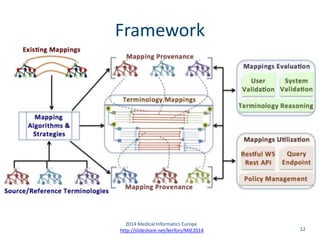
Framework 
13 
2014 Medical Informatics Europe 
http://slideshare.net/kerfors/MIE2014
Mapping Strategies 
• Lexical Mappings (LOOM) generated by performing lexical comparison between 
preferred labels and alternative labels of terms. These mappings are represented via 
skos:closeMatch property. 
• Xref OBO Mappings Xref and Dbxref are properties used by ontology developers to 
refer to an analogous term in another vocabulary. These mappings are represented 
via skos:relatedMatch property. 
• CUI Mappings from UMLS are extracted by utilizing the same Concept Unique 
Identifier (CUI) annotation as join point of similar terms from different vocabularies. 
These mappings are represented via skos:closeMatch property. 
• URI-based Mappings are generated identity mappings between term concepts in 
different ontologies that are represented by the same URI. These mappings are 
represented via skos:exactMatch property. 
14 
2014 Medical Informatics Europe 
http://slideshare.net/kerfors/MIE2014
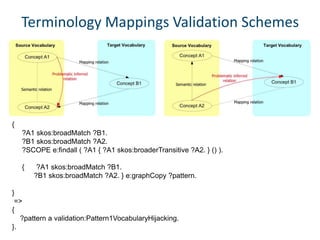
Terminology Mappings Validation Schemes
Collaborative semantic landscape 
16 
Informed consumers of 
terminology mappings 
Value adding providers of 
terminology mappings 
Value adding providers of 
terminologies 
Enabled by applications of 
the RDF standard
17 
Application of RDF for 
representing mappings 
Enabled by applications of 
the RDF standard
18 
Application of RDF for 
representing provenance 
Enabled by applications of 
the RDF standard
Applications of RDF for packaging assertions 
19 
(e.g. mappings) with provenance 
Enabled by applications of 
the RDF standard
20 
Applications of RDF for describing 
datasets and linksets with justifications 
Enabled by applications of 
the RDF standard
Example Scenario 
21 
matches 
matches 
matches 
Defined 
Mappings 
Inferred 
Mappings 
matches 
Problematic 
Mappings
22 
Example Scenario 
matches 
Defined 
Mappings 
Inferred 
Mappings
matches 
Defined 
Mappings 
Inferred 
Mappings 
23 
SKOS/RDF for representing mappings 
ICD9CM:999.4 skos:exactMatch SNOMEDCT:21332003 
SNOMEDCT:21332003 skos:exactMatch MedDRA:10067113 
ICD9CM:999.4 skos:exactMatch MedDRA:10067113
Nanopublication for packaging mappings 
and mapping provenance representations 
ICD9CM:999.4 skos:exactMatch MedDRA:10067113 
matches 
Defined 
Mappings 
Inferred 
Mappings 
24 
Assertion 
Justification trace generated from EYE reasoning engine
Justification Vocabulary terms for 
Relating Terminology Concepts/Terms 
25 
??
26 
Applications of RDF for describing 
datasets and linksets with justifications 
2014 Medical Informatics Europe 
http://slideshare.net/kerfors/MIE2014 
Enabled by applications of 
the RDF standard
Linksets: Justification Vocabulary Terms 1(3) 
27 
2014 Medical Informatics Europe 
http://slideshare.net/kerfors/MIE2014
Linksets: Justification Vocabulary Terms 2(3) 
28 
2014 Medical Informatics Europe 
http://slideshare.net/kerfors/MIE2014
Linksets: Justification Vocabulary Terms 3(3) 
29 
2014 Medical Informatics Europe 
http://slideshare.net/kerfors/MIE2014
CIM Workshop at ISWC2014 to discuss: 
Justification Vocabulary terms for 
Relating Terminology Concepts/Terms 
30
Acknowledgments 
• Session chair 
• MIE2014 organizers 
• SALUS team: Hong Sun, Ali Anil Sinaci, Gokce Banu Laleci Erturkmen 
– Support from the European Community’s Seventh Framework Programme 
(FP7/2007–2013) under Grant Agreement No. ICT-287800, SALUS Project 
(Scalable, Standard based Interoperability Framework for Sustainable 
Proactive Post Market Safety Studies). 
• EHR4CR team: WP4, WPG2, WP7 members 
– Support from the Innovative Medicines Initiative Joint Undertaking under 
grant agreement n° [No 115189]. European Union's Seventh Framework 
Programme (FP7/2007-2013) and EFPIA companies 
• Open PHACTS team: Alasdair Gray 
• W3C HCLS team: Eric Prud’Hommeaux, Charlie Mead 
31 
2014 Medical Informatics Europe 
http://slideshare.net/kerfors/MIE2014
Reference material 
• Projects/organisations of the authors of this paper 
• Example 
– Mapping Representation using SKOS 
– Mapping Provenance Representation 
2014 Joint Summits on Translational Science 32
EHR4CR 
Electronic Healthcare Record For Clinical Research 
http://www.ehr4cr.eu/ 
• IMI (Innovative Medicine Initiative) 
– Public-Private Partnership between EU and EFPIA 
• ICT platform: using EHR data for supporting 
clinical research 
• Protocol feasibility 
• Patient recruitment 
• Clinical trial execution: Clinical Research Forms (eCRF)/ 
Individual Case Safety Reports (ICSR) prepopulation 
• 33 European academic and industrial partners 
– 11 pilot sites from 5 countries – 4 millions patients 
33 
2014 Medical Informatics Europe 
http://slideshare.net/kerfors/MIE2014
Open PHACTS 
Open Pharmacology Space 
http://www.openphacts.org/ 
• IMI (Innovative Medicine Initiative) 
• 31 partners: 10 pharma – 21 academic / SME 
• The Challenge - Open standards for 
drug discovery data 
– Develop robust standards for solid 
integration between data sources via 
semantic technologies 
– Implement the standards in a semantic 
integration hub (“Open Pharmacological Space”) 
– Deliver services to support on-going drug 
discovery programs in pharma and 
public domain 
34 
2014 Medical Informatics Europe 
http://slideshare.net/kerfors/MIE2014
SALUS 
Sustainable Proactive Post Market Safety Studies 
http://www.salusproject.eu/ 
• European Commission (STREP) 
• ICT platform : using EHRs data to improve post-market 
safety activities on a proactive basis 
• Semi-automatic notification of suspected adverse events 
• Reporting adverse events (Individual Case Safety Reports 
(ICSR) prepopulation) 
• Post Marketing safety studies 
• 8 European academic and industrial partners 
– 2 pilot sites 
• Lombardia Region (Italy) and Eastern Saxony (Germany) 
35 
2014 Medical Informatics Europe 
http://slideshare.net/kerfors/MIE2014
W3C 
Semantic Web Health Care and Life Sciences Interest 
Group (HCLS IG) 
http://www.w3.org/2001/sw/ 
• .. 
36 
2014 Medical Informatics Europe 
http://slideshare.net/kerfors/MIE2014
Mapping Representation using SKOS 
37 
<http://purl.bioontology.org/ontology/ICD9CM/999.4> 
<http://www.w3.org/2004/02/skos/core#broadMatch> 
<http://purl.bioontology.org/ontology/MDR/10002198>, 
<http://purl.bioontology.org/ontology/MDR/10002199>, 
<http://purl.bioontology.org/ontology/MDR/10020751>, 
<http://purl.bioontology.org/ontology/MDR/10067484> . 
<http://purl.bioontology.org/ontology/MDR/10002198> a <http://www.w3.org/2004/02/skos/core#Concept>; 
<http://purl.bioontology.org/ontology/MDR/level> "PT"; 
<http://www.w3.org/2004/02/skos/core#broader> <http://purl.bioontology.org/ontology/MDR/10002220>, 
<http://purl.bioontology.org/ontology/MDR/10057181>; 
<http://www.w3.org/2004/02/skos/core#inScheme> <http://purl.bioontology.org/ontology/MDR>; 
<http://www.w3.org/2004/02/skos/core#notation> "10002198"; 
<http://www.w3.org/2004/02/skos/core#prefLabel> "Anaphylactic reaction" . 
<http://purl.bioontology.org/ontology/MDR/10002199> a <http://www.w3.org/2004/02/skos/core#Concept>; 
<http://purl.bioontology.org/ontology/MDR/level> "PT"; 
<http://www.w3.org/2004/02/skos/core#broader> <http://purl.bioontology.org/ontology/MDR/10002220>, 
<http://purl.bioontology.org/ontology/MDR/10009193>; 
<http://www.w3.org/2004/02/skos/core#inScheme> <http://purl.bioontology.org/ontology/MDR>; 
<http://www.w3.org/2004/02/skos/core#notation> "10002199"; 
<http://www.w3.org/2004/02/skos/core#prefLabel> "Anaphylactic shock" . 
<http://purl.bioontology.org/ontology/MDR/10020751> a <http://www.w3.org/2004/02/skos/core#Concept>; 
<http://purl.bioontology.org/ontology/MDR/level> "PT"; 
<http://www.w3.org/2004/02/skos/core#broader> <http://purl.bioontology.org/ontology/MDR/10027654>; 
<http://www.w3.org/2004/02/skos/core#inScheme> <http://purl.bioontology.org/ontology/MDR>; 
<http://www.w3.org/2004/02/skos/core#notation> "10020751"; 
<http://www.w3.org/2004/02/skos/core#prefLabel> "Hypersensitivity" . 
<http://purl.bioontology.org/ontology/MDR/10067484> a <http://www.w3.org/2004/02/skos/core#Concept>; 
<http://purl.bioontology.org/ontology/MDR/level> "PT"; 
<http://www.w3.org/2004/02/skos/core#broader> <http://purl.bioontology.org/ontology/MDR/10043409>; 
<http://www.w3.org/2004/02/skos/core#inScheme> <http://purl.bioontology.org/ontology/MDR>; 
<http://www.w3.org/2004/02/skos/core#notation> "10067484"; 
<http://www.w3.org/2004/02/skos/core#prefLabel> "Adverse reaction" .
Mapping Provenance Representation 
38 
:NanoPub_1_Supporting_2 = { 
[ a r:Proof, r:Conjunction; 
r:component <#lemma1>; 
r:component <#lemma2>; 
r:component <#lemma3>; 
r:component <#lemma4>; 
r:component <#lemma5>; 
r:component <#lemma6>; 
r:gives { 
<http://purl.bioontology.org/ontology/ICD9CM/999.4> skos:prefLabel "Anaphylactic shock due to serum, not elsewhere classified". 
<http://purl.bioontology.org/ontology/SNOMEDCT/213320003> skos:prefLabel "Anaphylactic shock due to serum". 
<http://purl.bioontology.org/ontology/MDR/10067113> skos:prefLabel "Anaphylactic transfusion reaction". 
<http://purl.bioontology.org/ontology/ICD9CM/999.4> skos:exactMatch <http://purl.bioontology.org/ontology/SNOMEDCT/213320003>. 
<http://purl.bioontology.org/ontology/SNOMEDCT/213320003> skos:exactMatch <http://purl.bioontology.org/ontology/MDR/10067113>. 
<http://purl.bioontology.org/ontology/ICD9CM/999.4> skos:exactMatch <http://purl.bioontology.org/ontology/MDR/10067113>. 
}]. 
……. 
……. 
……. 
<#lemma13> a r:Inference; r:gives {<http://purl.bioontology.org/ontology/ICD9CM/999.4> skos:exactMatch 
<http://purl.bioontology.org/ontology/MDR/10067113>}; r:evidence ( 
<#lemma11> 
<#lemma12>); 
r:binding [ r:variable [ n3:uri "http://localhost/var#x0"]; r:boundTo [ n3:uri "http://purl.bioontology.org/ontology/ICD9CM/999.4"]]; 
r:binding [ r:variable [ n3:uri "http://localhost/var#x1"]; r:boundTo [ n3:uri "http://purl.bioontology.org/ontology/SNOMEDCT/213320003"]]; 
r:binding [ r:variable [ n3:uri "http://localhost/var#x2"]; r:boundTo [ n3:uri "http://purl.bioontology.org/ontology/MDR/10067113"]]; 
r:rule <#lemma14>. 
<#lemma14> a r:Extraction; r:gives {@forAll var:x0, var:x1, var:x2. {var:x0 skos:exactMatch var:x1. 
var:x1 skos:exactMatch var:x2} => {var:x0 skos:exactMatch var:x2}}; 
r:because [ a r:Parsing; r:source <file:///Users/sajjad/workspace/terminology-reasoning-test-case/example-term-map.n3>]. 
}.

MIE2014: A Framework for Evaluating and Utilizing Medical Terminology Mappings

  • 1.
    A Framework forEvaluating and Utilizing Medical Terminology Mappings EHR4CR – Open PHACTS, SALUS and W3C collaboration Sajjad Hussain1, Hong Sun2, Ali Anil Sinaci3, Gokce Banu Laleci Erturkmen3, Charlie Mead4, Alasdair Gray5, Deborah McGuinness6, Eric Prud’Hommeaux7, Christel Daniel1, Kerstin Forsberg8 MIE2014 2-Sept-2014 EHR4CR: 1INSERM UMRS 1142, Paris, France; 8 AstraZeneca, R&D Information, Mölndal Sweden Open PHACTS: 5School of Mathematical and Computer Sciences, Heriot-Watt University SALUS: 3Software Research, Development and Consultancy, Ankara, Turkey, 2Advanced Clinical Applications Research Group, Agfa HealthCare, Gent, Belgium W3C: 4Health Care and Life Sciences IG, 7MIT, Cambridge, MA, USA, 6Department of Computer Science, Rensselaer Polytechnic Institute, Troy, US 1 2014 Medical Informatics Europe Version 1.0 http://slideshare.net/kerfors/MIE2014
  • 2.
    Objective • Showthe challenging nature of mapping utilization among different terminologies. • A framework built upon existing terminology mappings to: – Infer new mappings for different use cases. – Present provenance of the mappings together with the justification information. – Perform mapping validation in order to show that inferred mappings can be erroneous. • Enable a more collaborative semantic landscape with providers and consumers of terminology mappings. 2 2014 Medical Informatics Europe http://slideshare.net/kerfors/MIE2014
  • 3.
    Semantic landscape 1(3) 3 For more information about these see the reference slides in the end of this slide deck. 2014 Medical Informatics Europe http://slideshare.net/kerfors/MIE2014 Consumers and, somewhat reluctant, creators of mappings
  • 4.
    Semantic landscape 2(3) 4 Providers of terminology mappings, some examples 2014 Medical Informatics Europe http://slideshare.net/kerfors/MIE2014 Consumers and, somewhat reluctant, creators of mappings
  • 5.
    Semantic landscape 3(3) 5 Providers of terminology mappings, some examples Providers of terminologies, some examples 2014 Medical Informatics Europe http://slideshare.net/kerfors/MIE2014 Consumers and, somewhat reluctant, creators of mappings
  • 6.
    Rationale • Challengingnature of mapping utilization, or “How hard can it be?” – Appear to the uninitiated as a simple exercise like “this term in this terminology is the same as that term in that terminology” 6 2014 Medical Informatics Europe http://slideshare.net/kerfors/MIE2014
  • 7.
    Example Scenario •Challenging nature of mapping utilization, or “How hard can it be?” – Appear to the uninitiated as a simple exercise like “this term in this terminology is the same as that term in that terminology” 7
  • 8.
    Example Scenario 1(3) 8 Defined Mappings
  • 9.
    Example Scenario 2(3) 9 matches matches matches Defined Mappings Inferred Mappings
  • 10.
    Example Scenario 3(3) 10 matches matches matches Defined Mappings Inferred Mappings matches Problematic Mappings
  • 11.
    “It’s complicated”. So,we often become, somewhat reluctant, creators of our own mappings • Availability of up-to-date information to assess the suitability of a given terminology for a particular use case. • Difficulty of correctly using complex, rapidly evolving terminologies. • Differences in granularity between the source and target terminologies. • Lack of semantic mappings in order to completely and unambiguously define computationally equivalent semantics. • Lack of provenance information, i.e. how, when and for what purposes the mappings were created. • Time and effort required to complete and evaluate mappings. 11 2014 Medical Informatics Europe http://slideshare.net/kerfors/MIE2014
  • 12.
    Objective: A morecollaborative semantic landscape 12 Informed consumers of terminology mappings Value adding providers of terminology mappings Value adding providers of terminologies
  • 13.
    Framework 13 2014Medical Informatics Europe http://slideshare.net/kerfors/MIE2014
  • 14.
    Mapping Strategies •Lexical Mappings (LOOM) generated by performing lexical comparison between preferred labels and alternative labels of terms. These mappings are represented via skos:closeMatch property. • Xref OBO Mappings Xref and Dbxref are properties used by ontology developers to refer to an analogous term in another vocabulary. These mappings are represented via skos:relatedMatch property. • CUI Mappings from UMLS are extracted by utilizing the same Concept Unique Identifier (CUI) annotation as join point of similar terms from different vocabularies. These mappings are represented via skos:closeMatch property. • URI-based Mappings are generated identity mappings between term concepts in different ontologies that are represented by the same URI. These mappings are represented via skos:exactMatch property. 14 2014 Medical Informatics Europe http://slideshare.net/kerfors/MIE2014
  • 15.
  • 16.
    Collaborative semantic landscape 16 Informed consumers of terminology mappings Value adding providers of terminology mappings Value adding providers of terminologies Enabled by applications of the RDF standard
  • 17.
    17 Application ofRDF for representing mappings Enabled by applications of the RDF standard
  • 18.
    18 Application ofRDF for representing provenance Enabled by applications of the RDF standard
  • 19.
    Applications of RDFfor packaging assertions 19 (e.g. mappings) with provenance Enabled by applications of the RDF standard
  • 20.
    20 Applications ofRDF for describing datasets and linksets with justifications Enabled by applications of the RDF standard
  • 21.
    Example Scenario 21 matches matches matches Defined Mappings Inferred Mappings matches Problematic Mappings
  • 22.
    22 Example Scenario matches Defined Mappings Inferred Mappings
  • 23.
    matches Defined Mappings Inferred Mappings 23 SKOS/RDF for representing mappings ICD9CM:999.4 skos:exactMatch SNOMEDCT:21332003 SNOMEDCT:21332003 skos:exactMatch MedDRA:10067113 ICD9CM:999.4 skos:exactMatch MedDRA:10067113
  • 24.
    Nanopublication for packagingmappings and mapping provenance representations ICD9CM:999.4 skos:exactMatch MedDRA:10067113 matches Defined Mappings Inferred Mappings 24 Assertion Justification trace generated from EYE reasoning engine
  • 25.
    Justification Vocabulary termsfor Relating Terminology Concepts/Terms 25 ??
  • 26.
    26 Applications ofRDF for describing datasets and linksets with justifications 2014 Medical Informatics Europe http://slideshare.net/kerfors/MIE2014 Enabled by applications of the RDF standard
  • 27.
    Linksets: Justification VocabularyTerms 1(3) 27 2014 Medical Informatics Europe http://slideshare.net/kerfors/MIE2014
  • 28.
    Linksets: Justification VocabularyTerms 2(3) 28 2014 Medical Informatics Europe http://slideshare.net/kerfors/MIE2014
  • 29.
    Linksets: Justification VocabularyTerms 3(3) 29 2014 Medical Informatics Europe http://slideshare.net/kerfors/MIE2014
  • 30.
    CIM Workshop atISWC2014 to discuss: Justification Vocabulary terms for Relating Terminology Concepts/Terms 30
  • 31.
    Acknowledgments • Sessionchair • MIE2014 organizers • SALUS team: Hong Sun, Ali Anil Sinaci, Gokce Banu Laleci Erturkmen – Support from the European Community’s Seventh Framework Programme (FP7/2007–2013) under Grant Agreement No. ICT-287800, SALUS Project (Scalable, Standard based Interoperability Framework for Sustainable Proactive Post Market Safety Studies). • EHR4CR team: WP4, WPG2, WP7 members – Support from the Innovative Medicines Initiative Joint Undertaking under grant agreement n° [No 115189]. European Union's Seventh Framework Programme (FP7/2007-2013) and EFPIA companies • Open PHACTS team: Alasdair Gray • W3C HCLS team: Eric Prud’Hommeaux, Charlie Mead 31 2014 Medical Informatics Europe http://slideshare.net/kerfors/MIE2014
  • 32.
    Reference material •Projects/organisations of the authors of this paper • Example – Mapping Representation using SKOS – Mapping Provenance Representation 2014 Joint Summits on Translational Science 32
  • 33.
    EHR4CR Electronic HealthcareRecord For Clinical Research http://www.ehr4cr.eu/ • IMI (Innovative Medicine Initiative) – Public-Private Partnership between EU and EFPIA • ICT platform: using EHR data for supporting clinical research • Protocol feasibility • Patient recruitment • Clinical trial execution: Clinical Research Forms (eCRF)/ Individual Case Safety Reports (ICSR) prepopulation • 33 European academic and industrial partners – 11 pilot sites from 5 countries – 4 millions patients 33 2014 Medical Informatics Europe http://slideshare.net/kerfors/MIE2014
  • 34.
    Open PHACTS OpenPharmacology Space http://www.openphacts.org/ • IMI (Innovative Medicine Initiative) • 31 partners: 10 pharma – 21 academic / SME • The Challenge - Open standards for drug discovery data – Develop robust standards for solid integration between data sources via semantic technologies – Implement the standards in a semantic integration hub (“Open Pharmacological Space”) – Deliver services to support on-going drug discovery programs in pharma and public domain 34 2014 Medical Informatics Europe http://slideshare.net/kerfors/MIE2014
  • 35.
    SALUS Sustainable ProactivePost Market Safety Studies http://www.salusproject.eu/ • European Commission (STREP) • ICT platform : using EHRs data to improve post-market safety activities on a proactive basis • Semi-automatic notification of suspected adverse events • Reporting adverse events (Individual Case Safety Reports (ICSR) prepopulation) • Post Marketing safety studies • 8 European academic and industrial partners – 2 pilot sites • Lombardia Region (Italy) and Eastern Saxony (Germany) 35 2014 Medical Informatics Europe http://slideshare.net/kerfors/MIE2014
  • 36.
    W3C Semantic WebHealth Care and Life Sciences Interest Group (HCLS IG) http://www.w3.org/2001/sw/ • .. 36 2014 Medical Informatics Europe http://slideshare.net/kerfors/MIE2014
  • 37.
    Mapping Representation usingSKOS 37 <http://purl.bioontology.org/ontology/ICD9CM/999.4> <http://www.w3.org/2004/02/skos/core#broadMatch> <http://purl.bioontology.org/ontology/MDR/10002198>, <http://purl.bioontology.org/ontology/MDR/10002199>, <http://purl.bioontology.org/ontology/MDR/10020751>, <http://purl.bioontology.org/ontology/MDR/10067484> . <http://purl.bioontology.org/ontology/MDR/10002198> a <http://www.w3.org/2004/02/skos/core#Concept>; <http://purl.bioontology.org/ontology/MDR/level> "PT"; <http://www.w3.org/2004/02/skos/core#broader> <http://purl.bioontology.org/ontology/MDR/10002220>, <http://purl.bioontology.org/ontology/MDR/10057181>; <http://www.w3.org/2004/02/skos/core#inScheme> <http://purl.bioontology.org/ontology/MDR>; <http://www.w3.org/2004/02/skos/core#notation> "10002198"; <http://www.w3.org/2004/02/skos/core#prefLabel> "Anaphylactic reaction" . <http://purl.bioontology.org/ontology/MDR/10002199> a <http://www.w3.org/2004/02/skos/core#Concept>; <http://purl.bioontology.org/ontology/MDR/level> "PT"; <http://www.w3.org/2004/02/skos/core#broader> <http://purl.bioontology.org/ontology/MDR/10002220>, <http://purl.bioontology.org/ontology/MDR/10009193>; <http://www.w3.org/2004/02/skos/core#inScheme> <http://purl.bioontology.org/ontology/MDR>; <http://www.w3.org/2004/02/skos/core#notation> "10002199"; <http://www.w3.org/2004/02/skos/core#prefLabel> "Anaphylactic shock" . <http://purl.bioontology.org/ontology/MDR/10020751> a <http://www.w3.org/2004/02/skos/core#Concept>; <http://purl.bioontology.org/ontology/MDR/level> "PT"; <http://www.w3.org/2004/02/skos/core#broader> <http://purl.bioontology.org/ontology/MDR/10027654>; <http://www.w3.org/2004/02/skos/core#inScheme> <http://purl.bioontology.org/ontology/MDR>; <http://www.w3.org/2004/02/skos/core#notation> "10020751"; <http://www.w3.org/2004/02/skos/core#prefLabel> "Hypersensitivity" . <http://purl.bioontology.org/ontology/MDR/10067484> a <http://www.w3.org/2004/02/skos/core#Concept>; <http://purl.bioontology.org/ontology/MDR/level> "PT"; <http://www.w3.org/2004/02/skos/core#broader> <http://purl.bioontology.org/ontology/MDR/10043409>; <http://www.w3.org/2004/02/skos/core#inScheme> <http://purl.bioontology.org/ontology/MDR>; <http://www.w3.org/2004/02/skos/core#notation> "10067484"; <http://www.w3.org/2004/02/skos/core#prefLabel> "Adverse reaction" .
  • 38.
    Mapping Provenance Representation 38 :NanoPub_1_Supporting_2 = { [ a r:Proof, r:Conjunction; r:component <#lemma1>; r:component <#lemma2>; r:component <#lemma3>; r:component <#lemma4>; r:component <#lemma5>; r:component <#lemma6>; r:gives { <http://purl.bioontology.org/ontology/ICD9CM/999.4> skos:prefLabel "Anaphylactic shock due to serum, not elsewhere classified". <http://purl.bioontology.org/ontology/SNOMEDCT/213320003> skos:prefLabel "Anaphylactic shock due to serum". <http://purl.bioontology.org/ontology/MDR/10067113> skos:prefLabel "Anaphylactic transfusion reaction". <http://purl.bioontology.org/ontology/ICD9CM/999.4> skos:exactMatch <http://purl.bioontology.org/ontology/SNOMEDCT/213320003>. <http://purl.bioontology.org/ontology/SNOMEDCT/213320003> skos:exactMatch <http://purl.bioontology.org/ontology/MDR/10067113>. <http://purl.bioontology.org/ontology/ICD9CM/999.4> skos:exactMatch <http://purl.bioontology.org/ontology/MDR/10067113>. }]. ……. ……. ……. <#lemma13> a r:Inference; r:gives {<http://purl.bioontology.org/ontology/ICD9CM/999.4> skos:exactMatch <http://purl.bioontology.org/ontology/MDR/10067113>}; r:evidence ( <#lemma11> <#lemma12>); r:binding [ r:variable [ n3:uri "http://localhost/var#x0"]; r:boundTo [ n3:uri "http://purl.bioontology.org/ontology/ICD9CM/999.4"]]; r:binding [ r:variable [ n3:uri "http://localhost/var#x1"]; r:boundTo [ n3:uri "http://purl.bioontology.org/ontology/SNOMEDCT/213320003"]]; r:binding [ r:variable [ n3:uri "http://localhost/var#x2"]; r:boundTo [ n3:uri "http://purl.bioontology.org/ontology/MDR/10067113"]]; r:rule <#lemma14>. <#lemma14> a r:Extraction; r:gives {@forAll var:x0, var:x1, var:x2. {var:x0 skos:exactMatch var:x1. var:x1 skos:exactMatch var:x2} => {var:x0 skos:exactMatch var:x2}}; r:because [ a r:Parsing; r:source <file:///Users/sajjad/workspace/terminology-reasoning-test-case/example-term-map.n3>]. }.

Editor's Notes

  • #2 Presentation Title: A Framework for Evaluating and Utilizing Medical Terminology Mappings Timeslot 19- Tuesday, Sep. 2nd. 10:30 - 12:00 in room 04-Haskoy as a Full paper. Track: Natural Language Processing Session: Natural Language Processing 2
  • #3 In this paper we show the challenging nature of mapping utilization among different terminologies. The introduced framework has been built upon existing terminology mappings to infer new mappings for different computable semantic interoperability use cases, present provenance of the mappings together with the context information—an important problem for term mapping utilization, and perform mapping validation in order to show that inferred mappings can be erroneous. The framework enables a more collaborative semantic landscape with providers and consumers of terminology mappings.
  • #7 For example, considering SNOMED-CT as hub terminology, both ICD-9 and MedDRA codes are mapped to SNOMED-CT codes.
  • #8 For example, considering SNOMED-CT as hub terminology, both ICD-9 and MedDRA codes are mapped to SNOMED-CT codes.
  • #9 For example, considering SNOMED-CT as hub terminology, both ICD-9 and MedDRA codes are mapped to SNOMED-CT codes.
  • #10 For example, considering SNOMED-CT as hub terminology, both ICD-9 and MedDRA codes are mapped to SNOMED-CT codes.
  • #11 For example, considering SNOMED-CT as hub terminology, both ICD-9 and MedDRA codes are mapped to SNOMED-CT codes.
  • #14 For example, considering SNOMED-CT as hub terminology, both ICD-9 and MedDRA codes are mapped to SNOMED-CT codes.
  • #18 Enable a more collaborative semantic landscape with providers and consumers of terminology mappings.
  • #19 Enable a more collaborative semantic landscape with providers and consumers of terminology mappings.
  • #20 Enable a more collaborative semantic landscape with providers and consumers of terminology mappings.
  • #21 Enable a more collaborative semantic landscape with providers and consumers of terminology mappings.
  • #22 For example, considering SNOMED-CT as hub terminology, both ICD-9 and MedDRA codes are mapped to SNOMED-CT codes.
  • #23 For example, considering SNOMED-CT as hub terminology, both ICD-9 and MedDRA codes are mapped to SNOMED-CT codes.
  • #24 For example, considering SNOMED-CT as hub terminology, both ICD-9 and MedDRA codes are mapped to SNOMED-CT codes.
  • #25 Using the nanopublication schema, the inferred mapping are represented as an RDF triple in the Assertion graph. The provenance information related to the mapping assertions are recorded into two categories: Attribution, where meta-data and context about the mapping can be represented; Supporting, where the justification behind obtaining the recorded mapping assertion are represented. In this case, the Supporting graph includes a ‘meta-level’ justification trace generated from EYE reasoning engine.
  • #26 Using the nanopublication schema, the inferred mapping are represented as an RDF triple in the Assertion graph. The provenance information related to the mapping assertions are recorded into two categories: Attribution, where meta-data and context about the mapping can be represented; Supporting, where the justification behind obtaining the recorded mapping assertion are represented. In this case, the Supporting graph includes a ‘meta-level’ justification trace generated from EYE reasoning engine.
  • #27 Enable a more collaborative semantic landscape with providers and consumers of terminology mappings.
  • #31 Using the nanopublication schema, the inferred mapping are represented as an RDF triple in the Assertion graph. The provenance information related to the mapping assertions are recorded into two categories: Attribution, where meta-data and context about the mapping can be represented; Supporting, where the justification behind obtaining the recorded mapping assertion are represented. In this case, the Supporting graph includes a ‘meta-level’ justification trace generated from EYE reasoning engine.
  • #34 Largest public-private partnership to date with the goal to tie interoperability aspects The IMI EHR4CR project will run over 4 years (2012-2015) and involve 33 European academic and industrial partners Comprehensive business model for governance, acceptance, adoption and sustainability