Decision Support
Systems
Dr. Kamal Gulati
Decision Support Systems
• Decision support systems (DSS)
• Offer potential to assist in solving both semi-structured and unstructured
problems
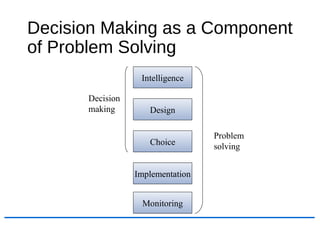
Decision Making as a Component
of Problem Solving
Intelligence
Design
Choice
Implementation
Monitoring
Problem
solving
Decision
making
Solution Types
• Optimization model
• Finding the best solution
• Satisficing model
• Finding a good -- but not necessarily the best -- solution to a problem
• Heuristics
• Commonly accepted guidelines or procedures that usually find a good
solution
Problem Solving Factors
•Multiple decision objectives
•Increased alternatives
•Increased competition
•The need for creativity
•Social and political actions
•International aspects
•Technology
•Time compression
Characteristics of a DSS (1)
• Handles large amounts of data from different sources
• Provides report and presentation flexibility
• Offers both textual and graphical orientation
Characteristics of a DSS (2)
• Supports drill down analysis
• Performs complex, sophisticated analysis and comparisons using
advanced software packages
• Supports optimization, satisficing, and heuristic approaches
Characteristics of a DSS (3)
• Performs different types of analyses
• “What-if” analysis
• Makes hypothetical changes to problem and observes impact on the results
• Simulation
• Duplicates features of a real system
• Goal-seeking analysis
• Determines problem data required for a given result
Goal Seeking Example
• You know the desired result
• You want to know the required input(s)
• Example:
• Microsoft Excel’s “Goal Seek” and “Solver” functions
Excel
demo
Capabilities of a DSS (1)
• Supports
• Problem solving phases
• Different decision frequencies
Frequency
low high
Merge with
another
company?
How many
widgets
should I order?
Capabilities of a DSS (2)
• Highly structured problems
• Straightforward problems, requiring known facts and relationships.
• Semi-structured or unstructured problems
• Complex problems wherein relationships among data are not always clear,
the data may be in a variety of formats, and are often difficult to manipulate
or obtain
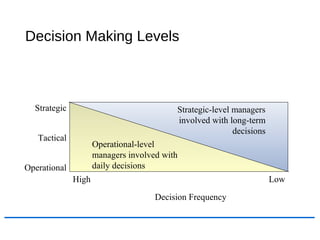
Decision Making Levels
Operational-level
managers involved with
daily decisions
Strategic-level managers
involved with long-term
decisions
LowHigh
Decision Frequency
Strategic
Tactical
Operational
Integration of
TPS, MIS, and DSS
• In many organizations they are integrated through a common
database
• Separation of DSS transactions in the database from TPS and MIS
transactions may be important for performance reasons
Web-Based
Decision Support Systems
• Web-based decision support systems
• Decision support system software provides business intelligence through
web browser clients that access databases either through the Internet or a
corporate intranet
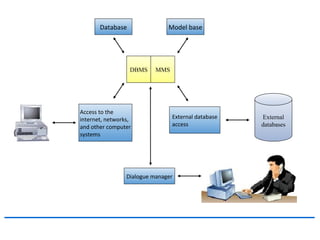
Components of a DSS
• Model management software (MMS)
• Coordinates the use of models in the DSS
• Model base
• Provides decision makers with access to a variety of models
• Dialogue manager
• Allows decision makers to easily access and manipulate the DSS
Database Model base
External database
access
Access to the
internet, networks,
and other computer
systems
Dialogue manager
DBMS MMS
External
databases
Model Base
•Model Base
• Provides decision makers with
access to a variety of models and
assists them in decision making
•Models
• Financial models
• Statistical analysis models
• Graphical models
• Project management models
Advantages and Disadvantages
of Modeling
• Advantages
• Less expensive than custom approaches or real systems.
• Faster to construct than real systems
• Less risky than real systems
• Provides learning experience (trial and error)
• Future projections are possible
• Can test assumptions
• Disadvantages
• Assumptions about reality may be incorrect
• Accuracy of predications often unreliable
• Requires abstract thinking
Group Decision Support System
• Group Decision Support System (GDSS)
• Contains most of the elements of DSS plus software to provide effective
support in group decision-making settings
Databases
Model base GDSS processor GDSS software
Dialogue
manager
External database
access
Users
Access to the internet
and corporate intranet,
networks, and other
computer system
External
databases
Characteristics of a GDSS (1)
•Special design
•Ease of use
•Flexibility
•Decision-making support
• Delphi approach (decision makers are geographically
dispersed)
• Brainstorming
• Group consensus
• Nominal group technique
Characteristics of a GDSS (2)
• Anonymous input
• Reduction of negative group behaviour
• Parallel communication
• Automated record keeping
• Cost, control, complexity factors
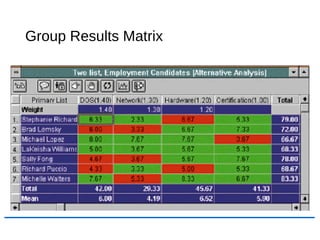
Group Results Matrix
Components of a GDSS and GDSS
Software
•Database
•Model base
•Dialogue manager
•Communication capability
•Special software (also called GroupWare)
•E.g., Lotus Notes
• people located around the world work on the same
project, documents, and files, efficiently and at the same
time
GDSS Alternatives
Local area
decision network
Wide area
decision network
Decision
room
Teleconferencing
Location of group members
close distant
high
low
Decisionfrequency
Decision Room
•Decision Room
• For decision makers located in the same geographic area
or building
• Use of computing devices, special software, networking
capabilities, display equipment, and a session leader
• Collect, coordinate, and feed back organized information
to help a group make a decision
• Combines face-to-face verbal interaction with
technology-aided formalization
Wide Area Decision Network
• Characteristics
• Location of group members is distant
• Decision frequency is high
• Virtual workgroups
• Groups of workers located around the world working on common problems via a GDSS
Executive Support System
• Characteristics
• A specialized DSS that includes all the hardware,
software, data, procedures, and people used to
assist senior-level executives within the
organization
Board of directors
President
Function area
vice presidents
Function area
managers
Characteristics of ESSs
•Tailored to individual executives
•Easy to use
•Drill down capabilities
•Support the need for external data
•Help with situations with high degree of uncertainty
•Futures orientation (predictions, forecasting)
•Linked with value-added business processes
Capabilities of an ESS
• Support for
• defining overall vision
• strategic planning
• strategic organizing and staffing
• strategic control
• crisis management

Introduction to Decision Support System

  • 1.
  • 2.
    Decision Support Systems •Decision support systems (DSS) • Offer potential to assist in solving both semi-structured and unstructured problems
  • 3.
    Decision Making asa Component of Problem Solving Intelligence Design Choice Implementation Monitoring Problem solving Decision making
  • 4.
    Solution Types • Optimizationmodel • Finding the best solution • Satisficing model • Finding a good -- but not necessarily the best -- solution to a problem • Heuristics • Commonly accepted guidelines or procedures that usually find a good solution
  • 5.
    Problem Solving Factors •Multipledecision objectives •Increased alternatives •Increased competition •The need for creativity •Social and political actions •International aspects •Technology •Time compression
  • 6.
    Characteristics of aDSS (1) • Handles large amounts of data from different sources • Provides report and presentation flexibility • Offers both textual and graphical orientation
  • 7.
    Characteristics of aDSS (2) • Supports drill down analysis • Performs complex, sophisticated analysis and comparisons using advanced software packages • Supports optimization, satisficing, and heuristic approaches
  • 8.
    Characteristics of aDSS (3) • Performs different types of analyses • “What-if” analysis • Makes hypothetical changes to problem and observes impact on the results • Simulation • Duplicates features of a real system • Goal-seeking analysis • Determines problem data required for a given result
  • 9.
    Goal Seeking Example •You know the desired result • You want to know the required input(s) • Example: • Microsoft Excel’s “Goal Seek” and “Solver” functions
  • 10.
  • 11.
    Capabilities of aDSS (1) • Supports • Problem solving phases • Different decision frequencies Frequency low high Merge with another company? How many widgets should I order?
  • 12.
    Capabilities of aDSS (2) • Highly structured problems • Straightforward problems, requiring known facts and relationships. • Semi-structured or unstructured problems • Complex problems wherein relationships among data are not always clear, the data may be in a variety of formats, and are often difficult to manipulate or obtain
  • 13.
    Decision Making Levels Operational-level managersinvolved with daily decisions Strategic-level managers involved with long-term decisions LowHigh Decision Frequency Strategic Tactical Operational
  • 14.
    Integration of TPS, MIS,and DSS • In many organizations they are integrated through a common database • Separation of DSS transactions in the database from TPS and MIS transactions may be important for performance reasons
  • 15.
    Web-Based Decision Support Systems •Web-based decision support systems • Decision support system software provides business intelligence through web browser clients that access databases either through the Internet or a corporate intranet
  • 16.
    Components of aDSS • Model management software (MMS) • Coordinates the use of models in the DSS • Model base • Provides decision makers with access to a variety of models • Dialogue manager • Allows decision makers to easily access and manipulate the DSS
  • 17.
    Database Model base Externaldatabase access Access to the internet, networks, and other computer systems Dialogue manager DBMS MMS External databases
  • 18.
    Model Base •Model Base •Provides decision makers with access to a variety of models and assists them in decision making •Models • Financial models • Statistical analysis models • Graphical models • Project management models
  • 19.
    Advantages and Disadvantages ofModeling • Advantages • Less expensive than custom approaches or real systems. • Faster to construct than real systems • Less risky than real systems • Provides learning experience (trial and error) • Future projections are possible • Can test assumptions • Disadvantages • Assumptions about reality may be incorrect • Accuracy of predications often unreliable • Requires abstract thinking
  • 20.
    Group Decision SupportSystem • Group Decision Support System (GDSS) • Contains most of the elements of DSS plus software to provide effective support in group decision-making settings
  • 21.
    Databases Model base GDSSprocessor GDSS software Dialogue manager External database access Users Access to the internet and corporate intranet, networks, and other computer system External databases
  • 22.
    Characteristics of aGDSS (1) •Special design •Ease of use •Flexibility •Decision-making support • Delphi approach (decision makers are geographically dispersed) • Brainstorming • Group consensus • Nominal group technique
  • 23.
    Characteristics of aGDSS (2) • Anonymous input • Reduction of negative group behaviour • Parallel communication • Automated record keeping • Cost, control, complexity factors
  • 24.
  • 25.
    Components of aGDSS and GDSS Software •Database •Model base •Dialogue manager •Communication capability •Special software (also called GroupWare) •E.g., Lotus Notes • people located around the world work on the same project, documents, and files, efficiently and at the same time
  • 26.
    GDSS Alternatives Local area decisionnetwork Wide area decision network Decision room Teleconferencing Location of group members close distant high low Decisionfrequency
  • 27.
    Decision Room •Decision Room •For decision makers located in the same geographic area or building • Use of computing devices, special software, networking capabilities, display equipment, and a session leader • Collect, coordinate, and feed back organized information to help a group make a decision • Combines face-to-face verbal interaction with technology-aided formalization
  • 29.
    Wide Area DecisionNetwork • Characteristics • Location of group members is distant • Decision frequency is high • Virtual workgroups • Groups of workers located around the world working on common problems via a GDSS
  • 30.
    Executive Support System •Characteristics • A specialized DSS that includes all the hardware, software, data, procedures, and people used to assist senior-level executives within the organization Board of directors President Function area vice presidents Function area managers
  • 31.
    Characteristics of ESSs •Tailoredto individual executives •Easy to use •Drill down capabilities •Support the need for external data •Help with situations with high degree of uncertainty •Futures orientation (predictions, forecasting) •Linked with value-added business processes
  • 32.
    Capabilities of anESS • Support for • defining overall vision • strategic planning • strategic organizing and staffing • strategic control • crisis management