Hybrid Cloud Management
and ManageIQ
John Mark Walker
Open Source Ecosystems Manager
Open Source and Standards, Red Hat
Who Needs Management?
Innovation -> Management
New Technology
Adoption
ProliferationChaos
Control
Why Open Source?
● Revenge of the Customer
Proprietary
Vendor
Customer
OSS Vendor Customer
Interest in Hybrid Cloud Computing
Source:
Gartner (September, 2013)
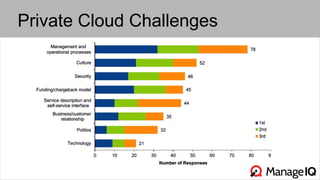
Private Cloud Challenges
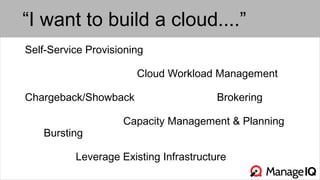
“I want to build a cloud....”
Self-Service Provisioning
Cloud Workload Management
Chargeback/Showback Brokering
Capacity Management & Planning
Bursting
Leverage Existing Infrastructure
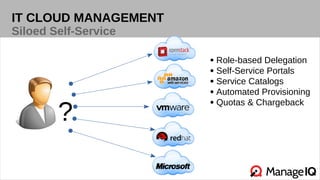
IT CLOUD MANAGEMENT
Siloed Self-Service
● Role-based Delegation
● Self-Service Portals
● Service Catalogs
● Automated Provisioning
● Quotas & Chargeback
?
IT CLOUD MANAGEMENT
Seamless Self-Service
● Role-based Delegation
● Self-Service Portals
● Service Catalogs
● Automated Provisioning
● Quotas & Chargeback
Cloud
Manager
SELF-SERVICE AUTOMATED PROVISIONING
Deployment of Self-Service Resources
Cloud
Manager
Management
RBAC
Quota
Requests
Quota
Enforcement
Approval
Workflow
“Intelligent”
Workload
Placement
Converged
Infrastructure
Service
Delivery
Chargeb
ack
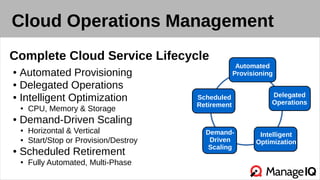
Cloud Operations Management
● Automated Provisioning
● Delegated Operations
● Intelligent Optimization
● CPU, Memory & Storage
● Demand-Driven Scaling
● Horizontal & Vertical
● Start/Stop or Provision/Destroy
● Scheduled Retirement
● Fully Automated, Multi-Phase
Complete Cloud Service Lifecycle
Automated
Provisioning
Delegated
Operations
Intelligent
Optimization
Demand-
Driven
Scaling
Scheduled
Retirement
Cloud Operations Example
● Read the blog post:
http://manageiq.org/blog/2014/09/avoid-shellshock-with-manageiq/
● Download the following policy and import it into Control
● https://github.com/jonnyfiveiq/CloudFORMSNOW/blob/master/Policies/She
● Assign the policy to your targets
● Check policy compliance will show which VMs are vulnerable
● Either decommission VMs or remediate issue(s)
● Re-run compliance checks to ensure vulnerabilities resolved
Avoiding Shellshock and the Bash Plague
The Community Vision
Why ManageIQ is Open Source
● It's Red Hat DNA
● First to market with Open Source cloud management
● Customer demand
● Innovation in an open-source model more responsive to
customers
● Who do you expect to build better integration to other
infrastructure components?
The Freedom to Fail
Commercial Product
Open Source
Community
● How “open source”
projects are often
done by vendors
● Designed to fail
● Control engineering
● Runtware, no identity
● Copyright assignment
● “Open Core”
The Freedom to Fail
Open Source Community
Commercial
Products
● A better way:
Give more
leeway to
upstream
development
ManageIQ Community to Date
●
Source code, community builds released June 19
●
Discussion site, talk.manageiq.org, also live
●
ManageIQ developed transparently and in the open
●
Open for business with 9 partners: CiRBA, VMTurbo,
BBVA, Gandi.net, AutoTrader Group, Booz Allen
Hamilton, Cloudsoft, Chef, ICE Systems
●
First GA release, Anand, in late August
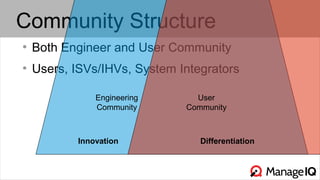
Community Structure
●
Both Engineer and User Community
●
Users, ISVs/IHVs, System Integrators
Engineering
Community
User
Community
Innovation Differentiation
Community Resources
ManageIQ
Small Private
Company
Resource
Constrained
Red Hat
Post Acquisition
Large Public
Company
Manageiq.org
Global Community of
Users & Devs
Open Source Dev Strategy
One Community
Many Projects
Platform Instrumentation
Cloud Governance
Finan.
Mgmt
Service
Management
Data
Management
Resource
Management
Cloud Automation
Architecture/Taxonomy
Roadmaps
Anand Release
●
GA September, 2014
●
Named after chess world champions and grandmasters
●
1st
release “Anand” named after Vishwanathan Anand
●
Current release cycle: Botvinnik
●
Features:
●
Support for Hyper-V, MS SCVMM
●
Lots of code cleanup – removal of proprietary libs
●
Better security model, RBAC
●
Can be built by mere humans
Future Releases
●
See current sprint
●
http://manageiq.org/documentation/development/current_sprint/
●
Roadmaps and other developer guides
●
http://manageiq.org/documentation/development/
●
Emphasis for Botvinnik:
●
CloudFormations, Heat, Foreman,
●
Comprehensive RESTful API
●
Pluggable provider architecture
Developer Planning
●
First ManageIQ Design Summit:
●
See submitted blueprints at
talk.manageiq.org/category/developers/blueprints
●
See submitted talks at talk.manageiq.org/category/abstracts
●
Videos and slides
●
slideshare.com/manageiq & youtube.com/user/manageiqvideo
●
Co-sponsored by Red Hat and Booz Allen Hamilton
Founding Partners
Your Gateway to the Open Cloud
Web site: manageiq.org
Download: manageiq.org/download/
Discuss: talk.manageiq.org
Twitter: @manageiq

Hybrid Cloud Management with ManageIQ

  • 1.
    Hybrid Cloud Management andManageIQ John Mark Walker Open Source Ecosystems Manager Open Source and Standards, Red Hat
  • 2.
  • 3.
    Innovation -> Management NewTechnology Adoption ProliferationChaos Control
  • 4.
    Why Open Source? ●Revenge of the Customer Proprietary Vendor Customer OSS Vendor Customer
  • 5.
    Interest in HybridCloud Computing Source: Gartner (September, 2013)
  • 6.
  • 7.
    “I want tobuild a cloud....” Self-Service Provisioning Cloud Workload Management Chargeback/Showback Brokering Capacity Management & Planning Bursting Leverage Existing Infrastructure
  • 8.
    IT CLOUD MANAGEMENT SiloedSelf-Service ● Role-based Delegation ● Self-Service Portals ● Service Catalogs ● Automated Provisioning ● Quotas & Chargeback ?
  • 9.
    IT CLOUD MANAGEMENT SeamlessSelf-Service ● Role-based Delegation ● Self-Service Portals ● Service Catalogs ● Automated Provisioning ● Quotas & Chargeback Cloud Manager
  • 10.
    SELF-SERVICE AUTOMATED PROVISIONING Deploymentof Self-Service Resources Cloud Manager Management RBAC Quota Requests Quota Enforcement Approval Workflow “Intelligent” Workload Placement Converged Infrastructure Service Delivery Chargeb ack
  • 11.
    Cloud Operations Management ●Automated Provisioning ● Delegated Operations ● Intelligent Optimization ● CPU, Memory & Storage ● Demand-Driven Scaling ● Horizontal & Vertical ● Start/Stop or Provision/Destroy ● Scheduled Retirement ● Fully Automated, Multi-Phase Complete Cloud Service Lifecycle Automated Provisioning Delegated Operations Intelligent Optimization Demand- Driven Scaling Scheduled Retirement
  • 12.
    Cloud Operations Example ●Read the blog post: http://manageiq.org/blog/2014/09/avoid-shellshock-with-manageiq/ ● Download the following policy and import it into Control ● https://github.com/jonnyfiveiq/CloudFORMSNOW/blob/master/Policies/She ● Assign the policy to your targets ● Check policy compliance will show which VMs are vulnerable ● Either decommission VMs or remediate issue(s) ● Re-run compliance checks to ensure vulnerabilities resolved Avoiding Shellshock and the Bash Plague
  • 13.
  • 14.
    Why ManageIQ isOpen Source ● It's Red Hat DNA ● First to market with Open Source cloud management ● Customer demand ● Innovation in an open-source model more responsive to customers ● Who do you expect to build better integration to other infrastructure components?
  • 15.
    The Freedom toFail Commercial Product Open Source Community ● How “open source” projects are often done by vendors ● Designed to fail ● Control engineering ● Runtware, no identity ● Copyright assignment ● “Open Core”
  • 16.
    The Freedom toFail Open Source Community Commercial Products ● A better way: Give more leeway to upstream development
  • 17.
    ManageIQ Community toDate ● Source code, community builds released June 19 ● Discussion site, talk.manageiq.org, also live ● ManageIQ developed transparently and in the open ● Open for business with 9 partners: CiRBA, VMTurbo, BBVA, Gandi.net, AutoTrader Group, Booz Allen Hamilton, Cloudsoft, Chef, ICE Systems ● First GA release, Anand, in late August
  • 18.
    Community Structure ● Both Engineerand User Community ● Users, ISVs/IHVs, System Integrators Engineering Community User Community Innovation Differentiation
  • 19.
    Community Resources ManageIQ Small Private Company Resource Constrained RedHat Post Acquisition Large Public Company Manageiq.org Global Community of Users & Devs
  • 20.
    Open Source DevStrategy One Community Many Projects Platform Instrumentation Cloud Governance Finan. Mgmt Service Management Data Management Resource Management Cloud Automation Architecture/Taxonomy
  • 21.
  • 22.
    Anand Release ● GA September,2014 ● Named after chess world champions and grandmasters ● 1st release “Anand” named after Vishwanathan Anand ● Current release cycle: Botvinnik ● Features: ● Support for Hyper-V, MS SCVMM ● Lots of code cleanup – removal of proprietary libs ● Better security model, RBAC ● Can be built by mere humans
  • 23.
    Future Releases ● See currentsprint ● http://manageiq.org/documentation/development/current_sprint/ ● Roadmaps and other developer guides ● http://manageiq.org/documentation/development/ ● Emphasis for Botvinnik: ● CloudFormations, Heat, Foreman, ● Comprehensive RESTful API ● Pluggable provider architecture
  • 24.
    Developer Planning ● First ManageIQDesign Summit: ● See submitted blueprints at talk.manageiq.org/category/developers/blueprints ● See submitted talks at talk.manageiq.org/category/abstracts ● Videos and slides ● slideshare.com/manageiq & youtube.com/user/manageiqvideo ● Co-sponsored by Red Hat and Booz Allen Hamilton
  • 25.
  • 26.
    Your Gateway tothe Open Cloud Web site: manageiq.org Download: manageiq.org/download/ Discuss: talk.manageiq.org Twitter: @manageiq

Editor's Notes

  • #8 Some prospects will know what they want from their cloud deployment and have thought through needs and wants, others will be less mature in their cloud approach. Either way, its important for us to probe in key areas we've learned are important to our existing customers. This will help us target our capabilities and possibly help some realize needed capabilities they've not thought of (we become trusted advisor). Self-Service Provision – prospect all want this! But need controls and analytics to operationally provide it. Intelligent workload placement is important as org look to automate this process. Cloud Workload Mgmt – this is optimizing my environment, cloud doesn't really help save time and money if org simple throw resources (Compute, storage, networking) as consumption increases. Also being able to quickly identify and rectify problem is key to cloud operations Chargeback – Most orgs want/need to be able to chargeback (or at least showback) to the business for infrastructure usage, especially in a self-service model. Detailed tracking and monitoring around CPU, Storage, memory, and network is key. Capacity Management & Planning – These are actually two different disciplines – Capacity mgmt allows IT to know when resources are trending toward limits set by IT. Allows them to see resource availability across the environment, and make best-fit recommendations for new workloads based on availability, IT policies, and cost. Capacity Planning with CloudForms allows IT to model future scenarios to see impact prior to actually doing it. (If I add more CPU to cluster “x”, will it cause a problem with networking, storage, and memory resources?) Being able to model future additions and see projected impact, help orgs make informed and impactful and cost effective decision/additions to their cloud environment. Cloud Brokering – Use intelligence around not only available resource pools, but policies that affect placement (production workloads cannot run in public cloud), and which options offer least cost (placing this workload on RHEV saves me licensing cost on VMware) Deploy N-Tier Apps – Org have a need to offer/delivery “workloads” in addition to simple Virtual machines (VMs). By workloads I meant n-tier apps.....could be combination of web server, app server, and database server. This is a step in the direction of PaaS, but not as extensive and deep as OpenShift Enterprise. Public Cloud Flexing and Bursting – Many orgs want to take advantage of readily available public cloud resources, but want to control usage and dictate conditions. Orgs may want to use Public Cloud for DR purposes, seasonal spikes in business demand, and/or more permanent use for dev and test reasons. Use Existing Infrastructure – Orgs want to use existing platforms (ie VMware) and have option to add new, when and if they want to (OpenStack; RHEV). Integrate to config mgmt, service catlog, and other systems monitoring tools. Manage Converged Infrastructure – Converged infrastructure is pre-configured hardware stacks like vBlock, FlexPod, and PureFlex. Typically these commercially available “stacks” come with cloud management capabilities, but some orgs want better capabilities than what's provided....hence an opportunity for CloudForms. Some orgs may also go to their local systems integrators and task them with building a “stack” for them.....this may be done without consideration for management. CloudForms also has an opportunity to win business here as well.
  • #9 Note: By OpenStack we mean Red Hat's distribution – Red Hat Enterprise Linux OpenStack Platform (CloudForms may be able to manage other distributions of OpenStack, but we've only tested our Red Hat version) From a user perspective, getting to “self-service” poses some challenges. There are often islands or silos of VM s for use in services Multiple portals with inconsistent look and feel and different capabilities Lack of any kind of quota or chargeback construct or display CLOUDforms delivers capabilities to IT to have a policy controlled, role-delegated portal that is web accessible from any location. This service delivery can be effected across VMWare, Red Hat, Microsoft and Amazon environments with consistent look and feel and behavior. Through CLOUDForms own Service Catalog or an integrated internal service catalog, you can provision and retire services to authorized users across the organization. Users have access to dashboards that show them, what they have allocated, what is available and what is consumed, and offers them details on their quota levels and chargeback / showback amounts.
  • #10 Note: By OpenStack we mean Red Hat's distribution – Red Hat Enterprise Linux OpenStack Platform (CloudForms may be able to manage other distributions of OpenStack, but we've only tested our Red Hat version) From a user perspective, getting to “self-service” poses some challenges. There are often islands or silos of VM s for use in services Multiple portals with inconsistent look and feel and different capabilities Lack of any kind of quota or chargeback construct or display CLOUDforms delivers capabilities to IT to have a policy controlled, role-delegated portal that is web accessible from any location. This service delivery can be effected across VMWare, Red Hat, Microsoft and Amazon environments with consistent look and feel and behavior. Through CLOUDForms own Service Catalog or an integrated internal service catalog, you can provision and retire services to authorized users across the organization. Users have access to dashboards that show them, what they have allocated, what is available and what is consumed, and offers them details on their quota levels and chargeback / showback amounts.
  • #11 Note: By OpenStack we mean Red Hat's distribution – Red Hat Enterprise Linux OpenStack Platform (CloudForms may be able to manage other distributions of OpenStack, but we've only tested our Red Hat version) Service Delivery – could be VMs, Instances/Templates, n-tier applications/workloads; CF could be integrated into an existing Service Catalog Role-Based Access Controls (RBAC) – Ensure only authorized workloads are accessible by authorized users and admins Quota Enforcement – Ensure users/groups do not exceed their allocated infrastructure; Can Tag objects, users, groups to make quota enforcement as detailed or broad as org wants Approval Workflow – Force an optional automated approval process on any IT request Intelligent Workload Placement – Use logic and policies to determine best infrastructure for the job Chargeback – Important for most orgs to be able to accurately track and charge for consumption. Even if they simply want to “showback” to the business consumption vs actualy charging them for it. (This is actual saving told to us by Media Company... you could setup a peer-to-peer call with them and have them tell prospect same thing!) Example: Media Company saved 25 person hours per VM provisioned So far in 2013, they have provisioned little over 1000 VMs with CloudForms. Assuming $100 cost per man hour Comcast saves $2,500 per VM (25 x $100) So far this year, they have saved $2.5M! ($2,500 x 1000 VMs) Benefits Business: - Reduce time in meeting customer request/accelerate projects & innovation - Elevate the value and perception of IT internally Technical: - Less people needed in the provision process (reallocate heads elsewhere) - Control access, usage and request fulfillment – Lifecycle control (Request thru retirement)
  • #12 CLOUDForms covers service provisioning and deployment aspects shown earlier. CLOUDForms provides the ability to manage VMs across their lifecycle from provisioning or conversion (P2V/V2V) through operations and eventually to retirement. CLOUDForms automatically discovers, assesses, classifies, monitors and tracks VMs in any state, powered on, off or suspended, and provides a spectrum of lifecycle management and automation including: VM Lifecycle Management- including automatic discovery, tracking, inventory, analysis, assessment, aging and retirement. Self-Service Provisioning and Self-Management - through a rich, web-based portal with fine-grained access control and support for request management, tracking and approval. Configuration Management - including automatic, agent-free deep VM discovery, analysis, assessment and tracking of software, accounts, users, groups, patches, services, packages, registry keys, MD5s and configuration files. Comprehensive Baselining and Drift - including the virtual hardware, settings, guest configuration, network settings as well as relationships and classifications. Real-Time Policy-Based Standards Enforcement – assessment, analysis and policy-based enforcement of VM configuration, operational, network, resource and security standards. Resource Monitoring and Optimization – performance monitoring, identification of over-allocated resources, current and future bottlenecks, automatic VM aging and retirement. Quota Enforcement, Usage, Chargeback and Cost Allocation – detailed usage tracking by configurable classifications with support for multiple rates tables, fixed cost, allocation and usage and reservation based chargeback. Advanced Capacity Planning, Trending, and Best-Fit Placement – factors in resource availability, policies and business classifications across time periods optimizing planning and VM placement.
  • #13 CLOUDForms covers service provisioning and deployment aspects shown earlier. CLOUDForms provides the ability to manage VMs across their lifecycle from provisioning or conversion (P2V/V2V) through operations and eventually to retirement. CLOUDForms automatically discovers, assesses, classifies, monitors and tracks VMs in any state, powered on, off or suspended, and provides a spectrum of lifecycle management and automation including: VM Lifecycle Management- including automatic discovery, tracking, inventory, analysis, assessment, aging and retirement. Self-Service Provisioning and Self-Management - through a rich, web-based portal with fine-grained access control and support for request management, tracking and approval. Configuration Management - including automatic, agent-free deep VM discovery, analysis, assessment and tracking of software, accounts, users, groups, patches, services, packages, registry keys, MD5s and configuration files. Comprehensive Baselining and Drift - including the virtual hardware, settings, guest configuration, network settings as well as relationships and classifications. Real-Time Policy-Based Standards Enforcement – assessment, analysis and policy-based enforcement of VM configuration, operational, network, resource and security standards. Resource Monitoring and Optimization – performance monitoring, identification of over-allocated resources, current and future bottlenecks, automatic VM aging and retirement. Quota Enforcement, Usage, Chargeback and Cost Allocation – detailed usage tracking by configurable classifications with support for multiple rates tables, fixed cost, allocation and usage and reservation based chargeback. Advanced Capacity Planning, Trending, and Best-Fit Placement – factors in resource availability, policies and business classifications across time periods optimizing planning and VM placement.
  • #19 <number>