South London Practice Nurse
       Launch Event
         3rd November 2011
   Matthew Hodson & Kirsty Barnes
        HEIC COPD Fellows
A play of 2 half's
•   Introduce to ACERs Team
•   Integration & Challenges
•   Organisation & Wider Picture in COPD
•   Resources
•   The Shine Project
Introducing ACERS
      Acute COPD
Early Response Service
               Matthew Hodson
                Nurse Consultant ACERS
              Homerton University Hospital
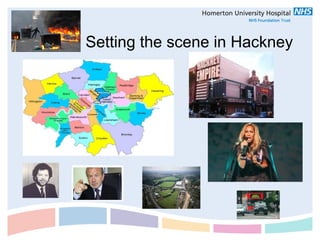
Setting the scene in Hackney
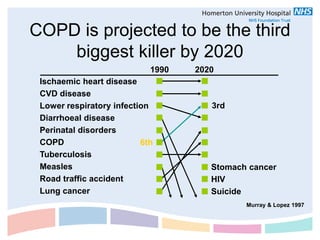
COPD is projected to be the third
    biggest killer by 2020
                            1990   2020
 Ischaemic heart disease
 CVD disease
 Lower respiratory infection          3rd
 Diarrhoeal disease
 Perinatal disorders
 COPD                     6th
 Tuberculosis
 Measles                              Stomach cancer
 Road traffic accident                HIV
 Lung cancer                          Suicide
                                             Murray & Lopez 1997
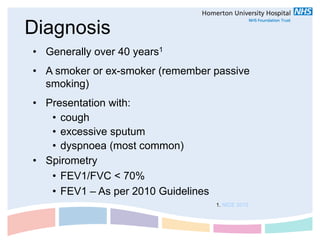
Diagnosis
• Generally over 40 years1
• A smoker or ex-smoker (remember passive
  smoking)
• Presentation with:
   • cough
   • excessive sputum
   • dyspnoea (most common)
• Spirometry
   • FEV1/FVC < 70%
   • FEV1 – As per 2010 Guidelines
                                     1. NICE 2010
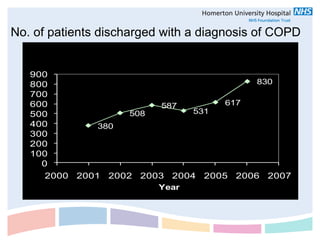
No. of patients discharged with a diagnosis of COPD


   900
   800                                  830
   700
   600                   587       617
   500              508       531
   400         380
   300
   200
   100
     0
      2000 2001 2002 2003 2004 2005 2006 2007
                          Year
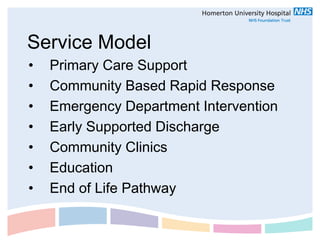
Service Model
•   Primary Care Support
•   Community Based Rapid Response
•   Emergency Department Intervention
•   Early Supported Discharge
•   Community Clinics
•   Education
•   End of Life Pathway
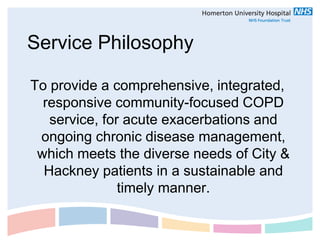
Service Philosophy

To provide a comprehensive, integrated,
  responsive community-focused COPD
   service, for acute exacerbations and
 ongoing chronic disease management,
 which meets the diverse needs of City &
  Hackney patients in a sustainable and
               timely manner.
Who are we?
• 1 wte Nurse Consultant – Matthew Hodson
• 2 wte COPD Specialist Nurses
• 4 wte COPD Senior Staff Nurses
• 2 wte COPD Specialist Physiotherapists
• 1 wte COPD Team Administrator
• Medical Consultant Lead
Base: Respiratory Offices, Homerton Hospital
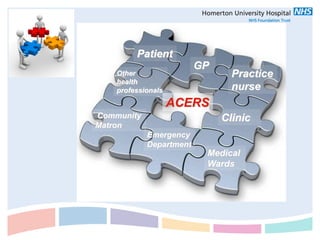
Patient
                         GP
    Other                       Practice
    health
    professionals               nurse
                    ACERS
Community                     Clinic
Matron
            Emergency
            Department
                          Medical
                          Wards
ACERS Core Features
• Opening Hours (7 days, 8 am – 7 pm)
• Response Time (<4 hrs for community referral)
• Length of Care Package for H @ H within the
  community (approx< 8 days)
• Focus on 30 and 90 days post exacerbation
• Referral in to PR – ASAP after exacerbation
• Medical Support (Close links with hospital team)
Clinical Responsibility
• ACERS have regular contact with
  Respiratory Consultant and SpR
• Easy access to hospital diagnostics
• Regular communication with Practice
  Nurse & GP
• GP asked for input with non-respiratory
  problems when appropriate
Hospital @ Home
•   Admission Avoidance – SOS Calls
•   Early & Supportive Discharge
•   Links with Other Local Acute Hospitals
•   Acute Intervention
•   Weekly MDT & Links with Respiratory Team
•   Up to 14 days intervention (HV/Telephone)
•   Physiotherapy Intervention
•   Post exacerbation PR offered
Specialist COPD Case Management
• Level 1 & 2 COPD case management
• Proactive disease management can make a real
  difference to patients with a single condition
  provided by a specialist team
• COPD main long term condition
• Support generic workforce in managing COPD in
  community links with practice nurse
• Focus on 30 and 90 day follow-up – single
  pathway
Community Clinics
• Diagnostic and therapeutic support to
  practices
• Assist in case detection / diagnosis
• Follow up of exacerbations seen at home
• Advise in the management of “difficult”
  problems
• Location Homerton Hospital
Education
• Support LES and Non LES practices in
  providing direct education to the practice in
  COPD.
• In practice join COPD Clinics with PN
• Named COPD Nurse links with Practice Nurse
• Direct Access to COPD Healthcare
  professional – Via fax spirometry / phone
• Email Advice
Education - Challenges
 •   Key – self management
 •   Understanding and accepting diagnosis
 •   New diagnosis – where does it start?
 •   NICE 2010 Guidelines – update
 •   Rescue Packs
 •   Variety of inhaler choices – but why and MDI?
 •   Annual Reviews – making changes
Multidisciplinary working
 – COPD care should be delivered by a multidisciplinary team that
   includes respiratory nurse specialists & Specialist Ward Nurses
 – Consider referral to specialist departments (not just respiratory
   physicians)
  Specialist department     Who might benefit?
  Physiotherapy             People with excessive sputum
  Dietetic advice           People with BMI that is high, low or
                            changing over time
  Occupational therapy      People needing help with daily living
                            activities
  Social services           People disabled by COPD
  Multidisciplinary palliative People with end-stage COPD (and their
  care teams                   families and carers)
  [2004]
Organisational Aspects
 and key messages in
       COPD
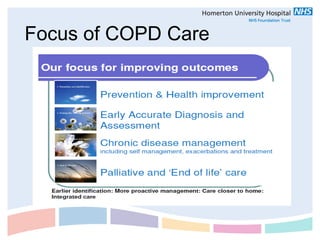
Focus of COPD Care
Outcomes that matter
•   Improved Survival
•   Earlier and Accurate Diagnosis
•   Improved Quality of Life
•   Slower disease progression
•   Reduced exacerbation rate
•   Reduce hospital admission & re-admission rates
• High Quality End of Life care
• Patient centred quality care
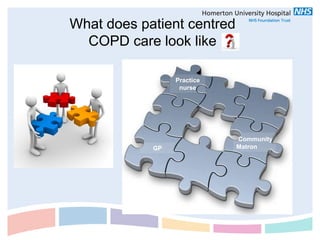
What does patient centred
  COPD care look like

                 Practice
                  nurse


                            Community
            GP              Matron
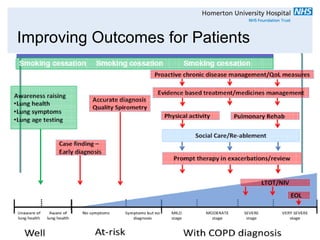
Improving Outcomes for Patients
Key Messages to bottle up ..
• Earlier Diagnosis

• Smoking as treatment for COPD

• Responsible Prescribing

• Pulmonary Rehabilitation

• Responsible oxygen prescribing

• Living with advanced COPD
…but now what do with them?
               • Recognise that there is fantastic
                 work already happening within
                 current work places.

               • Integration across primary and
                  secondary care is key in
                  improving the patient pathway:
                  - join up working
                  - reduce repetition
                  - no silo working
                 - patient centred care
Quality COPD Service
•   Proactive and opportunistic case finding to minimise the impact of late
    diagnosis on individuals and the healthcare system

•   Quality assured, accurate diagnosis and assessment of severity and ongoing monitoring
    and review of the condition through a proactive chronic disease management model.

•    People with COPD are screened, assessed and managed with
    pharmacological and non-pharmacological interventions in line with
    NICE/quality guidelines

•    People with COPD are educated and supported in the management of their
     condition so that they can become active partners in care.

•    Effective prevention and management of exacerbations and of hospital
     Admissions

•    Effective palliative, end of life care and bereavement support for people with COPD
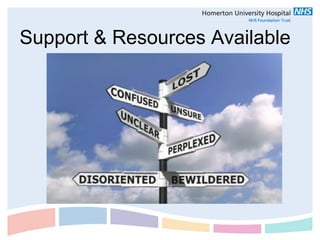
Support & Resources Available
Many available..
•   Contact your local COPD or
    Respiratory Specialist within
    your local hospital or
    Community Health Services

•   Explore the hospital or
    community website – use
    COPD as a search term

•   Identify your oxygen champion

• Who is leading on
  Pulmonary Rehabilitation
  within your local area
National & Resources
• National Institute for Clinical Excellence – NICE 2010 Update Guidelines
   for the management of COPD in primary and secondary care


• British Lung Foundation
• Primary Care Respiratory Society (PCRS)

• NHS Improvement Programme – Lung Work stream

• NHS London Respiratory Team

• IMPRESS (BTS and PCRS)

• Association of Respiratory Nurse Specialist
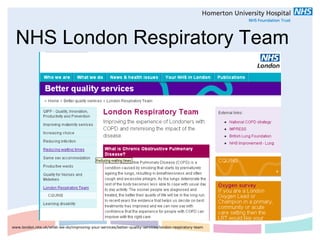
NHS London Respiratory Team


www.london.nhs.uk/what-we-do/improving-your-services/better-quality-services/london-respiratory-team
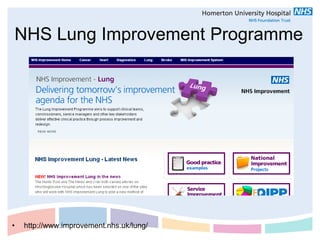
NHS Lung Improvement Programme


•   http://www.improvement.nhs.uk/lung/
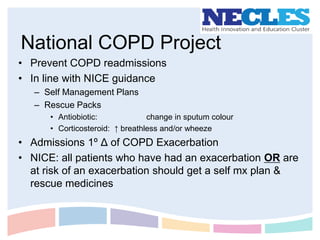
National COPD Project
• Prevent COPD readmissions
• In line with NICE guidance
   – Self Management Plans
   – Rescue Packs
      • Antiobiotic:             change in sputum colour
      • Corticosteroid: ↑ breathless and/or wheeze
• Admissions 1º Δ of COPD Exacerbation
• NICE: all patients who have had an exacerbation OR are
  at risk of an exacerbation should get a self mx plan &
  rescue medicines
Department of Health
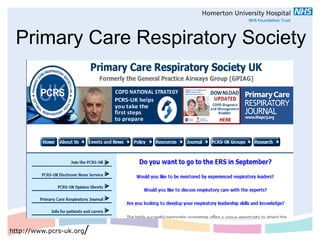
Primary Care Respiratory Society


http://www.pcrs-uk.org   /
And finally…

        Even after the
  COPD Annual Review
with the Practice Nurse the next
day the patient presents to the
  ED department and says…
Acknowledgements
                                Team
      Dr A Bhowmik             Respiratory Consultant
    Jane Osei-Wusu         COPD Clinical Nurse Specialist
          Ailsa Dann       COPD Clinical Physiotherapist
     Arthur Tadique                 COPD SSN
      Edmer Sayat                   COPD SSN
      Aminata Gbla                  COPD SSN
    Aziza Zina & Team           Team Administrator


      •    Nancy Hallett – Chief Executive
      •    John Coakley – Medical Director
      •    Dylan Jones – General Manager for Medicine
      •    Louise Olley – Head of Nursing GEM
      •    Mervyn Freeze – Assistant GM
Kirsty Barnes
HEIC COPD Physiotherapist
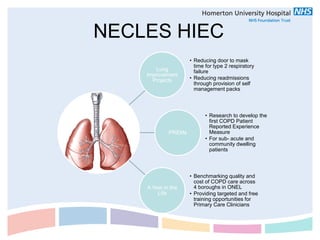
NECLES HIEC
                     • Reducing door to mask
                       time for type 2 respiratory
       Lung            failure
    Improvement
      Projects       • Reducing readmissions
                       through provision of self
                       management packs


                           • Research to develop the
                             first COPD Patient
                             Reported Experience
             PREMs           Measure
                           • For sub- acute and
                             community dwelling
                             patients


                     • Benchmarking quality and
                       cost of COPD care across
    A Year in the      4 boroughs in ONEL
        Life         • Providing targeted and free
                       training opportunities for
                       Primary Care Clinicians
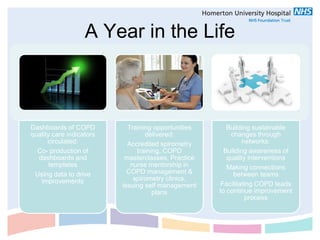
A Year in the Life


Dashboards of COPD          Training opportunities      Building sustainable
quality care indicators           delivered:             changes through
      circulated:           Accredited spirometry             networks:
  Co- production of            training, COPD          Building awareness of
  dashboards and           masterclasses, Practice      quality interventions
       templates             nurse mentorship in        Making connections
 Using data to drive        COPD management &             between teams
   improvements               spirometry clinics,
                          issuing self management     Facilitating COPD leads
                                     plans           to continue improvement
                                                               process
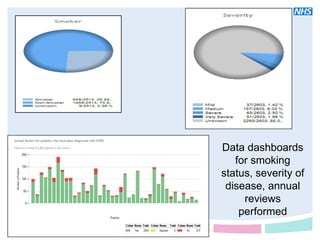
Data dashboards
   for smoking
status, severity of
 disease, annual
     reviews
    performed
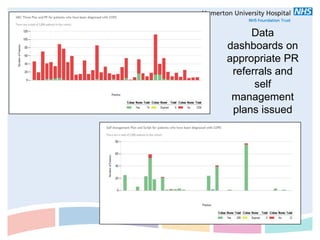
Data
dashboards on
appropriate PR
 referrals and
      self
 management
 plans issued
COPD training opportunities
• Accredited spirometry training
• Practice Nurse mentorship in COPD
  management
• COPD masterclasses
• Performing the COPD annual review
  and issuing a self management plan
• Consultant education sessions in
  Practice
Thank
 you


        Questions?

COPD presentation

  • 1.
    South London PracticeNurse Launch Event 3rd November 2011 Matthew Hodson & Kirsty Barnes HEIC COPD Fellows
  • 2.
    A play of2 half's • Introduce to ACERs Team • Integration & Challenges • Organisation & Wider Picture in COPD • Resources • The Shine Project
  • 3.
    Introducing ACERS Acute COPD Early Response Service Matthew Hodson Nurse Consultant ACERS Homerton University Hospital
  • 5.
  • 6.
    COPD is projectedto be the third biggest killer by 2020 1990 2020 Ischaemic heart disease CVD disease Lower respiratory infection 3rd Diarrhoeal disease Perinatal disorders COPD 6th Tuberculosis Measles Stomach cancer Road traffic accident HIV Lung cancer Suicide Murray & Lopez 1997
  • 7.
    Diagnosis • Generally over40 years1 • A smoker or ex-smoker (remember passive smoking) • Presentation with: • cough • excessive sputum • dyspnoea (most common) • Spirometry • FEV1/FVC < 70% • FEV1 – As per 2010 Guidelines 1. NICE 2010
  • 8.
    No. of patientsdischarged with a diagnosis of COPD 900 800 830 700 600 587 617 500 508 531 400 380 300 200 100 0 2000 2001 2002 2003 2004 2005 2006 2007 Year
  • 10.
    Service Model • Primary Care Support • Community Based Rapid Response • Emergency Department Intervention • Early Supported Discharge • Community Clinics • Education • End of Life Pathway
  • 11.
    Service Philosophy To providea comprehensive, integrated, responsive community-focused COPD service, for acute exacerbations and ongoing chronic disease management, which meets the diverse needs of City & Hackney patients in a sustainable and timely manner.
  • 12.
    Who are we? •1 wte Nurse Consultant – Matthew Hodson • 2 wte COPD Specialist Nurses • 4 wte COPD Senior Staff Nurses • 2 wte COPD Specialist Physiotherapists • 1 wte COPD Team Administrator • Medical Consultant Lead Base: Respiratory Offices, Homerton Hospital
  • 13.
    Patient GP Other Practice health professionals nurse ACERS Community Clinic Matron Emergency Department Medical Wards
  • 14.
    ACERS Core Features •Opening Hours (7 days, 8 am – 7 pm) • Response Time (<4 hrs for community referral) • Length of Care Package for H @ H within the community (approx< 8 days) • Focus on 30 and 90 days post exacerbation • Referral in to PR – ASAP after exacerbation • Medical Support (Close links with hospital team)
  • 15.
    Clinical Responsibility • ACERShave regular contact with Respiratory Consultant and SpR • Easy access to hospital diagnostics • Regular communication with Practice Nurse & GP • GP asked for input with non-respiratory problems when appropriate
  • 16.
    Hospital @ Home • Admission Avoidance – SOS Calls • Early & Supportive Discharge • Links with Other Local Acute Hospitals • Acute Intervention • Weekly MDT & Links with Respiratory Team • Up to 14 days intervention (HV/Telephone) • Physiotherapy Intervention • Post exacerbation PR offered
  • 17.
    Specialist COPD CaseManagement • Level 1 & 2 COPD case management • Proactive disease management can make a real difference to patients with a single condition provided by a specialist team • COPD main long term condition • Support generic workforce in managing COPD in community links with practice nurse • Focus on 30 and 90 day follow-up – single pathway
  • 18.
    Community Clinics • Diagnosticand therapeutic support to practices • Assist in case detection / diagnosis • Follow up of exacerbations seen at home • Advise in the management of “difficult” problems • Location Homerton Hospital
  • 19.
    Education • Support LESand Non LES practices in providing direct education to the practice in COPD. • In practice join COPD Clinics with PN • Named COPD Nurse links with Practice Nurse • Direct Access to COPD Healthcare professional – Via fax spirometry / phone • Email Advice
  • 20.
    Education - Challenges • Key – self management • Understanding and accepting diagnosis • New diagnosis – where does it start? • NICE 2010 Guidelines – update • Rescue Packs • Variety of inhaler choices – but why and MDI? • Annual Reviews – making changes
  • 21.
    Multidisciplinary working –COPD care should be delivered by a multidisciplinary team that includes respiratory nurse specialists & Specialist Ward Nurses – Consider referral to specialist departments (not just respiratory physicians) Specialist department Who might benefit? Physiotherapy People with excessive sputum Dietetic advice People with BMI that is high, low or changing over time Occupational therapy People needing help with daily living activities Social services People disabled by COPD Multidisciplinary palliative People with end-stage COPD (and their care teams families and carers) [2004]
  • 22.
    Organisational Aspects andkey messages in COPD
  • 23.
  • 24.
    Outcomes that matter • Improved Survival • Earlier and Accurate Diagnosis • Improved Quality of Life • Slower disease progression • Reduced exacerbation rate • Reduce hospital admission & re-admission rates • High Quality End of Life care • Patient centred quality care
  • 25.
    What does patientcentred COPD care look like Practice nurse Community GP Matron
  • 26.
  • 27.
    Key Messages tobottle up .. • Earlier Diagnosis • Smoking as treatment for COPD • Responsible Prescribing • Pulmonary Rehabilitation • Responsible oxygen prescribing • Living with advanced COPD
  • 28.
    …but now whatdo with them? • Recognise that there is fantastic work already happening within current work places. • Integration across primary and secondary care is key in improving the patient pathway: - join up working - reduce repetition - no silo working - patient centred care
  • 29.
    Quality COPD Service • Proactive and opportunistic case finding to minimise the impact of late diagnosis on individuals and the healthcare system • Quality assured, accurate diagnosis and assessment of severity and ongoing monitoring and review of the condition through a proactive chronic disease management model. • People with COPD are screened, assessed and managed with pharmacological and non-pharmacological interventions in line with NICE/quality guidelines • People with COPD are educated and supported in the management of their condition so that they can become active partners in care. • Effective prevention and management of exacerbations and of hospital Admissions • Effective palliative, end of life care and bereavement support for people with COPD
  • 30.
  • 31.
    Many available.. • Contact your local COPD or Respiratory Specialist within your local hospital or Community Health Services • Explore the hospital or community website – use COPD as a search term • Identify your oxygen champion • Who is leading on Pulmonary Rehabilitation within your local area
  • 32.
    National & Resources •National Institute for Clinical Excellence – NICE 2010 Update Guidelines for the management of COPD in primary and secondary care • British Lung Foundation • Primary Care Respiratory Society (PCRS) • NHS Improvement Programme – Lung Work stream • NHS London Respiratory Team • IMPRESS (BTS and PCRS) • Association of Respiratory Nurse Specialist
  • 33.
    NHS London RespiratoryTeam www.london.nhs.uk/what-we-do/improving-your-services/better-quality-services/london-respiratory-team
  • 34.
    NHS Lung ImprovementProgramme • http://www.improvement.nhs.uk/lung/
  • 35.
    National COPD Project •Prevent COPD readmissions • In line with NICE guidance – Self Management Plans – Rescue Packs • Antiobiotic: change in sputum colour • Corticosteroid: ↑ breathless and/or wheeze • Admissions 1º Δ of COPD Exacerbation • NICE: all patients who have had an exacerbation OR are at risk of an exacerbation should get a self mx plan & rescue medicines
  • 36.
  • 37.
    Primary Care RespiratorySociety http://www.pcrs-uk.org /
  • 38.
    And finally… Even after the COPD Annual Review with the Practice Nurse the next day the patient presents to the ED department and says…
  • 40.
    Acknowledgements Team Dr A Bhowmik Respiratory Consultant Jane Osei-Wusu COPD Clinical Nurse Specialist Ailsa Dann COPD Clinical Physiotherapist Arthur Tadique COPD SSN Edmer Sayat COPD SSN Aminata Gbla COPD SSN Aziza Zina & Team Team Administrator • Nancy Hallett – Chief Executive • John Coakley – Medical Director • Dylan Jones – General Manager for Medicine • Louise Olley – Head of Nursing GEM • Mervyn Freeze – Assistant GM
  • 41.
    Kirsty Barnes HEIC COPDPhysiotherapist
  • 42.
    NECLES HIEC • Reducing door to mask time for type 2 respiratory Lung failure Improvement Projects • Reducing readmissions through provision of self management packs • Research to develop the first COPD Patient Reported Experience PREMs Measure • For sub- acute and community dwelling patients • Benchmarking quality and cost of COPD care across A Year in the 4 boroughs in ONEL Life • Providing targeted and free training opportunities for Primary Care Clinicians
  • 43.
    A Year inthe Life Dashboards of COPD Training opportunities Building sustainable quality care indicators delivered: changes through circulated: Accredited spirometry networks: Co- production of training, COPD Building awareness of dashboards and masterclasses, Practice quality interventions templates nurse mentorship in Making connections Using data to drive COPD management & between teams improvements spirometry clinics, issuing self management Facilitating COPD leads plans to continue improvement process
  • 44.
    Data dashboards for smoking status, severity of disease, annual reviews performed
  • 45.
    Data dashboards on appropriate PR referrals and self management plans issued
  • 46.
    COPD training opportunities •Accredited spirometry training • Practice Nurse mentorship in COPD management • COPD masterclasses • Performing the COPD annual review and issuing a self management plan • Consultant education sessions in Practice
  • 47.
    Thank you Questions?